United States vs European Union: Food Safety Regulation Compared
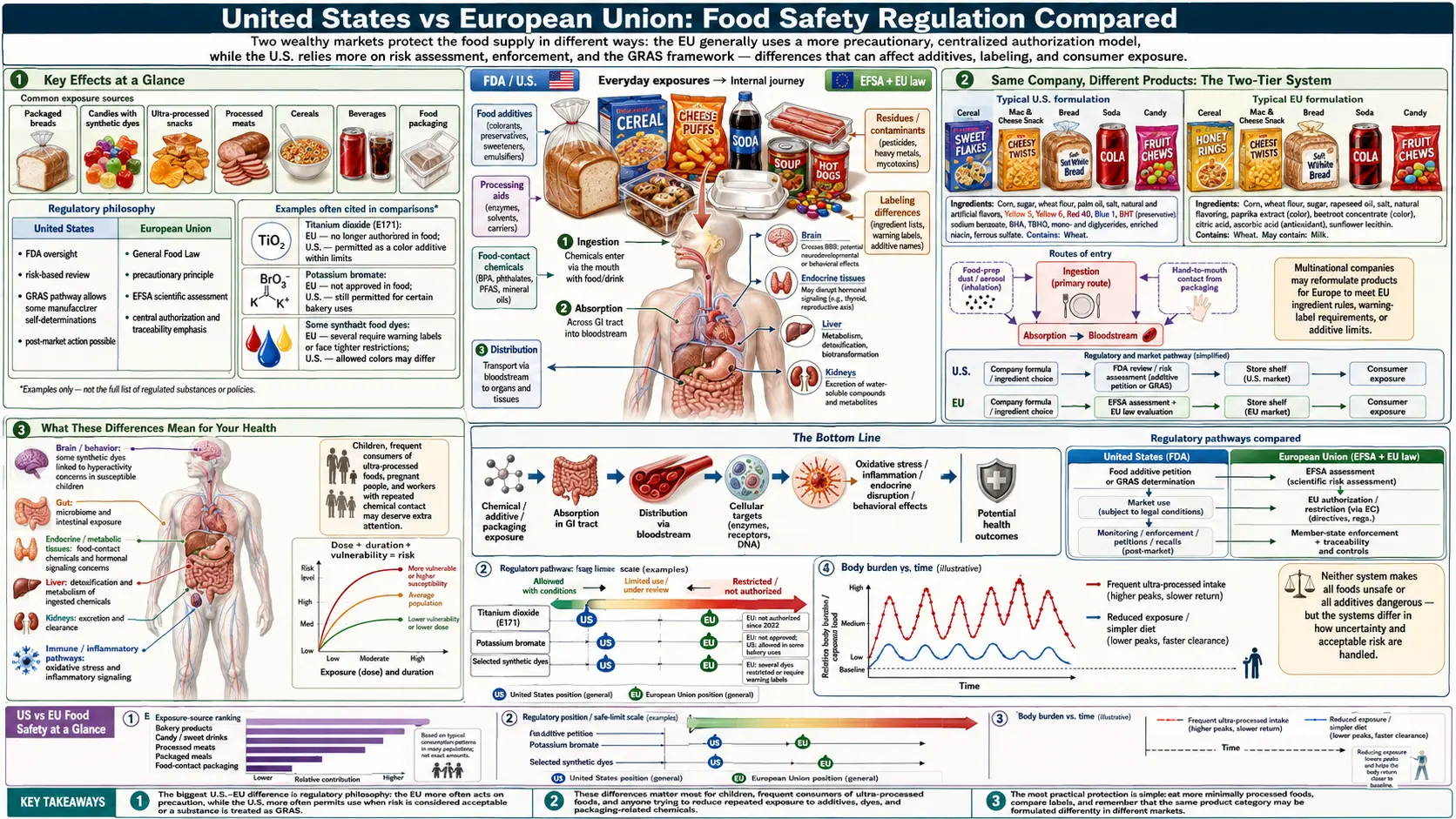
The United States and the European Union regulate food additives under different legal frameworks. Both require government authorization of food additives before use, but US law also allows a substance to be used without a U.S. Food and Drug Administration (FDA) authorization when it is “generally recognized as safe” (generally recognized as safe, GRAS), and until a 2026 proposal that conclusion could be reached by a company without notifying the U.S. Food and Drug Administration. The EU keeps a single closed list of authorized additives and has run a legal programme to re-evaluate every additive authorized before 2009. This page sets out how the two systems work, which specific additives are treated differently under the primary regulations, and what has changed in the US since 2023.
Table of Contents
- Key Effects at a Glance
- The Philosophical Divide
- The Generally Recognized as Safe Pathway
- Different Formulations for Different Markets
- U.S. Food and Drug Administration Funding and Industry Influence
- How the EU System Works in Practice
- What Is Known About Health Effects
- Labels, Certifications and Exposure Studies
- US Regulatory Changes Since 2023
- Summary
- Key Research Papers
- Connections
- Featured Videos
Key Effects at a Glance
- More than 10,000 substances are allowed in US human food, according to a 2011 review of the US food additive program; federal agencies made approximately 40% of the roughly 6,000 safety decisions behind them, and manufacturers and a trade association made the rest through generally recognized as safe conclusions without U.S. Food and Drug Administration review.
- The EU has one closed list — Annex II of Regulation (EC) No 1333/2008 — and an additive not on it may not be used in food.
- Some additives allowed in US food are not authorized in the EU, among them potassium bromate, azodicarbonamide, brominated vegetable oil (now also revoked in the US) and, since 2022, titanium dioxide (E171).
- Many others are allowed in both, including BHA (E320), BHT (E321), Blue 1 (E133) and Blue 2 (E132); six colours carry a mandatory EU warning label rather than a ban.
- In the 451 generally recognized as safe notices sent to the U.S. Food and Drug Administration from 1997 to 2012, a 2013 JAMA Internal Medicine analysis found no safety assessment made by an expert panel selected by an independent third party.
- Re-evaluation – the EU set legal deadlines to re-evaluate all additives authorized before 2009; the U.S. Food and Drug Administration finalized a post-market chemical review framework in May 2026 and opened reassessments of BHA, BHT and azodicarbonamide that year.
The Philosophical Divide
The EU Precautionary Principle
The precautionary principle appears in Article 191 of the Treaty on the Functioning of the European Union and, for food, in Article 7 of Regulation (EC) No 178/2002 (the General Food Law). Article 7 allows provisional risk-management measures where the possibility of harmful effects on health has been identified but scientific uncertainty persists, pending further scientific information.
In practice, EU food additive law works as follows:
- Pre-market approval is required — A new food additive must be authorized by the European Commission, on the basis of a scientific risk assessment by the European Food Safety Authority (EFSA), and listed in the Union list before it can be used in food.
- The applicant supplies the safety data — The company seeking authorization submits the toxicological and exposure data on which European Food Safety Authority bases its assessment.
- Authorized additives are re-evaluated — Article 32 of Regulation 1333/2008 requires European Food Safety Authority to re-evaluate every additive authorized before 20 January 2009. One outcome was titanium dioxide (E171): European Food Safety Authority concluded in 2021 that “a concern for genotoxicity could not be ruled out” and that E171 “can no longer be considered safe when used as a food additive,” and Commission Regulation (EU) 2022/63 of 14 January 2022 removed its authorization from 7 February 2022, with foods made earlier allowed on the market until 7 August 2022.
- Uncertainty can be grounds for action — As the E171 decision shows, EU regulators can act on an unresolved concern (there, genotoxicity) without waiting for proof of harm in humans; animal, in vitro and mechanistic data enter the assessment.
- EU additive decisions are still risk assessments — European Food Safety Authority opinions set acceptable daily intakes and compare them with estimated exposure; most additives are authorized with maximum levels for named food categories.
The US Approach: Premarket Approval With a Generally Recognized as Safe Exception
In the United States, food additives are regulated by the U.S. Food and Drug Administration under the Federal Food, Drug, and Cosmetic Act; meat, poultry and egg products are inspected by the U.S. Department of Agriculture (USDA). The main features are:
- Food additives need U.S. Food and Drug Administration authorization — The Food Additives Amendment of 1958 created a premarket approval process: a “food additive” may be used only under a U.S. Food and Drug Administration regulation. Color additives need their own U.S. Food and Drug Administration listing and, according to the U.S. Food and Drug Administration, cannot be generally recognized as safe.
- Generally recognized as safe substances are outside that definition — A substance whose use is generally recognized as safe by qualified experts is not legally a “food additive,” so it needs no U.S. Food and Drug Administration authorization. Notifying the U.S. Food and Drug Administration of a generally recognized as safe conclusion has been voluntary; the U.S. Food and Drug Administration proposed in August 2026 to make it mandatory.
- Post-market action — Once a substance is authorized or used as generally recognized as safe, removing it requires the U.S. Food and Drug Administration to act, as it did for brominated vegetable oil (2024) and Red No. 3 (2025). Critics describe this as a system that responds to evidence of harm rather than one that re-examines substances on a schedule.
- A hazard-based rule also exists in US law — The Delaney Clause bars approval of a food or color additive found to induce cancer in humans or animals; it was the legal basis for the U.S. Food and Drug Administration’s 2025 revocation of Red No. 3.
The Generally Recognized as Safe Pathway
The Generally Recognized as Safe (GRAS) provision dates from the 1958 amendment. For substances used in food before 1 January 1958 it can rest on common use in food; otherwise it requires scientific procedures. The 2011 review cited above found that most substances now used in US food rest on safety decisions made by manufacturers or a trade association rather than by a federal agency.
How Generally Recognized as Safe Works
- Self-affirmed generally recognized as safe — A company can conclude that a use of a substance is generally recognized as safe on the basis of its own review or that of experts it selects, and it has not been required to tell the U.S. Food and Drug Administration. The U.S. Food and Drug Administration therefore does not have a complete list of these substances. U.S. Department of Health and Human Services (HHS) directed the U.S. Food and Drug Administration in March 2025 to explore ending this pathway, and the U.S. Food and Drug Administration published a proposed rule on 11 August 2026 (91 FR 51834) that would make notification mandatory; as of October 2026 it is a proposal open for comment.
- Voluntary generally recognized as safe notification — A company can notify the U.S. Food and Drug Administration of its generally recognized as safe conclusion. The U.S. Food and Drug Administration evaluates the notice and may respond that it has “no questions”; this is a response to the company’s submission, not a U.S. Food and Drug Administration approval, and the agency does not run its own toxicity tests on the substance.
- Who makes the safety decisions — A 2013 study in JAMA Internal Medicine examined 451 generally recognized as safe notifications voluntarily submitted to the U.S. Food and Drug Administration between 1997 and 2012. It found that 22.4% of the safety assessments were made by an employee of the additive manufacturer, 13.3% by an employee of a consulting firm selected by the manufacturer, and 64.3% by an expert panel selected by a consulting firm or the manufacturer; none were made by a standing expert panel selected by a third party. The authors concluded that financial conflicts of interest were “ubiquitous” in these determinations.
- Re-evaluation — Until 2025 the U.S. Food and Drug Administration had no scheduled program for re-examining generally recognized as safe or other authorized substances. In May 2025 it announced a strengthened program for chemicals already in the food supply, and in May 2026 it finalized the framework for choosing and reviewing them.
- Older substances: BHA and BHT — According to the U.S. Food and Drug Administration, it listed BHA as generally recognized as safe in 1958 and approved it as a food additive in 1961. BHA and BHT are each authorized both as generally recognized as safe antioxidants (21 CFR 182.3169 and 182.3173) and under food additive regulations (21 CFR 172.110 and 172.115). The National Toxicology Program lists BHA as “reasonably anticipated to be a human carcinogen” based on animal studies. The U.S. Food and Drug Administration opened a formal reassessment of BHA in February 2026 and of BHT in May 2026; neither has been revoked. Both are also authorized in the EU, as E320 and E321, with maximum levels.
The Numbers in Context
- A widely repeated figure says the EU bans or restricts “over 1,300 chemicals.” That figure refers to the list of substances prohibited in cosmetic products under the EU Cosmetics Regulation (Regulation (EC) No 1223/2009, Annex II), not to food additives, and it is not a measure of the gap in food law.
- The more than 10,000 substances counted in US food in the 2011 review include food additives, generally recognized as safe substances, color additives, prior-sanctioned substances and food-contact substances, so the number is not directly comparable with the EU’s list of direct food additives.
Different Formulations for Different Markets
Products sold under the same name by multinational manufacturers have at times carried different ingredient lists in the US and in Europe (including the United Kingdom, which kept the EU rules on colours after leaving the EU). The differences that have been reported follow the regulations rather than a single company policy:
Synthetic Colours and the EU Warning Label
Annex V of Regulation 1333/2008 requires foods containing any of six colours — sunset yellow (E110, US Yellow 6), quinoline yellow (E104), carmoisine (E122), allura red (E129, US Red 40), tartrazine (E102, US Yellow 5) and ponceau 4R (E124) — to carry the statement that the colour “may have an adverse effect on activity and attention in children.” These colours are not banned in the EU; they are authorized with this label. Quinoline yellow is not permitted in US food, and carmoisine and ponceau 4R are not on the US list either. Blue 1 (brilliant blue FCF, E133) and Blue 2 (indigotine, E132) are authorized in the EU without the warning. Versions of orange soft drinks, sweets, breakfast cereals and boxed macaroni and cheese sold in Europe have been reported to use plant-derived colourings such as paprika extract, beta-carotene, carrot or pumpkin concentrates, black carrot or spirulina extract, where US versions used Red 40, Yellow 5 or Yellow 6; some US versions have since been reformulated.
Flour Treatment Agents
Azodicarbonamide, a flour bleaching agent and dough conditioner nicknamed the “yoga mat chemical” because it is also used to make foamed plastics, is permitted in US flour and bread at up to 45 parts per million (21 CFR 172.806). It is not on the EU’s list of authorized food additives. A US sandwich chain removed it from its bread in 2014 after public pressure. Potassium bromate is likewise not authorized in the EU; in the US, bromated flour may contain up to 50 parts per million (21 CFR 137.155), and the U.S. Food and Drug Administration has not revoked that use. California’s 2023 law, not a federal rule, prohibits it in food sold in the state from 2027.
Preservatives and Processing Aids
TBHQ (E319) and dimethylpolysiloxane (E900, an anti-foaming agent) are both authorized food additives in the EU as well as the US, so a product made with them in one market can lawfully use them in the other; where European ingredient lists for fried foods omit them, that reflects a manufacturer’s choice rather than an EU ban. The same is true of BHT in breakfast cereals: BHT is authorized in the EU (E321).
These examples show that the same manufacturers produce formulations without certain additives for markets that ban them or require a warning label. Whether the alternative formulation is safer depends on the additive in question; for colours that the EU authorizes with a label, the regulation reports a possible effect on children’s activity and attention, not a finding that the substitute is safer.
U.S. Food and Drug Administration Funding and Industry Influence
Critics of US food-chemical regulation point to the U.S. Food and Drug Administration’s funding model and to industry influence on regulatory decisions.
Industry User Fees
Part of the U.S. Food and Drug Administration’s budget comes from user fees paid by the industries it regulates. A 2020 JAMA analysis reported that Prescription Drug User Fee Act fees rose from an annual mean of $66 million in 1993–1997 to $820 million in 2013–2017, and that in 2018 user fees accounted for approximately 80% of the salaries of the review personnel responsible for approving new drugs. Food additive and generally recognized as safe reviews are not funded by an equivalent user-fee program; critics argue that the broader reliance on fees shapes the agency’s relationship with regulated industries.
The Revolving Door
The movement of personnel between the U.S. Food and Drug Administration, the U.S. Department of Agriculture and the food, chemical and agricultural industries is a recurring criticism:
- Industry to government — Critics note that former executives and lobbyists of agrochemical, chemical and food companies have held senior positions at the U.S. Food and Drug Administration and U.S. Department of Agriculture.
- Government to industry — U.S. Food and Drug Administration and U.S. Department of Agriculture officials have also left government service for positions in the industries they previously regulated.
- Advisory committee conflicts — U.S. Food and Drug Administration advisory committees can include members with financial ties to affected industries; disclosure rules and waivers govern their participation.
Industry-Funded Research and Lobbying
The food and beverage industry lobbies at the federal and state levels. Documented examples of industry influence on the science include:
- A 2016 analysis of internal documents found that a sugar-industry trade group sponsored a 1965 literature review, published in the New England Journal of Medicine, that singled out fat and cholesterol as the dietary causes of coronary heart disease and downplayed evidence on sucrose; the group set the review’s objective and received drafts, and its funding was not disclosed. The authors concluded that the industry sponsored a research program in the 1960s and 1970s that cast doubt on the hazards of sucrose while promoting fat as the culprit.
- The herbicide atrazine has not been approved in the EU since a ban announced in October 2003, adopted because of widespread and unpreventable water contamination, while the US EPA approved its continued use the same year; a 2006 review described the manufacturer’s private meetings with the EPA during that assessment.
How the EU System Works in Practice
The European Food Safety Authority (EFSA)
European Food Safety Authority was established by Regulation (EC) No 178/2002, after food safety crises that included the BSE (mad cow disease) outbreak. It provides the scientific risk assessments on which the European Commission and member states base regulatory decisions. Key features include:
- Funding and independence — European Food Safety Authority is funded from the EU budget. Members of its scientific panels must declare interests under its independence rules.
- Transparency — Under the Transparency Regulation (Regulation (EU) 2019/1381), European Food Safety Authority publishes the studies and data submitted in support of applications, subject to rules on confidential information.
- Systematic re-evaluation — Regulation (EU) No 257/2010 set the programme for re-evaluating additives authorized before 20 January 2009, with deadlines of 31 December 2015 for colours, 31 December 2018 for most other additives and 31 December 2020 for sweeteners. The E171 opinion of 2021 and the 2022 removal of titanium dioxide came out of this work.
- Scope — European Food Safety Authority assesses food additives, pesticides, GMOs, contaminants, animal feed, nutrition and food-borne diseases.
The EU Authorization Process
Before a food additive can be used in the EU, it goes through the following steps:
- Application submission — The applicant submits a dossier including toxicological studies, exposure assessments and proposed conditions of use.
- European Food Safety Authority scientific assessment — European Food Safety Authority’s Panel on Food Additives and Flavourings (FAF) evaluates the evidence and issues an opinion on the safety of the substance.
- Risk management decision — The European Commission, with the member states, makes the regulatory decision, taking European Food Safety Authority’s opinion into account along with other legitimate factors.
- Inclusion in the Union list — Authorized additives are listed in Annex II of Regulation 1333/2008, which specifies the food categories, maximum levels and conditions of use, with labelling requirements such as Annex V.
- Ongoing review — An authorization can be re-examined when new safety information emerges.
Hormones and Beta-Agonists in Meat
Council Directive 96/22/EC prohibits giving farm animals substances with hormonal or thyrostatic action, or beta-agonists, for growth promotion, and prohibits imports of meat from animals so treated. In the US, the U.S. Food and Drug Administration states that steroid hormone implants have been approved since the 1950s for growth in beef cattle and sheep, and that “no steroid hormone implants are approved for growth purposes in dairy cows, veal calves, pigs, or poultry.”
What Is Known About Health Effects
What the research and the regulators report about the consequences of these differences:
- Synthetic colours and behaviour — In a 2007 randomised, double-blinded, placebo-controlled crossover trial in the Lancet (153 three-year-olds and 144 eight-to-nine-year-olds in Southampton, UK), drinks containing mixes of artificial colours plus the preservative sodium benzoate increased a measure of hyperactivity compared with placebo (mix A in the three-year-olds; both mixes in the older children who drank at least 85% of the drinks). The EU warning label for six colours was adopted in Regulation 1333/2008 the following year.
- Titanium dioxide — The EU removal of E171 rests on European Food Safety Authority’s conclusion that a genotoxicity concern could not be ruled out, not on demonstrated harm in people.
- Red No. 3 — The U.S. Food and Drug Administration revoked Red No. 3 under the Delaney Clause because it induced thyroid tumours in male rats (not in female rats or other species tested); the U.S. Food and Drug Administration’s order states that the rat mechanism is of limited relevance to humans, a view it reports JECFA, EFSA and Food Standards Australia New Zealand share. Red No. 3 (erythrosine, E127) remains authorized in the EU for a few uses, such as cocktail and candied cherries.
- Chronic disease — Rates of obesity and other diet-related conditions differ between the US and many EU countries, but these differences have many causes, and the role of food additive rules in them is difficult to isolate.
Labels, Certifications and Exposure Studies
Information relevant to people who want to know which additives a food contains:
- US ingredient lists — Under 21 CFR 101.22, a certified color additive must be declared on the label by its listed name (for example “Red 40” or “Yellow 5”).
- EU labels — Additives are declared by name or E number, and foods with any of the six Annex V colours carry the activity-and-attention statement.
- U.S. Department of Agriculture Organic — Organic rules restrict non-organic ingredients in processed organic foods to a National List of allowed substances (7 CFR 205.605) and prohibit giving organic livestock hormones for growth promotion (7 CFR 205.238).
- Organic diet and pesticide exposure — In a 2019 study of 16 people in four US families, switching to an organic diet was followed by significant reductions in urinary levels of thirteen pesticide metabolites and parent compounds, including a chlorpyrifos metabolite.
- Whole foods — Unprocessed fruits, vegetables, whole grains, legumes, nuts and seeds contain no added additives, so the additive rules discussed here apply mainly to processed and packaged foods.
- Consumer pressure — Several of the US reformulations described above followed public campaigns; questions about an individual’s diet and health belong with a clinician.
US Regulatory Changes Since 2023
- California Food Safety Act (2023) — This state law (AB 418), signed in October 2023, prohibits Red No. 3, potassium bromate, brominated vegetable oil and propylparaben in food sold in California from 1 January 2027. Bills modeled on it have been introduced in other states.
- Brominated vegetable oil revoked (2024) — The U.S. Food and Drug Administration revoked its authorization for BVO effective 2 August 2024, with a compliance date of 2 August 2025. BVO is not authorized in the EU.
- Red No. 3 revoked (2025) — On 15 January 2025 the U.S. Food and Drug Administration revoked the authorization for Red No. 3 in food, with a deadline of 15 January 2027 for foods and 18 January 2028 for ingested drugs.
- Synthetic dye phase-out plan (2025) — On 22 April 2025 U.S. Department of Health and Human Services and the U.S. Food and Drug Administration announced measures to phase out petroleum-based synthetic dyes. The remaining certified dyes (including Red 40, Yellow 5, Yellow 6, Blue 1 and Blue 2) were not banned; the U.S. Food and Drug Administration tracks voluntary industry pledges to remove them by the end of 2027, revoked Orange B in 2026 and proposed revoking Citrus Red No. 2, and has approved several colours from natural sources.
- Generally recognized as safe and chemical reviews (2025–2026) — The U.S. Food and Drug Administration launched a strengthened post-market chemical review program in May 2025, opened reassessments of BHA, BHT and azodicarbonamide in 2026, and on 11 August 2026 proposed making generally recognized as safe notification mandatory.
- Corporate reformulations — Several large food manufacturers have removed some artificial dyes and preservatives from US products, often citing consumer demand.
Summary
The US and EU systems draw on the same body of science but apply it under different laws. The EU authorizes additives on a single closed list, re-evaluates older additives under legal deadlines, and can act on unresolved concerns, as it did for titanium dioxide. The US requires U.S. Food and Drug Administration approval for food and color additives but allows generally recognized as safe substances into food without it, and has relied on case-by-case action to remove substances, as with BVO and Red No. 3. Several additives allowed in US food — potassium bromate, azodicarbonamide and titanium dioxide among them — are not authorized in the EU, while many others, including BHA, BHT, Red 40, Yellow 5, Yellow 6, Blue 1 and Blue 2, are authorized in both, some with an EU warning label.
Since 2023, US rules have been changing: a California law, the federal revocations of BVO and Red No. 3, a voluntary dye phase-out, reassessments of BHA, BHT and azodicarbonamide, and a proposal to end self-affirmed generally recognized as safe. Which of these become final, and on what timetable, is still open.
Key Research Papers
- Neltner TG, Alger HM, O’Reilly JT, Krimsky S, Bero LA, Maffini MV. Conflicts of interest in approvals of additives to food determined to be generally recognized as safe. JAMA Internal Medicine. 2013;173(22):2032-2036. — doi:10.1001/jamainternmed.2013.10559
- Regulation (EC) No 1333/2008 on food additives (consolidated). Official Journal of the European Union.
- Regulation (EC) No 178/2002 (General Food Law) establishing EFSA and the precautionary principle.
- EFSA Panel on Food Additives. Safety assessment of titanium dioxide (E171) as a food additive. EFSA Journal. 2021;19(5):6585. — doi:10.2903/j.efsa.2021.6585
- Neltner TG, Kulkarni NR, Alger HM, Maffini MV, Bongard ED, Fortin ND, Olson ED. Navigating the U.S. food additive regulatory program. Comprehensive Reviews in Food Science and Food Safety. 2011;10(6):342-368. — doi:10.1111/j.1541-4337.2011.00166.x
- McCann D, Barrett A, Cooper A, et al. Food additives and hyperactive behaviour in 3-year-old and 8/9-year-old children in the community: a randomised, double-blinded, placebo-controlled trial. Lancet. 2007;370(9598):1560-1567. — PubMed PMID: 17825405
- Kearns CE, Schmidt LA, Glantz SA. Sugar industry and coronary heart disease research: a historical analysis of internal industry documents. JAMA Internal Medicine. 2016;176(11):1680-1685. — PubMed PMID: 27617709
- Darrow JJ, Avorn J, Kesselheim AS. FDA approval and regulation of pharmaceuticals, 1983-2018. JAMA. 2020;323(2):164-176. — PubMed PMID: 31935033
- Sass JB, Colangelo A. European Union bans atrazine, while the United States negotiates continued use. International Journal of Occupational and Environmental Health. 2006;12(3):260-267. — PubMed PMID: 16967834
- Hyland C, Bradman A, Gerona R, Patton S, Zakharevich I, Gunier RB, Klein K. Organic diet intervention significantly reduces urinary pesticide levels in U.S. children and adults. Environmental Research. 2019;171:568-575. — PubMed PMID: 30765100
- Commission Regulation (EU) 2022/63 of 14 January 2022 amending Annexes II and III to Regulation (EC) No 1333/2008 as regards the food additive titanium dioxide (E 171). Official Journal of the European Union. — CELEX:32022R0063
- Commission Regulation (EU) No 257/2010 setting up a programme for the re-evaluation of approved food additives. Official Journal of the European Union. — CELEX:32010R0257
- Council Directive 96/22/EC concerning the prohibition on the use in stockfarming of certain substances having a hormonal or thyrostatic action and of beta-agonists. Official Journal of the European Communities. — CELEX:31996L0022
PubMed Topic Searches
- PubMed topic search: GRAS food additive conflict of interest
- PubMed topic search: precautionary principle food safety regulation. — Search PubMed
- PubMed topic search: food additive regulation EU US comparison. — Search PubMed
- PubMed topic search: titanium dioxide E171 genotoxicity
- PubMed topic search: azodicarbonamide flour improver toxicity. — Search PubMed
- PubMed topic search: brominated vegetable oil BVO thyroid
- PubMed topic search: potassium bromate flour carcinogen
- PubMed topic search: ultra-processed food chronic disease
Connections
- All Toxins
- Banned Additives
- Preservatives
- BHA and BHT
- Sodium Nitrite
- Pesticides
- Food Dyes Banned Worldwide
- Red 3 Erythrosine
- Red 40 Allura Red
- Yellow 5 Tartrazine
- Acesulfame Potassium
- Food Additives
- Titanium Dioxide
- Azodicarbonamide
- Brominated Vegetable Oil
- Potassium Bromate
- Attention-Deficit/Hyperactivity Disorder
- Allergies
- Food Dyes
- Dr. Bryan Ardis: U.S. Food and Drug Administration User Fees and Drug Advertising