Weight Loss
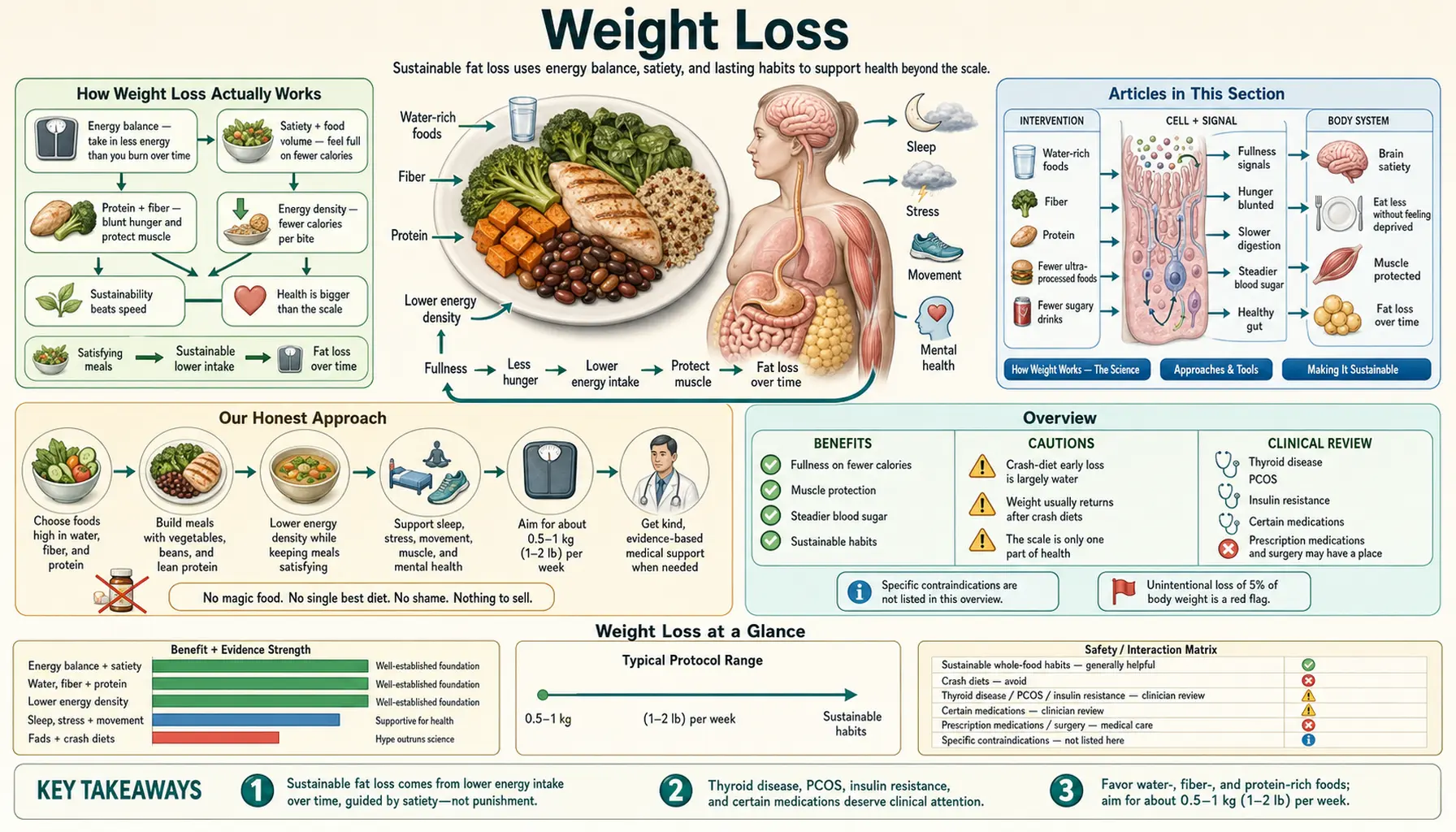
Almost everyone has tried to lose weight, and almost everyone has been sold something along the way — a supplement, a cleanse, a “fat-burning” food, a 30-day miracle. This section is the opposite of that. There is no magic food and no single best diet that works for everyone, but there is a real, well-studied science of why we feel full, why we overeat, and what actually helps people eat less without feeling deprived. Our goal is to explain that science honestly, in plain language, with nothing to sell — so you can tell the difference between an approach worth trying and a fad worth skipping. We also believe the number on the scale is only one part of health, and that lasting change comes from sustainable habits, not punishment.
How Weight Loss Actually Works
Strip away the marketing and sustainable weight loss comes down to a handful of well-established ideas. Almost every honest approach — including the diets covered in this section — works by using one or more of them:
- Energy balance is real, but hunger runs the show. You lose fat when you take in less energy than you burn over time — but how full and how satisfied you feel is what decides whether that deficit is sustainable or miserable.
- Satiety and food volume beat willpower. Foods high in water, fiber, and protein fill you up on fewer calories. A plate of vegetables, beans, and lean protein satisfies; the same calories as chips or soda do not.
- Protein and fiber are your allies. They blunt hunger, help protect muscle while you lose fat, and steady blood sugar so you are less driven to snack.
- Energy density is the quiet lever. Choosing foods with fewer calories per bite lets you eat satisfying amounts of food while still lowering your intake — the mechanism behind everything from potato diets to filling up on soup or salad first.
- Sustainability beats speed. A realistic, healthy pace is about 0.5–1 kg (1–2 lb) per week. Crash diets cause fast early loss that is largely water, and the weight usually returns.
- Health is bigger than the scale. Sleep, stress, movement, muscle, and mental health all shape your weight — and improving them is worthwhile even on weeks when the number barely moves.
Articles in This Section
Each article takes a popular weight-loss idea and separates the real, evidence-backed part from the hype — so you leave understanding why something works or doesn't, not just trying the next trend. The series is grouped into three themes.
How Weight Works — The Science
The Science of Satiety
The biology of hunger and fullness — the hormones and food qualities that really control how much you eat.
Energy Density
Calories per bite: how water- and fiber-rich foods let you eat more while taking in less.
Protein and Weight Loss
Why protein is the most filling, muscle-protecting, metabolism-friendly macronutrient when you're losing fat.
Fiber and Weight Loss
The underrated ally that fills you up, slows digestion, and feeds a healthy gut.
Ultra-Processed Foods
Why engineered foods override your fullness signals — and the landmark study that proved it.
Added Sugar & Sugary Drinks
The real problem of liquid calories, told honestly — without the “sugar is poison” hype.
Approaches & Tools
The Potato Diet
The viral potato “hack,” examined honestly — real satiety science, but no magic.
Intermittent Fasting
Does when you eat beat how much? The honest verdict: it works by helping you eat less.
Meal Timing
Breakfast myths, late-night eating, and “six small meals” — what actually matters.
Calorie Counting & Tracking
The real pros and cons of logging food — and the no-counting alternatives.
Exercise and Weight Loss
What exercise can and can't do: modest for losing weight, powerful for keeping it off.
Making It Sustainable
Why Diets Fail
The biology of regain — why it isn't willpower, and what predicts keeping weight off.
Realistic Expectations
A healthy pace, the power of losing just 5–10%, plateaus, and non-scale victories.
Sleep, Stress, and Weight
The overlooked half of weight management: rest, cortisol, and cravings.
Mindful & Intuitive Eating
The non-diet approach — its genuine benefits and its honest limits.
Emotional Eating
Breaking the cue–craving–guilt cycle, with compassion and practical tools.
Our Honest Approach
We will never promise you a number by a deadline, shame you, or point you toward a supplement to buy. Every approach here is presented with what the evidence actually supports and where the hype outruns the science. Sometimes the honest answer is that a trendy diet “works” only because it quietly cuts calories; sometimes it is that a simple, unglamorous habit genuinely helps.
We are also clear about when weight is a medical matter rather than a willpower one. Conditions such as thyroid disease, PCOS, insulin resistance, and certain medications can make weight loss genuinely harder, and proven medical tools — including newer prescription medications and, for some people, surgery — have their place. Wanting or needing help is not a failure. If you are struggling, talking with a clinician who treats weight seriously and kindly is a strong first step.
Connections
- All Remedies
- The Potato Diet for Weight Loss
- Unintentional Weight Loss (Symptom) — the other kind of weight loss — losing 5% of body weight without trying is a red flag, and that page covers the malignancy, endocrine, gastrointestinal and psychiatric causes and the workup they need.
- Fasting
- Mediterranean Diet
- Exercise
- Meditation
- Endocrinology & Metabolism
- Whole Foods