The Science of Satiety: Why You Feel Full
Most advice about eating less treats hunger as a test of willpower — something to grit your teeth and push through. But hunger and fullness are not moral qualities. They are biological signals, produced by hormones, nerves, and a stretching stomach, and they are surprisingly open to influence once you understand how they work. This page is about satiety: the sense of being satisfied and comfortably full that quietly decides how much you eat. Getting satiety on your side — rather than fighting it — is arguably the single most important and least-discussed lever in lasting weight control. We will walk through what fullness actually is, meet the handful of hormones that rise and fall around every meal (in plain language, with analogies), see why some foods fill you up on far fewer calories than others, and look honestly at why modern ultra-processed food seems almost engineered to slip past these signals. There are no miracle claims here and no shame. Just the real mechanics of feeling full, and how to work with them.
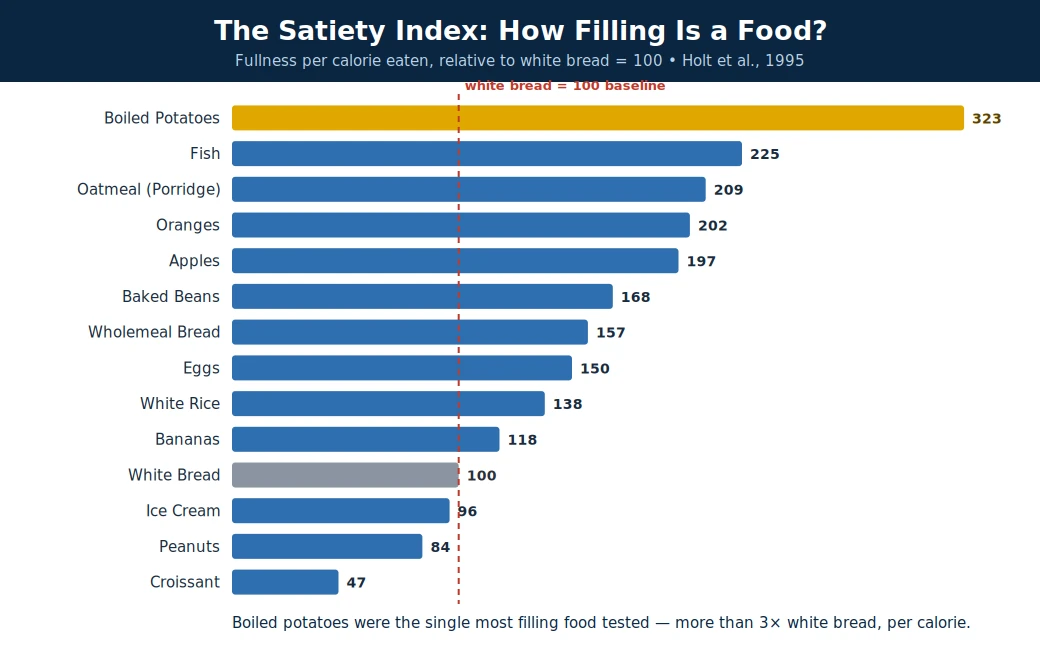
Table of Contents
- Satiation vs. Satiety: Two Different Kinds of "Full"
- The Hunger and Fullness Hormones, in Plain Language
- Your Stomach as a Stretch Sensor
- The Satiety Index: Why Some Foods Fill You Up
- What Actually Makes a Food Filling
- Why Ultra-Processed Foods Blunt Fullness
- True Hunger vs. Food Reward: The "Room for Dessert" Problem
- How Sleep, Stress, and Dieting Itself Move the Dial
- How to Eat for Fullness: A Practical Guide
- The Honest Bottom Line
- Research Papers
- Connections
- Featured Videos
Satiation vs. Satiety: Two Different Kinds of "Full"
Scientists split "fullness" into two related but distinct ideas, and the difference is genuinely useful once you notice it in your own meals.
Satiation is the feeling that builds during a meal and eventually makes you stop eating. It is the process that ends a meal — the sense of "that's enough" that grows bite by bite. Satiety is what happens after the meal: how long you stay comfortably satisfied before hunger returns and you start thinking about food again. One controls how much you eat at a sitting; the other controls how soon you come back for more.
A simple way to picture it: satiation is the brake that stops the current meal, and satiety is how long the tank stays full before the low-fuel light comes on again. A food or an eating pattern can be strong on one and weak on the other. A large soda, for example, is poor at satiation (it does little to make you stop) and poor at satiety (the hunger returns fast). A bowl of lentil soup, by contrast, tends to be good at both. Most of what follows is about nudging both of these systems in your favor — eating in a way that lets you feel satisfied sooner and stay satisfied longer, without counting every calorie.
The Hunger and Fullness Hormones, in Plain Language
Your appetite is not decided by your stomach alone. It is orchestrated by a small cast of hormones — chemical messengers released by your gut, your pancreas, and your fat tissue — that talk to the appetite-control centers of your brain (chiefly a region called the hypothalamus). You do not feel these hormones directly. You feel their result: the rumble of hunger, the ease of pushing the plate away, the contentment an hour after a good meal. Here is the cast, in everyday terms. A broad, readable review by Klok and colleagues covers how the two biggest players — ghrelin and leptin — fit together.
Ghrelin — the "hunger hormone"
Ghrelin is the only major hormone that drives hunger, and it comes mostly from the stomach. Think of it as the doorbell that rings when the kitchen is empty. Ghrelin rises before a meal — it climbs in the run-up to the times you usually eat, which is a big reason hunger can feel scheduled — and then falls sharply once food arrives. Cummings and colleagues elegantly showed this pre-meal rise in humans, timing ghrelin surges to habitual mealtimes. When people describe a "growling, empty" hunger, ghrelin is a large part of what they are feeling.
Leptin — the long-term fuel gauge
Leptin is released by your fat tissue, and it works on a slow, background timescale rather than meal to meal. Picture it as the fuel gauge for your body's long-term energy stores: the more fat you carry, the more leptin you make, telling the brain "reserves are full, you can ease off." In theory this should protect against overeating — and in people who are lean it broadly does. The complication is leptin resistance: in many people with obesity, leptin levels are high but the brain stops listening to the signal, much as constant noise fades into the background. This is one honest, biological reason that "just eat less" is far harder for some bodies than others — the fullness gauge itself has been turned down.
GLP-1, PYY, and CCK — the gut's "the meal has arrived" messengers
As food moves out of your stomach and into your intestine, the gut releases a set of fullness hormones that tell the brain to wind the meal down. Three matter most:
- CCK (cholecystokinin) is the fast first responder, released within minutes of fat and protein reaching the gut. In a classic human experiment, Kissileff and colleagues infused a form of CCK and watched people spontaneously eat less — direct evidence that this gut signal curbs appetite.
- PYY (peptide YY) rises more slowly and keeps appetite suppressed for hours after eating. Batterham and colleagues showed that giving PYY to volunteers meaningfully reduced how much they ate at a later meal — a real, measurable "I'm satisfied" signal from the gut.
- GLP-1 (glucagon-like peptide 1) both signals fullness to the brain and slows how fast the stomach empties, stretching out satiety. Its physiology, reviewed thoroughly by Holst, is exactly why it became famous: the modern GLP-1 weight-loss medications work largely by imitating and amplifying this natural satiety hormone.
Insulin — a quieter satiety signal
Insulin is best known for managing blood sugar, but it also acts on the brain as a longer-term signal of energy status, nudging appetite down. It is a supporting player rather than a lead, but it is part of the same conversation — one more voice telling the brain how well-fueled the body is.
The key idea to carry forward is this: hunger and fullness are a chorus, not a single switch. Ghrelin pushes you toward the table; the stomach's stretch and the gut hormones (CCK, PYY, GLP-1), backed by leptin and insulin, pull you away from it. What you eat, and how, changes how loudly each voice sings.
Your Stomach as a Stretch Sensor
Long before any hormone can act, your stomach is already sending fullness signals — and it does so mainly by feeling stretched. The stomach wall is lined with stretch receptors wired straight to the brain through the vagus nerve. As a meal fills the stomach and its walls expand, those sensors fire off a simple, powerful message: "we are getting full." It is the biological equivalent of a balloon that reports how inflated it is. Geliebter's work on gastric distension showed the direct link between how much the stomach is filled and how much people go on to eat — volume in the stomach genuinely dampens appetite, somewhat independently of calories.
This is why a food's bulk matters so much, and it explains one of the most reliable tricks in eating for fullness: high-water, high-fiber foods (vegetables, broth-based soups, fruit, beans, plain potatoes) physically fill the stomach for very few calories, triggering the stretch signal early and cheaply. A dense granola bar delivers the same calories in a bite or two and barely moves the balloon.
The second half of the story is gastric emptying speed — how quickly the stomach drains into the intestine. Slow emptying keeps the stomach fuller for longer and prolongs satiety; fast emptying leaves you hungry sooner. Protein, fiber, and fat all slow emptying, which is part of why they "stick with you." Liquid calories, especially sugary drinks, empty fast and stretch the stomach only briefly — a major reason they are so easy to over-consume without ever feeling full.
The Satiety Index: Why Some Foods Fill You Up
If foods differ so much in how filling they are, can we actually measure it? In 1995 the researcher Susanne Holt and her colleagues did exactly that, creating what they called the Satiety Index. They fed volunteers equal-calorie portions (about 240 kilocalories) of 38 common foods, then tracked how full people felt over the next two hours and how much they spontaneously ate afterward. Every food was scored against plain white bread, which was fixed at 100%.
The results upended a lot of assumptions. The single most filling food tested was the humble boiled potato, which scored roughly 323% — more than three times as satisfying, calorie for calorie, as white bread, and well ahead of foods people often think of as "diet" choices. In general, the pattern was clear: foods high in protein, fiber, and water ranked near the top, while airy, sugary, fatty processed foods (croissants, cake, candy) ranked near the bottom. Two foods with identical calories can leave you feeling completely differently — one satisfied for hours, the other hungry again within the hour.
This is the honest, evidence-based heart of eating for weight control, and it is why our Potato Diet page treats the potato's satiety power as the one genuinely useful kernel inside a faddish plan. You do not need to eat only potatoes. You need to understand why they top the list — because those same properties can be built into an ordinary, varied, enjoyable diet.
What Actually Makes a Food Filling
Pull the Satiety Index apart and a handful of properties explain almost all of it. A filling food tends to have several of these at once:
- Protein. Gram for gram, protein is the most satiating of the three main nutrients. It triggers gut fullness hormones, slows stomach emptying, and takes real work to digest. This is why an egg or some yogurt at breakfast holds you far better than the same calories of toast or juice.
- Fiber. Fiber adds bulk that stretches the stomach, slows digestion, and feeds the gut bacteria that release fullness signals of their own. Whole plant foods — beans, vegetables, fruit, whole grains — are naturally fiber-rich; most processed foods have had the fiber stripped out.
- Water and volume. Water carries no calories but takes up real space in the stomach. Foods that hold a lot of water (soups, fruit, vegetables, cooked whole grains) let you eat a large, satisfying volume for few calories.
- Low energy density. This is the concept that ties the others together. Energy density is simply how many calories are packed into a given weight of food. Water and fiber dilute it; fat and sugar concentrate it. Barbara Rolls' research shows that people tend to eat a fairly constant weight of food each day, so choosing lower-energy-density foods means you fill up on that same comfortable weight while taking in fewer calories — almost automatically. It is the closest thing to a free lunch in appetite science.
Notice what these have in common: none of them is a trick or a supplement. They are ordinary features of whole, minimally processed food. Which sets up the flip side of the story.
Why Ultra-Processed Foods Blunt Fullness
If whole foods are built to fill you up, much of modern food seems built to do the opposite — and there is now a landmark experiment showing it is not just in your head. In 2019, Kevin Hall and colleagues at the U.S. National Institutes of Health ran a tightly controlled inpatient randomized trial. Twenty adults lived in a research ward and, for two weeks each, ate either an ultra-processed diet or an unprocessed one. Crucially, the two diets were carefully matched for calories, sugar, fat, fiber, and protein on offer, and people were simply told to eat as much or as little as they wanted.
The result was striking. On the ultra-processed diet, people ate about 500 extra calories per day and gained weight; on the whole-food diet, the same people ate less and lost weight — without being told to change a thing. Same person, same appetite, wildly different intake, driven entirely by the type of food in front of them.
Why does ultra-processed food slip past the fullness system? Several reasons stack up:
- It is high in energy density. Calories are concentrated into a small, easy-to-eat package, so the stomach's stretch sensors are barely triggered before you have eaten a lot.
- It is soft and quick to eat. Much processed food requires little chewing and is swallowed fast — people in the trial literally ate more quickly — so the meal is over before the gut's slower fullness hormones can catch up and say "stop."
- Fiber, water, and intact structure are removed. Stripping these out removes exactly the properties that create satiety.
- It is engineered to be palatable. Precise combinations of sugar, fat, salt, and texture make these foods extremely rewarding and easy to keep eating past the point of fullness — which leads directly to the next idea.
None of this means processed food is poison or that you must eat perfectly. It means the deck is stacked: the modern food environment is full of products that deliver a lot of calories while doing very little to satisfy you. Understanding that is not a reason for shame — it is a reason to be a little suspicious of foods that never seem to fill you up.
True Hunger vs. Food Reward: The "Room for Dessert" Problem
Everyone knows the experience: you finish a big dinner, genuinely full, push the plate away — and then someone brings out dessert, and suddenly there is room after all. This is not a failure of character. It reveals that we have two separate appetite systems, and they do not always agree.
The first is homeostatic hunger — true, body-driven need for fuel, run by the hormones and stretch signals above. The second is hedonic hunger, or food reward: the pull to eat for pleasure, driven by the brain's reward circuitry rather than by any real energy shortage. Lowe and colleagues named and described this hedonic dimension of appetite, and it explains a great deal of everyday overeating. The dessert goes down not because your body needs it, but because it is delicious and your reward system lights up.
Part of what makes dessert possible after a filling meal is a quirk called sensory-specific satiety: as you eat a lot of one food, that particular food becomes less appealing, but a different taste (sweet, after a savory meal) feels fresh and tempting again. Rolls and colleagues demonstrated this directly — it is why a buffet, or simply "variety," reliably leads people to eat more. It is a beautifully designed survival feature (encouraging a varied diet in nature) that misfires badly in a world of unlimited, engineered variety.
The practical point is not to shame the dessert stomach out of existence — food is one of life's genuine pleasures. It is to notice the difference between "my body needs food" and "this looks good and I want it," because the two call for different responses. Much of what feels like weak willpower is really the reward system doing exactly what it evolved to do.
How Sleep, Stress, and Dieting Itself Move the Dial
The satiety system is not fixed. Three everyday forces — too little sleep, chronic stress, and (ironically) dieting itself — all quietly turn the fullness signals down and the hunger signals up.
Sleep. Short sleep is a direct appetite disruptor. In a careful study, Spiegel and colleagues restricted healthy young men to about four hours of sleep and found their ghrelin rose and their leptin fell — the exact hormonal recipe for more hunger — along with increased appetite, especially for calorie-dense, sugary foods. If you have ever noticed that a bad night leaves you ravenous and reaching for junk the next day, this is why. Protecting sleep is one of the most underrated things you can do for appetite control.
Stress. Chronic stress raises the hormone cortisol, which can increase appetite and steer cravings toward high-calorie "comfort" foods. Stress also drives eating for emotional reasons that have nothing to do with hunger at all. This is a real physiological effect, not weakness — and it means that managing stress is a legitimate part of managing weight.
Dieting itself. Here is one of the most important and least-told truths in this whole subject. When you lose weight, your body fights to get it back. As fat stores shrink, leptin falls (the fuel gauge reads "low") and ghrelin rises — and Cummings and colleagues showed that ghrelin climbs after diet-induced weight loss, actively pushing hunger up. Your body does not know you wanted to lose the weight; it responds as if to a famine, defending its old set-point. This is why crash diets so often rebound, and why lasting change usually has to be gentle and gradual enough that these defenses are not fully triggered. If you have regained weight after a strict diet, this is the biology behind it — not a lack of discipline.
How to Eat for Fullness: A Practical Guide
Everything above points to a handful of simple, evidence-based habits. None of them require counting calories, buying anything special, or eating foods you hate. The idea is to make fullness work with you.
- Build meals around protein and plants. Aim to include a protein source (eggs, fish, poultry, beans, lentils, yogurt) and plenty of vegetables or fruit at each meal. These are the top-of-the-Satiety-Index foods for a reason.
- Choose foods with high water and fiber, low energy density. Soups, salads, beans, whole fruit, cooked whole grains, and simply prepared potatoes fill the stomach for few calories. Let these crowd the plate.
- Start meals with the filling part. A broth-based soup or a vegetable starter genuinely reduces how much you eat of the richer courses — the energy-density research in action.
- Slow down. The gut's fullness hormones take roughly fifteen to twenty minutes to reach the brain. Eating slowly gives them time to arrive before you have overshot. Chewing thoroughly and putting the fork down between bites genuinely helps.
- Drink your calories rarely. Sugary drinks empty from the stomach fast and trigger almost no satiety — they are among the easiest ways to take in calories you will never "feel." Water, tea, or coffee are your friends.
- Be honest about reward eating. When you reach for food, pause and ask whether it is body-hunger or reward. Neither answer is wrong — but naming it puts you back in the driver's seat.
- Protect sleep and manage stress. These are not side issues. Poor sleep and chronic stress reliably crank up hunger; guarding them is guarding your appetite.
- Lose weight slowly if you are trying to. A gentle pace of roughly half a kilogram to one kilogram (about one to two pounds) a week is far less likely to trigger the body's hunger defenses than a crash diet — and far more likely to last.
The Honest Bottom Line
Feeling full is not a matter of willpower. It is a physiological system — a stretching stomach, a chorus of hunger and fullness hormones, and a reward circuit layered on top — and, like any system, it can be worked with or against. Most diets fail because they pit sheer willpower against this machinery and lose. The more sustainable path is to stop fighting your biology and start recruiting it: eat foods that are genuinely filling for their calories, respect the stomach's need for bulk and the gut's need for time, protect your sleep, and be gentle enough that your body does not slam on the hunger brakes.
This is not a promise that weight management becomes easy — it is shaped by genetics, hormones, medications, stress, income, and a food environment designed to be over-eaten, none of which is a personal failing. But the science of satiety offers something better than another gimmick. It offers a reason for hope grounded in how your body actually works: when eating less stops feeling like deprivation and starts feeling like satisfaction, it becomes something you can live with. Working with your fullness, not against it, is what makes eating less sustainable — and sustainability, in the end, is the only thing that lasts.
Research Papers
- Holt SHA, Miller JCB, Petocz P, Farmakalidis E. A satiety index of common foods. European Journal of Clinical Nutrition. 1995;49(9):675-690. PubMed: PMID 7498104 — the landmark study ranking 38 foods by fullness per calorie; boiled potatoes scored highest (~323% vs. white bread's 100%).
- Hall KD, Ayuketah A, Brychta R, et al. Ultra-processed diets cause excess calorie intake and weight gain: an inpatient randomized controlled trial of ad libitum food intake. Cell Metabolism. 2019;30(1):67-77.e3. doi:10.1016/j.cmet.2019.05.008 — on identical people, an ultra-processed diet led to ~500 extra calories a day and weight gain versus a whole-food diet.
- Cummings DE, Purnell JQ, Frayo RS, Schmidova K, Wisse BE, Weigle DS. A preprandial rise in plasma ghrelin levels suggests a role in meal initiation in humans. Diabetes. 2001;50(8):1714-1719. doi:10.2337/diabetes.50.8.1714 — direct human evidence that the hunger hormone ghrelin rises just before habitual mealtimes.
- Cummings DE, Weigle DS, Frayo RS, et al. Plasma ghrelin levels after diet-induced weight loss or gastric bypass surgery. New England Journal of Medicine. 2002;346(21):1623-1630. doi:10.1056/NEJMoa012908 — ghrelin rose after diet-induced weight loss, part of why the body defends its weight and diets rebound.
- Batterham RL, Cowley MA, Small CJ, et al. Gut hormone PYY3-36 physiologically inhibits food intake. Nature. 2002;418(6898):650-654. doi:10.1038/nature00887 — the gut hormone PYY reduced how much volunteers subsequently ate, a genuine fullness signal.
- Klok MD, Jakobsdottir S, Drent ML. The role of leptin and ghrelin in the regulation of food intake and body weight in humans: a review. Obesity Reviews. 2007;8(1):21-34. doi:10.1111/j.1467-789X.2006.00270.x — a readable overview of how the fat-derived "fuel gauge" leptin and the "hunger hormone" ghrelin govern appetite.
- Holst JJ. The physiology of glucagon-like peptide 1. Physiological Reviews. 2007;87(4):1409-1439. doi:10.1152/physrev.00034.2006 — the definitive review of GLP-1, the natural satiety hormone that modern weight-loss drugs imitate.
- Kissileff HR, Pi-Sunyer FX, Thornton J, Smith GP. C-terminal octapeptide of cholecystokinin decreases food intake in man. The American Journal of Clinical Nutrition. 1981;34(2):154-160. doi:10.1093/ajcn/34.2.154 — classic human evidence that the gut hormone CCK reduces how much people eat.
- Geliebter A. Gastric distension and gastric capacity in relation to food intake in humans. Physiology & Behavior. 1988;44(4-5):665-668. doi:10.1016/0031-9384(88)90333-2 — shows that filling and stretching the stomach itself dampens appetite, the basis of "volume" eating.
- Spiegel K, Tasali E, Penev P, Van Cauter E. Brief communication: sleep curtailment in healthy young men is associated with decreased leptin levels, elevated ghrelin levels, and increased hunger and appetite. Annals of Internal Medicine. 2004;141(11):846-850. doi:10.7326/0003-4819-141-11-200412070-00008 — short sleep raised ghrelin, lowered leptin, and increased hunger, especially for calorie-dense foods.
- Lowe MR, Butryn ML. Hedonic hunger: a new dimension of appetite? Physiology & Behavior. 2007;91(4):432-439. doi:10.1016/j.physbeh.2007.04.006 — describes eating for reward and pleasure as distinct from true energy need, the "room for dessert" effect.
- Rolls BJ, Rowe EA, Rolls ET, Kingston B, Megson A, Gunary R. Sensory specific satiety in man. Physiology & Behavior. 1981;27(1):137-142. doi:10.1016/0031-9384(81)90310-3 — the classic demonstration that a food loses appeal as you eat it while a new taste stays tempting, so variety drives overeating.
Connections
- All Remedies
- Energy Density
- Protein and Weight Loss
- Fiber and Weight Loss
- Ultra-Processed Foods
- Added Sugar & Sugary Drinks
- Weight Loss
- Potato Diet
- Fasting
- Mediterranean Diet
- Exercise
- Endocrinology
- Food