Emotional Eating: Breaking the Cycle
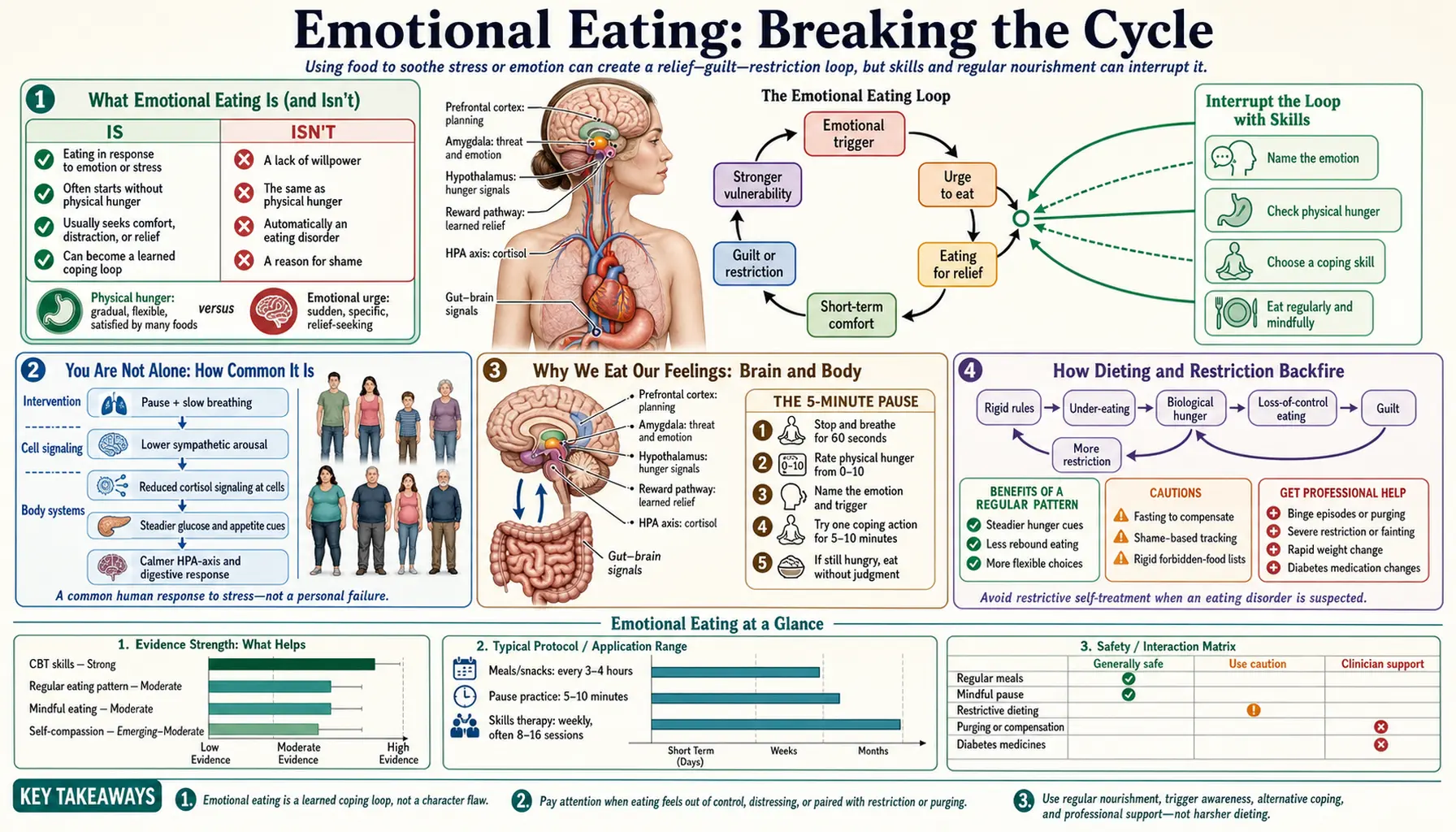
Almost everyone has done it. You reach for a snack not because your stomach is empty, but because the day was long, the news was bad, the house is quiet, or you simply do not know what else to do with a restless feeling. That is emotional eating — using food to soothe stress, boredom, sadness, anxiety, or loneliness rather than to answer physical hunger. If you are reading this because you feel stuck in a loop with it, please hear the most important thing first: this is common, it is deeply human, and it is not a character flaw. Reaching for comfort when you are hurting is not gluttony or weakness — it is a coping strategy your brain learned because, in the moment, it works. This page explains, in plain language, what emotional eating is, why it happens in the brain and body, how to tell emotional hunger from physical hunger, and — most of all — the calm, evidence-based ways to loosen its grip. There are no miracle claims here and nothing to buy. Just an honest look at what the research actually shows, offered without a trace of shame.
Table of Contents
- What Emotional Eating Is (and Isn't)
- You Are Not Alone: How Common It Is
- Why We Eat Our Feelings: Brain and Body
- How Dieting and Restriction Backfire
- Emotional Hunger vs. Physical Hunger
- The Guilt–Restriction–Binge Cycle
- Strategies That Actually Help
- Self-Compassion: The Surprising Key
- When It's Something Bigger
- A Hopeful Bottom Line
- Research Papers
- Connections
- Featured Videos
What Emotional Eating Is (and Isn't)
Emotional eating is eating in response to feelings instead of to physical hunger. Instead of food answering an empty stomach, it answers an uncomfortable emotion — stress, sadness, anxiety, anger, boredom, or loneliness. Researchers who study this have a formal way of measuring it, most famously the Dutch Eating Behavior Questionnaire, which asks how strongly a person feels the urge to eat when anxious, irritable, or down. In careful experiments, people who score high on emotional eating actually do eat differently after being made to feel sad, reaching more for palatable, high-calorie comfort foods than others do.
It helps to be clear about what emotional eating is not. It is not the same as simply enjoying food, celebrating with a meal, or eating a slice of birthday cake you are not physically hungry for — pleasure and eating have always gone together, and that is healthy. It is also not, by itself, an eating disorder. It sits on a wide spectrum: for most people it is an occasional habit that causes little harm; for some it becomes a frequent, distressing pattern that gets in the way of the life or the health they want. Wherever you fall on that spectrum, the mechanics are the same, and so are the tools for change. And to say it plainly one more time: needing comfort is not a moral failing. Food is one of the very first ways human beings are ever soothed — a hungry baby is fed and calmed at the same time — so it is no surprise that the brain files "eat" and "feel better" close together for life.
You Are Not Alone: How Common It Is
If emotional eating feels like your private struggle, it is worth knowing how thoroughly ordinary it is. Surveys and studies across many countries find that a large share of adults eat more — and reach for richer, sweeter, or saltier food — when they are stressed or upset. It is common enough that psychologists treat it as a normal variation in eating behavior, not a rare pathology. Large population studies have followed thousands of people over years and found that emotional eating is woven through everyday life, more pronounced in people also carrying depression or poor sleep, and linked over the long run to gradual weight gain in some.
Why does this matter to you? Because shame thrives on the belief that you are uniquely broken — that everyone else has this handled and you alone cannot. That belief is simply false. Emotional eating is one of the most widely shared human experiences there is. Naming it as common is not an excuse to ignore it; it is the ground you stand on to change it. You are not weak, and you are not alone in this. You are dealing with something that a great many thoughtful, disciplined, kind people also wrestle with — and that a great many of them have learned to loosen.
Why We Eat Our Feelings: Brain and Body
Emotional eating is not a matter of poor willpower. It is the predictable result of how the brain and body are built. Three forces stack up together.
Comfort food and the brain's reward system
Rich, sweet, salty, and fatty foods light up the brain's reward circuitry — the same dopamine-driven pathways involved in other pleasures. Eating these foods can genuinely, if briefly, dampen distress and lift mood. In other words, "comfort food" is not just a figure of speech; there is a real, measurable soothing effect. Adam and Epel described exactly this link between stress, eating, and the reward system: under emotional pressure, the brain nudges us toward the foods most likely to deliver a quick hit of relief. When your body is flooded with an unpleasant feeling, reaching for the food that reliably takes the edge off is not irrational — it is your nervous system doing what it has learned works.
Stress, cortisol, and cravings
When you are under sustained stress, your body releases the hormone cortisol. Among its many effects, cortisol appears to increase appetite and specifically drive cravings for high-fat, high-sugar food. This is an old survival wiring — in a genuine crisis, seeking dense calories made sense — but it fires just as readily during a stressful commute or a hard week at work. In one striking study, women under chronic stress ate more comfort food, and the researchers traced a chronic-stress response network that helps explain why the most stressed among us are the most drawn to soothing, calorie-dense food. So if you notice cravings surge exactly when life gets hardest, that is not you being "bad." That is biology.
Learned habit loops
The third force is habit. The brain is a pattern machine, and emotional eating quickly becomes a learned loop: a cue (a feeling — stress, boredom, loneliness), a craving (the pull toward food), the action (eating), and a reward (brief relief). Each time the loop completes, the pathway is reinforced, and the next time the same feeling arises, the urge arrives faster and stronger, often before you have consciously decided anything. Macht's well-known "five-way model" of how emotions affect eating describes several routes by which feelings translate into eating — and the habit route is one of the most powerful, because it runs largely on autopilot. Understanding this is oddly freeing: if the pattern was learned, then a new pattern can be learned too. You are not fighting your nature; you are updating a habit.
How Dieting and Restriction Backfire
Here is one of the most important and least talked-about parts of the whole story: strict dieting can actually cause the very eating it is meant to prevent. This is not a fringe idea — it is one of the most established findings in the psychology of eating. Decades ago, Polivy and Herman laid out a causal analysis showing that rigid restraint sets people up to binge. When you tell yourself a food is forbidden, or you white-knuckle your way through the day on too little food, you create both a physical drive (real hunger, low energy) and a psychological pressure (deprivation, preoccupation, the "forbidden fruit" pull). Eventually the restraint breaks — and it tends to break not into a measured bite but into an overwhelming rush.
Anyone who has ever thought "I've blown my diet, so I might as well eat everything" has felt this firsthand. Restriction and rebound are two ends of the same seesaw. The cruel twist is that the harder and more extreme the diet, the harder the rebound. This is why, throughout this page, you will not find advice to simply restrict more. Extreme restriction is not the cure for emotional eating — it is often one of its engines. Gentle, adequate, non-punishing eating is not the soft option; for many people it is the more effective path, precisely because it takes the deprivation fuel out of the fire.
Emotional Hunger vs. Physical Hunger
One of the most practical skills you can build is learning to tell the two hungers apart in the moment. They feel similar at first, but they behave very differently, and a little pause is usually enough to notice which one is knocking. Here is a simple guide:
- Speed. Physical hunger builds gradually — it grows over time and can wait a little. Emotional hunger arrives suddenly and feels urgent, like it must be satisfied right now.
- What will satisfy it. Physical hunger is open to options; almost any food will do, including a plain, simple meal. Emotional hunger demands a specific comfort food — the chips, the ice cream, the chocolate — and a substitute rarely satisfies it.
- Where you feel it. Physical hunger is felt in the stomach — the growl, the emptiness. Emotional hunger tends to live above the neck: it is a craving in the mind and mouth, not a signal from the gut.
- The "off" switch. Physical hunger stops when you are comfortably full. Emotional hunger often keeps going past fullness, because the goal was never to fill the stomach — it was to change a feeling.
- What comes afterward. Eating to satisfy physical hunger leaves you neutral or content. Eating to satisfy emotional hunger is frequently followed by guilt or shame — a strong clue that the eating was about emotion, not fuel.
You do not need to get this "right" every time. The point of the exercise is not judgment; it is simply noticing. Each time you pause and ask, "Is this my stomach or my mood?" you weaken the autopilot a little and hand a bit of choice back to yourself. That awareness alone, practiced gently over time, is one of the most powerful changes you can make.
The Guilt–Restriction–Binge Cycle
Emotional eating rarely stays a single event. For many people it spins into a self-perpetuating cycle, and seeing the whole loop clearly is the first step to stepping out of it. It usually runs like this:
- A difficult feeling arrives — stress, sadness, boredom, loneliness.
- You eat for comfort, and for a moment it works — the feeling eases.
- Afterward comes guilt and shame: "Why did I do that again? What is wrong with me?"
- To make up for it, you restrict — skip meals, swear off the food, crack down hard.
- Restriction creates deprivation and stress — which becomes the next difficult feeling — and the loop starts over, often stronger.
Notice the trap: the guilt and the crackdown are not the cure. They are the fuel. Shame is a miserable motivator that tends to drive more of the behavior it condemns, and the restriction that follows guilt sets up the next rebound, exactly as Polivy and Herman described. The way out is not to try harder at the parts that are failing you. It is to break the loop at its weakest link: the guilt. When a comfort-eating episode is met with understanding instead of self-attack — "That was hard; I reached for what I know soothes me; I can make a different choice next time" — there is no shame spiral to trigger the restriction, and no rebound waiting on the other side. Dropping the guilt is not letting yourself off the hook. It is removing the very thing that keeps the hook set.
Strategies That Actually Help
Everything above leads here. These are calm, evidence-informed tools — not a rigid program, and not a promise. Try them the way you would try on clothes: keep what fits, leave what doesn't, and expect it to take practice. The research on emotional eating points repeatedly to two themes: getting better at handling emotions directly, and stopping the punishing restriction that feeds the cycle.
Notice your triggers with a feelings-and-food journal
For a week or two, jot down not just what you eat but how you felt right before — and how you felt after. You are not counting calories; you are collecting clues. Patterns almost always emerge: the mid-afternoon slump, the lonely evening, the after-argument reach for something sweet. You cannot change a trigger you cannot see. Naming it — "this is a boredom snack," "this is a stress craving" — is itself a small act of freedom, and it turns a vague, overwhelming habit into something specific and workable.
Run the HALT check
When a craving hits and you suspect it is not physical hunger, pause and ask whether you are Hungry, Angry, Lonely, or Tired. HALT is a simple, borrowed-from-recovery checklist, and it works because it points you straight at the real need. If you are genuinely hungry, eat — food is the right answer. But if the truth is angry, lonely, or tired, then food will not fix it, and naming the real need opens the door to the thing that actually might: a hard conversation, a phone call to a friend, or simply going to bed.
Urge-surf and use the pause
Cravings feel permanent in the moment, but they are not. Like a wave, an urge rises, peaks, and falls — usually within a number of minutes — whether or not you act on it. "Urge-surfing" means riding that wave instead of being swept under it: when the craving comes, set a short timer, breathe, and simply watch the urge without fighting it or obeying it. Very often it recedes on its own. Even a brief, deliberate pause — a glass of water, a walk to another room, three slow breaths — is enough to slip a sliver of choice between the feeling and the food, which is exactly where the autopilot loses its grip.
Build a menu of non-food comfort
Emotional eating is trying to meet a real need for soothing; the trouble is that food is the only tool on the shelf. So stock the shelf. Make an actual written list — your personal "comfort menu" — of things that genuinely calm or lift you, and keep it where you can see it. Good candidates cluster around a few themes: movement (a short walk, stretching, dancing to one song), connection (texting a friend, calling family, petting the dog), calming the body (slow breathing, a warm shower, a few minutes of meditation), and rest and distraction (a nap, music, a book, a favorite show). None of these has to be perfect. They only have to give you a real choice in the moment other than eating. Studies of emotional eating find that people who lean on a wider range of coping strategies — rather than food alone — tend to fare better, which is the whole idea behind building a menu.
Drop the extreme restriction
This one is counterintuitive but, as the section above explained, essential: ease up on rigid dieting. Eat enough. Stop labeling foods as strictly forbidden. Aim for regular, satisfying meals with enough protein and fiber so that physical hunger is not constantly stacking on top of emotional hunger. When you are not running on empty and not white-knuckling deprivation, the emotional pull toward food gets quieter on its own, and there is far less rebound pressure to manage. Gentleness here is not indulgence; it is strategy.
Self-Compassion: The Surprising Key
If there is one shift that ties all of this together, it is self-compassion — treating yourself, especially after a slip, with the same warmth and understanding you would offer a good friend. The psychologist Kristin Neff described self-compassion as a healthier stance toward oneself than harsh self-criticism, built on kindness, a sense of shared humanity, and honest, balanced awareness rather than self-attack. It sounds soft. The evidence suggests it is anything but.
Because guilt and shame are what keep the emotional-eating cycle spinning, self-compassion strikes at the root. When you drop the self-punishment, you remove the fuel for the next round of restriction and rebound. And this is not just a nice idea — it has been tested. In a randomized pilot trial, self-compassion training helped reduce binge eating, and broader research links a kinder relationship with oneself to less disordered and emotional eating, not more. The fear many people carry — "if I stop being hard on myself, I'll lose all control" — turns out to be backwards. Harshness tightens the cycle; kindness loosens it. Talking to yourself gently after a hard moment ("that was a rough day, and I did the best I could") is not letting yourself off the hook. It is, quietly, one of the most effective things you can do.
When It's Something Bigger
Occasional emotional eating is a normal part of being human. But sometimes it is a sign of something larger that deserves real support — and recognizing that is wisdom, not weakness. It may be worth reaching out for help if you notice any of these: eating that feels genuinely out of control, as though you cannot stop once you start; regularly eating unusually large amounts in a short time, often in secret, followed by deep distress; emotional eating that is clearly tangled up with persistent low mood, anxiety, or a history of trauma; or a pattern that is harming your health or your peace of mind and will not budge no matter what you try.
Frequent, distressing loss-of-control eating can point to binge eating disorder, which is common, real, and — importantly — very treatable. Depression and emotional eating also travel together, each feeding the other, and long-term studies link the pair to weight gain over time; treating the mood often eases the eating. The good news is that effective help exists. Cognitive behavioral therapy is a leading, well-studied treatment for eating problems, and self-compassion-based approaches show real promise too. Seeking out a therapist, a doctor, or a registered dietitian is not an admission of failure — it is one of the strongest, healthiest, most self-respecting steps a person can take. You would not think less of someone for seeing a doctor about a stubborn cough. This is exactly the same. Reaching for help is reaching for yourself.
A Hopeful Bottom Line
If you take only a few things from this page, let them be these. Emotional eating is common, human, and learned — which means it is not a verdict on your character, and it is not permanent. It happens for real reasons rooted in the brain's reward system, in stress hormones, and in habit — not in some flaw in you. The way out is not harsher discipline or a stricter diet; those tend to make the cycle worse. The way out is gentler and, happily, better supported by the evidence: notice your triggers, learn the difference between the two hungers, build a menu of comfort that isn't food, ease off the punishing restriction, and — above all — meet your own slips with compassion instead of shame.
Change here is rarely a straight line. There will be hard days and old-habit days, and that is not failure — that is simply what learning looks like. Every time you pause before eating, name a feeling, phone a friend instead of opening the fridge, or forgive yourself for a rough evening, you are laying down a new path, and paths get easier the more they are walked. You do not have to do it perfectly, and you do not have to do it alone. Be patient with yourself. You are not broken, and you are not beyond help — you are a person learning a kinder way to care for yourself, and that is something to be proud of.
Research Papers
- van Strien T, Cebolla A, Etchemendy E, et al. Emotional eating and food intake after sadness and joy. Appetite. 2013;66:20-25. doi:10.1016/j.appet.2013.02.016 — experimental evidence that people high in emotional eating eat more after being made to feel sad.
- van Strien T. Causes of Emotional Eating and Matched Treatment of Obesity. Current Diabetes Reports. 2018;18(6):35. doi:10.1007/s11892-018-1000-x — review of what drives emotional eating and why it matters for weight and treatment.
- Adam TC, Epel ES. Stress, eating and the reward system. Physiology & Behavior. 2007;91(4):449-458. doi:10.1016/j.physbeh.2007.04.011 — foundational account of how stress steers eating through the brain's reward pathways.
- Macht M. How emotions affect eating: a five-way model. Appetite. 2008;50(1):1-11. doi:10.1016/j.appet.2007.07.002 — maps the several distinct routes by which feelings translate into eating, including habit and emotion regulation.
- Evers C, Marijn Stok F, de Ridder DTD. Feeding your feelings: emotion regulation strategies and emotional eating. Personality and Social Psychology Bulletin. 2010;36(6):792-804. PubMed: PMID 20460650 — links poorer emotion-regulation skills to more emotional eating, supporting coping-skill approaches.
- Tomiyama AJ, Dallman MF, Epel ES. Comfort food is comforting to those most stressed: evidence of the chronic stress response network in high stress women. Psychoneuroendocrinology. 2011;36(10):1513-1519. doi:10.1016/j.psyneuen.2011.04.005 — ties chronic stress and cortisol biology to comfort-food eating.
- Polivy J, Herman CP. Dieting and binging: a causal analysis. American Psychologist. 1985;40(2):193-201. — Search PubMed — the classic demonstration that rigid dietary restraint sets people up to overeat and binge.
- Braden A, Musher-Eizenman D, Watford T, Emley E. Eating when depressed, anxious, bored, or happy: are emotional eating types associated with unique psychological and physical health correlates? Appetite. 2018;125:410-417. doi:10.1016/j.appet.2018.02.022 — shows emotional eating comes in distinct types tied to coping and health.
- Konttinen H, van Strien T, Männistö S, Jousilahti P, Haukkala A. Depression, emotional eating and long-term weight changes: a population-based prospective study. International Journal of Behavioral Nutrition and Physical Activity. 2019;16(1):28. doi:10.1186/s12966-019-0791-8 — large prospective study linking depression, emotional eating, and gradual weight gain.
- Kelly AC, Carter JC. Self-compassion training for binge eating disorder: a pilot randomized controlled trial. Psychology and Psychotherapy: Theory, Research and Practice. 2015;88(3):285-303. PubMed: PMID 25330466 — a randomized trial showing self-compassion training reduced binge eating.
- Neff KD. Self-compassion: an alternative conceptualization of a healthy attitude toward oneself. Self and Identity. 2003;2(2):85-101. doi:10.1080/15298860309032 — the foundational paper defining self-compassion as a healthier stance than self-criticism.
- Fairburn CG, Cooper Z, Shafran R. Cognitive behaviour therapy for eating disorders: a "transdiagnostic" theory and treatment. Behaviour Research and Therapy. 2003;41(5):509-528. doi:10.1016/S0005-7967(02)00088-8 — the influential framework behind CBT for binge eating and related problems.
Connections
- All Remedies
- Why Diets Fail
- Realistic Expectations
- Sleep, Stress, and Weight
- Mindful & Intuitive Eating
- Weight Loss
- The Potato Diet for Weight Loss
- Natural Anxiety Relief
- Meditation
- Journaling
- Psychiatry