Energy Density: How to Eat More and Weigh Less
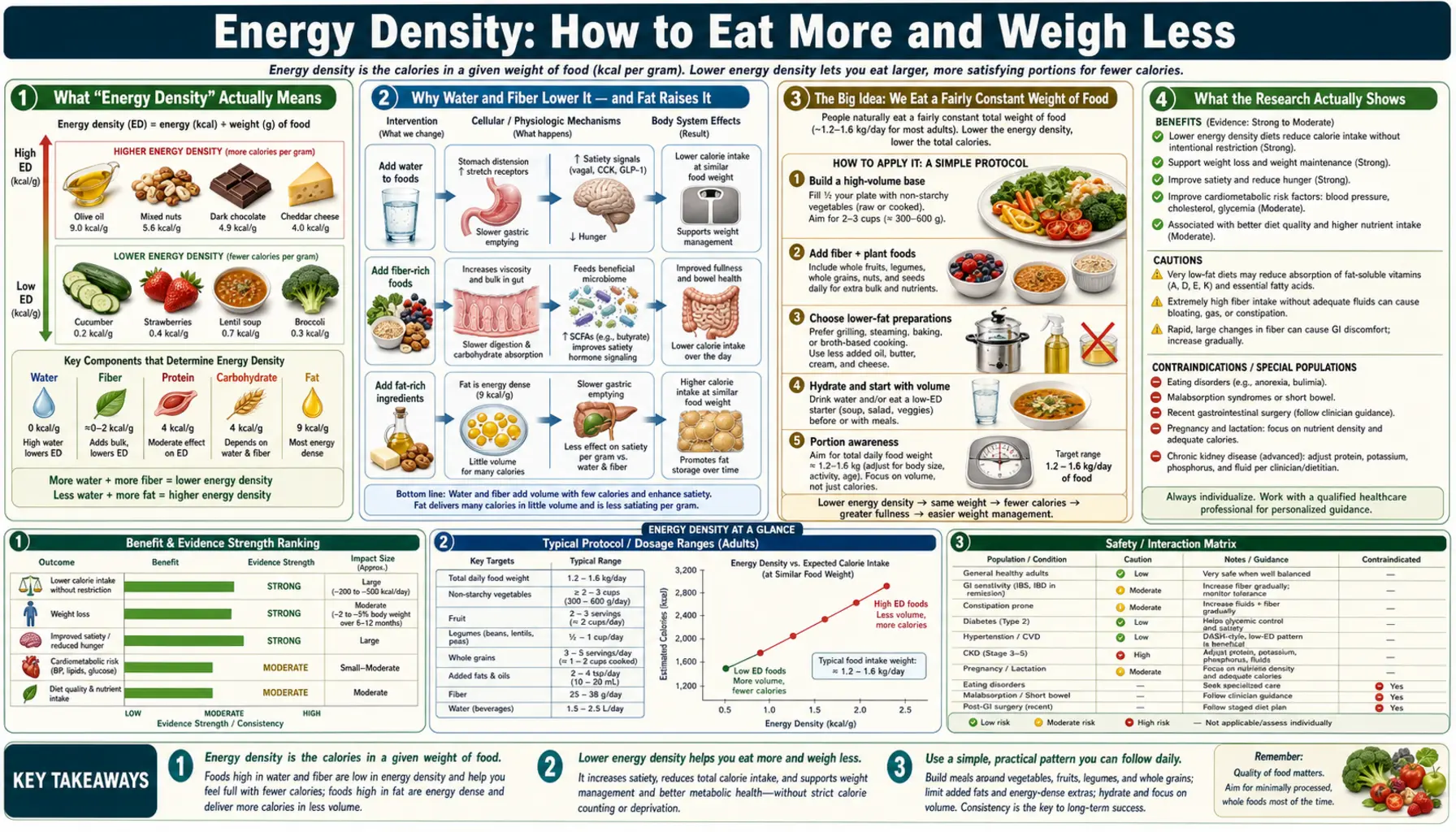
Energy density is one of the quietest and most useful ideas in all of weight management, and almost nobody talks about it by name. It simply means how many calories are packed into a given weight of food — calories per gram. Foods heavy with water and fiber, like soup, fruit, and vegetables, spread relatively few calories across a large, satisfying volume; foods heavy with fat and dry ingredients, like chips, cookies, crackers, and oils, pack many calories into a small bite. This matters because of a genuinely surprising finding: people tend to eat a fairly consistent weight of food each day, rather than a consistent number of calories. Lower the energy density of what fills your plate and you can eat the same satisfying amount — sometimes more food, not less — while quietly taking in fewer calories, and without the gnawing hunger that sinks most diets. This is not a fad or a marketing trick; it is one of the best-studied principles in the science of appetite, built largely on decades of careful feeding experiments by Barbara Rolls and her colleagues at Penn State. This page explains what energy density is, why water, fiber, and fat behave the way they do, what the evidence actually shows, and exactly how to use it — including an honest look at where it stops being magic and plain calories still matter.
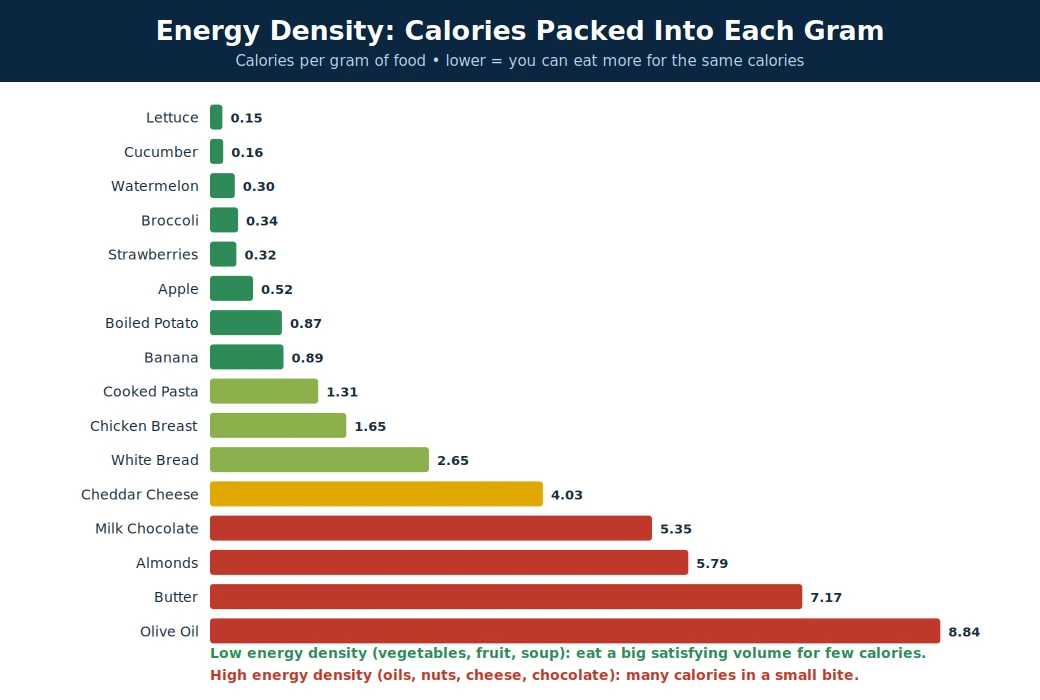
Table of Contents
- What "Energy Density" Actually Means
- Why Water and Fiber Lower It — and Fat Raises It
- The Big Idea: We Eat a Fairly Constant Weight of Food
- What the Research Actually Shows
- The Year-Long Trial: Adding Food Beat Cutting Fat
- A Simple Low- vs High-Energy-Density Food Guide
- Practical Strategies You Can Start Today
- The Sneaky Part: Add-Ons and "Healthy" Dry Foods
- The Honest Part: A Tool, Not Magic
- Putting It Together
- Research Papers
- Connections
- Featured Videos
What "Energy Density" Actually Means
Energy density is the number of calories in a given weight of food, usually written as calories per gram (kcal/g). That is all it is. A food that is high in energy density delivers a lot of calories in a small, light portion; a food that is low in energy density delivers few calories even in a large, heavy portion. The single most important thing to understand is that energy density is about weight, not volume of the plate or size of the serving on its own.
The idea comes alive with concrete examples. Picture a big bowl of brothy vegetable soup. It might weigh 400 grams and still carry only about 150 to 200 calories, because it is mostly water and vegetables. Now picture a small chocolate bar that weighs a fraction of that — maybe 40 grams — yet carries roughly the same 200 calories, because it is concentrated sugar and fat with almost no water. Same calories; wildly different amounts of actual food. One fills your stomach and takes real time to eat; the other is gone in a few bites and barely registers. That gap is energy density in a single picture.
Another everyday example: grapes and raisins. Raisins are simply grapes with the water removed. A cup of fresh grapes has around 100 calories and fills a lot of space; the same weight of raisins has roughly four times the calories, because taking the water out concentrated everything that was left. Nothing was added — the sugar and calories were always there — but stripping out the water turned a low-energy-density food into a high-energy-density one. Drying, frying, and adding fat all do the same thing: they push a food up the energy-density scale.
Why Water and Fiber Lower It — and Fat Raises It
Energy density is not mysterious once you know what each part of food contributes in calories per gram. There are only a handful of building blocks, and their numbers explain almost everything:
- Water — 0 calories per gram. Water adds weight and volume with no calories at all. This makes it, by far, the most powerful lever on energy density. A food that is 80–90% water simply cannot be calorie-dense.
- Fiber — about 2 calories per gram, and it adds bulk. Fiber contributes few calories, holds water, slows digestion, and physically fills the stomach. Foods rich in fiber tend to sit lower on the scale and feel more filling.
- Protein and carbohydrate — about 4 calories per gram each. These are the moderate middle.
- Fat — about 9 calories per gram. Fat is more than twice as calorie-dense as protein or carbohydrate, and infinitely more than water. Adding fat is the fastest way to push a food's energy density up.
Put those numbers together and the whole pattern falls out. Water-rich, fiber-rich foods — vegetables, fruit, broth-based soups, beans, cooked whole grains — land low on the energy-density scale because so much of their weight is water and fiber that carry few or no calories. Dry, fatty foods — oils, butter, chips, crackers, cookies, chocolate, nuts — land high because they have little water and a lot of fat. This is also why the same food can move up or down the scale depending on how it is prepared: a plain baked potato is low in energy density, but turn it into fries by soaking it in oil, or a loaded baked potato heaped with butter and cheese, and its energy density climbs steeply.
The water point has one important wrinkle, and researchers tested it directly: it is the water inside a food that lowers energy density, not a glass of water drunk alongside it. In a controlled study, water blended into a food (as soup) reduced how much people ate later, while the same amount of water simply served as a drink beside the meal did not. Water bound into the food itself changes the food's weight and how full it makes you; water in a separate glass drains away too quickly to count. This is one reason a bowl of vegetable soup is more filling than the same vegetables eaten dry with a glass of water on the side.
The same logic explains why whole fruit beats fruit juice. A whole orange comes packaged with water and fiber and takes real chewing and time; its juice strips away much of the fiber and concentrates the sugar into a form you can swallow in seconds. Two oranges are filling; a glass of orange juice made from several oranges is not, even though it may carry more calories. Choosing the whole food over its juiced or dried version is energy density working in your favor.
The Big Idea: We Eat a Fairly Constant Weight of Food
Here is the insight that makes energy density genuinely useful, and it is the heart of Barbara Rolls's research program, which she named Volumetrics. Across many careful studies, people tend to eat a fairly consistent weight or volume of food from day to day — more consistent than the number of calories they eat. In other words, your body and habits seem to aim for a certain amount of actual food on the plate, and fullness tracks the weight and volume of what you eat at least as much as it tracks calories.
Think about what that means. If you reliably eat about the same weight of food, then the calories in that food depend heavily on how energy-dense it is. Fill that weight with high-energy-density foods and you take in a lot of calories before you feel full. Fill the same weight with low-energy-density foods and you take in far fewer calories to reach the very same fullness. You are not eating less food — you may even be eating more by weight — but you are eating fewer calories, almost without noticing.
This flips the usual, miserable logic of dieting. Most diets ask you to eat a smaller amount of food and simply tolerate being hungry. Energy density lets you keep eating a satisfying, stomach-filling amount and cut calories by changing what fills the plate rather than how much. Instead of a small portion of something rich, you have a generous portion of something water-and-fiber rich. The stretch receptors in your stomach, the weight of the meal, and the time it takes to eat all still signal "full" — you have just spent fewer calories getting there. That is why lowering energy density is one of the few weight-management strategies that works with your appetite instead of against it.
What the Research Actually Shows
This is not a clever theory built on one study. It is one of the more consistently replicated findings in appetite research, tested in controlled feeding experiments where scientists secretly changed the energy density of meals and measured what people actually ate.
- Lower energy density, fewer calories, same fullness. When Rolls and colleagues varied the energy density of foods offered to women over two-day periods, the women ate a similar weight of food regardless — but took in substantially fewer calories when the food was less energy-dense, and reported feeling just as full and satisfied.
- It is the energy density, not the fat, that matters. A key experiment separated the two, because fatty foods are usually also energy-dense. When energy density was held constant, changing the fat content did not change how many calories people ate — energy density was the factor driving intake, not fat per se.
- Start a meal with a low-density "preload." A large, low-energy-density first-course salad reduced the total calories people ate at lunch; but a smaller, high-energy-density salad loaded with dressing and cheese actually increased total intake. Similarly, a bowl of soup eaten before a meal cut total lunch calories by roughly a fifth — a reliable, easy trick.
- Portion size and energy density stack. Reducing both the portion size and the energy density of foods produced larger, sustained drops in calorie intake than either change alone — and people did not report feeling hungrier or less satisfied.
- The old classic. As far back as 1983, researchers found that both obese and lean people ate roughly half as many calories on a low-energy-density diet as on a high-energy-density one when allowed to eat freely to fullness — and they spent more time eating and felt satisfied.
- It holds in the real world, too. Population studies find that adults who habitually eat lower-energy-density diets tend to take in fewer total calories, have lower body weight, and eat higher-quality diets overall. Systematic reviews of many studies reach the same broad conclusion: lower dietary energy density is associated with better weight outcomes.
Taken together, the feeding studies show a clear, mechanism-level effect, and the population and review data show it plays out across ordinary diets. Few nutrition ideas are this well supported.
The Year-Long Trial: Adding Food Beat Cutting Fat
The single most persuasive study is worth its own section, because it answers the obvious question: does this hold up for a whole year in real people trying to lose weight, not just for two days in a lab? In 2007, Ello-Martin and colleagues ran a year-long randomized trial in about 200 women with obesity. Everyone was counseled to lose weight, but the two groups were told to do it differently.
- Group 1 was told simply to reduce fat — the standard low-fat advice of the era.
- Group 2 was told to reduce fat and to add more water-rich foods, especially fruits and vegetables — that is, to lower the energy density of their diet by adding low-density food rather than only subtracting.
The result is the reason this study is so often cited. The group that added water-rich fruits and vegetables lost more weight over the year — on the order of about 8 kilograms (roughly 17 pounds) versus about 6 kilograms in the reduce-fat-only group. And here is the striking part: the group that added more food reported feeling less hungry, not more. They ate a greater weight of food, felt more satisfied, and lost more weight. That is the whole promise of energy density confirmed in a real, year-long trial: the winning move was not to eat less food but to shift toward foods that let you eat a satisfying amount for fewer calories. Adding the right food beat simply cutting fat.
A Simple Low- vs High-Energy-Density Food Guide
You do not need to memorize numbers to use this. A rough mental map of where common foods sit is enough. Energy density is usually grouped into four bands, from waterlogged and filling to dry and concentrated.
Very low energy density (eat freely, build meals around these)
- Most non-starchy vegetables — leafy greens, tomatoes, cucumber, peppers, broccoli, cauliflower, zucchini, carrots, mushrooms.
- Broth-based and vegetable soups.
- Most fruit — berries, melon, oranges, apples, peaches.
- Plain nonfat yogurt and skim milk; broths.
Low energy density (generous portions, the base of a plate)
- Cooked whole grains — oatmeal, brown rice, quinoa, whole-grain pasta.
- Beans, lentils, and other legumes.
- Starchy vegetables like plain potatoes and sweet potatoes.
- Lean proteins — skinless poultry, white fish, eggs, tofu.
Medium energy density (moderate portions, pay attention)
- Breads, bagels, and drier baked goods.
- Cheese and fattier cuts of meat.
- Dried fruit — remember the raisins.
- Higher-fat mixed dishes and many restaurant plates.
High energy density (small portions, enjoy mindfully)
- Oils and butter — the most energy-dense foods there are.
- Nuts, seeds, and nut butters.
- Chips, crackers, cookies, chocolate, and candy.
- Bacon, many processed snack foods, and most fast food.
Notice that "high energy density" is not the same as "unhealthy." Olive oil, nuts, and seeds are near the top of the scale and are genuinely good for you. The scale tells you about calorie concentration and portion sensitivity, not virtue. The next two sections deal with exactly that tension.
Practical Strategies You Can Start Today
The beauty of energy density is that you can use it with small, unglamorous habits, without counting a single calorie. A few reliable moves, most of them straight out of the research above:
- Start meals with a soup or a salad. A bowl of brothy vegetable soup or a large, lightly dressed salad before the main course takes the edge off your hunger with very few calories, so you eat less of the richer food that follows. The studies show this works — as long as the salad is not drowned in high-density dressing and cheese.
- Add volume rather than only subtracting. Instead of eating a smaller bowl of pasta, keep the bowl full but make half of it vegetables. Bulk up scrambled eggs with spinach and tomatoes, stir extra vegetables into stews and stir-fries, pile salad greens onto a sandwich. You end up with a bigger, more filling plate for fewer calories.
- Make water-rich foods the base of the plate. A useful habit is to fill about half your plate with non-starchy vegetables and fruit first, then add the grain and the protein around them. The low-density foods take up space and fullness that would otherwise go to denser calories.
- Choose the whole food over its concentrated version. Whole fruit instead of juice; whole grapes or an apple instead of dried fruit; a baked potato instead of chips. Each swap keeps the water and fiber that make food filling.
- Cook in ways that keep water in. Steaming, boiling, and stewing hold on to water and keep energy density low; deep-frying strips water out and drives fat and calories up. The cooking method can move the same ingredient from one band of the scale to another.
None of these ask you to go hungry. They ask you to trade some concentrated calories for a larger, more satisfying volume of food — which is exactly the trade your appetite is happy to make.
The Sneaky Part: Add-Ons and "Healthy" Dry Foods
If energy density has a blind spot, it is the small, calorie-dense extras that hide in plain sight — because they weigh so little that they do not seem to "count," yet they carry a lot of calories.
Fats and dressings are the biggest culprits. A tablespoon of oil is roughly 120 calories and weighs almost nothing; a couple of tablespoons of creamy dressing can carry more calories than the entire salad underneath it. Butter, mayonnaise, cheese, cream sauces, and oily marinades can quietly turn a low-energy-density meal into a high-energy-density one without changing how full it looks. This is not a reason to fear these foods — it is a reason to be aware that they are the fastest lever in the other direction. A drizzle is different from a pour.
Dry, calorie-dense foods deserve mindfulness even when they are healthy. Nuts, seeds, and nut butters are nutritious, heart-friendly foods — and they are also among the most energy-dense things you can eat, because they are mostly fat with very little water. A handful of nuts is a fine snack; an absent-minded few handfuls in front of the television is several hundred calories that never registered as much food. The same goes for granola, trail mix, dried fruit, and even wholesome crackers. The point is not to avoid these foods — it is to portion them on purpose rather than grazing from the bag, because their low weight makes it very easy to eat a lot of calories before you feel you have eaten much at all.
The honest rule of thumb: low-energy-density foods are the ones you can eat freely; high-energy-density foods, even the healthy ones, are the ones worth serving as a measured portion rather than eating by the handful.
The Honest Part: A Tool, Not Magic
Energy density is powerful, but it is a tool, not a miracle, and it is worth being clear about its limits so you do not overuse it or feel misled.
Calories still count. Energy density works precisely because it helps you eat fewer calories while staying full — it is a way of managing calorie intake through fullness, not a way of escaping the fact that calories matter. You can absolutely overeat calories on low-energy-density foods if you try, and you can lose weight on higher-density foods if the total calories are low enough. Energy density stacks the odds in your favor by making it easier to feel satisfied on fewer calories; it does not repeal arithmetic.
Some of the most calorie-dense foods are among the healthiest. Olive oil, nuts, seeds, and avocado sit high (or, for avocado, in the middle) on the energy-density scale, yet they are genuinely good for you — rich in beneficial fats, vitamins, and compounds tied to better heart and metabolic health. They belong in a healthy diet. The lesson of energy density is not to strip every calorie-dense food from your plate; it is to enjoy those foods in sensible portions while building the bulk of your meals from water-rich, filling foods. A diet chasing the very lowest possible energy density — all salad and broth, no olive oil, no nuts — would be joyless and could even shortchange you on nutrients and satisfaction.
It is one lever among several. Adequate protein protects muscle and is very filling; enough fiber, decent sleep, managing stress, movement, and an eating pattern you can actually sustain all matter too. Energy density fits alongside those — it is not a substitute for them. Used sensibly, it is one of the most comfortable and sustainable tools you have, because it lets you eat well and feel full while eating fewer calories. Used as a rigid rule, it becomes just another way to make eating stressful. The goal is a plate you enjoy that happens to be mostly filling, water-rich foods, with the rich stuff present in amounts that make sense.
Putting It Together
Energy density is the quiet lever behind a lot of good eating advice you have already heard — "fill half your plate with vegetables," "start with a salad," "eat whole fruit, not juice." Now you know why those tips work: they lower the calories per gram of what you eat, so you can eat a full, satisfying amount of food while taking in fewer calories, and without fighting your hunger the whole way.
If you want a simple place to start this week, try three things. First, add a soup or a salad to the front of one meal a day. Second, when you build a plate, put the vegetables and fruit down first and let them take up real space. Third, keep the calorie-dense extras — oils, dressings, nuts, cheese — on the plate, because many of them are good for you, but serve them as a measured portion rather than pouring or grazing. None of this requires counting calories, weighing food, or going hungry.
A closing word, meant kindly. Lasting weight management is genuinely hard, and it is shaped by biology, sleep, stress, medications, income, and a food environment engineered to be over-eaten — not by willpower alone, and never by any moral failing. Energy density will not fix all of that. But it is one of the rare tools that makes eating well feel easier rather than harder, because it lets you eat more food, not less. That is a good foundation to build on, and it is yours to use gently and at your own pace.
Research Papers
- Rolls BJ. The relationship between dietary energy density and energy intake. Physiology & Behavior. 2009;97(5):609-615. doi:10.1016/j.physbeh.2009.03.011 — a clear review of why low-energy-density foods let people feel full on fewer calories; the foundational overview of the concept.
- Duncan KH, Bacon JA, Weinsier RL. The effects of high and low energy density diets on satiety, energy intake, and eating time of obese and nonobese subjects. The American Journal of Clinical Nutrition. 1983;37(5):763-767. doi:10.1093/ajcn/37.5.763 — the early classic showing people ate about half the calories on a low-density diet while eating freely to fullness.
- Bell EA, Castellanos VH, Pelkman CL, Thorwart ML, Rolls BJ. Energy density of foods affects energy intake in normal-weight women. The American Journal of Clinical Nutrition. 1998;67(3):412-420. doi:10.1093/ajcn/67.3.412 — women ate a similar weight of food but fewer calories when energy density was lowered, and felt equally full.
- Rolls BJ, Bell EA, Castellanos VH, Chow M, Pelkman CL, Thorwart ML. Energy density but not fat content of foods affected energy intake in lean and obese women. The American Journal of Clinical Nutrition. 1999;69(5):863-871. doi:10.1093/ajcn/69.5.863 — separated the two variables and showed energy density, not fat content, drives how much people eat.
- Rolls BJ, Bell EA, Thorwart ML. Water incorporated into a food but not served with a food decreases energy intake in lean women. The American Journal of Clinical Nutrition. 1999;70(4):448-455. doi:10.1093/ajcn/70.4.448 — the elegant test showing it is water bound into a food, not a glass of water beside it, that lowers energy density and intake.
- Rolls BJ, Roe LS, Meengs JS. Salad and satiety: energy density and portion size of a first-course salad affect energy intake at lunch. Journal of the American Dietetic Association. 2004;104(10):1570-1576. doi:10.1016/j.jada.2004.07.001 — a large low-density salad first cut total lunch calories, while a rich high-density salad increased them.
- Flood JE, Rolls BJ. Soup preloads in a variety of forms reduce meal energy intake. Appetite. 2007;49(3):626-634. doi:10.1016/j.appet.2007.04.002 — a bowl of soup before a meal reduced total lunch calories by roughly a fifth.
- Rolls BJ, Roe LS, Meengs JS. Reductions in portion size and energy density of foods are additive and lead to sustained decreases in energy intake. The American Journal of Clinical Nutrition. 2006;83(1):11-17. doi:10.1093/ajcn/83.1.11 — cutting portion size and energy density together produced larger, lasting drops in intake without more hunger.
- Ledikwe JH, Blanck HM, Kettel Khan L, Serdula MK, Seymour JD, Tohill BC, Rolls BJ. Dietary energy density is associated with energy intake and weight status in US adults. The American Journal of Clinical Nutrition. 2006;83(6):1362-1368. doi:10.1093/ajcn/83.6.1362 — in a national sample, lower-energy-density diets tracked with fewer calories, lower body weight, and higher diet quality.
- Ello-Martin JA, Roe LS, Ledikwe JH, Beach AM, Rolls BJ. Dietary energy density in the treatment of obesity: a year-long trial comparing 2 weight-loss diets. The American Journal of Clinical Nutrition. 2007;85(6):1465-1477. doi:10.1093/ajcn/85.6.1465 — the flagship RCT: women told to add water-rich fruits and vegetables lost more weight and reported less hunger than those told only to cut fat.
- Ledikwe JH, Rolls BJ, Smiciklas-Wright H, Mitchell DC, Ard JD, Champagne C, et al. Reductions in dietary energy density are associated with weight loss in overweight and obese participants in the PREMIER trial. The American Journal of Clinical Nutrition. 2007;85(5):1212-1221. doi:10.1093/ajcn/85.5.1212 — in a large lifestyle trial, people who lowered their diet's energy density lost more weight.
- Pérez-Escamilla R, Obbagy JE, Altman JM, Essery EV, McGrane MM, Wong YP, et al. Dietary energy density and body weight in adults and children: a systematic review. Journal of the Academy of Nutrition and Dietetics. 2012;112(5):671-684. doi:10.1016/j.jand.2012.01.020 — a formal review concluding that lower dietary energy density is associated with better weight outcomes.
Connections
- All Remedies
- The Science of Satiety
- Protein and Weight Loss
- Fiber and Weight Loss
- Ultra-Processed Foods
- Added Sugar & Sugary Drinks
- Weight Loss
- The Potato Diet for Weight Loss
- Mediterranean Diet
- Fasting
- Endocrinology
- Food