Why Diets Fail: Metabolic Adaptation and Weight Regain
If you have lost weight on a diet and then watched it creep back — maybe more than once, maybe most of your adult life — this page is for you, and it begins with a promise: there is no shame here, and there is no lecture about willpower. The single most important thing to understand about weight regain is that it is not a character flaw, a lack of discipline, or proof that you "failed." It is, in very large part, biology pushing back. When you lose weight, your body does not sit quietly. It lowers the calories it burns, turns up your hunger, quiets your fullness signals, and works — quite literally, through hormones and metabolism — to pull you back toward where you started. Understanding why this happens changes everything, because it moves the story from "What is wrong with me?" to "What is my body actually doing, and how do I work with it instead of against it?" This page walks honestly through the science of metabolic adaptation and weight regain, separates the real evidence from the diet-industry hype, and then turns to the genuinely hopeful part: what actually helps people keep weight off, according to the research on those who have done it. Regaining weight is common. It is understandable. And it is not your fault.
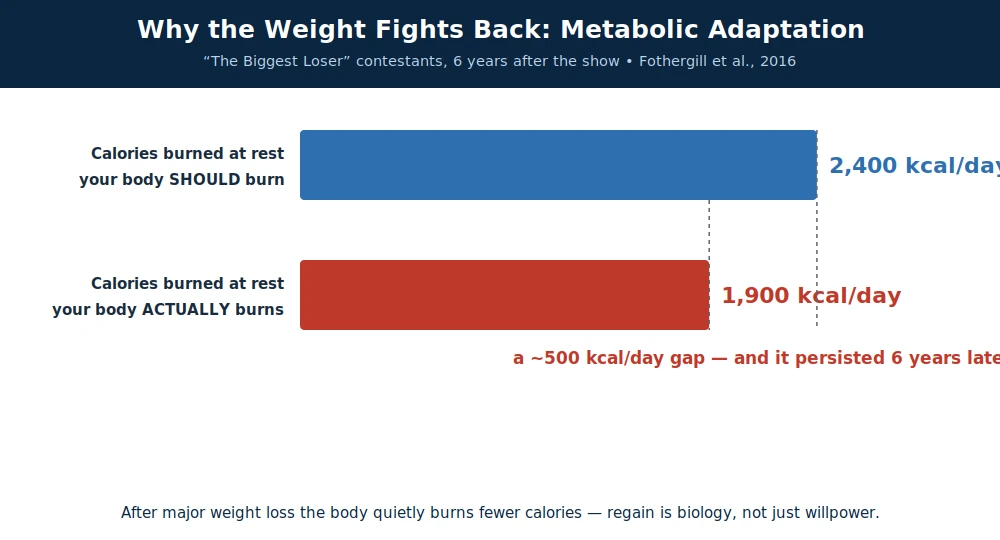
Table of Contents
- Most Diets End in Regain — and Why That Is Not Your Fault
- Metabolic Adaptation: Burning Less Than Expected
- The Hormonal Pushback: Hunger Up, Fullness Down
- The "Biggest Loser" Study: Slowed Metabolism Years Later
- Set Point and Settling Point: The Weight Your Body Defends
- Why Crash Diets Backfire the Hardest
- The Psychology of Restriction and All-or-Nothing Thinking
- What Actually Predicts Keeping Weight Off
- Slow and Steady: Habits, Protein, and Muscle
- Self-Compassion Is a Strategy, Not a Cop-Out
- The Honest Bottom Line
- Research Papers
- Connections
- Featured Videos
Most Diets End in Regain — and Why That Is Not Your Fault
Let us start with the statistic that the diet industry works hard to keep you from hearing clearly: most people who lose weight by dieting regain much or all of it over the following years. This is not a fringe claim or a pessimist's opinion — it is one of the most consistent findings in the whole field of obesity research. When scientists follow dieters for long enough, the average trajectory is a loss followed by a slow return, and a meaningful share of people end up back where they began or slightly above it. A careful systematic review of high-quality, long-term follow-up studies (Nordmo and colleagues, 2020) found that, on average, lost weight is largely regained over the years that follow, with true long-term maintenance being the exception rather than the rule.
Sit with what that means for a moment, because it reframes your whole history. If regain were mostly about willpower, we would expect it to be rare — a few undisciplined people scattered among the successes. Instead it is the norm. When a result happens to almost everyone who attempts something, the honest scientific conclusion is not "almost everyone is weak." It is "we are fighting something systematic." That something is your own physiology, which evolved over hundreds of thousands of years in a world where food was scarce and losing weight was a threat to survival. Your body cannot tell the difference between a chosen diet and a famine. It responds to weight loss the way it always has: by defending you.
So if you have blamed yourself — if you have thought I just don't have the discipline, other people can do this and I can't — please consider setting that story down. The rest of this page explains, mechanism by mechanism, exactly what your body does after weight loss. None of it is your fault. And understanding it is the first step toward strategies that actually last.
Metabolic Adaptation: Burning Less Than Expected
Here is the first and most important piece of biology. When you lose weight, your body starts burning fewer calories than it "should" for its new size. Scientists call this adaptive thermogenesis or metabolic adaptation, and it is one of the best-documented reasons diets stall and reverse.
To see why it matters, you have to separate two things. Part of the drop in calorie burning after weight loss is obvious and expected: a smaller body simply needs less fuel, the same way a smaller car uses less gas. But adaptive thermogenesis is an extra reduction on top of that expected drop. In other words, after you lose weight, your body burns fewer calories than a person who is naturally that same weight would burn. Your metabolism has become unusually thrifty — and it did this on purpose, to conserve energy and coax the weight back.
The classic experiments come from Rudolph Leibel, Michael Rosenbaum, and their colleagues. In a landmark 1995 study (Leibel and colleagues), volunteers who were kept at 10% below their usual body weight burned roughly 250 to 400 fewer calories a day than would be predicted from their new, smaller size. Their later reviews of adaptive thermogenesis in humans (Rosenbaum and Leibel, 2010) confirmed the pattern: after weight loss, both resting metabolism and the calories burned during everyday movement drop below what body size alone can explain, and muscle becomes more efficient, doing the same work on less fuel. Broad physiological reviews (MacLean and colleagues, 2011; Greenway, 2015) describe this as a coordinated "biological response to dieting" — a whole system of changes whose net effect is to favor weight regain.
Now picture what this feels like in real life. You lose 20 pounds. You are eating carefully, doing everything "right," and the scale simply stops moving — even though the calorie math says it should still be dropping. You have not cheated. You have not lost your resolve. Your body has quietly lowered the amount of energy it spends, so the deficit you worked to create has partly closed on its own. That maddening plateau is not evidence of failure. It is metabolic adaptation, doing exactly what it evolved to do.
The Hormonal Pushback: Hunger Up, Fullness Down
Burning less is only half of the pushback. The other half is that your body makes you hungrier and harder to satisfy — and it does this through hormones you cannot consciously control.
Two hormones lead the story. Leptin is made by your fat cells; it is roughly a "fullness and fuel-plenty" signal that tells your brain there is enough energy on board. When you lose fat, leptin falls — and it often falls further than the fat loss alone would predict. To your brain, low leptin reads as a warning of starvation, which cranks up appetite and slows metabolism. Ghrelin, made mostly in the stomach, is the main hunger hormone; it rises before meals and tells you to eat. After weight loss, ghrelin tends to increase. So you finish a diet with your fullness signal turned down and your hunger signal turned up — a genuinely difficult combination that has nothing to do with weak character.
The most sobering evidence comes from a study by Priya Sumithran and colleagues, published in the New England Journal of Medicine in 2011. Participants lost weight on a low-calorie program, and researchers then measured their appetite hormones. The striking finding was not just that hunger hormones shifted — it was how long the shift lasted. A full year after the weight loss, the participants' hormones were still altered in the direction that promotes eating: ghrelin was still elevated, several fullness-related hormones (including leptin) were still suppressed, and people still reported feeling hungrier than before they lost the weight. The title of the paper says it plainly: the hormonal adaptations to weight loss show "long-term persistence." A companion review by Sumithran and Proietto (2013) framed this as the body's active defence of its former weight.
This is one of the most validating findings in all of weight science, so let it land: if you lost weight and then felt hungry — really, persistently, months-later hungry — you were not imagining it, and you were not being greedy. Your body was chemically dialing up your appetite and keeping it there. Fighting that with sheer willpower, day after day, is like holding your breath: possible for a while, exhausting to sustain, and no reflection at all on your worth.
The "Biggest Loser" Study: Slowed Metabolism Years Later
Perhaps the most famous illustration of metabolic adaptation comes from following the contestants of the American television show The Biggest Loser, in which people lost enormous amounts of weight very quickly through extreme dieting and hours of daily exercise. Researchers led by Erin Fothergill studied fourteen of the contestants and published the results in the journal Obesity in 2016.
The findings were stark. Six years after the competition, most of the contestants had regained much of the weight they had lost — which by itself is consistent with everything above. But the deeper finding was about metabolism. Even after all that regain, their resting metabolic rate remained strikingly suppressed: on average their bodies were burning roughly hundreds of calories a day fewer than expected for their body size — in the range of about 500 calories per day below prediction. In other words, the metabolic adaptation triggered by their dramatic weight loss did not bounce back over six years. It persisted, quietly making it harder to keep the weight off, even as the weight itself returned.
It is worth being fair about what this one study does and does not prove. Fourteen people who underwent an unusually extreme program is a small and unusual group, and not every study of milder weight loss finds adaptation this large or this lasting. Some of the debate in this field is exactly about how much adaptation persists and for whom. But the direction is not in doubt, and the Biggest Loser data are a vivid warning about the specific danger of rapid, extreme weight loss: the harder and faster you force the body down, the harder it may fight to come back. That lesson points directly toward gentler, slower approaches — which we will get to.
Set Point and Settling Point: The Weight Your Body Defends
All of these separate mechanisms — the thriftier metabolism, the higher hunger, the lower fullness — add up to a single idea that helps many people finally make sense of their bodies: the set point, sometimes described more flexibly as a settling point.
The idea is that your body behaves as though it has a preferred weight range that it actively defends, much like a thermostat defends a room's temperature. Push the weight below that range by dieting, and the body responds with the countermeasures we have described — slowing energy use, raising appetite — to push you back up. (The system defends the lower boundary far more vigorously than the upper one, which is part of why gaining is often easier than losing; the thermostat is more worried about famine than about surplus.) The "settling point" version of the idea adds an important, hopeful nuance: this defended range is not a single fixed number carved in stone. It is shaped over time by your environment, your habits, your activity, your sleep, and your food surroundings. That means the range can drift — slowly — which is precisely why gradual, sustained change tends to outlast a sudden shock.
You do not need to treat "set point" as a rigid law of physics to take the practical lesson from it. The lesson is this: your body is not a passive bag of calories that simply subtracts what you skip. It is an active, regulated system with strong opinions about its own weight. When you understand that, two things follow. First, a stall or a regain is the system doing its job, not you failing at yours. Second, the winning strategy is not to overpower the system in a short, violent burst, but to nudge it patiently over months and years so its defended range can slowly move with you.
Why Crash Diets Backfire the Hardest
If the body defends its weight, then how you try to lose matters enormously — and the evidence is unkind to the most dramatic methods. Crash diets and extreme restriction tend to trigger the strongest pushback, and they carry a specific, often-overlooked cost: muscle loss.
Consider what a very-low-calorie crash diet signals to the body. A sudden, severe drop in food is exactly the pattern of a famine, and the body's ancient response to famine is to protect itself as aggressively as possible — ramping up hunger hormones, deepening the metabolic slowdown, and defending its fat stores. The more extreme the deficit, the louder these alarms. This is why so many people who lose weight fast on a crash plan find the regain equally fast once normal eating resumes.
Then there is the muscle problem. When you lose weight rapidly, especially without enough protein and without strength-type activity, a larger fraction of what you lose is lean muscle rather than fat. This matters for two reasons. First, muscle is metabolically active tissue — it burns calories around the clock — so losing it lowers your metabolism even further, deepening the very adaptation you are fighting. Second, muscle is what lets you move, lift, and stay strong and independent as you age; losing it is a genuine health cost, not just a cosmetic one. So the crash diet delivers a double blow: it provokes the fiercest biological defense and it burns away the tissue that would have helped you keep the weight off. It is, in a real sense, the least efficient way to reach a lasting result — even though it produces the fastest number on the scale, which is exactly why it keeps selling.
The Psychology of Restriction and All-or-Nothing Thinking
Weight regain is not only physical. There is a psychological pattern that runs alongside the biology and often makes it worse, and naming it clearly can be a relief, because most people who have dieted will recognize themselves instantly.
Strict diets work by restriction — a long list of forbidden foods and rigid rules. In the short term, rules can feel clarifying. But over weeks, restriction breeds deprivation, and deprivation has a way of building pressure. The forbidden food becomes more tempting precisely because it is forbidden; a single lapse then feels like a catastrophe rather than a normal human moment. This is the heart of all-or-nothing thinking: the belief that you are either perfectly "on plan" or completely "off it," with nothing in between. Under that mindset, one cookie does not stay one cookie. It becomes proof that "I've blown it," which becomes "so I might as well eat everything," which becomes abandoning the whole effort — the classic what-the-heck effect that behavioral researchers describe.
Notice how cleanly this dovetails with the biology. Your body, hungry from lowered leptin and raised ghrelin, is already pushing hard toward food. Now add a mindset that treats any imperfection as total failure, and you have a system almost designed to end in a binge and a spiral of self-blame. The fix is not more rules or more shame — those pour fuel on the fire. The fix is a fundamentally gentler and more flexible relationship with eating: no forbidden foods, room for imperfection, and the understanding that a single meal, or a single day, never defines the whole. A plan you can follow at 85% forever will beat a plan you follow at 100% for three weeks and then abandon. Consistency, not perfection, is what the body actually responds to.
What Actually Predicts Keeping Weight Off
Here is where the story turns genuinely hopeful. Because — and this is crucial — some people do keep weight off for the long term. Regain is the average, not the destiny. And because researchers have studied the people who succeed, we are not guessing about what helps. We can describe it.
The richest source is the National Weight Control Registry, a long-running research project that has tracked thousands of people who lost a significant amount of weight (at least about 30 pounds) and kept it off for years. Summaries of what these successful maintainers have in common (Wing and Phelan, 2005; and a 10-year follow-up by Thomas and colleagues, 2014) are remarkably consistent, and — notably — remarkably ordinary:
- They stay physically active. High levels of regular activity are one of the strongest common threads — often on the order of about an hour of moderate movement (much of it simply walking) most days. Activity helps hold the metabolic line and protects muscle.
- They eat in a consistent, regular pattern. Successful maintainers tend to eat similarly across weekdays and weekends and across the year, rather than swinging between strict "on" phases and blowout "off" phases. Most also eat breakfast regularly. Consistency, again, beats intensity.
- They monitor themselves. Many weigh themselves regularly — often weekly — not to punish themselves, but as an early-warning system, so a small regain gets caught and corrected before it becomes a large one. Keeping a light eye on food intake serves the same purpose.
- They keep going after slips. Maintainers are not people who never have a bad day; they are people who recover from a bad day without abandoning the whole effort — the practical opposite of all-or-nothing thinking.
What is striking about this list is how unglamorous it is. There is no secret food, no magic window, no cleanse. It is movement, regularity, gentle self-monitoring, and resilience — ordinary habits repeated over a long time. That is genuinely good news, because it means success does not require heroic willpower or a perfect metabolism. It requires a sustainable set of routines, built slowly, that quietly work with your biology instead of against it.
Slow and Steady: Habits, Protein, and Muscle
Everything above points in the same practical direction, and it is nearly the opposite of what the crash-diet industry sells. If the body defends its weight and fights rapid loss hardest, then the durable approach is slow, steady, and habit-based.
A few evidence-aligned principles:
- Aim for a gentle pace. Roughly 0.5 to 1 kilogram (about 1 to 2 pounds) per week is a sensible target for most people. Slower loss provokes less of the famine alarm, is easier to sustain, and is more protective of muscle. The tortoise genuinely beats the hare here.
- Get enough protein. Adequate protein is one of the most useful levers in weight management. It is highly satiating — it helps quiet the hunger that biology is already amplifying — and it helps preserve lean muscle during weight loss, blunting the extra metabolic slowdown that muscle loss would cause. A thorough review of the evidence (Leidy and colleagues, 2015) supports protein's role in both losing weight and, importantly, keeping it off.
- Protect your muscle with resistance training. Strength-type activity — lifting, resistance bands, body-weight work — signals the body to hold onto muscle even in a calorie deficit. Combined with enough protein, it directly counters the muscle-loss trap of crash dieting and helps keep your metabolism from sinking further.
- Change habits, not just menus. A "diet" is something you go on and, inevitably, come off. A habit — a daily walk, a protein-forward breakfast, a consistent bedtime — is something you simply live. Because the settling point responds to sustained patterns rather than short shocks, durable results come from small changes you can repeat for years, not big changes you can survive for weeks.
Note how neatly this counters the biology, point for point. Slow loss softens the famine alarm. Protein answers the raised hunger. Resistance training and muscle preservation defend the metabolism. And habit-based change gives the settling point the steady, long-term signal it needs to drift with you. None of it is dramatic. All of it is durable.
Self-Compassion Is a Strategy, Not a Cop-Out
It might sound soft — even like an excuse — to talk about self-compassion in an article full of hormones and metabolic rates. It is neither. Self-compassion is a practical tool, and here is the mechanism, in plain terms.
Recall the all-or-nothing spiral: a slip triggers shame, shame triggers "I've ruined everything," and that thought triggers giving up. Self-compassion breaks that chain at the weakest link. When you can meet a slip with the same kindness you would offer a good friend — that was a hard day, it is one meal, tomorrow is normal again — you interrupt the shame before it becomes surrender. You get back on track in one meal instead of one month. Over a year, the difference between recovering in a meal and recovering in a month is enormous. That is not indulgence; that is exactly the "keep going after slips" resilience that separates the people who maintain from the people who regain.
Shame, by contrast, is a terrible coach. Decades of self-blame have not made anyone thinner; they have mostly made people miserable and more likely to eat for comfort. If harsh self-criticism worked, it would have worked by now. So consider replacing the inner critic with an inner ally — not because you have lowered your standards, but because kindness is simply the more effective approach. Given everything your biology is doing after weight loss, you are not fighting a fair fight. The least you deserve, and the smartest thing you can do, is to stop fighting yourself on top of it.
The Honest Bottom Line
Let us gather the whole story into something you can carry with you. Diets so often "fail" not because you are weak but because a single, temporary, restrictive diet is fundamentally the wrong tool for a body that actively defends its weight. When you lose weight, your metabolism slows beyond what your size predicts, your hunger hormones rise and your fullness hormones fall — and these changes can persist for a year or more. The faster and more extreme the diet, the fiercer the pushback and the more muscle you tend to lose. This is biology, not weakness, and it happens to nearly everyone. You were never the problem.
The way through is not a better diet to "go on." It is a sustainable way of living that you never have to recover from — built from slow, gentle change, enough protein, movement you can keep doing, muscle-protecting strength work, consistent and flexible eating, honest self-monitoring, and real self-compassion. This is unglamorous, it is not fast, and it is exactly what the people who succeed actually do.
And one more truth that deserves to be said clearly, because too many people suffer without it: needing help is not failure. Because weight regulation is biological, sometimes biology needs a biological answer. Working with a doctor or a registered dietitian is a wise, ordinary step, not a defeat. And modern medical treatments — including the newer GLP-1 receptor agonist medications, which work in part by acting on the very hunger and fullness signals described on this page — are legitimate options that can help some people work with a body that defends its weight so stubbornly. Obesity is increasingly understood by clinicians as a chronic medical condition, not a moral report card. Seeking treatment for it is as reasonable as seeking treatment for high blood pressure. You do not have to white-knuckle this alone, you do not owe anyone a particular body, and you were never failing a test that was never fair to begin with. You deserve accurate information, a plan you can live with, and support — and none of that requires you to first prove you are worthy of it. You already are.
Research Papers
- Sumithran P, Prendergast LA, Delbridge E, et al. Long-term persistence of hormonal adaptations to weight loss. New England Journal of Medicine. 2011;365(17):1597-1604. doi:10.1056/NEJMoa1105816 — a full year after weight loss, hunger hormones (including elevated ghrelin) and suppressed fullness hormones were still altered, and people still felt hungrier: the body's appetite pushback is long-lasting, not a matter of willpower.
- Fothergill E, Guo J, Howard L, et al. Persistent metabolic adaptation 6 years after "The Biggest Loser" competition. Obesity. 2016;24(8):1612-1619. doi:10.1002/oby.21538 — six years after extreme rapid weight loss, contestants' resting metabolism remained suppressed by hundreds of calories a day even as weight was regained.
- Rosenbaum M, Leibel RL. Adaptive thermogenesis in humans. International Journal of Obesity. 2010;34(S1):S47-S55. doi:10.1038/ijo.2010.184 — key review showing that after weight loss the body burns fewer calories than its new size predicts, and that muscle becomes more fuel-efficient.
- Leibel RL, Rosenbaum M, Hirsch J. Changes in energy expenditure resulting from altered body weight. New England Journal of Medicine. 1995;332(10):621-628. doi:10.1056/NEJM199503093321001 — the classic experiment quantifying that maintaining a ~10% lower weight lowers daily energy expenditure well below prediction.
- Sumithran P, Proietto J. The defence of body weight: a physiological basis for weight regain after weight loss. Clinical Science. 2013;124(4):231-241. doi:10.1042/CS20120223 — reviews how coordinated metabolic and hormonal changes actively "defend" the body's former weight and drive regain.
- MacLean PS, Bergouignan A, Cornier MA, Jackman MR. Biology's response to dieting: the impetus for weight regain. American Journal of Physiology — Regulatory, Integrative and Comparative Physiology. 2011;301(3):R581-R600. doi:10.1152/ajpregu.00755.2010 — a detailed account of the many biological systems that together push a dieter back toward the starting weight.
- Greenway FL. Physiological adaptations to weight loss and factors favouring weight regain. International Journal of Obesity. 2015;39(8):1188-1196. doi:10.1038/ijo.2015.59 — summarizes the metabolic and appetite adaptations that make lost weight so prone to return.
- Hall KD, Guo J. Obesity energetics: body weight regulation and the effects of diet composition. Gastroenterology. 2017;152(7):1718-1727. doi:10.1053/j.gastro.2017.01.052 — models how the body regulates weight and why overall calories and adherence, not diet gimmicks, drive long-term results.
- Wing RR, Phelan S. Long-term weight loss maintenance. The American Journal of Clinical Nutrition. 2005;82(1 Suppl):222S-225S. doi:10.1093/ajcn/82.1.222S — National Weight Control Registry findings: successful maintainers stay very active, eat consistently, monitor themselves, and recover from slips.
- Thomas JG, Bond DS, Phelan S, Hill JO, Wing RR. Weight-loss maintenance for 10 years in the National Weight Control Registry. American Journal of Preventive Medicine. 2014;46(1):17-23. doi:10.1016/j.amepre.2013.08.019 — a decade of follow-up showing that continued activity and self-monitoring predict lasting maintenance.
- Leidy HJ, Clifton PM, Astrup A, et al. The role of protein in weight loss and maintenance. The American Journal of Clinical Nutrition. 2015;101(6):1320S-1329S. doi:10.3945/ajcn.114.084038 — evidence that higher protein supports fullness and lean-muscle preservation during and after weight loss.
- Nordmo M, Danielsen YS, Nordmo M. The challenge of keeping it off: a descriptive systematic review of high-quality, follow-up studies of obesity treatments. Obesity Reviews. 2020;21(1):e12949. doi:10.1111/obr.12949 — a careful review confirming that, on average, lost weight is largely regained over long-term follow-up, making true maintenance the exception.
Connections
- All Remedies
- Realistic Expectations
- Sleep, Stress, and Weight
- Mindful & Intuitive Eating
- Emotional Eating
- Weight Loss
- Potato Diet
- GLP-1 Receptor Agonists
- Exercise
- Fasting
- Endocrinology