Protein and Weight Loss
If there is one honest, un-hyped lever in the whole tangled subject of weight loss, it is protein. Not a magic protein powder, not a branded shake, not a metabolism "hack" — just eating enough of the ordinary protein that already sits on most plates. Of the three macronutrients (protein, carbohydrate, and fat), protein is the one that does the most useful work while you are trying to lose fat, and it does that work through three plain, well-studied mechanisms rather than any mystery. It is the most filling of the three, so it quiets hunger and you naturally eat less. It costs your body the most energy to digest, a small but real metabolic edge. And it is the nutrient that protects your muscle while you are eating less, so that more of what you lose is fat and less is the lean tissue you actually want to keep. This page walks through each of those three levers in plain language, tells you roughly how much protein the evidence supports while dieting, explains the interesting "protein leverage" idea about why low-protein processed food is so easy to overeat, points you to good everyday protein sources, and stays honest about the limits — because protein is a genuinely useful tool, not a miracle, and total calories still run the show.
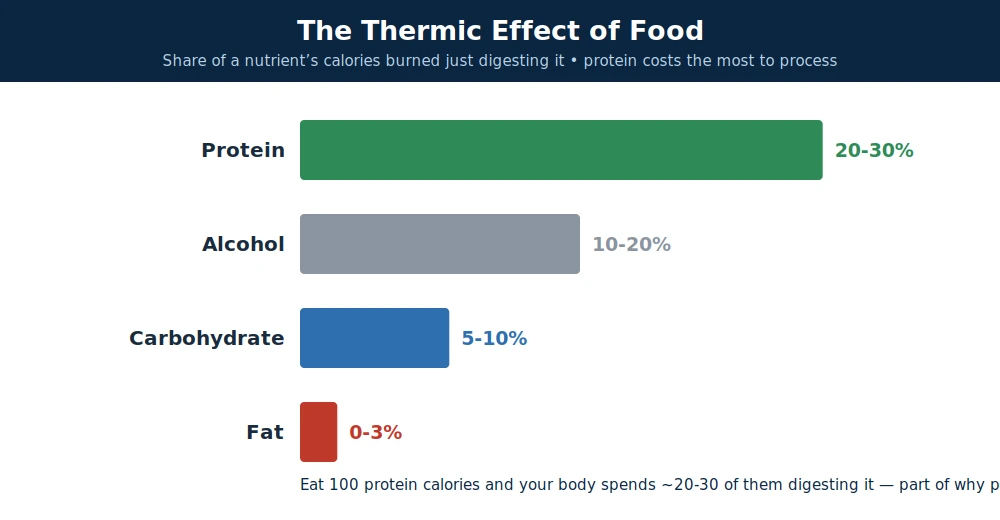
Table of Contents
- Why Protein Matters Most When You Are Losing Weight
- Lever 1: Protein Is the Most Filling Macronutrient
- Lever 2: The Thermic Effect of Food
- Lever 3: Protecting Muscle in a Calorie Deficit
- How Much Protein Do You Actually Need?
- The "Protein Leverage" Idea
- Good Protein Sources
- Spreading Protein Across the Day
- Honest Limits: Protein Is Not Magic
- Safety: Kidneys and Who Needs Guidance
- The Real Takeaway
- Research Papers
- Connections
- Featured Videos
Why Protein Matters Most When You Are Losing Weight
Every food is built from some mix of three macronutrients: protein (meat, fish, eggs, dairy, beans, lentils), carbohydrate (bread, rice, potatoes, fruit, sugar), and fat (oils, butter, nuts, the fat in meat). When you eat in a calorie deficit — taking in less energy than you burn — your body is forced to make up the difference from its own stores, and that is what produces weight loss. So far, so simple. The question this page answers is a more useful one: given that you are going to eat less, which macronutrient should you protect and prioritize? The answer, backed by a large and fairly consistent body of research, is protein.
The reason is that protein pulls three levers at once, and no other macronutrient pulls all three. First, it is the most satiating nutrient, meaning it makes you feel full and stay full on fewer calories, so a higher-protein diet tends to quietly reduce how much you eat without white-knuckle willpower. Second, it carries the highest thermic effect of food: your body spends more energy digesting and processing protein than it does for carbohydrate or fat, a modest but genuine metabolic bonus. Third, and arguably most important, adequate protein preserves lean muscle during weight loss, so a larger share of what you shed is actual fat rather than the muscle that keeps you strong and keeps your resting metabolism up. A broad review by Leidy and colleagues in The American Journal of Clinical Nutrition lays out exactly these three roles, and the sections below take them one at a time.
Lever 1: Protein Is the Most Filling Macronutrient
Hunger is the reason most diets fail. You can know exactly what to do and still be undone by the simple, relentless pull of appetite. This is where protein earns its keep, because calorie for calorie it is the most satiating of the three macronutrients — it produces more fullness and keeps it going longer than the same number of calories from carbohydrate or fat.
This is not just a feeling; it has been measured directly. In a well-known controlled study, Weigle and colleagues raised participants' protein intake and let them eat as much or as little of everything else as they wanted. Without being told to cut back, people spontaneously ate roughly 400 fewer calories a day and lost weight over the following weeks — simply because the extra protein left them less hungry. That is the whole mechanism in one clean result: more protein in, less hunger, fewer calories eaten, weight down. No portion-counting required for the effect to show up.
Why is protein so filling? Several ordinary factors stack together:
- Appetite hormones. Protein is unusually good at nudging the gut hormones that signal fullness (such as GLP-1, PYY, and cholecystokinin) up, and the main hunger hormone (ghrelin) down. Your body registers a protein-rich meal as substantial.
- Slower digestion. Protein takes longer to break down and leave the stomach than fast carbohydrate does, which stretches out the feeling of satisfaction between meals.
- The metabolic cost itself. Some researchers think the sheer energy your body spends processing protein (the next section) is part of what the brain reads as "I have been fed."
The practical upshot is worth stating plainly: if you build meals around a solid serving of protein, you tend to feel full sooner, stay full longer, and reach for less afterward — and you get all of that without any special product or trick. It is the single most reliable appetite tool most people are not using.
Lever 2: The Thermic Effect of Food
Here is a genuinely surprising fact that gets exaggerated online but is real when stated carefully: your body has to spend energy in order to digest, absorb, and process the food you eat. That energy cost is called the thermic effect of food (TEF), or diet-induced thermogenesis. It means that not every calorie you swallow is a calorie your body keeps — a slice is burned off simply handling the meal. And the size of that slice depends heavily on the macronutrient.
The rough figures, drawn from thermogenesis reviews by Westerterp and by Halton and Hu, are:
- Protein: about 20–30% of its calories are burned in processing. Eat 100 calories of protein and your body spends roughly 20 to 30 of them just dealing with it.
- Carbohydrate: about 5–10%.
- Fat: about 0–3% — dietary fat is very cheap for the body to store, which is part of why it is so easy to over-consume.
Protein's high cost comes from the extra biochemical work of breaking it into amino acids and rearranging them; it is metabolically "expensive" in a way carbohydrate and fat are not. Practically, this means a higher-protein diet quietly hands you a slightly higher daily calorie burn for the same amount eaten — the effective, usable calories from a high-protein meal are modestly lower than the label total.
An honest caveat matters here, because this is exactly the point marketers inflate. The thermic effect is modest, not dramatic — over a day it might amount to the equivalent of some tens of extra calories, not hundreds, and it will never out-run overeating. It is a small tailwind, not an engine. But it is real, it is free, and it points in the right direction, which is more than can be said for most "metabolism boosters." Taken together with protein's much larger effect on appetite, it is a reasonable second reason to favor protein while dieting.
Lever 3: Protecting Muscle in a Calorie Deficit
This is the lever people overlook, and it may be the most important of the three. When you lose weight, you never lose pure fat — some of the loss always comes from lean tissue, including muscle. How much comes from muscle is not fixed, though, and this is where you have real control. The goal of any sensible weight-loss effort is not just to make the scale go down; it is to make sure that as much of the loss as possible is fat and as little as possible is muscle. Two things shift that balance strongly in your favor: eating enough protein, and doing some form of resistance exercise (lifting, bands, bodyweight work).
The evidence is clear and consistent. In a randomized controlled trial, Pasiakos and colleagues put volunteers into a calorie deficit and found that higher protein intakes better maintained fat-free mass (the muscle-containing part of the body) and kept muscle-building machinery more active during weight loss. A meta-analysis by Wycherley and colleagues, pooling many trials, reached the same conclusion: compared with standard-protein diets, energy-restricted higher-protein diets preserved more lean mass while trimming more fat. And when protein is paired with resistance training, the muscle-sparing effect is stronger still — a large meta-analysis by Morton and colleagues confirms that adequate protein amplifies the muscle you keep and build when you train.
Why does keeping muscle matter so much for someone trying to lose weight? Three reasons, all practical:
- It protects your metabolism. Muscle is metabolically active tissue that burns calories around the clock. Lose a lot of muscle and your resting calorie burn drops, which makes further loss harder and regain easier. Keep your muscle and you keep more of your engine.
- It changes what "losing weight" actually looks like. Two people can lose the same number of pounds; the one who kept muscle looks and feels leaner, firmer, and stronger. Fat loss with muscle retention is the outcome people actually mean when they say they want to lose weight.
- It keeps you functional and independent. Strength, balance, and everyday capability all depend on muscle — a point that grows more important with age (see the section below on older adults).
The takeaway is simple and freeing: adequate protein plus a bit of resistance exercise is the combination that turns "weight loss" into "fat loss." That is the difference that lasts.
How Much Protein Do You Actually Need?
The official minimum — the Recommended Dietary Allowance of about 0.8 grams of protein per kilogram of body weight per day — is set to prevent deficiency in a sedentary person who is not dieting. It is a floor, not a target, and while you are losing weight the evidence supports eating meaningfully more than that floor. Higher intakes are what drive the satiety, muscle-sparing, and thermic benefits described above.
Reviews of weight-loss research (Leidy and colleagues; Wycherley and colleagues) converge on a practical range of roughly 1.2 to 1.6 grams of protein per kilogram of body weight per day while dieting, with the higher end favored for people who are very active or older. To make that concrete rather than abstract, here is what the range works out to at a few body weights:
- A person weighing about 60 kg (132 lb): roughly 72–96 g of protein a day.
- A person weighing about 70 kg (154 lb): roughly 84–112 g a day.
- A person weighing about 80 kg (176 lb): roughly 96–128 g a day.
- A person weighing about 90 kg (198 lb): roughly 108–144 g a day.
If you are carrying a lot of excess weight, it is common to base the target on a more moderate reference weight rather than current scale weight, so the number does not become unrealistically high; a doctor or registered dietitian can help set a sensible figure. To picture the grams: a palm-sized (100 g) piece of cooked chicken breast is around 30 g of protein, a large egg about 6 g, a cup of Greek yogurt about 17 g, a cup of cooked lentils about 18 g, and a can of tuna about 25 g. Hitting the range is usually a matter of anchoring each meal with a real protein source rather than a matter of powders or heroics.
Two older groups deserve a special note. As we age, muscle is lost more readily and built less easily (a process called sarcopenia), and the aging body responds less efficiently to a given dose of protein. For this reason, expert panels such as the PROT-AGE group (Bauer and colleagues) recommend that healthy older adults aim higher — often around 1.0 to 1.2 g/kg even without dieting, and more when losing weight — specifically to defend muscle. Paddon-Jones and Rasmussen make the same case: adequate protein is one of the best-supported tools for slowing age-related muscle loss. If you are over about 60 and trying to lose weight, protecting muscle with protein and resistance exercise is not optional polish; it is the core of doing it safely.
The "Protein Leverage" Idea
One of the more thought-provoking explanations for why modern diets drive overeating is the protein leverage hypothesis, proposed by the biologists Stephen Simpson and David Raubenheimer. The idea is elegant and worth understanding, because it reframes overeating as something other than simple weakness.
The hypothesis goes like this: humans (like many animals) have a strong, prioritized appetite specifically for protein, and we will keep eating until we have taken in the amount of protein our bodies are seeking. If the food available is rich in protein, we hit that target quickly and stop — total calories stay in check. But if the food is diluted with protein — that is, low in protein and heavy in refined carbohydrate and fat, which describes a great deal of cheap, ultra-processed food — we have to eat more total calories to reach the same protein target. In this view, protein "leverages" overall intake: dilute the protein in the food supply, and people are quietly pushed to over-consume energy while still chasing enough protein. It offers a coherent explanation for why highly processed, protein-poor diets and rising obesity have tracked together.
It is important to be measured here. The protein leverage hypothesis is a well-argued and much-discussed theory that fits a lot of evidence, but it is not the single, settled explanation for obesity, and it does not mean carbohydrate or fat are villains. What it usefully suggests for someone trying to lose weight is intuitive and low-risk: make sure your diet actually contains enough protein. When your protein need is met, the drive to keep eating — and the appeal of protein-poor snack food — tends to ease on its own. It is the same practical conclusion the satiety research reaches, arrived at from a completely different direction, which is part of why it is compelling.
Good Protein Sources
You do not need supplements to eat enough protein; whole foods do the job well, and there are good options whatever your eating pattern. What follows is an honest, practical list rather than a sales pitch for any one food or product.
Animal sources
Animal proteins are "complete," meaning they supply all the essential amino acids in useful proportions, and they tend to be protein-dense, which makes hitting your target easy:
- Poultry, fish, and lean meats — chicken and turkey, fish and seafood, and lean cuts of beef and pork are among the most protein-dense foods available. Fatty fish such as salmon and sardines add beneficial omega-3 fats as a bonus.
- Eggs — inexpensive, versatile, and a benchmark-quality protein; the whole egg (yolk included) also carries useful nutrients.
- Dairy — Greek yogurt, cottage cheese, and milk are convenient and filling. Plain, unsweetened versions keep the protein without added sugar.
Plant sources
Plant proteins can meet your needs comfortably; a few are complete on their own, and the rest combine easily over the course of a day:
- Legumes — lentils, chickpeas, black beans, and other beans deliver protein together with fiber, which stacks two satiety mechanisms in one food.
- Nuts and seeds — almonds, peanuts, pumpkin seeds, and hemp seeds add protein along with healthy fats (mind the portions, as they are calorie-dense).
- Whole grains and pseudo-grains — quinoa is a complete protein; oats and whole grains contribute a meaningful amount across the day.
A fair note for people eating mostly or entirely plants: individual plant foods are often lower in the amino acid lysine or slightly less protein-dense than meat, so it helps to include a variety of sources (for example, beans plus grains) and to lean a little toward the higher end of the intake range. This is a matter of ordinary attention, not a problem — well-planned plant-based diets meet protein needs comfortably. Because meal patterns and preferences vary widely, this page deliberately does not push any single "best" protein or product; the best protein source is a wholesome one you will actually eat regularly.
Spreading Protein Across the Day
Beyond the daily total, there is a reasonable — not obsessive — case for spreading protein across your meals rather than saving it all for dinner. The body builds muscle in response to protein at a meal, and there is some evidence that a moderate serving at each of two or three meals supports muscle maintenance and steady fullness better than one large evening load with a protein-thin breakfast and lunch.
In a weight-loss study by Leidy and colleagues, overweight men who ate higher-protein meals spread through the day reported better appetite control and greater fullness than those eating less protein or concentrating it in fewer meals. The practical version of this is easy and worth doing: aim for a real protein source at each main meal — eggs or Greek yogurt at breakfast, a protein-anchored lunch, protein at dinner — roughly 20 to 40 grams per meal for most adults.
But keep this in proportion. The evidence that total daily protein matters is far stronger than the evidence about perfect timing, and chasing an exact number of grams in a precise window every few hours is the kind of fussiness that makes eating stressful without adding much. Hitting a sensible daily total, loosely spread across your meals, captures almost all of the benefit. Distribution is a gentle optimization, not a rule to be anxious about.
Honest Limits: Protein Is Not Magic
Everything above is a case for protein, so this section is the necessary counterweight — because the surest sign of an honest health page is that it tells you where a good thing stops.
- Total calories still govern fat loss. This is the big one. Protein makes a calorie deficit far easier to reach and to tolerate, but it does not repeal the arithmetic. If you eat more total calories than you burn — even from protein — you will not lose fat. High-protein foods are food; they count. Protein is a powerful ally to a calorie deficit, not a substitute for one.
- More is not endlessly better. The benefits of extra protein flatten out. Pushing intake far above roughly 1.6 g/kg while dieting brings diminishing returns for most people — you have already captured the satiety and muscle-sparing gains, and eating more mainly crowds out other nutritious food or adds calories you did not need. There is no prize for extreme intakes.
- Protein source and packaging matter. A pile of highly processed high-protein snack bars, sugary "protein" desserts, or protein consumed alongside a lot of added fat and sugar is not the same as protein from whole foods. The processed-food environment can wrap protein in exactly the calories you are trying to reduce.
- It works with the basics, not instead of them. Protein's muscle benefit largely depends on also doing some resistance exercise; its appetite benefit works best inside an overall pattern of whole, filling foods, decent sleep, and manageable stress. It is one strong lever among several, not a stand-alone cure.
None of this diminishes the case for protein. It simply places it correctly: prioritizing protein is one of the highest-value, lowest-risk things you can do while losing weight — and it still lives inside the ordinary rules of energy balance, not outside them.
Safety: Kidneys and Who Needs Guidance
The most common worry people raise about higher-protein eating is the kidneys, and it deserves a clear, honest answer rather than either alarm or dismissal.
For people with healthy kidneys, higher protein intake is safe. The idea that a high-protein diet damages normal kidneys is a persistent myth not supported by the evidence in healthy adults. A systematic review and meta-analysis by Devries and colleagues examined this directly and found that higher-protein diets did not cause harmful changes in kidney function in healthy people compared with lower- or normal-protein diets. Healthy kidneys handle the intakes discussed on this page without trouble. Drinking enough water is sensible as always, but there is no reason for a person with normal kidney function to fear a protein target in the ranges above.
The important exception is existing kidney disease. This is where the picture genuinely changes. People with chronic kidney disease are often advised to limit protein, because impaired kidneys can struggle to clear its byproducts, and the right amount becomes a medical decision tailored to the stage of disease. If you have kidney disease, are on dialysis, or have been told to watch your protein, do not raise your intake based on a general web page — talk to your doctor or a renal dietitian first.
A few others should also individualize with professional help before making a big change: people with liver disease, anyone with a metabolic disorder affecting protein or amino-acid handling, and people who are pregnant (whose needs are higher and more specific). For the large majority of healthy adults, though, the honest bottom line is reassuring: eating enough protein to support weight loss is safe, well-tolerated, and one of the better-evidenced dietary moves you can make.
The Real Takeaway
If you remember one thing from this page, make it this: while you are losing weight, protein is the macronutrient to protect and prioritize — not because it is magic, but because it quietly does three useful jobs at once. It fills you up so you eat less, it costs a little extra energy to digest, and it defends the muscle that keeps you strong and keeps your metabolism up. Here is how to put that to work without turning eating into a chore:
- Anchor every meal with real protein. Eggs, Greek yogurt, fish, poultry, lean meat, beans, lentils, tofu — whatever fits your plate and your budget. If protein leads, fullness usually follows.
- Aim for a sensible daily total. Roughly 1.2 to 1.6 grams per kilogram of body weight while dieting covers most people, with the higher end for those who are very active or older. Use the gram examples above to sanity-check yourself; you do not need to weigh every meal.
- Add a little resistance exercise. Protein and strength work together are what turn "weight loss" into "fat loss." Even bodyweight movements or bands a couple of times a week make a real difference to what you keep.
- Keep the whole picture in view. Protein sits inside an overall calorie-appropriate, mostly-whole-food pattern — alongside filling vegetables, enough fiber, decent sleep, and patience. It is a strong lever, not the only one.
A closing word, meant kindly. Losing weight and keeping it off is genuinely hard, shaped by biology, stress, sleep, hormones, medications, income, and a food supply engineered to be over-eaten — not by willpower alone, and never by any moral failing. Prioritizing protein will not make that struggle disappear, but it is one of the few tools that is honestly on your side: cheap, safe for healthy people, well-supported by evidence, and free of hype. Use it as the reliable foundation it is, be patient with yourself, and get real medical or dietitian support if you want it. There is no shame in needing help, and there is a lot of quiet power in getting one simple thing consistently right.
Research Papers
- Leidy HJ, Clifton PM, Astrup A, et al. The role of protein in weight loss and maintenance. The American Journal of Clinical Nutrition. 2015;101(6):1320S-1329S. doi:10.3945/ajcn.114.084038 — the key overview tying protein's satiety, thermic, and muscle-sparing effects to weight management.
- Weigle DS, Breen PA, Matthys CC, et al. A high-protein diet induces sustained reductions in appetite, ad libitum caloric intake, and body weight despite compensatory changes in diurnal plasma leptin and ghrelin concentrations. The American Journal of Clinical Nutrition. 2005;82(1):41-48. doi:10.1093/ajcn.82.1.41 — raising protein led people to eat ~400 fewer calories a day without being asked to, and to lose weight.
- Halton TL, Hu FB. The effects of high protein diets on thermogenesis, satiety and weight loss: a critical review. Journal of the American College of Nutrition. 2004;23(5):373-385. doi:10.1080/07315724.2004.10719381 — a careful review of protein's higher thermic effect and its appetite and weight benefits.
- Westerterp KR. Diet induced thermogenesis. Nutrition & Metabolism. 2004;1(1):5. doi:10.1186/1743-7075-1-5 — documents the macronutrient differences in the thermic effect of food (protein ~20-30% vs. carbohydrate ~5-10% vs. fat ~0-3%).
- Simpson SJ, Raubenheimer D. Obesity: the protein leverage hypothesis. Obesity Reviews. 2005;6(2):133-142. doi:10.1111/j.1467-789X.2005.00178.x — the original statement of the idea that we keep eating until a protein target is met, so protein-poor food drives overeating.
- Pasiakos SM, Cao JJ, Margolis LM, et al. Effects of high-protein diets on fat-free mass and muscle protein synthesis following weight loss: a randomized controlled trial. The FASEB Journal. 2013;27(9):3837-3847. doi:10.1096/fj.13-230227 — higher protein better preserved fat-free mass during a calorie deficit.
- Wycherley TP, Moran LJ, Clifton PM, Noakes M, Brinkworth GD. Effects of energy-restricted high-protein, low-fat compared with standard-protein, low-fat diets: a meta-analysis of randomized controlled trials. The American Journal of Clinical Nutrition. 2012;96(6):1281-1298. doi:10.3945/ajcn.112.044321 — pooled trials show higher-protein dieting preserves more lean mass and loses more fat.
- Morton RW, Murphy KT, McKellar SR, et al. A systematic review, meta-analysis and meta-regression of the effect of protein supplementation on resistance training-induced gains in muscle mass and strength in healthy adults. British Journal of Sports Medicine. 2018;52(6):376-384. doi:10.1136/bjsports-2017-097608 — adequate protein amplifies the muscle preserved and built when combined with resistance exercise.
- Leidy HJ, Tang M, Armstrong CLH, Martin CB, Campbell WW. The effects of consuming frequent, higher protein meals on appetite and satiety during weight loss in overweight/obese men. Obesity. 2011;19(4):818-824. doi:10.1038/oby.2010.203 — higher-protein meals spread across the day improved appetite control and fullness while dieting.
- Bauer J, Biolo G, Cederholm T, et al. Evidence-based recommendations for optimal dietary protein intake in older people: a position paper from the PROT-AGE Study Group. Journal of the American Medical Directors Association. 2013;14(8):542-559. doi:10.1016/j.jamda.2013.05.021 — why healthy older adults benefit from higher protein targets to defend muscle.
- Paddon-Jones D, Rasmussen BB. Dietary protein recommendations and the prevention of sarcopenia. Current Opinion in Clinical Nutrition & Metabolic Care. 2009;12(1):86-90. doi:10.1097/MCO.0b013e32831cef8b — adequate protein as a well-supported tool against age-related muscle loss.
- Devries MC, Sithamparapillai A, Brimble KS, et al. Changes in kidney function do not differ between healthy adults consuming higher- compared with lower- or normal-protein diets: a systematic review and meta-analysis. The Journal of Nutrition. 2018;148(11):1760-1775. doi:10.1093/jn/nxy197 — higher-protein diets did not harm kidney function in healthy people.
Connections
- All Remedies
- The Science of Satiety
- Energy Density
- Fiber and Weight Loss
- Ultra-Processed Foods
- Added Sugar & Sugary Drinks
- Weight Loss
- Potato Diet
- Exercise
- Fasting
- Amino Acids
- Endocrinology
- Food