Calorie Counting and Food Tracking: Does It Work?
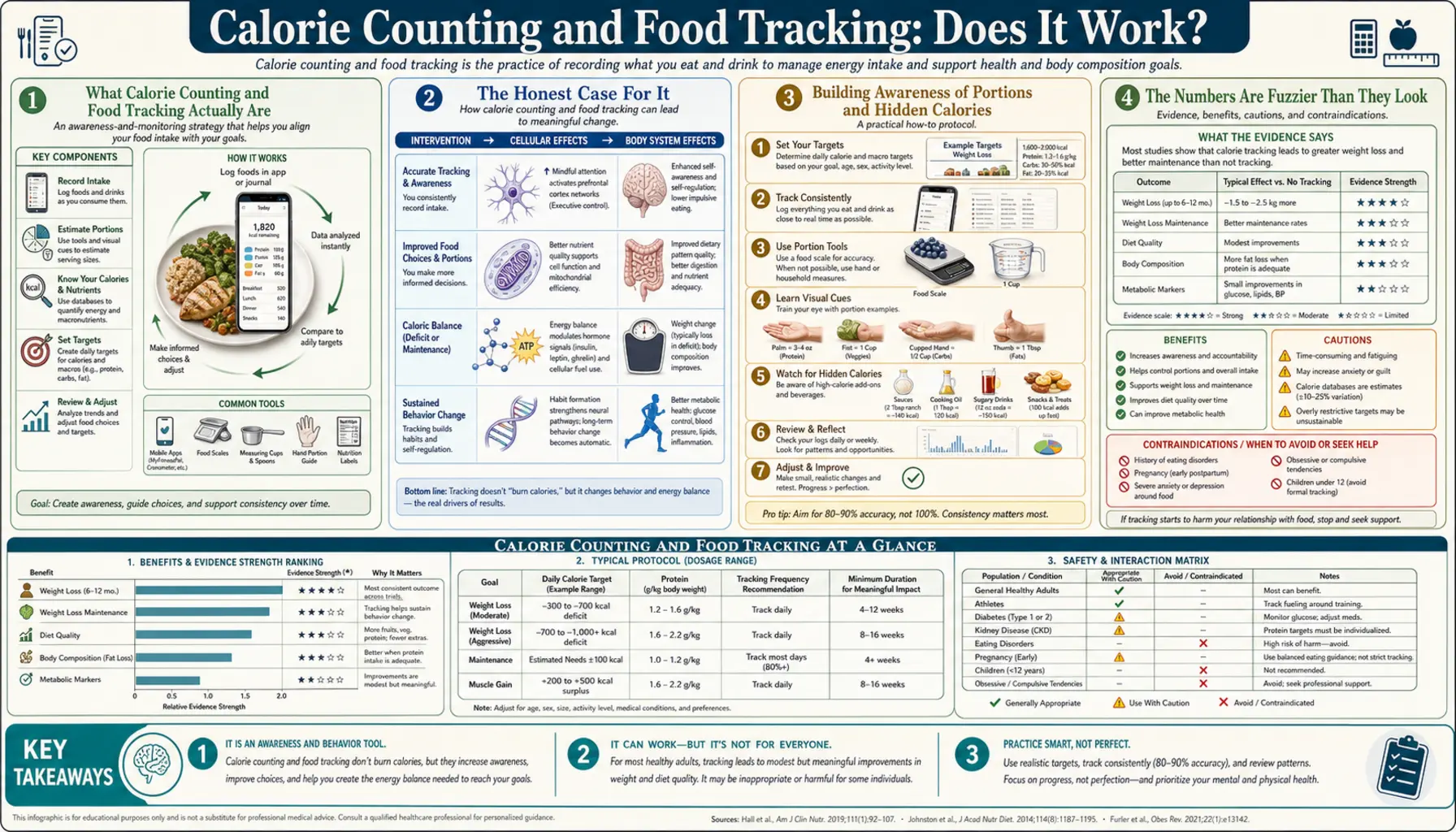
Almost everyone who has tried to lose weight has, at some point, been told to "just count your calories." Today that usually means tapping meals into an app, keeping a food diary, or weighing portions on a kitchen scale. It sounds simple and scientific: track what goes in, keep it under what you burn, and the weight comes off. So does it actually work? The honest answer is yes and no, and this page tries to give you both sides fairly, without hype and without shame. The yes is real and well earned: paying attention to what you eat — what researchers call self-monitoring — is one of the most consistently supported behaviors in the entire weight-loss literature. The no is just as real: calorie numbers are far fuzzier than they look, your body does not absorb food like a laboratory calorimeter, tracking is tedious and easy to quit, and for some people — especially anyone with a history of disordered eating — rigid counting can quietly make their relationship with food worse. This page walks through the honest case for tracking, its genuine limits, who it tends to help and who it may harm, the alternatives that need no counting at all, and a flexible way to use tracking as a tool rather than a life sentence.
Table of Contents
- What Calorie Counting and Food Tracking Actually Are
- The Honest Case For It
- Building Awareness of Portions and Hidden Calories
- The Numbers Are Fuzzier Than They Look
- Your Body Is Not a Perfect Calorimeter
- Tedious, and Easy to Abandon
- When Counting Can Do Harm
- Who It Helps, and Who It May Hurt
- Alternatives That Need No Counting
- Mindful and Intuitive Eating — Honestly
- Using Tracking as a Tool, Not a Life Sentence
- A Kind Bottom Line
- Research Papers
- Connections
- Featured Videos
What Calorie Counting and Food Tracking Actually Are
At its simplest, calorie counting means adding up the estimated energy — measured in calories, or more precisely kilocalories — in everything you eat and drink, and comparing that total to a daily target. "Food tracking" is the broader, gentler cousin: writing down or logging what you ate, whether or not you tally the numbers. In practice these blur together, and people do them in several ways:
- Apps. Smartphone trackers with big food databases and barcode scanners are the most common tool today. You search a food, pick a portion, and the app keeps the running total for you.
- A written or digital food diary. A notebook, a notes app, or a printed log where you simply record meals, snacks, and drinks — sometimes with calories, sometimes just the food itself.
- Weighing and measuring food. A kitchen scale, measuring cups, or spoons to pin down portion sizes, which is where most calorie estimates go wrong.
It helps to be clear about what tracking is and is not. It is a measurement and awareness habit — a way of noticing what and how much you eat. It is not itself a diet, and it does not burn a single calorie. Whether it helps you depends entirely on what you do with the information and, just as much, on how the habit makes you feel. Both of those threads run through the rest of this page.
The Honest Case For It
Let us start with the strong evidence, because it is genuinely impressive and often undersold by people who dislike counting. Of all the behaviors studied in weight management, self-monitoring is one of the most reliably linked to success. In a widely cited systematic review, Burke and colleagues examined 15 studies of dietary self-monitoring and found a consistent, significant association between keeping track of what you eat and losing more weight. It was not a fluke of one trial; it showed up across the literature.
The pattern that keeps repeating is a "dose-response" one: the more consistently people track, the better they tend to do. A study by Harvey and colleagues, tellingly titled Log Often, Lose More, followed adults using an electronic food diary and found that those who logged most days lost substantially more weight than sporadic loggers — and, importantly, the logging did not have to be long or fussy to help. Ingels and colleagues reported the same theme from a different angle, showing that greater adherence to dietary tracking predicted greater weight loss over time. Older work pointed the same way: Boutelle and Kirschenbaum found that people who kept up their self-monitoring even through the hardest stretches — the holidays — managed their weight better than those who let it slide.
It matters for the long haul too, not just the first few weeks. Peterson and colleagues found that people who kept some form of dietary self-monitoring going were more likely to sustain their results, which is where most weight-loss efforts otherwise fall apart.
Why would simply writing things down do so much? The leading explanation is not magic but attention. Tracking makes eating deliberate instead of automatic. When you know a bite will be logged, you pause; you notice the handful of chips, the splash of cream, the second helping. That small moment of awareness is where most of the benefit lives — which is also, as we will see, why perfect numeric accuracy matters far less than people assume.
Building Awareness of Portions and Hidden Calories
The most useful thing tracking teaches most people has little to do with the final total. It is calibration — learning what a real portion looks like and where calories quietly hide. Almost everyone underestimates portions, often dramatically. A "serving" of pasta on the plate is frequently two or three of the servings on the box. A tablespoon of olive oil, a swirl of dressing, a latte, a handful of nuts, or a couple of squares of chocolate can each carry more energy than a whole meal's worth of vegetables — and they slip by unnoticed because they feel like extras rather than food.
Tracking, even briefly, drags these into the light. People are routinely surprised the first week they log honestly, not because they were lying to themselves but because the calories in oils, sauces, drinks, and snacks are genuinely invisible until you write them down. This is why many dietitians suggest tracking as a temporary teaching tool: a week or two of honest logging can recalibrate your eye for portions in a way that sticks long after you stop counting. You do not have to track forever to keep what you learned. In that sense, one of tracking's best uses is to make itself unnecessary.
The Numbers Are Fuzzier Than They Look
Now the other side, told just as honestly. The great weakness of calorie counting is that it wears a lab coat it has not really earned. The numbers look exact — 212 calories, right there on the screen — but they rest on a stack of estimates, and the errors are larger than most people realize.
Start with the labels themselves. Packaged-food calorie counts in many countries are legally allowed to be off by a meaningful margin, and studies find they often are. When Urban and colleagues measured the true energy of reduced-calorie packaged and restaurant foods, the stated values understated the real calories by an average of roughly 18 percent, with some items far higher. A later multi-site study by the same group put a bomb calorimeter to popular restaurant meals and found their real energy content differed sharply from menu claims — and that individual restaurant dishes were the least reliable of all, some containing hundreds of calories more than advertised.
App databases add their own layer of fuzz. Many entries are user-submitted and unverified, so the same food can appear a dozen times with a dozen different numbers. "Generic" and homemade entries are educated guesses. And even a correct database figure assumes you weighed your portion, which most people eyeball. Stack a mis-sized portion on top of a shaky database entry on top of a legally-imprecise label, and a day's total can be off by a fair bit — frequently on the order of 20 to 25 percent — while still displaying to the last digit. The false precision is the trap: the app shows "1,487 calories," and it is easy to forget that the honest version is "somewhere in the neighborhood of 1,500, give or take a couple hundred."
Your Body Is Not a Perfect Calorimeter
Even if every number you logged were perfect, the deeper problem is that the calories you eat are not the calories you absorb. Your gut is not a bomb calorimeter that extracts every joule from food. How much energy you actually take up depends on the food's structure, how it was cooked, your own gut bacteria, and how much fiber came along for the ride.
A clean example comes from Novotny and colleagues, who measured the true energy people absorb from almonds. The familiar Atwater factors — the century-old formula behind nearly every calorie count — predict about 170 calories per serving, but the body actually absorbs closer to 129, because some of the fat stays locked in the nut's cell walls and passes through undigested. That is a roughly 25 percent overestimate baked into the "known" number for a single common food. Whole, high-fiber, minimally processed foods tend to give up fewer of their calories this way than the labels claim; highly processed foods tend to give up more.
There is a human factor too: people are simply bad at recording intake, and it skews in one direction. In a striking controlled study, Champagne and colleagues found that even registered dietitians — the experts — underestimated their own calorie intake when tracking, by around 200 to 300 calories a day. If the professionals cannot log perfectly, no app user should feel like a failure for the same slippage. None of this means calories are fake or that "a calorie is not a calorie" in some magical sense — energy balance still governs weight. It means the daily number on your screen is an estimate wearing the costume of a fact, and it is wisest to treat it as a rough guide and a trend line, not a precise ledger.
Tedious, and Easy to Abandon
There is a plainer problem, and it may be the biggest one of all: tracking is work. Logging every meal, decoding restaurant dishes, guessing at a friend's home cooking, weighing portions, and searching a database several times a day is tedious. It is easy to keep up for a motivated week or two and much harder to sustain for months. This is why app-store trackers have famously steep drop-off rates — most people who download one have quietly stopped within weeks.
That abandonment matters because, as the research above shows, the benefit of tracking comes from consistency, not intensity. A tool you quit is a tool that stops working. Worse, quitting often carries a sting of failure that has nothing to do with your body and everything to do with the method being tiresome. If you have started and stopped tracking several times, that is not weakness or lack of discipline — it is the predictable result of a chore-like tool colliding with an ordinary busy life. The right conclusion is usually not "try harder to count forever," but "find the lightest version of self-monitoring you will actually keep, or a different approach altogether."
When Counting Can Do Harm
For most people, tracking is at worst a tedious neutral. But for some, it is not neutral at all, and this deserves to be said plainly rather than buried in a disclaimer. Rigid calorie counting can feed anxiety, preoccupation, and an unhealthy relationship with food — and it can be genuinely dangerous for anyone vulnerable to an eating disorder.
The evidence here is real. Levinson and colleagues surveyed people in eating-disorder treatment about calorie-tracking apps and found that a large share used them, and many felt the apps contributed to their eating disorder — turning food into a running tally of numbers to be minimized, and a source of guilt when the "budget" was exceeded. The app was not a harmless tool in their hands; it was fuel.
Part of the danger is the style of control, not just the counting. Linardon and Mitchell found that rigid dietary control — all-or-nothing, strict, rule-bound eating — was associated with more disordered eating and body-image distress, while flexible control (allowing treats, adjusting, not treating a slip as a catastrophe) was not, and looked psychologically much healthier. The same food diary can be used two very different ways: as gentle awareness, or as a rigid scoreboard that punishes every deviation. The first can help; the second can hurt. If tracking makes you more anxious, more obsessive, more likely to skip meals to "save" calories, or more likely to spiral after one "bad" entry, that is a clear signal to stop — and it is a sign of wisdom, not failure, to put the app down.
Who It Helps, and Who It May Hurt
Because tracking is a tool and not a treatment, the honest question is not "does it work?" but "does it work for whom?" Rough guidance from the evidence and clinical experience:
It tends to help people who…
- Like data, structure, and feedback, and find a running total motivating rather than stressful.
- Are genuinely unsure where their calories are coming from and want to learn portion sizes — often best served by tracking for a defined stretch, then stopping.
- Can hold the numbers loosely, treat them as a trend, and shrug off an imperfect or missed day.
- Are working with a specific, concrete goal (for example, getting enough protein, or noticing liquid calories) rather than chasing perfection.
It may hurt people who…
- Have any history of an eating disorder or disordered eating — for this group, structured calorie counting is best avoided or done only with professional support.
- Notice tracking making them anxious, guilty, obsessive, or rigid — ruminating over numbers, or letting a single "over" day ruin their mood.
- Find the whole exercise so tedious that it becomes another cycle of starting, quitting, and feeling like a failure.
Neither list is a verdict on your worth or willpower. They are simply two different responses to the same tool, and knowing which one is yours is more useful than any calorie target.
Alternatives That Need No Counting
Here is the reassuring part: you do not have to count calories to eat well or lose weight. Every real benefit of tracking — awareness, reasonable portions, fewer hidden calories — can be reached by simpler habits that ask for judgment instead of arithmetic. These are not consolation prizes; for many people they work better because they last.
- The plate method. A no-math visual rule: fill half your plate with vegetables and fruit, one quarter with a protein, and one quarter with a starch or grain. It naturally moderates portions and improves the balance of a meal without a single number.
- Hand-portion guides. Use your own hand as a built-in measuring set — a palm of protein, a fist of vegetables, a cupped handful of carbs, a thumb of fats. It travels with you, scales to your body size, and needs no scale or app.
- Lead with protein and fiber. Building meals around protein and high-fiber, high-water whole foods — vegetables, fruit, beans, whole grains — is deeply filling for relatively few calories, so appetite does much of the portion control that counting tries to do by hand.
- Favor whole, minimally processed foods. Cooking more, and leaning on foods without labels at all, quietly lowers calorie density and cuts the hidden sugars, oils, and refined starches that trackers are forever trying to catch.
- A few gentle rules of thumb. Drink water instead of calories, slow down and stop at comfortably full, keep tempting foods out of easy reach. Small, boring, repeatable habits outperform precise short-lived counting.
None of these require you to know that a meal was 640 calories. They ask you to build a decent plate and pay a little attention — and for many people that is not only easier but more durable.
Mindful and Intuitive Eating — Honestly
At the far end from calorie counting sits intuitive and mindful eating — the practice of eating in response to your body's hunger and fullness cues rather than external numbers or rigid rules, and paying gentle attention to the experience of a meal. It is a genuinely different philosophy, and it deserves an honest accounting of both what the evidence shows and what it does not.
What the evidence does show is encouraging on the psychological side. In a literature review, Van Dyke and Drinkwater found that higher intuitive eating was consistently associated with better markers — lower body mass index, and notably better psychological health: less disordered eating, better body image, higher self-esteem and well-being. People who eat this way tend to have a calmer, less anxious relationship with food, which is exactly the thing rigid counting can erode.
What the evidence does not yet show is that intuitive eating is a reliable weight-loss method. Most of its research is cross-sectional — it observes that intuitive eaters tend to weigh less, but cannot prove the eating style caused it rather than the other way around — and it is generally framed as a path to a healthier relationship with food and weight stability, not as a fat-loss program. So the honest summary is this: intuitive and mindful eating are excellent for peace with food and psychological health, are a sensible refuge for anyone harmed by counting, and may help some people stop overeating — but they are not a guaranteed way to drop weight, and it is fair to be skeptical of anyone who sells them as one.
Using Tracking as a Tool, Not a Life Sentence
If you have read this far, the balanced conclusion should be coming into focus. Tracking is neither a miracle nor a trap; it is a tool with real power and real limits, and the trick is to use it deliberately and flexibly. A practical, kinder way to work with it:
- Treat it as a lesson, not a life sentence. Consider tracking for one to three weeks to learn your portions and spot your hidden calories — then feel free to stop and coast on what you learned. You can always return for a short "recalibration" if things drift.
- Aim for the trend, not the decimal. Because the numbers are only estimates, chase the direction over a week, not a perfect daily total. Consistent, honest-enough logging beats occasional perfect logging — the research is clear that frequency is what pays off.
- Choose the lightest version you will keep. If full calorie counting is too much, just photograph meals, jot foods in a notes app, or track only one thing (protein, or drinks, or takeout). A sustainable rough habit beats a precise one you abandon.
- Be flexible, not rigid. Plan for treats, expect imperfect days, and never let one "over" entry become a reason to give up. Flexible control is the version that is both effective and psychologically safe.
- Watch how it makes you feel. If tracking brings anxiety, guilt, obsession, or a worse relationship with food, that is your cue to stop and switch to the plate method, hand portions, or intuitive eating. No amount of weight loss is worth trading your peace with food.
A Kind Bottom Line
So — does calorie counting and food tracking work? It can, and for many people it genuinely does. Self-monitoring is one of the best-supported behaviors in all of weight-loss research, and even a short spell of honest tracking can teach you portion sizes and expose hidden calories in a way that lasts. That is not nothing; it is one of the most reliable tools we have.
But it comes with equally real limits. The numbers are estimates dressed as facts, off by a fifth or more once you stack imprecise labels, guessed portions, and a gut that never absorbs food perfectly. It is tedious and easy to abandon. And for some people — anyone with a fragile relationship with food — rigid counting can do more harm than good. Meanwhile, plenty of people reach the same place with no counting at all, through the plate method, hand portions, protein-and-fiber-forward whole foods, or a mindful, intuitive approach.
The kindest and truest thing we can tell you is that the best method is simply the sustainable one you will actually keep doing. For some, that is a food diary; for others, it is a well-built plate and a bit of attention. If tracking helps you and feels fine, use it, hold the numbers loosely, and let it teach you. If it makes you miserable, put it down without guilt and try another road — and know that once you have learned what you needed, it is completely fine to stop counting. That is not quitting. That is graduating.
Research Papers
- Burke LE, Wang J, Sevick MA. Self-monitoring in weight loss: a systematic review of the literature. Journal of the American Dietetic Association. 2011;111(1):92-102. doi:10.1016/j.jada.2010.10.008 — the landmark review finding a consistent link between dietary self-monitoring and greater weight loss.
- Harvey J, Krukowski R, Priest J, West D. Log often, lose more: electronic dietary self-monitoring for weight loss. Obesity (Silver Spring). 2019;27(3):380-384. doi:10.1002/oby.22382 — the more consistently people logged, the more weight they lost, and effective logging did not have to be lengthy.
- Ingels JS, Misra R, Stewart J, Lucke-Wold B, Shawley-Brzoska S. The effect of adherence to dietary tracking on weight loss: using HLM to model weight loss over time. Journal of Diabetes Research. 2017;2017:6951495. doi:10.1155/2017/6951495 — greater adherence to tracking predicted greater weight loss over time.
- Peterson ND, Middleton KR, Nackers LM, Medina KE, Milsom VA, Perri MG. Dietary self-monitoring and long-term success with weight management. Obesity (Silver Spring). 2014;22(9):1962-1967. doi:10.1002/oby.20807 — keeping up self-monitoring was tied to better long-term maintenance of weight loss.
- Boutelle KN, Kirschenbaum DS. Further support for consistent self-monitoring as a vital component of successful weight control. Obesity Research. 1998;6(3):219-224. doi:10.1002/j.1550-8528.1998.tb00340.x — people who kept monitoring even through the holidays managed their weight better than those who lapsed.
- Urban LE, Dallal GE, Robinson LM, Ausman LM, Saltzman E, Roberts SB. The accuracy of stated energy contents of reduced-energy, commercially prepared foods. Journal of the American Dietetic Association. 2010;110(1):116-123. doi:10.1016/j.jada.2009.10.003 — measured energy averaged about 18% higher than the labels claimed, with some items far higher.
- Urban LE, Weber JL, Heyman MB, et al. Energy contents of frequently ordered restaurant meals and comparison with human energy requirements and USDA database information. Journal of the Academy of Nutrition and Dietetics. 2016;116(4):590-598.e6. doi:10.1016/j.jand.2015.11.009 — real restaurant-meal calories often diverged sharply from stated values, individual dishes least reliable.
- Novotny JA, Gebauer SK, Baer DJ. Discrepancy between the Atwater factor predicted and empirically measured energy values of almonds in human diets. The American Journal of Clinical Nutrition. 2012;96(2):296-301. doi:10.3945/ajcn.112.035782 — almonds delivered ~129 calories, not the ~170 the standard formula predicts, because the body is not a perfect calorimeter.
- Champagne CM, Bray GA, Kurtz AA, et al. Energy intake and energy expenditure: a controlled study comparing dietitians and non-dietitians. Journal of the American Dietetic Association. 2002;102(10):1428-1432. doi:10.1016/s0002-8223(02)90316-0 — even registered dietitians underestimated their own recorded intake, showing how hard accurate tracking is.
- Levinson CA, Fewell L, Brosof LC. My Fitness Pal calorie tracker usage in the eating disorders. Eating Behaviors. 2017;27:14-16. doi:10.1016/j.eatbeh.2017.08.003 — many people in eating-disorder treatment used calorie-tracking apps and felt they contributed to the disorder.
- Linardon J, Mitchell S. Rigid dietary control, flexible dietary control, and intuitive eating: evidence for their differential relationship to disordered eating and body image concerns. Eating Behaviors. 2017;26:16-22. doi:10.1016/j.eatbeh.2017.01.008 — rigid, all-or-nothing control tracked with disordered eating; flexible control did not.
- Van Dyke N, Drinkwater EJ. Relationships between intuitive eating and health indicators: literature review. Public Health Nutrition. 2014;17(8):1757-1766. doi:10.1017/S1368980013002139 — intuitive eating was linked to lower BMI and notably better psychological health, though causation for weight loss is unproven.
Connections
- All Remedies
- Intermittent Fasting
- Exercise and Weight Loss
- Meal Timing
- Weight Loss
- Potato Diet
- Mediterranean Diet
- Natural Anxiety Relief
- Endocrinology
- Food