Stress Management — Benefits Deep Dive
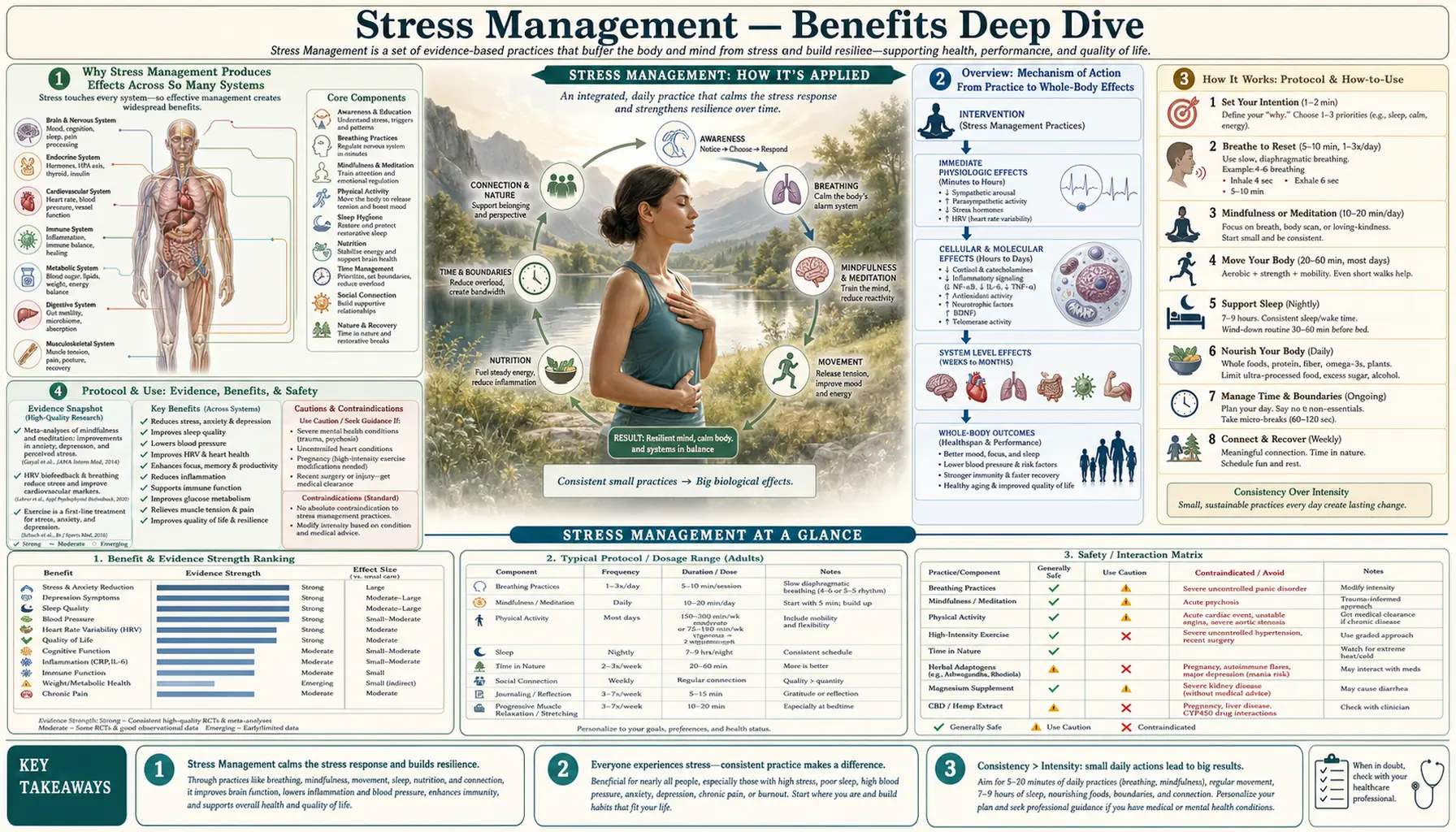
Chronic stress is not a vague psychological state — it is a measurable, dysregulated activation of the hypothalamic-pituitary-adrenal (HPA) axis and the sympathetic nervous system that drives downstream pathology in nearly every organ system. The four deep-dive pages below map the four most evidence-supported categories of intervention: HPA-axis-targeted behavioral and pharmacological tools, the adaptogenic herbs (Ashwagandha, Rhodiola, Holy Basil, Schisandra) with the strongest clinical-trial support, heart-rate variability (HRV) biofeedback as an objective measure and trainable parameter of autonomic balance, and the deliberate hormetic stressors of cold-water immersion and dry-sauna heat that paradoxically lower baseline stress reactivity through stress-inoculation effects.
Deep-Dive Articles
HPA Axis Regulation
The hypothalamic-pituitary-adrenal axis and the CRH-ACTH-cortisol cascade, normal diurnal cortisol rhythm (cortisol awakening response peaks 30-45 min post-wake, troughs near midnight), allostatic load and HPA flattening in chronic stress, the dexamethasone suppression test, salivary cortisol four-point curves, and the evidence base for mindfulness-based stress reduction (MBSR), cognitive-behavioral therapy (CBT-I), and phosphatidylserine in normalizing dysregulated cortisol.
Adaptogens
The Soviet-era Lazarev definition of an adaptogen (non-specific resistance, normalizing action, harmless at therapeutic dose), the four adaptogens with the strongest modern randomized-trial support — Ashwagandha (KSM-66 and Sensoril), Rhodiola rosea (SHR-5 standardized to 3% rosavins / 1% salidroside), Holy Basil (Tulsi), and Schisandra chinensis — mechanism of action on HSP70 and the stress-sensor kinase JNK, dosing, time-to-effect, and the chronic-use safety profile.
HRV Training
Heart-rate variability as a non-invasive readout of vagal tone and autonomic balance, RMSSD vs SDNN vs HF-HRV time- and frequency-domain metrics, the Lehrer-Vaschillo resonance-frequency breathing protocol (typically 5.5 breaths/min), HeartMath coherence training, wearable HRV trackers (Oura, Whoop, Polar), and the controlled-trial evidence that 4-8 weeks of paced breathing raises baseline HRV and lowers anxiety, blood pressure, and PTSD symptom scores.
Cold and Sauna Exposure
Hormetic stressors that lower chronic stress reactivity by deliberately spiking and then resolving acute sympathetic activation. Cold-water immersion (Wim Hof, cold plunge, cold shower) raises noradrenaline 200-500% and dopamine ~250% for hours; the Finnish KIHD cohort showed 4-7 sauna sessions per week roughly halve cardiovascular and all-cause mortality; the Soberg / Søberg cold-and-sauna protocol; risks include arrhythmia, cold-shock response, and the contraindication in uncontrolled hypertension.
Table of Contents
- Deep-Dive Articles
- Why Stress Management Produces Effects Across So Many Systems
- Research Papers: HPA Axis Regulation
- Research Papers: Adaptogens
- Research Papers: HRV Training
- Research Papers: Cold and Sauna Exposure
- Research Papers: Cross-Cutting (Mechanism, Measurement, Safety)
- External Authoritative Resources
- Connections
- Featured Videos
Why Stress Management Produces Effects Across So Many Systems
Most therapeutic interventions act on one organ system. Stress management is unusual because the upstream lesion — chronic activation of the HPA axis and sympathetic nervous system — drives downstream pathology in essentially every organ. Reducing chronic sympathetic and HPA tone therefore produces effects that look improbably broad. There are three principal mechanisms by which this happens, and each maps to a category of clinical benefit.
- Cortisol normalization (HPA axis) — chronically elevated or chronically flattened cortisol drives insulin resistance, central adiposity, hippocampal atrophy, immune dysregulation, sleep fragmentation, and accelerated bone loss. Restoring a healthy cortisol awakening response and proper evening trough — the focus of HPA-axis-targeted interventions — reverses or attenuates each of these. Bruce McEwen's allostatic-load framework is the dominant theoretical model.
- Autonomic rebalancing (parasympathetic vagal tone) — chronic stress produces sympathetic dominance and depressed vagal output, measurable as low heart-rate variability. Low HRV is independently predictive of cardiovascular mortality, depression, and inflammation. Targeted training of resonance-frequency breathing raises vagal tone and reverses many of the downstream effects.
- Hormetic adaptation (controlled stress exposure) — the body adapts to predictable, short-duration stressors by becoming more resilient to subsequent stress of all kinds. This is the principle behind adaptogenic herbs (which appear to upregulate the stress-protective heat-shock protein HSP70) and deliberate cold and heat exposure (which inoculate the system against larger, less-controllable stressors).
The complication is that stress is not always pathological — acute stress is adaptive and even necessary for performance, learning, and tissue repair. The goal of stress management is not to abolish the stress response but to restore the natural diurnal and episodic rhythm: rapid activation when warranted, complete and rapid return to baseline afterward. Each of the four deep-dive pages explores one of the four most evidence-supported categories of intervention for restoring that rhythm.
Research Papers: HPA Axis Regulation
- McEwen BS, Allostasis and allostatic load (1998 NEJM, foundational review) — Search PubMed
- Sapolsky RM, Romero LM, Munck AU, How do glucocorticoids influence stress responses? (Endocrine Reviews 2000) — PubMed 10696570
- Fries E, Dettenborn L, Kirschbaum C, The cortisol awakening response — PubMed 18854200
- Heim C, Ehlert U, Hellhammer DH, Hypocortisolism in stress-related bodily disorders — PubMed 10633533
- Kabat-Zinn J, Mindfulness-based stress reduction (MBSR) original Massachusetts trial PubMed: Kabat-Zinn MBSR 1982
- Pascoe MC et al., Mindfulness mediates the physiological markers of stress (meta-analysis 2017) — PubMed 28863392
- Hellhammer J et al., Phosphatidylserine and stress-induced cortisol (Lipids Health Dis 2014) PubMed: PS and cortisol
- Vgontzas AN et al., Insomnia and HPA axis hyperactivity — PubMed 11502812
- Trauer JM et al., Cognitive Behavioral Therapy for Insomnia (CBT-I) meta-analysis (Ann Intern Med 2015) — PubMed 26054060
- Heuser I, Yassouridis A, Holsboer F, The combined dexamethasone/CRH test (DEX/CRH) PubMed: DEX/CRH test
Research Papers: Adaptogens
- Panossian A, Wikman G, Effects of adaptogens on the central nervous system (Pharmaceuticals 2010) — PubMed 27713248
- Chandrasekhar K, Kapoor J, Anishetty S, Ashwagandha root extract in chronic stress (Indian J Psychol Med 2012) — PubMed 23439798
- Lopresti AL et al., An investigation into the stress-relieving effects of Ashwagandha (KSM-66) — PubMed 31517876
- Auddy B et al., A standardized Withania somnifera extract (Sensoril) in chronic stress PubMed: Sensoril clinical trial
- Olsson EM et al., Rhodiola rosea (SHR-5) in chronic stress and fatigue (Planta Med 2009) — PubMed 19016404
- Edwards D et al., Rhodiola rosea for chronic fatigue and stress (Phytother Res 2012) PubMed: Rhodiola fatigue
- Cohen MM, Tulsi — Ocimum sanctum: a herb for all reasons (J Ayurveda Integr Med 2014) — PubMed 25624701
- Panossian A et al., Adaptogens stimulate HSP70 and Hsp72 stress-response (Phytomedicine 2009) PubMed: HSP70 mechanism
- Panossian A, Wikman G, Adaptogens vs single-target drugs: a comparative review PubMed: Adaptogen vs single-target
- Panossian A et al., Schisandra chinensis lignans and stress-protective activity PubMed: Schisandra lignans
Research Papers: HRV Training
- Lehrer PM, Vaschillo E, Vaschillo B. Resonant frequency biofeedback training to increase cardiac variability: rationale and manual for training (Appl Psychophysiol Biofeedback 2000;25(3):177–191) — PubMed 10999236
- Lehrer PM, Gevirtz R, Heart-rate variability biofeedback: how and why does it work? (Front Psychol 2014) — PubMed 25101026
- Goessl VC et al., HRV biofeedback and stress / anxiety meta-analysis (Psychol Med 2017) — PubMed 28478782
- Thayer JF, Lane RD, A model of neurovisceral integration in emotion and HRV — PubMed 11163422
- Thayer JF et al., Meta-analysis of HRV and prefrontal cortex function Search PubMed
- Shaffer F, Ginsberg JP, An overview of heart-rate-variability metrics and norms — PubMed 29034226
- Tang Y-Y et al., The neuroscience of mindfulness meditation (Nat Rev Neurosci 2015) — PubMed 25783612
- Tan G et al., HRV biofeedback for combat-related PTSD PubMed: HRV biofeedback PTSD
- Sevoz-Couche C, Laborde S, HRV biofeedback as a neurocardiac training technique Search PubMed
- Lin G et al., Heart-rate-variability biofeedback decreases blood pressure (J Hum Hypertens 2012) PubMed: HRV and BP
Research Papers: Cold and Sauna Exposure
- Laukkanen T et al., Finnish sauna bathing and cardiovascular and all-cause mortality (KIHD JAMA Intern Med 2015) — PubMed 25705824
- Laukkanen JA et al., Cardiovascular and other health benefits of sauna bathing (Mayo Clin Proc 2018) — PubMed 30077204
- Hussain J, Cohen M, Clinical effects of regular dry sauna bathing: systematic review — PubMed 29849692
- Søberg S et al., Altered brown fat thermoregulation and enhanced cold-induced thermogenesis in winter swimmers Search PubMed
- Kox M et al., Voluntary activation of the sympathetic nervous system and attenuation of the innate immune response (Wim Hof PNAS 2014) — PubMed 24799686
- Šrámek P et al., Human physiological responses to immersion in water of different temperatures (cold-water plasma noradrenaline) — PubMed 10751106
- Janský L et al., Immune and endocrine response to repeated cold-water immersion PubMed: Jansky cold immersion
- Tipton MJ et al., Cold-water immersion: kill or cure? (review of physiology) — PubMed 28833689
- Patrick RP, Johnson TL, Sauna use as a lifestyle practice to extend healthspan Search PubMed
- Esperland D et al., Health effects of voluntary exposure to cold water (review 2022) — PubMed 36137565
Research Papers: Cross-Cutting (Mechanism, Measurement, Safety)
- Selye H, A syndrome produced by diverse nocuous agents (original 1936 Nature paper, General Adaptation Syndrome) PubMed: Selye GAS 1936
- Chrousos GP, Stress and disorders of the stress system (Nat Rev Endocrinol 2009) — PubMed 19488073
- Porges SW, The polyvagal theory: phylogenetic substrates of a social nervous system — PubMed 11587772
- Kiecolt-Glaser JK et al., Chronic stress and immune function (PNAS 2003) PubMed: Kiecolt-Glaser immune
- Cohen S, Janicki-Deverts D, Miller GE, Psychological stress and disease (JAMA 2007) — PubMed 17925521
- Black DS, Slavich GM, Mindfulness meditation and the immune system: systematic review — PubMed 26799456
- Stalder T et al., Stress-related and basic determinants of hair cortisol Search PubMed
- Hannibal KE, Bishop MD, Chronic stress, cortisol dysfunction, and pain — PubMed 25035267
- Goyal M et al., Meditation programs for psychological stress and well-being (JAMA Intern Med 2014) — PubMed 24395196
- Steptoe A, Kivimäki M, Stress and cardiovascular disease (Nat Rev Cardiol 2012) — PubMed 22473079
External Authoritative Resources
- NIH National Center for Complementary and Integrative Health — Stress — the principal U.S. government resource on integrative stress interventions
- American Psychological Association — Stress topic page
- CDC — Coping with Stress
- HeartMath Institute — HRV and coherence research library
- PubMed — All research on stress-management interventions (~80,000+ papers)
Connections
- All Remedies
- Stress Management (Main Page)
- HPA Axis Regulation
- Adaptogens
- HRV Training
- Cold and Sauna Exposure
- Ashwagandha
- Rhodiola
- Holy Basil (Tulsi)
- Magnesium Glycinate
- L-Theanine
- Cortisol Lab Test
- Adrenal Fatigue
- Meditation
- Sleep Hygiene