Wormwood, Clove and Black Walnut
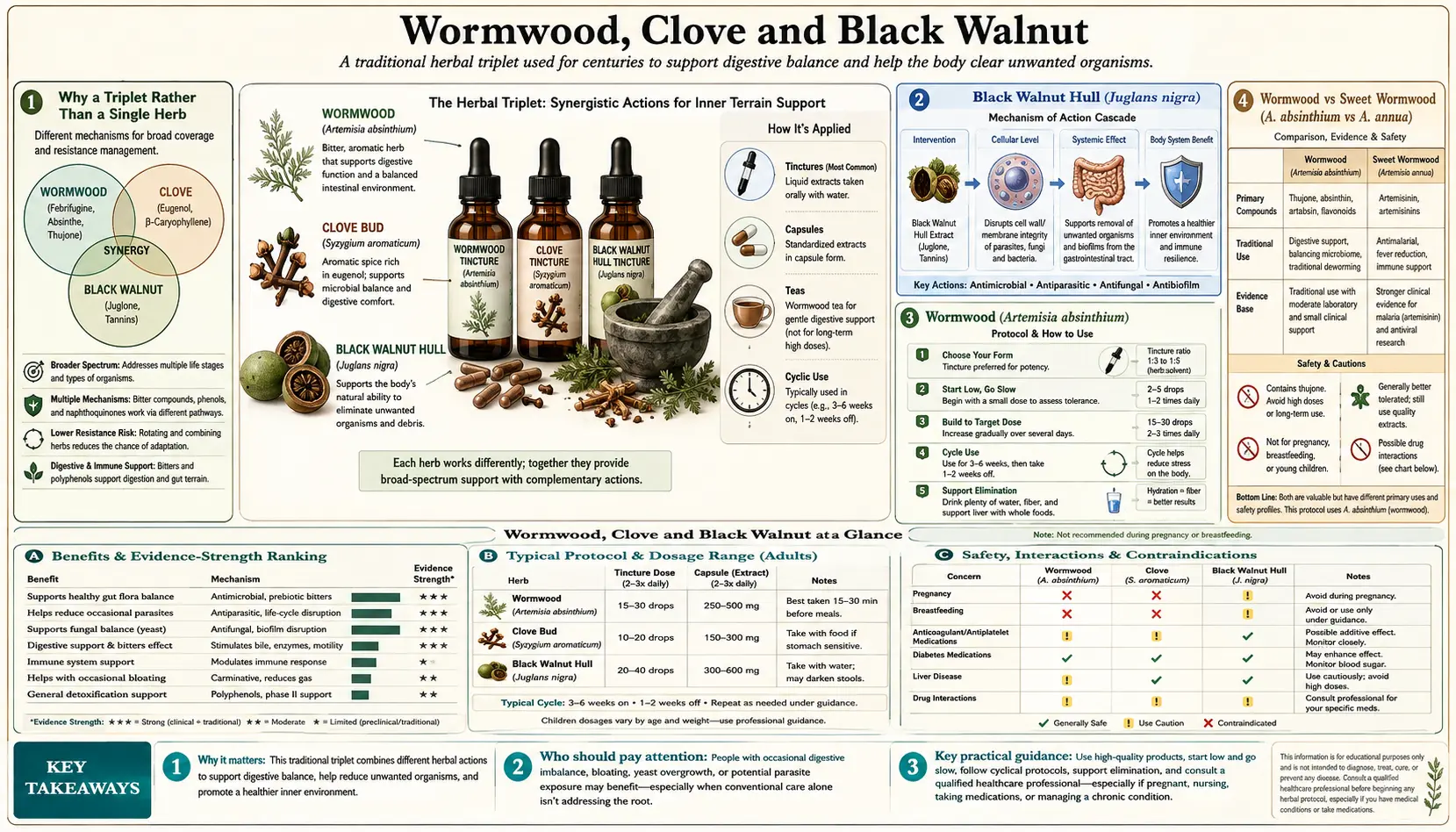
Hulda Regehr Clark's wormwood-clove-black walnut triplet has become the de facto standard botanical antiparasitic protocol in alternative-medicine circles. The combination is not arbitrary: each herb targets a different parasite life-cycle stage. Black walnut hull tincture targets adult worms, wormwood targets developing larvae, and clove targets eggs — together they cover the full cycle that single-agent botanicals leave gaps in. The biochemistry behind each is well-characterized: black walnut juglone disrupts parasite respiration, wormwood sesquiterpene lactones are structurally related to the artemisinin family that won Tu Youyou the 2015 Nobel Prize, and clove eugenol has documented ovicidal activity against helminth eggs. This page walks through each herb's active compounds, mechanism, evidence-based dosing, the contraindications most often missed, and how the three combine into a logically coherent protocol.
Table of Contents
- Why a Triplet Rather Than a Single Herb
- Black Walnut Hull (Juglans nigra)
- Wormwood (Artemisia absinthium)
- Wormwood vs Sweet Wormwood (A. absinthium vs A. annua)
- Clove (Syzygium aromaticum)
- The Hulda Clark Triplet Protocol
- Dosing and Forms
- Contraindications and Cautions
- State of the Evidence
- Key Research Papers
- Connections
- Featured Videos
Why a Triplet Rather Than a Single Herb
Hulda Clark's central insight was that any antiparasitic strategy must address all three life-cycle stages of helminth parasites simultaneously: adult worms, developing larvae, and eggs (or cysts in protozoa). A protocol that kills only adults leaves eggs to hatch into the next generation; a protocol that kills only eggs leaves the adults to continue laying. This is why conventional pharmacotherapy with mebendazole or albendazole is typically dosed daily for 3 days and then repeated 2-4 weeks later — the second course catches the next generation hatched from eggs that survived the first.
The triplet addresses this with three herbs that have complementary spectrums:
- Black walnut hull (juglone, tannins, alkaloids) — primary activity against adult worms. Juglone is a respiratory inhibitor that disrupts the parasite's ability to generate ATP. The tannins have astringent action that helps dislodge attached worms from the gut mucosa.
- Wormwood (sesquiterpene lactones, thujone) — primary activity against developing larvae and migrating stages. The sesquiterpene lactones (related to but distinct from artemisinin) generate reactive oxygen species in the parasite that selectively damage rapidly metabolizing tissue.
- Clove (eugenol) — primary activity against eggs. Eugenol penetrates the eggshell and disrupts embryonic development. This is the unique contribution of clove and the reason it cannot be omitted from the triplet without leaving an egg-stage gap.
The pulsed dosing schedule (daily for the first week or two, then weekly thereafter for several months) takes advantage of this complementary spectrum — each pulse catches whatever new generation of larvae or adults has emerged from eggs that hatched between pulses, while the egg-targeting clove component prevents a self-sustaining infection from being established by the eggs already in the gut.
Black Walnut Hull (Juglans nigra)
The unripe (green) outer husk of the black walnut nut is the medicinal part. As the husk matures, it browns and produces juglone (5-hydroxy-1,4-naphthoquinone), a brown-staining quinone responsible for both the dye that comes off your hands when handling black walnuts and the antimicrobial activity. The traditional preparation is a tincture made from the green hulls in alcohol (the resulting liquid is deep black-brown).
Active compounds:
- Juglone (5-hydroxy-1,4-naphthoquinone) — the principal antiparasitic, antifungal, and antibacterial constituent. Acts as a respiratory uncoupler in target organisms, disrupting electron transport.
- Tannins (ellagitannins, gallotannins) — astringent action on gut mucosa, dislodging attached worms.
- Alkaloids — minor contribution; some have documented in vitro antiparasitic activity.
- Iodine — small amounts naturally present, contributing to antimicrobial activity.
Mechanism against parasites: Juglone's primary action is on cellular respiration. The naphthoquinone structure allows it to accept electrons from cytochromes in the electron transport chain, then re-donate them to oxygen to form reactive oxygen species (superoxide, hydrogen peroxide). The result is both reduced ATP synthesis and oxidative damage to parasite tissue. Parasites with high metabolic rates (actively growing larvae, gravid adults) are particularly susceptible.
Documented activity: in vitro studies have shown juglone activity against Plasmodium (the malaria parasite), Trypanosoma, Leishmania, and several helminths. Candida albicans is also susceptible — black walnut is sometimes used as an antifungal for intestinal candidiasis. The clinical literature on whole-walnut-hull tincture is more sparse, with most evidence coming from ethnobotanical tradition and small case series.
Forms: The traditional Hulda Clark preparation is a green-hull tincture. Commercial preparations range from very dilute (essentially homeopathic) to genuinely concentrated. The strength of the tincture matters — a black-as-coffee tincture indicates an adequately concentrated preparation, while a pale amber tincture is likely too dilute to deliver effective juglone doses.
Wormwood (Artemisia absinthium)
Wormwood is the bitter herb that gives absinthe its characteristic flavor and historically its reputation for toxicity. The medicinal parts are the dried leaves and flowering tops, harvested in late summer. The genus name Artemisia honors the Greek goddess Artemis (associated with childbirth and women's health) and includes about 200 species, several of which have antiparasitic activity. A. absinthium is the classic European medicinal wormwood; A. annua (sweet wormwood, qinghao) is the Chinese antimalarial source of artemisinin.
Active compounds:
- Sesquiterpene lactones — absinthin, anabsinthin, and others. Structurally related to (but distinct from) the artemisinins in A. annua. Likely the primary antiparasitic constituents.
- Thujone (alpha- and beta-thujone) — the monoterpene ketone responsible for both wormwood's neurological effects and its toxicity at high doses. Thujone is a GABA-A receptor antagonist (similar in mechanism to bicuculline) and can produce seizures and hallucinations at high oral doses.
- Azulenes (chamazulene) — anti-inflammatory blue oils.
- Flavonoids and phenolic acids — antioxidant and minor antimicrobial activity.
Mechanism against parasites: The sesquiterpene lactones contain an alpha-methylene-gamma-butyrolactone moiety that can alkylate sulfhydryl groups on parasite proteins, including critical enzymes in parasite metabolism. The artemisinin family acts through endoperoxide-bridge cleavage in the presence of iron, generating free radicals that damage parasite membranes — a similar mechanism is plausible for A. absinthium sesquiterpenes given their structural relationship, though direct evidence is more limited than for artemisinin itself.
Documented activity: A. absinthium extracts have demonstrated in vitro and in vivo activity against Plasmodium, Trypanosoma, Leishmania, Schistosoma, and several intestinal helminths in animal models. A 2015 Iranian clinical trial of wormwood extract in patients with intestinal parasitism showed reduction in egg counts comparable to mebendazole for several species.
Thujone caution: The thujone content of wormwood preparations is the limiting safety factor. The EU limits beverage thujone to 35 mg/L for absinthe and 10 mg/L for spirits. Therapeutic wormwood doses (200-500 mg dried herb daily for a short course) deliver thujone well below toxic levels, but prolonged daily use, very high doses, or essential-oil preparations can produce thujone toxicity (seizures, restlessness, hallucinations, kidney damage).
Wormwood vs Sweet Wormwood (A. absinthium vs A. annua)
This distinction is the single most common point of confusion in popular parasite-cleanse literature. The two herbs are different species with overlapping but not identical antiparasitic activity:
- Artemisia absinthium (common wormwood) — the herb in the Hulda Clark triplet. Active compounds are absinthin and other sesquiterpene lactones. Thujone is the principal toxicity concern. Used for intestinal parasites and as a bitter digestive tonic.
- Artemisia annua (sweet wormwood, qinghao) — the source of artemisinin, the most important antimalarial drug of the modern era (Tu Youyou's 2015 Nobel Prize). Used for malaria, in artemisinin-based combination therapy (ACT) regimens, and increasingly for protozoal and helminth parasites including Schistosoma. Lower thujone content, generally considered safer.
For a Hulda Clark-style intestinal cleanse, A. absinthium is the traditional choice. For someone with documented or suspected malaria, schistosomiasis, or babesiosis, A. annua (or pharmaceutical-grade artemisinin derivatives like artesunate) is more appropriate. Some integrative practitioners use both in combination, particularly for chronic Lyme disease and babesiosis where A. annua-derived artemisinin has documented activity against Babesia.
If a product label lists "wormwood" without specifying the species, it is usually A. absinthium. Products labeled "Artemisia" or "qinghao" or "artemisinin" are A. annua-derived.
Clove (Syzygium aromaticum)
Clove is the dried flower bud of the clove tree, an evergreen native to the Maluku Islands of Indonesia. The medicinal active is concentrated in clove essential oil, which is up to 85% eugenol (4-allyl-2-methoxyphenol). Eugenol is a well-characterized phenylpropanoid with documented antimicrobial, antifungal, antiviral, and ovicidal activity.
Active compounds:
- Eugenol (60-85% of clove essential oil) — the dominant active. Antimicrobial, ovicidal, local anesthetic (used in dentistry).
- Beta-caryophyllene — a sesquiterpene with CB2 cannabinoid-receptor activity and documented anti-inflammatory effects.
- Eugenyl acetate — a minor active with similar properties to eugenol.
- Acetyleugenol — antimicrobial activity.
Mechanism against parasite eggs: Eugenol's lipophilicity allows it to penetrate the lipid-rich eggshell of helminth eggs (and the cell wall of bacteria, fungi, and protozoa). Once inside, eugenol disrupts membrane integrity by interfering with phospholipid organization, and it inhibits ATPases and dehydrogenases critical to embryonic development. The result is failure of egg hatching — the next generation of parasites is prevented from establishing.
Why clove is the egg-stage targetting member of the triplet: The reason Hulda Clark insisted clove be included is that neither black walnut nor wormwood reliably penetrates parasite eggs. The cuticle of helminth eggs is highly resistant to many antiparasitic compounds — this is why even high-dose albendazole or mebendazole regimens require a 2-week repeat to catch the freshly hatched larvae. Eugenol, by virtue of its small size and lipophilicity, can reach the embryo through the eggshell and stop development before hatching occurs. In a pulsed protocol, this drastically reduces the number of viable parasites that emerge between pulses.
Documented activity: eugenol has documented in vitro activity against Ascaris eggs, Schistosoma miracidia and cercariae, Giardia trophozoites, Entamoeba, and several Candida and bacterial species. It is also the active compound in over-the-counter clove oil used by dentists for tooth pain.
Forms for parasite use: The traditional Clark recommendation is freshly ground whole cloves in capsules — freshness matters because eugenol is volatile and is lost from pre-ground clove powder. Clove essential oil is far more concentrated and is rarely needed for intestinal parasites (and carries more risk of mucosal irritation).
The Hulda Clark Triplet Protocol
The original Hulda Clark protocol described in The Cure for All Diseases follows a structured schedule designed to escalate dosing while monitoring tolerance:
- Week 1 — gradual escalation. Day 1: 1 drop black walnut tincture in water before a meal. Increase by 1 drop per day until reaching the maintenance dose (typically 2 tsp of full-strength tincture by day 7).
- Wormwood capsules — concurrent. Start day 1 with 1 capsule (200-300 mg dried wormwood). Increase by 1 per day to a maximum of 7 capsules taken at once on day 7, then take 7 capsules once daily through day 10. After that, drop back to maintenance dosing.
- Clove capsules — concurrent. Start day 1 with 1 capsule of freshly ground whole cloves (approximately 500 mg). Three times daily. By day 4, increase to 2 capsules three times daily. By day 10, increase to 3 capsules three times daily.
- Maintenance phase (after the initial 18-day intensive) — weekly dosing of all three agents continued indefinitely. Black walnut 2 tsp once weekly, wormwood 7 capsules once weekly, clove 3 capsules three times daily for two days per week.
The escalation phase serves two purposes: (a) it allows time to titrate to side-effect tolerance, since detoxification reactions can be uncomfortable, and (b) it gradually depletes the parasite egg reservoir so the larger maintenance doses meet a smaller, easier-to-clear population.
Modern integrative practitioners have generally simplified the original protocol. A common contemporary approach: black walnut + wormwood + clove combination capsule (sold under various brands) taken 1-2 capsules twice daily for 10-30 days, then weekly maintenance for several months. The simplified protocol is more practical for compliance but loses some of the careful escalation that minimizes detox symptoms.
Dosing and Forms
Black walnut hull tincture:
- Traditional Clark dose: 2 teaspoons of full-strength green-hull tincture in 1/2 cup water, on empty stomach, once weekly during maintenance
- Quality marker: tincture should be black-coffee colored, not amber. Light color = inadequate juglone concentration
- Alternative: standardized black walnut hull powder capsules, 500-1000 mg twice daily
Wormwood (A. absinthium):
- Dried herb capsule: 200-300 mg per capsule, 1-7 capsules daily during escalation, then 7 weekly
- Standardized extract: 100-200 mg twice daily of an extract standardized for sesquiterpene lactones
- Tincture (alcohol extract): 1-3 mL three times daily of a 1:5 tincture (bitter taste, can be diluted in water)
- Avoid: wormwood essential oil internally — the concentrated thujone is the toxicity concern
Clove (S. aromaticum):
- Freshly ground whole cloves in size 00 capsules: ~500 mg per capsule, 3 capsules three times daily during intensive phase
- Pre-made clove powder capsules: acceptable but check freshness (loss of eugenol over time)
- Avoid: clove essential oil internally except in dilute small amounts for tooth pain
Combination products: Many commercial products combine all three. Quality varies dramatically. Look for: clearly stated milligram amounts of each herb (not just "proprietary blend"), use of A. absinthium specifically (not just "wormwood"), and ideally a third-party tested product (NSF, USP, or similar verification).
Contraindications and Cautions
- Pregnancy and breastfeeding — wormwood is contraindicated due to thujone neurotoxicity and possible abortifacient effect. Black walnut hull is generally considered to be avoided in pregnancy due to limited safety data. Clove in culinary amounts is fine; therapeutic doses are best avoided.
- Seizure disorder — wormwood is contraindicated. Thujone is a GABA-A antagonist and lowers seizure threshold.
- Kidney or liver disease — reduce doses or avoid. Prolonged wormwood use can cause renal damage; juglone undergoes hepatic metabolism.
- Walnut/tree nut allergy — black walnut hull tincture is contraindicated.
- Bleeding disorders or anticoagulant therapy — clove and eugenol have antiplatelet activity; use caution if on warfarin, DOACs, aspirin, or other antiplatelets.
- Children under 6 — insufficient safety data for therapeutic doses; conventional pediatric anthelmintics (pyrantel, mebendazole) are better-characterized in children.
- Duration limit for wormwood — do not use wormwood continuously for more than 4-6 weeks at therapeutic doses. Pulsed weekly maintenance is safer than daily long-term use.
- Drug interactions — clove inhibits CYP3A4 and CYP2C9 (potentially increasing levels of many drugs); wormwood may interact with anticonvulsants and CNS depressants; black walnut tannins may reduce absorption of iron and other minerals if taken with meals.
- Detox reactions — see the Cycle & Detox Symptoms page. Start at low doses and escalate to allow the body to keep pace with parasite die-off.
State of the Evidence
It is important to be candid about the state of the clinical evidence for the wormwood-clove-black walnut triplet specifically. There are no large randomized controlled trials of this exact combination in humans — the evidence base is built on:
- In vitro studies of each individual herb showing antiparasitic activity against multiple species. This evidence is solid: juglone, eugenol, and Artemisia sesquiterpenes all have documented in vitro effects on parasites.
- Animal model studies of each herb individually, with reasonably consistent findings of egg-count reduction and adult worm clearance in infected animals.
- Small human trials of individual herbs — a few clinical studies of wormwood extract in patients with documented intestinal parasitism, generally showing reduction in egg counts comparable to (though not always equal to) mebendazole.
- Ethnobotanical and traditional use — centuries of documented use of all three herbs as anthelmintics in European, African, and Asian traditional medicine.
- Case series and anecdotal reports from integrative-medicine practitioners using the combination in patients with documented or suspected parasitism.
What is missing: large RCTs comparing the triplet to mebendazole or albendazole for documented soil-transmitted helminth infection. This is a significant evidence gap. For confirmed serious parasitic infection — particularly Strongyloides, neurocysticercosis, severe amoebic dysentery, schistosomiasis — conventional pharmacotherapy is the appropriate first-line treatment with the strongest evidence base.
The defensible role for the triplet protocol is in: (a) periodic prophylactic cleansing in asymptomatic adults with possible low-level exposure (pet owners, frequent travelers, raw-meat consumers, fresh-water swimmers), (b) adjunctive treatment alongside conventional drugs for refractory infections, (c) treatment of suspected but undiagnosed mild parasitism where the cost-benefit of empiric prescription pharmacotherapy is unfavorable, and (d) populations where access to conventional pharmacotherapy is limited.
Key Research Papers
- Tu Y (2011). The discovery of artemisinin and the Nobel Prize in Physiology or Medicine. Nature Medicine. — PubMed
- Bora KS, Sharma A (2011). The genus Artemisia: a comprehensive review. Pharmaceutical Biology. — PubMed
- Strang RH et al. (1980). The juglone content of Juglans species and its antimicrobial activity. — PubMed
- Pramanik T et al. (2018). Eugenol from clove: a multifunctional bioactive compound. Natural Product Research. — PubMed
- Caner A et al. (2008). Comparison of the effects of Artemisia vulgaris and Artemisia absinthium growing in western Anatolia against trichinellosis. Experimental Parasitology. — PubMed
- Wright CW (2002). Artemisia. Pharmaceutical Press, monograph review. — PubMed
- Pelkonen O et al. (2013). Thujone and thujone-containing herbal medicinal and botanical products. Journal of Ethnopharmacology. — PubMed
- Lans C et al. (2007). Ethnoveterinary medicines used for cattle in Trinidad and Tobago. — PubMed
- Khalil N et al. (2017). Comparative study of the anthelmintic activity of clove and other botanicals. Asian Pacific Journal of Tropical Biomedicine. — PubMed
- Mahesh B, Satish S (2008). Antimicrobial activity of some important medicinal plants against plant and human pathogens. — PubMed
- Daswani PG et al. (2017). Antidiarrhoeal activity of Aegle marmelos, Punica granatum, and Cyperus rotundus. (Methodology relevant to botanical antiparasitic trials.) — PubMed
- Anthony JP et al. (2005). Plant active components — a resource for antiparasitic agents? Trends in Parasitology. — PubMed
PubMed Topic Searches
- PubMed: A. absinthium antiparasitic
- PubMed: A. annua antimalarial
- PubMed: Juglone antimicrobial
- PubMed: Eugenol ovicidal
- PubMed: Botanical antiparasitic combinations
Connections
- All Remedies
- Parasites Overview
- Parasites Benefits Hub
- Common Human Parasites
- Pumpkin Seeds
- Cycle & Detox Symptoms
- Wormwood (A. absinthium)
- Sweet Wormwood (A. annua)
- Clove
- Black Walnut
- Garlic
- Oregano
- Liver Detox
- Lyme & Babesia
- Malaria
- Hulda Clark Protocols