How to Start the Weston A. Price Diet: Plan, Shopping List and Menu
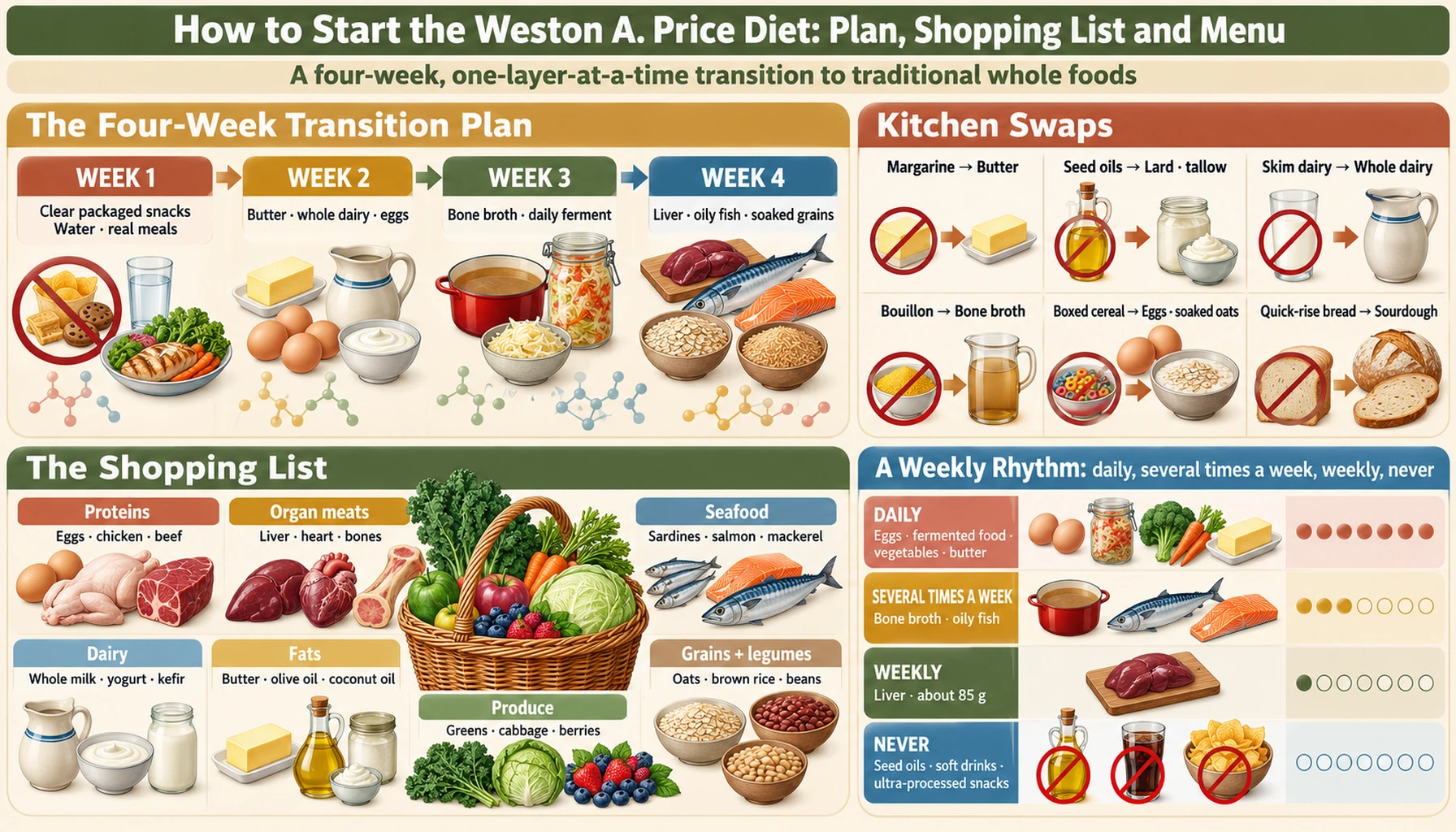
You do not have to overhaul your kitchen in a weekend. This page turns the Weston A. Price Foundation's guidelines into a gentle four-week plan: first clear out the packaged foods, then switch your fats and dairy, then add bone broth and a daily fermented food, and finally bring in liver, oily fish and properly prepared grains. You will find a swap list, a shopping list, budget tricks, a Sunday batch-cooking routine, a seven-day family menu, three simple recipes and the safety points that matter — each step paired with what the research actually shows.
Table of Contents
Before You Start: Why Go Slowly
The Foundation's booklet, Timeless Principles of Healthy Traditional Diets, lays out a long list of "Dietary Guidelines" and an equally long list of "Dietary Dangers." Read all at once, it can feel like being asked to change every meal you eat. The good news is that most of the benefit comes from a handful of big changes, and those are easier to keep when you make them one at a time. Think of it like learning a new language: a few useful words each week stick far better than a dictionary swallowed in one sitting.
There is also a practical reason to pace yourself. Your gut needs time to get used to fermented foods, your family needs time to get used to new flavours, and your budget needs time to find the cheapest sources. Four weeks is long enough to build the habits and short enough to keep your enthusiasm.
What does the science say about the overall direction? A fair summary, with the strength of each piece of evidence:
- Cutting ultra-processed food is the best-supported step. In a tightly controlled trial at the U.S. National Institutes of Health, 20 adults lived on the ward and ate either an ultra-processed or an unprocessed diet for 2 weeks each, eating as much as they liked. On the ultra-processed diet they ate about 500 extra calories a day (508 on average) and gained weight; on the unprocessed diet they lost it (Hall 2019 — randomised controlled trial in humans, small but rigorous).
- Cooking at home goes with a better diet. In a U.S. national survey of 9,569 adults, households that cooked dinner 6–7 nights a week ate less sugar and fat and fewer total calories than households that cooked 0–1 nights (Wolfson & Bleich 2015 — cross-sectional survey, which shows an association, not proof of cause). A large French study similarly linked meal planning with more food variety and better diet quality (Ducrot 2017 — cross-sectional).
- Fermented foods can change the gut. In a Stanford trial, 18 healthy adults who steadily increased fermented foods (yogurt, kefir, fermented vegetables, kombucha and similar) had more diverse gut bacteria and lower markers of inflammation (Wastyk 2021 — randomised trial in humans, small).
Other parts of the diet — the claims about saturated fat, raw milk and the Price-specific "activators" — are more debated, and they are covered honestly on our Myths and Evidence page. This page sticks to the practical side: what to buy, what to cook and how to do it safely.
The Four-Week Transition Plan
Each week builds on the one before. Nothing from an earlier week is undone — you are simply layering on the next habit.
- Week 1 — clear out the "dietary dangers." Go through the pantry and fridge. Give away or finish up the packaged snacks (chips, cookies, crackers, sweet cereals), soft drinks and sweetened juices, margarine and spreads, bottles of industrial seed oil (corn, cottonseed, canola, sunflower, safflower, grapeseed and other "vegetable oil"), refined sugar and white flour. Replace soft drinks with water, sparkling water or milk, and let fruit be dessert. If that is all you manage this week, you have already taken the step with the strongest evidence behind it.
- Week 2 — switch your fats and dairy. Cook in butter, lard, tallow, poultry fat or coconut oil; dress salads with extra virgin olive oil. Move from skim or low-fat milk to whole milk, plain whole-milk yogurt, real cheese and cream. Eat whole eggs, yolks included, ideally from pasture-raised hens. The booklet's reasoning is that the fat-soluble vitamins (A, D, E and K) travel with the fat, so stripping the fat strips the vitamins. See Traditional Fats and Oils for what the evidence says about each fat.
- Week 3 — add bone broth and one fermented food a day. Make your first pot of broth (recipe below) and use it for soups, stews, gravies and cooking grains. Add one lacto-fermented food daily: a forkful of sauerkraut, a few spoonfuls of kefir or plain yogurt, a little kimchi or a fermented pickle. Start with a spoonful and build up over two weeks so your digestion can adjust.
- Week 4 — bring in the nutrient-dense foods. Add organ meat once a week. The booklet does not set an amount; one serving of about 85 g (3 oz) of liver a week is plenty, for the vitamin A reason explained below. Eat oily fish such as sardines, salmon, mackerel or herring 2–3 times a week. Switch to sourdough bread and start soaking your oats, brown rice and beans before cooking. The Soaking, Sprouting and Fermenting page explains the why; the recipes below show the how.
Week five onwards is simply living it: keep the rhythm below, and fine-tune for your family's tastes and budget.
The weekly rhythm once you are settled
Read the chart from top to bottom: the daily foods are the base, broth and oily fish appear 2–3 times a week, liver about once a week, and the "never" row is the week-1 clear-out kept up for good. The one number to respect is liver's vitamin A. Pan-fried beef liver holds 7,740 mcg RAE per 100 g (USDA FoodData Central, food 168627). So an 85 g serving carries about 6,580 mcg RAE — about 21,900 IU, since 1 IU of retinol is 0.3 mcg. The NIH Office of Dietary Supplements sets the adult upper limit for preformed vitamin A at 3,000 mcg RAE (10,000 IU) a day. Once a week averages out comfortably — one 85 g serving a week works out to about 940 mcg RAE a day over 7 days, well under the 3,000 mcg RAE limit; every day would not.
Kitchen Swaps and Reading Labels
Most of the change happens through simple swaps. Instead of throwing out a meal you love, keep the meal and change the ingredient.
Instead of this, use that
- Instead of margarine or "buttery spread", use butter — cultured or from grass-fed cows if you can.
- Instead of "vegetable oil" for frying, use lard, tallow, ghee, coconut oil or butter; for salads, extra virgin olive oil.
- Instead of skim or low-fat milk, use whole milk; instead of flavoured low-fat yogurt, use plain whole-milk yogurt or kefir with fruit.
- Instead of bouillon cubes or carton broth, use homemade bone broth (frozen in portions).
- Instead of soft drinks or juice, use water, sparkling water with a squeeze of lemon, or a small glass of water kefir.
- Instead of boxed breakfast cereal, use eggs, or oats soaked overnight and cooked with butter.
- Instead of white bread and quick-rise loaves, use true sourdough (flour, water, salt — no added yeast).
- Instead of white rice, use brown rice soaked overnight.
- Instead of bottled dressing, use olive oil, raw vinegar or lemon, salt and herbs shaken in a jar.
- Instead of white sugar, use small amounts of raw honey or maple syrup — the booklet's "traditional sweeteners in moderation."
- Instead of lean "diet" meats and skinless chicken, use whole cuts with their fat and skin — and save the bones for broth.
- Instead of protein powders and bars, use real food: eggs, cheese, sardines, leftover roast meat.
- Instead of processed luncheon meats, use slices of home-roasted beef or chicken.
Reading labels
The booklet's first "danger" ends with two words: "Read labels!" A good rule of thumb is that real food has few ingredients and you can picture each one. These words are the giveaways:
- Industrial seed oils: soybean oil, corn oil, canola or rapeseed oil, cottonseed oil, sunflower or safflower oil, grapeseed oil, rice bran oil, "vegetable oil," "partially hydrogenated" anything, "interesterified" fat, and "may contain one or more of the following oils."
- Added sugars: sugar, cane sugar, dextrose, glucose or glucose syrup, high-fructose corn syrup, corn syrup solids, maltodextrin, rice syrup, fruit juice concentrate, invert sugar, and most words ending in "-ose." Several sugars on one label is a common way to push sugar lower down the ingredient list.
- Hydrolysed and extracted proteins: hydrolysed vegetable protein, hydrolysed soy or wheat protein, protein isolate, textured vegetable protein, autolysed yeast extract and yeast extract. The booklet asks readers to avoid these and monosodium glutamate (MSG). In fairness, research has not shown that ordinary food amounts of MSG harm most people; the stronger reason to skip these ingredients is that they are markers of heavily processed food.
- Long shelf life on a "fresh" food — bread that never goes stale, broth that keeps for a year — usually signals additives and processing.
Why this matters: the Hall trial's ultra-processed diet was matched with the unprocessed diet for calories, sugar, fat, fibre and salt on the plate, yet people still ate about 500 calories a day more from it. Labels are your way of spotting those foods before they reach the plate. For more, see our pages on Ultra-Processed Foods and Seed Oils.
The Shopping List
Buy the best quality you can afford — pasture-raised and organic where possible — but do not let perfect be the enemy of good. A supermarket whole chicken and ordinary butter are still a big step up from packaged meals.
Proteins
- Eggs (pasture-raised if possible) — a dozen or two a week for a family
- Whole chickens, bone-in thighs and drumsticks
- Beef: stewing beef, ground beef, a roast; lamb or pork for slow cooking
- Plain bacon or sausage with a short ingredient list
Organ meats
- Beef, lamb or chicken liver (chicken liver is mildest for beginners)
- Beef heart (tastes like steak, rich in CoQ10 and B vitamins)
- Chicken feet, necks and backs, or beef marrow and knuckle bones, for broth
Seafood
- Canned sardines, mackerel and wild salmon (bones in for calcium)
- Frozen wild fish fillets
- Shellfish such as mussels, clams or oysters when available; fish roe as a treat
Dairy
- Whole milk, plain whole-milk yogurt, kefir
- Butter (cultured or grass-fed), cream, sour cream
- Aged cheeses such as cheddar, Gouda or Parmesan
Fats and oils
- Butter, ghee, lard, beef tallow, duck or chicken fat (save it from roasts)
- Extra virgin olive oil, unrefined coconut oil
Vegetables and fruit
- Onions, garlic, carrots, celery (also your broth vegetables)
- Leafy greens, cabbage (for sauerkraut), broccoli, squash, sweet potatoes, potatoes
- Seasonal fruit and berries (frozen berries are cheap and good)
- Sauerkraut, kimchi or naturally fermented pickles (refrigerated section — the shelf-stable kind is usually pasteurised)
Grains and legumes
- Brown rice, rolled or steel-cut oats, buckwheat
- True sourdough bread
- Dry beans, lentils and chickpeas, to soak at home
Salt, herbs and sweeteners
- Unrefined sea salt; black pepper; dried and fresh herbs and spices
- Raw apple cider vinegar (for broth, dressings and soaking)
- Raw honey and pure maple syrup, in moderation
Notice what is not on the list: low-fat or "light" products, soy-based meat and milk substitutes, margarine, bottled seed oils and packaged snacks. That is deliberate; it matches both the booklet and this site's whole-food approach. For brown rice in particular, see Arsenic and Safe Cooking — rice takes up arsenic from soil, and cooking it in plenty of water and draining it lowers the amount.
Budget Tips and the Sunday Batch Cook
Traditional diets were built by people who wasted nothing, and that thrift still works. Many of the most nutrient-dense foods are also among the cheapest in the shop.
Budget tips
- Buy whole chickens. Roast one, eat the meat over two meals, then turn the carcass into broth. One bird, three or four meals.
- Choose cheaper organs and cuts. Chicken liver, beef heart and soup bones often cost less than ground beef. Stewing cuts and shoulders become tender in a slow pot.
- Lean on eggs. Even pasture-raised eggs are one of the cheapest complete proteins per serving.
- Stock canned fish. Canned sardines and salmon deliver omega-3 fats and, with the soft bones, calcium, at a fraction of fresh fillet prices. See Sardines.
- Buy frozen wild fish and frozen berries — frozen soon after harvest, often cheaper than fresh, and nothing spoils.
- Buy a share from a local farm. A quarter or half of a pasture-raised animal, split with friends, usually costs far less per kilogram than retail cuts — and farms will often include the liver, heart and bones if you ask.
- Buy dry beans and grains in bulk and soak them at home; they cost a fraction of canned.
- Make your own ferments. A head of cabbage and a spoonful of salt make a jar of sauerkraut for the price of a coffee.
- Save every scrap of fat from roasts and bacon for cooking.
The Sunday batch cook (about two hours of hands-on time)
- Morning: put a chicken (or last week's carcass and some bones) in the big pot for broth. It simmers on its own all day.
- Roast a tray of vegetables and a second chicken or a pork shoulder for Monday and Tuesday.
- Soak: put tomorrow's brown rice, oats and a pot of beans into bowls of warm water with a splash of vinegar or yogurt whey.
- Start a ferment: shred a cabbage with salt for sauerkraut; it will be ready in one to several weeks.
- Prep liver: make the week's hidden-liver burgers or a small batch of pâté and freeze portions.
- Evening: strain the broth, cool it quickly and portion it into jars — a few for the fridge, the rest for the freezer.
- Wash and chop salad greens and vegetables for quick weeknight meals.
Planning ahead is not just convenient. In the French NutriNet-Santé cohort, people who planned meals had more varied diets and better diet quality (Ducrot 2017 — cross-sectional, association only).
A Seven-Day Sample Menu
A realistic, family-friendly week using the Sunday batch cook. Swap days around freely; leftovers are part of the plan. Liver appears once, oily fish three times, broth several times, and a fermented food every day.
Monday
- Breakfast: scrambled eggs cooked in butter, a forkful of sauerkraut, sourdough toast
- Lunch: leftover roast chicken with roasted vegetables and olive-oil dressing
- Dinner: chicken and vegetable soup made with Sunday's broth
- Snack: whole-milk yogurt with berries and a drizzle of honey
Tuesday
- Breakfast: soaked oats cooked with butter, topped with cream and berries
- Lunch: sardines on sourdough with sliced tomato and a pickle
- Dinner: pulled pork shoulder with soaked brown rice and buttered greens
- Snack: aged cheese and an apple
Wednesday
- Breakfast: two fried eggs in lard, sweet-potato hash, kimchi on the side
- Lunch: leftover pork and rice bowl with fermented vegetables
- Dinner: hidden-liver beef burgers (recipe below), salad and potato wedges roasted in tallow — the week's liver serving
- Snack: a glass of kefir
Thursday
- Breakfast: plain yogurt or kefir with berries and soaked, dried nuts
- Lunch: egg salad made with homemade mayonnaise (olive oil) on lettuce
- Dinner: wild salmon baked with butter and lemon, brown rice soaked overnight, steamed broccoli
- Snack: carrot sticks with full-fat sour-cream dip
Friday
- Breakfast: omelette with cheese and spinach, sauerkraut
- Lunch: leftover salmon flaked over greens with olive oil and vinegar
- Dinner: beef stew in bone broth with carrots, onions and potatoes
- Snack: sourdough with butter
Saturday
- Breakfast: soft-boiled eggs with buttered sourdough "soldiers"
- Lunch: leftover stew
- Dinner: roast chicken with root vegetables roasted in the chicken fat; save the carcass for Sunday's broth
- Snack: liver pâté on sourdough or crackers you make yourself — optional, and keep it to a thin spread if the week's liver is already eaten
Sunday
- Breakfast: eggs, bacon with a short ingredient list, fermented pickles
- Lunch: canned mackerel or sardine fishcakes fried in butter, green salad
- Dinner: soaked bean and sausage soup in bone broth
- Snack: whole-milk yogurt with sliced fruit
Children can eat the same meals in smaller portions. Pâté and liver burgers are the usual way families make organ meat acceptable — see Pregnancy and Children for age-specific amounts.
Three Starter Recipes
1. Basic chicken bone broth
- Put 1 whole chicken, or about 1–1.5 kg (2–3 lb) of chicken bones, backs, necks and a few feet, into a large pot.
- Cover with about 3–4 litres (3–4 quarts) of cold filtered water and add 2 tablespoons of vinegar. Let it stand 30 minutes.
- Bring slowly to a simmer and skim off the foam that rises in the first half hour.
- Add a roughly chopped onion, 2 carrots and 2 celery stalks. Keep at the barest simmer for 6–12 hours (a slow cooker on low works well). If you used a whole bird, lift it out after about 90 minutes, take the meat off for meals, and return the bones to the pot.
- Add a handful of parsley in the last 10 minutes. Strain, and season with salt when you use it.
- Cool it fast. A full stockpot stays warm for hours, and warm broth is where bacteria grow. Pour it into several shallow containers or jars, or set the pot in a sink of ice water and stir. Get it into the fridge within 2 hours of turning off the heat.
- Use refrigerated broth within 3–4 days (the USDA guideline for soups and stews), or freeze it in jars with 2–3 cm (1 inch) of headroom for up to a few months. Bring broth to a full boil before using it.
- Good broth sets to a jelly when cold. The fat that hardens on top (the "fat cap") can be lifted off and used for cooking. It does not make the broth keep longer.
What to expect: broth is a warming, cheap base for soups, sauces and grains, and a good way to use bones. A laboratory analysis found that bone broth's collagen-building amino acids (glycine, proline, hydroxyproline) were far lower and much more variable than those in a 20 g dose of collagen supplement used in research (Alcock 2019 — laboratory food analysis, not a trial in people). Enjoy broth as food; do not count on it as a measured dose of anything. More at Bone Broth.
2. Easy "hidden liver" beef burgers
- Take about 85 g (3 oz) of beef or chicken liver. Partly frozen liver is easiest: grate it, or pulse it to a paste in a food processor.
- Mix it thoroughly with 450 g (1 lb) of ground beef, 1 teaspoon of salt, black pepper, and a little grated onion or garlic.
- Shape into 4–5 patties. Each burger now holds a small share of liver that most children never notice. For a toddler, half a patty is plenty — liver's vitamin A adds up fast in a small body.
- Fry in butter or tallow over medium heat, 4–5 minutes a side. Ground meat must be cooked through: 71 °C (160 °F) in the centre, checked with a meat thermometer, with no pink left. Wash hands, boards and knives after handling raw liver and mince.
- Serve on sourdough or lettuce with a pickle or a spoonful of sauerkraut.
This one batch is the family's liver for the week. Raw patties freeze well. See Beef Liver and Organ Meats.
3. Overnight-soaked brown rice
- Rinse 1 cup of brown rice in a sieve under cold water. Put it in a bowl and cover with plenty of warm water.
- Stir in 1 tablespoon of lemon juice, vinegar, or liquid whey from yogurt.
- Cover with a cloth and leave in a warm spot for 7–24 hours.
- Drain and rinse well.
- Cook it like pasta: in a large pot with about 6 cups of boiling water, for around 30 minutes until tender, then drain. Or simmer it in 1½ cups of bone broth for a richer side — tastier, but it keeps more arsenic.
- Finish with a knob of butter and salt.
Why cook rice in lots of water? Rice takes up arsenic from the soil. In a laboratory test, cooking rice in 6 parts water to 1 part rice and pouring the water off removed about 45% of the inorganic arsenic (measured in long-grain and basmati rice, not brown rice specifically), while the usual 2.5-to-1 method removed none (Raab 2009 — laboratory food analysis).
Why soak? Whole grains, beans and nuts carry phytic acid, which binds iron, zinc and magnesium in the gut. A review of food-processing research reports that soaking, sprouting and fermenting all lower phytic acid (Gupta 2015 — review of laboratory studies). The effect varies by grain and method: in one bread-making study, sourdough fermentation cut phytate in whole-wheat bread by 62%, against 38% for ordinary yeast (Lopez 2001 — laboratory study). For most people eating a varied diet the payoff is modest; it matters most when grains and beans are staple foods. See Soaking and Phytic Acid.
Common Mistakes, Adjustments and Safety
Going too fast
Switching everything in one week often ends with a tired cook, an unhappy family and a return to old habits. The four-week plan exists for this reason. If a week goes badly, repeat it rather than pushing on.
Too much vitamin A from cod liver oil plus liver
The booklet recommends cod liver oil to supply at least 10,000 IU of vitamin A and 1,000 IU of vitamin D a day, alongside liver and other organ meats. Taken together, that can exceed the adult upper limit of 10,000 IU (3,000 mcg RAE) a day of preformed vitamin A, before counting butter, eggs and liver. A single 85 g serving of pan-fried beef liver adds about 21,900 IU (about 6,580 mcg RAE). Over months, high preformed vitamin A has been linked to liver damage and to weaker bones; a review notes that hip fracture has been associated with preformed vitamin A intakes only about twice the recommended amount (Penniston & Tanumihardjo 2006 — review).
Pregnancy is the special case. In a study of 22,748 pregnant women, those taking more than 10,000 IU a day of preformed vitamin A from supplements had a higher rate of birth defects linked to the cranial neural crest — the authors estimated about 1 in 57 babies of those women had a malformation attributable to the supplement (Rothman 1995 — prospective cohort). If you are pregnant or trying to conceive, keep total preformed vitamin A from all sources under 10,000 IU a day; in practice that means choosing liver or cod liver oil, in measured amounts, not both freely. The details are on Fat-Soluble Activators.
Raw milk and vulnerable people
The booklet prefers raw milk. Raw milk carries a real infection risk: a U.S. Centers for Disease Control and Prevention analysis of dairy outbreaks from 1993 to 2006 found that unpasteurised products caused about 150 times more outbreaks per unit consumed than pasteurised ones, and that they disproportionately affected people under 20 (Langer 2012 — surveillance analysis). Pregnant women, babies and young children, older adults and anyone with a weakened immune system should choose pasteurised whole milk; the fat-soluble vitamins in whole milk are largely kept through pasteurisation. Full discussion: Nutrient-Dense Foods and Raw vs Pasteurized Milk.
Digestive adjustment to ferments
Some people get bloating or gas when they add fermented foods quickly. Start with a teaspoon of sauerkraut juice or a spoonful of yogurt and build up over two weeks. In the Stanford trial, participants increased fermented foods gradually over several weeks, which is a sensible model (Wastyk 2021). People with histamine intolerance may find aged and fermented foods trigger symptoms. See Fermented Foods.
Soft drinks deserve the "never" row
If one change gets the most attention, make it this one. In a meta-analysis of cohort studies with 310,819 participants, people drinking 1–2 sugar-sweetened drinks a day had a 26% higher risk of type 2 diabetes than those who rarely drank them (Malik 2010 — meta-analysis of cohort studies).
Oily fish: benefits outweigh worries for most
A major review found that eating fish 1–2 times a week, especially oily fish rich in EPA and DHA, was linked to about 36% lower risk of death from heart disease, and concluded that for most people the benefits outweigh the risks from contaminants (Mozaffarian & Rimm 2006 — review with meta-analysis). Small oily fish such as sardines, herring and mackerel are naturally low in mercury; pregnant women should follow seafood guidance on which large species to limit.
Who needs medical oversight before starting
- High LDL cholesterol or heart disease: more butter, cream and animal fat raises LDL in some people. Get a baseline lipid test and recheck after three months; olive oil, fish and eggs can carry more of the fat if LDL climbs.
- Kidney disease: a diet richer in protein, broth and salt may need adjusting, and potassium and phosphorus limits may apply.
- Gout: organ meats, some shellfish and sardines are high in purines, which raise uric acid. See Gout.
- Warfarin: vitamin K from greens, liver, egg yolks and aged cheese affects warfarin. The goal is a steady intake week to week, not avoidance — tell your clinic before you change your diet so your INR can be checked. See PT/INR.
- Pregnancy: the vitamin A and raw-milk points above apply.
Key Research Papers
- Hall KD, Ayuketah A, Brychta R, et al. (2019). Ultra-Processed Diets Cause Excess Calorie Intake and Weight Gain: An Inpatient Randomized Controlled Trial of Ad Libitum Food Intake. Cell Metabolism. — PubMed PMID: 31105044
- Wolfson JA, Bleich SN (2015). Is cooking at home associated with better diet quality or weight-loss intention? Public Health Nutrition. — PubMed PMID: 25399031
- Ducrot P, Méjean C, Aroumougame V, et al. (2017). Meal planning is associated with food variety, diet quality and body weight status in a large sample of French adults. International Journal of Behavioral Nutrition and Physical Activity. — PubMed PMID: 28153017
- Wastyk HC, Fragiadakis GK, Perelman D, et al. (2021). Gut-microbiota-targeted diets modulate human immune status. Cell. — PubMed PMID: 34256014
- Malik VS, Popkin BM, Bray GA, et al. (2010). Sugar-sweetened beverages and risk of metabolic syndrome and type 2 diabetes: a meta-analysis. Diabetes Care. — PubMed PMID: 20693348
- Alcock RD, Shaw GC, Burke LM (2019). Bone Broth Unlikely to Provide Reliable Concentrations of Collagen Precursors Compared With Supplemental Sources of Collagen Used in Collagen Research. International Journal of Sport Nutrition and Exercise Metabolism. — PubMed PMID: 29893587
- Gupta RK, Gangoliya SS, Singh NK (2015). Reduction of phytic acid and enhancement of bioavailable micronutrients in food grains. Journal of Food Science and Technology. — PubMed PMID: 25694676
- Lopez HW, Krespine V, Guy C, et al. (2001). Prolonged fermentation of whole wheat sourdough reduces phytate level and increases soluble magnesium. Journal of Agricultural and Food Chemistry. — PubMed PMID: 11368651
- Rothman KJ, Moore LL, Singer MR, et al. (1995). Teratogenicity of high vitamin A intake. New England Journal of Medicine. — PubMed PMID: 7477116
- Penniston KL, Tanumihardjo SA (2006). The acute and chronic toxic effects of vitamin A. American Journal of Clinical Nutrition. — PubMed PMID: 16469975
- Langer AJ, Ayers T, Grass J, et al. (2012). Nonpasteurized dairy products, disease outbreaks, and state laws—United States, 1993–2006. Emerging Infectious Diseases. — PubMed PMID: 22377202
- Raab A, Baskaran C, Feldmann J, Meharg AA (2009). Cooking rice in a high water to rice ratio reduces inorganic arsenic content. Journal of Environmental Monitoring. — PubMed PMID: 19137137
- Mozaffarian D, Rimm EB (2006). Fish intake, contaminants, and human health: evaluating the risks and the benefits. JAMA. — PubMed PMID: 17047219
PubMed Topic Searches
Connections
- All Remedies
- Weston A. Price Diet (hub)
- Diets and Fasting
- The 11 Principles
- Nutrient-Dense Foods
- Soaking, Sprouting and Fermenting
- Traditional Fats and Oils
- Fat-Soluble Activators
- Pregnancy and Children
- Myths and Evidence
- Bone Broth
- Beef Liver
- Organ Meats
- Fermented Foods
- Eggs
- Sardines
- Brown Rice
- Ultra-Processed Foods
- Vitamin A
- Mediterranean Diet