The 11 Principles of Traditional Diets (Weston A. Price)
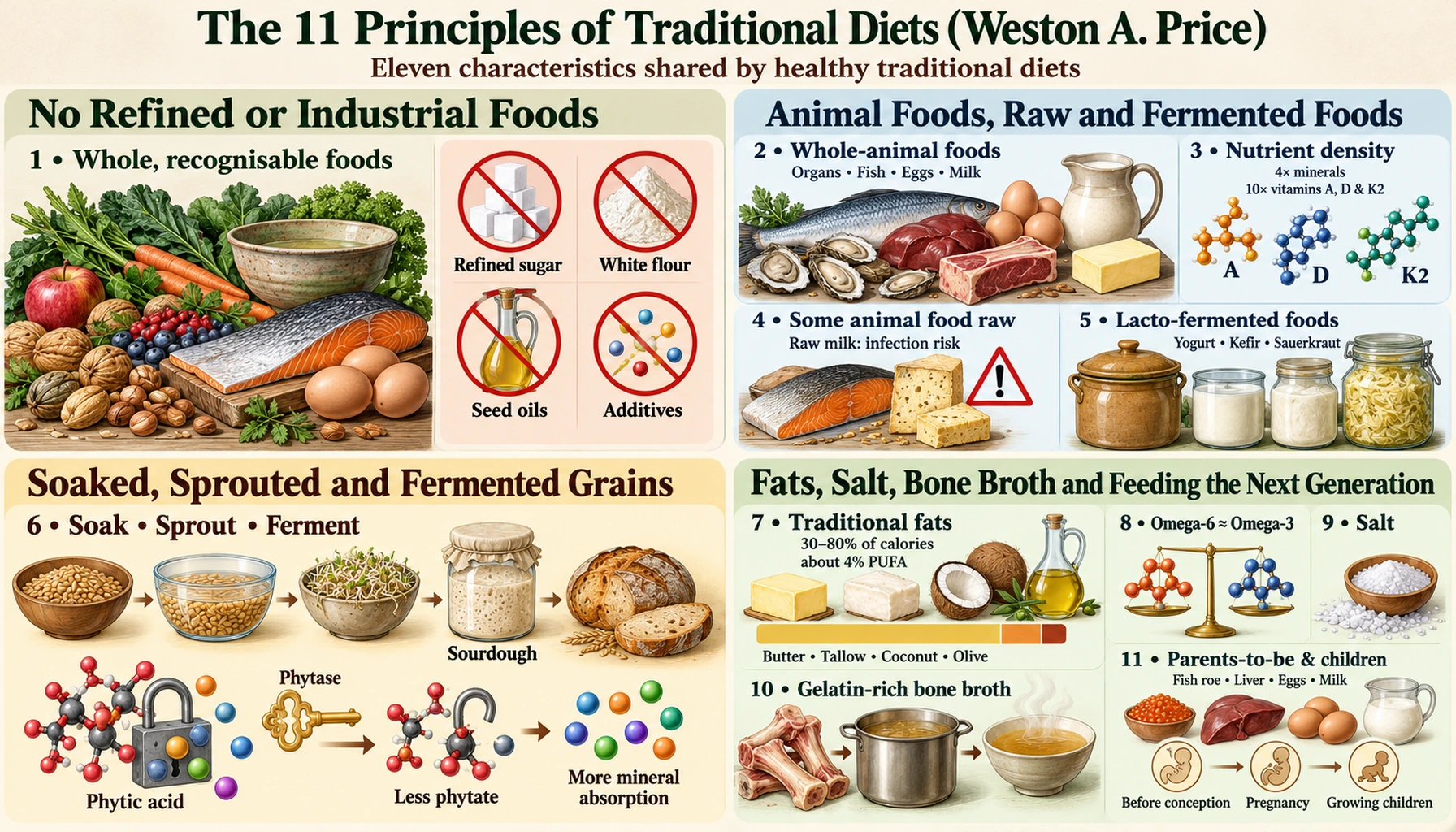
The Weston A. Price Foundation boils Dr. Price’s 1930s field studies down to eleven “characteristics of traditional diets” — from “no refined foods” to “special foods for parents-to-be.” This page takes them one at a time: what each principle says in plain words, why traditional cultures ate that way, what modern research shows, how strong that evidence is, and one thing you can do this week. The short version: several principles are strongly backed by modern trials, several are partly supported, and two are genuinely debated — one of them carries a documented safety risk.
Table of Contents
- Principle 1: No Refined or Industrial Foods
- Principles 2 & 3: Animal Foods and Nutrient Density
- Principles 4 & 5: Raw Animal Foods and Fermented Foods
- Principle 6: Soaked, Sprouted and Fermented Grains
- Principles 7 & 8: Fat Amount and the Omega Balance
- Principles 9 & 10: Salt and Bone Broth
- Principle 11: Feeding Parents-to-Be and Children
- The Evidence Scorecard
- Safety Notes
- Key Research Papers
- Connections
- Featured Videos
Principle 1: No Refined or Industrial Foods
A note on numbering first. In the Foundation’s booklet Timeless Principles of Healthy Traditional Diets, principle 8 (the omega-6 and omega-3 balance) is printed on its own beside the fats panel, so the main list appears to jump from 7 to 9. Nothing is missing — there are eleven principles, and this page presents all eleven in order, grouping neighbours that belong together.
What the diet says. The healthy groups Price visited ate no refined or “denatured” foods. The booklet’s list of things they never ate includes refined sugar and high-fructose corn syrup, white flour, canned foods, skim and low-fat milk, industrial seed oils, protein powders, synthetic vitamins and artificial additives and colourings. It also lists pasteurized and homogenized milk, a point we come back to under principle 4.
Why traditional cultures did it. They had no choice — and that was Price’s point. In his 1939 book Nutrition and Physical Degeneration he described the same peoples before and after white flour, sugar, canned goods and vegetable oils reached them by road or by trading ship, and reported that tooth decay and narrower dental arches followed the new foods within a generation. Those were careful field observations, not controlled experiments, but they framed the question well.
What modern evidence shows. The strongest single test is a 2019 inpatient trial at the U.S. National Institutes of Health (Hall and colleagues). Twenty adults lived in a hospital research unit for four weeks: two weeks on an ultra-processed diet and two weeks on an unprocessed one, with meals matched for calories offered, sugar, salt, fat, fibre and protein. Everyone could eat as much or as little as they liked. On the ultra-processed diet people ate about 508 more calories a day and gained about 0.9 kg; on the unprocessed diet they lost about 0.9 kg. Think of it as the same menu on paper, but one version slides down much faster.
Evidence tier: randomized controlled trial in humans (small, short, but tightly controlled), backed by many large cohort studies. The core of principle 1 — build meals from whole, recognisable foods — is strongly supported. Some individual items on the booklet’s list (pasteurized milk, every synthetic vitamin) are separate questions and are not settled by this trial.
One practical action: pick the one packaged food you eat most often — a breakfast cereal, a snack bar, a bottled dressing — and replace it this week with a whole-food version: eggs and fruit, a handful of nuts, or olive oil with lemon and salt. For the bigger picture see our page on ultra-processed foods.
Principles 2 & 3: Animal Foods and Nutrient Density
Principle 2 — every culture ate some animal food, the whole animal
What the diet says. Every traditional culture Price studied ate some animal food — fish and shellfish, birds, land and sea mammals, eggs, milk products, even insects — and ate the whole animal: muscle, organs, blood, bones and fat. Organs and fat were the prized parts, not the leftovers.
Why. In a world without supplements, the liver, the roe, the marrow and the fat were where the scarce nutrients were concentrated. Price reported that many groups set these parts aside for pregnant women and children.
What modern evidence shows. A 2022 analysis by Beal and Ortenzi built a global food-composition database and ranked foods by how densely they supply the six micronutrients most often lacking worldwide: iron, zinc, folate, vitamin A, calcium and vitamin B12. The top sources were organ meats, small fish, dark green leafy vegetables, bivalves such as clams and mussels, crustaceans, goat, beef, eggs and milk. That is close to a description of a traditional diet’s prized foods.
Evidence tier: food-composition analysis plus anthropology (traditional use). On nutrient density, principle 2 is strongly supported. Whether more or less red meat changes long-term disease risk is a separate, still-argued question.
One practical action: add one serving of organ meat a week. A good starter is 2–3 ounces (about the size of a deck of cards) of beef liver or chicken liver, sliced thin and fried in butter with onions. More on this in our organ meats guide.
Principle 3 — four times the minerals, ten times the fat-soluble vitamins
What the diet says. The booklet states that traditional diets supplied at least 4 times more minerals and water-soluble vitamins, and 10 times more of the fat-soluble vitamins A, D and K2, than the average American diet.
Why. These multipliers come from Price’s own laboratory analyses of the foods he collected in the 1930s, compared with the American diet of his day.
What modern evidence shows. The direction is very plausible: a diet built from the foods at the top of the Beal ranking will out-supply one built from white flour, sugar and seed oils by a wide margin. The exact 4× and 10× figures, though, have not been re-measured with modern methods on comparable diets, and both the traditional and modern diets vary enormously from place to place.
Evidence tier: historical field analyses (traditional use) with modern composition data supporting the direction. Partly supported: the idea is sound; the precise multipliers are best read as Price’s estimates. Our sister article on vitamins A, D and K2 covers the fat-soluble side in depth.
One practical action: swap one low-nutrient side (white bread, chips) for a high-nutrient one each day — an egg, a tin of sardines with bones, a cup of dark leafy greens with butter.
Principles 4 & 5: Raw Animal Foods and Fermented Foods
Principle 4 — some animal food eaten raw
What the diet says. All traditional cultures cooked some of their food, but all ate a portion of their animal foods raw — raw fish, raw milk and cheese, cured or fermented meat. The booklet’s guidelines recommend raw whole milk in particular.
Why. Raw foods keep heat-sensitive vitamins and enzymes intact, and many peoples simply had traditions — ceviche, sashimi, steak tartare, aged raw-milk cheese — that long predate refrigeration.
What modern evidence shows. Cooking does reduce some vitamins, but raw animal foods are also the classic route for food-borne infection. A U.S. Centers for Disease Control and Prevention analysis (Mungai and colleagues, 2015) found that outbreaks linked to unpasteurized milk rose from 30 in 2007–2009 to 51 in 2010–2012. 77% were caused by Campylobacter, and 81% involved milk bought in states where its sale was legal. Children, pregnant women, older adults and anyone with weak immunity carry most of the risk of serious illness, including kidney failure from certain E. coli strains and miscarriage from Listeria.
Evidence tier: outbreak surveillance (government data) showing documented harm; benefit claims rest mainly on traditional use and small studies. Debated — and the harm side is better documented than the benefit side. Our raw vs pasteurized milk page weighs both.
One practical action: if you want the “raw” benefit with less risk, choose aged raw-milk cheeses, sushi-grade fish from a trusted supplier, and fermented dairy — and skip raw milk, raw-milk soft cheeses, raw fish and raw shellfish entirely during pregnancy and for young children.
Principle 5 — lacto-fermented foods every day
What the diet says. Traditional diets were rich in food enzymes and beneficial bacteria from lacto-fermented vegetables, fruit, drinks, dairy, meat, fish and condiments — sauerkraut, kimchi, kefir, yogurt, fermented fish sauce.
Why. Fermentation was how people kept food through winter without a fridge. Lactic-acid bacteria turn sugars into acid, which preserves the food and adds a sour tang.
What modern evidence shows. In a 2021 Stanford randomized trial (Wastyk and colleagues), healthy adults were assigned to either a high-fibre diet or a high-fermented-food diet for 17 weeks, with 18 people per group. The fermented-food group — eating foods like yogurt, kefir, sauerkraut, kimchi and kombucha several times a day — showed a steady rise in gut microbiome diversity and a fall in inflammatory markers. The high-fibre group, surprisingly, did not gain diversity over that time.
Evidence tier: one small randomized controlled trial in humans, plus supportive cohort and laboratory work. Partly supported and promising; larger trials are needed before claiming specific disease benefits.
One practical action: add a forkful of unpasteurized sauerkraut or a small glass of kefir to one meal a day, and build up to several servings. See our fermented foods section for how to make your own.
Principle 6: Soaked, Sprouted and Fermented Grains
What the diet says. Seeds, grains and nuts were soaked, sprouted, fermented or naturally leavened (sourdough) to neutralise their natural “anti-nutrients” — enzyme inhibitors, oxalates, tannins and, above all, phytic acid.
Why. Phytic acid is the seed’s phosphorus store. In the gut it grips iron, zinc, calcium and magnesium tightly, so much of those minerals passes straight through. Soaking and fermenting wake up the grain’s own enzyme, phytase, which breaks phytic acid apart. Picture a padlock on the minerals: phytase is the key, and warm, slightly sour water is what gets it turning.
What modern evidence shows. Two lines of evidence fit together. In the laboratory (an in vitro study, not in people), Leenhardt and colleagues (2005) found that a gentle souring of the dough to about pH 5.5 (mildly acidic) — what sourdough fermentation produces — broke down about 70% of whole-wheat phytate, compared with about 40% without leavening or acidification. And in humans, Hurrell and colleagues (2003) measured iron absorption from cereal porridges with labelled iron: removing the phytate raised absorption from wheat porridge from 0.99% to 11.54%, and from maize from 1.80% to 8.92%. That study removed phytate with an added enzyme rather than by home soaking, so it shows how much phytate matters, not exactly how much a kitchen soak achieves.
Evidence tier: human mineral-absorption studies plus in vitro chemistry. Strongly supported for the mechanism — less phytate means more minerals absorbed — and especially relevant for anyone whose diet leans on grains and beans.
One practical action: soak brown rice, oats or beans overnight in warm water with a spoonful of yogurt whey or lemon juice, then rinse and cook; or choose a genuine long-fermented sourdough loaf. Our soaking and phytic acid page and the sister article on soaking, sprouting and fermenting give step-by-step methods.
Principles 7 & 8: Fat Amount and the Omega Balance
Principle 7 — 30 to 80 percent fat, only about 4 percent polyunsaturated
What the diet says. Total fat in traditional diets ranged from 30% to 80% of calories, but only about 4% of calories came from polyunsaturated fats (PUFA), and those came naturally from grains, legumes, nuts, fish, animal fats and vegetables. The rest of the fat was saturated and monounsaturated — butter, tallow, lard, coconut and olive oil.
Why. Before industrial presses and solvent extraction, it was hard to get much oil out of a seed. Fat came from animals, dairy, coconuts and olives.
What modern evidence shows. The change in the modern diet is real and well measured. Blasbalg and colleagues (2011) estimated from U.S. food-supply data that linoleic acid — the main omega-6 PUFA in seed oils — rose from 2.79% of calories in 1909 to 7.21% in 1999, driven mainly by a more than thousand-fold rise in soybean oil. So by 1999 linoleic acid alone supplied nearly double the booklet’s figure for all polyunsaturated fat.
What that does to health is where the argument starts. Recovered data from the Sydney Diet Heart Study, a 1966–73 randomized trial re-analysed by Ramsden and colleagues (2013), found that men with heart disease told to replace saturated fat with safflower oil had higher death rates than controls (17.6% vs 11.8%). On the other side, a 2020 Cochrane review (Hooper and colleagues; 15 trials, about 59,000 people) found that cutting saturated fat lowered combined cardiovascular events by about 21%, but had little or no effect on deaths from any cause. Both are honest findings, and they do not yet add up to one clear answer.
Evidence tier: randomized trials and a meta-analysis that point in different directions. Debated. The 30–80% fat range is a description of real diets, not a proven target; the shift toward much more seed-oil linoleic acid is well documented, and its full effect is still being worked out.
The top bar runs from 0 to 100% of calories; the lower bars are drawn on a zoomed scale from 0 to 10% so the small polyunsaturated shares can be compared.
One practical action for principle 7: cook with the traditional fats — butter, ghee, tallow, lard, coconut oil — and dress salads with genuine olive oil, rather than bottled “vegetable” oil. Our seed oils page and the sister article on traditional fats vs industrial seed oils go further.
Principle 8 — omega-6 and omega-3 in nearly equal amounts
What the diet says. Traditional diets contained nearly equal amounts of omega-6 and omega-3 essential fatty acids.
Why. Wild game, grass-fed animals, fish, seafood and wild greens all carry omega-3s, while concentrated sources of omega-6 (seed oils) did not exist.
What modern evidence shows. In a widely cited 2002 review, Simopoulos estimated that humans evolved on an omega-6 to omega-3 ratio of about 1 to 1, whereas Western diets run at about 15/1 to 16.7/1. Blasbalg’s U.S. data point the same way: the ratio of linoleic acid to alpha-linolenic acid (the plant omega-3) rose from 6.4 in 1909 to 10.0 in 1999, and estimated tissue omega-3 status fell. Raising omega-3 intake from fish is well supported for heart health; whether the ratio itself is the right thing to target, as opposed to simply eating more omega-3 and less seed oil, is still argued.
Evidence tier: evolutionary estimates, food-supply data and a large omega-3 trial literature. Partly supported: the modern imbalance is real; the exact 1-to-1 target has not been tested as such.
One practical action: eat oily fish such as sardines, salmon, mackerel or herring twice a week, and choose eggs and meat from pasture-raised animals when you can. More on our omega-3 fatty acids page.
Principles 9 & 10: Salt and Bone Broth
Principle 9 — all traditional diets contain salt
What the diet says. Every traditional diet included salt, whether from seawater, salt deposits, salted fish or the ashes of salty plants. The booklet favours unrefined sea salt.
Why. Sodium and chloride are essential: they keep blood volume up, carry nerve signals and make stomach acid. Salt was also the main way to preserve meat and fish.
What modern evidence shows. The best-known large study here is the PURE study (O’Donnell and colleagues, 2014), which estimated sodium intake from morning urine samples of 101,945 people in 17 countries and followed them for an average of 3.7 years. Compared with an estimated sodium intake of 4 to 6 grams a day (roughly 10 to 15 grams of salt, or about 2 to 2½ teaspoons), people above 7 grams of sodium a day had more deaths and heart events (odds ratio 1.15, meaning about 15% higher odds) — but so did people below 3 grams a day (odds ratio 1.27, about 27% higher odds). That J-shaped or U-shaped curve sits uneasily with guidelines that advise much less sodium, and the debate about measurement methods is ongoing. The high-salt risk was strongest in people with high blood pressure.
Evidence tier: a very large cohort study (observational, so it cannot prove cause). Partly supported: salt is clearly essential and very low intakes may not be better; the ideal amount is still disputed, and people with high blood pressure or kidney disease should follow their own medical advice.
One practical action: salt home-cooked whole food to taste, and get your salt mostly from your own salt shaker rather than from packaged and restaurant foods, which supply most of the sodium in a modern diet. See our sodium page.
Principle 10 — animal bones, usually as gelatin-rich broth
What the diet says. All traditional cultures used animal bones, usually simmered into gelatin-rich bone broths for soups, stews and sauces.
Why. Long simmering pulls gelatin, minerals and flavour from bones, joints and skin that would otherwise be wasted — a frugal way to get more from every animal.
What modern evidence shows. Broth is a good, satisfying food, but its content varies widely. A 2019 laboratory analysis (Alcock and colleagues) measured collagen-building amino acids such as glycine, proline and hydroxyproline in home-made, café and commercial broths. Broth made to a standard recipe supplied significantly less of them than a 20-gram dose of the collagen supplements used in research, and broths made to non-standard recipes varied enormously from one recipe to the next.
Evidence tier: traditional use plus food-composition analysis; no clinical trials of bone broth for joint or gut outcomes. Partly supported as a nourishing, thrifty food; specific healing claims remain unproven.
One practical action: keep a bag of bones and vegetable trimmings in the freezer; when it is full, simmer them with a splash of vinegar for 8–24 hours and use the broth for soups and for cooking brown rice. Recipes on our bone broth page.
Principle 11: Feeding Parents-to-Be and Children
What the diet says. Traditional cultures protected the next generation by giving special nutrient-rich animal foods to both parents before conception, to pregnant women and to growing children; by spacing children; and by teaching the young how to eat this way.
Why. Price described groups that set aside foods such as fish roe, liver and butter from spring grass for couples planning a family — an investment in the child before it was conceived.
What modern evidence shows. Two parts of this principle have strong modern support. First, nutrient needs really do rise before and during pregnancy, and the nutrient-dense foods ranked highest by Beal and Ortenzi — organs, small fish, eggs, milk — are exactly the ones that cover them. Second, spacing: a meta-analysis of 67 studies by Conde-Agudelo and colleagues (2006) found that, compared with a gap of 18 to 23 months between one birth and the next conception, a gap shorter than 6 months was linked with higher risks of preterm birth (odds ratio 1.40), low birth weight (1.61) and a baby small for its age (1.26).
There is one important caution. Preformed vitamin A, found in liver and cod liver oil, is essential in pregnancy but harmful in excess. In a study of 22,748 pregnant women, Rothman and colleagues (1995) found that women taking more than 10,000 IU of vitamin A a day from supplements had about 4.8 times the rate of certain birth defects of the head, face and heart of women taking 5,000 IU or less. A weekly serving of liver is very different from daily high-dose supplements stacked on top of it — count all sources.
Evidence tier: meta-analysis of observational studies (spacing), food-composition data (nutrient density) and a large cohort study (vitamin A harm). Strongly supported, with the vitamin A ceiling as a firm limit. Our sister article on preconception, pregnancy and childhood nutrition covers the details.
One practical action: if you are planning a pregnancy, start three to six months ahead with eggs every day, oily fish twice a week and a small weekly portion of liver — and add up the preformed vitamin A from all sources — liver, cod liver oil, fortified foods and supplements — so the total stays under the upper limit of 10,000 IU (3,000 mcg RAE) a day. For scale, 85 g (3 oz) of beef liver holds about 6,580 mcg RAE (USDA FoodData Central 168627, a value for pan-fried liver), so one serving is above the daily limit on its own — which is why liver is a weekly food. More in our vitamin A toxicity guide.
The Evidence Scorecard
Here are all eleven principles sorted by how well modern research backs them. “Strongly supported” means human trials or large analyses agree; “partly supported” means the mechanism is sound or small trials are encouraging, but the booklet’s specific claim goes beyond the data; “debated” means good studies conflict or there is documented harm.
Strongly supported
- Principle 1 — no refined or industrial foods. An inpatient randomized trial showed people eat about 508 more calories a day on ultra-processed food.
- Principle 2 — animal foods, including organs. Organ meats, small fish, shellfish, eggs and milk top modern rankings of micronutrient density.
- Principle 6 — soaked, sprouted and fermented grains. Less phytic acid means substantially more iron absorbed in human studies.
- Principle 11 — special foods for parents-to-be and children, and spacing births. Nutrient needs rise in pregnancy, and short birth intervals carry measurable risks — with a firm ceiling on supplemental vitamin A.
Partly supported
- Principle 3 — four and ten times the nutrients. The direction is right; the exact multipliers are Price’s 1930s estimates.
- Principle 5 — lacto-fermented foods. One small randomized trial found more microbiome diversity and less inflammation; more trials needed.
- Principle 8 — omega-6 about equal to omega-3. The modern imbalance is well documented; the 1-to-1 target has not been tested directly.
- Principle 9 — salt. Salt is essential and very low intake may not help; the ideal amount is still disputed.
- Principle 10 — bone broth. A nourishing, thrifty food with variable content; healing claims are untested.
Debated
- Principle 4 — some animal food raw. Raw milk is linked to documented outbreaks; benefits rest mostly on tradition and small studies.
- Principle 7 — 30–80% fat with about 4% polyunsaturated. Trials on swapping saturated fat for seed oils point in different directions.
For a claim-by-claim look at the rest of the booklet, see the sister article The Booklet’s Claims Checked Against the Evidence; to put the principles into practice, start with How to Start.
Safety Notes
- Raw milk and raw animal foods. These carry real infection risk (Campylobacter, E. coli, Listeria, Salmonella). Avoid them in pregnancy, for infants and young children, for older adults and for anyone with a weakened immune system.
- Vitamin A in pregnancy. Liver and cod liver oil are rich in preformed vitamin A. The upper limit of 10,000 IU (3,000 mcg RAE) a day applies to preformed vitamin A from all sources, including liver and cod liver oil, not only supplements and fortified foods. About 85 g (3 oz) of beef liver holds roughly 6,580 mcg RAE (USDA FoodData Central 168627, pan-fried), so a single serving is already above the daily limit — treat liver as a weekly food, not a daily one, especially in pregnancy.
- Salt. People with high blood pressure, heart failure or kidney disease should follow their own care team’s sodium advice rather than a general principle.
- Higher-fat eating. If you have a known blood-fat disorder such as familial hypercholesterolaemia, or a history of gallbladder or pancreas problems, make big changes in fat intake with your doctor’s monitoring.
- Fermented foods. Home ferments should smell pleasantly sour; discard anything slimy, mouldy or foul. People with histamine intolerance may react to large servings.
Key Research Papers
- Hall KD, Ayuketah A, Brychta R, et al. (2019). Ultra-Processed Diets Cause Excess Calorie Intake and Weight Gain: An Inpatient Randomized Controlled Trial of Ad Libitum Food Intake. Cell Metabolism. — PubMed PMID: 31105044
- Beal T, Ortenzi F (2022). Priority Micronutrient Density in Foods. Frontiers in Nutrition. — PubMed PMID: 35321287
- Mungai EA, Behravesh CB, Gould LH (2015). Increased outbreaks associated with nonpasteurized milk, United States, 2007-2012. Emerging Infectious Diseases. — PubMed PMID: 25531403
- Wastyk HC, Fragiadakis GK, Perelman D, et al. (2021). Gut-microbiota-targeted diets modulate human immune status. Cell. — PubMed PMID: 34256014
- Hurrell RF, Reddy MB, Juillerat MA, Cook JD (2003). Degradation of phytic acid in cereal porridges improves iron absorption by human subjects. American Journal of Clinical Nutrition. — PubMed PMID: 12716674
- Leenhardt F, Levrat-Verny MA, Chanliaud E, Rémésy C (2005). Moderate decrease of pH by sourdough fermentation is sufficient to reduce phytate content of whole wheat flour through endogenous phytase activity. Journal of Agricultural and Food Chemistry. — PubMed PMID: 15631515
- Blasbalg TL, Hibbeln JR, Ramsden CE, Majchrzak SF, Rawlings RR (2011). Changes in consumption of omega-3 and omega-6 fatty acids in the United States during the 20th century. American Journal of Clinical Nutrition. — PubMed PMID: 21367944
- Simopoulos AP (2002). The importance of the ratio of omega-6/omega-3 essential fatty acids. Biomedicine & Pharmacotherapy. — PubMed PMID: 12442909
- Ramsden CE, Zamora D, Leelarthaepin B, et al. (2013). Use of dietary linoleic acid for secondary prevention of coronary heart disease and death: evaluation of recovered data from the Sydney Diet Heart Study and updated meta-analysis. BMJ. — PubMed PMID: 23386268
- Hooper L, Martin N, Jimoh OF, et al. (2020). Reduction in saturated fat intake for cardiovascular disease. Cochrane Database of Systematic Reviews. — PubMed PMID: 32428300
- O'Donnell M, Mente A, Rangarajan S, et al.; PURE Investigators (2014). Urinary sodium and potassium excretion, mortality, and cardiovascular events. New England Journal of Medicine. — PubMed PMID: 25119607
- Alcock RD, Shaw GC, Burke LM (2019). Bone Broth Unlikely to Provide Reliable Concentrations of Collagen Precursors Compared With Supplemental Sources of Collagen Used in Collagen Research. International Journal of Sport Nutrition and Exercise Metabolism. — PubMed PMID: 29893587
- Conde-Agudelo A, Rosas-Bermúdez A, Kafury-Goeta AC (2006). Birth spacing and risk of adverse perinatal outcomes: a meta-analysis. JAMA. — PubMed PMID: 16622143
- Rothman KJ, Moore LL, Singer MR, Nguyen US, Mannino S, Milunsky A (1995). Teratogenicity of high vitamin A intake. New England Journal of Medicine. — PubMed PMID: 7477116
PubMed Topic Searches
Connections
- All Remedies
- Weston A. Price Diet (hub)
- Diets and Fasting
- Dr. Price and His Field Studies
- Vitamins A, D and K2
- Traditional Fats vs Seed Oils
- Soaking, Sprouting and Fermenting
- Claims Checked Against the Evidence
- Organ Meats
- Bone Broth
- Fermented Foods
- Seed Oils
- Ultra-Processed Foods
- Raw vs Pasteurized Milk
- Vitamin A
- Mediterranean Diet