Weston A. Price Diet
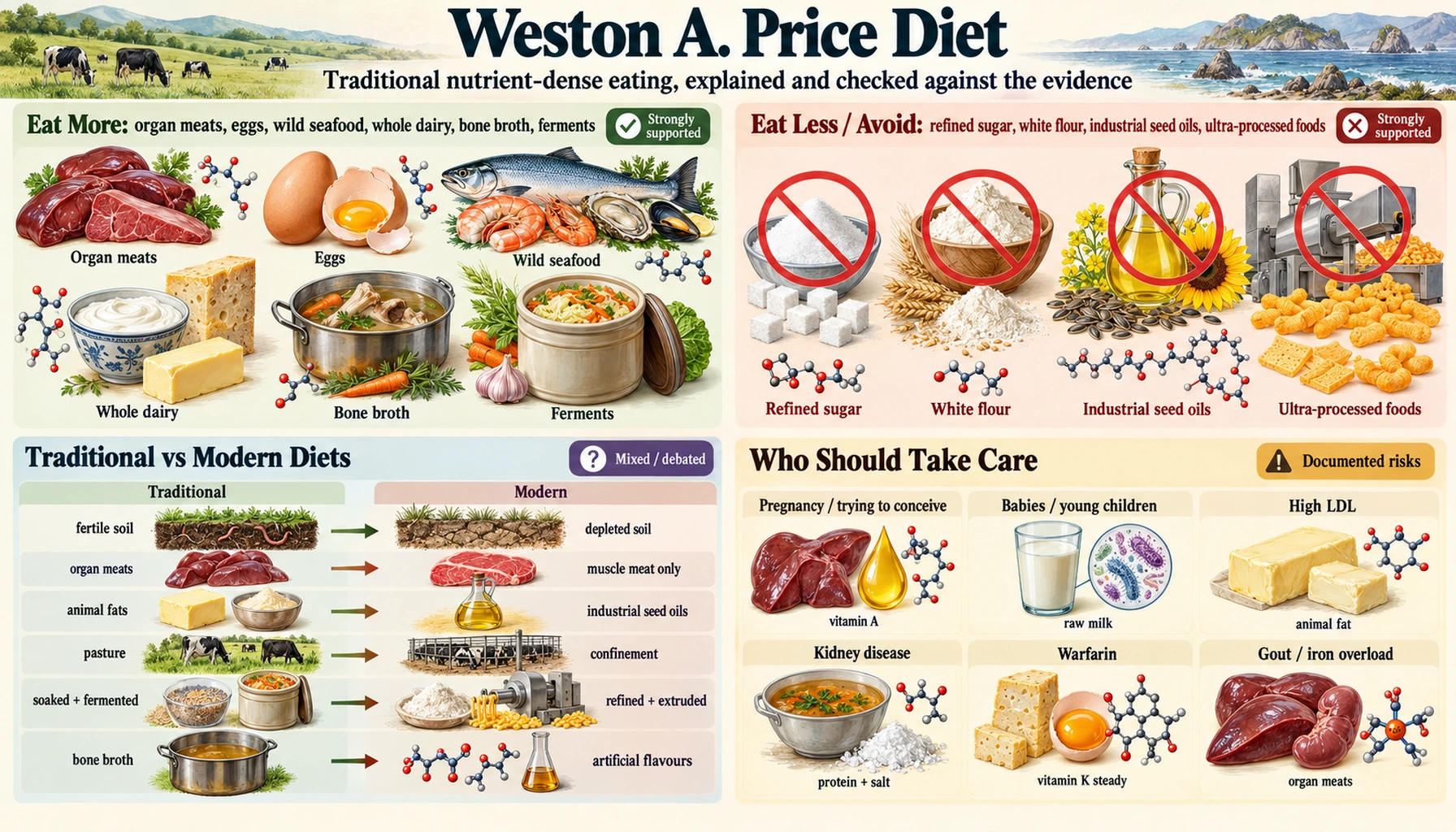
The Weston A. Price diet is a whole-food way of eating built on the 1930s field studies of a Cleveland dentist who went looking for communities without tooth decay. It asks you to eat the foods those communities prized — organ meats, eggs, seafood, whole dairy, animal fats, bone broth and fermented foods — and to prepare grains, beans and nuts the slow, traditional way. This hub gives you the whole diet in one page and links nine deep-dive guides; every claim is paired with what the evidence actually shows, and how strong that evidence is.
If you have heard the name but never looked closely, the short version is this: the diet’s strongest ideas — cut ultra-processed food, refined sugar and trans fat; eat more nutrient-dense whole foods; add fermented foods — are now backed by good human research. A few of its positions, most of all its relaxed view of saturated fat, are honestly debated. Two of its practical recommendations — raw milk and very high doses of vitamin A from cod liver oil — carry documented risks that you deserve to know before you start. New here? Begin with the step-by-step starter plan.
Deep-Dive Articles
How to Start the Weston A. Price Diet: Plan, Shopping List and Menu
Start here. A gentle, one-change-at-a-time plan, a shopping list in kitchen terms and a week of simple meals that put the principles on the plate.
Read the deep dive →Weston A. Price and His 1930s Field Studies: A History
How a dentist spent close to a decade visiting isolated communities on five continents, counting cavities and analysing their food. What later science confirmed from his observations, and what it could not test.
Read the deep dive →The 11 Principles of Traditional Diets
Each of the eleven “characteristics of traditional diets” in plain words, why traditional cultures ate that way, and what modern research shows. A scorecard rates every principle as strong, partly supported or debated.
Read the deep dive →Fat-Soluble Activators: Vitamins A, D and K2 (Activator X)
The diet’s central idea: three fat-soluble vitamins that help the body use minerals. How vitamin K2 steers calcium into bone, which foods supply each vitamin, and where the vitamin A ceiling sits.
Read the deep dive →Traditional Fats vs Industrial Seed Oils
Butter, tallow, lard, coconut and olive oil versus refined seed oils. Where the science agrees (trans fat, frying breakdown) and where the saturated-fat debate is still live.
Read the deep dive →Traditional Food Preparation: Soaking, Sprouting and Fermenting
Why grandmothers soaked beans overnight and made sourdough. How phytic acid binds minerals, how soaking and fermenting release them, and simple methods for a home kitchen.
Read the deep dive →Nutrient-Dense Foods: Organ Meats, Eggs, Seafood, Bone Broth and Whole Dairy
The foods the diet builds on, ranked by how many hard-to-get nutrients they deliver per bite. Practical portions, and the cautions that come with liver and raw dairy.
Read the deep dive →Preconception, Pregnancy and Childhood Nutrition
The traditional practice of special foods for parents-to-be, set beside modern pregnancy nutrition. Where the diet aligns with current guidance and where pregnancy calls for extra care.
Read the deep dive →The Booklet’s Claims Checked Against the Evidence
The diet’s best-known claims, one at a time, each with an evidence tier. Plainly marked: what is well supported, what is partly supported, and what later research did not confirm.
Read the deep dive →Table of Contents
What the Diet Is in One Minute
In the early 1930s Dr. Weston A. Price, a dentist, began travelling to communities that still ate their traditional foods — villages in the Swiss Alps, Gaelic islanders in the Outer Hebrides, and indigenous peoples in North and South America, Africa, Australia, New Zealand and the South Pacific. He reported that people eating their ancestral diets had far less tooth decay and better-formed dental arches than their neighbours who had switched to white flour, sugar and canned goods. His 1939 book, Nutrition and Physical Degeneration, set out those observations. (Evidence tier: field observation — careful and influential, but not a controlled trial.)
The Weston A. Price Foundation, founded in 1999, turned those observations into a modern eating plan. Its booklet, Timeless Principles of Healthy Traditional Diets, boils it down to a few ideas:
- Eat real food. Nothing refined, industrial or loaded with additives.
- Eat the whole animal. Organ meats, bones and fat as well as muscle meat, from animals raised on pasture.
- Prize the fat-soluble vitamins. Vitamins A, D and K2 — found in liver, egg yolks, butter, fish eggs and shellfish — which Price saw as the “activators” that let the body use minerals.
- Prepare plant foods the slow way. Soak, sprout, ferment or sour-leaven grains, beans and nuts.
- Feed the next generation first. Extra nutrient-rich foods for parents-to-be, pregnant women and growing children.
Think of it as the opposite of a packaged-food diet: a kitchen that runs on a stockpot, a crock of sauerkraut and a dish of butter. It is not low-carb by design and not low-fat by any measure — the booklet describes traditional diets drawing 30 to 80 percent of their calories from fat. The full story of Price’s travels is in the History deep dive.
The 11 Principles at a Glance
The booklet lists eleven “characteristics of traditional diets.” Here they are in our own words; each one is unpacked, with its evidence, in The 11 Principles of Traditional Diets.
- No refined foods — no white sugar, white flour, industrial seed oils, protein powders, synthetic vitamins or artificial additives.
- Some animal food in every culture — and the whole animal, with organs and fat preferred.
- Far more nutrients — Price reported traditional diets supplying at least four times the minerals and water-soluble vitamins, and ten times the fat-soluble vitamins, of the American diet of his day.
- Some animal food eaten raw — alongside cooked food.
- Plenty of fermented food — lacto-fermented vegetables, drinks, dairy, fish and condiments.
- Grains, seeds and nuts soaked, sprouted or fermented — to reduce phytic acid and other anti-nutrients.
- Fat from 30 to 80 percent of calories — with only about 4 percent of calories from polyunsaturated fat, the rest saturated and monounsaturated.
- Roughly equal omega-6 and omega-3 fatty acids.
- Salt in every traditional diet.
- Bones used — usually as gelatin-rich broth.
- Special foods for the next generation — for parents-to-be, pregnancy and childhood, with children spaced apart.
The quick verdict, explained in the deep dive: principles 1, 5, 6 and 10 line up well with modern evidence; the nutrient-density and omega-balance ideas are partly supported; eating animal foods raw and the high-fat target are where the debate and the safety questions sit.
Eat More, Eat Less, Avoid
The booklet gives twenty “Dietary Guidelines” and twenty “Dietary Dangers.” Condensed into a shopping-trip version:
Eat more
- Whole, unprocessed foods, cooked at home.
- Beef, lamb, pork, game, poultry and eggs from pasture-raised animals — and organ meats, especially liver — in small portions, about once a week, because liver is very rich in vitamin A (see the vitamin A note below).
- Wild fish, fish eggs and shellfish.
- Full-fat dairy — whole yogurt, kefir, butter, aged cheese and cream.
- Homemade bone broth, used in soups, stews and sauces.
- Lacto-fermented vegetables such as sauerkraut, a forkful or two with meals.
- Fresh vegetables and fruit, preferably organic, often cooked with butter.
- Whole grains, beans and nuts that have been soaked, sprouted or sour-leavened — brown rice soaked overnight, sourdough bread, soaked almonds.
- Traditional fats: butter, tallow, lard, poultry fat, coconut oil, and extra-virgin olive oil for salads.
Eat less
- Sweeteners of any kind. The booklet allows raw honey and maple syrup “in moderation” and rules out refined sugar.
- Alcohol — wine or beer only in strict moderation with meals.
- Caffeine from coffee, tea and chocolate (the booklet says avoid; many readers treat it as “cut back”).
Avoid
- Packaged snacks, soft drinks, ready meals and sauce mixes — “read labels.”
- Refined sugar, high-fructose corn syrup and fruit juice.
- White flour; the booklet also lists white rice. This site keeps both brown and white rice as whole-food staples, with brown rice preferred for its bran.
- Hydrogenated and partially hydrogenated fats, and refined industrial seed oils — including fried food cooked in them.
- Low-fat and skim dairy, lean-only cuts and egg whites without the yolks: the booklet’s point is that fat carries the vitamins needed to use protein and minerals.
- Protein powders and foods fortified with synthetic vitamins.
- Industrially processed soy foods. Only long-fermented soy in small amounts appears in the booklet’s traditional column; this site does not recommend soy foods.
- Extruded breakfast cereals, quick-rise breads and granola made from unsoaked grains.
- Highly processed luncheon meats and artificial additives.
A few items on the booklet’s list — avoiding microwave ovens, aluminium-containing foods and fluoridated water — go beyond what most food-science reviews address; the Myths and Evidence page takes these one at a time.
Traditional vs Modern Diets
A centrepiece of the booklet is a two-column comparison: traditional diets maximised nutrients, modern diets minimise them. The idea is that a modern food system lost nutrients at every step — in the soil, in how animals are raised, in which parts of the animal we eat, and in how food is processed. Paraphrased:
How does each row hold up? Read it as a list, row by row:
- Fertile soil vs depleted soil — plausible and partly documented for some minerals, but hard to measure on your plate. Partly supported.
- Organ meats vs muscle meat only — strongly supported. A 2022 analysis of which foods deliver the most hard-to-get micronutrients per calorie put organ meats first, followed by small fish, dark leafy greens, shellfish and eggs (Beal and Ortenzi). Food-composition analysis.
- Animal fats vs industrial seed oils — the trans-fat part is settled; the saturated-fat part is debated (see the next section).
- Pasture vs confinement — pasture-raised dairy and eggs tend to carry more omega-3 and fat-soluble vitamins; the health effect of that difference is not well tested. Composition studies.
- Fermented and soaked vs refined and extruded — well supported: refining strips fibre and minerals, and soaking and fermenting reduce phytic acid. Fermented foods raised gut-microbe diversity in a randomised trial (Wastyk 2021).
- Bone broth vs flavour additives — broth is a good way to use the whole animal; specific health claims for broth are mostly untested.
- Unrefined vs refined sweeteners — the bigger point, eating less sugar of any kind, is very well supported, including for teeth (Moynihan and Kelly).
The booklet’s list also contrasts natural vitamins in food with synthetic vitamins, traditional seeds with hybrid seeds, and traditional cooking with microwaving. The broad shift it describes — away from home-cooked whole foods toward refined, packaged food and sweetened drinks — is what nutrition researchers call the “nutrition transition,” documented worldwide alongside rising obesity (Popkin 2012).
What the Evidence Supports and Where It Is Debated
This is the balanced summary; the claim-by-claim version is The Booklet’s Claims Checked Against the Evidence.
Strongly supported
- Cutting ultra-processed food. In a tightly controlled inpatient trial, the same adults ate about 508 more calories a day and gained weight on an ultra-processed diet compared with an unprocessed one, even though both diets were matched for the nutrients on offer (Hall 2019). Randomised controlled trial in humans.
- Avoiding trans fat. Industrial trans fats from partially hydrogenated oils raise heart-disease risk, a conclusion drawn from both metabolic trials and large cohorts (Mozaffarian 2006). The US FDA has since removed partially hydrogenated oils from the food supply. Trials plus cohorts — strong.
- Cutting refined sugar. A systematic review for the World Health Organization found less tooth decay when free sugars stay below 10% of calories, with further benefit below 5% — though the review graded that 5% evidence very low quality (Moynihan and Kelly 2014) — fitting, since tooth decay was Price’s starting question. Systematic review.
- Eating nutrient-dense whole foods. Organ meats, small fish, shellfish, eggs and dairy rank among the richest sources of commonly lacking micronutrients (Beal and Ortenzi 2022). Food-composition analysis.
- Fermented foods. In a 10-week randomised trial, a high-fermented-food diet steadily increased gut-microbiome diversity and lowered inflammatory markers (Wastyk 2021). Small RCT in humans — promising.
Mixed or debated
- Saturated fat. The booklet says saturated fat does not cause heart disease. The Cochrane review of trials found that cutting saturated fat for at least two years reduced combined cardiovascular events by 17% (risk ratio 0.83), but showed no clear effect on deaths from any cause (risk ratio 0.96) or on cardiovascular deaths (Hooper 2020). Saturated fat also raises LDL cholesterol in most people. Honest summary: mixed — the debate is real, and the “no harm at all” position is stronger than the trials show. Details in Traditional Fats vs Industrial Seed Oils.
- Vitamin K2 as “Activator X.” The idea that Price’s unknown factor is vitamin K2 was proposed in 2007, alongside a hypothesis that vitamin K is needed to handle high vitamin D intakes safely (Masterjohn 2007). The biology of K2 activating calcium-handling proteins is well established; the specific toxicity mechanism remains a hypothesis. See the Fat-Soluble Activators deep dive.
Documented risks
- Raw milk. The booklet recommends raw dairy. US outbreaks linked to unpasteurised milk rose from 30 in 2007–2009 to 51 in 2010–2012, mostly caused by Campylobacter (77%), and most involved milk bought in states where its sale was legal (Mungai 2015, CDC). Outbreak surveillance — documented harm. Fermented, aged and pasteurised whole-milk products give you the full fat without that risk.
- Vitamin A ceiling. The booklet suggests cod liver oil providing at least 10,000 IU of vitamin A a day. That figure is the adult tolerable upper limit for preformed vitamin A (3,000 mcg RAE), not a floor. In pregnancy, a large cohort found birth defects linked to supplemental vitamin A above about 10,000 IU a day — roughly 1 baby in 57 born to women above that dose had a defect attributable to it (Rothman 1995). Cohort — documented harm. Liver plus cod liver oil can stack past that line quickly.
Who Should Take Care
For most healthy adults, the whole-food core of this diet is a step up from a packaged-food diet. A few groups should adapt it with their clinician:
- Pregnancy and trying to conceive. Keep preformed vitamin A from liver, cod liver oil and supplements combined under 10,000 IU a day; choose pasteurised dairy and well-cooked meat, eggs and seafood; skip raw milk and raw-milk soft cheese. See Pregnancy and Children.
- Babies and young children. Raw milk carries the highest risk for small children, whose immune systems are still developing.
- High LDL cholesterol or familial hypercholesterolaemia. A diet generous in butter and animal fat can raise LDL sharply in some people. Check a lipid panel before and a few months after switching, and lean on olive oil, fish and eggs if your numbers climb.
- Kidney disease. Large amounts of protein, organ meats, bone broth and unrestricted salt may need limits; your kidney team will set them.
- Taking warfarin. Vitamin K — including K2 from cheese, egg yolks and liver, and especially very high-vitamin-K foods and K2 supplements — changes how warfarin works. Keep your vitamin K intake steady and tell your anticoagulation clinic before changing your diet.
- Gout or iron overload. Organ meats are rich in purines and iron; go easy.
Map of This Guide
The nine deep dives are written to be read in roughly this order, though each stands on its own: start with the practical plan, then the why, then what to eat, how to prepare it, the special cases, and finally the evidence check.
The cards at the top of this page link every stage; the same links appear in the Connections list below.
Key Research Papers
- Hall KD, Ayuketah A, Brychta R, Cai H, Cassimatis T, Chen KY, et al. (2019). Ultra-Processed Diets Cause Excess Calorie Intake and Weight Gain: An Inpatient Randomized Controlled Trial of Ad Libitum Food Intake. Cell Metab. 30(1):67-77.e3. — PubMed PMID: 31105044
- Mozaffarian D, Katan MB, Ascherio A, Stampfer MJ, Willett WC (2006). Trans fatty acids and cardiovascular disease. N Engl J Med. 354(15):1601-13. — PubMed PMID: 16611951
- Hooper L, Martin N, Jimoh OF, Kirk C, Foster E, Abdelhamid AS (2020). Reduction in saturated fat intake for cardiovascular disease. Cochrane Database Syst Rev. 8:CD011737. — PubMed PMID: 32827219
- Moynihan PJ, Kelly SA (2014). Effect on caries of restricting sugars intake: systematic review to inform WHO guidelines. J Dent Res. 93(1):8-18. — PubMed PMID: 24323509
- Beal T, Ortenzi F (2022). Priority Micronutrient Density in Foods. Front Nutr. 9:806566. — PubMed PMID: 35321287
- Wastyk HC, Fragiadakis GK, Perelman D, Dahan D, Merrill BD, Yu FB, et al. (2021). Gut-microbiota-targeted diets modulate human immune status. Cell. 184(16):4137-4153.e14. — PubMed PMID: 34256014
- Popkin BM, Adair LS, Ng SW (2012). Global nutrition transition and the pandemic of obesity in developing countries. Nutr Rev. 70(1):3-21. — PubMed PMID: 22221213
- Masterjohn C (2007). Vitamin D toxicity redefined: vitamin K and the molecular mechanism. Med Hypotheses. 68(5):1026-34. — PubMed PMID: 17145139 (a hypothesis paper, not a trial)
- Rothman KJ, Moore LL, Singer MR, Nguyen US, Mannino S, Milunsky A (1995). Teratogenicity of high vitamin A intake. N Engl J Med. 333(21):1369-73. — PubMed PMID: 7477116
- Mungai EA, Behravesh CB, Gould LH (2015). Increased outbreaks associated with nonpasteurized milk, United States, 2007-2012. Emerg Infect Dis. 21(1):119-22. — PubMed PMID: 25531403
PubMed Topic Searches
- PubMed: Traditional diets and nutrient density
- PubMed: Ultra-processed food and health outcomes
- PubMed: Fermented foods and the gut microbiome
Dr. Price’s own observations are in his 1939 book Nutrition and Physical Degeneration, which has no PubMed record; the diet’s principles are summarised from the Weston A. Price Foundation booklet Timeless Principles of Healthy Traditional Diets (2026 edition).
Connections
- All Remedies
- Diets and Fasting
- Getting Started
- History
- The 11 Principles
- Fat-Soluble Activators
- Traditional Fats and Oils
- Soaking, Sprouting and Fermenting
- Nutrient-Dense Foods
- Pregnancy and Children
- Myths and Evidence
- Organ Meats
- Beef Liver
- Bone Broth
- Fermented Foods
- Eggs
- Olive Oil
- Mediterranean Diet
- Ketogenic Diet
- Vitamin A
- Vitamin D3
- Vitamin K2