Soaking, Sprouting and Fermenting: Traditional Food Preparation
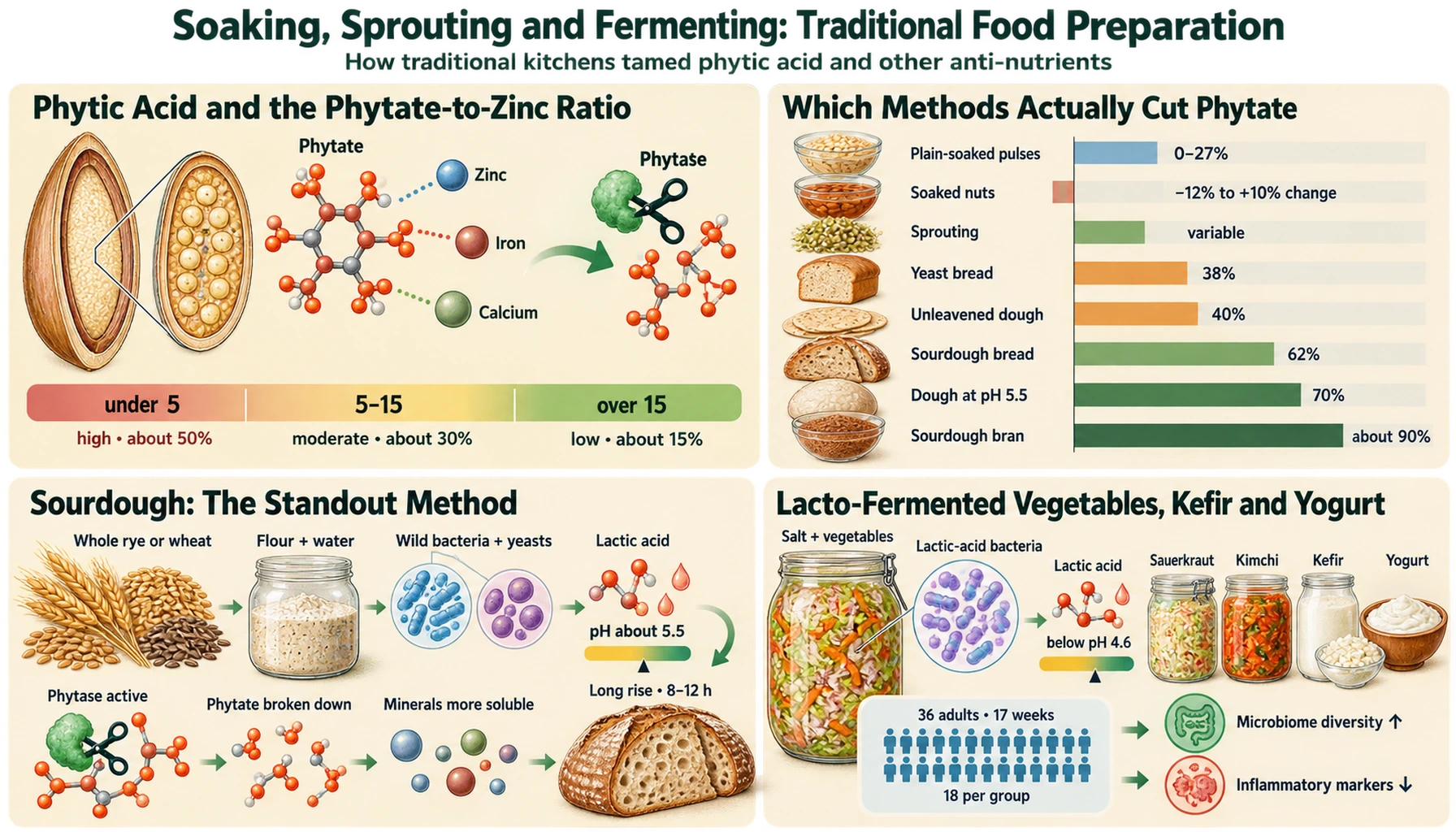
The Weston A. Price diet asks you to soak, sprout, ferment or sour-leaven your grains, beans, nuts and seeds, and to eat lacto-fermented vegetables and dairy regularly. Some of that advice is strongly backed by modern food science — sourdough fermentation breaks down most of the phytate in whole wheat, and a fermented-food diet raised gut-microbe diversity in a randomised trial. Some of it is weaker than it sounds: plain soaking makes only a modest, variable dent in the phytate of beans, and no real change in nuts. This page sorts the methods by what they actually do, then gives you step-by-step kitchen instructions and the safety rules that matter.
Table of Contents
- What the Booklet Recommends
- Phytic Acid and the Other “Anti-Nutrients”
- The Phytate-to-Zinc Ratio
- Which Methods Actually Cut Phytate
- Sourdough: The Standout Method
- Lacto-Fermented Vegetables, Kefir and Yogurt
- Kitchen Instructions, Step by Step
- Safety: Sprouts, Botulism, Beans and Histamine
- Key Research Papers
- Connections
- Featured Videos
What the Booklet Recommends
The Weston A. Price Foundation's booklet Timeless Principles of Healthy Traditional Diets lists the features Dr. Price believed the healthy traditional diets he studied had in common. Two of them are about food preparation:
- Living foods. The booklet says traditional diets were rich in food enzymes and beneficial bacteria, supplied by lacto-fermented vegetables, fruits, drinks, dairy, meat, fish and condiments.
- Prepared seeds. It says traditional peoples soaked, sprouted, fermented or naturally leavened their seeds, grains and nuts to neutralise what it calls anti-nutrients — enzyme inhibitors, oxalates, tannins and phytic acid.
Its practical guidelines turn those into two kitchen rules: buy whole grains, legumes and nuts and prepare them by soaking, sprouting or sour leavening; and eat lacto-fermented vegetables, fruits, beverages and condiments on a regular basis. Its side-by-side chart sets soaked or fermented grains against refined and extruded ones, lacto-fermented vegetables against processed pasteurised pickles, and lacto-fermented drinks against soft drinks.
The idea behind both rules is easy to picture. A seed is a packed lunch for a baby plant, with a lock on it. The lock — phytic acid and a few other compounds — keeps the minerals and protein stored until the seed sprouts. Traditional preparation is a way of picking that lock before we eat the seed. The useful question is how well each method actually works, and that is what the rest of this page measures. For the full list of principles, see The 11 Principles of Traditional Diets.
Evidence tier for the principle itself: traditional use, plus strong laboratory chemistry for phytate breakdown, plus one small randomised trial in humans for fermented foods and the gut.
Phytic Acid and the Other “Anti-Nutrients”
Phytic acid (phytate)
Phytic acid is how seeds store phosphorus. In the gut it grabs hold of iron, zinc and calcium and forms clumps the body cannot absorb, so those minerals pass straight through. A 2018 review in Nutrition Reviews calls phytate a potent inhibitor of iron and zinc absorption and explains why preparation helps: phytate either leaches out into the soaking water or is cut apart by an enzyme into smaller pieces that no longer block absorption (Gibson 2018). Its salt forms, together with the acid, are what nutritionists mean by “phytate”.
Phytase, the seed's own key
The enzyme that cuts phytate apart is called phytase. Seeds carry it and switch it on when they get wet, warm and slightly acidic — the conditions of germination, and also the conditions inside a sourdough. Grains differ a lot: one Swiss laboratory study found high phytase in untreated whole-grain rye, wheat, triticale, buckwheat and barley (Egli 2002), while oats, corn and most beans have much less. That is why a sourdough of rye or wheat clears phytate far better than soaking oats on their own.
Lectins and trypsin inhibitors
Lectins are sticky proteins found in beans and grains; trypsin inhibitors slow the enzyme that digests protein. Both are real, and both are largely destroyed by thorough, wet cooking. Red kidney beans are the cautionary example: a UK review of 50 suspected poisoning incidents between 1976 and 1989 found that people fell ill with vomiting and diarrhoea 1–7 hours after eating beans that were raw or under-heated, and that the bean lectin is inactivated by thorough cooking of well-soaked beans (Rodhouse 1990). So for beans, the important step is the boil, not the soak.
Oxalates and tannins
Oxalates bind calcium and, in susceptible people, contribute to kidney stones. Here soaking genuinely helps: in a Canadian study of peas, lentils, chickpeas, fava beans and common beans, soaking lowered total oxalate by 17–52%, and cooking lowered it further (Shi 2018). Tannins, found in tea, sorghum, some coloured beans and nut skins, reduce iron absorption from plant foods; dehulling, soaking and fermenting reduce them somewhat. For leafy greens, see Spinach: Iron Absorption and Oxalates.
The other side of phytate
Phytate is not purely a villain. In laboratory and animal experiments, phytic acid (also called IP6) acts as an antioxidant and has slowed cancer-cell growth; a review by its main researchers summarises those experimental results and one small pilot clinical trial, and stresses that proper human trials are still needed (Vucenik and Shamsuddin, 2003). Evidence tier: in vitro and animal only for the anticancer effect. The practical balance: if you eat meat, eggs and fish, as this diet does, you get plenty of easily absorbed zinc and iron, and phytate matters less. It matters most for people whose diet is built largely on unprepared whole grains and beans.
The Phytate-to-Zinc Ratio
Nutritionists do not judge phytate by itself. They compare it to the amount of zinc in the same meal or diet, counted molecule for molecule — the phytate-to-zinc molar ratio. Think of it as how many locks there are for every key.
The 1996 FAO/IAEA/WHO expert report on trace elements, as summarised in the later FAO/WHO report on vitamin and mineral requirements, sorted diets into three bands: a ratio under 5 means high zinc availability (roughly 50% of the zinc absorbed), 5 to 15 means moderate (roughly 30%), and over 15 means low (roughly 15%). The International Zinc Nutrition Consultative Group's 2004 technical document uses a similar approach, with 18 as its cut-off for unrefined, cereal-based diets (IZiNCG 2004). These ratios are now standard tools for estimating zinc needs by diet type (Gibson 2018).
How common is a ratio above 15? When nutrition researchers in China analysed 60 everyday cereal- and soy-based foods, 31 of the 60 had a phytate-to-zinc molar ratio above 15 (Ma 2005). In a balance study in adult men, a diet with ordinary whole wheat bran had a ratio of about 12, and one with dephytinised bran about 1.2 (Morris and Ellis, 1989) — the same authors noted that the body partly adjusts, and that a higher zinc intake softens the effect.
The ratio explains why the Price diet's two halves work together. Preparing grains well pushes the ratio down from the phytate side; eating animal foods pushes it down from the zinc side. For more on the minerals themselves, see Zinc and Iron.
Which Methods Actually Cut Phytate
Here the evidence gives a clear, slightly surprising answer: the big drops come from fermentation and acid, not from soaking. The chart below shows the percentage of starting phytate each method broke down in the studies cited on this page. No study we cite measured roasting, so it is left out rather than guessed.
Soaking: modest at best for phytate
Soaking is the step most people associate with this diet, and it is the weakest one for phytate — weak, but not always zero. Results differ a great deal from study to study. In one Canadian study, soaking peas, lentils, chickpeas, fava beans and common beans in distilled water had no impact on phytic acid at all (0% on the chart above), even though it cut oxalate (Shi 2018). In a study of velvet bean (Mucuna pruriens), a tropical pulse, a distilled-water soak lowered phytic acid by 27% (Vijayakumari 1996). Reviews list soaking among the traditional methods that can lower phytate, and explain that how much depends on the legume and on whether the soaking conditions suit its own phytase (Sandberg 2002; Li 2024). So the fair summary is a drop somewhere between nothing and about a quarter in these studies — far smaller than fermentation achieves. A Swiss team testing a wide range of grains and seeds concluded that soaking was not effective at raising phytase or lowering phytate (Egli 2002). Soaking still earns its place: it shortens cooking time, lowers oxalate, makes beans cook evenly (which matters for lectins) and makes many people less gassy.
Temperature changes the picture for rice. A Japanese study found that soaking brown rice at 50 °C for 36 hours raised phytase activity and lowered phytic acid significantly more than soaking at 30 °C, and that germinated brown rice delivered more absorbable zinc than unsoaked rice (Fukushima 2020). Evidence tier: laboratory food analysis, not a feeding trial.
Nuts: the honest note
“Activated” (soaked) nuts are popular, but a New Zealand study soaked whole and chopped almonds, hazelnuts, peanuts and walnuts for 4 or 12 hours in salt water or plain water and found phytate changed by only −12% to +10%. Soaking also washed some minerals out, especially from chopped nuts, and did not improve phytate-to-mineral ratios (Kumari 2020). If you enjoy the taste and texture of soaked nuts, there is no harm; just do not expect a nutritional upgrade. Full details: Almonds: Soaking and Phytic Acid.
Sprouting: real, but variable
Sprouting (germination) wakes up phytase. The Swiss study found germination raised phytase activity 3 to 5-fold in some grains and legumes, yet the drop in phytic acid was insignificant in most of the materials tested (Egli 2002). A 2022 review agreed that sprouting activates phytase and has improved iron, zinc and calcium availability in many lab studies, but that results vary with the species, the variety and the sprouting conditions, and that too few human studies exist to predict the effect (Elliott 2022). Evidence tier: laboratory and in vitro digestion studies; few human trials.
The practical reading: sprouting is worthwhile, especially for lentils, mung beans and brown rice, but it is not a guaranteed phytate cure. A seed with little phytase of its own will not clear much phytate however long it sprouts.
Sourdough: The Standout Method
If the booklet's preparation advice has one clear winner, it is sour leavening. A sourdough is flour and water colonised by wild lactic-acid bacteria and yeasts. The bacteria make the dough mildly acidic, and that acidity is exactly what wheat's own phytase needs to work.
Two French studies put numbers on it:
- Sourdough versus yeast. In whole wheat bread-making, sourdough fermentation reduced phytate by 62% against 38% for ordinary baker's yeast. Pre-fermenting the bran with sourdough before making the bread pushed phytate breakdown to near 90%, and sourdough also made more magnesium and phosphorus soluble (Lopez 2001).
- Only a little acid is needed. In a test-tube dough experiment, lowering the pH of whole wheat dough to about 5.5 — with sourdough or simply with added lactic acid — broke down 70% of the flour's phytate, against 40% with no leavening or acid. Most of the work was done by the wheat's own phytase, not by the sourdough microbes (Leenhardt 2005). Evidence tier: in vitro.
In plain terms: sourdough does not bring a new tool, it turns on the tool already in the flour. That is why whole rye and whole wheat sourdoughs work so well, and why a long, slow rise (overnight rather than one hour) gives the enzyme time to finish its job.
Sourdough and blood sugar
A 2017 review of human studies found that sourdough fermentation, compared with leavening by baker's yeast, can blunt the rise in blood glucose after eating bread, probably through the organic acids it produces; the effect on insulin was less clear (Stamataki 2017). Evidence tier: review of small, short-term human feeding studies. Sourdough white bread is still white bread — the booklet's own advice is whole grains, and the gain is largest when whole grain and sourdough go together.
Gluten: sourdough is not gluten-free and is not safe for people with coeliac disease. See Wheat for more.
Lacto-Fermented Vegetables, Kefir and Yogurt
Lacto-fermentation is not about phytate at all. It is the old way of preserving vegetables with salt: shredded cabbage or other vegetables are packed in brine, and naturally present lactic-acid bacteria turn their sugars into lactic acid, which sours and preserves the food. Sauerkraut, kimchi and traditional brine pickles are the classic examples. Shop-bought vinegar pickles and pasteurised sauerkraut are sour too, but they contain no live microbes — that is the distinction the booklet's chart draws.
Who does the fermenting
Fermentation is a relay race. Older studies of commercial sauerkraut identified four main lactic-acid bacteria: Leuconostoc mesenteroides, which starts the ferment, then Lactobacillus plantarum, Pediococcus pentosaceus and Lactobacillus brevis, which take over as the brine grows more acidic. DNA fingerprinting of 686 isolates from four commercial fermentations later showed the community is even more diverse than that, with several other Leuconostoc and Weissella species (Plengvidhya 2007). As acid builds, the brine falls well below pH 4.6, the line below which the botulism organism cannot grow and make toxin.
What the trial showed
The best human evidence for this principle is a Stanford randomised trial. Thirty-six healthy adults (18 per group) followed either a high-fibre diet or a high-fermented-food diet for 17 weeks, with deep measurements of gut microbes and the immune system. The fermented-food diet — described by Stanford Medicine as yogurt, kefir, fermented cottage cheese, kimchi and other fermented vegetables, vegetable-brine drinks and kombucha — steadily increased gut-microbiome diversity and decreased inflammatory markers. The high-fibre diet did not raise diversity over that time. One honest caveat: the trial's pre-chosen primary outcome, a cytokine response score, did not change (Wastyk 2021). Evidence tier: one small randomised trial in humans — encouraging, not final. More on this: Fermented Foods and Gut Microbiome Diversity.
Vitamins and “enzymes”
Lactic-acid bacteria can produce some B vitamins and forms of vitamin K2, and cabbage kept under brine holds on to much of its vitamin C, but the amounts vary greatly from batch to batch and are rarely measured, so they are a bonus rather than a reason. The booklet's emphasis on “food enzymes” is the weakest part of this principle: most food enzymes are proteins that stomach acid and our own digestive enzymes break down. The better-supported benefits are the live microbes, the acids, and the fact that fermentation makes vegetables keep and taste good enough to eat every day. Evidence tier: mechanism and laboratory analysis.
Kefir and yogurt
Dairy ferments are the most familiar fermented foods. Kefir is milk fermented by “grains” — a symbiotic clump of bacteria and yeasts — and originated in the Caucasus and Tibet. A 2017 review links regular kefir to better lactose tolerance and lists antibacterial, cholesterol-lowering, blood-glucose and anti-inflammatory effects, while noting that a large share of those findings come from cell and animal studies and that proper clinical trials are needed (Rosa DD et al., 2017, Nutrition Research Reviews, PubMed PMID: 28222814). The booklet prefers whole-milk, full-fat ferments, which fits this site's whole-food, no-low-fat approach. See Kefir and Yogurt.
Kitchen Instructions, Step by Step
These are home methods in kitchen measures. Use clean jars, clean hands and filtered or dechlorinated water for ferments (chlorine can slow the bacteria).
1. Overnight soaked oats
Oats are low in phytase, so soaking alone does little to their phytate. The traditional fix is to add a spoonful of a high-phytase whole grain and a little acid.
- Put 1 cup of rolled or steel-cut oats in a bowl with 1 cup of warm water.
- Stir in 1 tablespoon of plain whole-milk yogurt, kefir or lemon juice, plus 1 tablespoon of whole-rye or whole-wheat flour (the phytase source).
- Cover and leave at room temperature for 8–12 hours.
- Add another cup of water or whole milk and a pinch of salt, simmer until creamy (5 minutes for rolled, about 20 for steel-cut), and serve with butter or cream and fruit.
More on the grain: Oats.
2. Soaked (or lightly germinated) brown rice
- Rinse 1 cup of brown rice until the water runs clear.
- Cover with 3 cups of warm water and leave in a warm spot for 12–24 hours. Warmer is better for phytase (the lab study used 50 °C under controlled conditions), but at home a warm room is enough — do not hold wet rice in a low oven or on a heating pad for a day or more, where bacteria thrive. Keep it covered, change the water every 8–12 hours, and discard it if it smells off.
- For germinated rice, drain, rinse and leave the damp rice covered for another 12–24 hours, rinsing twice a day, until tiny white tips appear.
- Drain, add 1½ cups of fresh water and a pinch of salt, bring to the boil, then cover and simmer on low for 30–35 minutes. Soaked rice cooks faster and needs less water than dry rice.
More: Brown Rice.
3. Soaking dried beans, with a water change
- Pick out stones and shrivelled beans, then rinse.
- Cover with at least three times their volume of cool water and soak 12–24 hours. Change the water once or twice if you can.
- Drain and rinse. Never cook beans in their soaking water — it carries away part of the oxalate and gas-causing sugars.
- Cover with fresh water, bring to a full rolling boil and keep it boiling hard for at least 10 minutes. This is the step that destroys lectin, and it matters most for red kidney beans.
- Lower the heat and simmer until completely soft (usually 1–2 hours). Do not cook dried kidney beans from raw in a slow cooker that never reaches a boil.
More: Beans and Chickpeas: Anti-Nutrients, Cooking and Safety.
4. Sprouting lentils
- Use whole lentils (green, brown or black), not split red lentils, which will not sprout. Rinse ½ cup.
- Soak in a quart jar of cool water for 8–12 hours.
- Drain well. Cover the jar with mesh or a clean cloth and tip it at an angle so water can run out.
- Rinse and drain 2–3 times a day for 2–3 days, until the tails are about ¼ to ½ inch long.
- Refrigerate and use within 2–3 days. Steam or simmer them for a few minutes before eating — always for children, older adults, pregnant women and anyone with a weakened immune system (see Safety).
More: Lentils: Soaking and Phytates.
5. A basic sourdough starter (outline)
- Day 1: in a jar, stir 50 g of whole-rye or whole-wheat flour with 50 g of lukewarm water. Cover loosely.
- Every 24 hours: discard all but about 50 g, then feed with 50 g flour and 50 g water.
- After 5–10 days the starter should smell pleasantly sour and reliably double within 4–8 hours of a feed. It is then ready.
- For bread, mix starter into the dough and give it a long, cool rise — 8–12 hours or overnight — so the flour's phytase has time to work.
- Keep the starter in the fridge between bakes and feed it weekly.
6. Sauerkraut with 2% salt
- Weigh your shredded cabbage. For 1 kg (about 2¼ lb), use 20 g of salt — that is 2% by weight. Weighing is safer than spoon measures, because salt crystals vary in size.
- Remove the outer leaves (keep one), core and finely shred the cabbage. Mix in the salt and squeeze and massage it for 5–10 minutes until it is limp and wet.
- Pack it tightly into a clean jar, pressing down until brine rises above the cabbage. Lay the saved leaf on top and weigh it down so everything stays under the brine. Leave 2 inches of headspace.
- Cover loosely (or use an airlock lid) and keep at about 18–22 °C (65–72 °F), out of sunlight. Press it down daily for the first few days.
- Start tasting after 7 days. Most batches are pleasantly sour in 1–4 weeks; then move it to the fridge.
- Safety signs: a flat, white, wrinkly film on the surface is usually kahm yeast — harmless but off-tasting; skim it off. Fuzzy, raised mould in blue, green, black or pink means the batch should be thrown away. Slimy texture or a rotten (not sour) smell also means discard.
Kimchi follows the same logic with napa cabbage, radish, garlic, ginger and chilli. More: Sauerkraut and Kimchi.
7. Optional: beet kvass
- Peel and cut 2 medium beets into ½-inch cubes (not grated, which ferments too fast).
- Put them in a quart jar with 1–2 teaspoons of salt and fill with filtered water, leaving 1 inch of headspace.
- Cover and leave at room temperature 3–7 days, until tangy, then strain and refrigerate. Skim any kahm yeast as above.
Water kefir works similarly, using water-kefir grains in sugar water for 1–2 days. Most of the sugar is eaten by the microbes, but not all of it.
Safety: Sprouts, Botulism, Beans and Histamine
Raw sprouts carry a documented infection risk
Warm, wet sprouting is ideal for bacteria too, and pathogens on the seed multiply along with the sprout. From 1998 through 2010, 33 outbreaks in the United States were traced to seed and bean sprouts, sickening 1,330 reported people: 28 caused by Salmonella, four by Shiga-toxin-producing E. coli and one by Listeria. Even growers who followed U.S. FDA seed-disinfection guidance were not risk-free (Dechet 2014). In 2011 Germany's large outbreak of E. coli O104:H4, with many cases of haemolytic-uraemic syndrome, was traced to sprouts (Buchholz 2011). Home sprouting does not remove the risk, because the bacteria can be inside the seed. Practical rule: children, older adults, pregnant women and anyone with a weakened immune system should eat sprouts only when cooked until steaming hot; everyone else lowers the risk by cooking them too.
Botulism: salted vegetable ferments versus garlic in oil
Properly salted vegetable ferments are not a botulism risk, because the brine becomes too acidic (well below pH 4.6) for the organism to grow. The danger lies in low-acid foods sealed away from air without acid — most famously garlic kept in oil. In one outbreak, 36 people who had eaten at a restaurant were found to have botulism traced to commercial chopped garlic in oil (St Louis 1988). Make garlic or herb oils fresh, refrigerate them and use within a few days, or freeze them. A ferment that smells rotten rather than sour, or never turns sour, should be discarded.
Beans must be boiled
Soaking does not destroy bean lectin; a hard boil does. Raw or under-heated red kidney beans caused the UK incidents described above (Rodhouse 1990). Sprouted beans other than mung and lentil are best cooked as well.
Histamine intolerance
Fermented foods — sauerkraut, kimchi, aged cheese, kefir, kombucha — are among the richest dietary sources of histamine. People with histamine intolerance or mast-cell disorders may get flushing, headaches, hives or gut upset from them and often do better with fresh foods. See Low-Histamine Diet.
Salt, coeliac disease and raw milk
A 2% ferment is salty; people on a sodium-restricted diet should eat small portions. Sourdough contains gluten. If you ferment raw milk, the fermentation does not reliably remove pathogens from contaminated milk; that topic is covered on the Myths and Evidence page.
The balanced verdict
- Well supported: sourdough and long fermentation of whole grains (large phytate drops); boiling beans; fermented foods as part of the diet (one randomised trial).
- Partly supported: sprouting (real but variable); soaking for oxalate, cooking time and comfort.
- Not supported: soaking nuts to improve their nutrition; the idea that food enzymes themselves do the work.
Key Research Papers
- Gibson RS, Raboy V, King JC (2018). Implications of phytate in plant-based foods for iron and zinc bioavailability, setting dietary requirements, and formulating programs and policies. Nutrition Reviews. — PubMed PMID: 30010865
- Hotz C, Gibson RS (2007). Traditional food-processing and preparation practices to enhance the bioavailability of micronutrients in plant-based diets. The Journal of Nutrition. — PubMed PMID: 17374686
- Ma G, Jin Y, Piao J, Kok F, Guusje B, Jacobsen E (2005). Phytate, calcium, iron, and zinc contents and their molar ratios in foods commonly consumed in China. Journal of Agricultural and Food Chemistry. — PubMed PMID: 16366728
- Egli I, Davidsson L, Juillerat MA, Barclay D, Hurrell RF (2002). The influence of soaking and germination on the phytase activity and phytic acid content of grains and seeds potentially useful for complementary feeding. Journal of Food Science. — doi:10.1111/j.1365-2621.2002.tb09609.x
- Shi L, Arntfield SD, Nickerson M (2018). Changes in levels of phytic acid, lectins and oxalates during soaking and cooking of Canadian pulses. Food Research International. — PubMed PMID: 29580532
- Kumari S, Gray AR, Webster K, Bailey K, Reid M, Kelvin KAH, Tey SL, Chisholm A, Brown RC (2020). Does 'activating' nuts affect nutrient bioavailability? Food Chemistry. — PubMed PMID: 32199146
- Elliott H, Woods P, Green BD, Nugent AP (2022). Can sprouting reduce phytate and improve the nutritional composition and nutrient bioaccessibility in cereals and legumes? Nutrition Bulletin. — PubMed PMID: 36045098
- Lopez HW, Krespine V, Guy C, Messager A, Demigne C, Remesy C (2001). Prolonged fermentation of whole wheat sourdough reduces phytate level and increases soluble magnesium. Journal of Agricultural and Food Chemistry. — PubMed PMID: 11368651
- Leenhardt F, Levrat-Verny MA, Chanliaud E, Rémésy C (2005). Moderate decrease of pH by sourdough fermentation is sufficient to reduce phytate content of whole wheat flour through endogenous phytase activity. Journal of Agricultural and Food Chemistry. — PubMed PMID: 15631515
- Stamataki NS, Yanni AE, Karathanos VT (2017). Bread making technology influences postprandial glucose response: a review of the clinical evidence. British Journal of Nutrition. — PubMed PMID: 28462730
- Wastyk HC, Fragiadakis GK, Perelman D, et al. (2021). Gut-microbiota-targeted diets modulate human immune status. Cell. — PubMed PMID: 34256014
- Plengvidhya V, Breidt F Jr, Lu Z, Fleming HP (2007). DNA fingerprinting of lactic acid bacteria in sauerkraut fermentations. Applied and Environmental Microbiology. — PubMed PMID: 17921264
- Dechet AM, Herman KM, Chen Parker C, et al. (2014). Outbreaks caused by sprouts, United States, 1998-2010: lessons learned and solutions needed. Foodborne Pathogens and Disease. — PubMed PMID: 25076040
- Rodhouse JC, Haugh CA, Roberts D, Gilbert RJ (1990). Red kidney bean poisoning in the UK: an analysis of 50 suspected incidents between 1976 and 1989. Epidemiology and Infection. — PubMed PMID: 2249712
- Vucenik I, Shamsuddin AM (2003). Cancer inhibition by inositol hexaphosphate (IP6) and inositol: from laboratory to clinic. The Journal of Nutrition. — PubMed PMID: 14608114
- International Zinc Nutrition Consultative Group (IZiNCG), Brown KH, Rivera JA, et al. (2004). International Zinc Nutrition Consultative Group (IZiNCG) technical document #1. Assessment of the risk of zinc deficiency in populations and options for its control. Food and Nutrition Bulletin. — PubMed PMID: 18046856
- Morris ER, Ellis R (1989). Usefulness of the dietary phytic acid/zinc molar ratio as an index of zinc bioavailability to rats and humans. Biological Trace Element Research. — PubMed PMID: 2484373
- Vijayakumari K, Siddhuraju P, Janardhanan K (1996). Effect of different post-harvest treatments on antinutritional factors in seeds of the tribal pulse, Mucuna pruriens (L.) DC. International Journal of Food Sciences and Nutrition. — PubMed PMID: 8735780
- Sandberg AS (2002). Bioavailability of minerals in legumes. British Journal of Nutrition. — PubMed PMID: 12498628
- Li B, Zhou Y, Wen L, Yang B, Farag MA, Jiang Y (2024). The occurrence, role, and management strategies for phytic acid in foods. Comprehensive Reviews in Food Science and Food Safety. — PubMed PMID: 39136997
- Fukushima A, Uchino G, Akabane T, Aiseki A, Perera I, Hirotsu N (2020). Phytic Acid in Brown Rice Can Be Reduced by Increasing Soaking Temperature. Foods. — PubMed PMID: 33374851
- Rosa DD, Dias MMS, Grześkowiak ŁM, Reis SA, Conceição LL, Peluzio MDCG (2017). Milk kefir: nutritional, microbiological and health benefits. Nutrition Research Reviews. — PubMed PMID: 28222814
- Buchholz U, Bernard H, Werber D, et al. (2011). German outbreak of Escherichia coli O104:H4 associated with sprouts. New England Journal of Medicine. — PubMed PMID: 22029753
- St Louis ME, Peck SH, Bowering D, et al. (1988). Botulism from chopped garlic: delayed recognition of a major outbreak. Annals of Internal Medicine. — PubMed PMID: 3341673
Also referred to: World Health Organization (1996). Trace Elements in Human Nutrition and Health. Geneva: WHO (book; source of the phytate-to-zinc bands).
PubMed Topic Searches
Connections
- All Remedies
- Weston A. Price Diet
- Diets and Fasting
- The 11 Principles of Traditional Diets
- How to Start: Plan, Shopping List and Menu
- Nutrient-Dense Foods
- Myths and Evidence
- Fermented Foods
- Fermented Foods and Gut Microbiome Diversity
- Sauerkraut
- Kimchi
- Kefir
- Yogurt
- Almonds: Soaking and Phytic Acid
- Lentils: Soaking and Phytates
- Brown Rice
- Oats
- Zinc
- Iron
- Low-Histamine Diet