Fat-Soluble Activators: Vitamins A, D and K2 (Activator X)
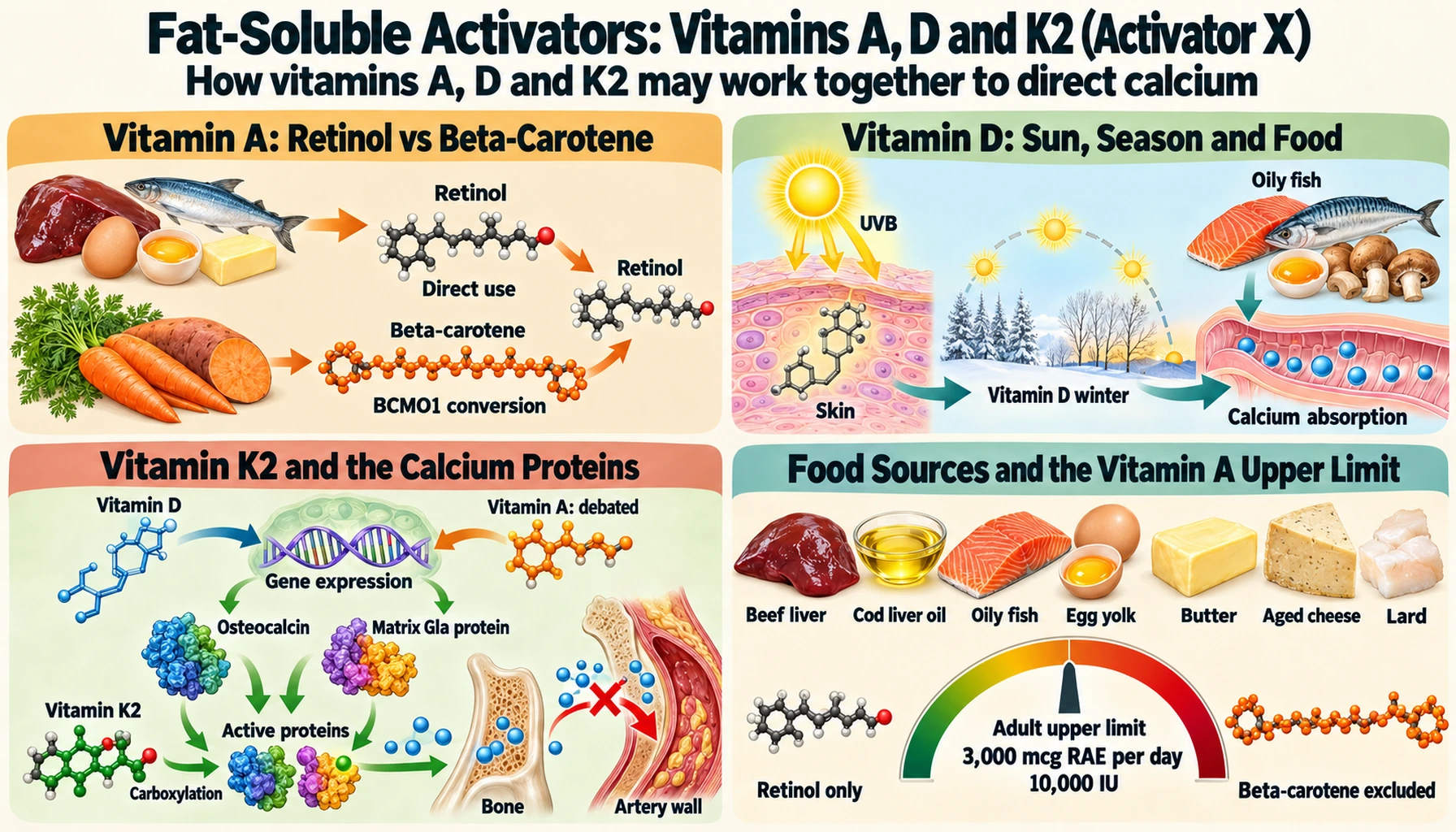
At the heart of the Weston A. Price diet is one idea: three fat-soluble vitamins — A, D and a mystery factor Price called “Activator X”, now thought to be vitamin K2 — act as the keys that let the body use the minerals it eats. Much of that idea has held up remarkably well: vitamin K2 really does switch on the proteins that steer calcium into bone and away from arteries, and vitamins A and D really do tell cells to make those proteins. This page explains each vitamin in plain language, shows where the food is, and is honest about the one place the diet’s advice needs care: preformed vitamin A has a real upper limit, especially in pregnancy.
Table of Contents
- What Price Meant by “Activators”
- Vitamin A: Retinol vs Beta-Carotene
- Vitamin D: Sun, Season and Food
- Vitamin K2: MK-4, MK-7 and the Calcium Proteins
- How A, D and K2 May Work Together
- Food Sources, Serving by Serving
- Cod Liver Oil and the Booklet’s Dose
- Safety: Upper Limits, Pregnancy, Bones and Warfarin
- Key Research Papers
- Connections
- Featured Videos
What Price Meant by “Activators”
In the 1930s, Dr. Weston Price travelled to isolated communities that still ate their traditional foods, and he analysed samples of those foods back home. His conclusion, which the Weston A. Price Foundation booklet Timeless Principles of Healthy Traditional Diets places at the centre of the whole diet, was that these diets were far richer in fat-soluble vitamins than the modern diet of sugar, white flour and processed oils — by the booklet’s account, about ten times richer.
Price called vitamins A and D, plus a third factor he could detect but not identify, the “fat-soluble activators”. The word was deliberate. He thought of them as catalysts: without them, he believed, the body cannot properly absorb or use calcium, phosphorus and other minerals no matter how much is on the plate. The booklet ties his third factor, “Activator X”, to butter from cows grazing rapidly growing grass, to organ meats and egg yolks from grass-fed animals, and lists aged cheese and the fat and livers of ducks and geese among its best sources. The booklet says it is now considered to be vitamin K2, the animal and fermented-food form of vitamin K.
Think of a building site. Minerals are the bricks. The activators are the foremen who decide where each brick goes. Plenty of bricks with no foremen gives you a pile, not a wall.
The evidence at a glance
- Vitamins A and D are needed for mineral handling and bone — well supported by decades of human physiology. Vitamin D raises calcium absorption from the gut; both vitamins act on genes.
- Activator X is vitamin K2 — a widely accepted modern interpretation, though Price never isolated the compound, so it cannot be proven from his own work.
- K2 activates calcium-handling proteins — well established biochemistry, measured in people.
- More K2 in the diet, less heart disease and artery calcification — cohort studies (an association, not proof).
- “Traditional diets had ten times more” — Price’s own 1930s measurements; historical observation that has not been repeated with modern methods.
- A, D and K2 must be taken together or toxicity follows — a hypothesis drawn largely from animal studies; not tested in human trials.
Vitamin A: Retinol vs Beta-Carotene
“Vitamin A” is really a family. The form the body uses directly is retinol (also called preformed vitamin A), found only in animal foods: liver, cod liver oil, egg yolks, butter and cheese. Plants supply carotenoids such as beta-carotene — the orange pigment in carrots and sweet potatoes — which the gut must convert into retinol before it can do vitamin A’s jobs.
Those jobs are wide. Vitamin A makes the light-sensing pigment in the eye, keeps the linings of the gut and lungs healthy, supports the immune system, and is essential for the developing embryo. Inside cells it becomes retinoic acid, which switches genes on and off — including, as the synergy section below explains, some of the same genes vitamin D controls.
The booklet’s claim: people are poor converters
The booklet says carotenes are not true vitamin A and that humans convert them poorly, so animal sources are needed. This is partly supported, and the reason is now partly understood. The enzyme that splits beta-carotene into vitamin A is called BCMO1. In a 2009 study (Leung and colleagues), two common variants in the BCMO1 gene turned up often: 42% and 24% of the gene copies examined carried them. In the laboratory, an enzyme carrying both changes worked 57% less well (in vitro). In female volunteers given a large test dose of beta-carotene, carriers of both variants showed about 69% less conversion, judged by how much vitamin A versus unconverted beta-carotene appeared in their blood fats afterwards (a small human study).
The authors note that up to 45% of healthy people have been reported to be “poor converters”. So the booklet’s point stands for a substantial minority: for someone carrying these variants, a plate of carrots supplies much less vitamin A than the label arithmetic suggests. For many others, conversion works well enough. Official tables already assume it takes about 12 micrograms of beta-carotene from food to make 1 microgram of retinol activity — the reason vitamin A is now counted in micrograms of RAE (retinol activity equivalents).
One genuine advantage of beta-carotene: conversion slows down when the body’s stores are full, which is why carotenes from food do not cause vitamin A poisoning. Retinol has no such brake. That is the flip side of the booklet’s advice, covered in the safety section.
Vitamin D: Sun, Season and Food
Vitamin D is unusual: the skin makes it when ultraviolet-B (UVB) light strikes a cholesterol-like molecule just under the surface. It then helps the gut absorb calcium and phosphorus, keeps blood calcium steady, and acts on genes in bone, muscle and immune cells.
The booklet’s claim: the sun is not enough most of the year
The booklet says the body only makes vitamin D when the sun is high — summer, around midday — so for much of the year food must supply it. This is well supported in principle, with one refinement on latitude. In a classic 1988 study, Webb, Kline and Holick exposed a vitamin D precursor and human skin samples to real sunlight on cloudless days:
- In Boston (42.2° N), sunlight made no vitamin D from November through February.
- In Edmonton (52° N), the dead season ran from October through March.
- Further south, at 34° N and 18° N, sunlight still made vitamin D in mid-winter.
The authors called this the “vitamin D winter” and noted that it lengthens the further you live from the equator. So the sun does not have to be directly overhead, but across most of North America and Europe there are months when it makes none at all — exactly when the booklet’s food sources matter most. (Evidence: laboratory measurement under real sunlight.)
Where the food is
Very few foods carry much vitamin D. Oily fish leads by far; egg yolks, liver and lard add smaller amounts (see the serving list). The booklet favours lard from pigs raised outdoors. There is measured support for the principle that sunlight raises the vitamin D in pork: in a 2023 animal study, pigs given 6 minutes of UVB light a day for about ten weeks had loin meat with 11.97 µg of vitamin D3 per kilogram, against 6.03 µg/kg in unexposed pigs (Neill and colleagues). That study measured loin, not lard, and used lamps rather than open sky, so it supports the idea without giving a number for lard from pasture-raised pigs.
A quick unit note: 1 microgram (mcg) of vitamin D equals 40 IU. The adult RDA is 15 mcg (600 IU) a day up to age 70, and 20 mcg (800 IU) after that.
Vitamin K2: MK-4, MK-7 and the Calcium Proteins
Most people know vitamin K only for blood clotting. The booklet rightly complains that this misses most of the story — and on this point modern biochemistry is firmly on its side.
Two families
- Vitamin K1 (phylloquinone) comes from green leaves. It mainly serves the liver’s clotting factors.
- Vitamin K2 (menaquinones, written MK-4 to MK-13) differ by the length of their tail. MK-4 is made by animals from K1 and sits in animal fats, organ meats and egg yolks — the foods Price linked to Activator X. Long-chain menaquinones such as MK-7 to MK-11 are made by bacteria, so they turn up in fermented foods, especially cheese. Most MK-7 supplements are produced by bacterial fermentation (commonly from natto, a fermented soybean food) rather than taken from the foods above.
What K2 actually does
Vitamin K is the cofactor for an enzyme that adds a small chemical “claw” (a carboxyl group) to certain proteins. Only once the claws are on can those proteins grab calcium. Two matter most here:
- Osteocalcin, made by bone-building cells, helps bind calcium into bone.
- Matrix Gla protein (MGP), made in artery walls and cartilage, stops calcium from depositing where it does not belong.
How important is MGP? In a 1997 study, mice bred without it developed to birth normally but died within two months as their arteries calcified and ruptured (Luo and colleagues — an animal study, but a striking one).
MK-7 behaves differently from K1 in people. In a 2007 study in healthy volunteers, both were absorbed well, but MK-7 lasted far longer in the blood, built up to 7- to 8-fold higher levels with daily intake, and switched on osteocalcin more completely (Schurgers and colleagues).
Hearts and bones in people
In the Rotterdam Study, 4,807 Dutch adults reported their diets in 1990–93 and were followed until 2000 (Geleijnse and colleagues, 2004 — a cohort). Compared with the lowest third of K2 intake, the highest third had a 57% lower risk of dying from coronary heart disease (relative risk 0.43), 26% lower all-cause mortality (0.74), and about half the odds of severe calcification of the aorta (odds ratio 0.48). Vitamin K1 intake showed no such link. A cohort cannot prove cause — people who eat more cheese may differ in other ways — but the result fits the MGP biology neatly.
For bone, there is a randomised controlled trial. Knapen and colleagues gave 244 healthy postmenopausal women either 180 mcg of MK-7 a day or a placebo for three years. MK-7 slowed the age-related loss of bone density at the lower back (lumbar spine) and the femoral neck — the narrow top of the thigh bone at the hip — and reduced the loss of height in the lower thoracic vertebrae (the lower part of the upper back). Bone density at the total hip did not differ. A modest but real effect, in one population.
There is no RDA specifically for K2. The adequate intake for total vitamin K is 90 mcg a day for women and 120 mcg for men, and no upper limit has been set because no toxicity has been seen from food or supplements in healthy people — with the big exception of blood-thinner users (see safety).
How A, D and K2 May Work Together
The booklet’s most distinctive claim is that the three vitamins are a team: A and D tell cells to make certain proteins, and K2 then switches those proteins on. The second half is solid, and so is the vitamin D part of the first: vitamin D raises the production of osteocalcin and MGP, and vitamin K then carboxylates them (adds the calcium-grabbing claws). Vitamin A’s part is less tidy. It also acts on genes, through a partner receptor it shares with vitamin D, but its effect on these particular proteins is not settled — the hypothesis paper below even proposes that vitamin A lowers the demand for vitamin K. What is not established is the next step the booklet takes — that taking A or D without K2 causes toxicity.
The fullest written version of the toxicity idea is a 2007 paper in the journal Medical Hypotheses by Chris Masterjohn. It proposes that very high vitamin D makes cells churn out so many K-dependent proteins that the vitamin K supply runs short, and that some symptoms of vitamin D overdose are really symptoms of K shortage. The paper builds on animal studies in which signs of vitamin D toxicity could be separated from high blood calcium. It is clearly labelled a hypothesis, and that is how it should be read: plausible, interesting, and not tested in human trials.
The practical takeaway is gentler than the booklet’s wording and fully in its spirit: eat the three vitamins together, in whole foods, rather than megadosing any one of them alone. A diet with liver, egg yolks, oily fish, butter and aged cheese does exactly that.
Food Sources, Serving by Serving
Every number below is from USDA FoodData Central (FDC), SR Legacy data, per the serving stated, with the FDC food named so you can check it. Vitamin A is in mcg RAE; vitamin D in mcg and IU. The adult RDA for vitamin A is 700 mcg RAE for women and 900 mcg for men.
- Beef liver (FDC 168627; USDA value for pan-fried liver) — 3 oz (85 g): 6,580 mcg RAE vitamin A; 1.0 mcg (42 IU) vitamin D. One serving is more than twice the daily upper limit for preformed vitamin A. Eaten once a week, it averages about 940 mcg a day — right where you want to be.
- Chicken liver (FDC 171061; USDA value for simmered liver) — 1 liver (44 g): about 1,750 mcg RAE vitamin A.
- Cod liver oil (FDC 173577) — 1 tsp (4.5 g): 1,350 mcg RAE (4,500 IU) vitamin A; 11.3 mcg (450 IU) vitamin D.
- Sockeye salmon (FDC 173692; USDA value for cooked fish) — 3 oz: 14.2 mcg (570 IU) vitamin D, nearly a full day’s RDA; 49 mcg RAE vitamin A.
- Atlantic herring (FDC 175117; USDA value for cooked fish) — 3 oz: 4.6 mcg (182 IU) vitamin D.
- Atlantic sardines, canned in oil, with bone (FDC 175139) — 1 can (92 g): 4.4 mcg (178 IU) vitamin D, plus the calcium of the soft bones.
- Egg, whole, large (FDC 171287) — 1 egg (50 g): 80 mcg RAE vitamin A; 1.0 mcg (41 IU) vitamin D. Nearly all of it is in the yolk: egg yolk (FDC 172184), 1 large yolk (17 g), 65 mcg RAE and 0.9 mcg (37 IU).
- Butter, salted (FDC 173410) — 1 tbsp: 97 mcg RAE vitamin A; FDC lists no vitamin D.
- Lard (FDC 171401) — 1 tbsp: 0.3 mcg (13 IU) vitamin D.
- Gouda cheese (FDC 171241) — 1 oz: 47 mcg RAE vitamin A.
The vitamin K2 gap in the tables
FoodData Central reports almost no menaquinone values, so the standard tables cannot tell you how much K2 is in butter, liver or egg yolk. The best measured data come from research labs. A USDA-funded study at Tufts (Fu and colleagues, 2017) measured US dairy foods and found that full-fat dairy carries appreciable menaquinones, mostly MK-9 to MK-11. Total vitamin K averaged 506 mcg per 100 g in soft cheese and 282 mcg per 100 g in hard cheese — roughly 80 mcg in a 1-oz piece of hard cheese, most of it K2. Reduced-fat and fat-free versions kept only about 5–22% of the vitamin K of their full-fat equivalents; whole (4%) milk had 38.1 mcg per 100 g against 7.7 mcg in nonfat. That is one more measured reason to choose full-fat dairy, as the booklet does.
Pasture-raised vs conventional: what has actually been measured
The booklet says that animals kept off green grass and out of the sun put far less vitamin A, D and K2 into their fat, organs, milk and eggs. The direction is plausible and partly measured — sunlight raises the vitamin D in pork (the pig study above), and the yellow colour of pasture butter comes from beta-carotene in grass. But FoodData Central does not list grass-fed and grain-fed butter or eggs separately, and this page does not quote a pasture-versus-barn number it cannot source. Treat “pasture-raised is richer” as likely and worth paying for where you can, not as a measured multiple.
Cod Liver Oil and the Booklet’s Dose
Cod liver oil is the booklet’s chosen insurance policy for vitamins A and D, and Price himself used it, often alongside a high-vitamin butter oil for the K2 factor. The booklet’s dietary guidelines ask readers to take enough cod liver oil to supply at least 10,000 IU of vitamin A and 1,000 IU of vitamin D a day. It also distinguishes cod liver oil from ordinary fish body oils, which provide omega-3 fats but little vitamin A or D — a correct distinction.
What that dose means in a spoon
Using the FDC value for cod liver oil (100,000 IU vitamin A and 10,000 IU vitamin D per 100 g), the booklet’s dose is about 10 g of oil — a little over 2 teaspoons (2.2 tsp). That delivers 10,000 IU of vitamin A, which is 3,000 mcg RAE, and 1,000 IU (25 mcg) of vitamin D. Products vary widely in how much of each vitamin they keep through processing, which the booklet itself warns about, so the label of the product in your hand matters more than any table.
Where that lands
- Vitamin D: 1,000 IU a day is comfortably above the 600 IU adult RDA and well below the adult upper limit of 4,000 IU (100 mcg). Reasonable, especially in the vitamin D winter.
- Vitamin A: 3,000 mcg RAE is exactly the adult upper limit for preformed vitamin A — before counting any liver, egg yolks, butter or cheese, all of which the same diet encourages. For an adult who also eats liver weekly, the total runs above the limit most days.
This is the one place where we would gently part ways with the booklet’s wording. Its goal — plenty of A and D from food-based sources — is sound. But “at least 10,000 IU” of preformed vitamin A on top of a liver-rich diet sits at or above the level where risks have been measured, and in pregnancy the evidence calls for a firm ceiling rather than a floor. A practical middle path for most adults: about 1 tsp of cod liver oil (1,350 mcg RAE and 450 IU D) on days you do not eat liver, more oily fish in winter, and liver about once a week.
Safety: Upper Limits, Pregnancy, Bones and Warfarin
Vitamin A: the upper limit and why it exists
The adult tolerable upper intake level (UL) for preformed vitamin A is 3,000 mcg RAE (10,000 IU) a day; for pregnant teenagers aged 14–18 it is a little lower. For comparison, the RDA in pregnancy is 770 mcg RAE a day for women 19 and older (750 mcg for ages 14–18), the value marked on the range bar above. The UL applies only to retinol from animal foods, liver oils and supplements — never to beta-carotene. It is about long-term daily habits, which is why one liver meal a week is fine while a daily liver habit plus cod liver oil is not.
Pregnancy. In a 1995 study of 22,748 pregnant women (Rothman and colleagues, cohort), babies of women taking more than 10,000 IU a day of preformed vitamin A from supplements had 4.8 times the rate of birth defects in tissues derived from the cranial neural crest (face, heart, nervous system) compared with women taking 5,000 IU or less. The risk was concentrated in women who took the high doses before the seventh week of pregnancy — often before they knew they were pregnant. The authors estimated that about 1 baby in 57 born to the high-dose group had a malformation attributable to the supplement, and saw an apparent threshold near 10,000 IU of supplemental vitamin A. This is why the booklet’s cod liver oil dose needs care for anyone who could become pregnant. The booklet strongly values nutrition before and during pregnancy, and that is right — the safest way to honour it is to keep total preformed vitamin A at or under the UL, with liver in modest weekly portions. The pregnancy and children article covers this in full.
Bones. High retinol intake is linked to weaker bones, the opposite of what the activators are meant to do. In Swedish women (Melhus and colleagues, 1998, case-control and cross-sectional), each extra 1 mg (1,000 mcg) of retinol a day was linked to a 68% higher risk of hip fracture, and intakes above 1.5 mg a day went with 10% lower bone density at the femoral neck (the top of the thigh bone at the hip) compared with intakes below 0.5 mg. In 2,322 Swedish men followed for 30 years (Michaëlsson and colleagues, 2003, cohort), those in the top fifth for blood retinol had, compared with men in the middle fifth, 1.64 times the risk of any fracture and 2.47 times the risk of hip fracture; blood beta-carotene showed no such link. Whether adequate vitamin D and K2 blunt this effect, as the synergy model would predict, has not been tested.
Acute poisoning from very large single doses, and liver damage from months of high intake, are well documented in the medical literature; our vitamin A toxicity page has the details.
Vitamin D: rare, but serious
The adult UL for vitamin D is 4,000 IU (100 mcg) a day. Vitamin D toxicity is rare and almost always comes from high-dose supplements, not food or sun. A 2018 clinical review (Marcinowska-Suchowierska and colleagues) describes its signs — confusion, apathy, repeated vomiting, abdominal pain, heavy urination, thirst and dehydration — driven by severely high blood calcium, and notes that blood 25-hydroxyvitamin D (the standard blood test for vitamin D status) above 150 ng/mL (375 nmol/L) is the hallmark of overdose. The booklet’s 1,000 IU is nowhere near that territory. See vitamin D toxicity.
Vitamin K2 and blood thinners
K2 is safe for most people, but it directly opposes warfarin and similar vitamin K antagonist drugs, which work by blocking vitamin K recycling. In the 2007 Schurgers study, the authors warned that MK-7 supplements of 50 mcg a day or more could interfere with anticoagulant treatment in a clinically relevant way. A 2013 follow-up (Theuwissen and colleagues, 18 healthy volunteers on a vitamin K antagonist) found that even 10 and 20 mcg a day of MK-7 lowered the clotting measure (INR) in a clinically relevant way in at least 40% and 60% of participants, and 45 mcg a day lowered average INR by about 40%. If you take warfarin, do not start or stop a K2 supplement — or make a big change in very high-vitamin-K foods and K2 supplements — without your anticoagulation clinic adjusting your dose and checking your INR. The newer direct oral anticoagulants do not work through vitamin K.
Who should take particular care
- Anyone pregnant or trying to conceive: total preformed vitamin A at or under 3,000 mcg RAE a day.
- People with liver disease, heavy alcohol use, or on retinoid medicines (such as acne retinoids): avoid extra preformed vitamin A.
- People with high blood calcium, kidney stones, sarcoidosis or other granulomatous disease: vitamin D supplements only under medical supervision.
- Anyone on warfarin: keep vitamin K intake steady, as above.
Key Research Papers
Price WA (1939). Nutrition and Physical Degeneration. Paul B. Hoeber, New York. (Book; no PubMed record.)
- Leung WC, Hessel S, Méplan C, Flint J, et al. (2009). Two common single nucleotide polymorphisms in the gene encoding beta-carotene 15,15′-monoxygenase alter beta-carotene metabolism in female volunteers. FASEB Journal. 23(4):1041–53. — PubMed PMID: 19103647
- Webb AR, Kline L, Holick MF (1988). Influence of season and latitude on the cutaneous synthesis of vitamin D3: exposure to winter sunlight in Boston and Edmonton will not promote vitamin D3 synthesis in human skin. Journal of Clinical Endocrinology and Metabolism. 67(2):373–8. — PubMed PMID: 2839537
- Neill HR, Gill CIR, McDonald EJ, McMurray R, et al. (2023). Improving vitamin D content in pork meat by UVB biofortification. Meat Science. 199:109115. — PubMed PMID: 36753832
- Luo G, Ducy P, McKee MD, Pinero GJ, et al. (1997). Spontaneous calcification of arteries and cartilage in mice lacking matrix GLA protein. Nature. 386(6620):78–81. — PubMed PMID: 9052783
- Schurgers LJ, Teunissen KJ, Hamulyák K, Knapen MH, et al. (2007). Vitamin K-containing dietary supplements: comparison of synthetic vitamin K1 and natto-derived menaquinone-7. Blood. 109(8):3279–83. — PubMed PMID: 17158229
- Geleijnse JM, Vermeer C, Grobbee DE, Schurgers LJ, et al. (2004). Dietary intake of menaquinone is associated with a reduced risk of coronary heart disease: the Rotterdam Study. Journal of Nutrition. 134(11):3100–5. — PubMed PMID: 15514282
- Knapen MH, Drummen NE, Smit E, Vermeer C, et al. (2013). Three-year low-dose menaquinone-7 supplementation helps decrease bone loss in healthy postmenopausal women. Osteoporosis International. 24(9):2499–507. — PubMed PMID: 23525894
- Fu X, Harshman SG, Shen X, Haytowitz DB, et al. (2017). Multiple vitamin K forms exist in dairy foods. Current Developments in Nutrition. 1(6):e000638. — PubMed PMID: 29955705
- Masterjohn C (2007). Vitamin D toxicity redefined: vitamin K and the molecular mechanism. Medical Hypotheses. 68(5):1026–34. — PubMed PMID: 17145139
- Rothman KJ, Moore LL, Singer MR, Nguyen US, et al. (1995). Teratogenicity of high vitamin A intake. New England Journal of Medicine. 333(21):1369–73. — PubMed PMID: 7477116
- Melhus H, Michaëlsson K, Kindmark A, Bergström R, et al. (1998). Excessive dietary intake of vitamin A is associated with reduced bone mineral density and increased risk for hip fracture. Annals of Internal Medicine. 129(10):770–8. — PubMed PMID: 9841582
- Michaëlsson K, Lithell H, Vessby B, Melhus H (2003). Serum retinol levels and the risk of fracture. New England Journal of Medicine. 348(4):287–94. — PubMed PMID: 12540641
- Marcinowska-Suchowierska E, Kupisz-Urbańska M, Łukaszkiewicz J, Płudowski P, et al. (2018). Vitamin D toxicity — a clinical perspective. Frontiers in Endocrinology. 9:550. — PubMed PMID: 30294301
- Theuwissen E, Teunissen KJ, Spronk HM, Hamulyák K, et al. (2013). Effect of low-dose supplements of menaquinone-7 (vitamin K2) on the stability of oral anticoagulant treatment: dose-response relationship in healthy volunteers. Journal of Thrombosis and Haemostasis. 11(6):1085–92. — PubMed PMID: 23530987
External Authoritative Resources
- NIH Office of Dietary Supplements: Vitamin A fact sheet
- NIH Office of Dietary Supplements: Vitamin D fact sheet
- NIH Office of Dietary Supplements: Vitamin K fact sheet
- USDA FoodData Central
PubMed Topic Searches
Connections
- All Remedies
- Weston A. Price Diet
- Diets and Fasting
- Dr. Weston Price and His Field Studies
- Nutrient-Dense Foods
- Pregnancy and Children
- Traditional Fats and Oils
- Myths and Evidence
- Vitamin A
- Vitamin A Toxicity
- Vitamin D3
- Vitamin K2
- Vitamin K
- The Vitamin K Cycle (animation)
- Vitamin D Synthesis (animation)
- Cod Liver
- Cod: Vitamin D and Liver Oil
- Beef Liver
- Organ Meats
- Eggs
- Lard Rendering
- Osteoporosis