Weston A. Price Diet Claims Checked Against the Evidence
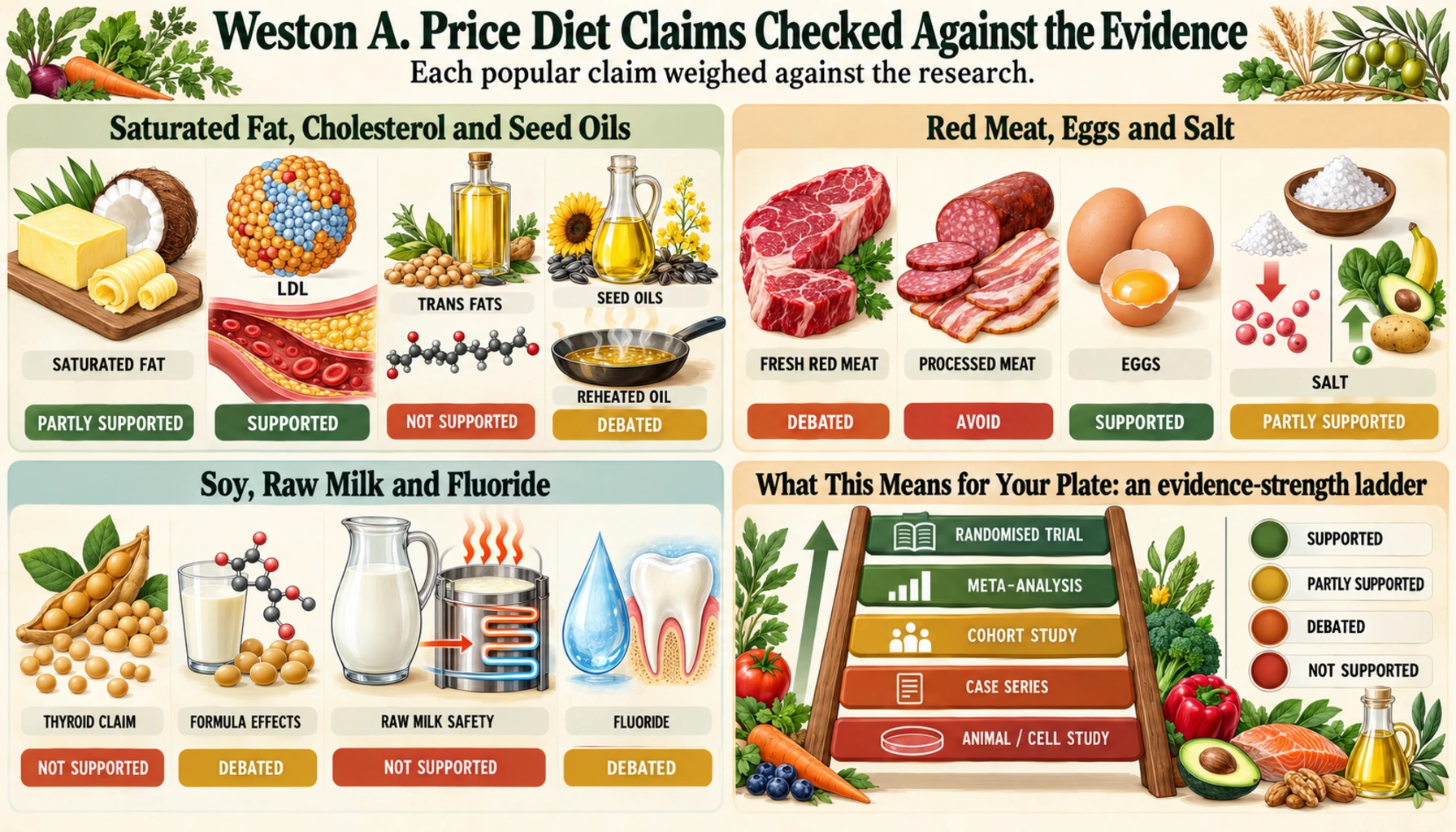
The Weston A. Price Foundation's booklet Timeless Principles of Healthy Traditional Diets ends with several lists of "myths and truths" about fat, cholesterol, meat, salt, soy, raw milk, fluoride and dentistry. This page takes those claims one at a time, says plainly what the booklet argues, and sets it beside what human studies actually show. Some claims hold up very well, some hold up in part, some are honestly debated, and a few are not supported by the evidence we have today — and we label each one in words so you can see which is which.
How to read the verdicts: Supported means good human evidence agrees with the booklet. Partly supported means one part of the claim holds and another does not. Debated means careful researchers still disagree, or the evidence points both ways. Not supported by current evidence means the best human studies do not back the claim as written. Every verdict carries an evidence tier — randomised trial, meta-analysis, cohort study, case series, animal or cell study — because a result in mice or in a dish is a hint, not proof that the same thing happens in people. We judge claims, never the people who made or quoted them.
Table of Contents
- Saturated Fat and Cholesterol
- Seed Oils, Margarine and Low-Fat Diets
- Red Meat, Eggs, Raw Milk and Salt
- Vegetarian Diets and Vitamin B12
- Soy Foods and Soy Formula
- Fluoride, Aluminium, Microwaves and Additives
- Root Canals and Amalgam Fillings
- What This Means for Your Plate
- Key Research Papers
- Connections
- Featured Videos
Saturated Fat and Cholesterol
This is the heart of the booklet's argument. It says saturated fats build cell membranes, support the immune system and bones, and "do not cause heart disease"; that dietary cholesterol is needed for the gut wall and a baby's growing brain; and that only oxidised cholesterol, as found in powdered milk and powdered eggs, harms arteries. It also quotes several researchers and a surgeon who doubted the diet–heart idea. Quotations are opinions, not data, so below we look at the data instead.
Claim: "Saturated fat does not cause heart disease"
What the evidence shows. The best test is to ask people to eat less saturated fat for years and count heart attacks. A 2020 Cochrane review pooled 15 such randomised trials with 56,675 participants. Cutting saturated fat lowered combined cardiovascular events by about 17% (moderate-quality evidence), and the bigger the cholesterol drop, the bigger the benefit. But it made little or no difference to deaths from any cause. In plain numbers, about 56 people would need to cut saturated fat for roughly four years for one of them to avoid a heart event.
The booklet is right that saturated fat is a normal, needed part of the body (your body makes it from carbohydrate), and right that eating less of it has not been shown to make people live longer. It goes too far in saying saturated fat has no effect on heart disease at all.
Verdict: Partly supported. Evidence tier: meta-analysis of randomised trials in humans.
Claim: "Cholesterol below 180 mg/dL raises the death rate"
What the booklet cites. It points to a 1992 paper in Circulation. The page reference it gives (volume 86, pages 1026–9) is actually a short health-policy commentary by Hulley and colleagues titled "Health policy on blood cholesterol: time to change directions," not a study. The data the booklet seems to mean are in the same issue: the US National Heart, Lung, and Blood Institute's Report of the Conference on Low Blood Cholesterol: Mortality Associations (Jacobs and colleagues, 1992), which pooled 19 cohort studies.
What that report found. In men, total death rates traced a U-shape: higher at very high cholesterol (mainly heart disease) and also higher at low cholesterol (some cancers, lung and digestive disease, injuries). In women the line was flat. Crucially, most conference participants thought the low-cholesterol deaths were probably explained by confounding — for example, serious illness itself lowers cholesterol, so sick people turn up in the "low" group. They did not conclude that low cholesterol causes death.
Later cohorts. A 2020 study of 108,243 Danish adults again found a U-shaped link between LDL ("bad") cholesterol and death from any cause: people under 70 mg/dL had a 25% higher death rate (hazard ratio 1.25) than people at 132–154 mg/dL, and the lowest risk sat at about 140 mg/dL. The same paper found that any increase in LDL went with more heart attacks. So both halves are true at once: very low cholesterol is a warning flag worth investigating, and higher LDL still means more heart attacks.
Verdict: Partly supported. The U-shaped association is real in several cohorts; the conclusion that a cholesterol under 180 mg/dL causes earlier death is not shown. Evidence tier: pooled cohort studies (association, not cause).
Claim: "The fat in artery plaques is mostly unsaturated (74%)"
What the paper found. The booklet cites a 1994 letter in The Lancet by Felton and colleagues. Its published abstract reports that the polyunsaturated fat (omega-6 and omega-3) in aortic plaques tracked the polyunsaturated fat in blood and body fat — a marker of diet — while saturated fat showed no such link. The authors suggested the trend toward eating more polyunsaturated fat should be reconsidered. The specific "74% unsaturated, 41% polyunsaturated" figures are not in the abstract, and we could not verify them.
What this kind of study cannot do is tell us what causes plaque. It measured what fats were sitting in plaques taken after death; it did not follow people over time. Plaques form around cholesterol-carrying particles, and the fat they carry reflects whatever you eat.
Verdict: Partly supported. The paper exists and leans the booklet's way; the exact percentages could not be verified, and composition does not prove cause. Evidence tier: small post-mortem comparison study.
Claim: "Only oxidised cholesterol harms arteries"
Oxidised fats and cholesterol are genuinely more damaging in laboratory and animal work, and avoiding highly processed, long-stored powdered foods is reasonable. But the trials above show that ordinary, unoxidised LDL cholesterol still tracks heart attacks. Verdict: Debated. Evidence tier: mostly laboratory and animal studies.
Seed Oils, Margarine and Low-Fat Diets
The booklet tells readers to avoid all hydrogenated fats and all industrial seed oils (soy, corn, safflower, canola, cottonseed, grapeseed, rice bran), to skip margarine, and to ignore advice to keep fat at 30% of calories. Our sibling article Traditional Fats vs Industrial Seed Oils covers the chemistry in depth; here are the verdicts.
Claim: "Avoid all hydrogenated and partially hydrogenated fats"
This is one of the booklet's strongest calls. Industrial trans fats, made when oils are partially hydrogenated, raise LDL, lower HDL and are strongly tied to heart disease, as summarised in a major 2006 New England Journal of Medicine review by Mozaffarian and colleagues. The US FDA later removed partially hydrogenated oils from the "generally recognized as safe" list. The booklet was warning about these fats long before that became official policy. See our Trans Fats page.
Verdict: Supported. Evidence tier: cohort studies, controlled feeding trials and reviews; regulatory action.
Claim: "Margarine eaters have twice the heart disease of butter eaters"
The booklet's source is a newsletter, not a study we could check. The idea fits the era when stick margarine was loaded with trans fat. Today's spreads in many countries are made without partially hydrogenated oil, so the old comparison no longer describes what is on the shelf. Butter remains a whole, traditional food; old-style margarine deserved its bad name because of trans fat specifically.
Verdict: Partly supported (true of the trans-fat margarines of the past). Evidence tier: indirect, via the trans-fat evidence.
Claim: "Polyunsaturated seed oils cause cancer and heart disease"
In the Cochrane trials above, people who swapped saturated fat for polyunsaturated fat did not have more heart events — the swap was associated with fewer events, about the same as swapping to carbohydrate. That is direct trial evidence against the claim that these oils cause heart disease. Where the booklet has a point is in heat damage: oils rich in polyunsaturated fat break down faster when reused for deep-frying, and Americans do eat far more omega-6 than omega-3 compared with traditional diets. Cooking with stable fats and eating more fish and pasture eggs are reasonable steps; fearing a teaspoon of canola is not backed by human data.
Verdict: Not supported by current evidence (as a cause of heart disease and cancer); the concern about repeatedly heated oil is debated and rests mainly on laboratory work. Evidence tier: randomised trials (heart events); in vitro (oxidation).
Claim: "Coconut oil does not cause heart disease"
A 2020 meta-analysis of 16 clinical trials in Circulation found coconut oil raised LDL cholesterol by about 10.47 mg/dL compared with non-tropical vegetable oils, while also raising HDL by about 4 mg/dL; it did not change blood sugar, inflammation or body fat. No trial has counted heart attacks on coconut oil long-term. Coconut is a traditional fat in many tropical diets that also ate fish, fibre and little processed food.
Verdict: Debated. Evidence tier: meta-analysis of trials measuring blood lipids, not heart events.
Claim: "Children on low-fat diets suffer growth failure"
The booklet cites a 1989 report by Lifshitz and Moses describing 8 children, out of 40, whose growth faltered on an unsupervised low-fat, low-cholesterol diet — they were simply not getting enough calories, zinc and vitamins. That is a real warning about overzealous restriction. But a randomised trial in 663 children aged 8 to 10 (the DISC study, 1995) found that a supervised diet with 28% of calories from fat kept growth, iron stores and wellbeing normal over three years.
Verdict: Partly supported. Badly planned fat restriction can stunt a child; a well-planned moderate-fat diet did not in a trial. Growing children need full-fat, nutrient-dense food and enough calories — the booklet's practical advice. Evidence tier: case series (harm); randomised trial (safety of a supervised diet).
Claim: "Low-fat diets do not prevent breast cancer"
The largest test, the Women's Health Initiative trial, put 48,835 postmenopausal women on a low-fat eating pattern or their usual diet. Over 8.1 years, invasive breast cancer occurred in 0.42% versus 0.45% per year — a difference that was not statistically significant (hazard ratio 0.91). The authors noted a trend that might firm up with longer follow-up.
Verdict: Supported (no proven protection), with an honest caveat about the trend. Evidence tier: large randomised trial.
Red Meat, Eggs, Raw Milk and Salt
The booklet defends red meat as a source of vitamin B12, B6, zinc, carnitine and coenzyme Q10; calls eggs "nature's perfect food"; asks readers to drink raw rather than pasteurised milk; and says salt restriction is misguided because salt is needed for digestion and the nervous system.
Claim: "Beef does not cause colon cancer" — and "avoid processed luncheon meats"
In 2015 the World Health Organization's cancer agency (IARC) classified processed meat — ham, bacon, salami, hot dogs — as Group 1, "carcinogenic to humans", based mainly on colorectal cancer, and red meat as Group 2A, "probably carcinogenic", based on limited human evidence plus strong mechanistic evidence. The booklet's own Dietary Dangers list already says to avoid highly processed luncheon meats and sausage, so on processed meat it agrees with IARC. Its comparison of beef-eating countries and religious groups is the weakest kind of evidence: whole populations differ in hundreds of ways besides beef.
Verdicts: "Avoid processed meats" — Supported. "Beef does not cause colon cancer" — Debated (fresh red meat is "probably", not "definitely", linked). Evidence tier: expert review of cohort, case-control and mechanistic studies.
Claim: "Eggs are nature's perfect food; don't cut back"
Three large US cohorts of more than 215,000 health professionals, followed for up to 32 years, found that eating at least one egg a day was not linked to heart disease once other habits were accounted for. The same 2020 BMJ paper pooled 33 risk estimates from 1.7 million people: one extra egg a day did not raise cardiovascular risk (relative risk 0.98). Eggs are rich in choline, lutein, vitamin A and high-quality protein. See Eggs and the Cholesterol Myth.
Verdict: Supported for typical intakes up to about an egg a day. Evidence tier: large cohorts and meta-analysis. (The booklet's line that egg substitutes cause "rapid death in test animals" is an animal claim we could not verify.)
Claim: "Raw milk is better and should replace pasteurised milk"
Raw milk does keep some heat-sensitive enzymes and has a loyal following. The safety record is the problem. A CDC review of US dairy outbreaks from 1993 to 2006 found that unpasteurised products caused 60% of outbreaks with known pasteurisation status — 1,571 illnesses, 202 hospitalisations and 2 deaths — and about 150 times more outbreaks per unit of product consumed than pasteurised dairy. People under 20 were hit disproportionately. Pregnant women, babies, young children, older adults and anyone with weak immunity face the most serious outcomes from bacteria such as Listeria, E. coli O157 and Campylobacter. See Raw vs Pasteurized Milk.
Verdict: Not supported by current evidence as a safe default; whole, full-fat and fermented dairy (yogurt, kefir, aged cheese) give most of the benefits without the gamble. Evidence tier: national outbreak surveillance.
Claim: "Restricting salt is unnecessary"
The evidence here truly points two ways, so the honest answer depends on who you are.
- The booklet's side. The PURE study measured urine sodium in 101,945 people across 17 countries. Compared with 4 to 6 grams of sodium a day, both high intake (7 grams or more) and low intake (under 3 grams) went with more deaths and heart events — a J-shaped curve. Most harm from high salt showed up in people with high blood pressure. Tier: cohort.
- The other side. The SSaSS trial randomised 600 villages in rural China, enrolling 20,995 older people with high blood pressure or a past stroke. Swapping regular salt for a salt substitute (75% sodium chloride, 25% potassium chloride) cut strokes by 14%, major heart events by 13% and deaths by 12% over nearly five years. Tier: large randomised trial.
Verdict: Partly supported. For healthy people with normal blood pressure, ordinary home-cooked salting (with unrefined salt, as the booklet suggests) is reasonable. For anyone with high blood pressure, a past stroke or kidney disease, cutting sodium and adding potassium is backed by trial evidence. Note that potassium salt substitutes are not safe for everyone with kidney disease — ask first. See Sodium and High Blood Pressure.
Vegetarian Diets and Vitamin B12
The booklet says "do not practise veganism", argues vegetarians do not live longer, and says vitamin B12 cannot be obtained from plants such as blue-green algae or fermented soy.
Claim: "Vegetarians do not live longer"
The booklet's death-rate figures come from an article on the Foundation's own website, which we could not check against a peer-reviewed source. The two largest studies give different answers:
- Adventist Health Study-2 (73,308 North American Seventh-day Adventists, 2013): vegetarians as a group had a 12% lower death rate than non-vegetarians (hazard ratio 0.88), with the clearest effect in men. Pesco-vegetarians, who eat fish, did best (0.81).
- EPIC-Oxford and a sister UK study (60,310 people, 2016): vegetarians and regular meat eaters had no significant difference in overall death rates (hazard ratio 1.02).
Both groups studied were unusually health-conscious, which makes it hard to separate diet from lifestyle. Neither study shows a meat-including whole-food diet shortens life.
Verdict: Debated. Evidence tier: large cohorts.
Claim: "Vitamin B12 is not reliably available from plants"
This one holds up. B12 is made by microbes and concentrates in animal foods — liver, clams, fish, meat, eggs and dairy. Many algae and fermented products contain B12 look-alike compounds that the body cannot use, and a 2014 review of plant sources identified dried purple laver (nori) as the most suitable natural plant source currently known. In practice, vegans need fortified foods or a supplement, and untreated deficiency can cause anaemia and lasting nerve damage. See Vitamin B12.
Verdict: Supported. Evidence tier: nutrient analysis and clinical deficiency data.
Soy Foods and Soy Formula
The booklet's "Myths and Truths About Soy" list argues that traditional Asian diets used soy in small, fermented amounts (tempeh, natto, miso, tamari); that modern soy blocks minerals, slows protein digestion, depresses the thyroid and disrupts hormones; and that soy infant formula exposes babies to large doses of plant oestrogens. It also mentions a soy-ingredient manufacturer that withdrew a GRAS (generally recognised as safe) application for isoflavones. The booklet itself favours small amounts of traditionally fermented soy over soy protein isolates. This site, like the booklet, favours traditionally fermented foods, including fermented soy such as natto, miso and tempeh, and does not recommend unfermented or industrial soy products (tofu, soy milk, soy protein isolate, soybean oil, soy formula); the verdicts below are about the evidence for each claim. The question is how strong each warning is.
Claim: "Soy depresses thyroid function; 30 mg of isoflavones a day can cause hypothyroidism"
A 2006 review in the journal Thyroid looked at 14 human trials and found that, with one exception, soy foods or isoflavones caused no change or only very modest changes in thyroid function in healthy people with enough iodine. Two real cautions remain: soy can reduce absorption of thyroid hormone tablets, so people taking them may need a dose check (but need not avoid soy), and people with low iodine intake or a weak thyroid have a theoretical risk based on cell and animal work.
Verdict: Not supported by current evidence in healthy, iodine-replete adults; a fair caution for people on thyroid medication or low in iodine. Evidence tier: review of human trials.
Claim: "Soy formula is like birth control pills for babies"
The measurement behind this is real. In a 1997 Lancet study, Setchell and colleagues found that 4-month-old babies fed soy formula took in about 4.5–8.0 mg of isoflavones per kilogram of body weight a day, 6 to 11 times the dose that has hormonal effects in adults. In 7 soy-fed infants, blood isoflavone levels were 13,000 to 22,000 times higher than the babies' own oestradiol. (The booklet phrases this as compared with babies on milk formula; the paper's comparison was with oestradiol.) Whether that exposure changes puberty, fertility or behaviour later in life is not settled: the most worrying findings come from animals, and isoflavones are far weaker than human oestrogen.
Verdicts: "Soy formula gives babies a high isoflavone dose" — Supported. "It causes early puberty or disrupted development" — Debated. Breast milk is first choice; when formula is needed, a cow's-milk-based formula avoids the question. Evidence tier: small human measurement study; animal studies.
The other soy claims
- "Asians eat soy in small, mostly fermented amounts." Traditional intakes were modest and often fermented, which is why the booklet prefers natto, miso and tempeh to modern soy products. Partly supported — tofu, an unfermented food, is also traditional.
- "Soy is low in methionine and cystine." True of legumes in general; mixing foods solves it. Supported as a nutrition fact.
- "Soy phytic acid lowers iron and zinc absorption." Phytate does bind minerals; soaking and fermenting reduce it, which is why the booklet favours them. Supported. See Soaking, Sprouting and Fermenting.
- "Soy causes cancer, infertility and lowers libido." These rest mostly on cell and animal studies (see the ladder above). The best-known animal work is in marmoset monkeys: newborn males hand-fed soy formula had lower blood testosterone than their twin brothers fed cow's-milk formula (Sharpe 2002), yet when the same kind of animals were followed into adulthood, puberty was normal and 6 of 7 soy-fed males were fertile, although their testes had more Leydig and Sertoli cells (Tan 2006). Not supported by current evidence in people at normal food intakes.
- Tofu in midlife and later dementia. This worry comes from one Hawaiian cohort of Japanese-American men: those who reported eating more tofu in 1965–1974 scored worse on cognitive tests and had more brain atrophy in their 70s and 80s (White 2000). It is an observational link, not confirmed as a cause. Debated.
Fluoride, Aluminium, Microwaves and Additives
The Dietary Dangers list tells readers not to drink fluoridated water, to avoid aluminium in salt, baking powder, antacids, cookware and deodorant, to avoid MSG and aspartame, to skip ultra-processed foods and refined sugar, and not to use a microwave.
Claim: "Do not drink fluoridated water"
This is a live public debate, and this site supports people's right to informed consent about what is added to their drinking water — see Fluoride: Consent and the Law. Here is what the evidence says on each side:
- Benefit has shrunk. The 2024 Cochrane update found that, in studies after fluoride toothpaste became widespread (post-1975), starting water fluoridation may reduce decay by only about a quarter of a baby tooth per child, with an estimate that "includes the possibility of benefit and no benefit" (low-certainty evidence). At 0.7 parts per million, about 12% of people had dental fluorosis of cosmetic concern. Tier: systematic review of non-randomised studies.
- Brain-development concern at higher exposure. In 2024 the US National Toxicology Program concluded, with moderate confidence, that fluoride exposures above 1.5 mg per litre of drinking water are associated with lower IQ in children, and that data were insufficient to judge the US level of 0.7 mg/L. A 2025 JAMA Pediatrics meta-analysis of 74 studies (mostly outside the US) found a dose-response link: about 1.63 IQ points lower per 1 mg/L more fluoride in urine; below 1.5 mg/L in water alone, the data were limited and uncertain. Tier: meta-analysis of cross-sectional and cohort studies (association).
Verdict: Debated. The dental benefit in the toothpaste era is smaller than once thought, the IQ signal at higher exposures is serious, and the evidence at today's US level is uncertain. That combination is exactly why consent matters. This site's position, which is a stance on consent and not a study finding: community water fluoridation removes each person's informed consent over a dose of fluoride, and we support ending it on informed-consent grounds while the evidence on neurodevelopment at higher exposures is reviewed. People who want to lower intake can use a reverse-osmosis filter; fluoride toothpaste (spat out, not swallowed) remains a separate, topical choice.
Claim: "Avoid ultra-processed foods and refined sweeteners"
Strongly backed. In a 2019 NIH inpatient trial, 20 adults ate either an ultra-processed or an unprocessed diet for two weeks each, with meals matched for calories offered, sugar, salt, fat and fibre. On the ultra-processed diet they ate about 508 more calories a day and gained about 0.9 kg; on the unprocessed diet they lost about the same. Verdict: Supported. Evidence tier: randomised controlled feeding trial.
Claims about aluminium, MSG, aspartame and microwaves
- Aluminium. Large amounts are clearly harmful to people with kidney failure, and limiting antacid overuse is sensible. The link between everyday aluminium (cookware, deodorant) and diseases such as Alzheimer's has not been established in people. Debated.
- Aspartame. In 2023 IARC classified aspartame as "possibly carcinogenic to humans" (Group 2B, its lowest positive category, based on limited evidence), while the WHO/FAO expert food-additive committee kept its acceptable daily intake unchanged. Calling it a "neurotoxin" goes beyond the human data. Debated.
- MSG. Glutamate occurs naturally in broth, tomatoes and aged cheese; controlled human tests have not shown consistent harm at food doses. Not supported by current evidence as a neurotoxin in food amounts.
- Microwaves. Microwaving heats food with radio waves; it does not make food radioactive, and short cooking with little water keeps many vitamins as well as or better than boiling. Use glass or ceramic, not plastic, to avoid plastic chemicals leaching. Not supported by current evidence.
Root Canals and Amalgam Fillings
The booklet's "Principles of Holistic Dentistry" recommend avoiding root canals and having existing ones removed if they are suspected of causing disease, avoiding mercury (amalgam) fillings, widening the palate in orthodontics, and extracting teeth in a way that avoids leaving infected cavities in the jawbone.
Claim: "Root-canal-treated teeth cause disease elsewhere in the body; remove them"
History. The idea comes from the early-twentieth-century "focal infection" theory: that a hidden infection in a tooth seeds disease in distant organs. Price's dental volumes were among the major works of that era. The theory led to many extractions, and it fell out of favour in the following decades when later research did not confirm that removing teeth cured systemic illness.
Modern evidence. Today's research looks at apical periodontitis — chronic infection at the tip of a tooth root, whether or not the tooth has had a root canal. A 2022 meta-analysis of 15 observational studies found a weak link with cardiovascular disease in cross-sectional studies (odds ratio 1.53), but no significant link in the case-control or the two cohort studies, and warned that results were inconsistent. This is an association, and it concerns untreated or failed infection, not successful root canals. No trial has shown that removing root-canal-treated teeth improves heart disease, arthritis or any other systemic illness, while extraction carries its own costs: bone loss, shifting teeth, and the expense and surgery of implants or bridges.
Verdict: Not supported by current evidence. The sound core of the advice is to treat oral infection rather than ignore it — which a well-done root canal or an extraction can both achieve. Make that choice tooth by tooth with a dentist. Evidence tier: historical theory; observational studies (association).
Claim: "Avoid amalgam fillings; have them removed"
Amalgam is about 50% elemental mercury and gives off small amounts of mercury vapour. Two randomised trials published together in JAMA in 2006 tested this in children:
- In the New England Children's Amalgam Trial (534 children aged 6–10, Bellinger and colleagues), amalgam raised urinary mercury slightly but showed no difference in IQ, memory, motor skills or kidney function over 5 years.
- In a Lisbon trial (507 children aged 8–10, DeRouen and colleagues), there were no differences in memory, attention, visuomotor function or nerve conduction over 7 years.
In September 2020, however, the US FDA recommended that people at higher risk — pregnant women and those planning pregnancy, nursing mothers and infants, children under six, people with neurological disease or impaired kidney function, and people sensitive to mercury — receive non-mercury fillings where appropriate. The FDA also advised against removing intact amalgam fillings in good condition, because drilling them out briefly raises mercury exposure and removes healthy tooth.
Verdict: Partly supported. Choosing non-mercury materials for new fillings, especially in high-risk groups, is consistent with FDA advice; routinely removing sound fillings is not. See Mercury. Evidence tier: randomised trials in children; regulatory review.
What This Means for Your Plate
Put together, the booklet's big food principles — whole foods, no trans fats, no ultra-processed foods, eggs and nutrient-dense animal foods, properly prepared grains and legumes — hold up well (the booklet, like this site, favours traditionally fermented foods, including fermented soy such as natto, miso and tempeh, and does not recommend unfermented or industrial soy). Where it runs into trouble is in some of its stronger "myths and truths" claims and in a few safety areas. The scorecard below sums up 18 headline claims from this page.
Safe to follow as written
- Cut out trans fats, ultra-processed foods, refined sugar and processed meats.
- Eat whole eggs, including the yolks; an egg a day is fine for most people.
- Cook from scratch with whole, minimally processed foods, including nutrient-dense foods such as liver, shellfish and oily fish.
- Soak, sprout or ferment grains and legumes. Like the booklet, this site favours traditionally fermented foods, including fermented soy such as natto, miso and tempeh, and does not recommend unfermented or industrial soy products.
- Do not go vegan without a reliable B12 source.
Modify before following
- Raw milk: pregnant women, babies, young children, older adults and anyone with weak immunity should not drink it. Fermented whole-milk foods are a safer route to the same nutrients.
- Vitamin A dose: the booklet's target of at least 10,000 IU of vitamin A a day from cod liver oil sits at the adult upper limit for preformed vitamin A (10,000 IU, or 3,000 micrograms). In pregnancy, preformed vitamin A above 10,000 IU a day has been linked to birth defects, so pregnant women should stay below it, counting liver and supplements together. See Fat-Soluble Activators and Pregnancy and Children.
- Salt: liberal salting is reasonable with normal blood pressure; with high blood pressure, a past stroke or kidney disease, cut back, and check with your doctor before using potassium salt substitutes.
- Saturated fat and cholesterol: if your LDL rises sharply on a high-butter diet, take that seriously; favour olive oil, fish and nuts alongside traditional animal fats, and track a lipid panel.
- Root canals and fillings: make each decision with a dentist. Treating infection matters; pulling healthy root-filled teeth or drilling out sound amalgam is not supported.
- Fluoride: an informed choice; filtering water is a reasonable option, especially for formula-fed infants and pregnant women concerned about exposure.
Ready to start? Getting Started turns the principles into a shopping list and a 7-day menu.
Key Research Papers
- Hooper L, Martin N, Jimoh OF, et al. (2020). Reduction in saturated fat intake for cardiovascular disease. Cochrane Database of Systematic Reviews. — PubMed PMID: 32827219
- Jacobs D, Blackburn H, Higgins M, et al. (1992). Report of the Conference on Low Blood Cholesterol: Mortality Associations. Circulation. — PubMed PMID: 1355411
- Johannesen CDL, Langsted A, Mortensen MB, Nordestgaard BG (2020). Association between low density lipoprotein and all cause and cause specific mortality in Denmark: prospective cohort study. BMJ. — PubMed PMID: 33293274
- Felton CV, Crook D, Davies MJ, Oliver MF (1994). Dietary polyunsaturated fatty acids and composition of human aortic plaques. The Lancet. — PubMed PMID: 7934543
- Bouvard V, Loomis D, Guyton KZ, et al. (2015). Carcinogenicity of consumption of red and processed meat. The Lancet Oncology. — PubMed PMID: 26514947
- Drouin-Chartier JP, Chen S, Li Y, et al. (2020). Egg consumption and risk of cardiovascular disease: three large prospective US cohort studies, systematic review, and updated meta-analysis. BMJ. — PubMed PMID: 32132002
- O'Donnell M, Mente A, Rangarajan S, et al. (2014). Urinary sodium and potassium excretion, mortality, and cardiovascular events. New England Journal of Medicine. — PubMed PMID: 25119607
- Neal B, Wu Y, Feng X, et al. (2021). Effect of Salt Substitution on Cardiovascular Events and Death. New England Journal of Medicine. — PubMed PMID: 34459569
- Orlich MJ, Singh PN, Sabaté J, et al. (2013). Vegetarian dietary patterns and mortality in Adventist Health Study 2. JAMA Internal Medicine. — PubMed PMID: 23836264
- Appleby PN, Crowe FL, Bradbury KE, Travis RC, Key TJ (2016). Mortality in vegetarians and comparable nonvegetarians in the United Kingdom. American Journal of Clinical Nutrition. — PubMed PMID: 26657045
- Setchell KD, Zimmer-Nechemias L, Cai J, Heubi JE (1997). Exposure of infants to phyto-oestrogens from soy-based infant formula. The Lancet. — PubMed PMID: 9217716
- Messina M, Redmond G (2006). Effects of soy protein and soybean isoflavones on thyroid function in healthy adults and hypothyroid patients: a review of the relevant literature. Thyroid. — PubMed PMID: 16571087
- Taylor KW, Eftim SE, Sibrizzi CA, et al. (2025). Fluoride Exposure and Children's IQ Scores: A Systematic Review and Meta-Analysis. JAMA Pediatrics. — PubMed PMID: 39761023
- Bellinger DC, Trachtenberg F, Barregard L, et al. (2006). Neuropsychological and renal effects of dental amalgam in children: a randomized clinical trial. JAMA. — PubMed PMID: 16622139
Further Studies Discussed Above
- Hulley SB, Walsh JM, Newman TB (1992). Health policy on blood cholesterol. Time to change directions. Circulation. — PubMed PMID: 1516172
- Mozaffarian D, Katan MB, Ascherio A, Stampfer MJ, Willett WC (2006). Trans fatty acids and cardiovascular disease. New England Journal of Medicine. — PubMed PMID: 16611951
- Neelakantan N, Seah JYH, van Dam RM (2020). The Effect of Coconut Oil Consumption on Cardiovascular Risk Factors: A Systematic Review and Meta-Analysis of Clinical Trials. Circulation. — PubMed PMID: 31928080
- Lifshitz F, Moses N (1989). Growth failure. A complication of dietary treatment of hypercholesterolemia. American Journal of Diseases of Children. — PubMed PMID: 2718985
- The Writing Group for the DISC Collaborative Research Group (1995). Efficacy and safety of lowering dietary intake of fat and cholesterol in children with elevated low-density lipoprotein cholesterol: the Dietary Intervention Study in Children (DISC). JAMA. — PubMed PMID: 7723156
- Prentice RL, Caan B, Chlebowski RT, et al. (2006). Low-fat dietary pattern and risk of invasive breast cancer: the Women's Health Initiative Randomized Controlled Dietary Modification Trial. JAMA. — PubMed PMID: 16467232
- Langer AJ, Ayers T, Grass J, et al. (2012). Nonpasteurized dairy products, disease outbreaks, and state laws – United States, 1993–2006. Emerging Infectious Diseases. — PubMed PMID: 22377202
- Sharpe RM, Martin B, Morris K, Greig I, McKinnell C, McNeilly AS, Walker M (2002). Infant feeding with soy formula milk: effects on the testis and on blood testosterone levels in marmoset monkeys during the period of neonatal testicular activity. Human Reproduction. — PubMed PMID: 12093826
- Tan KA, Walker M, Morris K, Greig I, Mason JI, Sharpe RM (2006). Infant feeding with soy formula milk: effects on puberty progression, reproductive function and testicular cell numbers in marmoset monkeys in adulthood. Human Reproduction. — PubMed PMID: 16476680
- White LR, Petrovitch H, Ross GW, Masaki K, Hardman J, Nelson J, Davis D, Markesbery W (2000). Brain aging and midlife tofu consumption. Journal of the American College of Nutrition. — PubMed PMID: 10763906
- Watanabe F, Yabuta Y, Bito T, Teng F (2014). Vitamin B12-containing plant food sources for vegetarians. Nutrients. — PubMed PMID: 24803097
- Iheozor-Ejiofor Z, Walsh T, Lewis SR, et al. (2024). Water fluoridation for the prevention of dental caries. Cochrane Database of Systematic Reviews. — PubMed PMID: 39362658
- Hall KD, Ayuketah A, Brychta R, et al. (2019). Ultra-Processed Diets Cause Excess Calorie Intake and Weight Gain: An Inpatient Randomized Controlled Trial of Ad Libitum Food Intake. Cell Metabolism. — PubMed PMID: 31105044
- Noites R, Teixeira M, Cavero-Redondo I, et al. (2022). Apical Periodontitis and Cardiovascular Disease in Adults: A Systematic Review with Meta-Analysis. Reviews in Cardiovascular Medicine. — PubMed PMID: 35345267
- DeRouen TA, Martin MD, Leroux BG, et al. (2006). Neurobehavioral effects of dental amalgam in children: a randomized clinical trial. JAMA. — PubMed PMID: 16622140
- National Toxicology Program (2024). NTP Monograph on the State of the Science Concerning Fluoride Exposure and Neurodevelopment and Cognition. — NTP fluoride assessment
- U.S. Food and Drug Administration (2020). FDA issues recommendations for certain high-risk groups regarding mercury-containing dental amalgam. — FDA announcement, September 24, 2020
PubMed Topic Searches
Connections
- All Remedies
- Weston A. Price Diet
- Diets and Fasting
- Traditional Fats vs Seed Oils
- Fat-Soluble Activators
- Nutrient-Dense Foods
- Pregnancy and Children
- Getting Started
- Trans Fats
- Eggs and Cholesterol
- Raw vs Pasteurized Milk
- Vitamin B12
- Fluoride: Consent and the Law
- Mercury
- Sodium and Blood Pressure
- Lipid Panel
- Mediterranean Diet