Traditional Fats vs Industrial Seed Oils
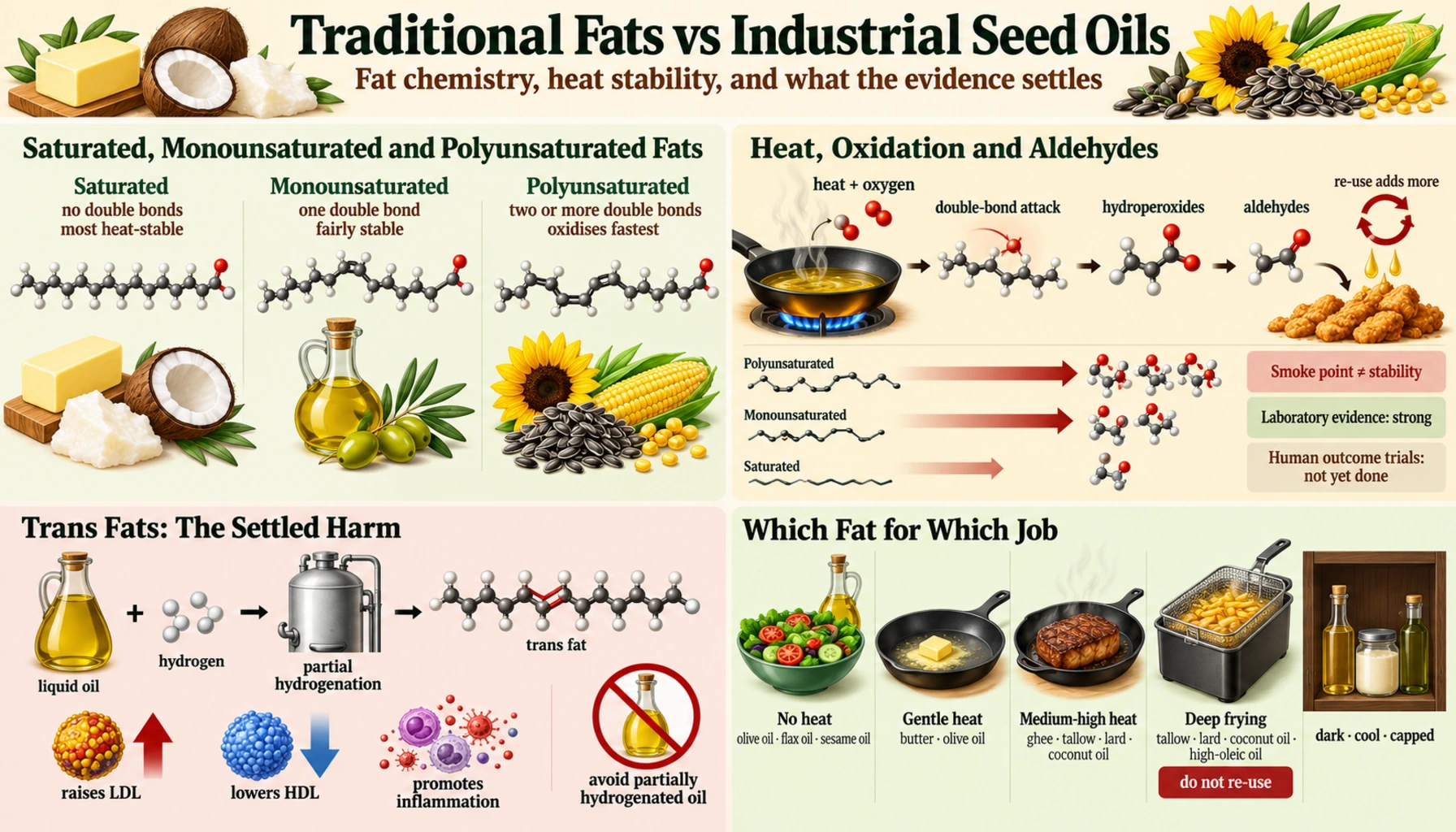
The Weston A. Price diet asks you to cook with butter, tallow, lard, poultry fat and coconut oil, dress salads with olive oil, and avoid hydrogenated fats and industrial seed oils. Part of that advice is now mainstream science: trans fat is harmful, and polyunsaturated oils break down into toxic aldehydes when they are fried hard and re-used. Part of it is still argued over: whether saturated fat raises heart risk is a live, honest debate, and saturated fat does raise LDL cholesterol (the “bad” cholesterol, carried in particles that can lodge in artery walls) in many people. This page walks through the chemistry, the trials and a practical kitchen guide — settled points and debated points kept clearly apart.
Table of Contents
- What the Booklet Recommends
- Fat Chemistry in Plain Language
- Heat, Oxidation and Aldehydes
- Trans Fats: The Settled Harm
- The Saturated Fat and Heart Debate
- Olive Oil: The Best-Tested Traditional Fat
- Which Fat for Which Job: a Kitchen Guide
- Safety and Who Should Be Careful
- Key Research Papers
- Connections
- Featured Videos
What the Booklet Recommends
The Weston A. Price Foundation's booklet Timeless Principles of Healthy Traditional Diets devotes a whole panel to the question it calls being "confused about fats." Its answer is a short list of fats that, it says, nourished healthy traditional peoples for thousands of years, and a short list of fats to avoid. In summary, the booklet recommends:
- For cooking and eating: butter (preferably from pasture-fed cows), tallow and suet from beef and lamb, lard from pigs, chicken, goose and duck fat, and the tropical oils — coconut, palm and palm kernel.
- For salads: genuine olive oil, plus small amounts of expeller-pressed sesame oil, high-oleic sunflower oil and flax oil.
- For fat-soluble vitamins: a cold-processed fish liver oil such as cod liver oil, which the booklet prefers over ordinary fish oil because fish oil carries little vitamin A or D. (Cod liver oil and the vitamin A limits in pregnancy are covered on our Fat-Soluble Activators page.)
And it warns against three things: all hydrogenated and partially hydrogenated oils; industrially processed seed oils such as soy, corn, safflower, cottonseed, canola, grapeseed and rice bran oil; and any fat, especially a polyunsaturated seed oil, that has been heated to very high temperatures in processing or frying. One of the booklet's principles adds that traditional diets got only about 4 percent of their calories from polyunsaturated fat, with the rest of the fat coming from saturated and monounsaturated sources, and another says traditional diets held omega-6 and omega-3 fats in roughly equal amounts.
The booklet also makes stronger claims: that saturated fat does not cause heart disease, that it is the heart's preferred fuel, and that the fats found in clogged arteries are mostly unsaturated. The sections below take each part in turn. The short version: the warnings are on firmer ground than the defences, and both deserve a careful look.
Fat Chemistry in Plain Language
Every fat you cook with is a blend of three families of fatty acids. The difference between them comes down to one feature: how many double bonds sit along the carbon chain. Think of a fatty acid as a chain of beads. A double bond is a kink in the chain — and a weak spot where oxygen can attack.
- Saturated (SFA) — no double bonds. The chains are straight, pack together tightly, and are solid at room temperature (butter, tallow, coconut oil). With no weak spots, they are the hardest to oxidise.
- Monounsaturated (MUFA) — one double bond. One kink, so they are liquid at room temperature but turn cloudy in the fridge (olive oil). One weak spot makes them fairly stable.
- Polyunsaturated (PUFA) — two or more double bonds. These include the essential omega-6 (linoleic acid) and omega-3 fats. Each extra double bond makes the chain more fragile, so PUFA-rich oils oxidise fastest, both on the shelf and in the pan.
No fat is purely one type. Lard, for example, has more monounsaturated than saturated fat. Here are the U.S. Department of Agriculture's FoodData Central (SR Legacy) figures, expressed as grams of each family per 100 g of the fat itself. Butter is only about 81% fat (the rest is mostly water), so its figures are scaled to 100 g of butterfat. They do not add to 100 because a few grams are glycerol and minor compounds:
- Butter: saturated 63, monounsaturated 26, polyunsaturated 4
- Beef tallow: 50, 42, 4
- Lard: 39, 45, 11
- Coconut oil: 83, 6, 2
- Olive oil: 14, 73, 11
- Canola oil: 7, 63, 28
- Soybean oil: 16, 23, 58
- Corn oil: 13, 28, 55
- Sunflower oil (regular, high-linoleic): 10, 20, 66. The high-oleic sunflower oil the booklet allows is a different crop variety: about 10, 84, 4 — closer to olive oil than to its high-linoleic cousin.
Read the chart from the bottom up and the booklet's logic becomes visible. Soybean, corn and regular sunflower oil are 55–66 percent polyunsaturated — the most fragile family. The traditional animal fats and coconut oil are mostly saturated and monounsaturated. Canola sits in between: mostly monounsaturated, but with 28 percent polyunsaturated fat, about a third of it (9 g) omega-3, the most oxidation-prone family of all.
One honest complication: the booklet groups canola with the worst seed oils, but by composition canola is closer to olive oil than to soybean oil. The stronger objection to canola and other refined oils is about how they are made and used — high-heat refining, deodorising and repeated frying — rather than the fatty acids alone.
Heat, Oxidation and Aldehydes
When fat is heated in air, oxygen attacks the double bonds. The first products, called hydroperoxides, quickly fall apart into smaller molecules — including aldehydes, reactive compounds that can damage proteins and DNA. The more double bonds a fat has, the faster this chain reaction runs. Picture a dry log versus a pile of kindling: polyunsaturated oils are the kindling.
A research group in the United Kingdom has spent years measuring this directly. In one study they heated common cooking oils at 180 °C (356 °F) to simulate shallow frying, and fried potato chips repeatedly at 170 °C in a domestic deep-fat fryer. The PUFA-rich oils generated far more aldehydes than a new monounsaturated-rich algae oil; with sunflower oil, the aldehyde content of the chips climbed with each re-use of the oil; and chips bought from fast-food outlets contained 10–25 parts per million of each class of aldehyde measured (Moumtaz 2019, laboratory study — the paper discloses that its senior investigator received funding from the maker of the algae oil tested). A 2020 review by the same group gathers the evidence that these aldehydes soak into fried food and are absorbed — but stresses that the harm data come from animal and cell studies, and calls for human trials that have not yet been done (Grootveld 2020).
Smoke point versus oxidative stability. Many cooking charts rank oils by smoke point — the temperature at which visible smoke appears. Refining strips out the free fatty acids and particles that smoke early, so a refined seed oil often has a high smoke point. But smoke point tells you nothing about how fast the double bonds are being attacked. A fat's stability under prolonged heat depends mainly on how polyunsaturated it is, plus its natural antioxidants (extra-virgin olive oil carries polyphenols and vitamin E that slow the process).
Verdict on the booklet's warning: supported in its chemistry (laboratory evidence is strong and consistent) and plausible as a health concern (animal and cell data), but not yet shown in human outcome trials. Avoiding repeated deep-frying in PUFA-rich oil is a reasonable precaution that costs nothing.
Trans Fats: The Settled Harm
On this point the booklet and mainstream science agree completely. Partial hydrogenation is an industrial process that bubbles hydrogen through a liquid vegetable oil to make it solid and shelf-stable. It was how stick margarine and vegetable shortening were made for most of the twentieth century. It produces trans fats — unsaturated fats whose double bond has been twisted into an unnatural, straight shape.
The evidence against artificial trans fat is among the strongest in nutrition. A major 2006 review in the New England Journal of Medicine pooled the controlled feeding trials and the large cohort studies: trans fat raises LDL cholesterol, lowers HDL (“good”) cholesterol, promotes inflammation, and, gram for gram, was more strongly linked to heart disease than any other dietary fat (Mozaffarian 2006, review of trials and cohorts). A meta-analysis of 60 controlled feeding trials found that replacing trans fat had almost twice the effect on the total-to-HDL cholesterol ratio as replacing saturated fat (Mensink 2003, meta-analysis of RCTs).
Regulators acted on it. In 2015 the U.S. Food and Drug Administration determined that partially hydrogenated oils are no longer "generally recognized as safe", and manufacturers had to remove them by 2018, with some extensions for products already made (FDA: Trans Fat). This is why the booklet's old warning about margarine reads so differently today: the margarines of earlier decades were trans-fat products.
Two small notes. Fully hydrogenated oils contain little trans fat (they become saturated instead), and the small amount of natural trans fat in butter and beef (from rumen bacteria) is a different molecular mix that has not shown the same harm at normal intakes. The settled rule is simple: avoid anything listing "partially hydrogenated" oil — the booklet's principle and the FDA's agree.
The Saturated Fat and Heart Debate
The booklet says saturated fat does not cause heart disease. Mainstream guidelines say it raises risk and should be replaced with unsaturated fat. The truth is that serious researchers have disagreed about this for decades, and the honest picture has several parts that do not all point the same way.
What is not in dispute: LDL usually rises
In controlled feeding trials, saturated fat raises LDL cholesterol on average, and replacing it with unsaturated fat lowers it (Mensink 2003, meta-analysis of 60 RCTs). The same meta-analysis found nuances the booklet would welcome: lauric acid, the main fat in coconut oil, raises total cholesterol strongly but much of the rise is in HDL; stearic acid (abundant in tallow) slightly lowered the total-to-HDL ratio; and replacing saturated fat with carbohydrate did not improve that ratio at all.
The cohort studies: no clear association
A 2010 meta-analysis of 21 prospective cohort studies, covering 347,747 people followed for 5–23 years, found that people who ate the most saturated fat were not at significantly higher risk of heart disease, stroke or cardiovascular disease than those who ate the least (Siri-Tarino 2010, meta-analysis of cohorts). Cohort studies can only show association, and they are easily muddied by what people eat instead of saturated fat — but they did not find the strong link that early guidelines assumed.
The randomised trials: fewer events, not fewer deaths
The most careful summary of the trials is the Cochrane review, updated in August 2020: 15 randomised trials with about 56,675 participants lasting at least two years. Cutting saturated fat — whether the calories were replaced by polyunsaturated fat or by carbohydrate, which the review found did not clearly differ — reduced combined cardiovascular events by 17% (risk ratio 0.83, moderate-quality evidence), and the more cholesterol fell, the bigger the benefit. But it showed little or no effect on deaths from any cause (risk ratio 0.96) or from cardiovascular disease (risk ratio 0.95) (Hooper 2020, meta-analysis of RCTs). In plain terms: in the trials, people who cut saturated fat had somewhat fewer heart attacks and strokes, but did not clearly live longer.
The recovered trials: linoleic acid lowered cholesterol, not deaths
Two old trials that replaced saturated fat with omega-6-rich oil were never fully published. When their raw data were recovered, they told an uncomfortable story for the seed-oil swap:
- Sydney Diet Heart Study (1966–73): 458 men who had already had a heart event. Those told to replace animal fats with safflower oil and safflower margarine had higher death rates — 17.6% versus 11.8% for all causes (Ramsden 2013, recovered RCT data). The study's safflower margarine was also a product of its era, so trans fat may have played a part.
- Minnesota Coronary Experiment (1968–73): 9,423 residents of a nursing home and six state mental hospitals. Corn oil lowered serum cholesterol by 13.8% compared with 1.0% in the control group, yet brought no reduction in deaths; in fact, each 30 mg/dL fall in cholesterol was linked to a 22% higher risk of death (Ramsden 2016, recovered RCT data).
These re-analyses are the strongest support for the booklet's distrust of seed oils as a heart medicine. They do not prove seed oils are deadly — the trials are half a century old, were run in unusual populations, and in Minnesota only 2,355 of the 9,423 participants stayed on the study diets for a year or more — but they show that lowering cholesterol by pouring on linoleic acid did not deliver the expected benefit.
The other side of the ledger
The American Heart Association reviewed the same field in 2017 and concluded strongly that replacing saturated fat with polyunsaturated vegetable oil lowers cardiovascular disease by about 30%, based on the trials it judged best designed, and that replacing it with refined carbohydrate and sugar does not help (Sacks 2017, expert advisory). Large cohort studies also link higher linoleic-acid intake with lower heart risk: a pooled analysis of 13 cohorts with 310,602 people found 15% fewer heart disease events in the highest intake group (Farvid 2014, meta-analysis of cohorts). Which trials to include, and how much weight to give the recovered ones, is exactly where experts part ways.
What about clogged arteries?
The booklet states that the fats in artery plaques are mostly unsaturated — 74% unsaturated, 41% polyunsaturated — citing a 1994 Lancet letter. That study is real: it compared the fatty acids in aortic plaques taken at autopsy with blood and body fat, and found that the polyunsaturated and monounsaturated fats in plaque tracked those in blood and body fat (a sign of diet), while saturated fat showed no such link (Felton 1994, autopsy study). Its published abstract reports these correlations but not the 74% and 41% figures, which we could not check against the full letter, so we do not repeat them as established. Either way, what a plaque is made of does not by itself show what caused it: plaque forms when LDL particles get trapped in the artery wall, and those particles carry whatever fatty acids are circulating.
Omega-6 and omega-3 balance
The booklet says traditional diets held omega-6 and omega-3 roughly equal. A widely cited review estimates that humans evolved on a ratio near 1:1, while Western diets now run around 15:1 to 16.7:1, largely because of seed oils (Simopoulos 2002, review). The direction of that change is not disputed. Whether the ratio itself is what matters, or simply getting enough omega-3, is debated — but both camps agree on the practical step: eat oily fish and other omega-3 foods, and do not let refined seed oils dominate your fat intake. See our Omega-3 Fatty Acids page.
Where this leaves you. Settled: artificial trans fat is harmful. Settled: saturated fat raises LDL cholesterol on average. Debated: whether that LDL rise translates into more deaths for a person eating whole foods, and whether swapping butter for seed oil helps — the trials point to fewer cardiovascular events but no clear survival gain. The booklet's claim that saturated fat is "the preferred food for the heart" mixes two things: the heart muscle does burn fatty acids as its main fuel, but that is physiology, not evidence about what a high-saturated-fat diet does to arteries.
Olive Oil: The Best-Tested Traditional Fat
Olive oil is on the booklet's approved list, and it has the best human trial evidence of any cooking fat. In the PREDIMED trial in Spain, 7,447 people aged 55 to 80 at high cardiovascular risk were assigned to a Mediterranean diet with extra-virgin olive oil, a Mediterranean diet with mixed nuts, or a control diet advising them to cut fat. After a median 4.8 years, the olive-oil group had about 30% fewer major cardiovascular events — heart attack, stroke or cardiovascular death — than the low-fat control group (hazard ratio 0.69) (Estruch 2018, RCT).
Two honest caveats. First, the trial's original 2013 report was withdrawn after protocol problems were found at some sites; the 2018 re-analysis corrected for them and the result held, including after excluding the 1,588 affected participants. Second, the comparison was against advice to eat less fat, not against butter or tallow, so PREDIMED supports olive oil and the whole Mediterranean pattern — it does not settle the animal-fat question. Notice also that the low-fat diet came off worst, which fits the booklet's (and this site's) rejection of low-fat eating.
The booklet adds that even olive oil can cause "imbalances" if eaten in large amounts. No trial supports that worry at the amounts PREDIMED used. More on the oil itself: Olive Oil and the Mediterranean Diet.
Which Fat for Which Job: a Kitchen Guide
Whatever you conclude about the heart debate, the chemistry gives clear kitchen rules. Match the fat's stability to the heat and the time it will spend there.
By cooking temperature
- No heat (dressings, drizzling): extra-virgin olive oil; small amounts of flax oil (never heat flax — it is the most fragile oil in the kitchen); cold-pressed sesame oil for flavour.
- Gentle heat (eggs, sweating onions, low sauté): butter, olive oil, any of the traditional fats. Whole butter's milk solids brown and burn first, so keep the heat moderate.
- Medium-high heat (searing, stir-frying, roasting): clarified butter or ghee (the milk solids removed), tallow, lard, coconut oil, extra-virgin olive oil — which holds up better under heat than its smoke point suggests, thanks to its monounsaturated fat and antioxidants.
- Deep frying (home fryers usually run around 170–190 °C, or 340–375 °F): the most stable fats — tallow, lard, coconut oil or high-oleic oils. Change the oil often; do not keep re-using it, because aldehydes build up with every session. Avoid deep-frying in soybean, corn, regular sunflower or safflower oil.
Storage
- Light, heat and air drive oxidation. Keep oils in dark glass or tins, away from the stove, tightly capped.
- Buy polyunsaturated-rich oils (flax, walnut, sesame) in small bottles and refrigerate them; use within weeks of opening.
- Olive oil keeps best in a cool cupboard and is at its best within a few months of opening.
- Butter, lard and tallow keep well refrigerated; render your own lard or tallow from good-quality fat if you have a source (see Lard Rendering).
- Smell before you use: a sharp, crayon-like or fishy smell means the oil has gone rancid. Throw it out.
Buying guidance (no brands, just what to look for)
- Olive oil: "extra virgin", a harvest or best-by date, dark glass. Olive oil fraud exists; buying from a source that names the harvest date and origin lowers the risk.
- Butter: plain butter, ideally from pasture-raised cows, which tends to be richer in vitamin A precursors and vitamin K2. Avoid "spreads" and blends built on refined oils.
- Animal fats: lard and tallow sold in the refrigerated section or rendered at home; shelf-stable "lard" may be partially hydrogenated — read the label.
- Coconut oil: virgin (unrefined) tastes of coconut; refined has a neutral taste. Both are stable for cooking.
- Labels: skip anything with "partially hydrogenated" in the ingredients. In packaged and restaurant food, the frying oil is usually a refined seed oil — cooking at home is the simplest way to control it.
For how this fits the rest of the diet, see Getting Started.
Safety and Who Should Be Careful
- LDL cholesterol often rises. Many people who switch to cooking with butter, tallow and coconut oil see their LDL cholesterol go up — this is the most consistent finding in the feeding trials. Some people's LDL rises a great deal ("hyper-responders"). If you make the switch, get a lipid panel before and a few months after, and discuss a large rise with your clinician.
- Familial hypercholesterolaemia (FH). People with this inherited condition already have very high LDL from birth and a much higher risk of early heart disease. A high-saturated-fat diet is not a safe experiment for them; anyone with FH, or a family history of heart attacks before age 55 in men or 65 in women, should plan their fat intake with medical guidance. See Cholesterol Management.
- Existing heart disease. If you have had a heart attack, stent or stroke, do not change your diet's fat profile without your cardiologist; the trials above included people like you and their results were mixed.
- Fish liver oil. Cod liver oil supplies preformed vitamin A. In pregnancy, preformed vitamin A above 10,000 IU a day from supplements is linked to birth defects; read the label and count all sources.
- Calories still count. Every fat supplies about 9 calories per gram — a tablespoon of any of these fats is roughly 100–120 calories. "Use liberally" means as part of whole-food meals, not added on top of a processed-food diet.
- Burns. Hot fat causes serious burns; never put water on a fat fire — smother it with a lid.
Key Research Papers
- Mozaffarian D, Katan MB, Ascherio A, Stampfer MJ, Willett WC (2006). Trans fatty acids and cardiovascular disease. N Engl J Med. — PubMed PMID: 16611951
- Mensink RP, Zock PL, Kester AD, Katan MB (2003). Effects of dietary fatty acids and carbohydrates on the ratio of serum total to HDL cholesterol and on serum lipids and apolipoproteins: a meta-analysis of 60 controlled trials. Am J Clin Nutr. — PubMed PMID: 12716665
- Hooper L, Martin N, Jimoh OF, Kirk C, Foster E, Abdelhamid AS (2020). Reduction in saturated fat intake for cardiovascular disease. Cochrane Database Syst Rev. — PubMed PMID: 32827219
- Siri-Tarino PW, Sun Q, Hu FB, Krauss RM (2010). Meta-analysis of prospective cohort studies evaluating the association of saturated fat with cardiovascular disease. Am J Clin Nutr. — PubMed PMID: 20071648
- Ramsden CE, Zamora D, Leelarthaepin B, Majchrzak-Hong SF, Faurot KR, et al. (2013). Use of dietary linoleic acid for secondary prevention of coronary heart disease and death: evaluation of recovered data from the Sydney Diet Heart Study and updated meta-analysis. BMJ. — PubMed PMID: 23386268
- Ramsden CE, Zamora D, Majchrzak-Hong S, Faurot KR, Broste SK, et al. (2016). Re-evaluation of the traditional diet-heart hypothesis: analysis of recovered data from Minnesota Coronary Experiment (1968-73). BMJ. — PubMed PMID: 27071971
- Sacks FM, Lichtenstein AH, Wu JHY, Appel LJ, Creager MA, et al. (2017). Dietary Fats and Cardiovascular Disease: A Presidential Advisory From the American Heart Association. Circulation. — PubMed PMID: 28620111
- Farvid MS, Ding M, Pan A, Sun Q, Chiuve SE, et al. (2014). Dietary linoleic acid and risk of coronary heart disease: a systematic review and meta-analysis of prospective cohort studies. Circulation. — PubMed PMID: 25161045
- Felton CV, Crook D, Davies MJ, Oliver MF (1994). Dietary polyunsaturated fatty acids and composition of human aortic plaques. Lancet. — PubMed PMID: 7934543
- Simopoulos AP (2002). The importance of the ratio of omega-6/omega-3 essential fatty acids. Biomed Pharmacother. — PubMed PMID: 12442909
- Estruch R, Ros E, Salas-Salvadó J, Covas MI, Corella D, et al. (2018). Primary Prevention of Cardiovascular Disease with a Mediterranean Diet Supplemented with Extra-Virgin Olive Oil or Nuts. N Engl J Med. — PubMed PMID: 29897866
- Moumtaz S, Percival BC, Parmar D, Grootveld KL, Jansson P, Grootveld M (2019). Toxic aldehyde generation in and food uptake from culinary oils during frying practices: peroxidative resistance of a monounsaturate-rich algae oil. Sci Rep. — PubMed PMID: 30858398
- Grootveld M, Percival BC, Leenders J, Wilson PB (2020). Potential Adverse Public Health Effects Afforded by the Ingestion of Dietary Lipid Oxidation Product Toxins: Significance of Fried Food Sources. Nutrients. — PubMed PMID: 32244669