Weston A. Price and His 1930s Field Studies: A History
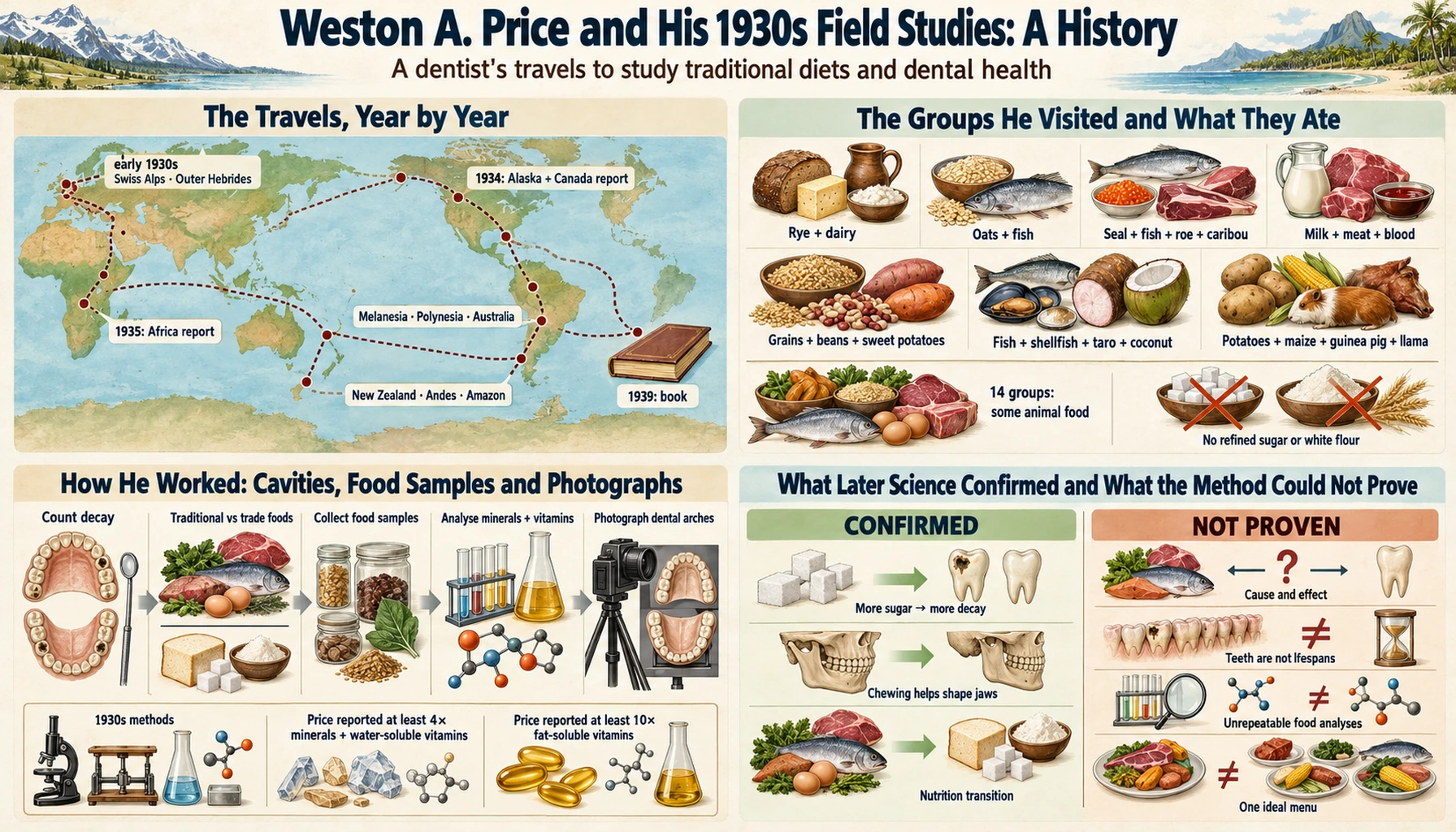
In the 1930s a Cleveland dentist named Weston A. Price set out to answer one question: why did some communities have almost no tooth decay while his own patients had mouths full of fillings? He spent close to a decade visiting isolated groups on five continents, counting cavities, photographing faces and sending food samples home for analysis. This page tells that story, explains how his findings became the modern traditional-diet movement, and sorts what later science confirmed from what his method could not prove.
Table of Contents
- Who Was Weston A. Price?
- The Travels, Year by Year
- The Groups He Visited and What They Ate
- How He Worked: Cavities, Food Samples and Photographs
- The 1939 Book and "Activator X"
- Pottenger's Cats and the Foundations That Followed
- What Later Science Confirmed
- What the Method Could Not Prove
- Key Research Papers
- Connections
- Featured Videos
Who Was Weston A. Price?
Weston Andrew Price (1870–1948) was born in Newburgh, Ontario, Canada, trained as a dentist, and built his career in Cleveland, Ohio. He was not a fringe figure in his own day. From 1914 to 1928 he led the research institute he had helped found at the National Dental Association — the body that became the American Dental Association — and he published regularly in its journal on subjects ranging from dental metals to calcium metabolism.
His early research centred on an idea that dominated medicine at the time: the focal-infection theory. It held that a small, hidden infection — often in a tooth or the tonsils — could seed disease elsewhere in the body, from arthritis to heart and kidney trouble. Price ran extensive laboratory work on this question and summarised it in two volumes published in 1923, Dental Infections, Oral and Systemic and Dental Infections and the Degenerative Diseases. The Foundation's booklet still draws on those books for its "holistic dentistry" advice about root-canal-treated teeth.
How has that particular idea held up? Mainstream dentistry moved away from the broad version of the theory by the 1940s and 1950s. A 2000 appraisal in a dental journal concluded that the evidence linking mouth bacteria to disease elsewhere was still "very limited", because there were few studies that followed people forward in time and no trials that tested treating the mouth to see whether disease elsewhere improved (evidence tier: narrative review). Researchers today do study real links between gum disease and conditions such as diabetes and heart disease, but there is no good evidence that removing root-canal-treated teeth cures disease elsewhere in the body. The Myths and Evidence page takes this up claim by claim.
Around 1930 Price changed direction. Rather than study a disease, he decided to study its absence. If he could find people who rarely got cavities, he reasoned, he might learn what protected them. That shift is what the rest of this page is about.
The Travels, Year by Year
Beginning in the early 1930s, Price travelled for close to ten years. His first trips took him to a high Alpine valley in Switzerland, the Lötschental, and to Gaelic-speaking crofting villages on the Isle of Lewis and other islands of the Outer Hebrides off Scotland. Over the following summers he visited Inuit communities in Alaska and First Nations peoples in northern Canada, the Seminole in Florida, islanders across Melanesia and Polynesia, cattle-herding and farming peoples in East and Central Africa, Aboriginal Australians and Torres Strait Islanders, the Maori of New Zealand, and communities high in the Andes of Peru and in the Amazon basin.
He reported as he went. The surviving journal record shows him reading his Alaska and Canada findings to the American Dental Association in August 1934 and his African findings in November 1935, both printed in its journal in 1936. The full synthesis came in 1939 with his book Nutrition and Physical Degeneration. He died in 1948.
Fifty-one years after his death, in 1999, a new nonprofit — the Weston A. Price Foundation — was founded in Washington, D.C., to spread his findings, and in 2007 a researcher associated with it proposed that the mystery nutrient Price had called "Activator X" was vitamin K2. The timeline below joins those dots.
The Groups He Visited and What They Ate
Price did not pick communities at random. He looked for places that were still largely cut off from trade foods — and, ideally, for a neighbouring village or a younger generation of the same people who had begun eating white flour, sugar, canned goods and polished rice. That pairing let him compare people with the same ancestry but different diets, which was the cleverest part of his design.
The diets he found were strikingly different from each other. The Swiss villagers lived mostly on rye bread and dairy from summer-pasture cows, with meat perhaps once a week. The Hebridean islanders lived on oats and the sea, including a dish of cod heads stuffed with oats and chopped cod liver. Inuit families ate seal, whale, fish, fish roe and caribou, organs included. East African herders lived largely on milk, meat and blood, while their farming neighbours ate grains, beans and sweet potatoes with smaller amounts of animal food. Andean families grew potatoes and maize, raised guinea pigs and llamas, and traded for dried fish eggs carried up from the coast.
What united them, in Price's account, was not one menu but a pattern: no refined sugar or white flour, and some animal food in every group — often organ meats, seafood, eggs or dairy fat, and often reserved for young people before marriage, pregnant and nursing mothers, and growing children. The booklet turns that pattern into its principles of traditional diets. The matrix below lists the fourteen groups as Price described them; the food lists are simplified from his accounts, and the group names use current terms rather than some of the words he used in the 1930s.
How He Worked: Cavities, Food Samples and Photographs
Price used three tools, and it helps to see each one plainly.
- Counting decay. In each community he examined as many mouths as he could and recorded the share of teeth with cavities. He then did the same among people of the same group who had begun eating trade foods. His striking finding, repeated in place after place, was that decay was rare among those on traditional diets and common among those who had switched.
- Analysing the food. He collected samples of local foods — butter, fish, grains, organ meats — and had them analysed back in his Cleveland laboratory for minerals such as calcium and phosphorus and for the fat-soluble vitamins. Comparing these with the typical American diet of the 1930s, he reported that the traditional diets supplied at least four times (4×) the minerals and water-soluble vitamins and at least ten times (10×) the fat-soluble vitamins. The booklet still repeats those figures in its 2026 edition.
- Photographing faces. He took thousands of photographs of dental arches and faces. Children born to parents who had already adopted trade foods, he argued, more often had narrow faces, crowded teeth and narrow palates than their own older siblings or parents.
The bar chart below shows Price's food-analysis claim with the modern diet of his day set at 1×. Read it for what it is: his own measurements, made with 1930s laboratory methods, on samples he chose. It has never been repeated as a formal study, and modern dietary surveys do not express nutrient intakes this way, so it is a historical result rather than a current fact (evidence tier: uncontrolled observational analysis).
The strength of the design was the within-group comparison: two generations of one family, or two villages of one people, differing mainly in whether trade foods had arrived. The weakness, discussed below, is everything else that changed at the same time.
The 1939 Book and "Activator X"
Nutrition and Physical Degeneration (Paul B. Hoeber, New York, 1939) gathered the travels into one argument: that the "displacing foods of modern commerce", as Price called sugar, white flour, polished rice, canned goods and vegetable fats, caused both tooth decay and narrowing of the face and dental arch within a single generation. It has been reprinted many times and is still in print. Its photographs, now held by the Price-Pottenger foundation, are the book's most famous feature.
Alongside vitamins A and D, Price described a third fat-soluble factor he could detect in his laboratory tests but could not chemically identify. He called it Activator X. He found it richest in butter from cows grazing on fast-growing spring and autumn grass, in fish livers and roe, and in the organs and fat of certain animals, and he reported that butter oil rich in it, given together with cod liver oil, appeared to halt tooth decay in a small number of children he treated. Those were uncontrolled case observations (evidence tier: case series).
For decades nobody knew what Activator X was. In 2007, Chris Masterjohn, then writing for the Foundation, proposed that it was vitamin K2 — the animal form of vitamin K, especially the form called menaquinone-4 (MK-4). The same year he published a peer-reviewed hypothesis paper arguing that vitamins A, D and K work as a team: vitamin D tells cells to make certain proteins, and vitamin K is needed to switch those proteins on, so very high vitamin D without enough K could cause harm (evidence tier: hypothesis built mainly on animal studies). The fit with Price's food list is good — US Department of Agriculture testing has found MK-4 in meat, egg and dairy foods — but the match is an inference from where the nutrient occurs and what it does. Nobody can re-test Price's original samples, so "Activator X = K2" is a well-reasoned proposal, not a proven identity. The Fat-Soluble Activators page covers what modern trials show about vitamins A, D and K2.
Pottenger's Cats and the Foundations That Followed
The cat studies
The booklet's story usually includes a California physician, Francis M. Pottenger Jr., who ran a long feeding experiment on cats from the early 1930s into the early 1940s. Several hundred cats (the figure usually quoted is about 900) were fed either raw meat and raw milk or diets in which the meat or milk had been cooked or processed. Pottenger reported that cats on the cooked diets developed more disease, poorer bones and narrower facial and dental structures, and that the problems deepened over generations. He published the dental findings in an orthodontics journal in 1946.
These were animal studies, and they say little directly about people. Cats are strict carnivores with very different needs from ours. Most importantly, in 1975 researchers showed that cats cannot make enough of the amino acid taurine and go blind without it in their food; in 1987 a study of 23 cats with failing heart muscle (dilated cardiomyopathy) found low blood taurine, and heart function returned to normal when the cats were given taurine by mouth. Taurine is partly lost when meat is cooked and drained, so a widely suggested explanation for much of what Pottenger saw is taurine deficiency, a problem humans do not share in the same way (evidence tier: animal study; applicability to humans contested). Pottenger's work is a historical curiosity, not evidence that people should eat their meat raw.
Two foundations
After Price's death, friends and colleagues set up a foundation in the early 1950s to preserve his photographs, notes and books. It later joined with a group preserving Pottenger's work and is known today as the Price-Pottenger foundation; it still holds the original archive.
The second, larger organisation came in 1999, when nutrition writer Sally Fallon Morell and nutritionist Mary Enig, a researcher on dietary fats, founded the Weston A. Price Foundation in Washington, D.C. It is a nonprofit educational charity funded by members and donations, and it states that it accepts no funding from the meat or dairy industries. It publishes the quarterly journal Wise Traditions, runs local chapters that connect people with farms, and produces the "Timeless Principles of Healthy Traditional Diets" booklet that this set of pages follows. Its dietary advice — nutrient-dense animal foods, traditional fats, fermented and soaked foods, bone broth, and no refined sugar or industrial seed oils — is laid out on the Weston A. Price Diet hub.
What Later Science Confirmed
Several of Price's central observations have held up well under modern methods.
Sugar and refined flour cause tooth decay
Price's link between trade foods and cavities is now textbook science. A systematic review commissioned for the World Health Organization in 2014 found that 42 of 50 studies in children, and all 5 in adults, reported at least one link between more sugar and more decay, and that decay is lower when free (added) sugars stay below 10% of daily calories (moderate-quality evidence), with weaker, very-low-quality evidence for a benefit below 5% (evidence tier: systematic review of cohort, population and intervention studies). The World Health Organization's 2015 sugar guideline was built on it. Two leading researchers went further in 2015, describing free sugars as the single essential cause of tooth decay, with fluoride and brushing acting only as brakes. Price did not know the bacterial mechanism in detail, but his central dietary observation was right. See Tooth Decay for the modern picture.
Soft modern diets and crowded teeth
Price's second big claim — that faces and dental arches narrow when people switch to modern foods — has also found real support, though the explanation has shifted. In 1984 the anthropologist Robert Corruccini described an "epidemiologic transition" in dental occlusion: crowded, poorly aligned teeth rise sharply wherever societies urbanise, too fast to be genetic. An earlier study he co-led (1983) of 341 Pima people in Arizona found that younger people raised on refined commercial foods had narrower palates and more irregular bites than their elders raised on traditional diets (evidence tier: cross-sectional, a one-time snapshot). A comparison of 16th-century Norwegian skulls with modern children found an objective need for orthodontic treatment in 36% of the medieval sample against 65% today.
The likely mechanism, though, is mainly chewing, not just nutrients. In an animal study, rock hyraxes raised on cooked, softer food grew about 10% less in the lower and rear face than those raised on raw, tougher food (evidence tier: animal study). Price attributed narrowing faces chiefly to missing vitamins and minerals; today's researchers think hard, fibrous, chewy traditional foods that work the jaws during childhood are a large part of the story. Both explanations point toward the same plate of whole, minimally processed food.
The nutrition transition
Price's broader picture — that health declines when communities swap traditional foods for refined sugar, white flour and vegetable oils — is now a whole field of research called the nutrition transition. Studies across low- and middle-income countries document rapid rises in obesity, type 2 diabetes and high blood pressure as diets shift toward processed foods, edible oils and sugary drinks (evidence tier: population and cohort data). Price saw an early version of this in the 1930s with nothing more than a camera, a mouth mirror and a notebook.
What the Method Could Not Prove
None of this makes Price's travels proof of every recommendation built on them. His method was observational and pioneering, and it has the limits all such work shares.
- Many things changed at once. When trade foods arrived, so did new sugar habits, less chewing, less physical work, new infections, money and stress. Without modern statistics, Price could not separate the effect of a missing vitamin from the effect of added sugar — and sugar alone explains much of the decay he saw.
- No control for who was examined. He examined whoever he could reach, often in short visits, and he chose the communities knowing what he was looking for. Healthy-looking villages are easier to photograph than sick ones, and nobody checked his counts blind.
- Teeth are not lifespans. Price measured teeth, faces and general appearance. He did not track lifespan, infant mortality or chronic disease over time, so the step from "good teeth" to "freedom from degenerative disease" is an extrapolation.
- The food analyses are unrepeatable. The 4× and 10× figures rest on 1930s laboratory methods and samples nobody can retest.
- Diversity cuts both ways. The fourteen diets ranged from nearly all animal food to mostly plants. That supports "avoid refined foods" very strongly; it supports any single specific menu much less.
Reading this history safely
Two practices from the traditional diets Price admired carry documented risks today. Raw milk, which the Foundation campaigns for, is a recognised source of outbreaks of Campylobacter, E. coli O157 and Listeria, and US health agencies advise pregnant women, young children, older adults and anyone with a weakened immune system not to drink it. Cod liver oil and liver are rich in preformed vitamin A, and more than 10,000 IU a day from supplements in pregnancy has been linked to birth defects. The Pregnancy and Children page gives safe amounts.
The fair summary: Price's core observation — refined sugar and flour displace nourishing food and damage teeth and jaws — was ahead of its time and has been confirmed. His specific explanations, and some of the advice built on them, need the evidence check that the Myths and Evidence page provides.
Key Research Papers
- Price WA (1936). Eskimo and Indian Field Studies in Alaska and Canada. The Journal of the American Dental Association. 23(3):417–437. — doi:10.14219/jada.archive.1936.0057
- Price WA (1936). Field Studies Among Some African Tribes on the Relation of their Nutrition to the Incidence of Dental Caries and Dental Arch Deformities. The Journal of the American Dental Association. 23(5):876–890. — doi:10.14219/jada.archive.1936.0378
- Pottenger FM (1946). The effect of heat-processed foods and metabolized vitamin D milk on the dentofacial structures of experimental animals. American Journal of Orthodontics and Oral Surgery. 32(8):A467–A485. — doi:10.1016/0096-6347(46)90180-9
- Hayes KC, Carey RE, Schmidt SY (1975). Retinal degeneration associated with taurine deficiency in the cat. Science. 188:949–951. — PubMed PMID: 1138364
- Pion PD, Kittleson MD, Rogers QR, Morris JG (1987). Myocardial failure in cats associated with low plasma taurine: a reversible cardiomyopathy. Science. 237:764–768. — PubMed PMID: 3616607
- Masterjohn C (2007). Vitamin D toxicity redefined: vitamin K and the molecular mechanism. Medical Hypotheses. 68:1026–1034. — PubMed PMID: 17145139
- Elder SJ, Haytowitz DB, Howe J, Peterson JW, Booth SL (2006). Vitamin K contents of meat, dairy, and fast food in the U.S. diet. Journal of Agricultural and Food Chemistry. 54:463–467. — PubMed PMID: 16417305
- Moynihan PJ, Kelly SA (2014). Effect on caries of restricting sugars intake: systematic review to inform WHO guidelines. Journal of Dental Research. 93:8–18. — PubMed PMID: 24323509
- Sheiham A, James WP (2015). Diet and Dental Caries: The Pivotal Role of Free Sugars Reemphasized. Journal of Dental Research. 94:1341–1347. — PubMed PMID: 26261186
- Corruccini RS (1984). An epidemiologic transition in dental occlusion in world populations. American Journal of Orthodontics. 86:419–426. — PubMed PMID: 6594064
- Corruccini RS, Potter RH, Dahlberg AA (1983). Changing occlusal variation in Pima Amerinds. American Journal of Physical Anthropology. 62:317–324. — PubMed PMID: 6660288
- Evensen JP, Øgaard B (2007). Are malocclusions more prevalent and severe now? A comparative study of medieval skulls from Norway. American Journal of Orthodontics and Dentofacial Orthopedics. 131:710–716. — PubMed PMID: 17561048
- Lieberman DE, Krovitz GE, Yates FW, Devlin M, St Claire M (2004). Effects of food processing on masticatory strain and craniofacial growth in a retrognathic face. Journal of Human Evolution. 46:655–677. — PubMed PMID: 15183669
- Popkin BM, Adair LS, Ng SW (2012). Global nutrition transition and the pandemic of obesity in developing countries. Nutrition Reviews. 70:3–21. — PubMed PMID: 22221213
- Pallasch TJ, Wahl MJ (2000). The focal infection theory: appraisal and reappraisal. Journal of the California Dental Association. 28:194–200. — PubMed PMID: 11326533
Price's book itself has no PubMed or DOI record: Price WA (1939). Nutrition and Physical Degeneration: A Comparison of Primitive and Modern Diets and Their Effects. New York: Paul B. Hoeber.