Ivermectin and COVID-19: An Honest Record of the Controversy
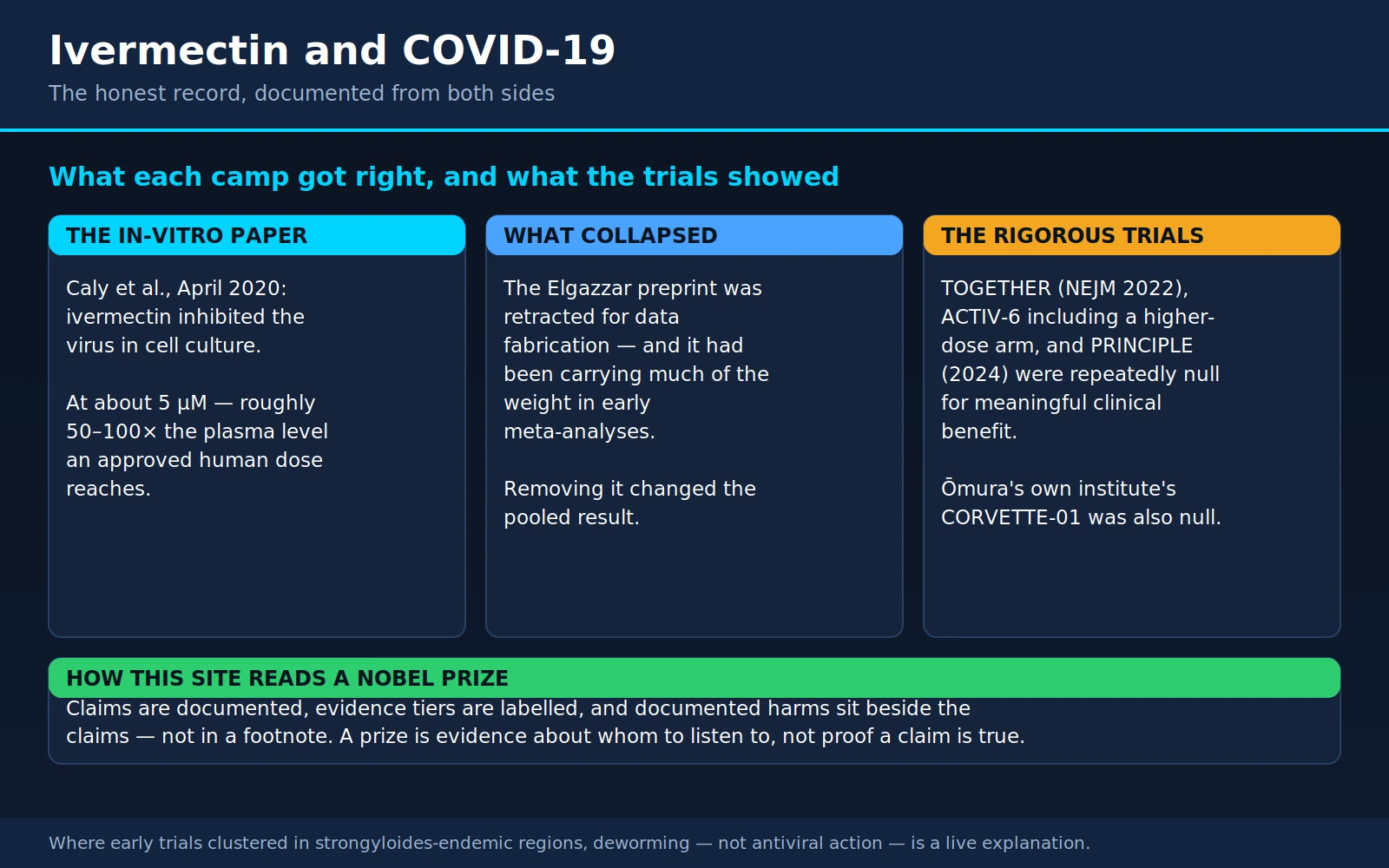
Between 2020 and 2023, a Nobel-honored antiparasitic drug became the most argued-about medicine on Earth. Families split over it. Doctors lost jobs over it. Regulators tweeted about horses, and a Nobel laureate — the discoverer himself — publicly took the side officialdom rejected. Most coverage of the ivermectin–COVID story was written to win an argument, in one direction or the other. This page is written to record it: what was claimed, what was tested, what was fraudulent, what was null, what each side got right and wrong, and where honest uncertainty briefly lived and what closed it. Per this site's standing policy: claims are documented as claims, evidence tiers are labeled, harms sit beside hopes, and inclusion is never endorsement.
The bottom line, stated up front so nothing below feels like a lawyer's build-up: the rigorous randomized trials, run at standard and elevated doses, found no clinically meaningful benefit of ivermectin for treating COVID-19 — and the early evidence that suggested otherwise was contaminated by fraud, confounding, and a parasite-related artifact that is itself one of the most instructive scientific detours of the pandemic. How a genuinely great drug ended up in this position is a story worth telling properly.
Table of Contents
- Why This Page Exists
- April 2020: The Petri-Dish Spark
- The Hope Phase
- The Fraud That Poisoned the Well
- The Proponents' Case, Documented
- Ōmura's Own Verdict
- The Rigorous Trials
- Cochrane and the Regulators
- The Strongyloides Confounder
- What Each Side Got Right — and Wrong
- Where Honest Uncertainty Remains
- What to Do with All This
- Key Research Papers
- Connections
- Featured Videos
1. Why This Page Exists
This site keeps a hub honoring Satoshi Ōmura because ivermectin's record against parasitic disease is one of medicine's monuments. That is precisely why the COVID chapter cannot be skipped or sanitized: a page that celebrated the wonder drug and whispered past its most famous controversy would teach readers to distrust everything else on it. And there is a second reason. The ivermectin–COVID episode is the best modern case study in how medical evidence works — how lab findings mislead, how fraud propagates through meta-analyses, how honest signals arise from confounding, and how large randomized trials eventually settle what shouting could not. A reader who follows this one story attentively will come out better equipped to judge the next contested remedy, whatever it is.
Some context for why the hypothesis was never crazy: ivermectin had shown laboratory activity against several RNA viruses (dengue, Zika, and others) in the 2010s, via a proposed mechanism — blocking a cellular import shuttle some viruses borrow — unrelated to its parasite-killing chloride-channel action (see the pharmacology article). Drug repurposing is real science; this same drug's move from cattle to river blindness, and later to rosacea, was repurposing. The question was never whether the idea deserved testing. It was what the tests would show, and what everyone would do while waiting.
2. April 2020: The Petri-Dish Spark
On April 3, 2020 — weeks into global lockdowns, with no proven treatments — Leon Caly, Kylie Wagstaff, and colleagues at Monash University and the Doherty Institute in Australia published a short paper in Antiviral Research: in monkey-kidney cells in a dish, ivermectin at 5 micromolar concentration reduced SARS-CoV-2 viral RNA roughly 5,000-fold in 48 hours. The paper was real, competent, and instantly world-famous.
The problem was visible on day one to anyone who read the concentration and did division. Five micromolar is enormous for this drug: the peak blood level from a standard 200 µg/kg human dose is on the order of fifty to a hundred times lower than the concentration used in the dish. Pharmacologists ran the models within weeks (Schmith and colleagues, cited below): even at ten times the approved dose — the ceiling formally tested for safety — predicted lung concentrations still fell far short of the dish. Plenty of substances kill viruses in glassware at high concentration — the joke in pharmacology is that so does a flamethrower; the whole game is achieving the effect at levels a living human can sustain. So the honest April 2020 summary was: a legitimate lead with a known, serious dosing gap — worth trials, unlikely on the numbers.
Two clarifications this site owes both camps. To skeptics: "in vitro concentrations were unachievable" is an argument for skepticism, not proof of futility — tissue accumulation and secondary mechanisms (ivermectin does concentrate in lung tissue and has plausible anti-inflammatory actions) meant a modest clinical effect could not be excluded from an armchair. That is why running the big trials was right. To proponents: the gap was never answered, only waved at — and when trials at 600 µg/kg for six days later came back null (below), the "just dose higher" version of the hypothesis had been tested on its own terms.
3. The Hope Phase
Through mid-2020, small studies and desperate systems generated real-looking hope. An influential observational report (the "ICON" study, Florida) found lower mortality in ivermectin-treated hospitalized patients; small trials from several countries reported faster viral clearance or symptom relief; and some governments acted — Peru added ivermectin to national guidelines in May 2020 (later removing it), parts of Bolivia and several Indian states distributed it, and in India's Uttar Pradesh it entered home-treatment kits. When case waves later fell in those places, proponents read vindication; when they fell equally in comparable places that never used ivermectin, skeptics read regression and rising immunity. Ecological data of this kind — whole-population before/after comparisons with no controls — sit on the lowest rung of the evidence ladder, and this site labels them accordingly: suggestive to the hopeful eye, uninterpretable to the careful one, in both directions.
In November 2020, the Front Line COVID-19 Critical Care Alliance (FLCCC) — a group of practicing critical-care physicians led by Pierre Kory and Paul Marik — placed ivermectin at the center of its I-MASK+ protocol. On December 8, 2020, Kory testified before a US Senate committee, calling ivermectin a "miracle drug" whose mountain of data made further placebo-controlled trials almost unethical. The clip traveled the world. Document the claim, label the tier: what stood behind it at that moment was a mixture of in-vitro work, observational series, and small trials of very uneven quality — the exact evidence stratum from which pandemic history's false leads (hydroxychloroquine most recently) had always been built. The FLCCC physicians were real clinicians seeing real dying patients, and their frustration with the treatment vacuum was human and widely shared. Sincerity, however, is not a tier of evidence.
4. The Fraud That Poisoned the Well
The single most consequential document of the hope phase was a preprint from Benha University, Egypt — Ahmed Elgazzar and colleagues, posted November 2020 — reporting on roughly 400 patients and claiming, among other things, a 90% reduction in mortality with ivermectin. Because it was large and dramatic, it dominated early meta-analyses, the statistical summaries that pool trials into a single estimate.
In mid-2021 it fell apart, and the way it fell apart matters. A London master's student, Jack Lawrence, assigned to appraise the paper, noticed plagiarized passages; data sleuths (Gideon Meyerowitz-Katz, Kyle Sheldrick, Nick Brown, James Heathers) then found the dataset's problems: blocks of apparently duplicated patient records and deaths whose recorded dates preceded the study — anomalies with no innocent explanation. The preprint server withdrew the paper on July 14, 2021; the affair is chronicled in the Nature news feature by Sara Reardon (Nature 2021;596:173-174).
Now watch the contamination propagate. Andrew Hill's meta-analysis (Open Forum Infectious Diseases, July 2021), which had reported a roughly 56% mortality reduction and was cited worldwide, depended heavily on Elgazzar; with it and other integrity-flagged trials removed, the survival benefit disappeared — Hill's group published the reanalysis and the original was formally retracted in 2022 (original, retraction). The Bryant–Lawrie meta-analysis (American Journal of Therapeutics, 2021), which claimed a 62% mortality reduction and became the movement's central citation, likewise leaned on Elgazzar and other studies later flagged; its authors stood by it, and readers can weigh that stance against the reanalyses. The enduring statement of the lesson is Lawrence and colleagues' essay in Nature Medicine (cited below): meta-analyses built on summary data are only as sound as their weakest included trial, because pooling cannot detect fabrication — it launders it into a confidence interval.
Be precise about what this proves and doesn't. The fraud does not prove ivermectin fails against COVID; fraud proves nothing except itself. What it explains is why the early evidence looked so strong — and why everything afterward had to rest on trials whose raw data could be trusted.
5. The Proponents' Case, Documented
Per site policy, here is the proponents' case at its strongest, stated as its holders stated it — documented faithfully, labeled as claims:
- Breadth of signal: dozens of studies, whatever their individual flaws, pointed mostly the same direction; proponent websites aggregated them in living meta-analyses and argued the pattern could not all be noise. (Counterpoint, applied later in this page: aggregation amplifies shared biases exactly as efficiently as shared truths.)
- Safety and cost: a generic, WHO-essential medicine with billions of doses of track record, they argued, deserved permissive use during an emergency even under uncertainty — "what's the downside?" (The safety article largely grants the premise at prescription doses — while documenting the veterinary self-dosing wave that was the actual downside as lived.)
- Mechanistic plausibility: laboratory antiviral and anti-inflammatory actions gave the claims a scientific vocabulary; timing arguments (treat early, before viral peak) explained away null hospital trials.
- Ecological vindication: Peru's and Uttar Pradesh's case curves, and later the claim that trial-country parasite burdens masked the drug's true antiviral effect elsewhere.
- Institutional distrust: proponents noted that Merck — which disavowed ivermectin for COVID in February 2021 — was developing its own antiviral (molnupiravir), and read the disavowal as conflicted; they pointed to regulators' haste and mockery as evidence the question was being managed, not investigated.
- Credentialed support: practicing ICU physicians (FLCCC), the chairman of the Tokyo Metropolitan Medical Association (February 2021), and — the crown jewel — Satoshi Ōmura himself.
That is the case as it was made. The rest of this page tests it against what happened when the highest-quality instruments science has — large, blinded, randomized trials — were finally aimed at it.
6. Ōmura's Own Verdict
In March 2021, Ōmura co-authored a long review in the Japanese Journal of Antibiotics — Yagisawa, Foster, Hanaki & Ōmura, "Global trends in clinical studies of ivermectin in COVID-19" (not PubMed-indexed; see the related literature) — surveying the observational and early trial data and concluding that ivermectin's efficacy against COVID-19 was strongly supported, that meta-analytic signals of the time (including Hill's, then unretracted) justified use, and that regulatory hesitancy — including Merck's public disavowal of its own legacy drug — was unwarranted. He earned the right to be heard, and we document his position without embarrassment: the discoverer of the avermectins, at 85, publicly argued his molecule could help against the pandemic and pushed for Japan to test and use it.
Two things distinguish Ōmura's conduct from much of the movement that quoted him. First, he asked for trials, and his institute ran one. Kitasato University mounted CORVETTE-01, a double-blind, placebo-controlled randomized trial of a single 200 µg/kg dose in mild-to-moderate COVID-19. Its result, published in 2023 (Wada et al., cited below), was honest and null: no significant effect on time to viral clearance. Second, when Japan's pharmaceutical company Kowa — partnering with Kitasato — ran a full phase III trial in over a thousand omicron-era outpatients, it too reported no efficacy on symptom resolution (announced September 2022; published as Mikamo et al., J Infect Chemother 2024;30(6):536-543). The laureate's side of the ledger thus contains something rarer than being right: his own institution's trials came back against his hypothesis, and they were published, unspun.
How to weigh the review itself? By its date. In March 2021 the evidence base it summarized was genuinely suggestive and genuinely rotten — the rot (Elgazzar and kin) not yet exposed. Ōmura's error, shared with many, was treating volume of low-tier evidence as a substitute for quality; the reader deciding how much deference his Nobel deserves here can note that expertise in discovering a molecule is not expertise in clinical trial appraisal — and that the trials his own side ran are on this page, counting against the claim, which is science working exactly as it should.
7. The Rigorous Trials
From 2021 onward, the question finally met instruments worthy of it: large, randomized, placebo-controlled, mostly outpatient trials — testing early treatment, the proponents' own preferred window, several at elevated doses. In chronological order of publication:
- López-Medina (Colombia; JAMA, March 2021). 476 mild outpatients, 300 µg/kg daily for 5 days: no significant difference in time to symptom resolution (median 10 vs 12 days; the difference did not reach significance). The first sizable early-treatment null.
- TOGETHER (Brazil; NEJM, March 2022). The heavyweight: 679 ivermectin vs 679 placebo, 400 µg/kg daily for 3 days, in newly symptomatic high-risk outpatients. Primary outcome (hospitalization or extended emergency observation): 14.7% vs 16.3% — relative risk 0.90 with a credible interval spanning 0.70 to 1.16. No significant benefit, no subgroup rescue.
- I-TECH (Malaysia; JAMA Internal Medicine, 2022). 490 high-risk patients, 400 µg/kg for 5 days: progression to severe disease 21.6% with ivermectin vs 17.3% without — statistically indistinguishable, numerically unfavorable.
- ACTIV-6 (US; JAMA, October 2022). NIH platform trial, 1,591 outpatients, 400 µg/kg for 3 days: median recovery 12 vs 13 days; the posterior probability of any benefit (0.91) fell below the trial's 0.95 bar, with no effect on hospitalization or death.
- ACTIV-6 higher-dose (US; JAMA, March 2023). The direct answer to "the dose was too low": 600 µg/kg — triple the standard dose — for 6 days, 1,206 patients: median recovery 11 days vs 11 days; hazard ratio 1.02. Null, at the dose and duration proponents had specified.
- PRINCIPLE (UK; Journal of Infection, 2024). The largest: 2,157 randomized to ivermectin (300 µg/kg for 3 days) against thousands of usual-care controls. Self-reported recovery came about two days sooner — a statistically clear but modest effect, short of the margin the investigators had prespecified as clinically meaningful — with no reduction in hospitalizations or deaths and no benefit on longer-term outcomes. The trialists' summary: ivermectin is "unlikely to provide clinically meaningful benefit."
- CORVETTE-01 (Japan; Frontiers in Medicine, 2023) and Kowa's phase III (Japan/Thailand; 2022–24) — the Kitasato-linked trials described above: both null.
Note what this list is not: hospital-only trials that missed the early window (several exist too — also null, including the international REMAP-CAP platform in the critically ill), or low-dose strawmen. The pattern across continents, variants, doses, and durations is as consistent as clinical evidence gets. If a meaningful treatment effect existed at tolerable doses, trials totaling many thousands of randomized patients, several designed around the proponents' own specifications, were positioned to find it. They found, at most, the two-day symptom shading in PRINCIPLE — an effect size in the territory of throat lozenges, not of the mortality revolutions claimed in 2020.
8. Cochrane and the Regulators
The Cochrane review — medicine's standing institution for systematic evidence appraisal, which for this question adopted an unusually strict trials-integrity policy (admitting only studies whose conduct could be verified) — concluded in its 2022 update (Popp et al., below) that ivermectin has no supported role in treating or preventing COVID-19 outside rigorous trials: for outpatients, moderate-certainty evidence of little or no effect on mortality, worsening, or recovery. The WHO (March 2021 onward) recommended against use outside clinical trials; the EMA and NIH guidelines panel reached the same destination, the NIH moving from "insufficient evidence" (early 2021) to a recommendation against use (2022) as the large trials read out. Merck itself had said in February 2021 that its scientists saw no meaningful evidence of efficacy — a statement proponents discounted for the molnupiravir conflict noted above; readers may hold both facts at once.
Then there is the FDA, whose August 2021 social-media post — "You are not a horse. You are not a cow. Seriously, y'all. Stop it." — became the controversy's most famous sentence. It was aimed at a real event: the 2021 surge in poisonings from veterinary formulations (documented in the safety article). It was also, as communication, a gift to the movement — official mockery that let a WHO-essential human medicine be caricatured as horse paste, insulting both the drug's history and the legitimate patients taking it for parasitic disease. In 2024, settling a lawsuit brought by three physicians, the FDA agreed to delete the posts while conceding no wrongdoing and maintaining its position on efficacy. This site's judgment, offered plainly: the FDA was right about the medicine and wrong about the mockery, and the mockery cost more trust than the rightness earned back.
9. The Strongyloides Confounder
One genuinely beautiful piece of science emerged from the wreckage, and it deserves its own section. Researchers noticed a geographic pattern in the trial data: the studies showing ivermectin mortality benefits clustered in regions where strongyloidiasis — the chronic worm infection described in the global-health article — is endemic. Avi Bitterman and colleagues formalized it in a meta-analysis (JAMA Network Open, 2022, below): group the trials by regional strongyloidiasis prevalence, and the apparent survival benefit lives almost entirely in the high-prevalence regions, evaporating in the low-prevalence ones.
The proposed mechanism is elegant and grim. COVID-19's standard treatment for serious cases is dexamethasone, a steroid that suppresses immunity — and immunosuppression is precisely the trigger that converts silent strongyloidiasis into disseminated hyperinfection, which kills. In worm-endemic regions, a COVID patient given dexamethasone with an unrecognized Strongyloides infection faces a real added mortality risk — and ivermectin, the definitive strongyloides drug, removes it. In such a trial, the ivermectin arm genuinely dies less. The drug is genuinely saving lives — by killing worms, not coronavirus.
This reframing respects everyone's data while dissolving the contradiction: early positive trials from endemic regions and null mega-trials from non-endemic ones can both be true. It also yields the one clinical recommendation on which ivermectin enthusiasts and infectious-disease orthodoxy fully agree: patients from endemic regions who need steroids — for COVID or anything else — should be screened or presumptively treated for strongyloidiasis first. That guidance predates the pandemic and outlives it; our Strongyloides treatment page covers it in practical detail.
10. What Each Side Got Right — and Wrong
The proponents were right that the early-pandemic treatment vacuum was intolerable and that repurposing a cheap, safe generic deserved fast, serious testing; right that prescription-dose safety fears were overblown; right that some of the establishment's conduct — the horse mockery, pharmacies refusing legitimate antiparasitic prescriptions, the occasional pretense that the question was settled before the big trials existed — was contemptuous where it should have been merely correct. And in the strongyloides-endemic corner of the world, their drug really was saving some lives in COVID wards, for reasons nobody on either side initially understood.
The proponents were wrong where it counted most: on the clinical claim. The evidence pyramid exists because sincere clinical impressions and small studies mislead — that is not a slur on anyone's honesty, it is the founding observation of modern medicine. The movement absorbed a fraudulent trial into its certainty, and when the fraud was exposed, mostly did not update; when the null mega-trials arrived, the goalposts moved — dose, timing, formulation, conspiracy — through each of which the higher-dose and early-treatment trials had already driven. Some voices monetized protocols and consultations, a pattern this site weighs against any movement, mainstream or alternative.
The skeptics were right about the pharmacokinetics from week one, right to demand data integrity (the fraud detections were their unglamorous, decisive contribution), and right about where the RCTs would land. The skeptics were wrong whenever they let being right curdle into ridicule: "horse dewormer" was a falsehood about one of humanity's most important human medicines; conflating barn-shelf self-poisoning with physician-prescribed use smeared legitimate patients; and the reflexive certainty of mid-2020 — before TOGETHER and ACTIV-6 existed — was faith wearing evidence's clothes, the very thing skepticism exists to prevent. The trials were worth running because the question was open; those who said so at the time, on both sides, were the ones doing science.
11. Where Honest Uncertainty Remains
A trustworthy page must say what is still genuinely unknown, and resist inflating it:
- Prophylaxis (preventing infection) was never tested in a mega-trial of TOGETHER's caliber; the existing prevention studies are smaller and mixed-quality. Given the null treatment record and the concentration gap, a large preventive effect is implausible — but "implausible with limited direct mega-trial data" is the accurate phrasing, and this site uses it.
- Anti-inflammatory and immunomodulatory effects of ivermectin are real in laboratory systems; whether any of them matter clinically in humans, for any inflammatory condition at achievable doses, remains unestablished.
- The PRINCIPLE two-day effect is a real datum. If ivermectin shaves symptom duration slightly — via minor antiviral action, anti-inflammatory action, incidental deworming, or unblinding artifacts in a self-reported outcome — the effect is small, uncertain in mechanism, and far below what would justify the claims made for the drug. Honest uncertainty lives here, at the scale of days of sniffles — not at the scale of mortality.
- What is not uncertain: that ivermectin meaningfully reduces COVID hospitalization or death. Across many thousands of randomized patients, at up to triple doses, it does not. Scientific questions are never closed with metaphysical finality, but this one is closed to the standard medicine uses for every other drug.
12. What to Do with All This
- For COVID-19 itself: effective, evidence-based options exist (antivirals for the eligible, dexamethasone for the severely ill); ivermectin is not among them, and hours spent obtaining it are hours lost to treatments that work.
- Never use veterinary formulations for anything human — the one unambiguous harm of this whole episode was self-poisoning with concentrated animal products, detailed in the safety article.
- If you have lived in the tropics or subtropics and face steroids or other immunosuppression — for COVID or anything else — ask about strongyloidiasis screening or presumptive ivermectin. This is the page's one live, evidence-backed intersection of ivermectin and COVID care.
- If you took ivermectin for COVID and recovered: most people recover from COVID regardless; that is precisely why randomized controls exist. Your recovery is real; the drug's credit for it, the trials show, is not.
- Keep the drug and the debate separate in your mind. Ivermectin remains a genuinely great medicine for its real indications — nothing in this page subtracts from the river-blindness story — and a great medicine needs no borrowed victories.
13. Key Research Papers
- Caly L, Druce JD, Catton MG, Jans DA, Wagstaff KM. The FDA-approved drug ivermectin inhibits the replication of SARS-CoV-2 in vitro. Antiviral Res 2020;178:104787
- Schmith VD, et al. The Approved Dose of Ivermectin Alone is not the Ideal Dose for the Treatment of COVID-19. Clin Pharmacol Ther 2020;108(4):762-765
- Lawrence JM, Meyerowitz-Katz G, Heathers JAJ, Brown NJL, Sheldrick KA. The lesson of ivermectin: meta-analyses based on summary data alone are inherently unreliable. Nat Med 2021;27(11):1853-1854
- López-Medina E, López P, Hurtado IC, et al. Effect of Ivermectin on Time to Resolution of Symptoms Among Adults With Mild COVID-19: A Randomized Clinical Trial. JAMA 2021;325(14):1426-1435
- Reis G, Silva EASM, Silva DCM, et al. Effect of Early Treatment with Ivermectin among Patients with Covid-19 (TOGETHER). N Engl J Med 2022;386(18):1721-1731
- Lim SCL, Hor CP, Tay KH, et al. Efficacy of Ivermectin Treatment on Disease Progression Among Adults With Mild to Moderate COVID-19 and Comorbidities: The I-TECH Randomized Clinical Trial. JAMA Intern Med 2022;182(4):426-435
- Naggie S, Boulware DR, Lindsell CJ, et al. Effect of Ivermectin vs Placebo on Time to Sustained Recovery in Outpatients With Mild to Moderate COVID-19: A Randomized Clinical Trial (ACTIV-6). JAMA 2022;328(16):1595-1603
- Naggie S, Boulware DR, Lindsell CJ, et al. Effect of Higher-Dose Ivermectin for 6 Days vs Placebo on Time to Sustained Recovery in Outpatients With COVID-19: A Randomized Clinical Trial (ACTIV-6). JAMA 2023;329(11):888-897
- Popp M, Reis S, Schießer S, et al. Ivermectin for preventing and treating COVID-19. Cochrane Database Syst Rev 2022;6(6):CD015017
- Hayward G, Yu LM, et al. Ivermectin for COVID-19 in adults in the community (PRINCIPLE): An open, randomised, controlled, adaptive platform trial of short- and longer-term outcomes. J Infect 2024;88(4):106130
- Bitterman A, Pereira Martins C, Cices A, Nadendla MP. Comparison of Trials Using Ivermectin for COVID-19 Between Regions With High and Low Prevalence of Strongyloidiasis: A Meta-analysis. JAMA Netw Open 2022;5(3):e223079
- Wada T, et al. Efficacy and safety of single-dose ivermectin in mild-to-moderate COVID-19: the double-blind, randomized, placebo-controlled CORVETTE-01 trial. Front Med (Lausanne) 2023;10:1139046
Live PubMed Searches
- Ivermectin COVID-19 RCTs
- Ivermectin SARS-CoV-2 pharmacokinetics
- Meta-analysis integrity debates
- Strongyloides and steroids in COVID
- Drug-repurposing lessons of COVID-19
- Detecting fraud in clinical trials
Connections
- Satoshi Ōmura Hub — the discoverer whose legacy this chapter complicated
- How Ivermectin Works & Safety — the concentration gap and the 2021 poisonings, explained
- River Blindness and Global Health — what the drug genuinely does, at world scale
- The Discovery of Ivermectin — where the wonder-drug reputation was earned
- Beyond Ivermectin — the rest of Ōmura's science, beyond the controversy
- William C. Campbell — the co-discoverer, and the drug's development for real indications
- All Notable Doctors
- Ivermectin for Strongyloides — the confounder disease, and the screening rule that saves lives
- Parasites & Parasitic Diseases — where ivermectin's evidence is strong, disease by disease
- Cyclospora and the Ivermectin Question — another popular claim examined: ivermectin does NOT treat Cyclospora
- Ivermectin and Acanthamoeba — evidence review for another off-label hope
- Tu Youyou — the 2015 co-laureate, and a discovery story free of this chapter's fate
- Linus Pauling — the closest parallel: a great scientist's late-career claims meeting the trial record
- Antiparasitic Remedies — the honest wider review of antiparasitic treatments