Ivermectin for Acanthamoeba — What the Evidence Actually Shows
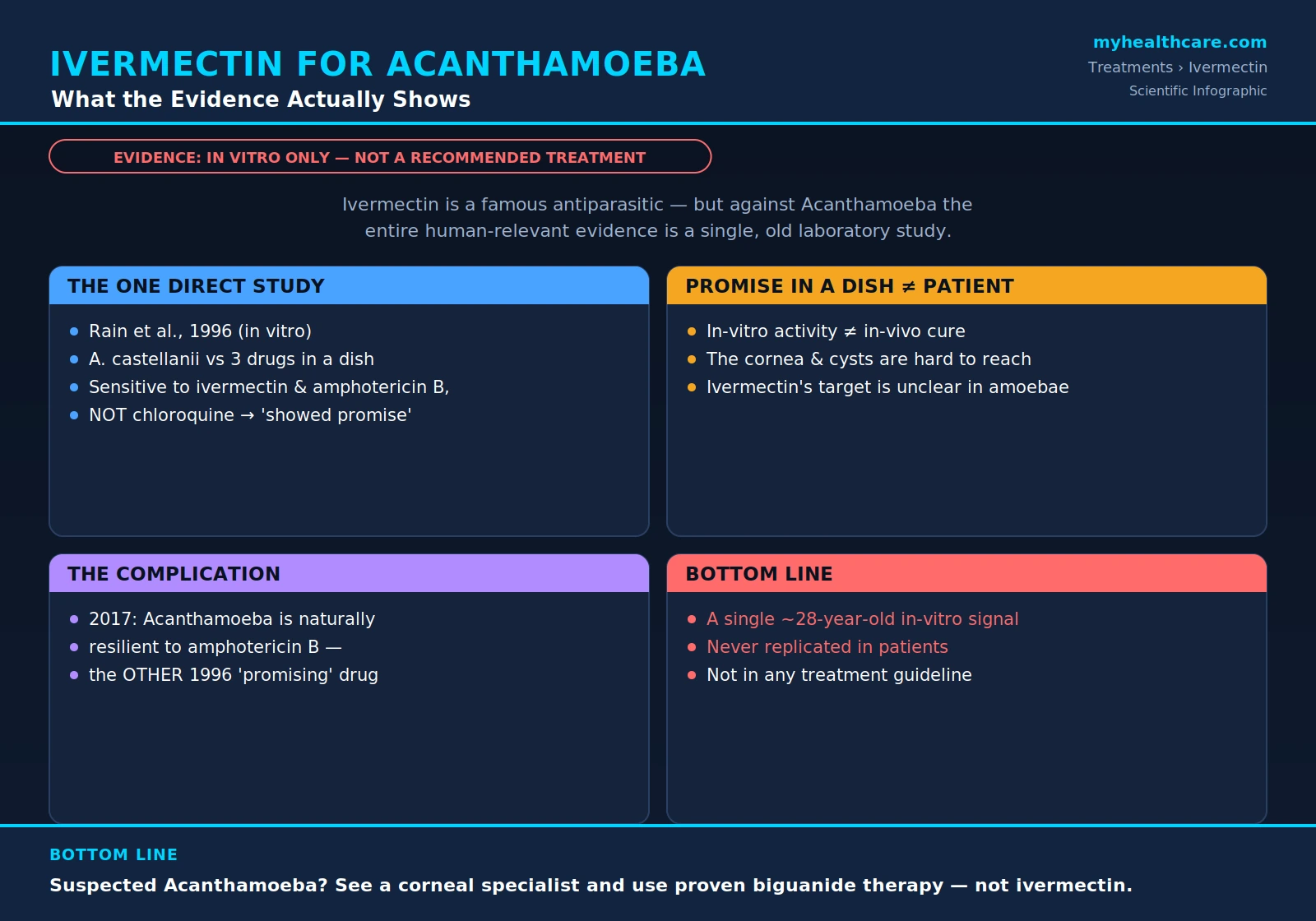
Ivermectin is one of the most famous antiparasitic drugs in the world, so it is reasonable to ask whether it can help against Acanthamoeba. This page is an honest evidence review, not a recommendation. The short version: a single laboratory study from 1996 found that Acanthamoeba was sensitive to ivermectin in a dish, but that finding has never been tested in patients, ivermectin appears in no treatment protocol for this infection, and there is no validated ivermectin eye medicine for it. If you have a suspected Acanthamoeba infection, the priority is urgent care from a corneal specialist using proven therapy.
Table of Contents
- Why People Ask About Ivermectin
- The One Direct Study
- What "Promise in a Dish" Does and Doesn't Mean
- The Evidence That Complicated It
- Where Ivermectin Is NOT
- Safety and Self-Medication
- Bottom Line
- Key Research Papers
- Featured Videos
1. Why People Ask About Ivermectin
Ivermectin earned a remarkable reputation. Discovered in the 1970s and brought into human medicine in the 1980s, it became the backbone of mass treatment for onchocerciasis (river blindness) and lymphatic filariasis, helped control strongyloidiasis (a roundworm infection), and is widely used for scabies and head lice. The work behind it was recognized with a share of the 2015 Nobel Prize in Physiology or Medicine. It is on the World Health Organization's list of essential medicines, and hundreds of millions of doses have been given.
When a drug is that well known, broadly used, and clearly "antiparasitic," it is natural to wonder whether it might also work against Acanthamoeba — the free-living amoeba that causes a stubborn, sight-threatening corneal infection (Acanthamoeba keratitis) and, rarely, a brain infection called granulomatous amoebic encephalitis (GAE). The honest answer has to start with managing expectations: the parasites ivermectin is proven against are worms and arthropods, not amoebae, and the evidence connecting ivermectin to Acanthamoeba is thin and indirect.
2. The One Direct Study
There is, as far as the published literature shows, exactly one piece of research that tested ivermectin specifically against Acanthamoeba. It is a single laboratory (in vitro) report from nearly three decades ago:
Rain AN, Radzan T, Sajiri S, Mak JW. "In vitro drug susceptibility of Acanthamoeba castellani to chloroquine, ivermectin and fungizon." Southeast Asian Journal of Tropical Medicine and Public Health. 1996;27(2):319–324 (PMID 9279996).
The researchers exposed Acanthamoeba castellanii to three drugs in the laboratory: chloroquine, ivermectin, and Fungizone (a brand of amphotericin B, an antifungal). They reported that the amoeba was sensitive to ivermectin and to amphotericin B, but not to chloroquine. On the strength of that result, the authors suggested that ivermectin and amphotericin B "show promise as therapeutic agents" against the parasite.
That single sentence is, essentially, the entire case for ivermectin against Acanthamoeba — and it is worth being clear-eyed about what it is. The "promise" was the high-water mark of the evidence, and it was measured in a dish, not in a patient. No follow-up study has put ivermectin into an actual eye infection, an animal model, or a clinical trial for this disease.
3. What "Promise in a Dish" Does and Doesn't Mean
An in vitro result — a drug killing or slowing an organism in laboratory glassware — is a useful starting hypothesis. It is not the same thing as a treatment that works in people. Many compounds that look impressive against a microbe in a dish go on to fail in the body. There are concrete reasons this gap exists, and they apply forcefully to Acanthamoeba:
- The drug has to reach the infection. The cornea has no blood vessels (it is avascular). Drugs taken by mouth do not flood the cornea the way they reach, say, the gut or the bloodstream. That is precisely why proven Acanthamoeba keratitis therapy is delivered as eye drops, applied directly and frequently, often for months.
- The cyst stage is armored. Acanthamoeba can convert from an active feeding form (trophozoite) into a tough, dormant cyst with a double wall. Cysts resist many agents that kill the active form, and they are a major reason these infections relapse. A drug that affects amoebae in a dish has not necessarily shown it can clear cysts.
- It has to work at a safe concentration, for long enough. "Sensitive in the lab" can mean concentrations far higher than the body could ever safely deliver to the target tissue.
- The mechanism is uncertain here. Ivermectin's well-established target is the glutamate-gated chloride channel, an ion channel found in the nerve and muscle cells of nematodes (roundworms) and arthropods. That channel is how ivermectin paralyzes and kills worms and insects. It is not an established, drug-targetable pathway in amoebae, so even the rationale for why ivermectin might work against Acanthamoeba is unclear — the 1996 result is an observation in search of an explanation, not a mechanism-based therapy.
4. The Evidence That Complicated It
The 1996 study named two drugs that "showed promise": ivermectin and amphotericin B. The later history of amphotericin B is a cautionary tale about how much weight a single in vitro "sensitive" result can bear.
In 2017, a focused laboratory study reported that Acanthamoeba has a natural resilience to amphotericin B — the amoeba's susceptibility kept returning to baseline with each passage despite prolonged drug exposure, a built-in, non-acquired adaptation rather than a one-time vulnerability:
Taravaud A, Loiseau PM, Pomel S. "In vitro evaluation of antimicrobial agents on Acanthamoeba sp. and evidence of a natural resilience to amphotericin B." International Journal for Parasitology: Drugs and Drug Resistance. 2017;7(3):328–336.
The lesson is not that the 1996 authors were careless — they reported what they saw. The lesson is structural: one in vitro "sensitive" reading is a hypothesis, not proof. One of the two drugs that looked promising in 1996 turned out, two decades later, to be of limited use against this organism. Ivermectin, by contrast, was never even revisited — so its 1996 "promise" is not just unconfirmed, it is essentially untested.
5. Where Ivermectin Is NOT
The clearest signal about ivermectin's place in Acanthamoeba care is where it does not appear. No established treatment approach for Acanthamoeba keratitis or for granulomatous amoebic encephalitis (GAE) includes ivermectin.
The recognized backbone of Acanthamoeba keratitis therapy is a topical biguanide — polyhexamethylene biguanide (PHMB) or chlorhexidine — frequently combined with a diamidine (such as propamidine or hexamidine), applied as intensive eye drops over an extended course. In severe or refractory disease, including suspected GAE, clinicians may add the oral drug miltefosine. Pain control, management of any secondary infection, and sometimes surgery (such as a corneal transplant) round out care. For a fuller account of proven therapy, see the Conventional Medical Treatment page.
Ivermectin is simply not part of that picture — not as a first-line agent, not as an add-on, not as a salvage option. Its absence from every credible protocol is itself a meaningful piece of evidence.
6. Safety and Self-Medication
Used as directed for its approved uses, oral ivermectin is generally well tolerated at standard antiparasitic doses. That track record, however, says nothing about whether it is safe or effective in the eye, and it should not be read as a green light to self-treat an eye infection.
- Ivermectin is not an eye medicine. There is no validated, approved ivermectin eye-drop formulation for Acanthamoeba. Putting a drug not designed for the eye onto the surface of the eye risks toxicity to delicate corneal tissue.
- Veterinary ivermectin is dangerous. Animal formulations (livestock "pour-on," horse paste, injectables) are concentrated for large animals, are not made to human-grade standards, and have caused serious human poisonings. They must never be self-administered.
- Delay is the real danger. Acanthamoeba keratitis is painful, aggressive, and time-sensitive. Substituting an unproven remedy for proven care — or simply waiting — can let the infection deepen and lead to permanent vision loss or blindness. The single most important action is to be seen quickly by a corneal specialist.
7. Bottom Line
The entire evidentiary case for ivermectin against Acanthamoeba is a single, in vitro, roughly 28-year-old study that found the amoeba sensitive to the drug in a dish and called it "promising." That signal has never been replicated in patients, has no confirmed mechanism in amoebae, and is absent from every recognized treatment approach. The companion drug that looked equally promising in that same 1996 report was later shown to have limited usefulness — a reminder of how little a lone laboratory result can be trusted on its own.
Ivermectin is not a recommended treatment for Acanthamoeba. If you have a suspected Acanthamoeba infection, do not experiment — seek a corneal specialist urgently and use proven therapy. Start with the Conventional Medical Treatment page, and read about the disease itself on the Acanthamoeba Keratitis page.
Key Research Papers
The evidence base linking ivermectin to Acanthamoeba rests on a single in vitro study; the remaining citations below provide the standard-of-care and resilience context that puts that one result in perspective. Verified citations link to the full text via DOI; the 1996 study has no DOI and links to PubMed. Live search links follow for topics where the literature is best read as a current query rather than a fixed reference.
- Rain AN, Radzan T, Sajiri S, Mak JW. In Vitro Drug Susceptibility of Acanthamoeba castellani to Chloroquine, Ivermectin and Fungizon. Southeast Asian Journal of Tropical Medicine and Public Health. 1996;27(2):319–324. (PMID 9279996) — the only study testing ivermectin directly against Acanthamoeba.
- Taravaud A, Loiseau PM, Pomel S. In Vitro Evaluation of Antimicrobial Agents on Acanthamoeba sp. and Evidence of a Natural Resilience to Amphotericin B. International Journal for Parasitology: Drugs and Drug Resistance. 2017;7(3):328–336.
- Lorenzo-Morales J, Khan NA, Walochnik J. An Update on Acanthamoeba Keratitis: Diagnosis, Pathogenesis and Treatment. Parasite. 2015;22:10.
- Marciano-Cabral F, Cabral G. Acanthamoeba spp. as Agents of Disease in Humans. Clinical Microbiology Reviews. 2003;16(2):273–307.
- Acanthamoeba keratitis — topical biguanide (PHMB / chlorhexidine) and diamidine therapy: current PubMed evidence.
- Miltefosine for free-living amoebic infection (severe keratitis and GAE): current PubMed evidence.
- Granulomatous amoebic encephalitis (GAE) — diagnosis and management: current PubMed evidence.
- Ivermectin mechanism — glutamate-gated chloride channels in nematodes and arthropods: current PubMed evidence.
- Acanthamoeba cyst resistance and treatment relapse: current PubMed evidence.
Live PubMed Searches
Each link opens a live PubMed query so results stay current as new papers are indexed.
- Ivermectin Acanthamoeba
- Ivermectin mechanism of action
- Acanthamoeba keratitis treatment
- Acanthamoeba amphotericin B resilience
- Acanthamoeba cyst drug susceptibility
- Acanthamoeba miltefosine encephalitis
- Ivermectin antiparasitic human uses
- Free-living amoeba drug treatment review
Connections
- All Parasites
- Acanthamoeba
- Acanthamoeba Treatments (Hub)
- Conventional Medical Treatment
- Castor Oil
- Acanthamoeba Keratitis
- Granulomatous Amebic Encephalitis (GAE)
- Eye Conditions
- Remedies
- Oregano
- Garlic
- Silver Nanoparticles
- Infectious Disease
- Cutaneous & Disseminated Infection
- Satoshi Ômura — the Nobel laureate who discovered ivermectin's source microbe
- How Ivermectin Works — mechanism, dosing, and the real safety record