Beyond Ivermectin: Satoshi Ōmura's Natural-Products Legacy
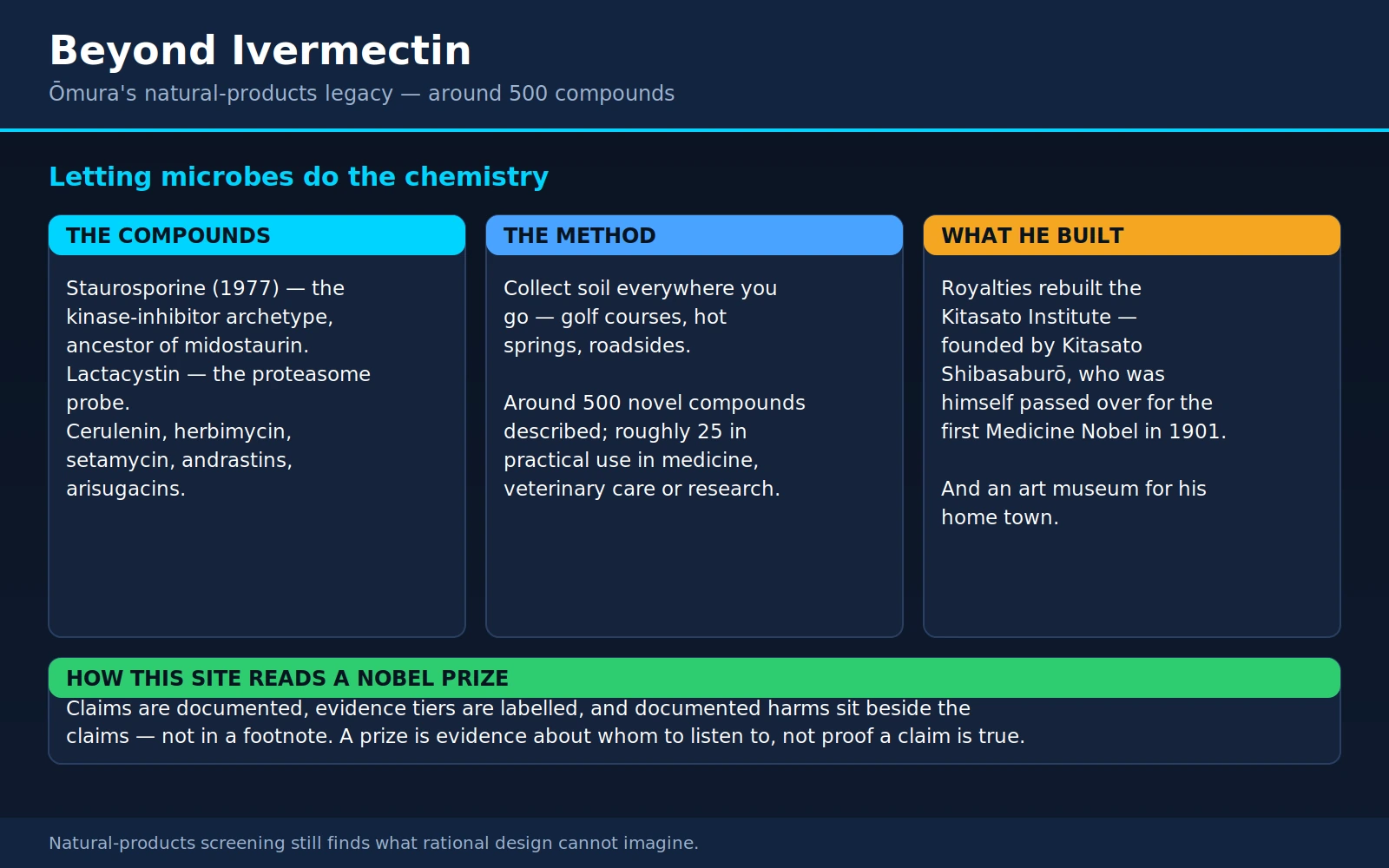
If ivermectin had never existed, Satoshi Ōmura would still rank among the most productive drug hunters in history — and most people who know his name for the Nobel have never heard why. His laboratory's compound library runs to nearly five hundred novel molecules, and scattered through it are tools that quietly built whole fields of modern medicine: the molecule that taught oncology how to drug kinases, the probe that proved the cell's protein shredder was a drug target, the inhibitor that opened fatty-acid metabolism to pharmacology, and an antibiotic so unusual its producing microbe founded a new genus named for his institute's founder. This article tours the library, the philosophy behind it, the remarkable lineage of the Kitasato Institute — and the art museum, hot spring, and soba restaurant a farm town in Yamanashi got out of it all.
This is part of our Satoshi Ōmura collection; the famous molecule's own story is in The Discovery of Ivermectin.
Table of Contents
- Overview
- The Philosophy: Let Microbes Do the Chemistry
- Staurosporine: The Kinase Key
- Lactacystin: The Proteasome Probe
- Cerulenin, Herbimycin, and the Toolbox
- Nearly 500 Compounds: The Scorecard
- The Genome Surprise
- The Kitasato Lineage
- Rebuilding Kitasato
- The Collector: Art, Hot Springs, and Soil Bags
- What Natural-Products Discovery Teaches
- Key Research Papers
- Connections
- Featured Videos
1. Overview
Drug discovery has two grand traditions. In one, chemists design molecules against a chosen target — rational, modern, and powerful when the target is well understood. In the other, older tradition, researchers harvest the chemistry that living things already make and then figure out what it does. Ōmura is the modern era's supreme practitioner of the second tradition, and his career is its best argument. The numbers alone make the case — close to 500 novel compounds, with roughly 25 reaching practical use as human medicines, veterinary drugs, agricultural agents, and research reagents, a hit rate industrial screening programs would envy.
But the numbers undersell the influence, because several of his molecules mattered less as products than as keys: probes that unlocked biological machinery nobody could study before, in cancer signaling, protein disposal, and lipid metabolism. A field-defining probe can end up saving more lives than most drugs, by making whole classes of drugs possible — and that is precisely the story of staurosporine and lactacystin, told below. It is also the deeper meaning of the half-joking title he gave his Nobel Lecture: the Earth's gift was never just ivermectin. It was a way of finding things.
2. The Philosophy: Let Microbes Do the Chemistry
Ōmura's method rested on three convictions, each of which sounds obvious now because his generation proved them:
- Microbes are the better chemists. A soil actinomycete carries hundreds of enzymes shaped by billions of years of chemical warfare, cooperation, and signaling. The molecules it secretes are pre-tested by evolution for potency against biological targets — something no random chemical library can claim. Ōmura's line — that he "borrowed the power of microbes" — is this conviction in one sentence.
- The bottleneck is culturing, not chemistry. Everyone screens; the winner is whoever can grow organisms nobody else can grow. His group's original isolation media and selection methods for rare actinomycetes were its true trade secret, and the reason its library kept yielding novel structures while competitors re-fished the same pond.
- Screen for everything, not just antibiotics. His generation's crucial widening move: where classical programs asked only "does this broth kill bacteria?", Ōmura's group built assays for enzyme inhibition and other non-antibacterial activities — and most of the treasures below were found precisely because someone thought to ask a non-obvious question of a broth that killed nothing.
Readers of this site will recognize the shape of the philosophy: it is the same posture we bring to traditional plant medicine — deep respect for nature's chemistry, followed by hard-nosed testing of what it actually does. Tu Youyou's artemisinin came from a 1,600-year-old herbal text; Ōmura's avermectins from a bag of golf-course soil. Both were nature's drafts. Both became medicine only through the grind of assays, chemistry, and trials.
3. Staurosporine: The Kinase Key
In 1977, Ōmura's group described a new alkaloid from a Streptomyces strain isolated from a soil sample from Iwate Prefecture — compound AM-2282, soon named staurosporine (the 1977 paper is in our list below). It showed modest antifungal and other activities; interesting, filed, not famous. Nearly a decade later, Japanese researchers testing it against a then-newly-celebrated enzyme found something astonishing: staurosporine inhibited protein kinase C at nanomolar concentrations — billionths-of-a-mole potency — making it by far the most powerful kinase inhibitor then known.
To see why that mattered, know what kinases are: the cell's switchboard operators, enzymes that flip other proteins on and off by attaching phosphate groups. Cancer is, to a large degree, a disease of jammed kinase switches. In the 1980s, the pharmaceutical consensus held that kinases were undruggable — there are hundreds of them, all using the same ATP pocket, so any inhibitor would supposedly hit them all and poison the patient. Staurosporine was the perfect test of that pessimism, because it is gloriously promiscuous: it wedges into the ATP pocket of hundreds of kinases. As a drug, hopeless. As a probe and a scaffold, revolutionary: it proved small molecules could occupy the kinase engine room with staggering potency, gave crystallographers the first detailed pictures of how, and handed chemists a starting skeleton to engineer selectivity into.
The lineage runs straight to the clinic. A chemically tamed derivative of staurosporine — midostaurin — was approved by the FDA in 2017 for FLT3-mutated acute myeloid leukemia (the RATIFY trial, cited below) and for advanced systemic mastocytosis: Ōmura's 1977 alkaloid, forty years later, extending the lives of leukemia patients. And conceptually, today's dozens of approved kinase inhibitors — imatinib (Gleevec) and its successors, the backbone of modern targeted cancer therapy — stand on the proof-of-possibility that staurosporine supplied. Ōmura's own retrospective title for the molecule — "a potentially important gift from a microorganism" — now reads as one of science's great understatements.
4. Lactacystin: The Proteasome Probe
In 1991, screening broths for compounds that could make nerve-like cells sprout neurites, Ōmura's group reported lactacystin, a small sulfur-containing molecule from a Streptomyces strain (paper below). It induced the sprouting, mechanism unknown — a curio, until it crossed the Pacific. In 1995, Gabriel Fenteany, Stuart Schreiber, and colleagues at Harvard published the answer in Science: lactacystin works by shutting down the proteasome — the barrel-shaped machine that shreds the cell's used and damaged proteins — and it does so with a chemist's precision, covalently modifying a single catalytic threonine at the active site. That specificity settled how the proteasome's unusual catalytic machinery works, and gave biology its first clean on/off switch for protein disposal.
The consequences ran far beyond technique. With lactacystin, researchers everywhere could finally ask "what happens if the shredder stops?" — and one answer proved medically explosive: certain cancers, especially multiple myeloma, are pathologically dependent on the proteasome and die when it stalls. That insight underwrote the development of the proteasome-inhibitor drugs — bortezomib (Velcade) and its successors, different molecules but the same validated target — which transformed myeloma from a swift killer into a disease many patients live with for years. Lactacystin itself never became a drug and never needed to: it was the key that proved the lock existed. Ask a myeloma specialist about the proteasome today and you are hearing, at one remove, from a broth in a Tokyo fermentation room in 1991.
5. Cerulenin, Herbimycin, and the Toolbox
Around the headliners stands a supporting cast that would each anchor a career elsewhere:
- Cerulenin — an inhibitor of fatty-acid synthesis, the subject of Ōmura's influential 1976 review (below). For decades it was the tool for switching off lipid manufacture in cells, and it seeded later drug hunting in metabolism and oncology, since many tumors are addicted to making their own fat.
- Herbimycin A (1979, below) — isolated as a herbicidal antibiotic, then reborn in the 1980s when it was found to reverse the malignant transformation driven by the Src oncogene. It became a workhorse probe of tyrosine-kinase signaling — the machinery of many cancers — and was later understood to act by attacking Hsp90, the "chaperone" protein that props up cancer-driving kinases: an early window into two of oncology's biggest ideas at once.
- Setamycin and the bafilomycin family — from a 1981 isolate (J Antibiot 1981;34(10):1253-6) so taxonomically odd that Ōmura's group erected a new genus to hold it: Kitasatosporia (now Kitasatospora), named for the institute's founder (paper below). The related plecomacrolides — bafilomycins — became standard laboratory probes of the cell's acidification machinery, ubiquitous today in autophagy research.
- Andrastins A–C (1996, below) — inhibitors of protein farnesyltransferase, an enzyme that activates Ras oncoproteins; part of the 1990s wave that pursued Ras, cancer's most notorious driver.
- Arisugacins (1995, below) — selective acetylcholinesterase inhibitors from a Penicillium — the same enzyme targeted by Alzheimer's drugs like donepezil — found by asking fungal broths a neurology question, and later conquered by total synthesis in Ōmura's own group.
- Plus the antibiotics proper: his early structural and fermentation work on macrolides (the erythromycin family) yielded, among other things, rokitamycin, a macrolide marketed in Japan — a reminder that the classical antibacterial mission was never abandoned, only widened.
Notice the pattern across the list: find the molecule first, understand it later, and let the biology community's questions reveal what the microbe had been holding all along. A probe is a gift that keeps unwrapping itself.
6. Nearly 500 Compounds: The Scorecard
The tallies attached to Ōmura's name — the Nobel Foundation counted more than 480 novel compounds; his institute says around 500; some 25 in practical use — deserve a moment of context, because the ratio is the achievement. Industrial natural-products programs historically screened millions of broths to land a handful of products; a single laboratory's library yielding two dozen practical agents — among them the best-selling animal-health drug in history and a WHO essential medicine — represents an efficiency that made "the Ōmura method" (rare organisms + diverse assays) a studied model.
The practical-use column spans five categories worth spelling out: human medicines (ivermectin above all, with staurosporine's descendant midostaurin as the second Nobel-adjacent drug in the tree); veterinary medicines (ivermectin again, transformative — see the discovery article); agricultural agents (avermectin B1 as the miticide abamectin); research reagents (staurosporine, lactacystin, cerulenin, herbimycin, bafilomycin-family probes — the toolbox half the world's cell-biology papers reach for); and taxonomy itself (new species, and the genus Kitasatospora). Few careers in any science have filled all five columns.
7. The Genome Surprise
When genomics matured, Ōmura's institute did the natural thing and sequenced its champion. The Streptomyces avermitilis genome — draft published in 2001, complete in 2003 with Haruo Ikeda leading (papers below) — was a revelation twice over. First, scale: a linear chromosome of about nine million base pairs, among the largest bacterial genomes then sequenced — twice the size of a typical bacterium's, befitting an organism that runs a chemical factory. Second, and more provocative: alongside the avermectin assembly line, the genome carried roughly thirty separate gene clusters for other complex natural products — polyketides, peptides, terpenes — most of them silent in the fermenter, several percent of the genome devoted to chemistry nobody had ever seen the organism perform.
Sit with the implication. The single most valuable microbe in pharmaceutical history had shown humanity one headline product — and its genome revealed it was withholding dozens more. Multiply by every soil organism never cultured, and you have the manifesto of modern genome mining: today's researchers read sequences first and then coax silent clusters awake with genetic switches, a strategy this genome did much to inspire. Ōmura's old conviction — that the microbial world's chemistry is essentially untapped — stopped being a romantic slogan and became a measurement. The library he spent a career sampling turns out to have back rooms beyond counting; his heirs are learning to read the catalog instead of waiting at the front desk.
8. The Kitasato Lineage
Ōmura's Nobel closed a circle a century wide, and the story deserves telling. The Kitasato Institute descends from Kitasato Shibasaburō (1853–1931), the samurai-born physician who went to Berlin in 1886 to work with Robert Koch and became one of bacteriology's founders: he achieved the first pure culture of the tetanus bacillus — a feat colleagues had called impossible — and, with Emil von Behring, created serum therapy, demonstrating that the blood of immunized animals carried "antitoxins" that could be transferred to protect others: the birth of antibody medicine. In 1894 he raced to plague-stricken Hong Kong and was among the first to describe the plague bacillus, in the same outbreak Alexandre Yersin studied (taxonomy ultimately honored Yersin; the history books record both men).
Then came the wound that Japanese science never quite forgot: when the first Nobel Prize in Physiology or Medicine was awarded in 1901 for serum therapy against diphtheria, it went to Behring alone. Kitasato, the indispensable collaborator on the foundational work, was nominated and passed over. He bore it with public grace, built on: when the Japanese government in 1914 abruptly folded his Institute for Infectious Diseases into Tokyo Imperial University over his head, he resigned outright and founded the private Kitasato Institute with his own resources, going on to help create Keiō University's medical school and to serve as the first president of the Japan Medical Association. Independence, self-reliance, and science in service of the public — the house creed Ōmura inherited in 1965.
So when the Nobel committee called a Kitasato Institute scientist in October 2015, the announcement carried a century of freight. The institution built by the man denied the first Nobel had produced, at last, a laureate of its own — honored, fittingly, for turning microbes against disease, the founder's own war. Ōmura, who led the institute for eighteen years and knew its history to the bone, did not need the symbolism explained.
9. Rebuilding Kitasato
The Merck royalty clause Ōmura negotiated in 1973 — the full story is in the discovery article — eventually returned roughly a quarter of a billion dollars to the private institute, and Ōmura, who became its president in 1990 and led it until 2008, spent the windfall the way his institute's founder would have: on independence and infrastructure. The signature project was the Kitasato Institute Medical Center, a full hospital opened in 1989 in Saitama Prefecture, built substantially on avermectin royalties — a research institute's soil-screening program transmuted into hospital beds. Research facilities followed, and in 2008 he steered the century-old institute's unification with Kitasato University, consolidating the founder's legacy for its second century.
The reinvestment closed a loop that this site finds genuinely instructive: a private, independent research institution — kept independent at real cost since 1914 — survived into the modern era because one of its scientists insisted, in a 1973 contract, that discovery should pay its source. Institutions that own their science can afford to serve the public with it; the Kitasato story is that principle, run forward over fifty years.
10. The Collector: Art, Hot Springs, and Soil Bags
Every profile of Ōmura eventually arrives, charmed, at the same trio of facts. He never stopped carrying plastic bags for soil — scooping samples at golf courses (the famous one included; by his own telling he was there to play), at hot-spring resorts, on walks, wherever the ground looked interesting, a working scientist's version of beachcombing that occasionally paid off at the scale of nations. He golfed devotedly. And he collected art — seriously, over decades, with a particular devotion to Japanese women painters, artists he felt the art establishment had undervalued much as the science establishment had once undervalued soil microbes.
What he did with the collection is the Ōmura signature: he gave it away, architecturally. In 2007 he opened the Nirasaki Ōmura Art Museum in his Yamanashi hometown — roughly two thousand works — and donated it to the city of Nirasaki, then made sure a visit would be a whole day's pleasure for the farming community he came from: a public hot-spring bath he had developed next door, and a soba noodle restaurant beside it. He also served as head of Joshibi University of Art and Design, the Tokyo women's art university, tying the two devotions together. Asked endlessly about the double life, his answer stayed constant: art and science are the same discipline — seeing — the trained eye finding what everyone else walked past, whether in a gallery of overlooked painters or a gram of golf-course dirt.
11. What Natural-Products Discovery Teaches
Zoom out from one career to the field it champions, and the lessons compound:
- Nature remains the deepest well. The standing analysis of fifty years of drug approvals (Newman & Cragg, below) finds that a large share of small-molecule medicines — and a majority in antibiotics and cancer — are natural products, derivatives, or molecules designed in imitation of them. The romantic-sounding claim is the statistically boring one.
- Probes can outrank products. Staurosporine and lactacystin never treated a patient directly; the fields they unlocked treat millions. Judging discovery only by shipped drugs misses where much of the value lives.
- The unculturable majority is the frontier. Most soil microbes still refuse laboratory cultivation, and even champions like S. avermitilis hold silent chemistry by the cluster. Genome mining, metagenomics, and culturing innovation are direct heirs of Ōmura's methods bet.
- Respect plus rigor is the whole method. The same stance this site takes toward medicinal plants applies to microbial chemistry: nature's compounds have earned attention, not exemption — every Ōmura molecule that became a medicine passed through assays and trials, and the one claim that skipped the queue (see the COVID article) is the cautionary tale in his own biography.
- And keep collecting. The next avermectin is, on the evidence of the genome era, statistically certain to exist — in a cluster nobody has awakened, in an organism nobody has cultured, possibly in soil somebody is walking over today without a plastic bag in their pocket.
12. Key Research Papers
- Ōmura S, Iwai Y, Hirano A, et al. A new alkaloid AM-2282 of Streptomyces origin. Taxonomy, fermentation, isolation and preliminary characterization. J Antibiot (Tokyo) 1977;30(4):275-82
- Ōmura S, Sasaki Y, Iwai Y, Takeshima H. Staurosporine, a potentially important gift from a microorganism. J Antibiot (Tokyo) 1995;48(7):535-48
- Stone RM, Mandrekar SJ, Sanford BL, et al. Midostaurin plus Chemotherapy for Acute Myeloid Leukemia with a FLT3 Mutation. N Engl J Med 2017;377(5):454-464
- Ōmura S, Fujimoto T, Otoguro K, et al. Lactacystin, a novel microbial metabolite, induces neuritogenesis of neuroblastoma cells. J Antibiot (Tokyo) 1991;44(1):113-6
- Fenteany G, Standaert RF, Lane WS, et al. Inhibition of proteasome activities and subunit-specific amino-terminal threonine modification by lactacystin. Science 1995;268(5211):726-31
- Ōmura S. The antibiotic cerulenin, a novel tool for biochemistry as an inhibitor of fatty acid synthesis. Bacteriol Rev 1976;40(3):681-97
- Ōmura S, Iwai Y, Takahashi Y, et al. Herbimycin, a new antibiotic produced by a strain of Streptomyces. J Antibiot (Tokyo) 1979;32(4):255-61
- Ōmura S, Takahashi Y, Iwai Y, Tanaka H. Kitasatosporia, a new genus of the order Actinomycetales. J Antibiot (Tokyo) 1982;35(8):1013-9
- Ōmura S, Inokoshi J, Uchida R, et al. Andrastins A-C, new protein farnesyltransferase inhibitors produced by Penicillium sp. FO-3929. I. Producing strain, fermentation, isolation, and biological activities. J Antibiot (Tokyo) 1996;49(5):414-7
- Ōmura S, Kuno F, Otoguro K, et al. Arisugacin, a novel and selective inhibitor of acetylcholinesterase from Penicillium sp. FO-4259. J Antibiot (Tokyo) 1995;48(7):745-6
- Ikeda H, Ishikawa J, Hanamoto A, et al. Complete genome sequence and comparative analysis of the industrial microorganism Streptomyces avermitilis. Nat Biotechnol 2003;21(5):526-31
- Newman DJ, Cragg GM. Natural Products as Sources of New Drugs over the Nearly Four Decades from 01/1981 to 09/2019. J Nat Prod 2020;83(3):770-803
Live PubMed Searches
- Staurosporine kinase inhibition
- Lactacystin and the proteasome
- Ōmura's Streptomyces compounds
- Genome mining for natural products
- Kitasato Shibasaburō and serum therapy
- Natural products among new drugs
Connections
- Satoshi Ōmura Hub — the life story these discoveries came from
- The Discovery of Ivermectin — the library's most famous volume, in full
- River Blindness and Global Health — what the famous molecule did in the world
- How Ivermectin Works & Safety — mechanism and margins, explained for patients
- The COVID-19 Controversy — the one claim that skipped the evidence queue
- William C. Campbell — the co-laureate who turned a broth into a drug
- Tu Youyou — nature's chemistry validated by rigor: the parallel career
- Alexander Fleming — where microbial drug discovery began
- Albert Szent-Györgyi — another natural-substance Nobel: vitamin C
- Christiaan Eijkman — the accidental observation that revealed vitamins
- Frederick Banting — insulin: biology's own molecule turned medicine
- All Notable Doctors
- Sweet Wormwood (Artemisia annua) — plant chemistry's answer to the soil microbes
- Parasites & Parasitic Diseases — the diseases this library reshaped
- Antiparasitic Remedies — the modern toolbox, reviewed honestly