River Blindness: How Ivermectin and a Historic Donation Changed Global Health
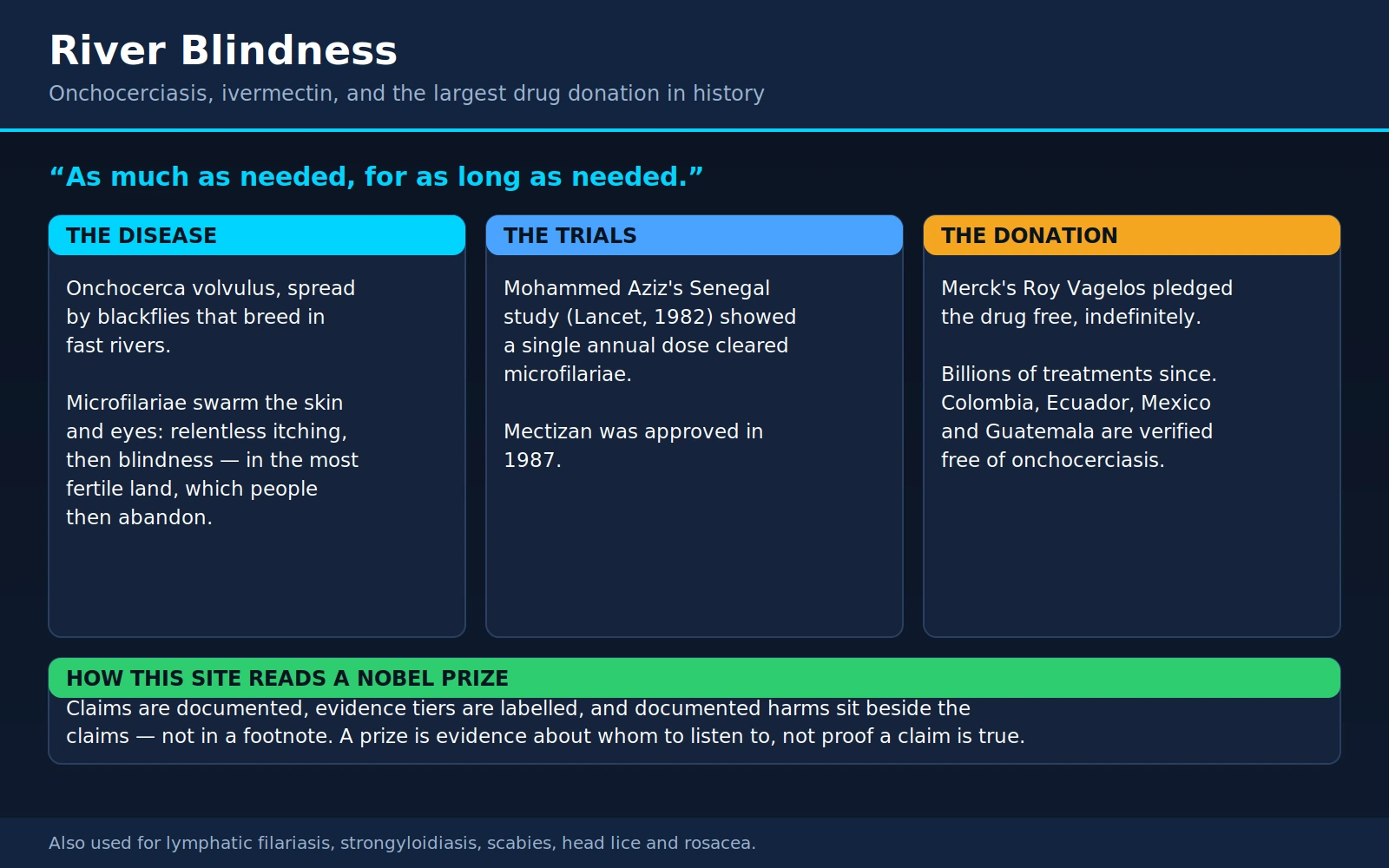
There are villages in West Africa where, within living memory, it was ordinary to see a child leading a line of blind adults along a path, each with a hand on the shoulder ahead. The disease that made that scene ordinary is onchocerciasis — river blindness — and the reason the scene has become rare is a tablet, taken once or twice a year, discovered in Japanese soil, developed in New Jersey, and given away in the largest drug-donation program ever undertaken. This article tells that story for patients and curious readers: the disease as a human experience, the trial that changed its future, the corporate pledge nobody expected, the volunteer armies who delivered on it — and the growing list of countries where the disease is simply gone.
This is part of our Satoshi Ōmura collection; the molecule's origin story is told in The Discovery of Ivermectin, and how it works in the body in How Ivermectin Works & Safety.
Table of Contents
- Overview
- What River Blindness Is
- Life Before Ivermectin
- Mohammed Aziz and the Senegal Trial
- Mectizan, 1987
- "As Much as Needed, for as Long as Needed"
- Armies of Volunteers: OCP, APOC, OEPA
- Countries Free of River Blindness
- One Drug, Many Diseases
- The Malaria Gambit
- What This Program Proved
- Key Research Papers
- Connections
- Featured Videos
1. Overview
Onchocerciasis is caused by a threadlike parasitic worm, Onchocerca volvulus, delivered by the bite of blackflies that breed in fast-flowing rivers. Before ivermectin, it was one of the world's leading infectious causes of blindness, and it shaped geography: in badly affected regions of West Africa, communities abandoned their most fertile river-valley land to escape the flies, trading blindness for hunger. The World Health Organization's control programs estimated the burden in the tens of millions of infected people, with the overwhelming majority — around 99% — in sub-Saharan Africa, and smaller foci in Latin America and Yemen.
Ivermectin did not merely treat this disease; it made mass, community-run control possible, because it is a single annual oral dose, safe enough to be handed out by trained village volunteers without a doctor within a day's walk. That property — as much as raw efficacy — is what turned a medicine into a public-health weapon. Add a manufacturer willing to donate it indefinitely, and the result reshaped what the world believed was possible against the so-called neglected tropical diseases.
The word "neglected" is doing quiet work in that sentence, and this story is the great counterexample: what happens when one of these diseases is, for once, not neglected — when first-rate science, corporate resources, and village-level organization all show up for people who could never pay for any of them.
2. What River Blindness Is
The parasite's life cycle explains every symptom, so it is worth two paragraphs of patience. A biting blackfly (genus Simulium) deposits infective larvae in the skin. Over about a year these mature into adult worms — females up to half a meter long, coiled with their mates inside fibrous lumps under the skin called nodules, often felt over hips, ribs, or scalp. The adults are long-haul residents: they live 10 to 15 years inside a person. Throughout that time each female releases a stream of microscopic offspring called microfilariae — on the order of a thousand per day — which migrate constantly through the skin and, fatefully, into the eyes.
Here is the counterintuitive key: the adult worms in their nodules cause relatively little harm, and even living microfilariae are fairly quiet. The devastation comes from microfilariae dying. Each death triggers a local burst of inflammation. Multiply that by millions of deaths over years, everywhere the larvae wander, and you get the disease's signature miseries: itching beyond ordinary description — sufferers speak of scratching with stones and thorns, of sleepless months; skin that thickens, cracks, and mottles ("lizard skin," and the patchy depigmentation called "leopard skin"); and in the eyes, cumulative scarring of the cornea and inflammation of deeper structures that dims the world year by year toward blindness. In heavily infected villages, blindness was not a misfortune; it was a stage of life. Surveys in the worst-hit river valleys found large fractions of adults over forty who could no longer see.
Transmission completes the circle: a blackfly bites an infected person, swallows microfilariae, and after a couple of weeks can inject them into someone new. The flies breed only in oxygen-rich turbulent water — rapids, spillways — which is why the disease hugs rivers, and why its name is a map.
3. Life Before Ivermectin
The pre-ivermectin toolkit was grim from both ends. The drugs were diethylcarbamazine (DEC) and suramin, and both were, for mass use, worse than nothing. DEC kills microfilariae fast — which is exactly the problem: massed simultaneous deaths produce a violent inflammatory storm (the Mazzotti reaction: ferocious itching, rash, fever, swollen nodes, sometimes collapse), and in the eyes the reaction could accelerate the very blindness treatment was meant to prevent. Suramin killed adult worms but is genuinely toxic and needs a course of intravenous injections — unusable for villages. Doctors in endemic areas largely stopped treating; the treatments were feared, with reason.
So the world attacked the fly instead. The Onchocerciasis Control Programme (OCP), launched in 1974 across West Africa, was one of the most ambitious public-health operations ever mounted: helicopters and aircraft dosing thousands of kilometers of river rapids with larvicide, week after week, year after year, to break the blackfly's life cycle. And it worked — within its territory. By its close in 2002 the OCP was credited with preventing an estimated 600,000 cases of blindness and reopening a huge acreage of fertile river-valley land for resettlement and farming. But vector control had hard limits: it treated rivers, not people — the millions already infected stayed infected, since the adult worms live for well over a decade; it was enormously expensive; and it could not scale to the vast forested endemic zones of central Africa. What the campaign needed, its own leaders said plainly, was a safe drug you could put through a village once a year.
That is precisely the specification ivermectin turned out to meet — a coincidence of need and molecule so neat that, as the program's historians like to note, no committee would have dared write it as a plan.
4. Mohammed Aziz and the Senegal Trial
Inside Merck, the champion of the human program was Mohammed A. Aziz — a Bangladeshi-born physician and infectious-disease researcher who had worked for the WHO in Africa and knew river blindness at ground level. When the veterinary results showed ivermectin demolishing Onchocerca species in animals (the thread William Campbell pulled inside Merck's labs, as told in the discovery article), Aziz pushed for the human trial, designed it conservatively, and took it to Dakar, Senegal in 1981.
The first study was tiny by modern standards — a few dozen men with light infections, given a single oral dose of ivermectin at microgram-per-kilogram levels, published in The Lancet in 1982. The results were the kind that end arguments. At the better doses, microfilariae in the skin fell to essentially zero and stayed near zero for months — from one swallow. Crucially, the dreaded Mazzotti storm largely failed to appear: reactions were mild, and the eyes showed none of the acute damage DEC caused. Ivermectin kills microfilariae more gradually and — just as important — sterilizes the adult females for months, shutting off the supply of new larvae, so the immune system never faces millions of corpses at once. (The full mechanism story lives in the pharmacology article.)
Larger trials through the mid-1980s — including the head-to-head against DEC led by Bruce Greene and colleagues, published in the New England Journal of Medicine in 1985 — confirmed the pattern: ivermectin matched or beat DEC on parasite clearance and was dramatically gentler, above all on the eyes. A once-a-year, single-tablet, village-safe treatment for river blindness existed. Now someone had to pay for it — for tens of millions of people, indefinitely, in the poorest places on Earth.
5. Mectizan, 1987
Merck named the human formulation Mectizan and obtained its first regulatory approval from the French authorities in October 1987 — France being the gateway registration for francophone West Africa, where the need was concentrated. (In the United States, ivermectin was later approved as Stromectol in 1996, for strongyloidiasis and onchocerciasis.) The approval was the easy part. The company had spent years searching for someone to buy the drug for Africa — governments, the WHO, foundations, aid agencies. The remembered answers ranged from lukewarm to none. The people who needed Mectizan had no money, and the institutions with money had other priorities.
What happened next is the part of this story taught in business-school ethics courses and global-health seminars alike. Merck's chief executive, Roy Vagelos — the physician-biochemist who, as research chief, had greenlit the human program in the first place — announced in October 1987 that Merck would donate Mectizan to everyone who needed it, "as much as needed, for as long as needed," until river blindness was gone. No time limit, no cap, no fine print clawing it back.
Vagelos was asked, then and for decades afterward, how he justified an open-ended gift to shareholders. His standing answer invoked the credo of George W. Merck — that medicine is for the people, not for the profits, and that when that order is respected the profits follow — plus a practical observation: the decision was, among other things, recruiting policy. For a generation afterward, scientists told Merck's interviewers they had applied because of Mectizan. Ōmura, for his part, always pointed at the donation when praise came his way: discovering a molecule, he said, is not yet helping a single human being; the donation is what turned chemistry into health.
6. "As Much as Needed, for as Long as Needed"
A pledge without a delivery system is a press release, so the Mectizan Donation Program (MDP) was created in 1987–88 with an independent expert committee — chaired first by William Foege, the strategist of smallpox eradication — to vet applications and set treatment policy, administered through what is now the Task Force for Global Health in Atlanta. The structure was deliberately arms-length: Merck supplies the tablets and pays for their delivery to port; decisions about who treats whom rest with the expert committee, health ministries, and partner NGOs. That governance is a large part of why, nearly four decades on, the program still runs and is still studied as the founding template of pharmaceutical philanthropy at scale.
The numbers have long since outgrown intuition. The program expanded in 1998 to cover lymphatic filariasis (elephantiasis) in Africa — where ivermectin is co-administered with donated albendazole — and across its lifetime the donation is counted in the billions of treatments, reaching hundreds of millions of people in dozens of countries through what MSD's own 30-year retrospective (cited below) describes as the largest ongoing medical donation in history. Annual treatment ceilings that once seemed fantastic — tens of millions of doses a year — became routine logistics.
Two honest footnotes belong in any adult telling. First, the donation did not fall from heaven: it followed years of failed attempts to find a payer, and it was affordable because the veterinary franchise was immensely profitable — a fact that subtracts nothing from the decision but explains why it was repeatable so rarely. Second, the pledge's phrase "as long as needed" quietly contains the program's radical ambition: the donation is designed to end, not by withdrawal, but by there being no disease left to treat.
7. Armies of Volunteers: OCP, APOC, OEPA
Free tablets still have to reach villages at the end of footpaths, every year, indefinitely. The instrument that achieved this — developed under the African Programme for Onchocerciasis Control (APOC, 1995–2015), successor to the river-spraying OCP — is one of global health's genuinely great inventions: community-directed treatment with ivermectin (CDTI). The health system does not deliver the drug to the community; the community delivers the drug to itself. Villages choose their own distributors — farmers, teachers, respected neighbors — who are trained to measure doses with a simple height stick (height stands in for weight well enough), keep the registers, watch for the situations that need referral, and go door to door. At its height, this machinery was treating well over 100 million Africans every year, at a delivery cost measured in cents per person, through more than a hundred thousand villages' own volunteers.
CDTI's success carried a lesson bigger than onchocerciasis: rural communities with no resident health professionals can run a precision annual drug campaign themselves, year after year, if the tool is safe enough and the respect is real. The same village networks were promptly borrowed for vitamin A distribution, bed-net campaigns, and other health work — infrastructure conjured out of trust.
In the Americas, the smaller Onchocerciasis Elimination Program for the Americas (OEPA), launched in 1993, took a more intensive approach across the six affected countries — treating twice (sometimes four times) a year to outrun the parasite entirely. And where APOC aimed at control — ending the disease as a public-health problem — the Americas program said the more ambitious word out loud from the start: elimination. Kill transmission completely, wait out the old worms, verify, and stop.
8. Countries Free of River Blindness
Elimination worked. After years of semiannual treatment drove transmission to zero and kept it there, the World Health Organization began formally verifying countries free of onchocerciasis: Colombia in 2013 — the first country in the world — then Ecuador in 2014, Mexico in 2015, and Guatemala in 2016. In these countries the blackflies still bite; there is simply nothing left to transmit. The last active focus in the Americas straddles the remote Venezuela–Brazil border in Yanomami territory — hard country, but a shrinking target.
Africa, with an incomparably larger burden, was long spoken of in terms of control rather than elimination — until the data started saying otherwise. Transmission studies showed ivermectin-based programs had interrupted the parasite in multiple African foci, and in January 2025 the WHO verified Niger as the first African country to eliminate onchocerciasis — a milestone that reframed the continental endgame from aspiration to timetable. Sustaining that momentum is genuine work: surveys, mop-up campaigns in border zones, and careful handling of areas co-endemic for Loa loa, where mass ivermectin needs screening precautions (the full story is in the safety article). New tools are joining late in the campaign, too — notably moxidectin, a longer-acting cousin from the same drug family, which beat ivermectin at suppressing skin microfilariae in a phase 3 trial (cited below) and was FDA-approved for onchocerciasis in 2018.
Set the two dates side by side. In 1974, river blindness was untreatable at scale, and the best the world could do was spray rivers from the air. Within one human lifetime, entire countries have been declared free of it. Medicine does not often move that far, that fast, for the poorest people on Earth — which is exactly why this story is told so often, including here.
9. One Drug, Many Diseases
Onchocerciasis made ivermectin famous, but the drug's parasite-killing spectrum turned it into a small public-health portfolio of its own:
- Lymphatic filariasis (elephantiasis). Mosquito-borne worms that block lymphatic drainage, disfiguring limbs. Annual ivermectin plus albendazole (and, since 2017, an even more potent triple combination with DEC where onchocerciasis is absent) has driven the global elimination campaign chronicled in the Ramaiah & Ottesen paper below; a growing list of countries has been validated free of it as a public-health problem.
- Strongyloidiasis. A soil-transmitted worm with a sinister trick: it can re-infect its host internally for decades, then explode into fatal "hyperinfection" if immunity is suppressed by steroids or transplant drugs. Oral ivermectin is the treatment of choice — better tolerated than the alternatives, per the Cochrane review below. If you or your family come from the tropics or subtropics and corticosteroids are on your horizon, this is the single most practical fact on this page: see our Strongyloides ivermectin guide.
- Scabies — including crusted scabies. Two oral doses a week apart rival the creams for ordinary scabies and are transformative for institutional outbreaks and for the severe crusted form (where ivermectin joins topicals in multi-dose regimens). In a landmark Fijian trial (Romani, NEJM 2015), community-wide ivermectin cut scabies prevalence by about 94% in a year — and impetigo fell with it, since the mite's scratched skin is the door bacteria walk through.
- Head lice. Oral ivermectin outperformed malathion lotion in difficult-to-treat infestations in a New England Journal trial, and a topical 0.5% lotion is approved in the US.
- Rosacea. The unexpected dermatology chapter: 1% ivermectin cream (Soolantra) beat metronidazole cream for the inflamed bumps of rosacea, very likely by suppressing Demodex mites — microscopic skin residents overabundant in rosacea — while calming inflammation. A parasite drug, repurposed with evidence, for a face rash: proof that "repurposing" per se was never the sin in the COVID story — skipping the trials was.
Add the veterinary universe — heartworm prevention alone — and it is easy to see why the literature reaches for the phrase "wonder drug" and why the WHO keeps ivermectin on its Model List of Essential Medicines. For the boundaries of the wonder — what ivermectin does not treat — see our honest pages on Cyclospora (not treatable with ivermectin) and Acanthamoeba.
10. The Malaria Gambit
The strangest active frontier deserves its own section, because it shows the discovery engine still turning. Ivermectin circulating in human blood is lethal to the mosquitoes that drink it. That observation raised an audacious question: could treating whole communities with ivermectin turn the human population itself into a mosquito-killing net — an "endectocide" strategy against malaria, complementing bed nets and sprays, especially against mosquitoes that bite outdoors where nets can't reach?
Two rigorous trials anchor the idea. IVERMAL (Kenya, Lancet Infectious Diseases 2018) showed that high-dose ivermectin added to standard malaria treatment made patients' blood lethal to Anopheles mosquitoes for at least 28 days, with side effects comparable to placebo — a striking pharmacological result in its own right. RIMDAMAL (Burkina Faso, Lancet 2019) went the distance: repeated village-wide ivermectin rounds during the rainy season measurably reduced childhood malaria episodes compared with control villages. Larger follow-on programs (the BOHEMIA trials in Mozambique and Kenya) have since tested the strategy at scale, and the WHO has kept it under active evaluation. It may or may not become policy — dosing frequency, resistance stewardship, and cost-effectiveness are genuinely open questions — but it is exactly what a fifty-year-old drug still generating first-class science looks like.
Ōmura's summary of his molecule's career — that it "continues to surprise and exceed expectations," the title theme of the Crump review below — is, on the malaria file, simply a literal description.
11. What This Program Proved
Beyond the epidemiology, the Mectizan story settled several arguments about how global health can work, and every later program stands on it:
- Drug donation at scale is operationally possible. The pledge was not a stunt; it built a governance structure that has run for nearly four decades and moved billions of treatments. Later donations — albendazole for filariasis, azithromycin for trachoma, praziquantel for schistosomiasis — walked through the door Mectizan opened.
- Communities can run their own campaigns. CDTI's village distributors, not visiting professionals, delivered most of those doses. Trust plus a safe tool beats infrastructure pessimism.
- Elimination — not perpetual control — is a legitimate goal for parasitic disease. Colombia proved it; Niger proved it for Africa. "For as long as needed" was always aimed at an ending.
- The chain matters more than any link. A Japanese soil microbe, an American assay, a corporate pledge, an Atlanta committee, a hundred thousand village volunteers: remove any one and nobody's grandmother keeps her sight. When this site honors Ōmura, it honors him explicitly as the first link in a chain of that length — which is how he always described himself.
12. Key Research Papers
- Aziz MA, Diallo S, Diop IM, Lariviere M, Porta M. Efficacy and tolerance of ivermectin in human onchocerciasis. Lancet 1982;2(8291):171-3
- Greene BM, Taylor HR, Cupp EW, et al. Comparison of ivermectin and diethylcarbamazine in the treatment of onchocerciasis. N Engl J Med 1985;313(3):133-8
- Crump A, Ōmura S. Ivermectin, 'wonder drug' from Japan: the human use perspective. Proc Jpn Acad Ser B Phys Biol Sci 2011;87(2):13-28
- Gustavsen KM, et al. For as Long as Necessary: Examining 30 years of MSD's Focus on Achieving Elimination of Onchocerciasis and Lymphatic Filariasis. Int Health 2018;10(suppl_1):i3-i6
- Thylefors B. The Mectizan Donation Program (MDP). Ann Trop Med Parasitol 2008;102 Suppl 1:39-44
- Nicholls RS, et al. Elimination of onchocerciasis from Colombia: first proof of concept of river blindness elimination in the world. Parasit Vectors 2018;11(1):237
- Ramaiah KD, Ottesen EA. Progress and impact of 13 years of the global programme to eliminate lymphatic filariasis on reducing the burden of filarial disease. PLoS Negl Trop Dis 2014;8(11):e3319
- Henriquez-Camacho C, Gotuzzo E, Echevarria J, et al. Ivermectin versus albendazole or thiabendazole for Strongyloides stercoralis infection. Cochrane Database Syst Rev 2016;2016(1):CD007745
- Currie BJ, McCarthy JS. Permethrin and ivermectin for scabies. N Engl J Med 2010;362(8):717-25
- Romani L, Whitfeld MJ, Koroivueta J, et al. Mass Drug Administration for Scabies Control in a Population with Endemic Disease. N Engl J Med 2015;373(24):2305-13
- Smit MR, Ochomo EO, Aljayyoussi G, et al. Safety and mosquitocidal efficacy of high-dose ivermectin when co-administered with dihydroartemisinin-piperaquine in Kenyan adults with uncomplicated malaria (IVERMAL): a randomised, double-blind, placebo-controlled trial. Lancet Infect Dis 2018;18(6):615-626
- Opoku NO, Bakajika DK, Kanza EM, et al. Single dose moxidectin versus ivermectin for Onchocerca volvulus infection in Ghana, Liberia, and the Democratic Republic of the Congo: a randomised, controlled, double-blind phase 3 trial. Lancet 2018;392(10154):1207-1216
Live PubMed Searches
- Onchocerciasis mass treatment
- Onchocerciasis elimination
- Community-directed treatment (CDTI)
- Lymphatic filariasis combination therapy
- Ivermectin for scabies
- Ivermectin against malaria vectors
Connections
- Satoshi Ōmura Hub — the discoverer's life, Nobel, and philosophy
- The Discovery of Ivermectin — how the molecule behind this story was found
- How Ivermectin Works & Safety — mechanism, Mazzotti reactions, and the Loa loa caution
- The COVID-19 Controversy — the drug's most contested modern chapter
- Beyond Ivermectin — the rest of the Ōmura compound library
- William C. Campbell — co-laureate; his assay and advocacy carried the drug to humans
- Tu Youyou — artemisinin and malaria: the 2015 prize's other half
- All Notable Doctors
- Parasites & Parasitic Diseases — our full section on the diseases in this article
- Ivermectin for Strongyloides — the screening-before-steroids issue, in practical detail
- Ivermectin and Acanthamoeba — where the evidence actually stands
- Cyclospora and the Ivermectin Question — a gut parasite ivermectin does NOT treat
- Sweet Wormwood (Artemisia annua) — the malaria-fighting plant honored alongside ivermectin
- Antiparasitic Remedies — conventional and natural options, reviewed honestly