The Discovery of Ivermectin: From Japanese Soil to Wonder Drug
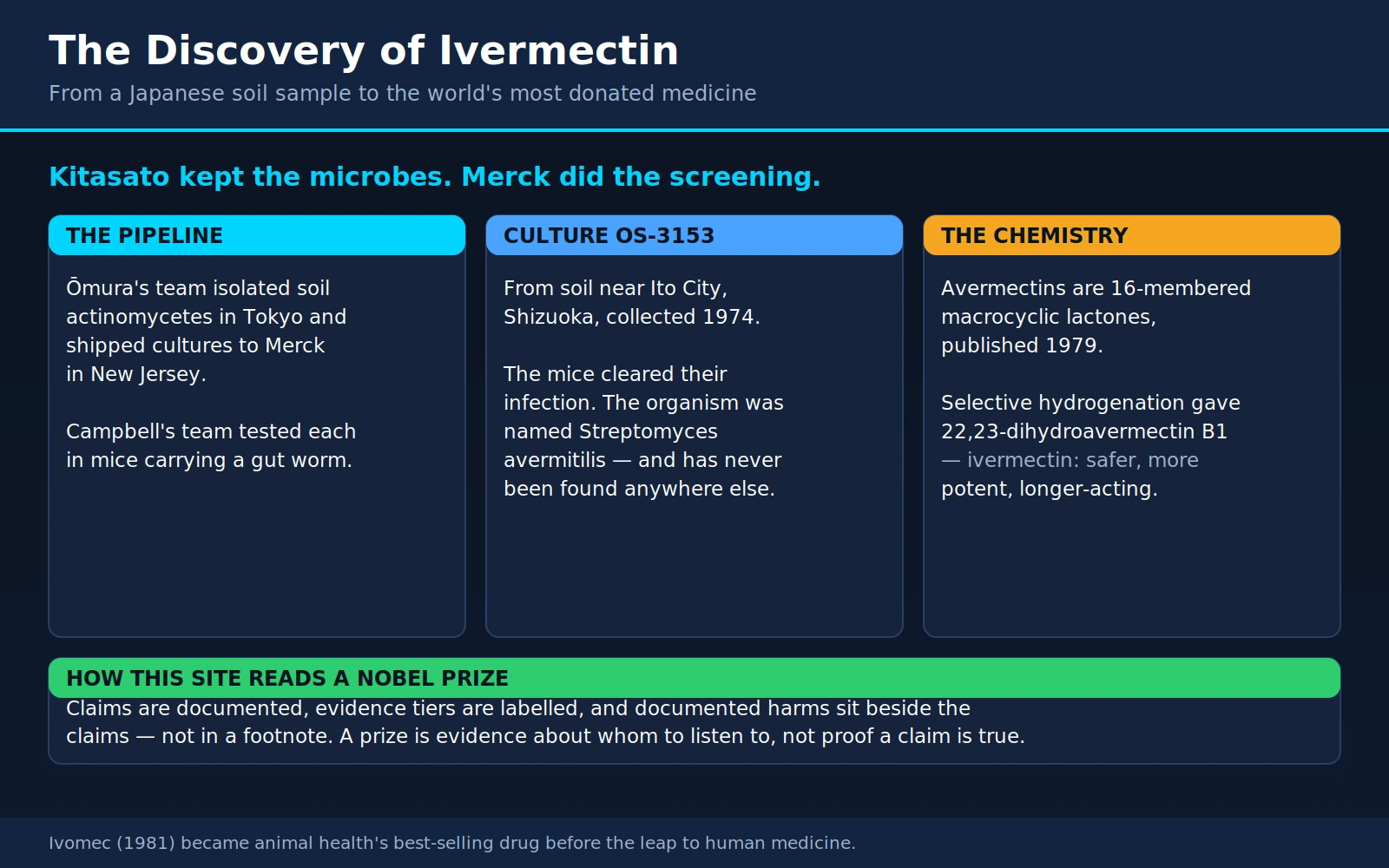
Most drug-discovery stories are stories about designing a molecule. This one is a story about finding one — in a bacterium, in a spoonful of soil, near a golf course on the Japanese coast. It runs from a handshake between a Tokyo institute and a New Jersey drug company, through a mouse experiment that could easily have missed, to a family of molecules so potent that the chemists measuring them kept re-checking their dilutions. It ends with the best-selling animal medicine on Earth, a human drug on the World Health Organization's essential-medicines list, and a shared Nobel Prize. And at every fork in the road, it could have gone the other way.
This is a companion article to our Satoshi Ōmura hub, which covers the man himself. Here we slow down and tell the discovery properly — because the details are not trivia. They are a working lesson in how real drugs actually get found.
Table of Contents
- Overview
- The Deal That Made It Possible
- A Handful of Soil from Kawana
- The Mouse Test That Caught It
- Eight Molecules Named Avermectin
- The Chemistry, in Plain Language
- One Double Bond: Making Ivermectin
- Ivomec: The Billion-Dollar Animal Drug
- The Leap to Humans
- The Only Organism Ever Found
- What the Discovery Teaches
- Key Research Papers
- Connections
- Featured Videos
1. Overview
Between 1974 and 1981, a previously unknown soil bacterium traveled from a seaside town in Shizuoka Prefecture to Merck's laboratories in Rahway, New Jersey, and emerged as a medicine. The timeline is startlingly short by pharmaceutical standards — roughly seven years from dirt to product — and the cast is small: Satoshi Ōmura's microbiology group at the Kitasato Institute, which found and grew the organism; William Campbell's parasitology group at Merck, which detected what it made and proved what it could do; and Merck's fermentation scientists and chemists, who isolated the active molecules and then quietly improved on nature.
The molecule family was named avermectin; the improved derivative, ivermectin. Against parasitic worms and arthropods, the avermectins were not incrementally better than existing drugs — they were roughly 25 times more potent than anything then on the market, effective against parasites already resistant to the older medicines, active at doses measured in millionths of a gram per kilogram, and — the properly miraculous part — largely indifferent to mammals, for a crisp biological reason explained in our pharmacology article.
One more number frames everything that follows. Ōmura's group sent Merck thousands of cultures over the years of the partnership. Of the tens of thousands of soil organisms screened worldwide before and since, exactly one has ever been found to make avermectins — the single strain from Kawana. Drug discovery from nature is a lottery with astonishing prizes, and this is what winning it looks like.
2. The Deal That Made It Possible
The discovery machine had to be built before it could run, and it was built on a contract. In 1971, Ōmura left Tokyo for a sabbatical at Wesleyan University in Connecticut, in the orbit of Max Tishler — the legendary chemist who had led Merck's research division for decades (his teams industrialized cortisone and vitamin B12, among much else) before retiring into academia. Tishler liked the intense Japanese visitor who talked about untapped microbes, and when Ōmura needed a way to keep his research funded and growing, Tishler opened Merck's door.
The agreement Ōmura negotiated in 1973 was unusual for its era, and each clause turned out to matter:
- Kitasato kept the microbes. The strains stayed in Japan, owned by the institute. Ōmura's lab would isolate soil organisms, culture them, run preliminary characterization, and ship promising cultures and broths to Merck.
- Merck did the screening. The company's assays, animal models, fermentation plants, and medicinal chemists — resources no academic institute could match — would hunt the samples for useful activity of any kind.
- Merck funded the source. Roughly $80,000 a year flowed to Ōmura's laboratory — substantial support for an academic microbiology group in 1973 — keeping the isolation pipeline full.
- Royalties, not a buyout. If any Kitasato organism ever became a product, the institute would share in the proceeds for the life of the patents.
Point four looked like optimistic boilerplate in 1973. It ultimately returned on the order of a quarter of a billion dollars to a private research institute, rebuilding it — a story told on the hub page. The deeper lesson is point one plus point two: the partnership worked because each side did what only it could do, and because the academic partner insisted on remaining a partner rather than becoming a supplier.
3. A Handful of Soil from Kawana
Ōmura's laboratory was not a random-sampling operation. Its competitive edge was a set of home-built methods for isolating and culturing actinomycetes — the filamentous soil bacteria, above all the genus Streptomyces, that produce a disproportionate share of nature's medically useful chemistry. Streptomycin, tetracycline, erythromycin, chloramphenicol, and rifamycin all came from this bacterial family. Most laboratories grew the actinomycetes that grow easily, which meant everyone kept rediscovering the same molecules. Ōmura's crews used unusual media and selection tricks to recover the rare, slow, difficult organisms — on the sound theory that a microbe nobody else could grow would make chemistry nobody else had seen.
The raw material was soil, and Ōmura collected it everywhere, famously carrying plastic bags in his pockets on principle. In 1974, a sample came into the lab from Kawana, in Ito City, Shizuoka Prefecture — a resort area on the Izu Peninsula coast, southwest of Tokyo, where the soil in question lay near a golf course. (Ōmura, a lifelong golfer, savored that detail in every retelling; by his account he was there to play.) From that sample his team isolated an actinomycete that earned its place in the outgoing shipment not because anyone knew what it made, but because it looked different — its colony morphology and spore-bearing structures didn't match the familiar catalog. Under the strain-numbering system it became OS-3153, and in 1974 it crossed the Pacific in a batch of 54 cultures.
It is worth being honest about what nobody knew at this point: nothing. No one at Kitasato or Merck had any idea the strain made an anthelmintic — a worm-killing compound. The strain was interesting because it was unfamiliar. Everything else was the screen's job to find out.
4. The Mouse Test That Caught It
At Merck, the sample entered an assay that deserves to be famous in its own right. Screening for worm-killing drugs in a test tube is treacherous — a compound can slaughter worms in glassware and do nothing in a living body, or poison the host along with the parasite. So Campbell's parasitology group screened in vivo from the start: mice were infected with Heligmosomoides polygyrus (then called Nematospiroides dubius), a natural intestinal roundworm of rodents, and candidate fermentation broths were simply mixed into the animals' feed for about a week. Then the worms were counted. A useful sample had to clear the infection and leave the mouse healthy — efficacy and safety tested in the same animal, at the very first step.
In 1975, the broth of culture OS-3153 went through this gauntlet. The result was the kind screeners dream about: the worms were gone — not reduced, eliminated — and the mice were fine. The activity survived dilution after dilution, which told the chemists the active ingredient was either abundant or shockingly potent. (It was the latter.) There was some toxicity at the crude-broth stage — enough that a less experienced team might have shelved the sample — but purification revealed that the toxic component and the worm-killing component were different substances. Separated from its neighbors, the active material had a wide, comfortable margin of safety.
Campbell later insisted, in his characteristically self-deprecating way, that the discovery owed much to luck — the right worm, the right feed schedule, a broth potent enough to survive dilution into mouse chow. That is true of every screen that ever worked. The un-lucky part was the design: an assay that demanded whole-animal efficacy and tolerability from the first pass is why a genuinely extraordinary compound was recognized as extraordinary immediately, rather than dying in a queue of ambiguous test-tube hits.
5. Eight Molecules Named Avermectin
Merck's fermentation and isolation teams pulled the activity apart and found not one molecule but a family: eight closely related compounds, four major pairs designated A1, A2, B1, and B2, each occurring in "a" and "b" forms that differ by a single small carbon branch. The family was named avermectin — coined, like the organism's species name avermitilis, from Latin roots meaning roughly "free of worms." The producing organism, characterized back in Ōmura's laboratory, was formally described as a new species: Streptomyces avermitilis.
The public unveiling came in 1979 as a coordinated trio of papers in Antimicrobial Agents and Chemotherapy — Burg and colleagues on the producing organism and fermentation, Miller and colleagues on the isolation and properties, Egerton and colleagues on the efficacy of the B1 component — all cited below. Read today, the efficacy paper still raises eyebrows: avermectin B1 cleared worm infections in sheep and cattle at oral doses down to tens of micrograms per kilogram, an order of magnitude (and more) below the field's existing champions, and it worked against strains already resistant to the benzimidazole dewormers then failing on farms worldwide.
Two features made the family a platform rather than a single hit. First, breadth: avermectins killed not only roundworms but arthropods — mites, lice, grubs, ticks — a two-kingdom spectrum almost unheard of in one molecule, which is why the class came to be called endectocides (killers of parasites inside and outside the body). Second, a conspicuous hole in the spectrum: avermectins do nothing to flukes and tapeworms — flatworms lack the drug's molecular target — and essentially nothing to bacteria or fungi. That selectivity pattern was the first fingerprint of the mechanism, worked out years later and explained in the pharmacology article.
6. The Chemistry, in Plain Language
You do not need organic chemistry to appreciate what kind of object an avermectin is, because the right mental image does the work: a sixteen-membered ring of carbon atoms — a "macrocyclic lactone," macro because the ring is huge by drug standards — decorated with fused smaller rings and, hanging off one side like a charm on a bracelet, a two-unit sugar chain (a disaccharide of the rare sugar oleandrose). The whole assembly weighs nearly 900 daltons, about twice the size of a typical synthetic drug molecule. No pharmaceutical chemist of the 1970s would have designed it; no chemist could have designed it, because its shape encodes a fit to a parasite protein nobody yet knew existed. The bacterium, so to speak, knew.
Within the family of eight, the differences are small chemical dial-settings — a methyl group here, a hydroxyl there, one double bond present or absent — but they tune potency and safety measurably. Merck's testing crowned the B1 pair (B1a with its slightly longer side chain, plus its minor sibling B1b) as the best combination of punch and tolerability. B1 itself, under the name abamectin, went on to a major career in agriculture, protecting crops from mites and controlling fire ants.
For the veterinary and human drug, though, the chemists believed they could do slightly better than the bacterium — which brings us to the single most consequential hydrogenation in pharmaceutical history.
7. One Double Bond: Making Ivermectin
Avermectin B1 carries a carbon–carbon double bond between positions 22 and 23 of its great ring. Merck's medicinal chemists — the team around Michael Fisher, whose names appear on the patents and the Science paper — found that adding two hydrogen atoms across that one bond, converting it to a single bond, yielded a molecule with the same ferocious potency and a meaningfully gentler safety profile in mammals. The catch was doing it only there: the molecule contains several other double bonds, including a conjugated pair essential to its activity, and ordinary hydrogenation would have flattened them all. The solution was a then-modern piece of precision catalysis — Wilkinson's rhodium catalyst, which is sterically fussy enough to reach only the accessible 22,23 position and leave the rest of the molecule untouched.
The product — 22,23-dihydroavermectin B1, a defined mixture of at least 80% B1a and no more than 20% B1b forms — was named ivermectin. The 1983 Science review by Campbell, Fisher, and colleagues, "Ivermectin: a potent new antiparasitic agent," announced it to the wider scientific world and remains the classic summary of what made it singular: activity against dozens of parasite species in cattle, sheep, horses, pigs, and dogs at doses of micrograms per kilogram, by mouth or injection, with a wide safety margin.
Pause on the scale, because it is the heart of the story. Older dewormers were dosed in tens of milligrams per kilogram. Ivermectin worked at around 200 micrograms per kilogram — hundredths of the old doses. For a human adult, the standard dose that would later treat river blindness is about 12 milligrams: a few grains of rice, once a year. When global-health veterans call ivermectin a wonder drug, the wonder starts here, in the arithmetic.
8. Ivomec: The Billion-Dollar Animal Drug
Merck launched ivermectin for livestock in 1981 under the name Ivomec, and the veterinary world adopted it with a speed that stunned even its makers. One product replaced entire shelves: a single treatment handled roundworms in the gut, lungworms in the airways, warbles and grubs burrowing under the hide, sucking lice, mange mites, and more. Within a few years Ivomec and its sibling formulations were the best-selling animal-health products in the world, a position the franchise held for two decades while sales ran on the order of a billion dollars a year at peak. Successor molecules followed from Merck and its competitors — abamectin for agriculture, then doramectin, eprinomectin, selamectin, and the related milbemycins including moxidectin — an entire drug class descended from one Shizuoka bacterium.
Two beneficiaries deserve special mention. Dog owners know ivermectin without knowing it: Heartgard, the monthly heartworm preventive, is ivermectin at a microscopic 6 micrograms per kilogram — a dose so small it is safe even in most of the collie-lineage dogs whose famous drug sensitivity we explain in the safety article. And economists of agriculture credit the avermectins with quietly raising meat, milk, wool, and leather yields across the developing world, where parasite burdens had always taxed every herd — a contribution to human nutrition that never makes the highlight reels.
The commercial triumph mattered morally, not just financially: it is what made the next chapter affordable. A company whose parasite drug was earning a billion dollars a year in the barnyard could contemplate giving the human version away forever.
9. The Leap to Humans
The leap from cattle to people was not obvious, and it was very nearly not taken. The human disease in question — onchocerciasis, river blindness — afflicted people with no purchasing power in countries with no pharmaceutical market. Developing a human drug costs a fortune in trials and regulatory work, and every sober business analysis said the same thing: there is no revenue at the end of this road.
The scientific case, however, kept improving. Ivermectin was spectacular against Onchocerca species in animals — including Onchocerca cervicalis in horses, a close cousin of the human parasite — and Campbell, tracking those results, pressed the question inside Merck: this drug should be tested against human river blindness. Management — ultimately Roy Vagelos, the physician-scientist then heading Merck's research — said yes to a human program with no plausible payday, a decision that looks simple only in hindsight.
The first human trial — run in Dakar, Senegal by Merck's Mohammed Aziz and published in The Lancet in 1982 — and everything that followed (registration as Mectizan in 1987, the donation pledge of "as much as needed, for as long as needed," the village-by-village campaigns, the national eliminations) belong to their own article: River Blindness and Global Health. For this page's purposes, one sentence closes the discovery arc: eight years after a soil sample left Ito City, the molecule it yielded was clearing parasites from human skin in West Africa at a single annual dose.
10. The Only Organism Ever Found
Here is the fact that keeps microbiologists up at night, in both senses. Natural-products laboratories and companies have screened soil microbes by the millions in the decades since 1974 — often specifically hoping to find another avermectin producer, since owning one would have been worth a fortune. None has ever been found. Streptomyces avermitilis remains, as far as anyone knows, the only organism on Earth that makes avermectins. Every gram of ivermectin ever swallowed by a person or an animal descends from the culture isolated at Kitasato in 1974.
When genomics matured, Ōmura's institute went back to the organism with sequencing machines — a homecoming with a twist. The genome, published in draft in 2001 and complete in 2003 (with Haruo Ikeda leading the analysis), revealed a linear chromosome of about nine million base pairs — among the largest bacterial genomes then known — carrying not just the avermectin machinery but roughly thirty separate gene clusters for making complex natural products, most of them silent under laboratory conditions, dedicating several percent of the genome to chemical manufacture. One unrepeatable organism, and even it was mostly untapped: the finding previewed today's genome-mining era, in which researchers wake sleeping clusters rather than waiting for fermentation luck.
The uniqueness also sharpens the ecological point Ōmura never tired of making. Nobody knows how many chemically irreplaceable microbes exist per hectare of ordinary ground, because nobody has ever come close to culturing them all. The one time humanity happened to catch this particular organism, the catch was worth — in health terms — more than almost any mine ever dug. Soil is not dirt. Soil is a library, mostly unread.
11. What the Discovery Teaches
Strip the story to its load-bearing beams and each one is a transferable lesson in how discovery works:
- Collect more than you can explain. The strain was shipped because it looked unusual, not because anyone had a hypothesis about it. Screening breadth beats foresight when the space is genuinely unknown.
- Test in the most honest system you can afford, first. The infected-mouse assay demanded efficacy and safety together, in a living body, at step one. Countless dish-active compounds died quietly elsewhere; this one announced itself unmistakably.
- Partner across strengths, and keep your ownership. Kitasato could never have developed ivermectin; Merck would never have held strain OS-3153. The deal's structure — specialization plus royalties — built an institute and a legend simultaneously.
- Nature drafts; chemistry edits. The bacterium supplied a scaffold no human would conceive; one precise human modification — two hydrogen atoms — finished the medicine. Neither alone was the drug.
- The best return on a discovery may not be revenue. The animal-health fortune underwrote a human gift. The full accounting of ivermectin includes profits, royalties, and something economics has no clean column for: villages that can see.
12. Key Research Papers
- Burg RW, Miller BM, Baker EE, et al. Avermectins, new family of potent anthelmintic agents: producing organism and fermentation. Antimicrob Agents Chemother 1979;15(3):361-7
- Miller TW, Chaiet L, et al. Avermectins, new family of potent anthelmintic agents: isolation and chromatographic properties. Antimicrob Agents Chemother 1979;15(3):368-71
- Egerton JR, Ostlind DA, Blair LS, et al. Avermectins, new family of potent anthelmintic agents: efficacy of the B1a component. Antimicrob Agents Chemother 1979;15(3):372-8
- Campbell WC, Fisher MH, Stapley EO, Albers-Schönberg G, Jacob TA. Ivermectin: a potent new antiparasitic agent. Science 1983;221(4613):823-8
- Ōmura S, Crump A. The life and times of ivermectin — a success story. Nat Rev Microbiol 2004;2(12):984-9
- Crump A, Ōmura S. Ivermectin, 'wonder drug' from Japan: the human use perspective. Proc Jpn Acad Ser B Phys Biol Sci 2011;87(2):13-28
- Campbell WC. History of avermectin and ivermectin, with notes on the history of other macrocyclic lactone antiparasitic agents. Curr Pharm Biotechnol 2012;13(6):853-65
- Ōmura S. Ivermectin: 25 years and still going strong. Int J Antimicrob Agents 2008;31(2):91-8
- Ōmura S. A Splendid Gift from the Earth: The Origins and Impact of the Avermectins (Nobel Lecture). Angew Chem Int Ed Engl 2016;55(35):10190-209
- Ōmura S, Ikeda H, Ishikawa J, et al. Genome sequence of an industrial microorganism Streptomyces avermitilis: deducing the ability of producing secondary metabolites. Proc Natl Acad Sci U S A 2001;98(21):12215-20
- Ikeda H, Ishikawa J, Hanamoto A, et al. Complete genome sequence and comparative analysis of the industrial microorganism Streptomyces avermitilis. Nat Biotechnol 2003;21(5):526-31
Live PubMed Searches
- Avermectin discovery
- Ivermectin as veterinary anthelmintic
- Streptomyces avermitilis genome
- Macrocyclic lactone antiparasitics
- H. polygyrus screening model
- Soil bacteria drug discovery
Connections
- Satoshi Ōmura Hub — the man behind the microbe: biography, Nobel, and legacy
- River Blindness and Global Health — what happened when this molecule met human disease
- How Ivermectin Works & Safety — the mechanism this discovery stumbled onto
- The COVID-19 Controversy — the wonder drug's most contested chapter
- Beyond Ivermectin — the rest of Ōmura's compound library
- William C. Campbell — the Merck parasitologist whose assay caught the strain
- Tu Youyou — artemisinin: the parallel discovery honored beside this one in 2015
- Alexander Fleming — penicillin: the founding accident of microbial drug discovery
- All Notable Doctors
- Parasites & Parasitic Diseases — the targets this discovery transformed
- Ivermectin for Strongyloides — a modern clinical use, step by step
- Cyclospora and the Ivermectin Question — a reminder of the spectrum's limits: ivermectin does not treat Cyclospora
- Sweet Wormwood (Artemisia annua) — nature's other Nobel-winning antiparasitic source
- Antiparasitic Remedies — the wider antiparasitic toolbox reviewed honestly