Satoshi Ōmura: Ivermectin, Soil Microbes, and the 2015 Nobel Prize
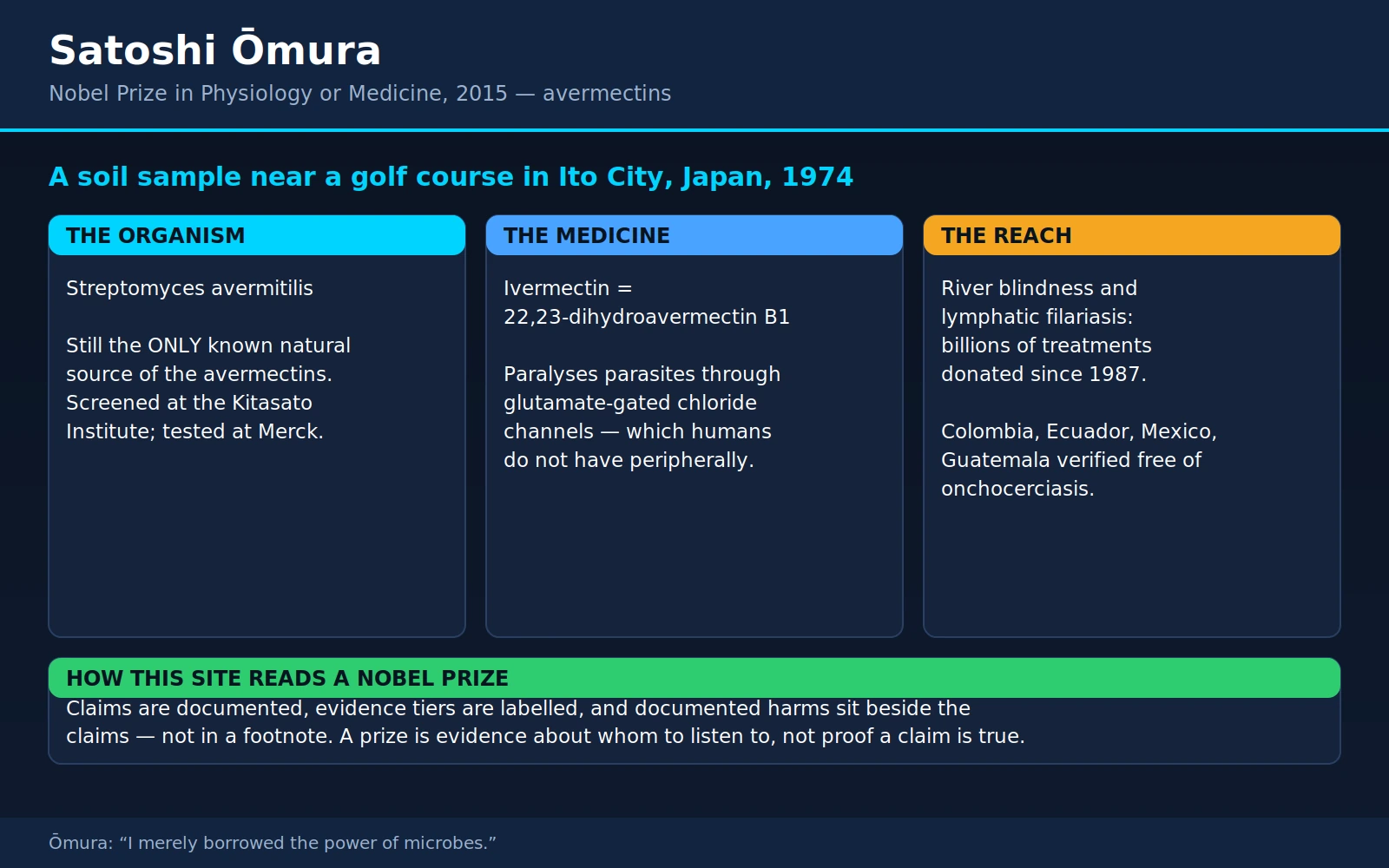
Satoshi Ōmura (大村智, born July 12, 1935) is a Japanese microbiologist and natural-products chemist who did something that sounds like a fable: he picked up a spoonful of soil near a seaside golf course, and the bacterium living in it went on to cure river blindness for tens of millions of people. The compounds from that single soil sample — the avermectins, refined by Merck's chemists into ivermectin — became one of the most consequential medicines of the twentieth century: the drug that broke the back of onchocerciasis and lymphatic filariasis, the backbone of the largest drug-donation program in history, and, before any of that, the best-selling animal-health medicine on Earth.
In 2015, Ōmura shared the Nobel Prize in Physiology or Medicine with the parasitologist William C. Campbell, who led the Merck team that found and developed what Ōmura's microbe made; the other half of that year's prize went to Tu Youyou for artemisinin, the malaria drug drawn from sweet wormwood. It was a Nobel for parasitic disease — the ancient afflictions of the world's poorest people — and Ōmura's reaction became as famous as the award. He said, in essence, that he did not deserve it: "I merely borrowed the power of microbes."
This hub tells his story the way this site tells all of its stories: with the wonder intact and the evidence labeled. The wonder is real — a farm boy from Yamanashi who nearly became a ski coach instead built one of the great drug-discovery engines of the modern era, close to 500 novel compounds deep. And the evidence needs labeling, because in 2020 ivermectin acquired a second, noisier life as a proposed COVID-19 treatment, a controversy in which Ōmura himself took a side. We cover that chapter honestly and completely in its own article below — the claims as they were made, the trials as they read out, and what each camp got right and wrong.
Deep-Dive Articles
1. The Discovery of Ivermectin
The full detective story: the Kitasato–Merck deal Ōmura negotiated himself, the soil sample labeled OS-3153, the infected-mouse assay that caught it, the eight avermectin molecules, and the one strategic double bond Merck's chemists removed to create ivermectin.
2. River Blindness and Global Health
What onchocerciasis does to a human being, the Senegal trial that changed everything, Merck's unprecedented pledge — "as much as needed, for as long as needed" — and the countries now verified free of a disease that once emptied entire river valleys.
3. How Ivermectin Works — and How Safe It Is
The chloride-channel mechanism in plain language, why a drug that paralyzes worms leaves you standing, the mutant-collie story that proves the rule, the real cautions (Loa loa, veterinary paste), and what billions of doses say about safety.
4. The COVID-19 Controversy
The honest, both-sides record: the petri-dish result and its dosing problem, the fraudulent study that poisoned the evidence, the proponents' claims documented as claims, Ōmura's own 2021 argument, and the large trials that came back null.
5. Beyond Ivermectin: The Natural-Products Legacy
Staurosporine, lactacystin, cerulenin, herbimycin and the rest of a compound library nearly 500 deep; the Kitasato Institute's remarkable lineage; the art museum he gave his hometown; and what Ōmura's way of working teaches drug hunters today.
Table of Contents
- Deep-Dive Articles
- Overview
- A Farm Boyhood in Yamanashi
- The Night-School Epiphany
- Skis, Soil, and the Kitasato Institute
- The Merck Partnership
- One Soil Sample from a Golf Course
- The 2015 Nobel Prize
- "I Merely Borrowed the Power of Microbes"
- Royalties That Rebuilt an Institute
- Where Mainstream Medicine Agrees
- Where Claims Outrun the Evidence
- What His Work Means for You
- Key Research Papers
- Connections
- Featured Videos
1. Overview
Every list of history's most valuable medicines includes a handful of names everyone knows — penicillin, insulin, the smallpox vaccine. Ivermectin belongs on that list, and most people in wealthy countries had never heard of it before 2020, because the diseases it conquered are diseases of poverty: river blindness (onchocerciasis), which blinded whole villages along the fertile rivers of West Africa; lymphatic filariasis, the mosquito-borne worm infection behind elephantiasis; strongyloidiasis, a gut worm that can silently persist for decades and turn lethal when the immune system is suppressed; and scabies, the itch mite that torments hundreds of millions. One drug, often one tablet a year, changed the trajectory of all of them.
The chain of events that produced it has three links, and Ōmura forged the first. His laboratory at Tokyo's Kitasato Institute developed unusually good methods for finding and growing soil bacteria — especially the Streptomyces group, filamentous bacteria that are nature's most prolific chemists and had already given medicine streptomycin, tetracycline, and erythromycin. In 1974 his team isolated a previously unknown strain from a soil sample collected in Kawana, near a golf course in Ito City, Shizuoka Prefecture. The second link was forged in America: at Merck, William Campbell's parasitology group found that broth from Ōmura's strain — sample OS-3153, later named Streptomyces avermitilis — annihilated intestinal worms in infected mice at doses that left the mice untroubled. The third link was chemistry: Merck's chemists isolated the eight active molecules, named them avermectins, and quietly improved the best of them into ivermectin. To this day, despite decades of worldwide searching, that one Japanese strain remains the only organism ever found on Earth that makes avermectins.
Ōmura's career is much larger than one molecule. Over five decades he and his colleagues discovered close to 500 novel compounds — the Nobel Foundation counted more than 480 — of which roughly 25 entered practical use as medicines, veterinary drugs, agricultural agents, and indispensable research reagents. Staurosporine, the master key that opened the field of kinase-inhibitor cancer drugs, is his. So is lactacystin, the probe that proved the cell's protein-shredding proteasome could be drugged. The full library is a story of its own, told in Beyond Ivermectin.
2. A Farm Boyhood in Yamanashi
Ōmura was born in 1935 in Nirasaki, a town in Yamanashi Prefecture where the Japanese Alps begin to rise, the second of five children in a farming family. His childhood was field work: rice, vegetables, horses, the endless small labor of a mid-century Japanese farm. His father expected him to take over the land. His grandmother, who largely raised him while his parents worked, repeated a maxim he would quote for the rest of his life — that a person should, above all, work for the benefit of others. He has said, with the dry humor that runs through his interviews, that as a boy he had no idea what she meant, and that it took him half a century of microbiology to find out.
He was not a prodigy, and he is emphatic about this. He describes himself as an unremarkable student who preferred sports — he was a serious cross-country skier in his school years, training to a competitive level in the deep snow of the Yamanashi mountains, and for a time an athletic career seemed as likely as a scientific one. He credits skiing, not school, with teaching him the two habits that later defined his science: endurance, and the willingness to keep going long after the initial excitement is gone. Anyone who has run a fermentation screen — thousands of broths, nearly all of them worthless — will recognize why a distance athlete thrives in that work.
He studied natural sciences at the University of Yamanashi, graduating in 1958, and moved to Tokyo — not to a famous laboratory, but to a job that would accidentally set the course of his life.
3. The Night-School Epiphany
In Tokyo, Ōmura took a position teaching evening classes at a metropolitan technical high school. His students were working people: young men and women who spent their days on factory floors and came to class at night to earn the education their circumstances had denied them. One evening, watching his students sit an examination, he noticed their hands — still stained with machine oil, because they had come straight from their shifts with no time to wash. They were exhausted, and they were there anyway.
Ōmura has retold this moment many times, always the same way: he was ashamed. He was the teacher, the one with the university degree, and he realized that he had never once worked at anything the way these students worked after a full day of manual labor. He resolved, in his own telling, to stop coasting — to study as if his hands, too, were stained with oil. He enrolled in night courses himself while teaching, then in graduate study at the Tokyo University of Science, and kept going until he held two doctorates: one in pharmaceutical sciences from the University of Tokyo (1968) and one in chemistry from the Tokyo University of Science (1970).
It is worth pausing on how unusual that dual training was. Microbiology finds the organisms; chemistry identifies what they make. Most researchers of his era stood on one side of that divide and collaborated across it. Ōmura stood on both sides at once — the same combination-of-two-worlds advantage that Tu Youyou carried into her artemisinin work as a pharmacist trained in both traditional Chinese medicine and modern extraction chemistry. When the moment came, he could find an unusual microbe and understand its chemistry, and very few people on Earth could do both as well.
4. Skis, Soil, and the Kitasato Institute
In 1965, Ōmura joined the Kitasato Institute, the private research institution founded in 1914 by Kitasato Shibasaburō — the samurai-born bacteriologist who made the first pure culture of the tetanus bacillus, co-invented antitoxin serum therapy, and was passed over for the first Nobel Prize in Medicine in 1901 while his German collaborator Emil von Behring received it alone. (That lineage, and the poetic justice of a Kitasato scientist finally winning the Nobel a century later, is a story we tell in full in Beyond Ivermectin.)
At Kitasato, Ōmura built his scientific identity around a conviction that sounds humble and is actually a research strategy: microorganisms are better chemists than we are. A gram of soil contains millions of bacteria, and the filamentous actinomycetes among them wage constant chemical warfare and diplomacy — antibiotics, signals, enzyme inhibitors, molecules of a complexity no human chemist would dream of building from scratch. Most laboratories screened the microbes that were easy to grow. Ōmura's edge was cultivating the ones that weren't: his group devised original isolation methods and culture media that coaxed rare and stubborn actinomycetes into growth, on the logic that an organism nobody else could grow would make molecules nobody else had seen.
The habit that made him famous followed directly from the strategy: he carried small plastic bags at all times — on walks, at hot-spring resorts, on golf courses, abroad — and scooped soil wherever he went. Colleagues found it endearing and slightly comic. The bags of dirt were, in fact, the front end of a discovery pipeline that would eventually yield hundreds of novel compounds and, from one sample, a medicine measured in billions of doses.
5. The Merck Partnership
In 1971 Ōmura went abroad on sabbatical, landing at Wesleyan University in Connecticut as a visiting professor in the laboratory of Max Tishler — a towering figure of American pharmaceutical chemistry who had spent three decades leading research at Merck before retiring into academia. Tishler became his mentor and door-opener, and when Ōmura's funds and time began to run out, the two of them engineered something that barely existed in that era: a formal research alliance between a Japanese academic institute and an American drug company.
The deal Ōmura negotiated in 1973 was ahead of its time, and its structure mattered enormously. Kitasato kept the microbes. Ōmura's laboratory would isolate promising soil organisms in Japan, culture them, and send broths and strains to Merck, whose industrial screening machinery — assays, chemists, animal facilities — would hunt for activity. Merck funded the Kitasato work (initially around $80,000 a year, serious money for an academic microbiology group in 1973), and if anything ever became a product, royalties would flow back to the institute, not merely a one-time fee. Colleagues thought the arrangement quixotic. It became one of the most productive academia–industry partnerships in the history of medicine, and the royalty clause — insisted on by a man from a farm family who understood what ownership means — would later rebuild the Kitasato Institute itself.
The division of labor also explains why the 2015 Nobel had two names on this half of the prize. Ōmura found and grew the organism; William Campbell's team at Merck found what it made, proved what it could do, and carried it to a drug. Neither could have done it alone, and neither has ever pretended otherwise.
6. One Soil Sample from a Golf Course
In 1974, among the year's harvest of cultures at Kitasato, was strain OS-3153, isolated from soil collected at Kawana, near a golf course in Ito City, Shizuoka Prefecture — a seaside resort area southwest of Tokyo. Ōmura, a lifelong golfer, has enjoyed telling the story of the sample's origin; the organism itself was flagged not because anyone knew what it made but because it looked unusual under his team's practiced eyes, and unusual organisms were exactly what the pipeline existed to catch. It went to Merck in a batch of 54 cultures.
At Merck, in a screen designed by Campbell's parasitology group, broth from OS-3153 was fed to mice infected with the intestinal worm Heligmosomoides polygyrus. The worms vanished; the mice thrived. Purification traced the activity to a family of eight closely related molecules — large, intricate macrocyclic lactones — which the team named avermectins, and the organism was christened Streptomyces avermitilis: roughly, "the worm-separating streptomycete." Merck's chemists then made a small, brilliant modification, hydrogenating one specific double bond to create ivermectin — slightly gentler, just as lethal to parasites. Launched in 1981 as the veterinary drug Ivomec, it became the best-selling animal-health product in the world. In 1987, as Mectizan, it became a human medicine — and the subject of the largest drug-donation pledge ever made.
The complete discovery story — the assay, the chemistry, the near-misses — is told in The Discovery of Ivermectin, and what the drug then did to river blindness, elephantiasis, scabies, and strongyloidiasis is told in River Blindness and Global Health. Two numbers preview those pages. First: the Mectizan Donation Program has delivered treatments counted in the billions — the largest disease-targeted drug donation in history. Second: four Latin American countries have been verified completely free of river blindness (Colombia 2013, Ecuador 2014, Mexico 2015, Guatemala 2016), and in 2025 Niger became the first country in Africa to join them. Diseases do not merely get treated in this story; they end.
7. The 2015 Nobel Prize
On October 5, 2015, the Nobel Assembly at the Karolinska Institute awarded the Prize in Physiology or Medicine in two halves: one half jointly to William C. Campbell and Satoshi Ōmura "for their discoveries concerning a novel therapy against infections caused by roundworm parasites," and the other half to Tu Youyou "for her discoveries concerning a novel therapy against Malaria." The committee's framing was blunt about the stakes: parasitic diseases had plagued humankind for millennia and disproportionately crush the world's poorest populations, and these two therapies — ivermectin and artemisinin — had "revolutionized" their treatment. The official summary is worth reading in full at nobelprize.org.
It was a strikingly unglamorous Nobel, and deliberately so. No gene editing, no immunotherapy — a soil bacterium and a roadside weed, aimed at river blindness and malaria. Within the world of global health the choice was celebrated as overdue recognition that the largest health gains of the late twentieth century included ones nobody in rich countries had noticed. Ōmura was 80 years old; he took the call from Stockholm and told reporters he had wondered aloud whether he deserved it.
His Nobel Lecture, delivered that December and later published under the title "A Splendid Gift from the Earth: The Origins and Impact of the Avermectins," is one of the most readable in the modern archive — part science, part autobiography, part love letter to microorganisms. The title is the thesis: he did not consider the avermectins his invention. They were the Earth's, and his role was to be the person who went looking.
8. "I Merely Borrowed the Power of Microbes"
Ōmura's humility is famous, quotable — and worth taking seriously as a scientific statement rather than mere modesty. When he says "I merely borrowed the power of microbes," he is describing a real methodological stance. Human medicinal chemists design molecules one hypothesis at a time. Microbes have been running chemical evolution for billions of years, and every compound a Streptomyces secretes has already survived nature's most ruthless screening program. Ōmura's bet — place yourself where the microbes are, learn to grow the ones nobody else can, and let their chemistry lead — is a philosophy of discovery, and its track record across his career is nearly five hundred compounds strong.
The humility had a personal register too. He kept his grandmother's maxim about working for others pinned to the center of his public storytelling; he credited his collaborators by name and insisted for decades that the avermectin achievement belonged equally to Campbell's team at Merck; and when the money came — and enormous money did come — almost none of it stayed with him, as the next section records. None of this makes him a saint, and this site does not do hagiography: he was by all accounts a demanding, fiercely competitive laboratory chief, and his late-career embrace of ivermectin's proposed use against COVID-19 outran the eventual evidence, as our controversy article documents without flinching. But the borrowed-power creed was not a pose. It was the operating system of the whole career.
9. Royalties That Rebuilt an Institute
The royalty clause in the 1973 Merck agreement turned out to be one of the most consequential sentences Ōmura ever negotiated. Ivomec and its successors became a franchise worth on the order of a billion dollars a year at its peak, and over the life of the patents the Kitasato Institute's share amounted, by most published estimates, to roughly a quarter of a billion US dollars.
Ōmura directed that river of money into rebuilding the institution that had trained him. The Kitasato Institute — proudly private since 1914, and chronically strapped because of it — gained modern research facilities and, most visibly, a full teaching hospital: the Kitasato Institute Medical Center, opened in 1989 in Saitama Prefecture, built substantially on avermectin royalties. Ōmura led the institute as president from 1990 to 2008 and steered its 2008 unification with Kitasato University. A discovery that began with the institute's soil-screening tradition ended up paying for the institute's next century — a circularity he clearly relished.
His personal share went, characteristically, sideways: into art. Ōmura became a devoted collector, with a particular eye for Japanese women painters, and rather than keep the collection he built the Nirasaki Ōmura Art Museum in his hometown and donated it — museum and collection together — to the city, adding a public hot-spring bath and a soba restaurant beside it so that visitors from the farming town he came from would have the full day out. He also served as head of Joshibi University of Art and Design, a women's art school in Tokyo. He liked to say that art and science are the same act — seeing what is already there, before others do.
10. Where Mainstream Medicine Agrees
It is hard to overstate how uncontested the core of Ōmura's legacy is. On the record of ivermectin against parasitic disease, there is no controversy anywhere in medicine — only superlatives that would sound like exaggeration if the sober literature did not keep using them:
- River blindness and lymphatic filariasis are in retreat worldwide because of mass ivermectin treatment — billions of doses, donated indefinitely, delivered village by village by programs described in our global-health article. Whole countries are now verified free of onchocerciasis.
- It sits on the WHO Model List of Essential Medicines, and standard references routinely group it with penicillin and aspirin among the drugs that have mattered most to human welfare. The paper that made the phrase famous — "Ivermectin, 'wonder drug' from Japan" — is a peer-reviewed history, not a headline.
- Its safety record at approved doses, across billions of administrations, is excellent — with specific, well-mapped exceptions (heavy Loa loa co-infection; veterinary formulations taken by humans) detailed in our pharmacology and safety article.
- The discovery model is canonized. The Kitasato–Merck alliance is taught as a template for academia–industry partnership, and the Mectizan donation is the founding example of modern pharmaceutical philanthropy at scale.
When this site places Ōmura in its Notable Doctors wing alongside Fleming and Banting, that is the consensus of medicine, not an alternative-health judgment.
11. Where Claims Outrun the Evidence
Precisely because the true story is so extraordinary, ivermectin became a magnet for claims the evidence does not support — and this site's policy is to document such claims, label their evidence tier, and place the documented record beside them rather than pretend they don't exist.
COVID-19 is the large case. Beginning with a genuine laboratory finding in April 2020, ivermectin was promoted — by clinician groups, by segments of the public, and, notably, by Ōmura himself in a 2021 review — as an effective treatment and preventive for COVID-19. The world's most rigorous randomized trials then tested it, repeatedly, at standard and elevated doses, and found no clinically meaningful benefit. The full timeline — including the concentration problem visible from day one, the fraudulent study whose removal collapsed the early meta-analyses, what the proponents got right about how they were treated, and where honest uncertainty genuinely remained — is laid out in Ivermectin and COVID-19: An Honest Record. We wrote it to be the fairest single page you can find on the subject, in either direction.
The "cures everything" halo is the small, persistent case. Because ivermectin is cheap, Nobel-honored, and genuinely broad against parasites, internet claims now attach it to cancer, autism, and routine "parasite cleanses" in people with no parasite diagnosis. The evidence tier for these uses is laboratory-dish and anecdote — no controlled human trials support them — and a Nobel Prize for one mechanism (killing invertebrate parasites via channels humans do not possess) is, if anything, an argument against expecting unrelated benefits in humans. Our Parasites section reviews, disease by disease, where ivermectin genuinely belongs — and where (as with Cyclospora, a parasite ivermectin does not treat) it doesn't.
12. What His Work Means for You
A Nobel biography can feel remote from your own health decisions. This one isn't. Practical takeaways, each expanded in the sub-articles:
- If you or your family lived in tropical or subtropical regions — or served or traveled there for long periods — and you now face steroids, chemotherapy, or transplant medication, ask your doctor about strongyloidiasis screening. The worm can persist silently for decades, immunosuppression can turn it deadly, and the cure is usually one or two doses of ivermectin. See our Strongyloides ivermectin guide.
- Scabies and head lice that shrug off creams have an oral option. Two tablets a week apart is standard for scabies; household-wide treatment is what actually ends the cycle.
- Rosacea with bumps and pustules responds to prescription topical ivermectin, likely by controlling Demodex skin mites — a mainstream, evidence-backed dermatology use.
- Never take veterinary ivermectin. A horse-paste syringe contains several adult human doses in an unregulated vehicle; the 2021 wave of poisonings was real. The human tablet, properly dosed, is one of the safest drugs known; the barn shelf is not. Details in the safety article.
- And the meta-lesson: nature remains medicine's deepest pharmacy. The same principle that honors traditional plant knowledge on this site — respect the source, then demand the evidence — is the principle Ōmura's soil bags embodied. Wonder and rigor are not opposites; his career is what they look like together.
13. Key Research Papers
- Crump A, Ōmura S. Ivermectin, 'wonder drug' from Japan: the human use perspective. Proc Jpn Acad Ser B Phys Biol Sci 2011;87(2):13-28
- Ōmura S. A Splendid Gift from the Earth: The Origins and Impact of the Avermectins (Nobel Lecture). Angew Chem Int Ed Engl 2016;55(35):10190-209
- Ōmura S, Crump A. The life and times of ivermectin — a success story. Nat Rev Microbiol 2004;2(12):984-9
- Burg RW, Miller BM, Baker EE, et al. Avermectins, new family of potent anthelmintic agents: producing organism and fermentation. Antimicrob Agents Chemother 1979;15(3):361-7
- Campbell WC, Fisher MH, Stapley EO, Albers-Schönberg G, Jacob TA. Ivermectin: a potent new antiparasitic agent. Science 1983;221(4613):823-8
- Aziz MA, Diallo S, Diop IM, Lariviere M, Porta M. Efficacy and tolerance of ivermectin in human onchocerciasis. Lancet 1982;2(8291):171-3
- Ōmura S. Ivermectin: 25 years and still going strong. Int J Antimicrob Agents 2008;31(2):91-8
- Crump A. Ivermectin: enigmatic multifaceted 'wonder' drug continues to surprise and exceed expectations. J Antibiot (Tokyo) 2017;70(5):495-505
- Ikeda H, Ishikawa J, Hanamoto A, et al. Complete genome sequence and comparative analysis of the industrial microorganism Streptomyces avermitilis. Nat Biotechnol 2003;21(5):526-31
- Campbell WC. History of avermectin and ivermectin, with notes on the history of other macrocyclic lactone antiparasitic agents. Curr Pharm Biotechnol 2012;13(6):853-65
Live PubMed Searches
- Ōmura avermectin discovery
- Ivermectin history & onchocerciasis
- Streptomyces avermitilis
- Mectizan Donation Program
- Natural products from actinomycetes
- 2015 Nobel Prize therapies
Connections
- The Discovery of Ivermectin — deep dive: from the Kawana soil sample to the world's medicine cabinet
- River Blindness and Global Health — deep dive: Mectizan, the donation, and the elimination map
- How Ivermectin Works & Safety — deep dive: mechanism, dosing, and the real cautions
- The COVID-19 Controversy — deep dive: the honest, both-sides record
- Beyond Ivermectin — deep dive: staurosporine, lactacystin, and the Kitasato legacy
- All Notable Doctors
- William C. Campbell — co-laureate: the Merck parasitologist who developed what Ōmura's microbe made
- Tu Youyou — the other half of the 2015 Nobel: artemisinin from sweet wormwood
- Alexander Fleming — the other legendary accidental microbe discovery, and its resistance warning
- Barry Marshall — another Nobel story of an unfashionable idea vindicated by evidence
- Parasites & Parasitic Diseases — the conditions ivermectin transformed, reviewed disease by disease
- Ivermectin for Strongyloides — the practical treatment guide
- Ivermectin and Acanthamoeba — an honest look at an off-label question
- Cyclospora and the Ivermectin Question — a parasite ivermectin does NOT treat
- Sweet Wormwood (Artemisia annua) — the plant behind the prize's other half
- Antiparasitic Remedies — where ivermectin sits among natural and pharmaceutical options