Parathyroid Hormone (PTH) Test
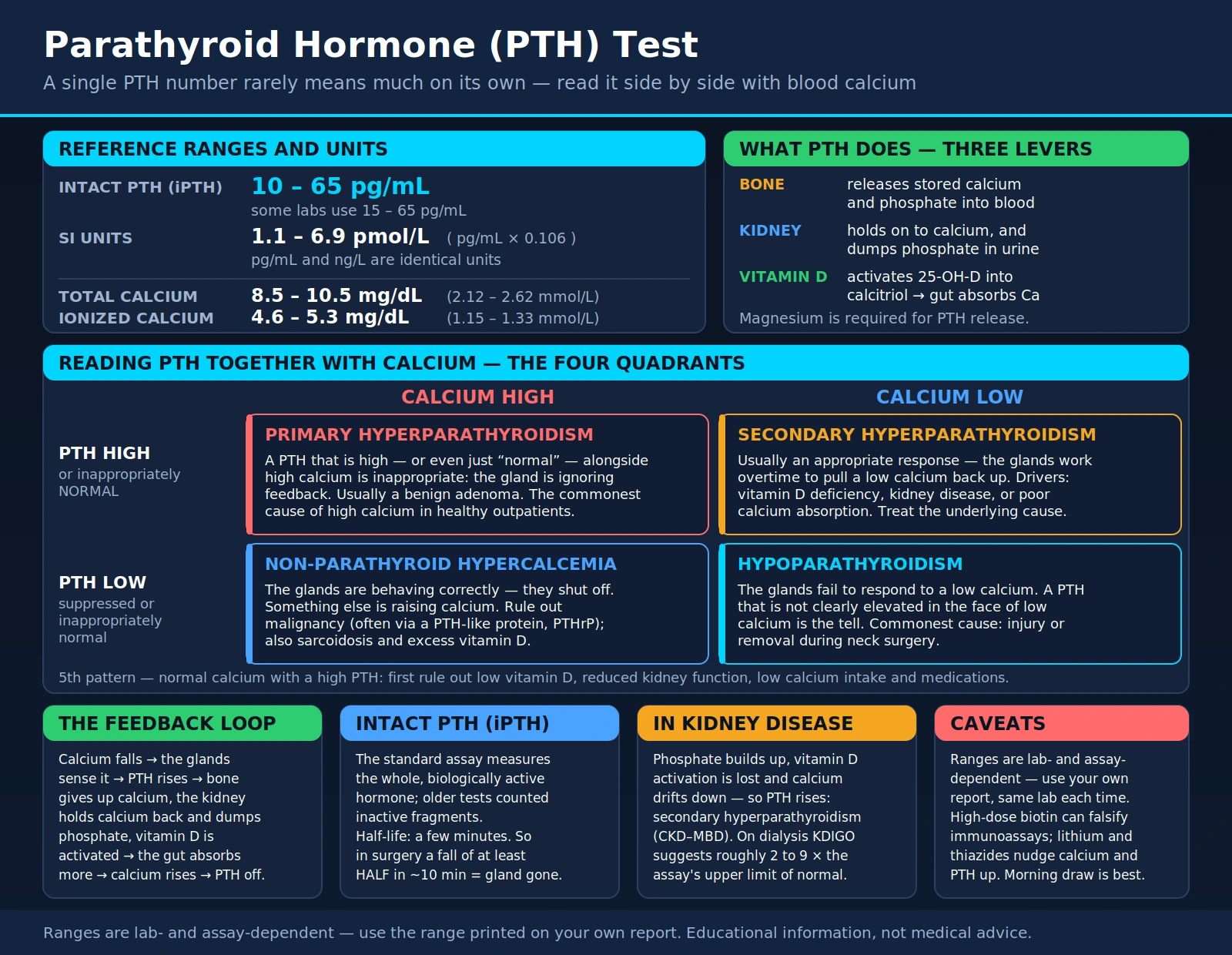
The parathyroid hormone (PTH) test measures the level of a hormone that acts as your body's calcium thermostat. Four tiny glands in your neck — the parathyroids — release PTH to keep the calcium in your blood within a very tight, tightly guarded range, because too much or too little calcium interferes with your nerves, muscles, heart, and bones. A single PTH number rarely means much on its own. Its real power comes from reading it side by side with your blood calcium: the same PTH value can be perfectly healthy or a red flag depending on whether calcium is high, normal, or low at the same moment. This page explains what PTH does, why the test is ordered, how to interpret it alongside calcium, and what the common patterns — the different kinds of hyperparathyroidism and hypoparathyroidism — actually mean.
Interactive Visualization Bone Remodeling & Calcium Balance Watch osteoclasts tunnel and osteoblasts rebuild — then drop vitamin D and see PTH quietly strip calcium out of your skeleton. Launch →
Table of Contents
- What PTH Is and What It Does
- Why the Test Is Ordered
- Reference Ranges and Units
- Reading PTH Together With Calcium
- Hyperparathyroidism: Primary, Secondary, Tertiary
- Hypoparathyroidism (Too Little PTH)
- PTH in Kidney Disease (CKD–MBD)
- Intact PTH and Intraoperative PTH
- How to Prepare and What to Expect
- Research Papers
- Connections
- Featured Videos
What PTH Is and What It Does
Parathyroid hormone is made and released by the four parathyroid glands, each about the size of a grain of rice, that sit behind the butterfly-shaped thyroid gland in your neck. Despite the similar name, the parathyroids have nothing to do with thyroid hormone or metabolism. Their one job is to manage calcium — and they do it minute by minute.
Calcium is far more than a bone mineral. Your nerves need it to fire, your muscles (including the heart) need it to contract, and your blood needs it to clot. Because these functions are so vital, the body keeps blood calcium in a narrow band and defends it aggressively. The parathyroid glands carry a sensor — the calcium-sensing receptor — that constantly samples the calcium level. When calcium starts to fall, the glands release more PTH; when calcium rises, they release less.
PTH raises blood calcium through three coordinated actions:
- Bone. Your skeleton is a vast calcium reserve. PTH signals bone to release some of its stored calcium (and phosphate) into the bloodstream. Brief, pulsed PTH is not harmful, but a chronically high level steadily withdraws calcium from bone and can weaken it over time.
- Kidneys. PTH tells the kidneys to hold on to calcium — reabsorbing it back into the blood instead of losing it in urine. At the same time it makes the kidneys dump more phosphate into the urine, which is why PTH tends to lower blood phosphate.
- Vitamin D activation. PTH switches on the kidney enzyme that converts stored vitamin D (the 25-hydroxyvitamin D your doctor usually measures) into its active form, calcitriol. Active vitamin D then increases how much calcium your gut absorbs from food. This is the indirect third lever.
Two other nutrients belong in the picture. Phosphate moves in a mirror-image partnership with calcium and is directly shaped by PTH. And magnesium is required for the parathyroid glands to release PTH at all — so a person who is severely low in magnesium can develop a low calcium that stubbornly refuses to correct until the magnesium is fixed. Understanding these relationships is what makes a PTH result interpretable.
Why the Test Is Ordered
Doctors almost never order PTH out of the blue. It is usually a second-step test ordered to explain something already noticed — most often an abnormal calcium. Common reasons include:
- High blood calcium (hypercalcemia). This is the classic trigger. High calcium is frequently spotted by accident on a routine metabolic panel, and PTH is the single most useful test for sorting out why.
- Low blood calcium (hypocalcemia). PTH helps distinguish a gland that is failing to respond from a gland that is working hard against a different problem (such as vitamin D deficiency).
- Bone disease. Osteoporosis, unexplained bone loss, fragility fractures, or bone pain may prompt a check for a hidden parathyroid problem quietly draining the skeleton.
- Kidney stones. Recurrent calcium kidney stones can be a sign of an overactive parathyroid gland pushing extra calcium through the kidneys.
- Chronic kidney disease. As kidney function declines, PTH almost always rises. It is monitored regularly as part of managing the bone and mineral problems of kidney disease (see CKD–MBD).
- Abnormal phosphate or magnesium that doesn't have an obvious explanation.
- Before and after parathyroid surgery. PTH confirms the diagnosis before an operation, and a special rapid version is measured during surgery to confirm the overactive gland has been removed (see Intraoperative PTH).
The single most important habit: PTH should almost always be drawn together with a calcium level, ideally from the same blood draw. The two numbers only make sense as a pair.
Reference Ranges and Units
Most laboratories report the modern intact PTH assay with a normal range of roughly 10 to 65 picograms per milliliter (pg/mL), though you will see labs use ranges such as 15–65 pg/mL depending on the exact method. In countries using SI units the same result is reported in picomoles per liter (pmol/L); to convert, multiply pg/mL by about 0.106, so a typical range of about 1.1 to 6.9 pmol/L. The number pg/mL and ng/L are identical, so those units are interchangeable.
For context, blood total calcium normally runs about 8.5 to 10.5 mg/dL (roughly 2.12–2.62 mmol/L), and ionized calcium — the biologically active fraction — about 4.6 to 5.3 mg/dL (1.15–1.33 mmol/L). These vary by lab too.
Three cautions about ranges are worth internalizing:
- Always use your own lab's printed range. Different PTH assays give different numbers for the same blood, so the range on your report is the one that counts.
- Use the same lab for follow-up. Because assays differ, comparing a PTH from one lab to a PTH from another can be misleading. Trends measured on the same platform are far more reliable.
- "Normal" is not automatically reassuring. A PTH squarely within the reference range can still be inappropriate for your calcium. This is the crux of interpretation, and it is the subject of the next section.
Reading PTH Together With Calcium
Here is the idea that makes PTH testing click. In a healthy person, calcium and PTH move in opposite directions: if calcium climbs, the parathyroids should sense it and switch PTH off; if calcium drops, they should switch PTH on. So the question is never simply "is PTH high or low?" — it is "does this PTH make sense given the calcium right now?" Doctors often picture the two results as four quadrants:
- High calcium + high (or middle-of-range) PTH. This is the fingerprint of primary hyperparathyroidism. When calcium is high, a healthy gland should shut PTH down to the bottom of the range or below. A PTH that is high — or even just "normal" — alongside high calcium is inappropriate: the gland is ignoring the feedback and driving calcium up on its own.
- High calcium + low (suppressed) PTH. Here the parathyroids are behaving correctly — they have shut off because calcium is high — which means something other than the parathyroids is raising calcium. The most important cause to rule out is a malignancy (some cancers raise calcium, often through a PTH-like protein called PTHrP); other causes include certain granulomatous diseases such as sarcoidosis and excess vitamin D.
- Low calcium + high PTH. This is usually an appropriate response: the glands are working overtime to pull a low calcium back up. Common drivers are vitamin D deficiency, kidney disease, or poor calcium absorption. This pattern is called secondary hyperparathyroidism.
- Low calcium + low (or middle-of-range) PTH. This is hypoparathyroidism — the glands are failing to respond to a low calcium the way they should. A PTH that is not clearly elevated in the face of low calcium is the tell.
A fifth, increasingly common situation is normal calcium with a high PTH. Before calling this "normocalcemic primary hyperparathyroidism," a doctor first rules out the ordinary reasons the glands would be appropriately busy — low vitamin D, reduced kidney function, low calcium intake, or certain medications — because those are far more common. This is exactly why PTH is rarely interpreted alone: a full picture usually includes calcium, vitamin D, kidney function (creatinine), phosphate, and sometimes 24-hour urine calcium.
Hyperparathyroidism: Primary, Secondary, Tertiary
"Hyperparathyroidism" simply means too much PTH activity, but there are three distinct types with very different meanings and treatments.
Primary hyperparathyroidism
In primary hyperparathyroidism, one (occasionally more) of the parathyroid glands becomes overactive on its own, usually because of a benign, non-cancerous growth called an adenoma. The gland pumps out PTH regardless of the calcium level, so blood calcium drifts high. It is the most common cause of high calcium found in otherwise healthy outpatients, and it is more frequent in women and after age 50.
Many people have no symptoms and are discovered only because a routine test showed high calcium. When symptoms do occur, they follow the old teaching phrase "bones, stones, groans, and psychiatric moans": thinning bones and fractures, kidney stones, abdominal and digestive complaints, and fatigue, low mood, or foggy thinking. Diagnosis rests on the classic pattern — high calcium with a PTH that is high or inappropriately normal — usually confirmed with vitamin D testing and a 24-hour urine calcium (to exclude a benign inherited condition, familial hypocalciuric hypercalcemia, that can mimic it). For the right candidates, surgery to remove the overactive gland (parathyroidectomy) is curative; international guidelines help decide who benefits most.
Secondary hyperparathyroidism
Secondary hyperparathyroidism is the glands doing their job — loudly. Something outside the parathyroids keeps calcium low (or phosphate high), and the glands respond correctly by producing more and more PTH to compensate. Here calcium is usually low or normal, not high. The usual causes are vitamin D deficiency, chronic kidney disease, and problems absorbing calcium (for example after certain intestinal surgeries or in malabsorption). The treatment is to fix the underlying cause — commonly replacing vitamin D and calcium, or managing the kidney disease — rather than the gland itself.
Tertiary hyperparathyroidism
Tertiary hyperparathyroidism is what can happen after years of secondary overdrive, most often in advanced kidney disease and after a kidney transplant. The glands, having been pushed hard for so long, become autonomous — enlarged and stuck in the "on" position. Even after the original problem is corrected, they keep over-producing PTH, and now calcium swings high. At this stage medication may no longer be enough and surgery is sometimes needed.
Hypoparathyroidism (Too Little PTH)
Hypoparathyroidism is the opposite problem: the parathyroid glands produce too little PTH, so blood calcium falls low and phosphate tends to rise. By far the most common cause is accidental injury to, or removal of, the parathyroid glands during neck surgery — typically thyroid surgery, since the tiny parathyroids sit right against the thyroid and are easy to bruise or disturb. Other causes include autoimmune destruction of the glands, rare genetic conditions (such as DiGeorge syndrome), and a functional shutdown caused by severe magnesium deficiency, in which the glands are intact but cannot release PTH until the magnesium is restored.
The symptoms are the symptoms of low calcium: tingling around the mouth and in the fingers and toes, muscle cramps and spasms (in severe cases a stiff, involuntary tightening called tetany), twitchiness, and — when calcium falls sharply — even seizures. On the lab report the pattern is unmistakable: low calcium with a PTH that is low or inappropriately normal instead of the high value a healthy gland would produce. Treatment centers on calcium and the active form of vitamin D (calcitriol) to keep calcium in a safe range, and in selected patients, PTH replacement therapy. Because both the disease and its treatment can affect the kidneys over time, people with hypoparathyroidism are followed closely with periodic blood and urine testing.
PTH in Kidney Disease (CKD–MBD)
Chronic kidney disease (CKD) deserves its own section because PTH behaves so predictably there. As the kidneys fail, three things happen at once: they can no longer clear phosphate, so it builds up; they lose the ability to activate vitamin D, so calcium absorption falls; and blood calcium tends to drift down. Every one of those changes is a signal for the parathyroids to make more PTH. The result is secondary hyperparathyroidism, which appears early in kidney disease and worsens as it progresses.
This is not just a number on a lab sheet. Over time the combination of abnormal calcium, phosphate, vitamin D, and PTH damages both the skeleton (a condition called renal osteodystrophy, with weak, painful bones) and the blood vessels (calcium deposits stiffening the arteries). Kidney specialists group these problems together under the label CKD–Mineral and Bone Disorder (CKD–MBD), and PTH is one of the key markers they track.
An important and slightly counterintuitive point: in people on dialysis, doctors do not aim to push PTH all the way down to the normal range. Failing bones in kidney disease actually need some extra PTH to keep turning over, so guidelines from the international KDIGO group suggest keeping PTH somewhere in the range of roughly two to nine times the upper limit of the assay's normal range, and — crucially — paying attention to the trend over time rather than reacting to any single value. Managing it involves controlling phosphate (diet and phosphate binders), vitamin D compounds, and drugs called calcimimetics that quiet the glands.
Intact PTH and Intraoperative PTH
Once in the blood, PTH is quickly chopped into fragments, and older tests were fooled by counting inactive pieces. The standard test today is the intact PTH (iPTH) assay, which measures the whole, biologically active hormone and gives a much truer reading. When your report says "PTH, intact," this is the test being used.
PTH also has a remarkable feature that surgeons exploit: an extremely short half-life of only a few minutes, meaning the level in your blood drops fast once the source is removed. This makes possible one of the more elegant tools in surgery — intraoperative PTH monitoring. During an operation for primary hyperparathyroidism, the surgeon draws a baseline PTH, removes the gland they believe is the culprit, and then re-measures PTH a few minutes later. If the level falls by at least half (and toward normal) within about ten minutes, it is strong real-time confirmation that the overactive gland is gone and no other overactive gland remains — so the surgeon can close with confidence. If it does not fall enough, it warns that another overactive gland is still hiding, and the search continues in the same operation. This rapid feedback is a major reason modern parathyroid surgery is so successful and increasingly minimally invasive.
How to Prepare and What to Expect
The PTH test itself is an ordinary blood draw from a vein in your arm, and it is nearly always ordered alongside a calcium test — sometimes the two come from the very same tube. A few practical points help make the result meaningful:
- Timing. PTH follows a mild daily rhythm and is often a little higher later in the day, so many clinicians prefer a morning draw, especially when comparing results over time.
- Fasting. A PTH level usually does not require fasting, but the tests commonly ordered with it (such as a metabolic panel or phosphate) sometimes do. Follow whatever instructions your lab or clinic gives.
- The companion tests. Expect calcium, and often vitamin D, kidney function (creatinine), phosphate, and magnesium, to be checked at the same time. That whole panel — not PTH alone — is what your doctor interprets.
- Medications and supplements. Tell your provider everything you take. Lithium and thiazide diuretics can nudge calcium and PTH upward; large doses of vitamin D or calcium supplements shift the picture; and high-dose biotin (a popular hair-and-nail supplement) can interfere with some laboratory immunoassays and produce falsely high or low readings. Your provider may ask you to pause biotin for a couple of days beforehand.
- Consistency. If you are being followed over time, try to use the same laboratory so the numbers are comparable.
Results usually return within a day or two. Remember that a PTH value is a snapshot to be read in context: your doctor will line it up against your calcium and the rest of the panel before drawing any conclusion. An isolated "high" or "low" on the page is a prompt for a conversation, not a diagnosis by itself.
Research Papers
- Goltzman D. Physiology of Parathyroid Hormone. Endocrinology and Metabolism Clinics of North America. 2018;47(4):743–758. doi:10.1016/j.ecl.2018.07.003 — A clear review of how PTH regulates calcium and phosphate through bone, kidney, and vitamin D — the biology underlying every result on this page.
- Insogna KL. Primary Hyperparathyroidism. New England Journal of Medicine. 2018;379(11):1050–1059. doi:10.1056/NEJMcp1714213 — A practical clinical-practice overview of the most common reason PTH is tested: high calcium with an inappropriately high or normal PTH.
- Bilezikian JP, Khan AA, Silverberg SJ, Fuleihan GE, et al. Evaluation and Management of Primary Hyperparathyroidism: Summary Statement and Guidelines from the Fifth International Workshop. Journal of Bone and Mineral Research. 2022;37(11):2293–2314. doi:10.1002/jbmr.4677 — The most recent expert consensus on diagnosing primary hyperparathyroidism and deciding who needs surgery.
- Eastell R, Brandi ML, Costa AG, D'Amour P, et al. Diagnosis of Asymptomatic Primary Hyperparathyroidism: Proceedings of the Fourth International Workshop. The Journal of Clinical Endocrinology & Metabolism. 2014;99(10):3570–3579. doi:10.1210/jc.2014-1414 — Details why PTH must be interpreted alongside calcium and describes the normocalcemic variant discussed above.
- Wilhelm SM, Wang TS, Ruan DT, Lee JA, et al. The American Association of Endocrine Surgeons Guidelines for Definitive Management of Primary Hyperparathyroidism. JAMA Surgery. 2016;151(10):959–968. doi:10.1001/jamasurg.2016.2310 — Surgical guidelines covering diagnosis, imaging, and the role of parathyroidectomy.
- Carneiro DM, Solorzano CC, Nader MC, Ramirez M, et al. Comparison of intraoperative iPTH assay (QPTH) criteria in guiding parathyroidectomy: which criterion is the most accurate? Surgery. 2003;134(6):973–979. doi:10.1016/j.surg.2003.06.001 — A foundational study of the "PTH drops by at least 50%" rule used during parathyroid surgery.
- Fraser WD. Hyperparathyroidism. The Lancet. 2009;374(9684):145–158. doi:10.1016/S0140-6736(09)60507-9 — A broad review spanning primary and secondary hyperparathyroidism and how the PTH–calcium relationship guides diagnosis.
- Jamal SA, Miller PD. Secondary and Tertiary Hyperparathyroidism. Journal of Clinical Densitometry. 2013;16(1):64–68. doi:10.1016/j.jocd.2012.11.012 — Explains how appropriate (secondary) overactivity can progress to autonomous (tertiary) disease.
- Ketteler M, Block GA, Evenepoel P, Fukagawa M, et al. Executive summary of the 2017 KDIGO Chronic Kidney Disease–Mineral and Bone Disorder (CKD–MBD) Guideline Update. Kidney International. 2017;92(1):26–36. doi:10.1016/j.kint.2017.04.006 — The guideline behind the "trend, not a single value" and the higher PTH targets used in dialysis patients.
- Bilezikian JP, Khan A, Potts JT, Brandi ML, et al. Hypoparathyroidism in the adult: epidemiology, diagnosis, pathophysiology, target-organ involvement, treatment, and challenges for future research. Journal of Bone and Mineral Research. 2011;26(10):2317–2337. doi:10.1002/jbmr.483 — A comprehensive reference on the low-PTH state, including its most common cause — neck surgery.
Connections
- All Lab Tests
- Bone Remodeling & Calcium Balance — interactive animation
- Vitamin D Test
- Kidney Function
- Comprehensive Metabolic Panel
- Magnesium Test
- Calcium
- Phosphorus
- Magnesium
- Vitamin D3
- Osteoporosis
- Kidney Disease
- Endocrinology