Paul Hermann Müller: DDT, the 1948 Nobel Prize, and a Chemical That Cut Both Ways
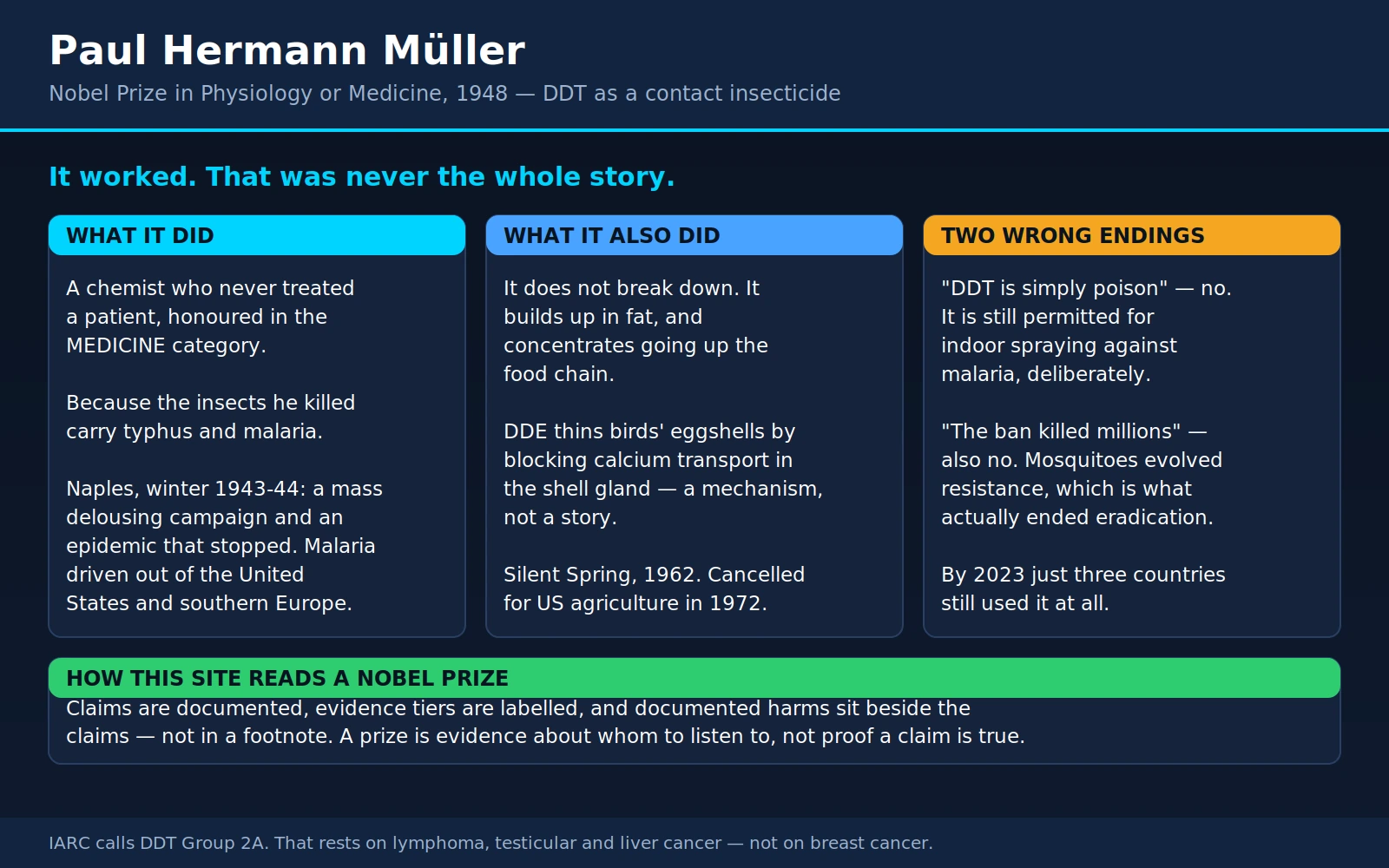
Table of Contents
- Overview
- The Chemist at Geigy
- What DDT Does to an Insect
- Typhus in Naples, Winter 1943–44
- Malaria in Retreat
- The 1948 Prize
- Persistence, Fat, and the Food Chain
- Eggshell Thinning: How It Actually Works
- Silent Spring and the 1972 Cancellation
- Human Health: What the Evidence Supports
- Early-Life Exposure and Breast Cancer
- Resistance: Why Eradication Failed
- DDT Today: The Stockholm Convention Exemption
- Does It Still Work? Spraying versus Nets
- Two Conclusions You Should Not Leave With
- Key Research Papers
- Connections
- Featured Videos
1. Overview
Paul Hermann Müller (12 January 1899, Olten, Switzerland – 12 October 1965, Basel) was an industrial chemist who never held a medical appointment, never treated a patient, and received the Nobel Prize in Physiology or Medicine in 1948 anyway — "for his discovery of the high efficiency of DDT as a contact poison against several arthropods." He is one of the very few laureates in the medicine category honoured for a chemical that kills insects rather than for anything that happens inside a human body. The committee's reasoning was straightforward: the insects in question carry typhus, malaria, and a long list of other diseases, and in the 1940s Müller's compound stopped them at a scale nothing had ever managed before.
What happened afterwards is why this page exists. DDT turned out to be extraordinarily persistent, fat-soluble, and capable of concentrating up food chains. Within twenty years of the prize it was implicated in the collapse of raptor populations across two continents; within twenty-four years the United States had cancelled its agricultural registration. Silent Spring, published in 1962, made DDT the founding case study of modern environmental toxicology. The compound is now listed under an international treaty for elimination.
Both of those paragraphs are true, and neither cancels the other. The temptation is to pick one — to file Müller under "chemical villain" or under "the man whose life-saving invention was destroyed by hysterics" — and both files are wrong. This page tries to hold the whole thing at once, because the DDT story is one of the best available worked examples of a problem that recurs constantly in public health: an intervention with real, measurable benefits and real, measurable harms, where the honest answer is neither "use it" nor "ban it" but "here, under these conditions, for this long, while we build something better."
That is, in fact, roughly what the world settled on. DDT is banned for agriculture in most of the world and still legally used for malaria vector control under a specific exemption in the Stockholm Convention on Persistent Organic Pollutants. As of 2023, three countries — India, South Africa, and Zimbabwe — were still using it for that purpose. The exemption is not a loophole and it is not a scandal. It is a considered trade-off, and the sections below set out what is actually on each side of it.
2. The Chemist at Geigy
Müller joined the dye and chemicals firm J.R. Geigy in Basel in 1925, straight out of a chemistry doctorate at the University of Basel, and stayed there for forty years until his death. He was not an academic and did not publish in the way academics do; he was a company research chemist working on plant protection and tanning agents, which in the Switzerland of the 1930s meant a very practical problem: crops were being eaten, and the available insecticides were either arsenic compounds (which poisoned everything, including the farmer) or plant extracts such as pyrethrum and rotenone (which were effective, expensive, and derived from imports that a European war would cut off).
From 1935 Müller set himself an explicit specification for an ideal insecticide. It had to kill insects on contact rather than only by ingestion; it had to work fast and at low concentration; it had to be broadly effective across many insect species; it had to be cheap and easy to manufacture; it had to be chemically stable so that a single application kept working; and it had to be as close to harmless as possible for plants and warm-blooded animals. He then worked through several hundred compounds against houseflies in a glass chamber, methodically, for four years.
In 1939 he tested dichlorodiphenyltrichloroethane and it met every item on the list at once. The molecule was not new: the German chemist Othmar Zeidler had synthesised it in 1874 as a piece of routine organic chemistry and had recorded no interest in what it did to insects, because he had no reason to look. That gap — sixty-five years between a compound existing and anyone noticing what it was for — is the reason the Nobel citation is worded the way it is. Müller was not credited with making DDT. He was credited with discovering the high efficiency of DDT as a contact poison, which is a discovery about a property, not about a substance.
It is worth registering how much of the eventual disaster was already implicit in that specification. Müller had deliberately optimised for chemical stability — the property that made one spraying last a whole season, and the property that would later be called persistence and treated as the defining hazard of an entire class of pollutants. He had also optimised for low acute toxicity to mammals, and DDT genuinely has that; people were dusted with it directly, by the hundreds of thousands, without dropping dead. What nobody in 1939 had a concept for was that a compound could be simultaneously non-toxic in an acute test and dangerous over decades through accumulation in fat, transfer up food chains, and effects on reproduction. That concept did not exist yet. DDT is a large part of why it does now.
3. What DDT Does to an Insect
DDT acts on the voltage-gated sodium channels in insect nerve cell membranes. These channels open and close to propagate a nerve impulse; DDT binds to them and interferes with the closing, so the channel leaks and the neuron fires repeatedly instead of resetting. The insect goes into uncontrolled tremors, then paralysis, then death — which is why the effect is called knockdown, and why it happens on contact through the cuticle rather than requiring the insect to eat anything.
Two facts about that mechanism matter enormously later on this page, so they are worth stating now rather than as an afterthought.
First: the pyrethrins and the synthetic pyrethroids hit the same target. The natural pyrethrins from chrysanthemum flowers, the synthetic pyrethroids that replaced DDT in most of the world, and DDT itself all act on the same voltage-gated sodium channel protein. They are chemically unrelated and share a binding site region. This is not a minor curiosity of pharmacology — it means that a mosquito which has evolved a modified sodium channel is protected against all of them at once.
Second: resistance to this class comes largely from changing the target. Insects can resist an insecticide either by detoxifying it faster or by altering the protein it binds to. For DDT and the pyrethroids, one of the most important resistance mechanisms is a modification of the sodium channel protein itself, known as knockdown resistance or kdr. A single amino-acid substitution in the channel can prevent binding, and the mosquito walks away from a dose that would have killed its ancestors. Because the target is shared, kdr confers cross-resistance across the whole class, and because a point mutation is a cheap evolutionary move, it appears fast under heavy selection pressure.
Everything in the resistance section below follows from those two sentences. So does the modern trial evidence in the indoor-spraying section, where the Cochrane reviewers do not classify insecticides by chemical family at all — they classify them as "pyrethroid-like" or "non-pyrethroid-like," and DDT is filed as pyrethroid-like, because as far as a mosquito's nervous system is concerned, that is what it is.
4. Typhus in Naples, Winter 1943–44
Epidemic typhus is caused by Rickettsia prowazekii and is carried by the human body louse. It is a disease of crowding, cold, and unwashed clothing, which is to say a disease of war, siege, prison, and refugee camp. Historically it killed on a scale comparable to the fighting that produced it, and it had a grim reliability: typhus epidemics started in winter, when people wore more layers and washed less, and burned until spring.
By 1942 the Allies knew a typhus epidemic in liberated Europe was coming and had put real institutional effort into preventing it. The Rockefeller Foundation's Louse Laboratory spent 1942–1944 developing anti-typhus technologies — the powders, the dusting equipment, the delousing protocols — and DDT arrived in the middle of that programme as a candidate louse powder that outperformed everything else available. The historian Daniel Stapleton has documented that development work in detail; it is one of the few well-sourced accounts of the earliest applied DDT research, and it makes clear that the Naples campaign was not improvised.
Typhus duly broke out in Naples in the winter of 1943–44, in a bombed city under military occupation with wrecked sanitation and a population living in shelters and caves. The Allied military government responded with mass delousing: people were dusted with DDT powder in their clothes, at stations set up across the city, on a scale usually given in the historical accounts as more than a million individuals. The epidemic broke, in winter, which had not happened before.
5. Malaria in Retreat
The larger use of DDT was against mosquitoes, and specifically against Anopheles, the genus that transmits malaria. Ronald Ross had proved the mosquito's role in transmission in the 1890s and won the second Nobel Prize in Medicine for it in 1902; for the next four decades, knowing the vector had not been the same as being able to do anything about it. Control meant draining swamps, oiling water surfaces, screening houses, and Paris green larvicide — laborious, expensive, and effective only where a state could sustain the effort.
DDT changed the arithmetic because of the property Müller had designed in. Sprayed on the inside walls of a house, it left a residue that stayed lethal for months. An Anopheles mosquito that bites at night and then rests on a wall to digest the blood meal lands on that residue and dies before it can transmit to the next person. This is indoor residual spraying (IRS), and its logic is elegant: you do not have to kill every mosquito, or even most of them. You only have to shorten the average adult mosquito's life below the time the malaria parasite needs to develop inside it. Do that and transmission collapses even though mosquitoes are still biting.
It worked. Malaria was endemic in the southeastern United States into the 1940s; a national eradication programme built on house spraying, run through the agency that would become the CDC, drove transmission to zero and the disease was considered eliminated from the country by the early 1950s. Southern Europe — Italy, Greece, the Balkans, where malaria had shaped settlement patterns for two thousand years — was cleared over roughly the same period. Sri Lanka, Taiwan, and large parts of the Caribbean saw comparable collapses in case numbers.
On the strength of those results the World Health Organization launched the Global Malaria Eradication Programme in 1955. The plan was explicit and time-limited: spray houses everywhere with DDT for a few years, break transmission, and stop before the mosquitoes could adapt. It was one of the most ambitious public-health undertakings ever attempted, and it eliminated malaria from a number of countries permanently. It was formally abandoned in 1969, having failed in tropical Africa, where it had barely been attempted, and having stalled or reversed in much of Asia.
Why it failed is the subject of section 12, and the answer is not the one most people assume.
6. The 1948 Prize
The Nobel Assembly at the Karolinska Institute awarded Müller the 1948 Prize in Physiology or Medicine, unshared, three years after the war ended and while the typhus and malaria results were still fresh. The citation — "for his discovery of the high efficiency of DDT as a contact poison against several arthropods" — is unusually narrow and unusually careful. It says nothing about safety, nothing about the environment, and nothing about how DDT should be used. It describes a specific, correct, verifiable finding: this compound kills arthropods on contact with unusual efficiency.
That precision is the reason Müller's prize sits differently from the others on our Prizes That Aged Badly page. Johannes Fibiger's 1926 prize was for a cause of cancer that turned out not to be a cause of cancer. Egas Moniz's 1949 prize was for an operation that destroyed the frontal lobes of tens of thousands of people. Those were prizes for findings that were simply wrong. Müller's finding was right, and remains right. DDT does exactly what he said it does.
What aged badly was not the finding but an assumption that got attached to it — the assumption that a compound which does not visibly poison a mammal in the short term is therefore safe to disperse across the biosphere in unlimited quantity and let sit there. Nothing in the citation asserts that. Everybody believed it anyway, including regulators, farmers, and public-health authorities, and it took twenty years and a collapsing population of peregrine falcons to dislodge it.
Müller himself stayed at Geigy until his death in 1965, three years after Silent Spring and seven years before the American cancellation. He lived long enough to see the criticism begin and did not live to see the regulatory reckoning.
7. Persistence, Fat, and the Food Chain
The environmental case against DDT is not that it is acutely poisonous. It is that it does not go away, and that it moves.
Persistence. DDT resists breakdown by sunlight, water, and microbial action. Its main breakdown product, DDE (dichlorodiphenyldichloroethylene), is even more stable than the parent compound and is the form that dominates in wildlife and human tissue decades after exposure. Soil half-lives are measured in years to decades depending on conditions. This is the property Müller deliberately selected for, working exactly as designed, in a context nobody had considered.
Lipophilicity. DDT and DDE are fat-soluble and essentially water-insoluble. An organism that takes them in does not excrete them efficiently; it stores them in adipose tissue, where they sit. In mammals this means DDT crosses the placenta into a developing fetus and is mobilised into breast milk during lactation — two routes by which a parent's lifetime accumulation is transferred to a child in concentrated form.
Biomagnification. Combine those two properties with a food chain and you get concentration at each step. A residue too dilute to measure in lake water becomes measurable in plankton, higher in the small fish that eat plankton, higher again in the large fish, and highest of all in the osprey or eagle at the top, which may carry residues tens of thousands of times the ambient concentration. Predatory birds and fish-eating birds are therefore the sentinel species for this class of pollutant — not because they are especially sensitive, but because they sit where the accumulation ends up.
By the early 2000s a review in Environmental Health Perspectives could state the endpoint of that process bluntly: because of its stability and its capacity to accumulate in adipose tissue, DDT is found in human tissue worldwide, and there is now not a single living organism on the planet that does not contain some. That is the sentence that defines a persistent organic pollutant, and DDT is the compound that taught the field what one is. Our Toxins section covers the rest of the family — PCBs, dioxins, brominated flame retardants, and PFAS — all of which were identified as problems using the conceptual toolkit that DDT forced into existence.
8. Eggshell Thinning: How It Actually Works
The strongest strand of evidence against DDT, and the one that actually drove regulation, is eggshell thinning in birds. It is usually stated as a bare claim — "DDT thinned eggshells and the eagles crashed" — which is true but skips the part that makes it convincing. The mechanism is known, it is specific, and it explains why some birds were devastated and others were not.
The observation
In 1967 the British ecologist Derek Ratcliffe published a short paper in Nature reporting a decrease in eggshell weight in certain British birds of prey. He had done something clever: museum and private egg collections held dated specimens going back a century, so the historical baseline was physically available for measurement. The following year Joseph Hickey and Daniel Anderson reported the same phenomenon in the United States in Science, and their abstract stated it precisely: catastrophic declines in three raptorial species had been accompanied by decreases in eggshell thickness that began in 1947, amounted to 19 percent or more, and were identical to the phenomenon reported in Britain. They also found that in 1967, shell thickness in herring gull eggs from five states decreased as chlorinated hydrocarbon residues increased.
The 1947 date is the crux. DDT went into large-scale civilian agricultural use in the United States in 1945–46. Two independent continental datasets, assembled from egg collections nobody had gathered for this purpose, both show the break in the same place, at the same time, in the same direction, in the birds carrying the highest residues. That is about as close to a natural experiment as field ecology gets.
The mechanism
Eggshell formation happens in a specialised organ, the eggshell gland, which pumps calcium out of the blood and deposits it as calcium carbonate around the egg over a period of hours. It is a high-throughput calcium transport process, and it is regulated in part by prostaglandins produced in the gland's own mucosa.
The agent is not DDT itself but p,p'-DDE, the persistent breakdown product. A review of the experimental work by Christina Lundholm sets out what happens: p,p'-DDE inhibits prostaglandin synthesis in the eggshell gland mucosa. In ducks — a sensitive species — DDE-induced eggshell thinning is accompanied by reduced activity of prostaglandin synthetase, reduced levels of prostaglandin E2, and reduced uptake of calcium by the eggshell gland mucosa; the calcium, bicarbonate, chloride, sodium, and potassium content of the gland lumen all fall. The calcium never reaches the shell, and the shell comes out thin.
Three details make this a real mechanism rather than a story:
- It is chemically specific. Similar treatment with o,p'-DDE, p,p'-DDT, o,p'-DDT, and p,p'-DDD does not cause eggshell thinning in ducks, and does not inhibit prostaglandin synthesis in the eggshell gland. The effect belongs to one isomer of one metabolite.
- It is reproducible with an unrelated compound that shares the mechanism. Indomethacin — a common anti-inflammatory drug whose entire job is inhibiting prostaglandin synthesis — produces the same eggshell thinning and the same calcium-transport changes. If the proposed mechanism is right, that is exactly what should happen, and it does.
- It is species-specific in a way that matches the field data. Ducks are sensitive; domestic chickens are not, showing none of these effects. This is why poultry farms never reported a problem while wild raptors were collapsing, and it is why "but chickens were fine" was never the rebuttal it sounded like.
The consequence, and the recovery
A thinned shell breaks under the weight of the incubating parent. The bird is not poisoned, does not look ill, and behaves normally; it simply fails to produce young, year after year, and the population ages out. Bald eagle, peregrine falcon, brown pelican, and osprey numbers fell sharply across North America.
The strongest confirmation came from the reversal. In 1982 James Grier reported in Science on bald eagles in northwestern Ontario: reproduction fell from 1.26 young per breeding area in 1966 to a low of 0.46 in 1974, then rose to 1.12 by 1981. DDE residues in addled eggs showed a significant inverse relationship with reproductive success. His conclusion was that this confirmed the effect of the toxicant at the population level and the effectiveness of the DDT ban — and that recovery was happening considerably faster than predicted. Populations that fall when a chemical is introduced and rise when it is withdrawn, with a dose-response relationship in the eggs, are not a coincidence.
9. Silent Spring and the 1972 Cancellation
Rachel Carson was a marine biologist and a professional science writer, not an activist by trade. Silent Spring, published in 1962, assembled the existing scientific literature on pesticide persistence, bioaccumulation, and wildlife harm into a single argument aimed at general readers, and it was ferociously attacked by the chemical industry on publication. It is the book usually credited with starting the modern environmental movement, and it is the reason "DDT" is a household word rather than a specialist one.
The book's contemporaries argued about it, and modern readers should too. Carson's central claims about persistence, biomagnification, and wildlife harm have held up well — the eggshell work above was published after the book and confirmed the direction of her argument. Her passages on human cancer risk were more speculative than the evidence then available supported, and some of them read as overstated sixty years later; the human carcinogenicity picture that eventually emerged is real but considerably more equivocal than Silent Spring implied. Both of those can be said without either dismissing the book or treating it as scripture.
The United States Environmental Protection Agency issued a cancellation order for DDT in 1972, on grounds of environmental harm and human health concerns. Two things about that order are routinely misdescribed:
- It cancelled agricultural registrations. Agriculture was where the overwhelming majority of the tonnage went — crop spraying, not house spraying — and it was agricultural use that produced the environmental burden. Public-health uses were treated separately.
- It was a United States action. It did not and could not ban DDT anywhere else, and many countries continued to use it for vector control without interruption.
DDT residues from historical use are still present in American soils and sediments half a century later, which is the persistence argument demonstrating itself.
10. Human Health: What the Evidence Supports
This is the section where it is easiest to go wrong in either direction, so it is worth being slow and precise.
Acute toxicity
DDT has low acute toxicity in mammals. This is not a chemical-industry talking point; it is why millions of people were dusted with it directly during the war and why a 2005 Lancet review by Walter Rogan and Aimin Chen could state plainly that DDT is generally not toxic to human beings and was banned mainly for ecological reasons. Anyone telling you that DDT is a fast-acting human poison is wrong, and being wrong about that makes the genuine concerns easier to dismiss.
Cancer: what IARC actually concluded
The International Agency for Research on Cancer convened a Working Group in June 2015 which classified DDT as Group 2A, "probably carcinogenic to humans." This was an upgrade: IARC had evaluated DDT in Volume 53 (1991) and placed it in Group 2B, "possibly carcinogenic."
The 2A classification rests on sufficient evidence of carcinogenicity in experimental animals plus limited evidence in humans. The specific human cancers behind that "limited" finding were non-Hodgkin lymphoma, testicular cancer, and liver cancer. The full evaluation is published as IARC Monographs Volume 113: DDT, Lindane, and 2,4-D, and it is worth noting for calibration that the same Working Group classified lindane — another organochlorine insecticide — as Group 1, carcinogenic to humans, on sufficient human evidence for non-Hodgkin lymphoma. IARC was not reflexively upgrading everything on the table; it graded three pesticides differently on the evidence.
Reproductive and developmental effects
The most consequential non-cancer finding concerns preterm birth. In 2001 Matthew Longnecker and colleagues published a study in The Lancet using stored maternal serum from the US Collaborative Perinatal Project — samples taken during pregnancy between 1959 and 1966, when American DDT exposure was several-fold higher than it is now. Among 2,380 children with complete data, of whom 361 were born preterm, the adjusted odds of preterm birth rose steadily across increasing maternal serum DDE concentrations: odds ratios of 1, 1.5, 1.6, 2.5, and 3.1 across the exposure categories, with a trend p-value below 0.0001. Small-for-gestational-age births showed a weaker and less consistent increase.
The authors' own interpretation is the important part: if this association is causal, it should be included in any cost-benefit assessment of vector control with DDT, because preterm birth is a major contributor to infant mortality. Rogan and Chen made that argument explicitly in 2005 — exposure to DDT at the levels required for malaria control might cause preterm birth and shortened breastfeeding, and could thereby offset some of the infant-mortality benefit from reduced malaria. That is a genuinely uncomfortable finding for both camps in the DDT debate, which is a good sign that it is being reported honestly.
The consensus review
In 2009 a group of researchers who had been working on DDT from many directions published the Pine River statement in Environmental Health Perspectives, reviewing 494 epidemiological studies published between 2003 and 2008. Their conclusions were carefully hedged in both directions: use restrictions had successfully lowered human exposure, but blood concentrations remained high in countries still spraying; and there was a growing body of evidence that DDT and DDE exposure may be associated with breast cancer, diabetes, decreased semen quality, spontaneous abortion, and impaired neurodevelopment in children.
Their most important sentence, though, was about ignorance rather than evidence: they highlighted the lack of knowledge about exposure and health effects in the communities where DDT is currently being sprayed. Almost all of the human data comes from historical agricultural-era exposure in wealthy countries. The people actually living in DDT-sprayed houses today — the population for whom the trade-off is real — are the least studied. That gap is still not closed.
11. Early-Life Exposure and Breast Cancer
The breast-cancer question deserves its own section because it is the single most cited human-health claim about DDT, because almost all of the positive evidence comes from one research programme, and because it is very easy to report either dishonestly.
Why earlier studies found nothing
Studies through the 1990s generally measured DDT or DDE in blood taken around the time of diagnosis, in middle-aged and older women, and generally found no association. Barbara Cohn's argument was that those studies had been asking the question at the wrong time: they measured exposure late in life, after most DDT had been eliminated from the body and after the compound had been banned, and long after the developmental windows when breast tissue is most vulnerable to an endocrine-active chemical.
The Child Health and Development Studies
Testing that required a cohort with stored blood from the era of peak exposure, and one existed. The Child Health and Development Studies recruited pregnant women in Oakland, California between 1959 and 1967, drew serum one to three days after delivery (mean maternal age 26), froze it, and followed the families for decades. Three papers came out of it:
- 2007, Environmental Health Perspectives. A nested case-control study of 129 women who developed breast cancer before age 50 and 129 matched controls. High serum p,p'-DDT predicted a statistically significant five-fold increased risk — but only among women born after 1931, who were under 14 when DDT came into widespread use in 1945. Women not exposed before age 14 showed no association at all (p = 0.02 for the difference by age).
- 2015, Journal of Clinical Endocrinology & Metabolism. The study moved to the next generation: 118 daughters of cohort mothers diagnosed with breast cancer by age 52, and 354 matched controls. Maternal o,p'-DDT measured during the pregnancy predicted the daughter's breast cancer, with an odds ratio of 3.7 (95% CI 1.5–9.0) comparing the highest to the lowest quartile. Mothers' lipids, weight, race, age, and breast cancer history did not explain it.
- 2019, Journal of the National Cancer Institute. 153 women diagnosed at ages 50–54, with 432 controls, pooled with the earlier premenopausal cases. p,p'-DDT was associated with early postmenopausal breast cancer — odds ratio 1.99 (95% CI 1.48–2.67) per doubling of serum concentration — but the association was carried by women first exposed after infancy (OR 2.83, 95% CI 1.96–4.10) rather than during infancy (OR 0.56, 95% CI 0.26–1.19).
How much weight this can carry
The hypothesis is biologically coherent: DDT and its isomers have endocrine activity, breast tissue has recognised developmental windows of susceptibility, and the closest human precedent — diethylstilbestrol, given to pregnant women and associated with elevated breast cancer risk in the daughters — behaves exactly this way. The prospective design is a real strength: the blood was drawn decades before any diagnosis, so recall bias and reverse causation are excluded by construction. The 2015 result was the first prospective human study to link a measured in-utero DDT exposure to later breast cancer.
The limitations are equally real and should not be buried:
- It is essentially one cohort and one research group. All three papers draw on the same California population studied by overlapping authors. Independent replication in another cohort with stored peak-era serum is what would settle this, and it has not happened, largely because very few such cohorts exist.
- The case numbers are small. 129, 118, and 153 cases. The 2015 confidence interval of 1.5 to 9.0 is a wide interval; the effect could be modest or very large, and the data do not distinguish.
- The findings rest on subgroup interactions. The headline is never "DDT raises breast cancer risk" — it is always "DDT raises risk in women exposed at this age, diagnosed at that age." Interaction terms in small studies are the least stable thing in epidemiology. The 2019 paper points in a different direction from the 2007 and 2015 papers on which early window matters, and the authors reconcile that with a susceptibility-window-times-diagnosis-age model, which is a defensible interpretation and also a flexible one.
- The 2015 paper drew published objections. At least five Comment letters appeared in the same journal, including one specifically on the statistical adjustment. Formal published disagreement is a normal part of science and is not evidence that a paper is wrong — but a reader entitled to the whole picture should know the paper was contested in print rather than accepted without argument.
- IARC did not use it. As noted above, breast cancer is not among the cancers supporting the Group 2A classification. The expert body that reviewed the entire literature in 2015 did not find the breast-cancer evidence strong enough to carry weight in its evaluation.
The fair summary: a coherent, prospective, biologically plausible body of work from one cohort suggests that early-life DDT exposure may raise later breast cancer risk, the finding has not been independently replicated, and it is not established. It is a serious hypothesis with real supporting data, not a proven harm and not a fabrication. Our page on breast cancer covers the risk factors that are established.
12. Resistance: Why Eradication Failed
Here is the part of the story that most retellings, in both directions, get wrong.
The WHO Global Malaria Eradication Programme was designed around a deadline for a specific reason: the people who designed it already knew that mosquitoes would become resistant. Resistance to DDT in houseflies was reported within a few years of the compound's introduction, and resistant Anopheles followed. The plan was to break transmission before resistance spread — a race, explicitly framed as one. The mosquitoes won it in much of the world, and they were helped enormously by agricultural use: spraying DDT over cotton and vegetable fields exposed vastly more mosquitoes to sublethal doses than house spraying ever did, and selected for resistance in the same populations the public-health programme was trying to control.
The mechanism is the one described in section 3. Target-site modification of the voltage-gated sodium channel — knockdown resistance, kdr — is cheap, arises readily, and protects the mosquito against DDT and pyrethroids alike. When it spreads through a population, wall residue stops shortening mosquito lifespans, and IRS stops working, whatever is sprayed on the wall.
The situation has since become considerably worse rather than better. Hilary Ranson and Natalie Lissenden's 2016 review in Trends in Parasitology is titled, without hedging, "Insecticide Resistance in African Anopheles Mosquitoes: A Worsening Situation that Needs Urgent Action to Maintain Malaria Control," and reports that the distribution and strength of resistance to the major insecticide classes increased dramatically in the years before publication, to the point of threatening control programmes. Countries have stopped using DDT specifically because their local vectors were resistant to it — not because of any treaty, but because it had stopped killing mosquitoes.
The timing matters for the political argument. Resistance was eroding the eradication programme before Silent Spring was published in 1962 and long before any regulatory action was taken anywhere. The programme's collapse also tracked the withdrawal of donor funding, the weakness of the health systems expected to sustain house spraying indefinitely, and war and displacement in several of the countries involved. Anyone who wants to blame the failure of malaria eradication on environmentalists has to explain why the failure began first, in places where nobody had banned anything.
13. DDT Today: The Stockholm Convention Exemption
The Stockholm Convention on Persistent Organic Pollutants, adopted in 2001, targets a set of chemicals for global elimination. DDT was among the original listings — but it was placed in Annex B, meaning restricted, not Annex A, meaning eliminated. The restriction permits production and use for disease vector control, in accordance with WHO recommendations and guidelines, where locally safe, effective, and affordable alternatives are not available.
The exemption comes with machinery. The Convention Secretariat maintains a DDT Register of parties producing or using it; parties must notify the Secretariat and report every three years using a standard questionnaire; and the Conference of the Parties periodically evaluates, in consultation with the WHO, whether DDT is still needed.
Why the exemption exists
Because the people who would bear the cost of a blanket ban are not the people who created the problem. When a global DDT ban was proposed during the treaty negotiations, malaria-endemic countries and a number of vector-control scientists objected that DDT remained a cheap and effective tool in settings with no affordable substitute. The best-known statement of that position was a 2000 commentary in Nature Medicine by Amir Attaran, Donald Roberts, Christopher Curtis, and Wen Kilama, whose title said the argument: "Balancing risks on the backs of the poor." The point is a serious one and it is not a chemical-industry talking point — the authors were malaria and vector-biology researchers. A rich country that eliminated its own malaria using DDT in the 1940s and then prohibits a poor country from doing the same is in a genuinely awkward moral position.
What actually happened
Use has fallen sharply, and it fell largely for practical rather than regulatory reasons. Global production and use each declined by roughly 30 percent between 2001 and 2014, with India by far the largest producer and user throughout. A 2025 review in The Lancet Planetary Health by Henk van den Berg and colleagues — several of them members of the Convention's own DDT expert group — reports that production and use have fallen substantially over the past eight years and that only three countries, India, South Africa, and Zimbabwe, were still using DDT in 2023, with a few others keeping the option open for emergency response.
The remaining obstacles the review identifies are worth quoting in substance because they are not what most people assume. The problem is not environmental opposition. It is that most alternative insecticides are less affordable than DDT, that global progress in malaria control has stagnated, and that there are stockpiles of obsolete DDT that somebody has to safely dispose of. India's shift away has been driven by resistance in its own vectors, a policy decision to phase out, wider use of treated nets, and the country's manufacturer moving into producing alternatives.
A useful way to hold this: DDT is being phased out mainly because it works less well than it used to and better options now exist — not because a treaty forced anyone's hand. The treaty codified a direction the epidemiology was already going.
14. Does It Still Work? Spraying versus Nets
The strongest version of the pro-DDT argument is not historical. It is that DDT still works, is still cheap, and that malaria-endemic communities are being denied it for reasons of Western sentiment. That is a testable claim, and it has been tested.
What insecticide-treated nets deliver
The benchmark that DDT spraying now has to beat is the insecticide-treated net (ITN), and the ITN evidence base is unusually strong. The 2018 Cochrane review by Joseph Pryce, Marty Richardson, and Christian Lengeler pooled 23 trials enrolling more than 275,000 adults and children and found that compared with no nets, ITNs:
- reduce all-cause child mortality by 17 percent (rate ratio 0.83, 95% CI 0.77–0.89; 5 trials, 200,833 participants; high-certainty evidence) — which the reviewers express as 5.6 lives saved each year for every 1,000 children protected (95% CI 3.6–7.6);
- reduce uncomplicated Plasmodium falciparum episodes by almost half (rate ratio 0.55, 95% CI 0.48–0.64; high-certainty evidence);
- reduce severe malaria episodes by 44 percent (rate ratio 0.56, 95% CI 0.38–0.82; high-certainty evidence).
And at population scale, the 2015 Nature analysis by Samir Bhatt and colleagues estimated that between 2000 and 2015, P. falciparum prevalence in endemic Africa halved and clinical incidence fell by 40 percent, with interventions averting 663 million clinical cases (542–753 million credible interval). Insecticide-treated nets were by far the largest single contributor, accounting for 68 percent of the cases averted.
What adding indoor spraying delivers on top
The 2022 Cochrane review by Pryce, Nancy Medley, and Leslie Choi asked the question that actually matters for policy: in communities that already use ITNs, does adding indoor residual spraying help? It included eight cluster-randomised trials plus two quasi-experimental studies, all conducted in sub-Saharan Africa since 2008, and it split the results by insecticide class. The finding is precise and it is awkward for both sides:
- Adding IRS with a non-pyrethroid-like insecticide — bendiocarb, pirimiphos-methyl, propoxur, all with a different mode of action from the pyrethroid on the nets — reduced malaria parasite prevalence (risk ratio 0.61, 95% CI 0.42–0.88; 4 cluster-randomised trials, 16,394 participants; high-certainty evidence). Incidence may also fall on average (rate ratio 0.86, 95% CI 0.61–1.23; low-certainty), though the effect was absent in two of the four trials and the heterogeneity was not explained.
- Adding IRS with a pyrethroid-like insecticide showed no detectable additional benefit: malaria incidence rate ratio 1.07 (95% CI 0.80–1.43; moderate-certainty), parasite prevalence risk ratio 1.11 (95% CI 0.86–1.44; moderate-certainty), anaemia prevalence risk ratio 1.12 (95% CI 0.89–1.40).
Two of the trials in that second, no-benefit group sprayed DDT. The Cochrane reviewers classified DDT as pyrethroid-like because it shares the sodium-channel target with the pyrethroids on the nets — the mechanism from section 3, showing up directly in a randomised trial result. One trial captured it especially cleanly: no effect on incidence or prevalence in its first year, when a pyrethroid-like insecticide was sprayed, and an effect on both in its second year, after switching to a non-pyrethroid-like one.
So the honest answer to "does DDT still work?" is: sometimes, less than it did, and in most of the places where malaria control is happening today there is a better insecticide to put on the wall — one that is unfortunately more expensive. The affordability gap is the real problem, and it is the one the 2025 phase-out review names first.
15. Two Conclusions You Should Not Leave With
Wrong conclusion one: "DDT is pure poison"
It is not. Its acute mammalian toxicity is low, which is why direct dusting of people was survivable and routine. The typhus and malaria benefits in the 1940s and 1950s were real, large, and are not seriously disputed by anyone. Malaria was eliminated from the United States and southern Europe with this compound. It is still a WHO-permitted vector-control tool under a treaty designed by people who thought very hard about the trade-off. The harms are genuine, they are mostly ecological and mostly slow, and they are a different kind of harm from the one the word "poison" evokes.
Wrong conclusion two: "the ban killed millions"
This claim circulates widely and it is not supportable as stated, for four separate reasons, any one of which would be sufficient:
- The 1972 United States action cancelled agricultural registrations. It was not a global ban and it did not remove DDT from public-health use.
- DDT has never been banned for malaria control. The Stockholm Convention placed it in the restricted annex specifically to preserve vector-control use, and three countries were still using it in 2023.
- Malaria eradication was already failing before Silent Spring was published, because Anopheles mosquitoes evolved resistance — accelerated by agricultural spraying, which is exactly the use that was banned.
- The programme also collapsed for reasons unrelated to insecticide — donor funding withdrawal, health systems that could not sustain annual house spraying, and war.
The steelman of the argument survives all of that, and should be stated: a blanket global ban would have imposed costs on the poorest malaria-endemic countries, which is precisely why the people negotiating the Stockholm Convention did not impose one. The argument won. That is why the exemption exists.
What is actually true
DDT was a genuine advance that stopped a typhus epidemic and cleared malaria from several continents; it was then used far beyond any defensible scope, on crops, over towns, and in quantities that saturated the biosphere; that overuse caused documented ecological harm through a well-understood mechanism, plausible but unsettled human harm, and — least remarked and most damaging to its own usefulness — the resistance that destroyed its efficacy against the very mosquitoes it was meant to control. It survives today as a narrow, monitored, shrinking exemption for the specific use it was always best at, and it is on its way out mainly because it works less well than it did.
Which brings the story back to Müller's citation. He was honoured for discovering that a chemical kills arthropods on contact with unusual efficiency. That was true in 1948 and it is true now. Everything that went wrong afterwards went wrong in the space between what was demonstrated and what was assumed — and the concepts that came out of the reckoning (persistence, bioaccumulation, biomagnification, body burden, developmental windows of susceptibility) are the intellectual foundation of the entire Toxins section of this site. That is a strange kind of legacy for a prize in medicine, but it is a real one.
16. Key Research Papers
Every citation below was verified against the PubMed record. Historical material from the 1940s campaigns is largely not indexed in PubMed and is discussed in the text as historical account rather than cited here as research.
Origins and early use
- Stapleton DH. A lost chapter in the early history of DDT: the development of anti-typhus technologies by the Rockefeller Foundation's Louse Laboratory, 1942–1944. Technol Cult 2005;46(3):513-540
- Davies TG, Field LM, Usherwood PN, Williamson MS. DDT, pyrethrins, pyrethroids and insect sodium channels. IUBMB Life 2007;59(3):151-62
Eggshell thinning and wildlife
- Ratcliffe DA. Decrease in eggshell weight in certain birds of prey. Nature 1967;215(5097):208-10
- Hickey JJ, Anderson DW. Chlorinated hydrocarbons and eggshell changes in raptorial and fish-eating birds. Science 1968;162(3850):271-3
- Lundholm CD. DDE-induced eggshell thinning in birds: effects of p,p'-DDE on the calcium and prostaglandin metabolism of the eggshell gland. Comp Biochem Physiol C Pharmacol Toxicol Endocrinol 1997;118(2):113-28
- Grier JW. Ban of DDT and subsequent recovery of reproduction in bald eagles. Science 1982;218(4578):1232-5
- Turusov V, Rakitsky V, Tomatis L. Dichlorodiphenyltrichloroethane (DDT): ubiquity, persistence, and risks. Environ Health Perspect 2002;110(2):125-8
Human health
- Loomis D, Guyton K, Grosse Y, et al.; IARC Monograph Working Group. Carcinogenicity of lindane, DDT, and 2,4-dichlorophenoxyacetic acid. Lancet Oncol 2015;16(8):891-2
- Cohn BA, Wolff MS, Cirillo PM, Sholtz RI. DDT and breast cancer in young women: new data on the significance of age at exposure. Environ Health Perspect 2007;115(10):1406-14
- Cohn BA, La Merrill M, Krigbaum NY, et al. DDT exposure in utero and breast cancer. J Clin Endocrinol Metab 2015;100(8):2865-72
- Cohn BA, Cirillo PM, Terry MB. DDT and breast cancer: prospective study of induction time and susceptibility windows. J Natl Cancer Inst 2019;111(8):803-810
- Longnecker MP, Klebanoff MA, Zhou H, Brock JW. Association between maternal serum concentration of the DDT metabolite DDE and preterm and small-for-gestational-age babies at birth. Lancet 2001;358(9276):110-4
- Eskenazi B, Chevrier J, Rosas LG, et al. The Pine River statement: human health consequences of DDT use. Environ Health Perspect 2009;117(9):1359-67
- Rogan WJ, Chen A. Health risks and benefits of bis(4-chlorophenyl)-1,1,1-trichloroethane (DDT). Lancet 2005;366(9487):763-73
Resistance, vector control, and policy
- Attaran A, Roberts DR, Curtis CF, Kilama WL. Balancing risks on the backs of the poor. Nat Med 2000;6(7):729-31
- Ranson H, Lissenden N. Insecticide resistance in African Anopheles mosquitoes: a worsening situation that needs urgent action to maintain malaria control. Trends Parasitol 2016;32(3):187-196
- Pryce J, Richardson M, Lengeler C. Insecticide-treated nets for preventing malaria. Cochrane Database Syst Rev 2018;11(11):CD000363
- Pryce J, Medley N, Choi L. Indoor residual spraying for preventing malaria in communities using insecticide-treated nets. Cochrane Database Syst Rev 2022;1(1):CD012688
- Bhatt S, Weiss DJ, Cameron E, et al. The effect of malaria control on Plasmodium falciparum in Africa between 2000 and 2015. Nature 2015;526(7572):207-211
- van den Berg H, Amwele HR, Brooke BD, et al. DDT: last mile in the global phase-out of its use for disease vector control? Lancet Planet Health 2025;9(8):101283
Live PubMed Searches
- DDT human health effects
- DDE eggshell thinning
- Indoor residual spraying for malaria
- Insecticide resistance in Anopheles
- Persistent organic pollutants and body burden
External Resources
- NobelPrize.org — 1948 Prize in Physiology or Medicine
- IARC Monographs Volume 113 — DDT, Lindane, and 2,4-D (full text)
- Stockholm Convention — DDT under the Convention
- US EPA — DDT: A Brief History and Status
- WHO Global Malaria Programme
17. Connections
- All Notable Doctors
- Nobel Prize in Physiology or Medicine — the full roll of laureates and what each was actually awarded for
- Prizes That Aged Badly — the four awards that look worst in hindsight, and why Müller's is the least like a mistake
- Ronald Ross — proved that mosquitoes transmit malaria, which is what made vector control conceivable at all
- Tu Youyou — artemisinin: the drug side of the same fight, and the same resistance lesson
- Alexander Fleming — whose 1945 warning about resistance applied to insecticides just as exactly as to antibiotics
- Satoshi Ōmura — avermectins and ivermectin, another arthropod-directed compound that changed tropical medicine
- Toxins — the section built on the concepts DDT forced into existence: persistence, bioaccumulation, body burden
- Pesticides — the wider class, its regulation, and residue exposure today
- PCBs — the other founding persistent organic pollutant, with a near-identical bioaccumulation profile
- Dioxins — unintentional POPs, and why fat-soluble contaminants concentrate in the food chain
- PFAS — the modern persistence problem, using the same analytical framework DDT established
- Flame Retardants — brominated compounds that repeated the DDT pattern three decades later
- Malaria — the disease all of this vector control was aimed at
- Malaria Prevention: Nets, Prophylaxis and Vaccines — what replaced house spraying, and how well it works
- History of Malaria — the long view, from Ross to eradication and back
- Breast Cancer — the established risk factors, against which the DDT hypothesis should be weighed
- Antibiotic Resistance (interactive) — the same evolutionary process that defeated DDT, shown step by step
- MRSA and Antibiotic Resistance — what happens when selection pressure meets a fast-reproducing organism
- Covered in depth on its own page: Malaria