Dr. Roger J. Williams and Biochemical Individuality
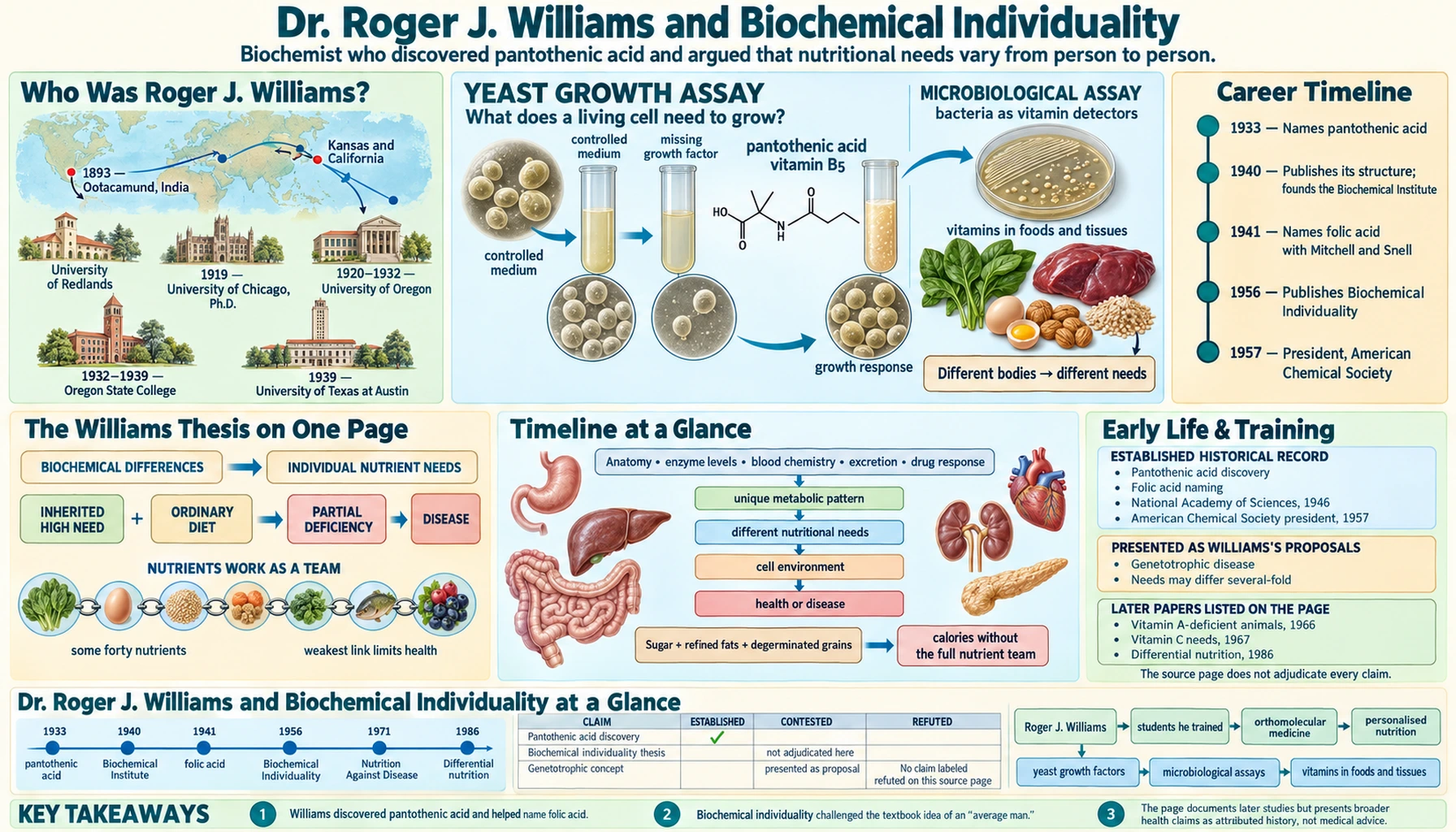
Roger John Williams (1893–1988) was the University of Texas biochemist who discovered pantothenic acid (vitamin B5), named folic acid, founded the Clayton Foundation Biochemical Institute, served as president of the American Chemical Society, and spent the second half of his career arguing that every human being is biochemically unique. His 1956 book Biochemical Individuality put that argument at the centre of nutrition: the “average man” of the textbooks does not exist, nutritional needs differ from person to person, sometimes several-fold, and much disease begins when the cells of a particular body are not given everything that body needs.
This hub gathers eight deep-dive articles on his work, drawn from his own papers and books, and presented as he stated it. Start with the discovery that made his name, or with the idea he considered his most important.
Table of Contents
Deep-Dive Articles
1. Life and Career
Born in India to missionary parents, a Chicago Ph.D. on what yeast needs to grow, the Oregon years, the move to Texas, the Clayton institute, the ACS presidency, his brother Robert and thiamine — with a full timeline.
Read the deep dive →2. How He Discovered Pantothenic Acid (Vitamin B5)
The yeast “bios” problem, the 1933 naming from the Greek for “from everywhere,” concentration from liver, structure and synthesis in 1940, coenzyme A, and the 1958 mouse longevity study.
Read the deep dive →3. Folic Acid and the Clayton Institute
The Texas laboratory that used bacteria as vitamin detectors: four tons of spinach and the naming of folic acid in 1941, biotin and egg-white injury, inositol, and the institute’s record of discoveries.
Read the deep dive →4. Biochemical Individuality (1956)
The book he considered his most important: stomachs, hearts and glands that differ in shape and size, blood and enzyme levels unique to each person, excretion patterns, drug and taste responses, and nutritional needs that vary several-fold.
Read the deep dive →5. The Genetotrophic Concept of Disease
His 1949–1950 idea that a disease can arise when an inherited, unusually high need for a nutrient meets an ordinary diet — and the animal experiments on individual needs for vitamins A and C behind it.
Read the deep dive →6. Alcoholism and Nutrition
Alcoholism as a disease with a biochemical basis: the 1947 hypothesis, rat experiments in which better diets lowered drinking, glutamine, the brain-glucose idea, and three books from 1951 to 1981.
Read the deep dive →7. Nutrition Against Disease (1971)
Disease begins in poorly nourished cells: the nutritional chain of some forty nutrients working as a team, enriched bread and the “trophic” value of foods, the cataract study, and supplements as insurance.
Read the deep dive →8. Books and Legacy
Every book he wrote, from his 1927 chemistry textbook to Rethinking Education (1986), the words he coined, the students he trained, and his influence on orthomolecular medicine and personalised nutrition.
Read the deep dive →Who Was Roger J. Williams?
Williams was born on August 14, 1893, in Ootacamund, India, where his parents were missionaries, and grew up in Kansas and California. He studied at the University of Redlands and took his Ph.D. at the University of Chicago in 1919 with a thesis on the vitamin requirement of yeast. That question — what does a living cell need to grow? — drove his work for the next two decades at the University of Oregon (1920–1932) and Oregon State College (1932–1939), and led him to the growth factor he named pantothenic acid in 1933.
In 1939 he moved to the University of Texas at Austin, and in 1940 he founded what became the Clayton Foundation Biochemical Institute, which he directed until 1963. Its workers concentrated and named folic acid, studied biotin and inositol, and built the microbiological assays that measured vitamins in foods and tissues. He was elected to the National Academy of Sciences in 1946 and served as president of the American Chemical Society in 1957. His older brother, Robert R. Williams, was the chemist who synthesized thiamine (vitamin B1).
From the late 1940s Williams turned from yeast to people. He studied the individual “metabolic patterns” of students, alcoholics and patients, proposed the genetotrophic concept of disease, and wrote a series of books for the public — Free and Unequal, Biochemical Individuality, Nutrition in a Nutshell, You Are Extraordinary, Nutrition Against Disease and others. He remained active into his nineties; his last paper and his last book appeared in 1986. He died in Austin on February 20, 1988.
The Williams Thesis on One Page
- Every person is biochemically distinctive. Anatomy, enzyme levels, blood chemistry, excretion patterns and responses to drugs differ between healthy people, often by large factors. The “average man” is a statistical fiction.
- Nutritional needs are individual. Because body chemistry differs, so does the amount of each nutrient a person needs. A diet adequate for one person may leave another short.
- Inherited high needs can cause disease (the genetotrophic concept). When an individual’s genetically raised need for a nutrient is not met, the resulting partial deficiency can show up as disease.
- Nutrients work as a team. Cells need some forty nutrients together; the weakest link in this nutritional chain limits health, so a single nutrient rarely works alone.
- Disease often begins in the cells’ environment. Improving the nourishment that reaches cells and tissues is a way to prevent disease, which Williams called environmental prevention.
- Refined foods dilute the diet. Sugar, refined fats and degerminated grains supply calories without the full team of nutrients.
- Medicine should take nutrition seriously. He argued that medical education neglected nutrition and called for a “renaissance of nutritional science.”
Timeline at a Glance
- 1893 — Born August 14 in Ootacamund, India.
- 1919 — Ph.D., University of Chicago: the vitamin requirement of yeast.
- 1920–1939 — University of Oregon, then Oregon State College; yeast growth factors.
- 1933 — Names pantothenic acid, a growth determinant of universal biological occurrence.
- 1938–1940 — Concentrates it from liver, calls it a vitamin, and publishes its structure.
- 1940 — Founds the Biochemical Institute at the University of Texas (Clayton Foundation).
- 1941 — With Mitchell and Snell, concentrates and names folic acid from spinach.
- 1946 — Elected to the National Academy of Sciences.
- 1949–1950 — Proposes the genetotrophic concept of disease.
- 1956 — Publishes Biochemical Individuality.
- 1957 — President of the American Chemical Society.
- 1971 — Publishes Nutrition Against Disease.
- 1986 — Last paper (“Differential nutrition”) and last book.
- 1988 — Dies February 20 in Austin, Texas.
Key Research Papers
- Williams RJ, Lyman CM, Goodyear GH, Truesdail JH, Holaday D. “Pantothenic acid,” a growth determinant of universal biological occurrence. J Am Chem Soc. 1933;55:2912-27. DOI: 10.1021/ja01334a049. — doi:10.1021/ja01334a049
- Williams RJ. Pantothenic acid—a vitamin. Science. 1939;89:486. — PubMed PMID: 17811089
- Williams RJ, Major RT. The structure of pantothenic acid. Science. 1940;91:246. — PubMed PMID: 17831185
- Mitchell HK, Snell EE, Williams RJ. The concentration of “folic acid”. J Am Chem Soc. 1941;63:2284. DOI: 10.1021/ja01853a512. — doi:10.1021/ja01853a512
- Williams RJ, Berry LJ, Beerstecher E. Individual metabolic patterns, alcoholism, genetotrophic diseases. Proc Natl Acad Sci USA. 1949;35:265-71. — PubMed PMID: 16588890
- Williams RJ, Beerstecher E Jr, Berry LJ. The concept of genetotrophic disease. Lancet. 1950;1:287-9. — PubMed PMID: 15405089
- Williams RJ. Early experiences with pantothenic acid; a retrospect. Nutr Rev. 1954;12:65-8. — PubMed PMID: 13133195
- Williams RJ, Pelton RB. Individuality in nutrition: effects of vitamin A-deficient and other deficient diets on experimental animals. Proc Natl Acad Sci USA. 1966;55:126-34. — PubMed PMID: 5220861
- Williams RJ, Deason G. Individuality in vitamin C needs. Proc Natl Acad Sci USA. 1967;57:1638-41. — PubMed PMID: 5231398
- Williams RJ, Heffley JD, Yew ML, Bode CW. A renaissance of nutritional science is imminent. Perspect Biol Med. 1973;17:1-15. — PubMed PMID: 4751533
- Davis DR, Williams RJ. Potentially useful criteria for judging nutritional adequacy. Am J Clin Nutr. 1976;29:710-5. — PubMed PMID: 937225
- Williams RJ, Davis DR. Differential nutrition—a new orientation from which to approach the problems of human nutrition. Perspect Biol Med. 1986;29:199-202. — PubMed PMID: 3951955