How Roger J. Williams Discovered Pantothenic Acid (Vitamin B5)
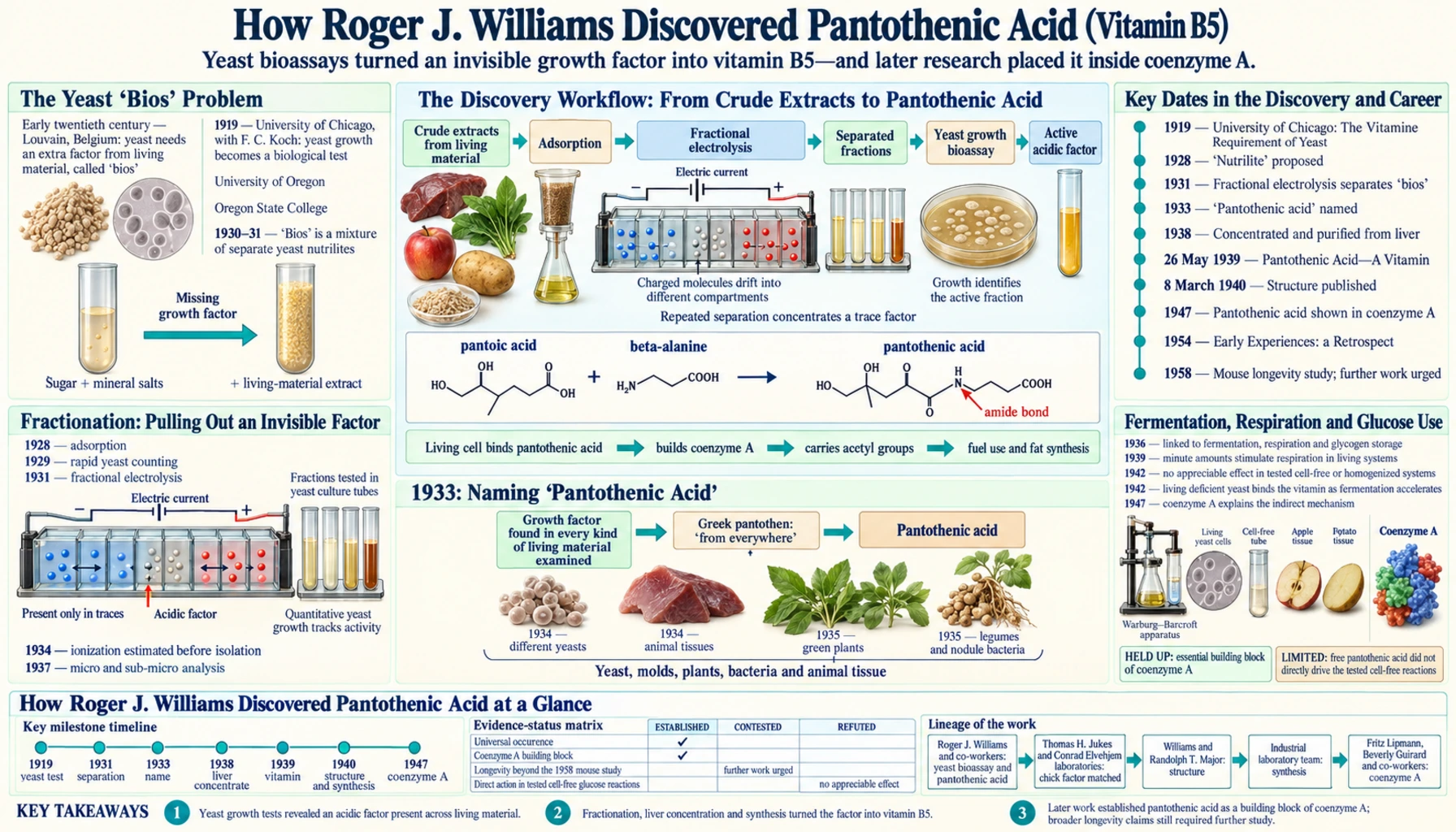
Pantothenic acid, the nutrient now sold as vitamin B5, was not found by studying a sick patient or a sick animal. Roger J. Williams found it by asking a much humbler question: what does a single yeast cell need in order to grow? He spent roughly two decades on that question, first at the University of Chicago, then at the University of Oregon and Oregon State College, and the answer turned out to be a substance present in practically every living thing he tested.
This page follows the discovery step by step, as Williams and his co-workers reported it in their own papers: the old puzzle of yeast “bios,” the electrical and chemical tricks he invented to pull an invisible factor out of crude extracts, the 1933 paper that gave pantothenic acid its name, the 1938 concentration from liver, the 1939 announcement that it was a vitamin, the 1940 structure and synthesis, and what came later — coenzyme A, Williams’s 1954 look back, his 1958 mouse longevity experiment, and what he said about pantothenic acid and people.
Table of Contents
- The Yeast “Bios” Problem
- Fractionation: Pulling Out an Invisible Factor
- 1933: Naming “Pantothenic Acid”
- Fermentation, Respiration and Glucose Use
- Concentration From Liver, 1938
- “Pantothenic Acid — A Vitamin,” 1939
- Structure and Synthesis, 1940
- Coenzyme A: Why Every Cell Needs It
- Williams Looks Back, 1954
- The 1958 Mouse Longevity Study
- Williams on Human Needs and Food Sources
- Key Research Papers
- Connections
- Featured Videos
1. The Yeast “Bios” Problem
At the beginning of the twentieth century, E. Wildiers, working at Louvain in Belgium, noticed that yeast would not grow well in a simple solution of sugar and mineral salts unless something extra from living material was added. He called that unknown something “bios.” For the next thirty years bios was a standing puzzle: everyone could show that it existed, but nobody could say what it was. (In 1938 Williams wrote a short note in Science titled “M. Ide, the Discoverer of ‘Bios,’” crediting M. Ide with the original discovery.)
Williams came to the problem through his family. His oldest brother, Robert R. Williams — who later isolated and synthesized vitamin B1 and named it thiamine — had seen deficiency diseases at first hand while growing up in India and encouraged Roger toward vitamin work. Roger’s 1919 University of Chicago Ph.D. thesis, done with F. C. Koch, was titled The Vitamine Requirement of Yeast, and his first paper that year described yeast growth as “a simple biological test for vitamine.”
The key to everything that followed was an idea his National Academy of Sciences biographers single out: Williams believed in the universality of the basic biochemistry of all living organisms. If a yeast cell could not make a substance and needed it from outside, the same substance was probably essential to animals and people too. According to that memoir, leading biochemists of the day urged him to switch to animal experiments; he kept working with yeast, and that persistence is what led to pantothenic acid.
- Why yeast? Yeast grows in hours, not weeks. Thousands of tests could be run on extracts for the price of a few animal experiments, and the amount of growth could be measured precisely.
- “Nutrilites.” Williams needed a word, like “vitamin,” that would cover growth factors for yeasts, molds and plants as well as animals. In 1928 he proposed “nutrilite” in Science — a word, the memoir records, that came to him in a dream.
- Bios is not one thing. By 1930–31 Williams and his students had evidence that “bios” was a mixture of several separate yeast nutrilites, and their 1931 paper on “The Further Fractionation of Yeast Nutrilites and Their Relationship to Vitamin B and Wildiers’ ‘Bios’” set out to separate them.
2. Fractionation: Pulling Out an Invisible Factor
The difficulty was scale. The factor Williams was chasing was present in only traces, mixed with thousands of other substances, and the only way to detect it was to see whether a fraction made yeast grow. So Williams’s laboratory became a workshop for new separation and measurement methods. His published papers from these years show the toolkit taking shape:
- Counting the yeast (1929). With E. D. McAlister and R. R. Roehm, Williams published “A Rapid and Accurate Method for Determining the Quantity of Yeast or Other Microorganisms in a Suspension” — the measuring stick for every later growth test.
- Adsorption (1928). With D. P. Grettie he studied how organic compounds stick to hydrous oxides and fuller’s earth, one of the classic ways to strip some substances out of an extract while leaving others behind.
- Fractional electrolysis (1931). With J. H. Truesdail he published “The Use of Fractional Electrolysis in the Fractionation of the ‘Bios’ of Wildiers.” An electric current was passed through a tank divided into many compartments; molecules drifted according to their electrical charge and collected in different cells. Time magazine reported the Oregon experiment in April 1931.
- An acid, with a measurable charge (1934). Using the same technique, Williams and R. Moser reported “The Approximate Ionization Constant of Pantothenic Acid as Determined by Fractional Electrolysis” — they could estimate how strong an acid the factor was before they had ever held it pure.
- Fractional electrical transport (1935). Williams described the general method in the Journal of Biological Chemistry as “Fractional Electrical Transport as a Tool in Biochemical Research.”
- Micro-analysis (1937). Because the amounts were so tiny, Williams and co-workers developed “Organic Oxidation Equivalent Analysis,” including micro and “sub-micro” methods, to learn something about the chemistry of samples too small to weigh comfortably.
The result was that Williams knew a great deal about his factor — that it was an acid, roughly how strongly it ionized, which separations it survived — years before it could be isolated. The 1932 study with J. M. Honn on the role of nutrilites in molds and other fungi, published in Plant Physiology, belongs to this same push to map what different microorganisms needed.
3. 1933: Naming “Pantothenic Acid”
In 1932 Williams, C. M. Lyman, G. H. Goodyear and J. H. Truesdail asked a pointed question in the title of a short Journal of the American Chemical Society note: “Is the Nutrilite for ‘Gebrüder Mayer’ Yeast of Universal Biological Importance?” The acidic factor needed by that strain of yeast seemed to turn up wherever they looked.
The full answer came in 1933. Williams, Lyman, Goodyear, Truesdail and Duncan Holaday published “‘Pantothenic Acid,’ a Growth Determinant of Universal Biological Occurrence” (J. Am. Chem. Soc. 55:2912–2927). The name came from the Greek pantothen — “from all sides,” usually rendered “from everywhere” — because the substance was found in material from every kind of living thing they examined. Williams’s own bibliography records that the paper was later named a “Citation Classic” by Current Contents (1990), with a commentary by Williams.
The NAS memoir notes that coining words was one of Williams’s gifts: after pantothenic acid he and his colleagues also named folic acid (Latin folium, leaf) and avidin (Latin avidus, to covet).
Testing “universal”
A claim of universal occurrence invites a test, and the Oregon group spent the next few years supplying them:
- Different yeasts (1934). Williams and D. H. Saunders compared the effects of inositol, crystalline vitamin B1 and pantothenic acid on different yeast strains (Biochemical Journal).
- Animal tissues (1934). E. Rohrmann, G. E. Burget and Williams reported the “Pantothenic Acid Content of Animal Tissues.”
- Green plants (1935). Williams and Rohrmann reported pantothenic acid as a nutrilite for green plants (Plant Physiology).
- Legumes and their bacteria (1935). C. H. McBurney, W. B. Bollen and Williams reported on pantothenic acid and the nodule bacteria–legume partnership in the Proceedings of the National Academy of Sciences.
Yeast, molds, plants, bacteria and animal tissue: by the mid-1930s the “from everywhere” name had been earned.
4. Fermentation, Respiration and Glucose Use
If pantothenic acid was in every cell, it had to be doing something basic. Williams’s group went looking for what that was.
- 1936 — fermentation, respiration and glycogen. Williams, W. A. Mosher and E. Rohrmann, at the Chemical Laboratory of Oregon State College, published “The Importance of ‘Pantothenic Acid’ in Fermentation, Respiration and Glycogen Storage” in the Biochemical Journal — tying the factor to the cell’s energy processes and its storage of sugar as glycogen.
- 1939 — breathing rate of cells. E. F. Pratt and Williams measured oxygen use with the Warburg–Barcroft apparatus. In the paper’s own summary, two yeasts in three different media were “strikingly stimulated in their respiration by minute amounts of pantothenic acid.” Nine other vitamins and biologically important compounds had a lesser effect or none; thiamin was the most effective of them, and its action was different from, and in some ways antagonistic to, that of pantothenic acid. Pantothenic acid also stimulated fermentation by dialyzed yeast juice and the respiration of apple and potato tissue, with indications of a similar effect on certain animal tissues.
- 1942 — a clue that it works indirectly. At the University of Texas, P. C. Teague and Williams tested whether added pantothenic acid sped up glucose fermentation by yeast juice, the phosphorylation of glucose, the breakdown of pyruvic acid, or glycolysis in tissue from deficient chicks. In each of these cell-free or homogenized systems it had no appreciable effect — yet its acceleration of fermentation by living, deficient yeast cells was accompanied by a “binding” of pantothenic acid by the cells.
That 1942 result is worth pausing on. Living cells took pantothenic acid in and held on to it, and only then did it help them; free pantothenic acid dropped into a test tube of enzymes did nothing. Read with hindsight, this is exactly what you would expect if the cell first has to build the vitamin into something larger — which is what the discovery of coenzyme A later showed (see section 8).
5. Concentration From Liver, 1938
Naming a substance is not the same as having it in a bottle. To learn its chemical structure Williams needed it far purer than any yeast extract, and he turned to liver, one of the richest animal sources.
The result was “Pantothenic Acid. II. Its Concentration and Purification from Liver,” by Williams, J. H. Truesdail, H. H. Weinstock Jr., E. Rohrmann, C. M. Lyman and C. H. McBurney (J. Am. Chem. Soc. 60:2719–2723, 1938). The paper was reprinted, in part, as a “Nutrition Classic” in Nutrition Reviews in 1979.
The liver work gave the group enough concentrated material to begin real chemistry. Their next papers in the same series show the molecule being taken apart:
- Pantothenic Acid. III (1939) — “Analysis and Determination of Constituent Groups.”
- Pantothenic Acid. IV (1939) — “Formation of Beta-Alanine by Cleavage.” Splitting the molecule released the small amino acid beta-alanine. The group had already reported a link between “Beta-Alanine and ‘Bios’” in 1936.
- Pantothenic Acid. V (1940) — “Evidence for Structure of Non-beta-Alanine Portion.”
Every step of this purification was followed with the quantitative yeast-growth tests Williams had developed — the methodology his NAS biographers single out as the foundation of his early work.
6. “Pantothenic Acid — A Vitamin,” 1939
Through the 1930s pantothenic acid was, officially, a yeast nutrilite. Separately, poultry researchers had been chasing a factor that prevented a scaly skin disease (dermatitis) in chicks, often called the chick “filtrate” or antidermatitis factor. Around 1939 the laboratories of Thomas H. Jukes and of Conrad Elvehjem showed that the chick factor and pantothenic acid were the same substance.
On 26 May 1939 Williams published a one-page note in Science whose title said it plainly: “Pantothenic Acid — A Vitamin.” The factor first found as a requirement of yeast was now recognized as a vitamin for animals as well — just what Williams’s belief in the unity of biochemistry had predicted.
Williams drew a broader lesson from it. In a 1941 Science article, “The Importance of Microorganisms in Vitamin Research,” he argued for the microbial approach that had found pantothenic acid. His NAS biographers credit this work, and that of one other laboratory, with giving microbial systems a leading role in discovering new nutritional factors and in the growth of biochemical genetics and the study of intermediary metabolism. Williams had also shown in 1937 that yeast and other fungi could be used to test for vitamin B1.
7. Structure and Synthesis, 1940
On 8 March 1940 Williams and Randolph T. Major published “The Structure of Pantothenic Acid” in Science. The molecule turned out to be built from two pieces joined by an amide bond: beta-alanine, the fragment released in the 1939 cleavage work, and a small hydroxy acid now called pantoic acid.
The same year brought synthesis:
- Williams’s group published “Pantothenic Acid. VII. Partial and Total Synthesis Studies” (Williams, H. K. Mitchell, H. H. Weinstock Jr. and E. E. Snell, 1940), and a study of the biological activity of a related compound, hydroxypantothenic acid.
- An industrial laboratory team — Stiller, Harris, Finkelstein, Keresztesy and Karl Folkers — reported a total synthesis of pure pantothenic acid in 1940.
Synthesis meant the vitamin no longer had to be wrung out of liver; it could be manufactured. According to the NAS memoir, patents on its synthesis were assigned to the Research Corporation, and the royalties, which ran to many hundreds of thousands of dollars a year, were largely ploughed back into scientific research. Williams, the memoir says, felt it was fortunate when scientists could concentrate on their work and forget about “the million dollars” it might yield.
In 1941, for the discovery of pantothenic acid, Williams received the Mead Johnson Award of the American Institute of Nutrition and the Chandler Medal of Columbia University. By then he had left Oregon: in 1939 he joined the University of Texas at Austin, where in 1940, with support from Benjamin Clayton and the Clayton Foundation, he founded the Biochemical Institute (see Folic Acid and the Clayton Foundation Biochemical Institute). His 1940 Science note “Vitamin Study at the University of Texas” described the new work there.
8. Coenzyme A: Why Every Cell Needs It
Williams had shown that pantothenic acid was everywhere and that cells needed it for fermentation and respiration. The final explanation of why came from another laboratory.
At Massachusetts General Hospital in Boston, the German-born biochemist Fritz Lipmann was studying how cells carry out acetylation — attaching small two-carbon acetyl groups to other molecules. In the mid-1940s he found a heat-stable helper molecule needed for these reactions and named it coenzyme A (“A” for acetylation). In 1947 Lipmann and co-workers, including Beverly Guirard, showed that pantothenic acid is a building block of coenzyme A. (Guirard also published with Williams and Esmond Snell at Texas.) Lipmann received the 1953 Nobel Prize in Physiology or Medicine “for his discovery of co-enzyme A and its importance for intermediary metabolism,” sharing the prize that year with Hans Krebs, who was honored for the citric acid cycle.
Coenzyme A explained the whole story:
- “From everywhere” — every living cell burns fuel and builds fats, so every cell needs coenzyme A, and therefore pantothenic acid or the ability to make it.
- Fermentation and respiration — coenzyme A carries the two-carbon pieces from sugar breakdown into the cell’s energy cycle, which is why Williams saw yeast breathe and ferment faster with minute amounts of the vitamin.
- The 1942 puzzle — free pantothenic acid did nothing in cell-free systems because enzymes use it only after a living cell has built it into coenzyme A.
For a plain-language look at the chemistry, see Vitamin B5 and Coenzyme A Synthesis, Energy and Fat Metabolism, and the animated glycolysis and Krebs cycle page.
9. Williams Looks Back, 1954
In March 1954, writing as director of the Biochemical Institute at the University of Texas, Williams published “Early Experiences with Pantothenic Acid — a Retrospect” in Nutrition Reviews (12:65–68). It is his own account of the two decades of work described on this page, written once the coenzyme A story had made the importance of his yeast factor plain.
It was one of several summaries Williams wrote of the vitamin he had named. His own bibliography lists, among others:
- “Pantothenic Acid,” Enzymologia (1941), and a short Science note titled “Pantothen” (1941);
- “Pantothenic Acid and the Microbiological Approach to the Study of Vitamins,” in The Biological Action of the Vitamins (University of Chicago Press, 1942);
- “The Chemistry and Biochemistry of Pantothenic Acid,” Advances in Enzymology, vol. 3 (1943);
- “Pantothenic Acid,” with W. Wenner, in the Encyclopedia of Chemical Technology (1952);
- “Pantothenic Acid,” in Comprehensive Biochemistry, vol. 11 (1963);
- The Biochemistry of B Vitamins (1950), a book written with R. E. Eakin, E. Beerstecher and W. Shive.
His NAS biographers add a telling note: although many people would remember him as the discoverer of pantothenic acid, Williams himself felt that his most important and far-reaching contributions were his books on human individuality — The Human Frontier, Free and Unequal and Biochemical Individuality. The pantothenic acid years taught him how widely living things share the same chemistry; his later work asked how much individuals differ within it.
10. The 1958 Mouse Longevity Study
Twenty-five years after naming the vitamin, Williams returned to it with a bold question: could extra pantothenic acid lengthen life? The study, by Richard B. Pelton and Williams of the Clayton Foundation Biochemical Institute, appeared as “Effect of Pantothenic Acid on the Longevity of Mice” in the Proceedings of the Society for Experimental Biology and Medicine (1958).
The idea came from bees
The paper explains the reasoning. Worker bees and queen bees differ enormously in life span, and the queen is raised on royal jelly. Pelton and Williams wrote that this disparity suggested pantothenic acid, “the most conspicuous nutritional constituent of royal jelly,” might prolong life in other species too. A second hint came from T. H. Gardner’s report (1948) that the vitamin acted as an anti-ageing factor in fruit flies (Drosophila).
What they did
- Seventy-four C-57 black mice, aged 4–5 weeks, were housed 6 or 7 to a cage by sex, and all ate standard laboratory pellets throughout.
- The experimental group — 13 males and 20 females, 33 mice — received approximately 300 micrograms of calcium pantothenate per day, added to the drinking water and adjusted each week to how much the mice drank.
- The control group — 21 males and 20 females, 41 mice — received no supplement.
What they reported
- The mean life span of the supplemented mice was 653.1 days, against 549.8 days for the controls. The paper gives the statistical difference as P = 0.05 by t test and 0.01 by U test.
- Supplemented males lived a mean of 660.4 days versus 559.0 for control males (18% longer); supplemented females 648.4 days versus 540.2 for control females (20% longer).
- After about 250 days, the supplemented mice of both sexes gained and kept slightly more weight than the controls. The authors called it speculative whether that meant better general health or a prolonged pre-senile period.
Their conclusion, in their words: the results “seem sufficiently significant to suggest further work with other species.”
11. Williams on Human Needs and Food Sources
Once pantothenic acid was known to be a vitamin, Williams pressed the question of what it meant for people. His own bibliography shows him at it early: in 1940 he was a co-author, with Tom D. Spies, S. R. Stanbery, Thomas H. Jukes and S. H. Babcock, of “Pantothenic Acid in Human Nutrition” in the Journal of the American Medical Association, and in 1942 he published “The Approximate Vitamin Requirements of Human Beings” in the same journal.
What Williams argued
- Measure what is really in tissues and foods. At Texas his institute published assays of B vitamins — pantothenic acid among them — in normal human tissues, in milk from different species and in foods (1942), along with “Losses of B Vitamins Due to Cooking of Foods” (V. H. Cheldelin, A. M. Woods and Williams, 1943). A 1942 Science report by A. Taylor, M. A. Pollack and Williams described “uniformities” in the B-vitamin content of malignant tumors.
- Needs differ from person to person. The central claim of Williams’s later career, set out in Biochemical Individuality (1956), was that inborn biochemical differences between individuals are widespread and often large, so that an average requirement does not describe any particular person. He applied this to nutrition generally (see Biochemical Individuality).
- A possible role in ageing. His 1958 mouse study, above, rested on the reasoning that the pantothenic acid of royal jelly might be connected to the long life of queen bees, and he called the results significant enough to pursue in other species.
- Whole diets, not food tables. In 1971 and 1973 PNAS papers, Williams and colleagues argued that food composition tables, which list only a handful of nutrients, can be “woefully misleading,” and that a food’s “trophic” value — its ability to supply all the raw materials cells need — should be tested biologically. In their rat feeding trials, “Eggs proved to be a remarkably complete food.”
Williams’s fuller case for generous, individually tuned nutrition is covered on Nutrition Against Disease (1971) and Cellular Nutrition. For today’s official intake figures and supplement forms, see Vitamin B5 Dosage and Supplement Forms.
Where pantothenic acid is found
True to its name, pantothenic acid is in almost every whole food, so a varied diet supplies it from many directions. Williams himself first concentrated it from liver, and the 1958 paper singled out royal jelly. The site’s Vitamin B5 food sources table, built from USDA data, ranks beef liver far above everything else, followed by foods including these:
- Beef liver, chicken liver and other organ meats
- Shiitake mushrooms
- Eggs
- Avocado
- Sunflower seeds and peanuts
- Trout, chicken and pork
- Sweet potato, lentils and brown rice (brown rice keeps more than white rice, which loses B5 in milling)
- Nutritional yeast — fitting, given where the story began
The rest of the site’s vitamin B5 library: the Vitamin B5 overview, History and Discovery, Benefits Deep Dive, Deficiency, Toxicity, Testing, Adrenal Function and Wound Healing.
Key Research Papers
- Williams RJ, Honn JM. Role of “nutrilites” in the nutrition of molds and other fungi. Plant Physiol. 1932;7:629-41. — PubMed PMID: 16652799
- Williams RJ, Lyman CM, Goodyear GH, Truesdail JH, Holaday D. “Pantothenic acid,” a growth determinant of universal biological occurrence. J Am Chem Soc. 1933;55:2912-27. DOI: 10.1021/ja01334a049. — doi:10.1021/ja01334a049
- Williams RJ, Saunders DH. The effects of inositol, crystalline vitamin B1 and “pantothenic acid” on the growth of different strains of yeast. Biochem J. 1934;28:1887-93. — PubMed PMID: 16745586
- Williams RJ, Rohrman E. Pantothenic acid as a nutrilite for green plants. Plant Physiol. 1935;10:559-63. — PubMed PMID: 16653297
- Williams RJ, Mosher WA, Rohrman E. The importance of “pantothenic acid” in fermentation, respiration and glycogen storage. Biochem J. 1936;30:2036-9. — PubMed PMID: 16746260
- Williams RJ. The use of yeast or other fungi for vitamin B1 tests. Science. 1937;86:349-50. — PubMed PMID: 17751233
- Williams RJ, Truesdail JH, Weinstock HH Jr, Rohrmann E, Lyman CM, McBurney CH. Pantothenic acid. II. Its concentration and purification from liver. J Am Chem Soc. 1938;60:2719-23. DOI: 10.1021/ja01278a051. — doi:10.1021/ja01278a051
- Williams RJ, Truesdail JH, Weinstock HH Jr, Rohrmann E, Lyman CM, McBurney CH. Nutrition classics: Pantothenic acid. II. Its concentration and purification from liver (reprint). Nutr Rev. 1979;37:15-8. — PubMed PMID: 372861
- Pratt EF, Williams RJ. The effects of pantothenic acid on respiratory activity. J Gen Physiol. 1939;22:637-47. — PubMed PMID: 19873124
- Williams RJ. Pantothenic acid—a vitamin. Science. 1939;89:486. — PubMed PMID: 17811089
- Williams RJ, Major RT. The structure of pantothenic acid. Science. 1940;91:246. — PubMed PMID: 17831185
- Williams RJ. Vitamin study at the University of Texas. Science. 1940;92:579. — PubMed PMID: 17757706
- Williams RJ. The importance of microorganisms in vitamin research. Science. 1941;93:412-4. — PubMed PMID: 17842471
- Teague PC, Williams RJ. Pantothenic acid and the utilization of glucose by living and cell-free systems. J Gen Physiol. 1942;25:777-83. — PubMed PMID: 19873313
- Taylor A, Pollack MA, Williams RJ. Uniformities in the content of B vitamins in malignant neoplasms. Science. 1942;96:322-3. — PubMed PMID: 17751370
- Williams RJ. Early experiences with pantothenic acid; a retrospect. Nutr Rev. 1954;12:65-8. — PubMed PMID: 13133195
- Pelton RB, Williams RJ. Effect of pantothenic acid on the longevity of mice. Proc Soc Exp Biol Med. 1958;99:632-3. — PubMed PMID: 13614445
- Williams RJ, Heffley JD, Bode CW. The nutritive value of single foods. Proc Natl Acad Sci USA. 1971;68:2361-4. — PubMed PMID: 5289871
- Williams RJ, Heffley JD, Yew ML, Bode CW. The “trophic” value of foods. Proc Natl Acad Sci USA. 1973;70:710-3. — PubMed PMID: 4514984
Biographical details on this page are drawn from Davis DR, Hackert ML, Reed LJ. Roger J. Williams, 1893–1988: A Biographical Memoir. National Academy of Sciences; 2008, and from the list of Williams’s articles kept by the University of Texas Biochemical Institute. Papers named in the text but not listed above are cited from that list.
PubMed Topic Searches
- https://pubmed.ncbi.nlm.nih.gov/?term=pantothenic+acid+history
- https://pubmed.ncbi.nlm.nih.gov/?term=pantothenic+acid+yeast+growth
- https://pubmed.ncbi.nlm.nih.gov/?term=pantothenic+acid+coenzyme+A+biosynthesis
- https://pubmed.ncbi.nlm.nih.gov/?term=pantothenic+acid+longevity
- https://pubmed.ncbi.nlm.nih.gov/?term=royal+jelly+pantothenic+acid
Connections
- Dr. Roger J. Williams and Biochemical Individuality
- Roger J. Williams: Life and Career
- Folic Acid and the Clayton Institute
- Biochemical Individuality (1956)
- Vitamin B5 (Pantothenic Acid)
- Vitamin B5: History and Discovery
- Vitamin B5 Food Sources
- Coenzyme A Synthesis
- Vitamin B1 (Thiamine)
- Glycolysis and the Krebs Cycle
- Linus Pauling
- Nutrition and Orthomolecular Pioneers