Biochemical Individuality (1956)
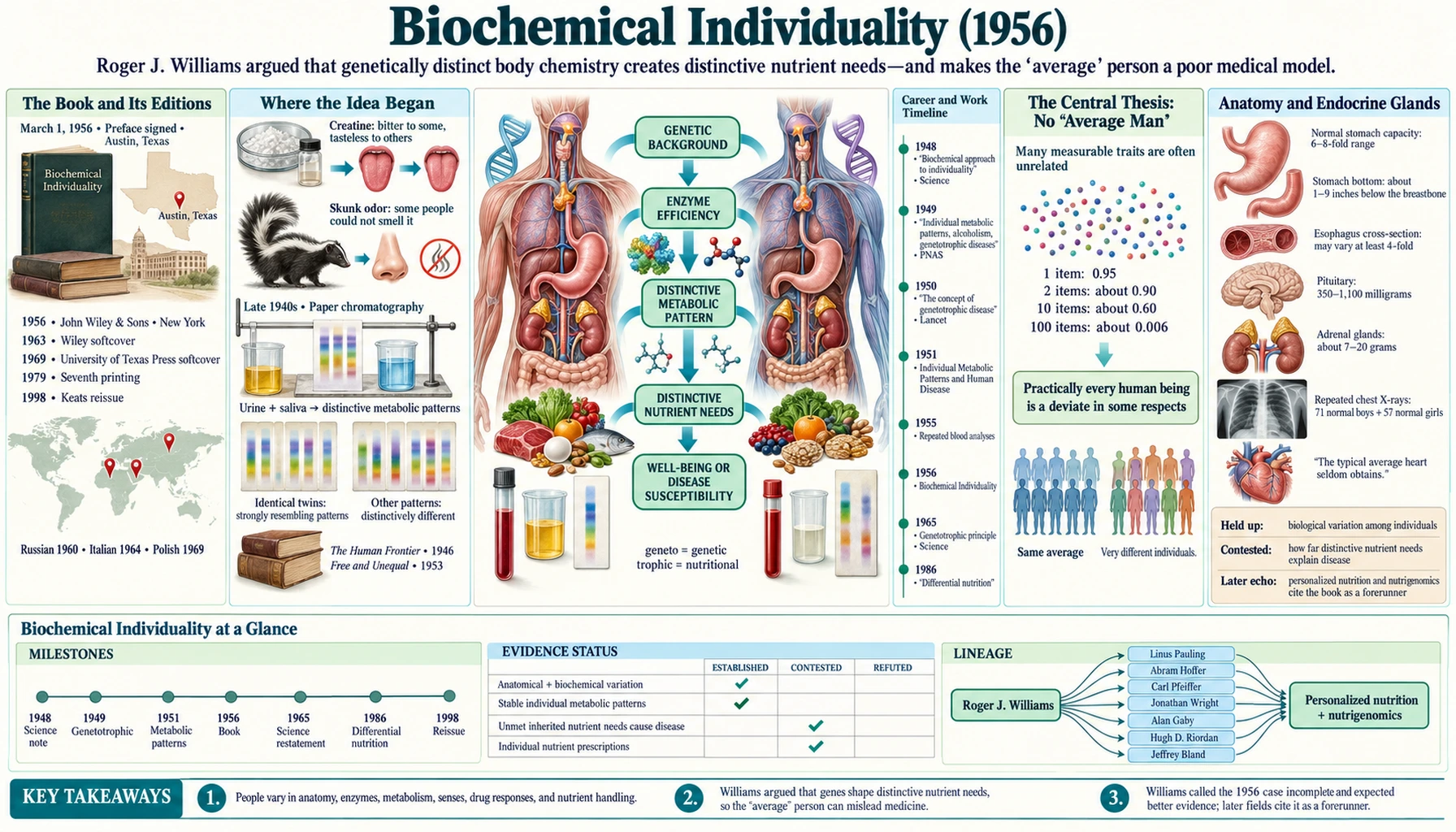
In 1956 Roger J. Williams, the University of Texas biochemist who had discovered pantothenic acid (vitamin B5), published Biochemical Individuality: The Basis for the Genetotrophic Concept. Its argument is simple to state and, Williams believed, enormous in its consequences: the “average” human being of textbooks does not exist. Each real person, he wrote, is built differently inside, runs on a distinctive body chemistry, and therefore has nutritional needs of his or her own.
This page walks through the book in plain language: how it came to be written, its central thesis, the evidence Williams gathered chapter by chapter — stomachs and hearts, glands, blood, enzymes, urine patterns from his own Texas laboratory, drugs, pain and taste, and nutrient needs that differ several-fold — his “genetotrophic” explanation of why one person falls ill on a diet another tolerates, the implications he drew for medicine and nutrition, and the companion books and papers that carried the idea forward. Quotations come from the book itself and from the preface and book listings published by the University of Texas Biochemical Institute.
Table of Contents
- The Book and Its Editions
- Where the Idea Began
- The Central Thesis: No “Average Man”
- Anatomy and Endocrine Glands
- Blood Composition and Enzyme Levels
- Excretion Patterns: The Texas Metabolic-Pattern Studies
- Drugs, Pain and Taste
- Nutritional Needs That Vary Several-Fold
- The Genetotrophic Principle and Disease
- Implications for Medicine and Nutrition
- Companion Books, Later Papers and Legacy
- Key Research Papers
- Connections
- Featured Videos
1. The Book and Its Editions
The full title is Biochemical Individuality: The Basis for the Genetotrophic Concept. Williams signed its preface in Austin, Texas, on March 1, 1956, and the first edition was published that year in New York by John Wiley & Sons. According to the book list kept by the University of Texas Biochemical Institute, Wiley issued a softcover in 1963; the University of Texas Press published a softcover in 1969 that reached its seventh printing in 1979; and Keats Publishing reissued it in 1998 in softcover, with a new introduction by Jeffrey Bland, a new afterword by Donald R. Davis, Davis’s 1988 “In Memoriam” for Williams, and an expanded index. The book was translated into Russian (1960), Italian (1964) and Polish (1969).
The 1956 text runs to fourteen chapters:
- Biochemical Variation; Its Significance in Biology and Medicine
- Genetic Basis of Biochemical Individuality
- Anatomical Variations — Significance
- Individuality in Composition
- Individual Enzymic Patterns
- Endocrine Activities
- Excretion Patterns
- Pharmacological Manifestations
- Miscellaneous Evidences of Individuality
- Individuality in Nutrition
- The Genetotrophic Approach
- Implications for the Biological Sciences
- Implications for Medical and Dental Research
- Implications for Advance in Psychiatry
The order is the argument: first the claim that variation matters, then the evidence layer by layer from the body’s structure down to its chemistry, then nutrition, and finally what Williams believed it all meant.
2. Where the Idea Began
In the preface Williams traced his interest to two small laboratory observations made more than twenty years earlier. Creatine had been described in the chemical reference literature as a bitter, biting substance, yet to many people it was, in his words, “absolutely tasteless.” About the same time he noticed that some otherwise normal people could not smell skunk odor at all.
By the mid-1940s he had become convinced that the differences between human beings, as well as their similarities, “needed to be brought to light.” He first set the idea out for general readers in The Human Frontier (1946) and Free and Unequal (1953). At first he regarded it as a side interest, “considerably divergent” from biochemistry. By 1956 he had changed his mind: “individuality and applied biochemistry are inextricably intertwined. I no longer regard my interest in individuality as a departure from biochemistry.”
In the scientific literature the thread runs through a short note in Science in 1948, “Biochemical approach to individuality,” and a 1949 paper in the Proceedings of the National Academy of Sciences with L. J. Berry and Ernest Beerstecher Jr., “Individual metabolic patterns, alcoholism, genetotrophic diseases,” where the word genetotrophic — a disease with both genetic (geneto) and nutritional (trophic) roots — first appeared. The same team set out the genetotrophic concept in The Lancet in 1950. In 1951 the Biochemical Institute published a book-length collection of its own studies, Individual Metabolic Patterns and Human Disease, built largely on paper chromatography of urine and saliva, and much of that work fed directly into the 1956 book.
Williams was candid in the preface that the book was incomplete. He wrote that he had “endeavored to avoid dogmatism,” expected better evidence to come within a few years, and hoped that “serious students can be trusted, however, not to discard the basic thesis because they have doubts about a few items.”
3. The Central Thesis: No “Average Man”
Williams opened Chapter I with physicians who had made the same point before him. He cited Galen’s remark that no cause can be efficient “without an aptitude of the body,” and Sir William Osler’s approving quotation of Parry of Bath, that it is “more important to know what sort of patient has a disease, than to know what sort of disease a patient has.” His own claim was stronger: that variability “is vastly more important in the biological sciences and in medicine than it is currently assumed to be,” and that the study of variation in nutritional needs deserved “ten times more direct attention” than it was receiving.
The arithmetic of being normal
Medicine, Williams observed, usually treats the middle 95 per cent of a population as normal and calls anyone outside that range a deviate. But if a person has many measurable traits that are not linked to one another, the chance of being “normal” in all of them shrinks fast. He worked it through: if 0.95 of people are normal for one item, only about 0.90 are normal for two, about 0.60 for ten, and about 0.006 for one hundred. From this he drew the sentence most often quoted from the book: the existence in every human being of a vast array of measurable and often unrelated attributes “makes quite tenable the hypothesis that practically every human being is a deviate in some respects.”
Two imaginary groups of ten men
To make the point concrete he pictured two groups. In Group I, ten men are all about average in height, foot size, hair, tendency to put on fat, appetite for alcohol, eyesight, emotional reactions, digestion and teeth. In Group II the averages may come out the same, but one man is six feet six inches tall, one has long, very narrow feet, one is rotund and finds it very hard to reduce, one is completely bald, one is an alcoholic, one is nearsighted, one is subject to fits of anger and depression, one has digestive upsets, and one has very bad teeth. In the first group, he noted, problems of beds, shoes, dentistry, obesity and indigestion barely exist; in the second they all exist in acute form. His argument was that real populations look far more like Group II — and that many medical and social problems persist precisely because we plan for Group I.
4. Anatomy and Endocrine Glands
Chapter III argued that bodies differ inside as much as outside, drawing heavily on the anatomist Barry J. Anson’s Atlas of Human Anatomy. Williams presented each variation as normal — not as disease.
- Stomachs. Reproducing drawings of normal specimens, Williams wrote that human stomachs vary greatly in size and shape and that “some stomachs hold six or eight times as much as others,” adding that it is no wonder our eating habits are not all alike. Measured from the tip of the breastbone, the bottom of a normal stomach could sit anywhere from about 1 to about 9 inches lower.
- Swallowing and digestion. He suggested that the cross-section of the esophagus might vary at least 4-fold, which could explain why some people bolt food or swallow large capsules easily and others cannot. He also showed that the bile duct and pancreatic duct join the duodenum in several different arrangements, none of them abnormal.
- Hearts and vessels. Of the hearts in Anson’s collection, Williams wrote that some valves and structures differed so much in size and contour “as to make one almost doubt that the hearts are from the same species.” He quoted a Denver study of repeated chest X-rays of 71 normal boys and 57 normal girls, which found that “the typical average heart seldom obtains.” Branching patterns of the major arteries were similarly diverse.
- Muscles. In an unselected population the pectoralis minor muscle attached to different ribs in different people — in 42 per cent to the 2nd through 5th, in 28.5 per cent missing the 2nd, in 15 per cent missing the 5th, in 5 per cent missing both. “There is no one normal pattern,” he wrote. Even the muscles of the hand, often assumed to be standard equipment, carried accessory slips in some people and not in others.
- Animals too. Organ weights in a group of rabbits, expressed per kilogram of body weight, showed ranges where, in his words, “ranges of 5- to 10-fold are commonplace.”
The endocrine glands
In Chapter VI Williams turned to the hormone-producing glands. He cited Stockard’s breeding studies showing that different breeds of dogs have characteristically different sizes of thyroid and pituitary glands, passed on to their offspring and related to differences in temperament. In people, he reported a normal range of 350 to 1,100 milligrams for the total weight of the pituitary gland; adrenal glands said to weigh from about 7 to 20 grams; and an adrenal cortex whose thickness varies so much that a 10-fold range in its activity might be expected. He found what he called little doubt of “several fold” variation in parathyroid activity among normal people, and he argued that two glands which look alike on the outside may differ greatly in how much of each specific hormone they make.
5. Blood Composition and Enzyme Levels
Repeated tests on the same healthy young men
The core evidence from Williams’s own laboratory came from studies in which healthy young men gave repeated samples under basal conditions, rather than one sample each. In one study, published in 1955 with William Duane Brown and Robert W. Shideler, five or six blood samples were drawn from each of eleven men at weekly intervals and analyzed for many constituents. Most values wandered within the normal range, but not all: one man showed a consistently low blood sugar in every one of six tests; another had high blood uric acid every time; others were consistently low in serum amylase or consistently high in alkaline phosphatase or acetylcholinesterase. One man’s blood creatinine showed a 2-fold spread while another’s gave identical values six times running.
A related mineral study of saliva, plasma, blood cells and urine found, among other things, nearly a 6-fold difference between two men in urinary calcium excretion with no overlap in values; nearly a 3-fold variation in plasma magnesium; a 4-fold variation in salivary sodium; a 5-fold variation in salivary magnesium; and taste thresholds that differed consistently from person to person over a 20-fold range. Williams’s conclusion was that, wherever an individual’s numbers fell, “each individual exhibited a distinctive pattern.”
What the wider literature showed
In Chapter IV Williams compiled published ranges for blood constituents, noting many items with a 3- or 4-fold variation and about a dozen with a variation of 10-fold or more. He cited a study of human milk in which vitamin C content varied nearly 10-fold among ten women and folic acid about 18-fold. On gastric juice, he described a study of more than 5,000 analyses in people with no sign of stomach disease, in which pepsin ranged from 0 to 4,300 units.
Enzymes
Chapter V proposed that every person has a distinctive “enzymic pattern” — not different enzymes, but enzymes working at genetically different efficiencies. As one example he cited serum amylase: practically unchanged from childhood to adulthood and unaffected by food, fasting or sleep within one person, yet varying up to 50-fold between individuals when a hospital population was included. Large differences between people combined with stability within each person were, for Williams, the signature of biochemical individuality.
6. Excretion Patterns: The Texas Metabolic-Pattern Studies
From the late 1940s Williams’s group at the Biochemical Institute used paper chromatography to map the amino acids and other substances in the urine and saliva of individual people over time. Chapter VII presents the results. A figure taken from a 1951 study by Helen K. Berry, Louise Cain and Lorene L. Rogers showed the urinary patterns of six people — glucose, creatinine, glutamic acid, serine, alanine, glycine, lysine and other items — each plotted against the group average. The two identical twins in the study had patterns that strongly resembled each other; every other pattern was distinctively different.
Williams asked whether these differences were merely the kidneys, or merely food habits. Against the kidney explanation he cited saliva: one woman whose urinary lysine was many times higher than another woman’s also showed 20 times as much lysine in her saliva. Against the diet explanation he noted that, although everyone ate self-selected diets, dietary differences were influencing but not crucial; that babies only a few months old, living largely on milk, already had patterns as distinctive as adults’; and that closely inbred strains of animals each showed a characteristic excretion pattern of their own. He also pointed out that food choice itself “is not necessarily based upon whim or habit, but may be based on differences in physiological need.”
These metabolic-pattern studies were the starting point for the laboratory’s research on alcoholism, in which the 1949 papers argued that the distinctive patterns of alcoholics pointed to inherited nutritional needs.
7. Drugs, Pain and Taste
Drug responses
In Chapter VIII Williams argued that people’s reactions to drugs are as individual as their chemistry. He cited a study in which 23 healthy students were given morphine against saline controls: morphine caused nausea in 18, sleep in 16, dizziness in 13, “drunkenness” in 9, itching in 9 and indistinct speech in 7. Proneness to morphine addiction, he added, also varies from person to person, and in some it excites instead of depressing. He linked some drug reactions to individual enzyme levels, such as a person’s characteristic cholinesterase.
Pain
Williams wrote that differences in sensitivity to pain “can hardly be questioned,” describing people who felt almost no pain at all and others who felt acute pain from moderate stimuli. He cited a report that, of 286 unselected surgical patients, about one-third complained of severe postoperative pain, one-third of moderate pain, and one-third of no pain at all. If people differ this much, he argued, the differences must have a genetic origin.
Taste and smell
Chapter IX returned to the observations that had started him: creatine, tasteless to some and bitter to others, and the compound phenylthiocarbamide (PTC), which most people find either violently bitter or completely tasteless, while a few assign it other tastes. The ability to taste PTC is inherited and had become, he noted, a standard tool of human geneticists. Williams concluded that “each individual has his own taste characteristics” tied to his genetically determined biochemistry. The same chapter collected differences in basal metabolism, growth patterns, blood flow and reactions to cold. In one starvation-diet experiment two men with similar total metabolism differed nearly seven-fold in daily nitrogen loss.
8. Nutritional Needs That Vary Several-Fold
Chapter X, “Individuality in Nutrition,” is the heart of the book. If bodies and enzymes differ, Williams reasoned, then the amount of each nutrient a person needs must differ too. He assembled the evidence nutrient by nutrient.
- Calcium. In balance studies on 19 healthy men lasting at least 20 days, the calcium needed to stay in balance ranged from 222 to 1,018 milligrams a day — over 4.5-fold. Williams concluded that people under ordinary conditions “require amounts of calcium which may vary from individual to individual by a factor of 5,” and that the average need means little when so many individuals are far from average. He cited an earlier report of two healthy five-year-olds in the same home, eating the same food, one of whom retained substantially more calcium than the other.
- Vitamin A. When 18 men were given the same large dose of vitamin A on four occasions, their blood levels six hours later varied nearly 10-fold. Williams was careful to add that this did not of itself prove a 10-fold variation in need, but showed that the vitamin “does behave very differently in different individuals.” Another study of 92 people found a 10-fold range in plasma vitamin A and a 30-fold range in carotenoids, steady within each person over days. From animal experiments he judged that, if enough animals were tested, vitamin A needs would be found to vary at least 10-fold, and saw good reason to think human populations vary as much.
- Potassium. He read the inherited condition familial periodic paralysis, relieved within about 30 minutes by potassium chloride, as an extreme case of an inherited need for extra potassium.
- Trace elements. He noted that in goiter regions not everyone develops goiter, while in iodine-sufficient regions some still do, and that blood zinc in normal people showed wide variation.
- Amino acids. Because amino-acid excretion, blood and digestive-juice patterns were distinctive for each person, he argued that amino-acid requirements must be distinctive as well, and he cited a suggestion that the presumably safe estimates of amino-acid needs then in use might be low by a factor of about 3.
He summed up the chapter in three points, which he said the animal evidence strongly corroborated: “(1) each human individual has quantitatively a distinctive pattern of nutritional needs, (2) from individual to individual, specific needs may vary several fold, and (3) important deficiencies may exist which have not been discoverable clinically by observing acute outward symptoms.”
9. The Genetotrophic Principle and Disease
Chapter XI gave the book its subtitle. Williams stated the genetotrophic principle this way: “Every individual organism that has a distinctive genetic background has distinctive nutritional needs which must be met for optimal well-being.” Stated so, he admitted, few would question it; its importance depended entirely on how large the individual differences are — which is why the preceding ten chapters were devoted to measuring them.
Why one person falls ill on a diet another tolerates
Williams traced the consequences across a lifetime. If an embryo’s needs are not met, it fails to develop fully; if a child’s special needs go unmet, he becomes prey to infections and his growth is retarded or distorted; if an adult fails to meet his particular needs, the resulting deficiency “may contribute to all manner of disease and disease susceptibility”; and as he ages, the organs with the highest special needs fail first. A diet adequate for the average person can therefore leave an individual with augmented needs quietly deficient.
His clearest illustration came from dental research. In rats of one strain given the same caries-producing diet, some developed no tooth decay while one had 27 sites of decay. Williams argued that the simplest interpretation was a genetically determined difference in nutritional requirements, and that it seemed “very unlikely indeed that one rat had access to an infection that another rat avoided.” He applied the same reasoning to people: “given access to the same food different children show tremendous variation in their susceptibility to dental caries. Why? Because of biochemical individuality which probably involves differences in nutritional needs.” Alcoholism, studied in his laboratory, was his other main example.
A hereditarian or an environmentalist?
Williams anticipated that readers would call him a “hereditarian” for stressing genes in chapter after chapter. He answered that, properly understood, the genetotrophic principle made him an “environmentalist,” because of the power it gave nutrition — a purely environmental factor. It raised, he wrote, “the theoretical possibility that practically any human weakness, deformity, deficiency, or disease can be combated with some success by supplying the needed nutrients to the right locality at the right time,” while, conversely, almost any disease could be created or worsened by lack of a crucial nutrient in a crucial tissue at a crucial time. He illustrated it with Walter de la Mare’s verse that whatever Miss T eats turns into Miss T — adding the corollary that whatever Miss T doesn’t eat doesn’t.
10. Implications for Medicine and Nutrition
For medicine
Williams wrote that if the genetotrophic principle is valid and variation is as great as his evidence suggested, “one of the chief frontiers of medical science in the decades to come will lie in the problem of finding out what specific needs are liable to go unmet, what consequences result from each deficiency, and how these needs can be met practically.” He criticized research built on “a single recognizable picture of man”: such a generalized being, he argued, lets many problems escape entirely. “What we need is to recognize and understand people and patients for what they are.”
In Chapter XIII he explained that he had once hoped to build a science of man by first studying individual people exhaustively, but concluded the range of differences was too vast. The better strategy, he argued, was to take specific diseases one at a time and investigate how individual differences enter into each — the approach his laboratory had applied to alcoholism, and which he urged for dental decay and diseases of unknown cause. He noted that the causes of many “idiopathic” diseases remained obscure while the possibility that individual nutritional deficiency contributed to them had not been explored.
For nutrition
Nutrition science, Williams observed, had concerned itself with facts that apply to all mammals, or to all human beings. If the genetotrophic principle was as sound as his data indicated, nutrition in future decades would have to turn to understanding and supplying individual needs — needs that do not apply to all humanity but are distinctive and crucial for particular people. Applying this, he warned, was a long-range proposal that might take decades to bear its best fruit.
For psychiatry
The final chapter argued that biochemical individuality was “extraordinarily important” for psychiatry, a field he saw as poorly integrated with the rest of medicine and dominated in America by Freudian thinking. He presented his view as an addition to existing knowledge rather than a replacement, proposing that individual differences in body chemistry be brought into the study of mental illness.
11. Companion Books, Later Papers and Legacy
Free and Unequal (1953)
Published by the University of Texas Press three years before Biochemical Individuality, Free and Unequal: The Biological Basis of Individual Liberty carried the same theme into social and political thought: that people are born biologically non-uniform, and that recognizing this strengthens the case for liberty. Williams named it in his 1956 preface, with The Human Frontier, as the book where the ideas behind Biochemical Individuality were first set forth. It was reissued by Wiley in softcover in 1964 and by Liberty Press in 1979.
You Are Extraordinary (1967)
Published by Random House and later in paperback by Pyramid Books (1971), and excerpted in Reader’s Digest in 1968, this was the popular version of the thesis. Its chapter titles — “Dirty-Gray Man?”, “Outsides and Insides,” “Are We Really That Different?”, “Eating, Drinking, Taking Medication” — follow the 1956 book’s logic for a general reader. The paperback’s summary page declared, “There is no ‘average person’!” In his preface Williams told the reader, “you will learn that by nature you are not approximately like anyone else in the way your mind and body work.”
The later papers
Williams kept testing the thesis in the laboratory. A 1960 paper applied “the facts of individuality” to research on the causes of disease. In 1962, with Richard B. Pelton and Frank L. Siegel, he published “Individuality as exhibited by inbred animals: its implications for human behavior” in the Proceedings of the National Academy of Sciences — extending the claim to animals bred to be as genetically alike as possible. With Pelton he restated the genetotrophic principle in Science in 1965 and reported individual responses to vitamin-A-deficient and other deficient diets in 1966; with G. Deason he published “Individuality in vitamin C needs” in 1967; and in 1973 his group described estimating optimal vitamin C intake for individuals by a lingual (tongue) test. In 1986, with Donald R. Davis, he proposed “differential nutrition” as a new orientation for human nutrition.
The later echo
The University of Texas Biochemical Institute’s Williams site credits Biochemical Individuality and his later books with helping to inspire the growth of nutrition research and with influencing figures including Linus Pauling, Abram Hoffer, Carl Pfeiffer, Jonathan Wright, Alan Gaby, Hugh D. Riordan and Jeffrey Bland. The 1998 reissue carried Bland’s new introduction. Writers in the later fields of personalized nutrition and nutrigenomics frequently cite the 1956 book as a forerunner of the idea that each person processes nutrients differently because of genetic variation.
Key Research Papers
- Williams RJ. Biochemical Individuality: The Basis for the Genetotrophic Concept. New York: John Wiley & Sons; 1956. Reissued Austin: University of Texas Press; 1969. Keats Publishing; 1998. (Book; primary source for this page.)
- Williams RJ. Biochemical approach to individuality. Science. 1948;107:459. — PubMed PMID: 18938467
- Williams RJ, Berry LJ, Beerstecher E. Individual metabolic patterns, alcoholism, genetotrophic diseases. Proc Natl Acad Sci USA. 1949;35:265-71. — PubMed PMID: 16588890
- Williams RJ, Berry LJ, Beerstecher E Jr. Biochemical individuality; genetotrophic factors in the etiology of alcoholism. Arch Biochem. 1949;23:275-90. — PubMed PMID: 18136954
- Williams RJ, Beerstecher E Jr, Berry LJ. The concept of genetotrophic disease. Lancet. 1950;1:287-9. — PubMed PMID: 15405089
- Williams RJ, Brown WD, Shideler RW. Metabolic peculiarities in normal young men as revealed by repeated blood analyses. Proc Natl Acad Sci USA. 1955;41:615-20. — PubMed PMID: 16589715
- Williams RJ. Etiological research in the light of the facts of individuality. Tex Rep Biol Med. 1960;18:168-85. — PubMed PMID: 13844934
- Williams RJ, Pelton RB, Siegel FL. Individuality as exhibited by inbred animals: its implications for human behaviour. Proc Natl Acad Sci USA. 1962;48:1461-6. — PubMed PMID: 14007221
- Williams RJ, Pelton RB. Individuality in nutrition: the genetotrophic principle. Science. 1965;148:669. — PubMed PMID: 17801961
- Williams RJ, Pelton RB. Individuality in nutrition: effects of vitamin A-deficient and other deficient diets on experimental animals. Proc Natl Acad Sci USA. 1966;55:126-34. — PubMed PMID: 5220861
- Williams RJ, Deason G. Individuality in vitamin C needs. Proc Natl Acad Sci USA. 1967;57:1638-41. — PubMed PMID: 5231398
- Yew ML, Lo Y, Williams RJ. Levels of optimal vitamin C intake in individuals as estimated by the lingual tests. Proc Soc Exp Biol Med. 1973;144:626-7. — PubMed PMID: 4746937
- Williams RJ, Davis DR. Differential nutrition—a new orientation from which to approach the problems of human nutrition. Perspect Biol Med. 1986;29:199-202. — PubMed PMID: 3951955
PubMed Topic Searches
- https://pubmed.ncbi.nlm.nih.gov/?term=Williams+RJ%5Bau%5D+individuality
- https://pubmed.ncbi.nlm.nih.gov/?term=Williams+RJ%5Bau%5D+genetotrophic
- https://pubmed.ncbi.nlm.nih.gov/?term=biochemical+individuality+nutrition
- https://pubmed.ncbi.nlm.nih.gov/?term=inter-individual+variation+nutrient+requirements
Connections
- Dr. Roger J. Williams and Biochemical Individuality
- Life and Career
- The Genetotrophic Concept of Disease
- Alcoholism and Nutrition
- Nutrition Against Disease (1971)
- Pantothenic Acid Discovery
- Books and Legacy
- Vitamin C
- Vitamin B5 (Pantothenic Acid)
- Linus Pauling
- Abram Hoffer
- Nutrition and Orthomolecular Medicine