Folic Acid and the Clayton Foundation Biochemical Institute
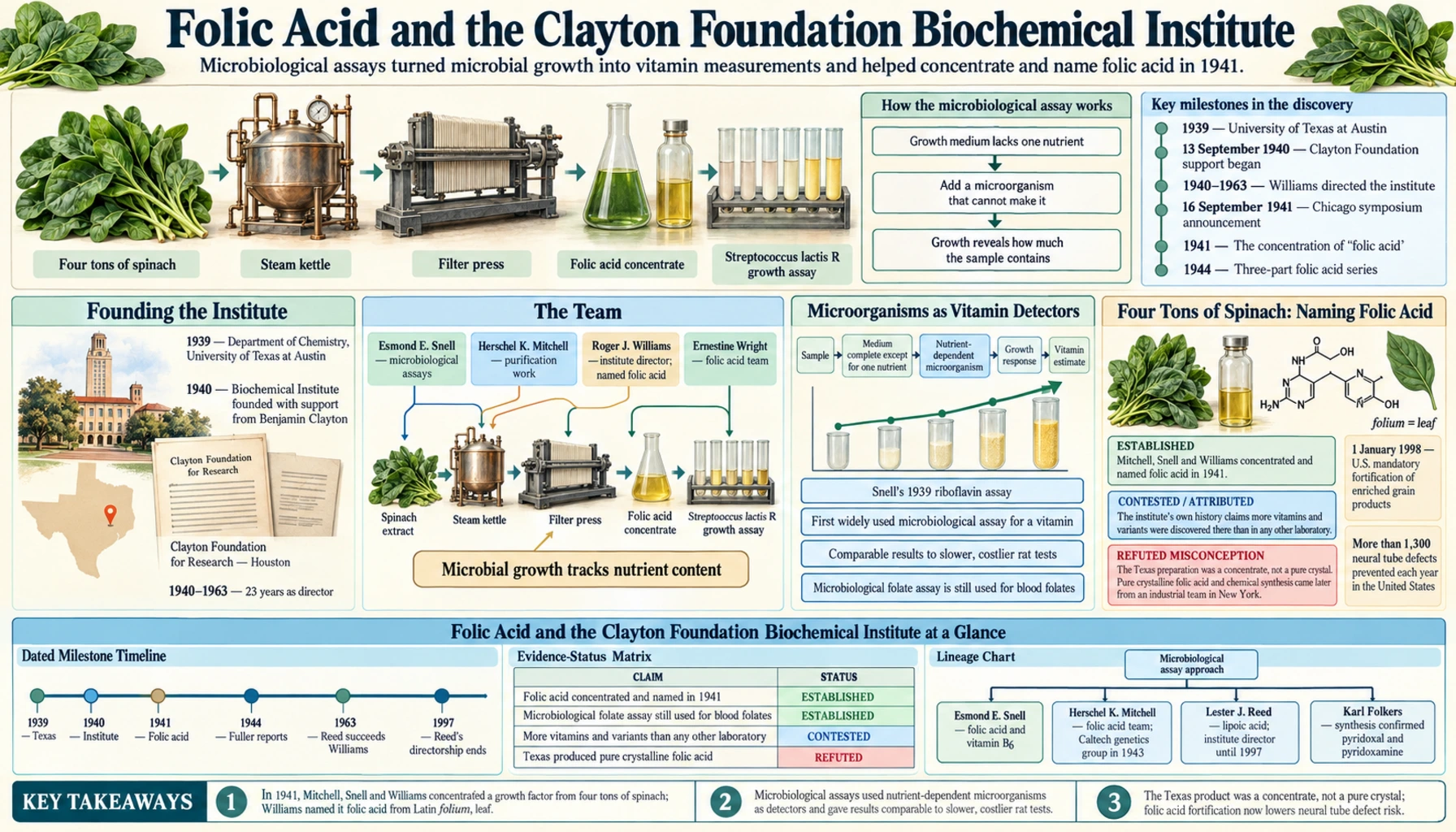
In 1939 Roger J. Williams left Oregon for a professorship in chemistry at the University of Texas at Austin, bringing with him the pantothenic acid work and a conviction that the simplest living cells — yeasts and bacteria — could reveal the vitamins that people need. The following year, with money from the Houston businessman Benjamin Clayton and the Clayton Foundation for Research, he founded the Biochemical Institute, later named the Clayton Foundation Biochemical Institute, and directed it for twenty-three years.
This page tells the story of that laboratory in its first, most productive years: the people Williams gathered, the microbiological assays they built, the four tons of spinach that gave the world the name “folic acid,” the biotin and egg-white work, inositol, the 1942 survey of B vitamins in tumours, the essays Williams wrote for Science about where vitamin research was heading, and the record of discoveries the institute claims for itself.
Table of Contents
- Founding the Institute
- The Team
- Microorganisms as Vitamin Detectors
- Four Tons of Spinach: Naming Folic Acid
- Biotin, Avidin and Egg-White Injury
- Inositol
- Vitamin B6 Forms and Amino-Acid Assays
- The 1942 Survey of B Vitamins in Tumours
- Williams’s Science Essays, 1940–1942
- The Institute’s Record of Discoveries
- Legacy: Folate and Biotin Today
- Key Research Papers
- Connections
- Featured Videos
1. Founding the Institute
Williams accepted a professorship in the Department of Chemistry at the University of Texas at Austin in 1939. According to the National Academy of Sciences biographical memoir written by his colleagues Donald R. Davis, Marvin L. Hackert and Lester J. Reed, he founded the Biochemical Institute the following year “with the support of Benjamin Clayton,” and the institute was later renamed the Clayton Foundation Biochemical Institute. Clayton (1882–1978) was a Houston businessman who, through the Clayton Foundation for Research, paid for the work.
The memoir records a date Williams liked to remember for two reasons. He was a keen golfer, and the first time he broke 80 on a regulation course was Friday, 13 September 1940 — the same day the Clayton Foundation began supporting his work at Texas. He shot a 76.
Williams served as director from 1940 to 1963, the dates given in the University of Texas Biochemical Institute’s own history; the memoir gives the same span as “23 years.” His successor was Lester J. Reed, who directed the institute until 1997. Williams himself remained on the university’s faculty until 1986.
The memoir sums up his philosophy as a director: he believed that the best approach to understanding the biochemistry of health and disease would come from studying the biochemistry of normal cells, and he built the institute so that individual young scientists could pursue their own lines of work to their full potential. In December 1940 he announced the new programme to the scientific community in a short note in Science titled “Vitamin study at the University of Texas.”
2. The Team
The institute’s strength was its people. The NAS memoir names Robert Eakin, Esmond Snell, William Shive and Lester Reed among Williams’s early colleagues there, and the University of Texas history adds Karl Folkers to the list of distinguished biochemists associated with the institute. The papers of the early 1940s show many more names.
- Esmond E. Snell (1914–2003) came from the University of Wisconsin in 1939 as a postdoctoral research associate with Williams, became assistant professor of chemistry in 1941 and associate professor in 1943, and left for Wisconsin in 1945. He later returned to Texas, went on to chair biochemistry at Berkeley, and came back to Austin again in 1976. His NAS memoir calls him one of the outstanding biochemists of the twentieth century.
- Herschel K. Mitchell was Williams’s doctoral student; he earned his PhD at Texas in 1941 and in 1943 joined George Beadle’s genetics group, moving with it to the California Institute of Technology.
- Robert E. Eakin (1916–1979) led much of the biotin and egg-white work and later co-wrote The Biochemistry of B Vitamins (1950) with Williams, Ernest Beerstecher and William Shive.
- Beverly M. Guirard was, in the words of the Snell memoir, one of Snell’s “earliest and longest associates.” At Texas in the early 1940s she took part in identifying the natural forms of vitamin B6 and co-authored the amino-acid and lactic-acid-bacteria papers with Snell and Williams.
- Ernestine Wright, a technician, is named by the University of Texas as part of the folic acid team.
- Other co-authors on the institute’s early papers include Alfred Taylor and Maxwell A. Pollack (the tumour studies), Robert C. Thompson (biotin extraction), Vernon H. Cheldelin (adsorption and cooking losses), Earl Frieden (folic acid adsorption) and Mary Ann Eppright (yeast assays).
3. Microorganisms as Vitamin Detectors
Williams had spent his early career measuring the chemicals yeast needs in order to grow. The NAS memoir explains that his more important idea was the “universality” of basic biochemistry: if all living things share the same chemical machinery, a substance that a yeast cell needs is likely to matter to animals and people too. He kept working with yeast, the memoir notes, despite attempts by leading biochemists of the day to persuade him to switch to animals — and that persistence produced pantothenic acid in 1933.
By the time he reached Texas, the memoir says, microbial systems were taking “a leading role” in the discovery of new nutritional factors. The practical tool was the microbiological assay: a test tube of growth medium complete except for one nutrient, seeded with a microorganism that cannot make that nutrient for itself. How much the organism grows tells you how much of the nutrient a sample contains. Snell had published a riboflavin assay of this kind in 1939 using lactic acid bacteria; his memoir describes it as the first widely used microbiological assay for a vitamin and a prototype for assays of each of the B vitamins, giving results comparable to the far slower and costlier rat tests.
The Texas group turned this into a production line. In 1940 the laboratory published an assay method for pantothenic acid and a paper on how inositol, thiamin, biotin, pantothenic acid and vitamin B6 affect the growth of yeasts. In 1941 the institute issued its first volume of Studies on the Vitamin Content of Tissues (University of Texas Publication 4137), with chapters by Williams and co-authors on assay methods for pantothenic acid, pyridoxine, inositol and thiamin. A second volume followed in 1942 with an introduction on microbiological assay methods and surveys of B vitamins in normal human tissues, milk and foods.
The same approach extended to amino acids. Mitchell and Williams reported in 1940 on the importance of amino acids as yeast nutrients, and by 1945–46 the group was publishing microbiological determinations of glutamic acid and glutamine with Lactobacillus arabinosus, and of lysine, histidine, arginine and valine.
4. Four Tons of Spinach: Naming Folic Acid
Through the late 1930s several laboratories had been chasing growth factors that went by different names depending on the test organism or animal used. At Texas, the factor of interest was something that a lactic acid bacterium, Streptococcus lactis R (also called S. faecalis), needed in order to grow. The Snell memoir records that, using S. lactis R as the test organism, Snell, Mitchell and Williams purified this growth factor “from four tons of spinach.”
The University of Texas tells the story of the spinach itself: the team brought four tons of it into the attic laboratory of the Chemistry Building and used a steam kettle and a filter press to process it. The spinach tonnage is given in the same terms by both the Snell memoir and the university, and the work was announced by Williams at a symposium at the University of Chicago on 16 September 1941.
The formal report was a one-page communication in the Journal of the American Chemical Society in 1941, “The concentration of ‘folic acid’,” by Mitchell, Snell and Williams. The name was Williams’s coinage. As the NAS memoir puts it, after naming pantothenic acid from the Greek pantothen (“from all sides”), he “continued with folic acid, the vitamin isolated from spinach leaves (Latin folium, leaf).” The name stuck because the substance turned out to be abundant in green leaves. The 1941 paper was later reprinted in Nutrition Reviews (1988) as a “Nutrition Classic.”
Fuller accounts followed in 1944 in a three-part series in the same journal: “Folic acid. I. Concentration from spinach” (Mitchell, Snell and Williams), “II. Studies on adsorption” (Frieden, Mitchell and Williams) and “III. Chemical and physiological properties” (Mitchell and Williams). The University of Texas biography of Williams describes his role in a single line: he “concentrated folic acid, another B-vitamin, and gave it its name.”
The Texas preparation was a concentrate, not a pure crystal. Pure crystalline folic acid and its chemical synthesis came a few years later from an industrial research team in New York, and the vitamin’s other early names faded in favour of the Texas one.
5. Biotin, Avidin and Egg-White Injury
Feeding animals large amounts of raw egg white was known to cause a peculiar illness, “egg-white injury,” with skin and hair changes. The Texas group helped show why. In 1940 Snell, Eakin and Williams published a quantitative microbiological test for biotin, and the same year Eakin, McKinley and Williams reported in Science that egg-white injury in chicks was related to a deficiency of vitamin H — biotin.
The next step was to find the culprit inside the egg white. Eakin, Snell and Williams described “a constituent of raw egg white capable of inactivating biotin in vitro” (1940), and in 1941 reported its concentration and assay, calling it “avidin, the injury-producing protein in raw egg white.” Williams named it too: the NAS memoir explains that avidin, “the egg-white protein that tenaciously binds to biotin,” takes its name from the Latin avidus, “to covet.”
A joint paper with Paul György and C. S. Rose in 1941 framed egg-white injury as the result of non-absorption or inactivation of biotin. That December, Thompson, Eakin and Williams published “The extraction of biotin from tissues” in Science, and in 1944 Chu and Williams examined whether some forms of biotin activity escaped avidin altogether, using Williams’s word “isotel” for substances that can stand in for one another nutritionally.
6. Inositol
Inositol had been part of Williams’s yeast work since Oregon. In 1934 Williams and Saunders published in the Biochemical Journal on the effects of inositol, crystalline vitamin B1 and “pantothenic acid” on the growth of different strains of yeast, and the 1940 Texas paper on yeast growth again listed inositol alongside thiamin, biotin, pantothenic acid and vitamin B6.
At the new institute, inositol got its own assay chapter in the 1941 Studies on the Vitamin Content of Tissues. In 1948 Lane and Williams reported in Archives of Biochemistry that inositol is an active constituent of pancreatic alpha-amylase, the starch-digesting enzyme. Both the University of Texas and the NAS memoir list “pioneering work on inositol” among the institute’s contributions.
7. Vitamin B6 Forms and Amino-Acid Assays
The assay work produced a discovery that nobody had set out to make. The Snell memoir explains that when Snell tested pyridoxine (vitamin B6) with S. faecalis, the bacterium needed an extraordinarily high amount if the vitamin was filter-sterilized, but far less if it was heat-sterilized with the growth medium. Yeast showed no such difference. Snell reasoned that heating, or mild chemical treatment, was converting pyridoxine into more active aldehyde and amine forms.
In 1942 Snell, Guirard and Williams reported the occurrence in natural products of a physiologically active metabolite of pyridoxine. The structures were then confirmed by synthesis with Karl Folkers’s group, and the new forms were named pyridoxal and pyridoxamine. Snell went on to develop assays that told the three forms of vitamin B6 apart, using three microorganisms with different needs. These are the “two of the three forms of vitamin B6” that the University of Texas lists among the institute’s discoveries.
8. The 1942 Survey of B Vitamins in Tumours
With a battery of microbiological assays in hand, Williams turned them on cancer. The second volume of Studies on the Vitamin Content of Tissues (University of Texas Publication 4237, 1942) included a chapter on B vitamins in human, rat and mouse neoplasms next to its survey of normal human tissues, so that tumours could be compared with the tissues they arose from.
The headline result went to Science in October 1942 as “Uniformities in the content of B vitamins in malignant neoplasms,” by Alfred Taylor, Maxwell A. Pollack and Williams. The same year the group published a four-part series in Cancer Research, “B vitamins in cancerous tissues,” with one paper each on riboflavin, nicotinic acid, biotin and pantothenic acid.
The cancer line continued. Williams wrote “B vitamins and cancer” for a 1944 American Association for the Advancement of Science research conference on cancer, and in 1945 the institute published a whole volume of Cancer Studies (University of Texas Publication 4507). It opened with Williams’s essay “A broad approach to the cancer problem” and included Taylor and Williams on diet and spontaneous lung tumours in strain A mice, and Loo and Williams on folic acid distribution “with respect to its possible relationship to cancer.”
9. Williams’s Science Essays, 1940–1942
Williams wrote for his fellow scientists as readily as he wrote papers, and during the institute’s first years he used Science to argue for his approach.
- “Vitamin study at the University of Texas” (December 1940). A short announcement of the new programme in Austin.
- “The importance of microorganisms in vitamin research” (May 1941). Williams’s case for the microbial method that had given him pantothenic acid and was about to give the institute folic acid. The NAS memoir describes the result of this approach: microbial systems “attained a leading role” in finding new nutritional factors and in founding biochemical genetics and the study of intermediary metabolism.
- “Vitamins in the future” (April 1942). The University of Texas bibliography identifies this as Williams’s Chandler Medal address, given jointly with his elder brother Robert R. Williams, the chemist who synthesized thiamine. Columbia University awarded Roger Williams its Chandler Medal in 1942, the year after he received the Mead Johnson Award of the American Institute of Nutrition.
The same year Williams published “The approximate vitamin requirements of human beings” in the Journal of the American Medical Association, and a chapter titled “Pantothenic acid and the microbiological approach to the study of vitamins” in The Biological Action of the Vitamins (University of Chicago Press, 1942). Taken together, these titles show where his thinking was going: from finding vitamins in microbes to asking how much of each one a human being needs — the question that would lead him to Biochemical Individuality.
10. The Institute’s Record of Discoveries
The institute makes a large claim for itself. Its official history states that “more vitamins and their variants were discovered in the Biochemical Institute than in any other laboratory in the world,” and the University of Texas biography of Williams repeats it. The list the university gives:
- Pantothenic acid (vitamin B5) — discovered by Williams, announced in 1933, before the move to Texas.
- Folic acid — concentrated and named in 1941.
- Two of the three forms of vitamin B6 — pyridoxal and pyridoxamine.
- Avidin — the biotin-binding protein of egg white.
- Lipoic acid — isolated in crystalline form by Lester Reed and his co-workers using a bacterial assay that grew out of Snell’s work.
- Folinic acid.
- Vitamin B12 — the NAS memoir says the group “developed a commercial synthesis of vitamin B12.”
- Inositol — “pioneering work.”
The NAS memoir points to another measure of the institute’s success: the awards and honours given to its scientists, and “a legacy of vitamins and biochemicals whose names were created by them,” citing pyridoxal, pyridoxamine, folic acid and lipoic acid. Williams had a gift for coining words; besides pantothenic acid, folic acid and avidin, the memoir credits him with “nutrilite,” “isotelic,” “propetology” and “genetotrophic.”
11. Legacy: Folate and Biotin Today
The name chosen in a Texas attic laboratory is now on the label of nearly every multivitamin and every bag of enriched flour in the United States. Folic acid is the synthetic form of folate, vitamin B9, and is best known today for lowering the risk of neural tube defects such as spina bifida when taken before and in early pregnancy. In the United States, mandatory fortification of enriched grain products took effect on 1 January 1998. In the University of Texas account, folic acid recommendations and fortification now prevent more than 1,300 neural tube defects a year in the country. Read more on our Vitamin B9 (Folate) page and its History and Discovery page.
The assay itself outlived its era. The Snell memoir notes that the microbiological folate assay that began with the spinach work “is still used for the determination of folates in the blood.”
The biotin–avidin pair has had a second life. The tight bond Williams captured in the word avidin is now used throughout molecular biology to tag and pull out molecules in the laboratory. For the vitamin itself, see our Vitamin B7 (Biotin) page.
Finally, the people. Snell went on to a distinguished career in vitamin B6 enzymology; Mitchell became a founding figure in the study of the heat shock response at Caltech; Reed led the institute for more than three decades after Williams. And Williams, freed by the institute’s success, turned increasingly to teaching the public and the medical profession about nutrition and biochemical individuality — the work described on the other pages of this section.
Key Research Papers
- Williams RJ, Saunders DH. The effects of inositol, crystalline vitamin B1 and “pantothenic acid” on the growth of different strains of yeast. Biochem J. 1934;28:1887-93. — PubMed PMID: 16745586
- Eakin RE, McKinley WA, Williams RJ. Egg-white injury in chicks and its relationship to a deficiency of vitamin H (biotin). Science. 1940;92:224-5. — PubMed PMID: 17743857
- Mitchell HK, Williams RJ. The importance of amino-acids as yeast nutrients. Biochem J. 1940;34:1532-6. — PubMed PMID: 16747285
- Williams RJ. Vitamin study at the University of Texas. Science. 1940;92:579. — PubMed PMID: 17757706
- Williams RJ. The importance of microorganisms in vitamin research. Science. 1941;93:412-4. — PubMed PMID: 17842471
- Mitchell HK, Snell EE, Williams RJ. The concentration of “folic acid”. J Am Chem Soc. 1941;63:2284. DOI: 10.1021/ja01853a512. — doi:10.1021/ja01853a512
- Mitchell HK, Snell EE, Williams RJ. Journal of the American Chemical Society, Vol. 63, 1941: The concentration of “folic acid” by Herschel K. Mitchell, Esmond E. Snell, and Roger J. Williams [Nutrition Classics]. Nutr Rev. 1988;46:324-5. — PubMed PMID: 3067148
- Thompson RC, Eakin RE, Williams RJ. The extraction of biotin from tissues. Science. 1941;94:589-90. — PubMed PMID: 17773977
- Williams RJ. Vitamins in the future. Science. 1942;95:340-4. — PubMed PMID: 17745283
- Taylor A, Pollack MA, Williams RJ. Uniformities in the content of B vitamins in malignant neoplasms. Science. 1942;96:322-3. — PubMed PMID: 17751370
- Mitchell HK, Snell EE, Williams RJ. Folic acid. I. Concentration from spinach. J Am Chem Soc. 1944;66:267-8. DOI: 10.1021/ja01230a032. — doi:10.1021/ja01230a032
- Guirard BM, Snell EE, Williams RJ. Microbiological determination of amino acids; lysine, histidine, arginine, and valine. Proc Soc Exp Biol Med. 1946;61:158-61. — PubMed PMID: 21017605
- Lane RL, Williams RJ. Inositol, an active constituent of pancreatic alpha-amylase. Arch Biochem. 1948;19:329-35. — PubMed PMID: 18891788
- Williams RJ. Early experiences with pantothenic acid; a retrospect. Nutr Rev. 1954;12:65-8. — PubMed PMID: 13133195
PubMed Topic Searches
Connections
- Dr. Roger J. Williams and Biochemical Individuality
- Roger J. Williams: Life and Career
- How Williams Discovered Pantothenic Acid
- Biochemical Individuality (1956)
- Roger J. Williams: Books and Legacy
- Vitamin B9 (Folate)
- Vitamin B9: History and Discovery
- Vitamin B7 (Biotin)
- Vitamin B6
- Vitamin B5 (Pantothenic Acid)
- Inositol
- Nutrition & Orthomolecular