Nutrition Against Disease (1971) and Cellular Nutrition
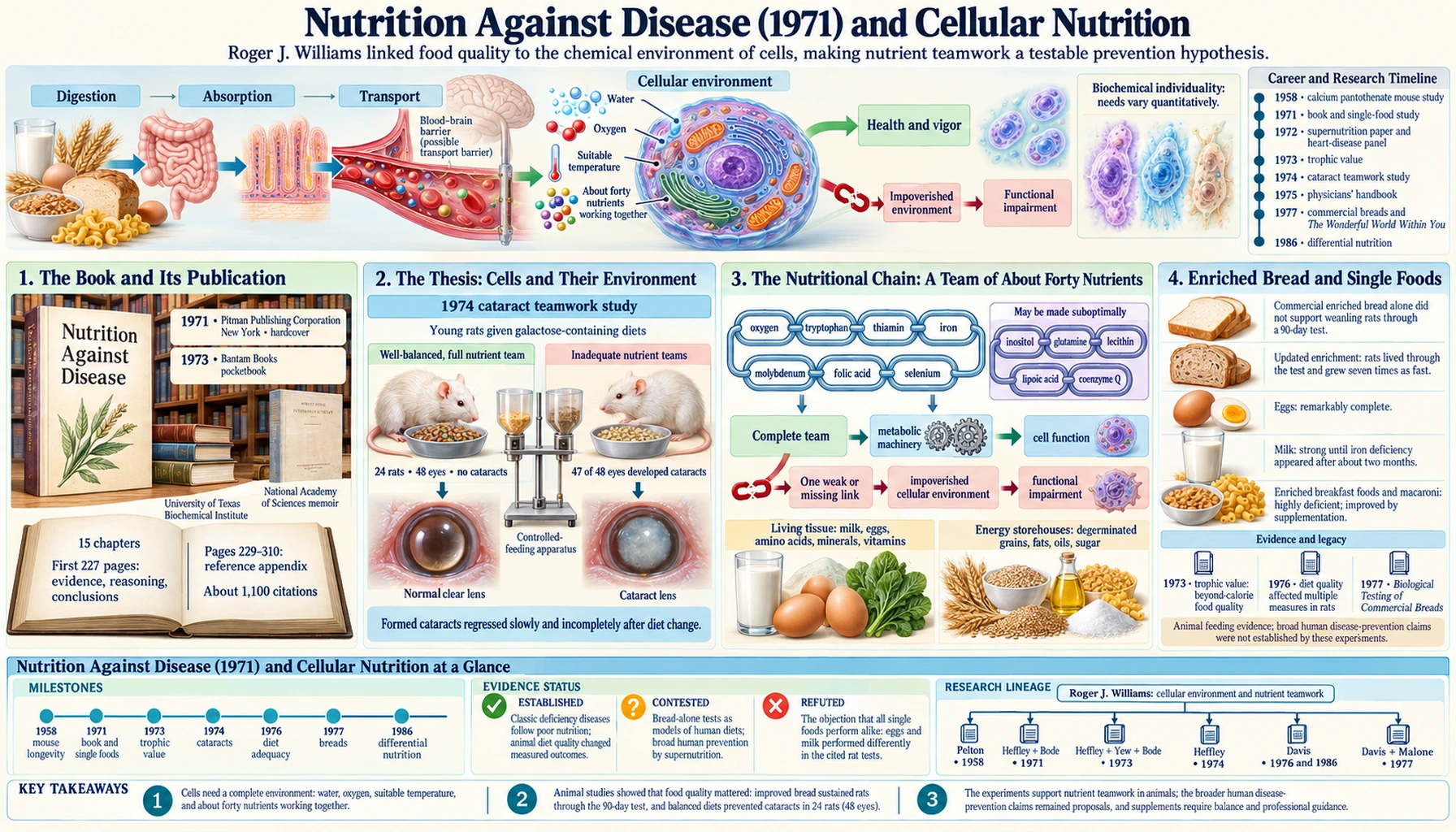
In 1971, the year he became an emeritus professor at the University of Texas, Roger J. Williams published Nutrition Against Disease: Environmental Prevention. It was the book in which the discoverer of pantothenic acid set out, for doctors and the general public alike, the idea he had been building for thirty years: that disease very often begins when the cells of the body are not given everything they need, and that improving the “environment” of those cells through better nutrition is a way of preventing disease rather than merely treating it.
This page follows that argument as Williams stated it — the cells and their internal environment, the “chain” of about forty nutrients that must all be present, his rat experiments with bread and other single foods, the “trophic” value of food, the chapters on birth defects, heart disease, obesity, arthritis, ageing, mental disease, alcoholism and cancer, the 1974 cataract experiment, his campaign to bring nutrition into medical education, his advice on supplements as “insurance,” and the books that surround Nutrition Against Disease.
Table of Contents
- The Book and Its Publication
- The Thesis: Cells and Their Environment
- The Nutritional Chain: A Team of About Forty Nutrients
- Enriched Bread and Single Foods
- The “Trophic” Value of Foods
- What the Book Proposed, Chapter by Chapter
- Heart Disease and the 1972 Presidential Panel
- The 1974 Cataract Teamwork Study
- Medical Education and a “Renaissance of Nutritional Science”
- Supplements as “Insurance”
- Related Books: 1962, 1975 and 1977
- Key Research Papers
- Connections
- Featured Videos
1. The Book and Its Publication
Nutrition Against Disease: Environmental Prevention was published in hardcover in New York by Pitman Publishing Corporation in 1971, and as a pocketbook by Bantam Books in 1973. Both dates and publishers are given in the bibliography kept by the University of Texas Biochemical Institute and in the National Academy of Sciences biographical memoir of Williams.
The book is really two books. Reviewing it in the first issue of the Journal of Orthomolecular Psychiatry in 1972, the Canadian psychiatrist Abram Hoffer noted that the first 227 pages hold the evidence, Williams’s reasoning and his conclusions, while pages 229 to 310 are an appendix of about 1,100 medical and scientific citations, each with a short note on what the report contains and how it relates to the main theme. The Institute’s published table of contents shows the same structure: fifteen chapters, then Reference Notes beginning on page 229, an Appendix I on “The Nutrient Value of Selected Foods,” an Appendix II titled “A Vitamin Supplement,” and an index.
The Institute’s biography notes that after he gave up the directorship of the Clayton Foundation Biochemical Institute in 1963 he “concentrated on human nutrition as his central field of interest,” and that Nutrition Against Disease, with Alcoholism: The Nutritional Approach and Nutrition in a Nutshell, was “widely read.”
2. The Thesis: Cells and Their Environment
The book’s subtitle, Environmental Prevention, refers not to air or water but to the chemical surroundings of the body’s own cells. Williams laid out the reasoning compactly in a paper he presented at the National Academy of Sciences in October 1971 and published in 1972 as “‘Supernutrition’ as a Strategy for the Control of Disease,” which cites Nutrition Against Disease as the place where he had assembled the evidence. The idea, he wrote, rests on two biological observations:
“First, living cells, in our bodies and everywhere, practically never encounter perfect optimal environmental conditions; second, living cells when furnished with wholly satisfactory environments, including the absence of pathogenic organisms, will respond with health and vigor.”
An ideal environment for the cells, in his description, would include water, oxygen and a suitable temperature, and also “an impressive team of about 40 nutrients all blended in about the right proportions and working together.” Because that ideal is rarely met, he argued, there is “vast room” for a serious attempt to give the cells and tissues of the body highly favourable conditions — an attempt that, in his words, “has never been made.”
Four levels of nutrition
Williams sorted human nutrition, apart from frank starvation, into levels. Poor nutrition produces underdevelopment and the classic deficiency diseases — beriberi, scurvy, pellagra, rickets, kwashiorkor. Fair nutrition is good enough to prevent those diseases but “not good enough to promote positive good health and excellent development”; this mediocre level, he wrote, is the kind physicians had generally been taught to regard as satisfactory. Good nutrition he found best exemplified by what farmers and pet owners give their animals — plenty of high-quality protein and a good assortment of minerals and vitamins “far above the danger line” — and he judged, citing his book, that probably no more than a minority of Americans had it. Above all of these he placed supernutrition, “total nutrition in the most sophisticated sense,” which he described as concerned with quality and “antithetical to calorie overnutrition.”
He also warned that eating a nutrient does not guarantee its arrival in every cell. Digestion, absorption and transport, he wrote, “are not automatic processes that always take place with perfection,” and barriers inside the body such as the blood–brain barrier (a point he credited to Linus Pauling) may keep needed nutrients out as well as unwanted ones. Added to this was his lifelong theme of biochemical individuality: each person’s nutritional needs are quantitatively distinctive, so no single standard fits everyone.
3. The Nutritional Chain: A Team of About Forty Nutrients
The image Williams returned to again and again was a chain. In the 1972 supernutrition paper he wrote:
“If any link in the environmental chain is weak or missing, then the cells cannot remain healthy. The weak link may be something well-recognized like oxygen, tryptophan, thiamin or iron or it may be something more obscure like molybdenum, folic acid or selenium. The result is the same: an impoverished environment which leads to functional impairment.”
From this he drew a conclusion about the old habit of speaking of “major” and “lesser” vitamins: “Any nutrient which is absolutely indispensable is a link in a chain and is a major nutrient regardless of quantitative relationships.” He called the cooperation of nutrients “teamwork,” and said it had “so often been neglected.” His colleague John J. Biesele, writing Williams’s obituary in the Journal of Orthomolecular Medicine in 1988, summed up the same idea: Williams “early emphasized the teamwork of the B vitamins and the necessity of adequate intake of each of the 40 or so essential nutrients.”
Williams gave a concrete example from his own laboratory. In 1958 Pelton and Williams had given extra calcium pantothenate in the drinking water of mice already eating a commercial stock diet; as Williams later described it, the result was an increased longevity of about 19 percent. “If this result is achieved by strengthening only one link in the chain,” he wrote, “one can legitimately expect the result to be even more striking if one attempted to strengthen all the links.”
The chain also included links not yet discovered. Because cells in tissue culture generally could not be grown in purely synthetic media, he argued, unknown nutrients must exist; “Every link in the environment is essential.” And he listed substances that the body normally makes for itself but, he thought, may sometimes make in suboptimal amounts: inositol, glutamine, lecithin, lipoic acid and coenzyme Q.
Energy storehouses versus living tissue
Williams’s critique of refined food followed directly from the chain. The “building blocks” of life — amino acids, minerals including trace minerals, and many vitamins — are, he wrote, present in the metabolic machinery of living cells whatever their origin, so that milk, eggs and “the cells and tissues of other organisms” supply them well. But the energy storehouses of plants and animals, for which he gave the examples “degerminated grains, fats, oils, sugar,” “do not contain all the nutritional essentials, and if we depend largely upon them for nutrition, the result will be an impoverishment of the environment of our cells and tissues.”
4. Enriched Bread and Single Foods
The best-known experiments from this period of Williams’s work used bread. In October 1971 Williams, James D. Heffley and Charles W. Bode published “The nutritive value of single foods” in the Proceedings of the National Academy of Sciences. Its summary describes an earlier study by the group in which, the authors wrote, a commercial “enriched” bread alone “would not support the life of weanling rats in a 90-day test,” but the enrichment “could be updated at low cost, with the result that rats consuming the improved bread alone lived during the test period and grew seven times as fast.”
That earlier result had been criticized by prominent nutritionists on the grounds that bread is not eaten alone and that other single foods are deficient too. The 1971 paper quotes the objection: “the experiments you performed would have given the same or similar results if you had begun with milk, eggs, meat, or any other food.” Doubting that statement, Williams’s group fed milk, meat, eggs and several other foods, including breakfast cereals, singly to groups of animals.
The results, as the authors reported them:
- Eggs “proved to be a remarkably complete food.”
- Milk showed about the same excellence until its iron deficiency became evident after about two months.
- “Enriched” breakfast foods and macaroni were “highly deficient and could be improved greatly by supplementation.”
The paper’s larger point was about food-composition tables. “On the basis of the tabulated data alone,” the authors wrote, “one might conclude that ‘enriched’ puffed rice, for example, is only slightly inferior nutritionally to eggs. Our experiments have shown this assumption to be grossly in error.” They proposed developing biological testing — feeding a food to growing animals and watching what happens — as a method “incomparably better for evaluating foods than consulting food composition tables.”
Williams kept testing bread for the rest of the decade. His Institute bibliography lists a 1977 paper by Donald R. Davis, Elizabeth Malone and Williams titled “Biological Testing of Commercial Breads” in the Journal of the International Academy of Preventive Medicine.
5. The “Trophic” Value of Foods
In March 1973 Williams, Heffley, Man-Li Yew and Bode gave the idea a name in a second PNAS paper, “The ‘trophic’ value of foods.” Foods, they wrote, must furnish two things: calories, which are easy to measure, and the raw materials “necessary for the building and maintenance of metabolic machinery which makes possible fuel utilization.” They called this “beyond-calorie” quality the food’s “trophic” value.
The central sentence of the paper restates the chain in one line: “A food cannot support life if it is missing, or deficient with respect to, any one of the necessary nutrients.” A table listing only a handful of nutrients — the authors named calcium, thiamin, riboflavin, niacin, phosphorus and iron — “can be woefully misleading, especially if these individual nutrients have been added by way of fortification.”
The authors proposed their animal-feeding measurement as a way to compare similar products — two grains, two breads, two milk products, or the same food grown, processed or preserved in different ways. Using essentially this method, they reported, “barnyard eggs are somewhat superior to battery eggs, but … whether they are fertile or infertile makes no difference.” They closed by urging “extensive biological testing of many commercial food products” to help promote human health “and better internal environments for our cells and tissues.”
The line of work continued in 1976, when Donald R. Davis and Williams fed four diets of deliberately different quality to large groups of weanling rats — a commercial rat chow, the same chow diluted with glucose calories, a simulated “American” diet built from 25 widely used foods, and that diet supplemented with small amounts of 25 vitamins and minerals — and looked for less traditional signs of nutritional adequacy. Among the measures they found affected by diet were voluntary food intake, sleeping time after anaesthesia, weight gain and healing time after surgery, hair regrowth after clipping, voluntary sugar consumption, and recovery time after cyanide poisoning.
6. What the Book Proposed, Chapter by Chapter
The fifteen chapters of Nutrition Against Disease, as listed in the University of Texas Biochemical Institute’s table of contents, are:
- The Flaw in Medical Education
- The Nutrition-Heredity Factor
- A New Hope for Better Health
- Stillborn, Deformed, and Mentally Retarded Babies
- Protecting the Hearts We Have
- The Fight Against Obesity
- Prevention of Dental Disease
- The Nutritional Approach to Arthritis and Related Disorders
- How Can We Delay Old Age?
- Environmental Control of Mental Disease
- The Battle Against Alcoholism
- How Is the Cancer Problem Related?
- Food Fads
- What the Food Industries Can Do
- Developments in Basic Medicine
Williams summarised the disease chapters himself in the 1972 supernutrition paper. He had presented elsewhere, he wrote, “evidence, hitherto unassembled,” citing Nutrition Against Disease, which supports the conclusion that supernutrition, or something approaching it, “if expertly applied,” has the capability of preventing:
- “The birth of defective, deformed and mentally retarded babies.”
- “The development of cardiovascular disease and premature aging.”
- “The high incidence of dental disease.”
- “Metabolic disorders, obesity, arthritis, etc.”
- “Mental disease with all its accompanying ramifications.”
He went further in the same paper: “It seems probable that even ‘incurable’ diseases such as muscular dystrophy and multiple sclerosis can be prevented by expert application of supernutrition, especially if it could be started with vulnerable individuals at an early age.”
Mental disease and alcoholism
In his 1972 review, Hoffer summarised the book as showing that “optimum nutrition supplemented by adequate doses of certain vitamins” would prevent or alleviate most of the physical conditions it discussed, and that the same could be said of schizophrenia and alcoholism, “with special emphasis on a few specific vitamins” — vitamin B3 and B6 for schizophrenia, and B3 with glutamine for alcoholics. The alcoholism chapter carried forward the work Williams had begun in the 1940s, described on the sibling page about alcoholism and nutrition.
Cancer
On cancer, Williams wrote that there is “certainly room for the hypothesis that cells will not go wild (become cancerous) if they are continuously supported by strong environmental conditions.” He pointed to animal studies in which cancer incidence fell when nutrition was improved in specific ways, and noted that “no one has taken the trouble to see whether attempts to strengthen every link in the nutritional chain will result in the decreased incidence or disappearance of cancer.” “If we spend money on cancer research wisely,” he added, “we will certainly not forget about the ounce of prevention.”
7. Heart Disease and the 1972 Presidential Panel
The year the book appeared, Williams also published “Nutrition and ischemic heart disease” in the Borden Review of Nutrition Research (1971). In 1972 he served on President Nixon’s Advisory Panel on Heart Disease; Oregon State University’s Pauling archive notes that he was its only non-physician member. In a letter to the Secretary of Health, Education, and Welfare quoted by the archive, Williams wrote:
“While no one knows why heart disease is so prevalent, it is highly probable that a primary cause lies in the fact that in our industrialized age the public chooses its food only on the basis of appearance and taste, and has not been educated to choose on the basis of nutritional value. Much of our food is processed, transported long distances and kept a long time, and the purveyors of food cater to those who want attractive and tasty foods and who pay little attention to its nutritional efficacy. Modern scientific prowess has not been utilized as it should have been. Nutritional science has lagged.”
He called for nutritional research centres and for teaching nutritional science to doctors and the public. Five years later, in The Wonderful World Within You (1977, page 112), he put his view of cholesterol plainly: atherosclerosis “is a complex problem that is not solved merely by eating less fat or avoiding cholesterol-containing foods. Cholesterol is not a bad substance; it is made by virtually every cell in our bodies and is necessary to life. Deposits of it in our arteries is what is bad. … there is much to be said for the idea that if we eat the right foods and get the right assortment of [nutrients], cholesterol and cholesterol deposits will take care of themselves.”
8. The 1974 Cataract Teamwork Study
In October 1974 Heffley and Williams published what they presented as a direct test of the teamwork idea: “The nutritional teamwork approach: prevention and regression of cataracts in rats,” again in PNAS. The paper opens with the principle in their own words: “no nutrient by itself should be expected to prevent or cure any disease; nutrients as such always work cooperatively in metabolism as a team.”
Young rats fed diets containing galactose regularly develop cataracts. The authors reported that:
- On four galactose-containing diets supplied with what they considered “a well balanced, full team of nutrients,” not a single cataract developed in 24 rats (48 eyes).
- On four diets with the same galactose challenge but inadequate nutritional teams, 47 of 48 eyes developed cataracts.
- Diets of intermediate quality produced intermediate numbers of cataracts.
- Cataracts already formed “were regressed slowly and incompletely” when the animals were shifted to a diet like the protective one.
The authors closed by discussing the significance of the findings for nutritional research and for “attacks on the problems of human cataracts and other ailments.”
9. Medical Education and a “Renaissance of Nutritional Science”
Nutrition Against Disease opens with “The Flaw in Medical Education.” Williams’s complaint was that medicine had neglected nutrition, and that the public had noticed. On page 18 of the book he wrote:
“Many laymen have become interested in nutrition because they have felt intuitively that nutrition is more important than is commonly supposed. Some have lapsed into faddism and others have been gulled by quacks, but it is difficult to blame them on this account. The very people who should have been able to give expert guidance to the layman’s intuitions about nutrition have, in fact, virtually abandoned the field. … A depressing aspect of the situation is that the layman’s intuitions, uninformed as they may be, are often more justified than the physician’s neglect.”
The same year he took the argument to academic readers in “How can the climate in medical education be changed?” in Perspectives in Biology and Medicine (1971). Hoffer’s review explained the book’s diagnosis of how the neglect arose: Williams believed that the remarkable advances brought by the germ theory of disease and by antibiotics had turned the medical profession away from nutrition, and that doctors had come to expect the rapid responses of a few simple deficiency diseases, such as scurvy, beriberi and pellagra.
In the 1972 supernutrition paper he called this neglect “an extremely important and unfortunate wrong turn,” and wrote that if medical education “had not been remiss in its attention to nutrition during the past six or eight decades, supernutrition would not by now be a strange idea.” He asked every section of the National Research Council concerned with human health to join the National Institutes of Health and the National Cancer Institute in “giving more than cursory study to ‘supernutrition’ and its possibilities.” To the objection that it was all untried, he answered: “Why hasn’t it been tried?”
In 1973 Williams, Heffley, Yew and Bode published “A renaissance of nutritional science is imminent” in Perspectives in Biology and Medicine — a paper the National Academy of Sciences memoir lists among his selected works. A 1986 paper he wrote with Donald R. Davis, near the end of his working life, was titled “Differential nutrition — a new orientation from which to approach the problems of human nutrition.”
10. Supplements as “Insurance”
Nutrition Against Disease ends its main text with an appendix titled “A Vitamin Supplement.” Williams’s reasoning for supplements followed from the chain: in the 1972 supernutrition paper he called providing “generous amounts of all the vitamins, especially those which have been demonstrated to be harmless at higher than usual levels” a “relatively easy step” toward supernutrition, because vitamins in moderate excess are in general physiologically inactive. He was careful to add that this is “less true in the case of amino acids and minerals,” that “trace minerals in general cannot be tolerated at high levels,” and that supernutrition means “not only supplying enough of every nutrient but also avoiding excesses and imbalance.” Applying it to people, he wrote, “is clearly no playground for amateurs.”
In the Physicians’ Handbook of Nutritional Science (1975, page 75) he framed his formulas explicitly as insurance:
“While I have never been in the vitamin business and have never derived profit from any vitamin or supplement formulation, I presently suggest the following vitamin formulation and mineral formulation to be used on a daily basis by those who need insurance. These formulations are subject to change when new information becomes available. No infallibility is claimed.”
He preferred that this advice come through doctors. In a 1982 foreword he wrote: “We agree with a vast segment of the medical profession that it is unfortunate for laymen to dose themselves with vitamins and minerals without professional advice. It would be much better if physicians were well informed about the intricacies of nutrition and could give patients sound, expert and dependable advice about the supplementation of their diets.” Reviewing the 1975 handbook, Linus Pauling noted that it suggested 250 milligrams up to 1 gram of vitamin C per day, which Pauling considered too conservative.
By his colleague Biesele’s account, Williams practised moderation himself: he “did not take nutritional supplements himself until relatively late in life, and his intake was always modest.” His Institute bibliography also records statements he contributed to congressional hearings on vitamin, mineral and food-supplement legislation in 1973 (House) and 1974 (Senate), one of them under the title “Drugs and Nutrients Must Be Differentiated.”
11. Related Books: 1962, 1975 and 1977
Nutrition in a Nutshell (1962)
Nine years before Nutrition Against Disease, Williams wrote a short popular introduction to nutrition, Nutrition in a Nutshell, published in 1962 in hardcover by Doubleday and as a Dolphin Books pocketbook. The Institute’s biography groups it with Alcoholism: The Nutritional Approach and Nutrition Against Disease as his widely read nutrition books.
Physicians’ Handbook of Nutritional Science (1975)
Published in hardcover by Charles C. Thomas in 1975, the handbook was written for doctors. Its preface states its aim: “it is the author’s ambitious hope that after reading this book the physician may be inclined to say to himself, ‘Now, for the first time, I really appreciate the deep significance and meaning of nutrition and its importance in medical practice.’” Pauling, reviewing it, wrote that it “may help the physicians of the United States to make up for a serious deficiency in their training,” and praised its treatment of biochemical individuality.
The Wonderful World Within You (1977)
The Wonderful World Within You: Your Inner Nutritional Environment appeared as a Bantam pocketbook in 1977, with later editions from Bio-Communications Press of Wichita, Kansas (1987 and 1998) and a Japanese translation in 1985. It was written for a general audience; Williams hoped it would reach high-school classrooms. Its message is the one in its subtitle. In an open letter of the time, quoted by the Pauling archive, Williams wrote of “monitoring the internal environments which surround the cells and tissues of our bodies and brains. We monitor the air and water as a matter of course, but who looks after the approximately 40 nutrient chemicals which come from the outside world and enter into our inner environments and make life and health possible? The answer is essentially, ‘No one.’”
According to the National Academy of Sciences memoir, his ideas helped inspire the founding in 1975 of a medical clinic in Wichita, Kansas, where every new patient received a copy of The Wonderful World Within You.
Key Research Papers
- Pelton RB, Williams RJ. Effect of pantothenic acid on the longevity of mice. Proc Soc Exp Biol Med. 1958;99:632-3. — PubMed PMID: 13614445
- Williams RJ, Beerstecher E Jr, Berry LJ. The concept of genetotrophic disease. Lancet. 1950;1:287-9. — PubMed PMID: 15405089
- Williams RJ. The expanding horizon in nutrition. Tex Rep Biol Med. 1961;19:245-58. — PubMed PMID: 13785510
- Williams RJ, Deason G. Individuality in vitamin C needs. Proc Natl Acad Sci USA. 1967;57:1638-41. — PubMed PMID: 5231398
- Williams RJ, Heffley JD, Bode CW. The nutritive value of single foods. Proc Natl Acad Sci USA. 1971;68:2361-4. — PubMed PMID: 5289871
- Williams RJ. How can the climate in medical education be changed? Perspect Biol Med. 1971;14:608-14. — PubMed PMID: 5568977
- Williams RJ. Nutrition and ischemic heart disease. Bordens Rev Nutr Res. 1971;31:17-29. — PubMed PMID: 4999895
- Williams RJ, Heffley JD, Yew ML, Bode CW. The “trophic” value of foods. Proc Natl Acad Sci USA. 1973;70:710-3. — PubMed PMID: 4514984
- Williams RJ, Heffley JD, Yew ML, Bode CW. A renaissance of nutritional science is imminent. Perspect Biol Med. 1973;17:1-15. — PubMed PMID: 4751533
- Heffley JD, Williams RJ. The nutritional teamwork approach: prevention and regression of cataracts in rats. Proc Natl Acad Sci USA. 1974;71:4164-8. — PubMed PMID: 4530292
- Davis DR, Williams RJ. Potentially useful criteria for judging nutritional adequacy. Am J Clin Nutr. 1976;29:710-5. — PubMed PMID: 937225
- Williams RJ, Davis DR. Differential nutrition—a new orientation from which to approach the problems of human nutrition. Perspect Biol Med. 1986;29:199-202. — PubMed PMID: 3951955
PubMed Topic Searches
Connections
- Dr. Roger J. Williams and Biochemical Individuality
- Roger J. Williams: Life and Career
- Biochemical Individuality (1956)
- The Genetotrophic Concept of Disease
- Roger J. Williams on Alcoholism and Nutrition
- Roger J. Williams: Books and Legacy
- Vitamin B5 (Pantothenic Acid)
- Vitamin C
- Cataracts
- Eggs
- Linus Pauling: Vitamin C and Orthomolecular Medicine
- Dr. Abram Hoffer and Orthomolecular Medicine
- Nutrition & Orthomolecular