Roger J. Williams on Alcoholism and Nutrition
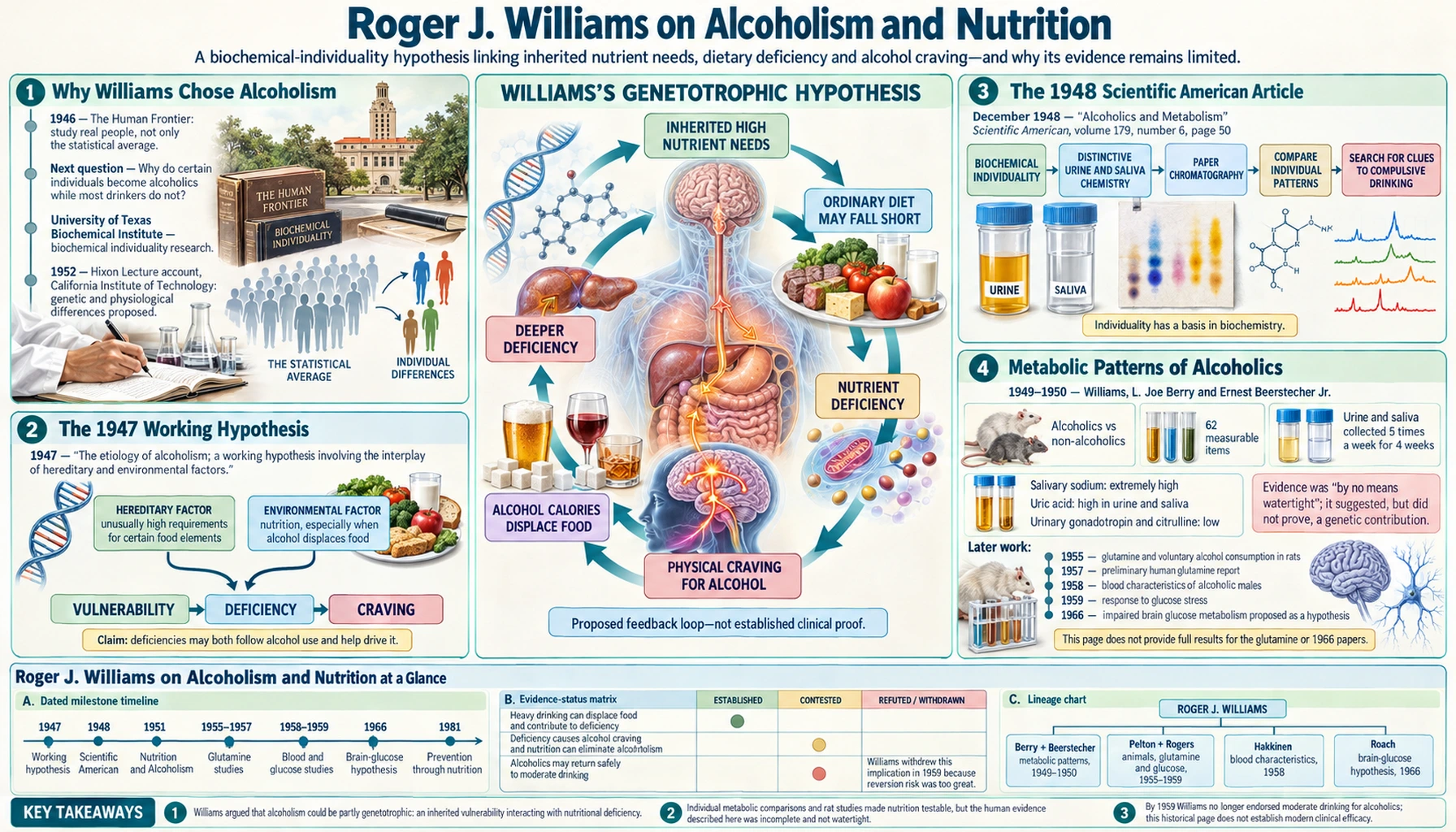
Alcoholism was the first real-world problem to which Roger J. Williams applied his idea that every person is biochemically distinct. From 1947 until his last books in the 1980s he argued that some people are born with unusually high needs for particular nutrients, that ordinary food — especially food diluted by alcohol and refined sugar — fails to meet those needs, and that the resulting deficiency shows up as a physical craving for drink. He wrote three books on the subject and, by the count of his own publication list, more than two dozen papers and addresses.
This page follows that work in order: the 1947 working hypothesis, the 1948 Scientific American article, the comparisons of alcoholics with non-alcoholics, the rat experiments with deficient diets, vitamins and glutamine, the blood and glucose studies of 1958–1959, the 1966 brain-glucose hypothesis, and the three books — Nutrition and Alcoholism (1951), Alcoholism: The Nutritional Approach (1959) and The Prevention of Alcoholism Through Nutrition (1981). Throughout, the claims are Williams’s own, quoted from his books where we could read them and otherwise paraphrased from his paper titles and contents pages.
Table of Contents
- Why Williams Chose Alcoholism
- The 1947 Working Hypothesis
- The 1948 Scientific American Article
- Metabolic Patterns of Alcoholics
- The Rat Experiments
- Nutrition and Alcoholism (1951): The First Regimen
- Glutamine and Amino Acids, 1955–1957
- Blood, Glucose Stress and the 1959 Book
- The 1966 Brain Glucose Hypothesis
- The Prevention of Alcoholism Through Nutrition (1981)
- A Disease, Not a Vice — and the Genetotrophic Idea
- Key Research Papers
- Connections
- Featured Videos
1. Why Williams Chose Alcoholism
In his 1946 book The Human Frontier Williams had argued that science should study real people rather than the statistically average person. In the opening chapters of Nutrition and Alcoholism (1951) he explained what came next. He was, he wrote, in the midst of writing that book “at the time the first atomic bomb was being dropped on Hiroshima,” and because it was not feasible to learn everything about everybody at once, he looked for one concrete problem to which the idea could be applied. “After discussion with colleagues and others, it was decided that the most promising immediate subject was alcoholism.” As the research developed, he added, “it has become apparent that alcoholism is tied up with individuality in nutrition.”
His starting question was not why people in general drink, but why some individuals become alcoholics while most drinkers do not. “We were not concerned with the problem of how people in general become alcoholics — because they do not,” he wrote, “but were at the outset interested in why certain individuals become alcoholics and other individuals do not.” He pointed to the wide differences in how people react to alcohol: some vomit after a small amount, some are drunk at a blood level that leaves others sober, some burn alcohol faster than others.
A 1952 account of his Hixon Lecture at the California Institute of Technology, “Alcoholism as a Genetotrophic Disease,” summarised the same motive: Williams suspected that the differences people show toward alcohol, and the fact that some develop a craving they cannot control, had a genetic as well as a physiological basis.
2. The 1947 Working Hypothesis
Williams first set out his idea in the Quarterly Journal of Studies on Alcohol in 1947, in a paper titled “The etiology of alcoholism; a working hypothesis involving the interplay of hereditary and environmental factors.” The title states the hypothesis: alcoholism arises where an inherited trait meets an environmental factor. In his later writing the environmental factor he emphasised was nutrition.
By 1951 he could put the combined idea in one sentence. The hereditary trait, he wrote, “is the possession of unusually high requirements for certain food elements. These make the individual vulnerable; food as ordinarily chosen is liable not to supply enough, especially when alcohol is consumed; deficiencies result and a craving for alcohol is developed.” If such a person gets plenty of all the nutrients he needs, “then the disease does not appear, and the hereditary trait which otherwise would be damaging is completely overcome. It is as simple as that.”
He also described a self-reinforcing loop. It was already known that heavy drinkers eat poorly and become deficient. “Our work, however, indicates that the whole story has not been revealed. Not only does alcoholic consumption give rise to body deficiencies, but conversely body deficiencies give rise to alcoholic consumption. Typical alcoholics are the ones who are caught in the vicious cycle.” The 1952 lecture account puts it in plain terms: alcohol supplies calories that displace food, so “the more he drinks, the more he dilutes his diet, the more deficient he becomes, the more he drinks.”
3. The 1948 Scientific American Article
In December 1948 Williams took the idea to a general audience in Scientific American with “Alcoholics and Metabolism” (volume 179, number 6, page 50). The magazine’s own summary line reads: “Individuality, points out the author, has a basis in biochemistry. The study of such variations may help in determining what creates compulsive drinkers.”
The article came at a turning point. Around this time Williams’s laboratory at the University of Texas Biochemical Institute was measuring many substances in the urine and saliva of individual people — work he later gathered in a 1951 monograph on individual metabolic patterns studied mainly by paper chromatography — and finding that each person’s pattern was distinctive. In his 1951 book he recalled that these studies placed the bloodhound’s ability to tell one person from another “on a more scientific basis by demonstrating that individuals, as a rule, possess salivas and urines which are distinctive in their chemical content.” As the magazine’s summary says, the article suggested that studying such biochemical variations might help show what creates compulsive drinkers.
4. Metabolic Patterns of Alcoholics
The comparison studies were published in 1949 and 1950 with his colleagues L. Joe Berry and Ernest Beerstecher Jr. — in the Proceedings of the National Academy of Sciences (“Individual metabolic patterns, alcoholism, genetotrophic diseases”), in Archives of Biochemistry (“Biochemical individuality; genetotrophic factors in the etiology of alcoholism”), in Texas Reports on Biology and Medicine and in The Lancet, where the three set out “The concept of genetotrophic disease.”
The 1952 Caltech account of Williams’s lecture describes what was done. Alcoholics and non-alcoholics were compared on some 62 measurable items. Urine and saliva samples were collected five times a week for four weeks. Among the findings it reports: the sodium content of the saliva of alcoholics was extremely high; uric acid in both urine and saliva was high; and gonadotropin and citrulline in the urine were low. The same studies, the account says, found highly significant differences between other groups too — for example between schizophrenic patients and healthy people.
The account is careful about the strength of the evidence: it “was by no means watertight, but it was sufficient to indicate to Williams that many of these metabolic patterns were to a considerable degree genetic in origin.” That led him to ask whether an inherited pattern — of endocrine-gland activity, for example — could be responsible for alcoholic tendencies, and from there to animal experiments.
5. The Rat Experiments
Williams described the animal work in detail in chapter 5 of Nutrition and Alcoholism. Each rat lived in its own cage with two bottles, one of water and one of 10 per cent alcohol; the bottles were switched daily “so as to make a deliberate choice necessary,” and the amount drunk from each was recorded. The innovation, he wrote, was that the team watched individual rats rather than averages. (The 1952 lecture account adds his remark that the rats “were not allowed to give parties.”)
The rats varied widely. Some drank freely from the first day; one was a “teetotaler” who shunned the alcohol; others started slowly and drank more after weeks; some drank in sprees. Closely inbred strains drank relatively uniformly, which Williams took as evidence that the differences were inborn. Then came the dietary findings, in his words:
- On “marginal diets — lacking adequate amounts of various B vitamins — the differences tended to disappear, and within a short time all the animals were consuming alcohol at a fairly high level.”
- On abundant diets “containing plenty of all the nutrient elements needed by rats,” none of them “drank appreciably.”
- When drinking rats on marginal diets were dosed with the vitamins they lacked, “the alcohol consumption dropped overnight and the animals ceased to drink as long as the missing elements were supplied.”
- Different rats responded to different nutrients. A mixture of ten B vitamins stopped some; adding vitamin B12 stopped about two-thirds of those that had not responded; “The most elaborate mixtures cured the most rats.”
He named thiamine (B1), riboflavin (B2), calcium pantothenate (B5), pyridoxine (B6) and vitamin B12 as important factors in rats, “but other vitamins and nutritional factors (including some unknowns) play a part, too.” He was frank that rats from other colonies were harder: in one colony about 40 per cent were not cured by the supplements that cured all of the original colony. The 1952 account adds that rats borrowed from the university’s Home Economics department “proved to be much heavier drinkers, and were much harder to cure.”
In 1955 Williams, Pelton and Rogers published “Dietary deficiencies in animals in relation to voluntary alcohol and sugar consumption” in the Quarterly Journal of Studies on Alcohol — a paper whose title shows the group was by then tracking sugar consumption alongside alcohol in deficient animals.
6. Nutrition and Alcoholism (1951): The First Regimen
Williams’s first book on the subject, Nutrition and Alcoholism, was published by the University of Oklahoma Press in May 1951 with a foreword by the University of Chicago physiologist A. J. Carlson. Its first line states its purpose: “This book has been written to bring hope and help to thousands of alcoholics and their families. My colleagues and I believe that we have found a basic cause for alcoholism and that by nutritional supplements the essential difficulty can eventually be eliminated.” He added that, as a matter of policy, “the treatment of disease should be in the hands of physicians.”
Why supplements rather than food alone? Williams answered that, for the B vitamins especially, “there is no food source rich enough to supply generous amounts of all,” and he assumed for dosing purposes that certain individuals have requirements “of at least four or five times what is considered the average need.” The regimen he described, to be given “through the co-operation of physicians,” had two parts:
- Food. “Good, nourishing foods, including high-quality proteins (meats), dairy products, vegetables, and fruits,” plus one tablespoon of corn oil daily in salad dressing or another form.
- A multi-nutrient capsule taken with meals. As printed in the book, each capsule contained thiamine 3.3 mg, riboflavin 2.67 mg, nicotinamide 10 mg, calcium pantothenate 10 mg, pyridoxine 3.3 mg, biotin 0.05 mg, folic acid 1.1 mg, inositol 53 mg, choline 53 mg, vitamin A 6,667 units, vitamin C 33.3 mg, alpha-tocopherol 6.67 mg and vitamin D (viosterol) 333 units, together with p-aminobenzoic acid and vitamin B12 in amounts the available scan does not render legibly. He advised three capsules a day the first week, six the second, and nine from the third week on if there were no contraindications.
He explained that calcium pantothenate and pyridoxine were included “in larger relative amounts than is usual because in our experimental work they have been demonstrated to be of unquestionable importance.” He also wrote that the regimen was “short of the ideal” judged by the rat work, that unknown vitamin-like factors probably mattered, and that “individualized study may have to be carried further than it has been to date.”
The book reported informal results from about twenty patients treated for roughly two months or more. Williams wrote that he knew of none who had not seemed to benefit, and estimated that “the partial successes and the complete successes are about equal in number,” while stressing that records were incomplete. His first patient, a man who had been an alcoholic for ten years, reported better sleep within a month and, after four months, said his compulsion was gone; he went on to drink beer moderately. Williams called him probably “the first case on record in which an alcoholic has become a moderate drinker.” As section 8 shows, Williams later withdrew that implication.
7. Glutamine and Amino Acids, 1955–1957
The nutrient most closely tied to Williams’s name in alcoholism is the amino acid glutamine. In June 1955 his group — L. L. Rogers, R. B. Pelton and Williams — published “Voluntary alcohol consumption by rats following administration of glutamine” in the Journal of Biological Chemistry. A year later the same three authors followed with “Amino acid supplementation and voluntary alcohol consumption by rats,” testing amino acids more widely.
The next step was in people. In December 1957 Rogers and Pelton published “Glutamine in the treatment of alcoholism; a preliminary report” in the Quarterly Journal of Studies on Alcohol. Glutamine stayed in Williams’s recommendations for the rest of his life: a quarter-century later, chapter 7 of The Prevention of Alcoholism Through Nutrition is titled “Use Glutamine as a Supplementary Food” (see section 10).
We were not able to read the full text of the 1955–1957 glutamine papers, so this page does not give their amounts or results; readers who want the numbers should consult the papers themselves through the PubMed links below.
8. Blood, Glucose Stress and the 1959 Book
In the late 1950s the Clayton Foundation group turned from rats back to alcoholic patients. In February 1958 Williams, Pelton, H. M. Hakkinen and Rogers reported in the Proceedings of the National Academy of Sciences on the “Identification of blood characteristics common to alcoholic males.” In 1959 Pelton, Williams and Rogers published “Metabolic characteristics of alcoholics. I. Response to glucose stress,” a study of how alcoholics handle a sugar load. That same year Williams summarised his position in the Quarterly Journal of Studies on Alcohol under a title that states it: “Biochemical individuality and cellular nutrition: prime factors in alcoholism.”
His second book, Alcoholism: The Nutritional Approach (University of Texas Press, 1959), brought the work up to date for general readers. Its preface, published on the University of Texas Biochemical Institute’s Williams website, records an important change of view. The 1951 book, he wrote, “carried an implication — namely that alcoholics might well look forward to a life of moderate drinking — which I cannot now endorse. If an alcoholic is able to drink moderately for a time, this is strong evidence that his appetite has been changed. However, at the present time in the actual handling of alcoholics, the risks of reversion are too great.” He dedicated the book to Alcoholics Anonymous as “testimony of the fact that my advice to alcoholics now coincides with that of this organization, namely that alcoholics should abstain. I believe that by nutritional means we can help tremendously in achieving this end.”
The same preface set his nutritional work alongside other help rather than against it: “We do not wish, however, to overemphasize biochemistry and physiology to the exclusion of psychology. We are convinced that people are not built in separate compartments — anatomical, biochemical, psychological — but that they are integrated in such a way that alcoholism, for example, has its roots in every aspect of an individual’s make-up.” And he looked ahead: “The greatest hope for the future lies, I believe, in the prevention of the disease.”
9. The 1966 Brain Glucose Hypothesis
In August 1966 M. K. Roach and Williams published “Impaired and inadequate glucose metabolism in the brain as an underlying cause of alcoholism — an hypothesis” in the Proceedings of the National Academy of Sciences. As its title says, the paper proposed that an underlying cause of alcoholism may lie in how the brain uses glucose, its main fuel — that in vulnerable people brain glucose metabolism is impaired or inadequate. The paper’s reference list includes the group’s 1957 report on glutamine in the treatment of alcoholism.
The hypothesis carried the 1959 glucose-stress work into the brain and fitted Williams’s long-standing view that the problem lies in the nourishment of cells. The same year he took his broader message abroad in a speech, “A Broader Approach to the Prevention of Alcoholism,” to the 12th International Institute on the Prevention and Treatment of Alcoholism in Prague; his publication list records that it was translated into several languages.
We could not read the full text of the 1966 paper, so its detailed argument is not summarised here beyond what its title states.
10. The Prevention of Alcoholism Through Nutrition (1981)
Williams’s third alcoholism book, a paperback published by Bantam Books in 1981 when he was in his late eighties, shifted the emphasis from treating alcoholics to preventing alcoholism. Its contents page, reproduced on the University of Texas Williams website, opens with Part I, “Steps to Prevent Alcoholism Most Effectively”:
- Treat Yourself As the Unique Individual You Really Are
- Eat High Quality Foods
- Avoid Low Quality Foods
- Exercise to Promote Internal Nutrition
- Cultivate Moderation — and Inner Peace
- Use Nutritional Supplements
- Use Glutamine as a Supplementary Food
Part II, “Prevention the Only Sensible Course,” asks when to use prevention and what it would be worth. Part III, “Alcoholism an ‘Alien Disease,’” explains why, in his view, medicine had failed to deal with alcoholism, with chapters including “Alcoholism Is a Metabolic Disease,” “Medical Emphasis on Cure and Treatment Rather Than Prevention,” “Failure to Recognize Inborn Individuality as a Crucial Factor” and “Exclusion From Medical Thinking of the Concept of Quality Control of Nutritional Cellular Environments.” Appendices cover nutritional supplements and give his critique of biochemical research on alcoholism.
A 1984 published review of the book quoted Williams: “In my extensive experience in the field of nutrition and in attempting to combat alcoholism, I have never known anyone to become an alcoholic who has followed our recommendations even approximately.”
The “low quality foods” step echoes a warning he had given thirty years earlier. In the closing chapter of the 1951 book, “Prevention Rather Than Cure,” he wrote that “the extensive use of refined foods — sugar, white flour, white rice, and alcohol — contributes to poorer nutrition,” and that in people with unusually high requirements their extensive use “would help create a deficiency and intensify the craving for alcohol.” His advice then was to give growing children “plenty of fresh vegetables, milk, and meat,” avoid extensive use of refined foods, and pay special attention to the nutrition of any young person inclined toward drinking too much. “Alcohol in more than minor amounts is an enemy of good nutrition,” he concluded, “and good nutrition, we believe, is an enemy of excessive alcohol consumption.”
11. A Disease, Not a Vice — and the Genetotrophic Idea
Williams wrote at a time when, as Carlson put it in the foreword to the 1951 book, the tradition that alcoholism is “a sin and a crime” had prevailed among physicians and laymen “until very recent times.” Williams saw that as the reason alcoholism had been left untreated. “Many persons have regarded it not as a disease but as a sign of moral depravity,” he wrote. “The upshot is that alcoholism has remained in no-man’s-land — the general practitioner has no treatment for chronic alcoholism which is even halfway successful.” He noted that physicians and ministers alike tended to give the same advice, to join Alcoholics Anonymous, a group whose work he admired; in 1959 he asked whether there was any other disease for which doctors send patients to a lay group.
His position was that the craving itself is physical. A person who “must take another and another, on and on, having no control over his own actions in the matter, is in our opinion in a different boat and is afflicted with a physiological urge which can receive really effective help only by physiological means.” He compared it to other cravings the body produces when tissues are depleted — for water, salt or calcium — and called the craving for alcohol “a perversion. Physiologically, alcohol is not what the alcoholic really needs.” By 1981 he gave a whole chapter the title “Alcoholism Is a Metabolic Disease.”
He did not, however, remove personal responsibility. “I think that after an alcoholic has reached the point where he cannot resist liquor, his condition is better described as a disease rather than as a moral lapse,” he wrote in 1951, “but I do not think we can absolve him from all responsibility for his actions from that point on.”
The framework behind all of this was his genetotrophic concept of disease. “‘Geneto’ refers to genetics or heredity, ‘trophic’ to feeding or nutrition,” he explained, and his conclusion was “that alcoholism is at least in large part a genetotrophic disease, that is, one which stems from both an inborn or hereditary trait and nutritional deficiency.” Alcoholism was the first disease to which he applied the idea, and in the 1949–1954 papers the two words travel together — “Individual metabolic patterns, alcoholism, genetotrophic diseases” (1949) and “The genetotrophic concept; nutritional deficiencies and alcoholism” (1954). The broader idea that each person’s nutritional needs are distinctive is the subject of his 1956 book, described on our page on Biochemical Individuality.
For the present-day medical picture of alcohol problems, see our page on Alcohol Use Disorder.
Key Research Papers
- Williams RJ. The etiology of alcoholism; a working hypothesis involving the interplay of hereditary and environmental factors. Q J Stud Alcohol. 1947;7:567-87. — PubMed PMID: 20288149
- Williams RJ. Alcoholics and metabolism. Sci Am. 1948;179:50-3. — PubMed PMID: 18123854
- Williams RJ, Berry LJ, Beerstecher E. Individual metabolic patterns, alcoholism, genetotrophic diseases. Proc Natl Acad Sci USA. 1949;35:265-71. — PubMed PMID: 16588890
- Williams RJ, Berry LJ, Beerstecher E Jr. Biochemical individuality; genetotrophic factors in the etiology of alcoholism. Arch Biochem. 1949;23:275-90. — PubMed PMID: 18136954
- Williams RJ, Beerstecher E Jr, Berry LJ. The concept of genetotrophic disease. Lancet. 1950;1:287-9. — PubMed PMID: 15405089
- Williams RJ, Berry LJ, Beerstecher E Jr. Genetotrophic diseases; alcoholism. Tex Rep Biol Med. 1950;8:238-56. — PubMed PMID: 15418493
- Williams RJ. Alcoholism as a nutritional problem. J Clin Nutr. 1952;1:32-6. — PubMed PMID: 12990681
- Williams RJ. The genetotrophic concept; nutritional deficiencies and alcoholism. Ann N Y Acad Sci. 1954;57:794-811. — PubMed PMID: 13181310
- Rogers LL, Pelton RB, Williams RJ. Voluntary alcohol consumption by rats following administration of glutamine. J Biol Chem. 1955;214:503-6. — PubMed PMID: 14381386
- Williams RJ, Pelton RB, Rogers LL. Dietary deficiencies in animals in relation to voluntary alcohol and sugar consumption. Q J Stud Alcohol. 1955;16:234-44. — PubMed PMID: 14385004
- Rogers LL, Pelton RB, Williams RJ. Amino acid supplementation and voluntary alcohol consumption by rats. J Biol Chem. 1956;220:321-3. — PubMed PMID: 13319351
- Rogers LL, Pelton RB. Glutamine in the treatment of alcoholism; a preliminary report. Q J Stud Alcohol. 1957;18:581-7. — PubMed PMID: 13506018
- Williams RJ, Pelton RB, Hakkinen HM, Rogers LL. Identification of blood characteristics common to alcoholic males. Proc Natl Acad Sci USA. 1958;44:216-22. — PubMed PMID: 16590170
- Pelton RB, Williams RJ, Rogers LL. Metabolic characteristics of alcoholics. I. Response to glucose stress. Q J Stud Alcohol. 1959;20:28-32. — PubMed PMID: 13645911
- Williams RJ. Biochemical individuality and cellular nutrition: prime factors in alcoholism. Q J Stud Alcohol. 1959;20:452-63. — PubMed PMID: 13844933
- Roach MK, Williams RJ. Impaired and inadequate glucose metabolism in the brain as an underlying cause of alcoholism—an hypothesis. Proc Natl Acad Sci USA. 1966;56:566-71. — PubMed PMID: 5229978
PubMed Topic Searches
- https://pubmed.ncbi.nlm.nih.gov/?term=genetotrophic+alcoholism
- https://pubmed.ncbi.nlm.nih.gov/?term=glutamine+voluntary+alcohol+consumption
- https://pubmed.ncbi.nlm.nih.gov/?term=vitamin+deficiency+alcohol+preference+rats
- https://pubmed.ncbi.nlm.nih.gov/?term=Williams+RJ[Author]+AND+alcoholism[Title]
Connections
- Dr. Roger J. Williams and Biochemical Individuality
- Roger J. Williams: Life and Career
- The Genetotrophic Concept of Disease
- Biochemical Individuality (1956)
- Nutrition Against Disease (1971)
- Roger J. Williams: Books and Legacy
- Alcohol Use Disorder
- Alcohol: The Legal Toxin
- Glutamine
- Vitamin B1 (Thiamine)
- Vitamin B5 (Pantothenic Acid)
- Nutrition & Orthomolecular