Roger J. Williams: Books and Legacy
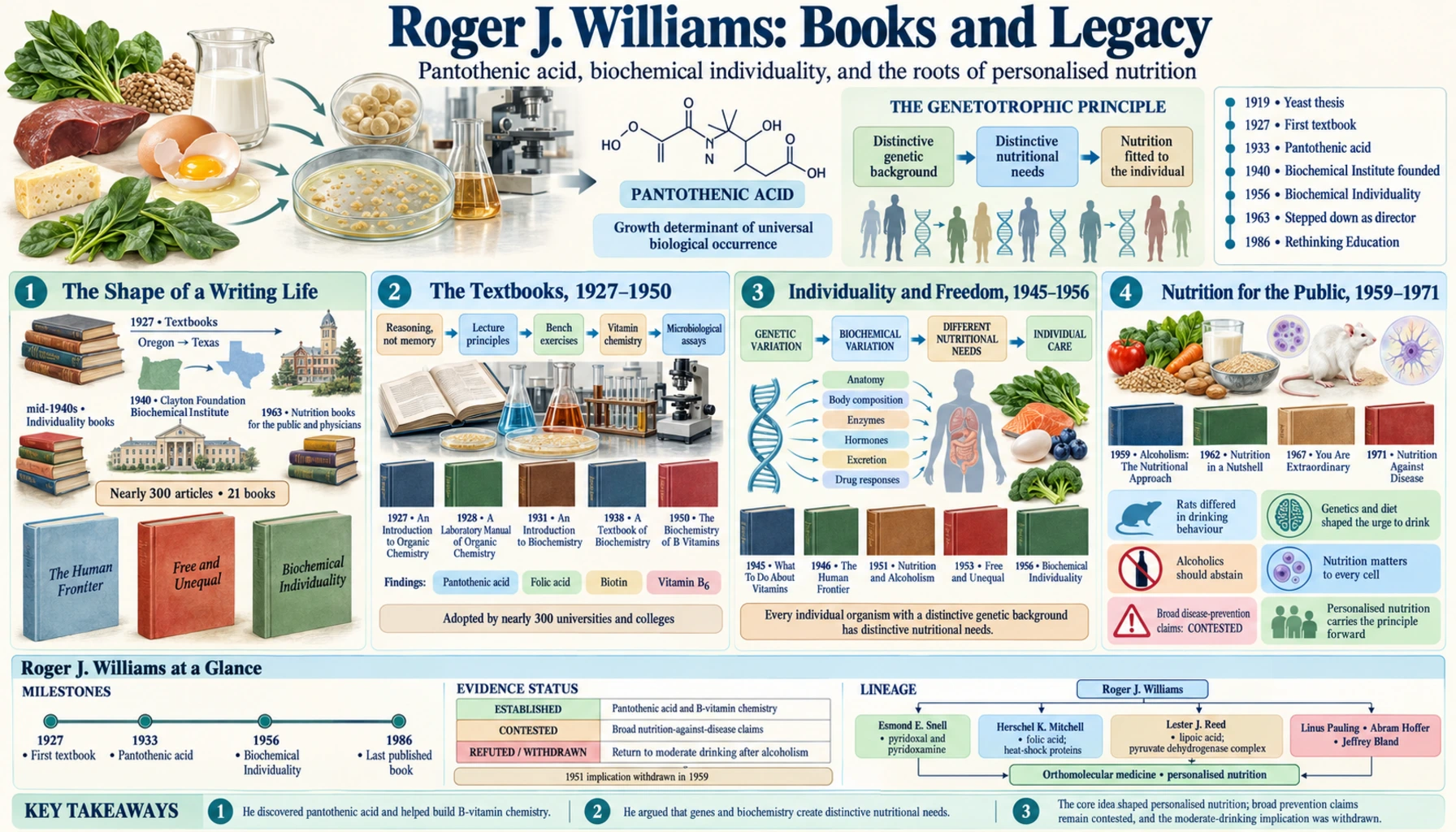
Roger J. Williams wrote for students, for physicians and for the general public for six decades. The National Academy of Sciences memoir by Donald R. Davis, Marvin L. Hackert and Lester J. Reed (2008) credits him with “nearly 300 articles and 21 books,” from an organic chemistry textbook in 1927 to a book on education in 1986, when he was in his nineties. This page is an annotated bibliography of every one of those books, in date order, with the publisher of the first edition and a short summary of the argument as Williams himself stated it.
The second half of the page follows what he left behind: the words he coined, the students and colleagues of the Clayton Foundation Biochemical Institute who went on to their own fame, his influence on orthomolecular medicine and on the idea of personalised nutrition, the honours he received, the Biochemical Institute today, and where his books can still be read free of charge.
Table of Contents
- The Shape of a Writing Life
- The Textbooks, 1927–1950
- Individuality and Freedom, 1945–1956
- Nutrition for the Public, 1959–1971
- The Late Books, 1975–1986
- The Words He Coined
- Students and Co-Workers Who Became Notable
- Influence on Orthomolecular Medicine
- Influence on Personalised Nutrition
- Honours, and the Biochemical Institute Today
- Where to Read Him Today
- Key Research Papers
- Connections
- Featured Videos
1. The Shape of a Writing Life
Williams had wanted to be a writer before he became a chemist. The NAS memoir records that as a college junior he was elected editor of the monthly college publication and as a senior won a $20 essay prize open to all students, but that he judged writing “would probably not afford him a decent livelihood.” He became a chemist who wrote.
His books fall into three groups. First came the textbooks of organic chemistry and biochemistry, written while he was teaching in Oregon and Texas. Then, from the mid-1940s, came the individuality books, which argued that every human being is biochemically distinct and that this fact matters for medicine, education and politics. Finally, especially after he stepped down as director of the Clayton Foundation Biochemical Institute in 1963, came the nutrition books for the public and for physicians.
The memoir states that Williams himself, although best remembered as the discoverer of pantothenic acid, “felt that his most important and far-reaching contributions were embodied in his books The Human Frontier, Free and Unequal, and Biochemical Individuality.”
The complete list below follows the book list kept on the University of Texas Williams website, maintained by his long-time collaborator Donald R. Davis, checked against the NAS memoir. Nineteen books are his own (some co-written), two are works he edited, and one late manuscript was never published — which matches the memoir’s count of 21 books.
2. The Textbooks, 1927–1950
All of the early textbooks were published by D. Van Nostrand of New York and went through several editions. They paid his way, and they taught a generation of chemistry students.
- An Introduction to Organic Chemistry (1927, D. Van Nostrand). His first book; later editions appeared in 1931, 1935, 1941 and 1948 (the fifth with L. F. Hatch). The NAS memoir traces it to his University of Chicago teacher Julius Stieglitz, who, Williams said, “lifted organic chemistry out of the hopeless state (for me) of being merely something to memorize.” Williams set out to present organic chemistry as reasoning rather than memory work, and the memoir reports the book was eventually adopted by nearly three hundred universities and colleges.
- A Laboratory Manual of Organic Chemistry (1928, D. Van Nostrand), with R. Q. Brewster. The companion laboratory book, revised in 1934, 1939 and 1948. It turned the lecture text’s principles into bench exercises for students.
- An Introduction to Biochemistry (1931, D. Van Nostrand). A teaching text on the chemistry of living things, written while his own research on the “bios” growth factors of yeast was under way. A second edition with Ernest Beerstecher appeared in 1948.
- A Textbook of Biochemistry (1938, D. Van Nostrand). A fuller biochemistry text, with a second edition in 1942. It appeared the year his group published the concentration of pantothenic acid from liver, and its revision came after his move to Texas.
- The Biochemistry of B Vitamins (1950, Reinhold), with R. E. Eakin, E. Beerstecher and W. Shive. A technical monograph written with three members of the Clayton Foundation Biochemical Institute, drawing together the vitamin chemistry that the Institute had helped to create: pantothenic acid, folic acid, biotin, the forms of vitamin B6 and the microbiological assays used to measure them.
3. Individuality and Freedom, 1945–1956
- What To Do About Vitamins (1945, University of Oklahoma Press). The earliest of his books aimed beyond the classroom. The NAS memoir groups it with his later books that urged the use of nutritional science “in both traditional medicine and preventive medicine.”
- The Human Frontier (1946, Harcourt Brace). His first statement of the idea that would occupy the rest of his life: that people differ from one another far more than science and society assume. “Since, as science demonstrates, people show wide variability in every respect,” he wrote, “the environment which is suitable for one will not be suitable for all. Society must accommodate itself to individual needs.” As the title suggests, he saw the study of real individuals, rather than the statistically average person, as the unexplored frontier of human science.
- Nutrition and Alcoholism (1951, University of Oklahoma Press). His first book on alcoholism, presenting the Clayton group’s view that some people inherit unusually high needs for certain nutrients and that this can produce a physiological craving for alcohol. It described a nutritional regimen of good food plus a multi-nutrient supplement, to be given through physicians, and reported early informal results. It also carried the implication that an alcoholic might return to moderate drinking — which Williams withdrew in 1959 (see below and Alcoholism and Nutrition).
- Free and Unequal: The Biological Basis of Individual Liberty (1953, University of Texas Press; reissued by Liberty Press in 1979). The political companion to The Human Frontier. As the NAS memoir summarises his position, Williams held that human differences are “politically extremely important because they are the basis for our love of freedom,” and that appreciating them is essential to goodwill, tolerance and human understanding. People are born unequal in make-up, he argued, which is exactly why they need to be free.
- Biochemical Individuality: The Basis for the Genetotrophic Concept (1956, John Wiley & Sons). His most cited book, gathering the evidence that “normal” people differ in anatomy, body composition, enzymes, hormones, excretion patterns, drug responses and nutritional needs. “The existence in every human being of a vast array of attributes which are potentially measurable … makes quite tenable the hypothesis that practically every human being is a deviate in some respects,” he wrote. In the preface he stated that “individuality in nutritional needs is the basis for the genetotrophic approach and for the belief that nutrition applied with due concern for individual genetic variations, which may be large, offers the solution to many baffling health problems.” Translated into Russian (1960), Italian (1964) and Polish (1969); reissued in 1998 with an introduction by Jeffrey Bland and an afterword by Donald R. Davis. See Biochemical Individuality (1956).
4. Nutrition for the Public, 1959–1971
- Alcoholism: The Nutritional Approach (1959, University of Texas Press). A new account of the alcoholism work for general readers, built on the rat and patient studies of the 1950s. Williams reported three findings in rats: that individual animals fed and treated alike differ greatly in drinking behaviour, that this difference is “genetically determined,” and that “what the rats have to eat … is a potent factor in determining how great is their physiological urge to drink alcohol.” In its preface he withdrew the 1951 book’s implication “that alcoholics might well look forward to a life of moderate drinking,” dedicated the volume to Alcoholics Anonymous, and stated that his advice now coincided with that organisation’s: “alcoholics should abstain.” Nutrition, he wrote, could “help tremendously in achieving this end.”
- Nutrition in a Nutshell (1962, Doubleday; also Dolphin Books). A short primer for the general reader. Its chapters ask when nutrition starts, what in the body needs nourishment, what nourishing food contains, which ills may be due to faulty nutrition and how common deficient nutrition is, and close with chapters on good nutritional advice and on supplements. Its message, carried through those chapters, is that nutrition matters to every cell and to far more ills than people commonly suppose.
- You Are Extraordinary (1967, Random House; Pyramid paperback 1971). The individuality message retold for a popular audience, opening with a chapter titled “Dirty-Gray Man?”. Its chapters move from bodies and nerves to eating, sleep and exercise, and then to psychology, philosophy and religion, arguing that each reader is a unique individual whose differences should be respected rather than ironed out. It was excerpted in Reader’s Digest in August 1968.
- The Encyclopedia of Biochemistry (1967, Reinhold), edited with E. M. Lansford Jr. A reference work for students and scientists, one of the two books he edited rather than wrote.
- Nutrition Against Disease: Environmental Prevention (1971, Pitman; Bantam paperback 1973). His fullest case that improved nutrition of the body’s cells could help prevent a wide range of disease, with chapters on birth defects, heart disease, obesity, dental disease, arthritis, ageing, mental disease, alcoholism and cancer. It opens with “The Flaw in Medical Education,” his charge that medicine had neglected nutrition. “The very people who should have been able to give expert guidance to the layman’s intuitions about nutrition have, in fact, virtually abandoned the field,” he wrote, adding that “the layman’s intuitions, uninformed as they may be, are often more justified than the physician’s neglect.” See Nutrition Against Disease (1971).
5. The Late Books, 1975–1986
The UT brief biography notes that after his 80th birthday Williams “continued to be actively involved, writing and editing several important books dealing with aspects of human nutrition and education.” The NAS memoir adds that after age 80 he gave more than 80 lectures and seminars on biochemical individuality and nutrition.
- Physicians’ Handbook of Nutritional Science (1975, Charles C. Thomas). A book written for doctors. “It is the author’s ambitious hope that after reading this book the physician may be inclined to say to himself, ‘Now, for the first time, I really appreciate the deep significance and meaning of nutrition and its importance in medical practice,’” he wrote in the preface. It included his suggested daily vitamin and mineral formulations “for those who need insurance,” with the note: “While I have never been in the vitamin business and have never derived profit from any vitamin or supplement formulation … No infallibility is claimed.”
- A Physician’s Handbook on Orthomolecular Medicine (1977, Pergamon), edited with Dwight K. Kalita. A volume on orthomolecular medicine for clinicians; the second of his two edited books. A 1978 printing was issued “with corrections” and a 1979 softcover (Keats Publishing) carried a quotation from Linus Pauling on the cover.
- The Wonderful World Within You: Your Inner Nutritional Environment (1977, Bantam Books; updated editions 1987 and 1998). A plain-language tour of how cells are nourished and why each person’s needs differ, ending with a long chapter on how to choose your own nourishment and a chapter titled “What Improved Nutrition Has Done For Me.” On heart disease he wrote that atherosclerosis “is a complex problem that is not solved merely by eating less fat or avoiding cholesterol-containing foods. Cholesterol is not a bad substance; it is made by virtually every cell in our bodies and is necessary to life.” Translated into Japanese in 1985.
- The Prevention of Alcoholism Through Nutrition (1981, Bantam Books). His third alcoholism book shifts from treatment to prevention. Part I lists his steps: treat yourself as the unique individual you are, eat high-quality foods, avoid low-quality foods, exercise, cultivate moderation and inner peace, use nutritional supplements, and use glutamine as a supplementary food. Later parts argue that alcoholism is “a metabolic disease” that medicine had treated as an “alien disease.”
- The Advancement of Nutrition (1982, International Academy of Preventive Medicine). A short statement of principles in numbered chapters: “Nutrition Must Be for Real People. ‘Statistical Man’ Is of Little or No Interest”; “Nutrients Work Together As in a Chain or Team”; “Cellular Nutrition Is Basic.” Its core claim is in one line: “Always nutrition can be improved, and this improvement is the chief objective of nutritional study.”
- Rethinking Education: The Coming Age of Enlightenment (1986, Philosophical Library). His last book, published when he was 92. Its preface proposes “that education at all levels move as rapidly as is possible away from a fragmented, disjointed approach toward a more unified approach which will be coherent and integrated instead of incoherent and compartmentalized.” He argued that unified knowledge, with a place for individuality, would improve human understanding and help prevent war.
- Exploring Your Individuality: A Vital Step to Human Understanding (1988, with D. R. Davis; unpublished). Listed on the UT website as a manuscript from the year of his death that was never published.
6. The Words He Coined
The NAS memoir calls Williams’s “flair for coining words” an “interesting sidelight” of his science: “When new names or words were needed, he simply created them.” The UT website lists these, each with the paper that introduced it:
- Nutrilite (1928). A substance needed in small amounts by any organism, including plants, bacteria and fungi — a vitamin-like word for the whole living world. The memoir says the word came to him in a dream, in which his brother Robert approved it; he published it in Science (67:607).
- Pantothenic acid (1933). From the Greek pantothen, “from everywhere,” because the growth factor turned up in every kind of living material tested. See How Williams Discovered Pantothenic Acid.
- Folic acid (1941). From the Latin folium, leaf, after the vitamin concentrated from spinach by Mitchell, Snell and Williams. See Folic Acid and the Clayton Institute.
- Avidin (1941). The raw egg-white protein that “avidly” binds biotin and makes it unavailable, named by Eakin, Snell and Williams.
- Isotel, isotelic (1943). From the Greek for “same purpose”: a substance that serves the same function as another in nutrition.
- Genetotrophic (1949). A disease with both genetic (geneto) and nutritional (trophic) roots, introduced in the 1949 PNAS paper with Berry and Beerstecher. See The Genetotrophic Concept of Disease.
- Propetology (1961). From the Greek for “leaning toward”: a proposed science of the inborn leanings of individuals toward particular diseases, set out with F. L. Siegel in the American Journal of Medicine.
The memoir adds that the Institute’s staff also named pyridoxal, pyridoxamine and lipoic acid — “a legacy of vitamins and biochemicals whose names were created by them.”
7. Students and Co-Workers Who Became Notable
Williams ran the Institute as an association of independent investigators. “There is, in my opinion, no place for orthodoxy in science,” he wrote in his 1966 short history of it, and “by encouraging each investigator to make his own contributions and earn his own reputation, it has been possible to attract and keep able and highly productive individuals on the staff.” He counted nearly 300 investigators as authors of the Institute’s roughly 700 publications from 1940 to 1965. Among them:
- Esmond E. Snell (1914–2003). Came to Austin as a postdoctoral associate in 1939, after a Wisconsin doctorate, so he was a colleague rather than a student. He worked with Williams on biotin, avidin and folic acid, and discovered pyridoxal and pyridoxamine, the active forms of vitamin B6. Williams singled him out as “a notable example” of the Institute’s policy: he became a professor at Wisconsin and later chairman of biochemistry at the University of California, Berkeley. He was elected to the National Academy of Sciences.
- Herschel K. Mitchell (1913–2000). Took a master’s degree at Oregon State College in 1938, while Williams taught there, and a Ph.D. at Texas in 1941, working with Williams and Snell on folic acid and vitamin B6. He was first author of the 1941 paper that named folic acid. He spent most of his career at the California Institute of Technology, where in the 1970s, with Alfred Tissières, he found that heat shock makes cells produce a small set of proteins while shutting down most others — a starting point for the study of heat-shock proteins.
- Robert E. Eakin (1916–1979). A Texas Ph.D. (1942) whose work with Williams and Snell explained raw egg-white injury as biotin deficiency and identified avidin. He stayed as one of the Institute’s principal investigators.
- William Shive (1916–2001). A Texas Ph.D. (1941) and co-author of The Biochemistry of B Vitamins; by 1965 he was chairman of the UT Chemistry Department. In his Short History Williams credited “the work of Dr. Shive and his medical collaborators” with the finding that oral glutamine hastened the healing of peptic ulcers in some individuals.
- Lester J. Reed (1925–2015). Not a student but a younger colleague: an Illinois Ph.D. who joined UT in 1948, isolated lipoic acid and worked out the structure of the large pyruvate dehydrogenase enzyme complex — what Williams called “possibly the most elegant work contributed by our Institute.” Reed succeeded Williams as director in 1963 and served until 1997, and was elected to the NAS in 1973.
- Donald R. Davis. Williams’s collaborator in his last decades, co-author of the 1976 paper on criteria for nutritional adequacy and of the 1986 paper on “differential nutrition.” He kept the Williams website at the Biochemical Institute, wrote the 1988 In Memoriam, the afterword to the 1998 Biochemical Individuality and the preface to the 1998 Wonderful World Within You, and was lead author of the 2008 NAS memoir. In 2004 he and co-authors compared US Department of Agriculture data for 43 garden crops between 1950 and 1999 and reported apparent declines in six nutrients.
Other names that run through the Institute’s papers include Ernest Beerstecher Jr., Beverly M. Guirard, Alfred Taylor and Robert B. Pelton. The Biochemical Institute’s own history adds that Williams was instrumental in attracting the coenzyme Q researcher Karl Folkers to Austin.
8. Influence on Orthomolecular Medicine
Williams was a biochemist, not a physician, but in 1977 he co-edited a handbook of orthomolecular medicine, and the UT website states that his books “strongly influenced many prominent leaders such [as] Linus Pauling … Jonathan Wright, Alan Gaby, Abram Hoffer, Jeffrey Bland, Carl Pfeiffer, and Hugh D. Riordan.”
- Linus Pauling. Pauling coined the word “orthomolecular” in 1968. The NAS memoir records that Williams was one of the founders, with Albert Szent-Györgyi, Linus Pauling and Arthur M. Sackler, of the Foundation for Nutritional Advancement. The 1979 edition of Williams’s A Physician’s Handbook on Orthomolecular Medicine carried a Pauling quotation on its cover. See Linus Pauling: Vitamin C and Orthomolecular Medicine.
- Abram Hoffer. The UT website names the Canadian psychiatrist among those Williams’s books influenced. The orthomolecular journals published tributes to Williams: a 1985 profile of the Williams brothers, “Nutrient Pioneers,” in the Journal of Orthomolecular Psychiatry, and a 1988 In Memoriam by John J. Biesele in the Journal of Orthomolecular Medicine. See Dr. Abram Hoffer and Orthomolecular Medicine.
- The Orthomolecular Medicine Hall of Fame. When the International Society for Orthomolecular Medicine founded its Hall of Fame in 2004, Roger Williams was in the first class, alongside Linus Pauling, Humphry Osmond, Carl Pfeiffer, Irwin Stone and others. Hoffer was inducted in 2006.
9. Influence on Personalised Nutrition
The idea now marketed as “personalised” or “precision” nutrition — that diet should fit the individual’s own genes and biochemistry — is the idea Williams called the genetotrophic principle. In Biochemical Individuality he put it in one sentence: “Every individual organism that has a distinctive genetic background has distinctive nutritional needs which must be met for optimal wellbeing.”
His laboratory tried to measure those differences directly. With Robert Pelton he published “Individuality as exhibited by inbred animals” (1962, with F. L. Siegel), “Individuality in nutrition: the genetotrophic principle” (1965) and a 1966 study of how individual experimental animals fared on vitamin A-deficient and other deficient diets. With Gary Deason he published “Individuality in vitamin C needs” (1967), and with M. L. Yew and Y. Lo he estimated individual optimal vitamin C intakes by lingual (tongue) tests (1973). And with Davis he proposed, in 1976, criteria for judging whether a diet is adequate for a particular person and, in 1986, “differential nutrition” — nutrition aimed at the needs of the individual rather than the average.
The reissues kept the idea in circulation. The 1998 edition of Biochemical Individuality carried a new introduction by Jeffrey Bland, one of the names the UT website lists among those Williams influenced. The NAS memoir adds that his ideas helped inspire a medical clinic founded in Wichita, Kansas, in 1975, where every new patient received a copy of The Wonderful World Within You.
10. Honours, and the Biochemical Institute Today
The NAS memoir lists these honours:
- Mead Johnson Award of the American Institute of Nutrition (1941) and the Chandler Medal of Columbia University (1942), both for pantothenic acid (the UT brief biography dates both to 1941).
- Election to the National Academy of Sciences (1946) and the presidency of the American Chemical Society (1957).
- The Southwest Regional Award of the American Chemical Society (1950) and the Arthur M. Sackler Foundation Award for Nutrition (1983).
- Honorary D.Sc. degrees from the University of Redlands (1934), Columbia University (1942) and Oregon State University (1956).
- Service on the Food and Nutrition Board of the National Research Council (1949–1953) and on the President’s Advisory Panel on Heart Disease (1972).
Later recognition includes his 2004 induction into the Orthomolecular Medicine Hall of Fame, and, as the UT website records, the 1990 listing of his 1933 pantothenic acid paper as a “Citation Classic” in Current Contents. We could find no prize or award named after Roger J. Williams. An American Heart Association award with a similar name honours a different scientist, the genetic epidemiologist Roger R. Williams.
The Biochemical Institute he founded in 1940 with Benjamin Clayton’s support still exists at the University of Texas at Austin. Its history page records that Lester Reed directed it from 1963 to 1997 and repeats the claim that “more vitamins and their variants were discovered in the Biochemical Institute than in any other laboratory in the world.” The Institute hosts the Williams website, including the full text of his 1966 Short History and its publication list. His papers are held in the University of Texas archives, and he is buried in Austin Memorial Park.
11. Where to Read Him Today
Several of Williams’s books are free to read in full on the Internet Archive:
- Biochemical Individuality (1956) — Digital Library of India scan, open to all.
- Nutrition and Alcoholism (1951) — open scan.
- The Biochemistry of B Vitamins (1950) — open scan from the Biodiversity Heritage Library collection.
- Rethinking Education (1986) — the full book, reproduced on ERIC microfiche (ED289758).
- The Vitamine Requirement of Yeast (1919) — his Chicago doctoral thesis, where the work began.
Most of the popular books — The Human Frontier, Free and Unequal, Alcoholism: The Nutritional Approach, Nutrition in a Nutshell, You Are Extraordinary, Nutrition Against Disease, Physicians’ Handbook of Nutritional Science, The Wonderful World Within You and The Prevention of Alcoholism Through Nutrition — are in the Internet Archive’s lending library, which lets you borrow a copy for free with an account.
Two other sources are free and authoritative: the University of Texas Roger J. Williams website, which has contents pages, prefaces, a sampler of quotations, his 1954 autobiography and the Short History of the Institute; and the National Academy of Sciences Biographical Memoir (2008).
Key Research Papers
- Williams RJ, Lyman CM, Goodyear GH, Truesdail JH, Holaday D. “Pantothenic acid,” a growth determinant of universal biological occurrence. J Am Chem Soc. 1933;55:2912-27. DOI: 10.1021/ja01334a049. — doi:10.1021/ja01334a049
- Eakin RE, McKinley WA, Williams RJ. Egg-white injury in chicks and its relationship to a deficiency of vitamin H (biotin). Science. 1940;92:224-5. — PubMed PMID: 17743857
- Mitchell HK, Snell EE, Williams RJ. The concentration of “folic acid”. J Am Chem Soc. 1941;63:2284. DOI: 10.1021/ja01853a512. — doi:10.1021/ja01853a512
- Guirard BM, Snell EE, Williams RJ. Microbiological determination of amino acids; lysine, histidine, arginine, and valine. Proc Soc Exp Biol Med. 1946;61:158-61. — PubMed PMID: 21017605
- Williams RJ. Biochemical approach to individuality. Science. 1948;107:459. — PubMed PMID: 18938467
- Williams RJ, Berry LJ, Beerstecher E. Individual metabolic patterns, alcoholism, genetotrophic diseases. Proc Natl Acad Sci USA. 1949;35:265-71. — PubMed PMID: 16588890
- Williams RJ. Early experiences with pantothenic acid; a retrospect. Nutr Rev. 1954;12:65-8. — PubMed PMID: 13133195
- Williams RJ. Biochemical individuality and cellular nutrition: prime factors in alcoholism. Q J Stud Alcohol. 1959;20:452-63. — PubMed PMID: 13844933
- Williams RJ, Pelton RB. Individuality in nutrition: the genetotrophic principle. Science. 1965;148:669. — PubMed PMID: 17801961
- Williams RJ, Deason G. Individuality in vitamin C needs. Proc Natl Acad Sci USA. 1967;57:1638-41. — PubMed PMID: 5231398
- Yew ML, Lo Y, Williams RJ. Levels of optimal vitamin C intake in individuals as estimated by the lingual tests. Proc Soc Exp Biol Med. 1973;144:626-7. — PubMed PMID: 4746937
- Williams RJ, Heffley JD, Yew ML, Bode CW. A renaissance of nutritional science is imminent. Perspect Biol Med. 1973;17:1-15. — PubMed PMID: 4751533
- Davis DR, Williams RJ. Potentially useful criteria for judging nutritional adequacy. Am J Clin Nutr. 1976;29:710-5. — PubMed PMID: 937225
- Williams RJ, Davis DR. Differential nutrition—a new orientation from which to approach the problems of human nutrition. Perspect Biol Med. 1986;29:199-202. — PubMed PMID: 3951955
PubMed Topic Searches
Connections
- Dr. Roger J. Williams and Biochemical Individuality
- Roger J. Williams: Life and Career
- How Roger J. Williams Discovered Pantothenic Acid
- Folic Acid and the Clayton Foundation Biochemical Institute
- Biochemical Individuality (1956)
- The Genetotrophic Concept of Disease
- Roger J. Williams on Alcoholism and Nutrition
- Nutrition Against Disease (1971)
- Linus Pauling: Vitamin C and Orthomolecular Medicine
- Dr. Abram Hoffer and Orthomolecular Medicine
- Vitamin B5 (Pantothenic Acid)
- Nutrition & Orthomolecular