Roger J. Williams: Life and Career
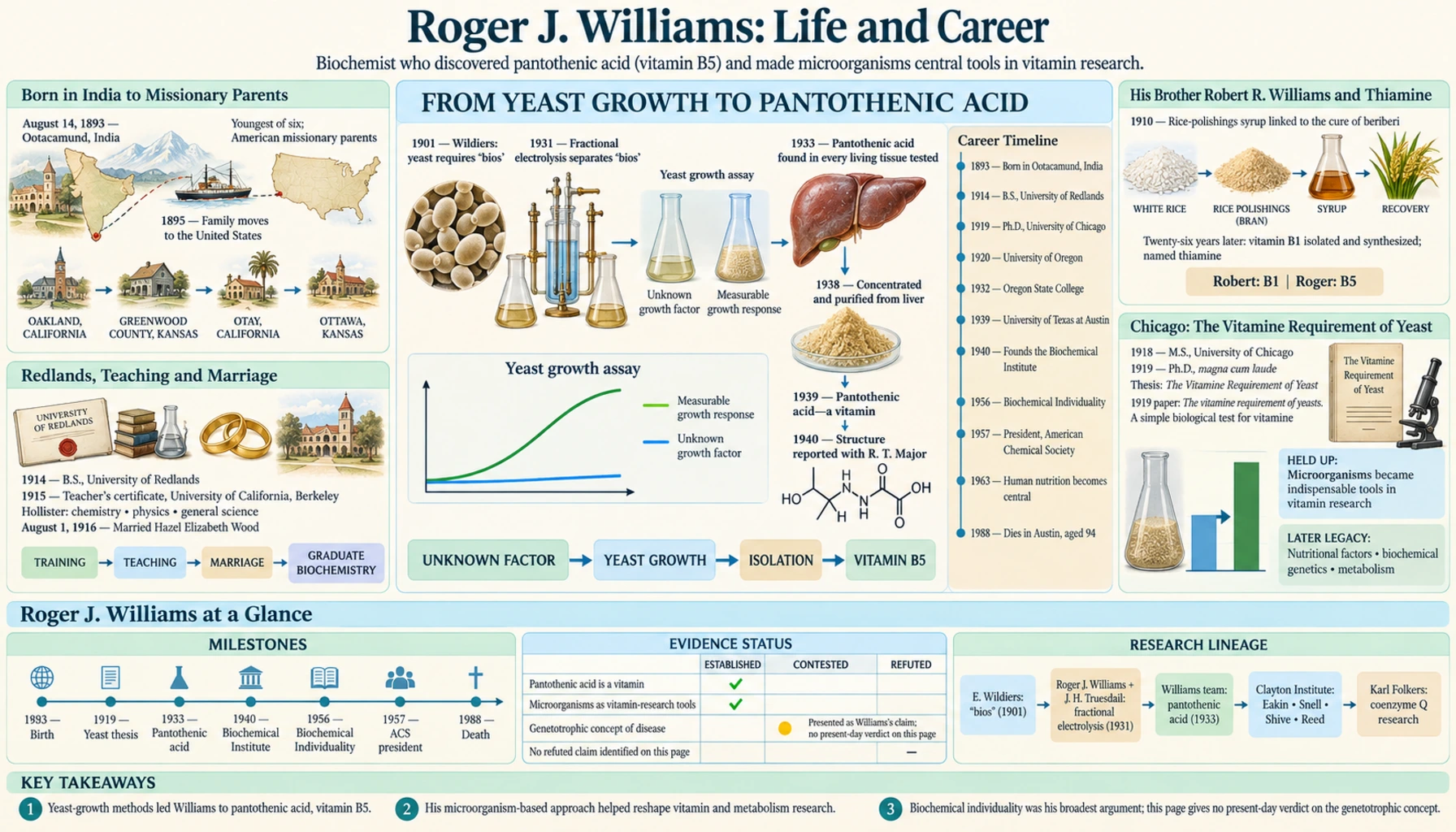
Roger John Williams (August 14, 1893 – February 20, 1988) was an American chemist who began his career studying what made yeast cells grow and ended it as one of the best-known voices for nutrition in medicine. Along the way he discovered pantothenic acid (vitamin B5), named folic acid, founded the Clayton Foundation Biochemical Institute at the University of Texas at Austin, served as president of the American Chemical Society, and wrote the book he considered his most important, Biochemical Individuality (1956).
This page tells the story of his life in plain language: a childhood that began in India, a brother who conquered beriberi, a doctoral thesis on the “vitamine” needs of yeast, the Oregon years that produced pantothenic acid, the Texas institute that his colleagues credited with more vitamin discoveries than any other laboratory, and the long second career he devoted to teaching the public about nutrition. The dates come from the National Academy of Sciences biographical memoir by Donald R. Davis, Marvin L. Hackert and Lester J. Reed (2008) and from the University of Texas Biochemical Institute’s own history pages.
Table of Contents
- Born in India to Missionary Parents
- His Brother Robert R. Williams and Thiamine
- Redlands, Teaching and Marriage
- Chicago: The Vitamine Requirement of Yeast
- The Oregon Years and Pantothenic Acid
- Texas and the Clayton Foundation Biochemical Institute
- A Maker of New Words
- The Turn to Human Nutrition and Individuality
- Honours and Public Service
- Later Years and Death
- Timeline
- Key Research Papers
- Connections
- Featured Videos
1. Born in India to Missionary Parents
Roger John Williams was born on August 14, 1893, in Ootacamund (the memoir spells it Ootacumund), a hill town in southern India. He was the youngest of six children of American missionary parents. When he was two years old the family sailed across the Pacific to the United States.
After a short stop in Oakland, California, his father bought an 800-acre ranch in Greenwood County, Kansas, about 12 miles outside Eureka. At four, Roger walked to a one-room country school about 2 miles from home. The family later moved to California, where his father took a small pastorate at Otay, near the Mexican border. About four years later they returned to the Kansas ranch and eventually settled in nearby Ottawa, Kansas.
Williams was a good student, but he read with difficulty. Much later it was found that he had severe aniseikonia, an eye condition in which the two eyes see images of different sizes, which caused eyestrain whenever he read for more than a short time. The condition was not even recognized until about 1930, and special glasses corrected it only moderately, in 1941, when he was nearly 50. According to his biographers, he never felt sorry for himself about it; he liked to say that his affliction gave him more time to think while others were reading.
2. His Brother Robert R. Williams and Thiamine
Roger’s interest in chemistry came from his oldest brother, Robert R. Williams, eight years his senior, whom he admired all his life. Robert had seen the effects of nutritional deficiency disease first-hand while the family lived in India. In 1910, when Roger was 17, Robert learned that a syrup made from rice polishings (the bran layer removed when rice is milled white) could cure beriberi. According to the National Academy memoir, twenty-six years later Robert isolated and synthesized vitamin B1, which he named thiamine.
Both brothers were eventually elected to the National Academy of Sciences, and both are remembered for a B vitamin: Robert for thiamine (B1), Roger for pantothenic acid (B5). Robert also turned up in one of Roger’s favorite stories, about how he came to coin the word “nutrilite” (see section 7).
3. Redlands, Teaching and Marriage
At college Williams studied chemistry but also weighed careers in medicine, the ministry and writing. As a junior he was elected editor of the monthly college publication, and as a senior he won a $20 essay prize open to all students. He had, his biographers wrote, the “writing bug,” but he judged that writing would probably not earn him a decent living. That talent returned decades later in more than twenty books.
He received his B.S. from the University of Redlands in California in 1914 and a high school teacher’s certificate from the University of California, Berkeley, in 1915. His first job offer was as foreman of a small nursery; as a teenager in Ottawa he had worked budding young fruit trees, two thousand a day for one dollar. At the last minute a teaching post opened in Hollister, California, where he taught chemistry, physics and general science and supervised study halls. He later called it “the hardest work I ever did.”
On August 1, 1916, during his first year of teaching, he married his college sweetheart, Hazel Elizabeth Wood. They had three children: Roger John Williams Jr. (born 1918), Janet Elizabeth Williams (born 1920) and Arnold Eugene Williams (born 1927). After another year of teaching the couple decided to leave so that he could do graduate work at the University of Chicago, where his three older brothers had studied.
4. Chicago: The Vitamine Requirement of Yeast
At Chicago, Williams met Professor Julius Stieglitz, who changed how he saw chemistry. His undergraduate organic chemistry had left him discouraged, and he later said that Stieglitz “lifted organic chemistry out of the hopeless state (for me) of being merely something to memorize.” That experience led, years later, to his own textbook, An Introduction to Organic Chemistry (1927), which the memoir reports was adopted by nearly three hundred colleges and universities and ran to five editions.
He earned his M.S. in 1918 and his Ph.D., magna cum laude, in 1919, working in biochemistry with F. C. Koch. His thesis was titled “The Vitamine Requirement of Yeast” (published in the Journal of Biological Chemistry in 1919 as “The vitamine requirement of yeasts. A simple biological test for vitamine”). At that time vitamins were still spelled “vitamines” and were known only as unidentified factors whose absence caused disease in animals. Williams was always glad, he later said, that he had been drawn to this rich new field so early. This 1919 thesis is the first entry in the memoir’s bibliography and marks the start of his research career.
After Chicago he worked briefly as a research chemist for a yeast company before returning to academic life.
5. The Oregon Years and Pantothenic Acid
In 1920 Williams became an assistant professor at the University of Oregon, rising to full professor in 1928. From 1932 to 1939 he was a professor at Oregon State College (today Oregon State University). These nearly twenty years in Oregon produced the work that made his name.
His starting point was an old puzzle. In 1901 the Belgian scientist E. Wildiers had shown that yeast needed an unknown substance, which he called “bios,” in order to grow. Williams developed methods for measuring exactly how well yeast grew, and in 1931 he and J. H. Truesdail reported using fractional electrolysis to separate the “bios” of Wildiers into its parts. The memoir stresses the idea that guided him: the basic biochemistry of all living things is the same, so a substance that yeast needs to grow is likely to matter to animals and people too. Leading biochemists of the day urged him to switch to animal experiments; he kept working with yeast.
That persistence paid off. In 1933 Williams and his co-workers announced a yeast growth factor that they found in every kind of living tissue they tested, and named it pantothenic acid, from the Greek pantothen, “from all sides.” In 1938 the group reported concentrating and purifying it from liver, and in 1939 Williams published a note in Science titled “Pantothenic acid—a vitamin,” and its structure was reported with R. T. Major in 1940. Over the same years his laboratory showed that the substance mattered for molds and green plants as well as for yeast. The full story is told on the companion page How Roger J. Williams Discovered Pantothenic Acid (Vitamin B5).
The patents on the synthesis of pantothenic acid were assigned to Research Corporation, a nonprofit foundation that funds science. According to the memoir the royalties came to many hundreds of thousands of dollars a year, much of it put back into research. Williams felt scientists were fortunate when they could concentrate on their work and forget about “the million dollars” it might bring in.
Oregon also gave him his lifelong hobbies. He learned to fish for trout and spoke fondly of wading in clear mountain streams even when nothing was biting. He took up golf, and he had absolute pitch and could tune and play the violin or piano by ear.
6. Texas and the Clayton Foundation Biochemical Institute
In 1939 Williams accepted a professorship in the Department of Chemistry at the University of Texas at Austin. In 1940, with funding from the Houston businessman and philanthropist Benjamin Clayton and the Clayton Foundation for Research, he founded the Biochemical Institute, later named the Clayton Foundation Biochemical Institute. He directed it for 23 years, until 1963, when Lester J. Reed succeeded him. Williams liked to recall that the first time he broke 80 on a regulation golf course, with a 76, was Friday, September 13, 1940, the same day the Clayton Foundation began supporting his work in Texas.
Williams believed, his biographers wrote, that the best way to understand health and disease was to understand the biochemistry of normal cells. He ran the institute as an association of semi-independent investigators, each supported to succeed in his own area. His early colleagues included Robert Eakin, Esmond Snell, William Shive and Lester Reed, and he helped bring the coenzyme Q researcher Karl Folkers to the university.
The record of the Williams years is long. According to the National Academy memoir and the institute’s history, Williams and his students and collaborators:
- discovered or characterized pantothenic acid, folic acid, pyridoxal and pyridoxamine (two forms of vitamin B6), lipoic acid and avidin;
- concentrated folic acid from spinach leaves and gave it its name (1941);
- identified avidin, the raw egg-white protein that binds biotin and causes “egg-white injury” (1940–1941);
- discovered folinic acid and did pioneering work on inositol;
- developed a commercial synthesis of vitamin B12.
The institute’s history states that more vitamins and their variants were discovered there than in any other laboratory in the world. Williams himself, writing in Science in 1941, argued that microorganisms had become indispensable tools in vitamin research, and the memoir credits his work, together with that of one other laboratory, with giving microbes their leading role in the discovery of new nutritional factors, in biochemical genetics and in the study of metabolism. The folic acid story is told on Folic Acid and the Clayton Foundation Biochemical Institute.
7. A Maker of New Words
His biographers noted his flair for coining words. When a new name was needed, he simply made one up:
- Pantothenic acid — from the Greek pantothen, “from all sides,” because it occurs everywhere in living matter.
- Folic acid — from the Latin folium, “leaf,” because it was concentrated from spinach leaves.
- Avidin — from the Latin avidus, “to covet,” for the egg-white protein that grips biotin so tightly.
- Nutrilite — a word like “vitamin” that would apply to plants and microbes as well as animals.
- Genetotrophic, isotelic and propetology — terms for his ideas about heredity, nutrition and individual differences.
“Nutrilite” came to him in a dream. In the dream he and his brother Robert were discussing the need for such a word; Roger proposed “nutrilite,” and Robert agreed it sounded good. With that dream approval, the memoir reports, he published the suggestion in Science in 1928, and he used it in later papers such as his 1932 study of “nutrilites” in molds and other fungi.
8. The Turn to Human Nutrition and Individuality
Although most people remember Williams for pantothenic acid, his biographers wrote that he himself felt his most important and far-reaching contributions were his books The Human Frontier (1946), Free and Unequal (1953) and Biochemical Individuality: The Basis for the Genetotrophic Concept (1956).
The idea began with his own body. After an operation, a routine dose of morphine had an “opposite-than-expected” effect on him. His first scientific study of individual differences, published in 1928, looked at how differently people taste creatine. By 1948 he was writing in Science about a “biochemical approach to individuality.” His central claim, as the memoir summarizes it, was that inborn differences between people are widespread, often large, and crucial to understanding most human problems, and that medicine had paid too much attention to how “the human body” works and too little to the striking differences between individual metabolic patterns. He extended this into politics and education as well: he contended that these differences are the basis of our love of freedom and that appreciating them is essential to tolerance and goodwill.
From these ideas came his “genetotrophic” concept, first set out with his co-workers L. J. Berry and E. Beerstecher Jr. around 1949–1950: that some diseases arise when a person’s inherited needs for particular nutrients are higher than his diet supplies. He applied it first and most persistently to alcoholism. See Biochemical Individuality (1956), The Genetotrophic Concept of Disease and Roger J. Williams on Alcoholism and Nutrition.
After he stepped down as director of the institute in 1963, the University of Texas biography records, human nutrition became his central interest. His popular and professional books on the subject included What To Do About Vitamins (1945), Alcoholism: The Nutritional Approach (1959), Nutrition in a Nutshell (1962), You Are Extraordinary (1967), Nutrition Against Disease: Environmental Prevention (1971), Physicians’ Handbook of Nutritional Science (1975), The Wonderful World Within You (1977), The Prevention of Alcoholism Through Nutrition (1981) and Rethinking Education: The Coming Age of Enlightenment (1986). In journal articles he argued that the “nutritive value of single foods” could be measured by how well they supported life on their own (1971), that “a renaissance of nutritional science is imminent” (1973), and that medical education needed to change to make room for nutrition. The books are discussed on Nutrition Against Disease (1971) and Cellular Nutrition and Roger J. Williams: Books and Legacy.
9. Honours and Public Service
Williams received most of the honours his field could give. The National Academy memoir lists:
- Election to the National Academy of Sciences, 1946.
- President of the American Chemical Society, 1957.
- Mead Johnson Award of the American Institute of Nutrition, 1941, for the discovery of pantothenic acid.
- Chandler Medal of Columbia University, 1942.
- Southwest Regional Award of the American Chemical Society, 1950.
- Arthur M. Sackler Foundation Award for Nutrition, 1983.
- Honorary D.Sc. degrees from the University of Redlands (1934), Columbia University (1942) and Oregon State University (1956).
He served on the Food and Nutrition Board of the National Research Council (1949–1953), on President Nixon’s Advisory Panel on Heart Disease (1972), on the editorial board of Archives of Biochemistry, and on advisory boards of national multiple sclerosis, muscular dystrophy and cancer charities. He was one of the founders, with Albert Szent-Györgyi, Linus Pauling and Arthur M. Sackler, of the Foundation for Nutritional Advancement. His ideas also helped inspire a medical clinic founded in Wichita, Kansas, in 1975, where, according to the memoir, every new patient received a copy of The Wonderful World Within You.
10. Later Years and Death
Hazel Williams died in 1952 after 35 years of marriage. In 1953 Williams married Mabel Phyllis (Foote) Hobson, a widow with one son, John Wallace Hobson. The couple traveled widely in the United States and abroad. Even after the age of 80, the memoir reports, Williams gave more than 80 lectures and seminars on biochemical individuality and the importance of nutrition in health and medicine.
He became Emeritus Professor of Chemistry in 1971 and, according to the University of Texas biography, retired from that position in 1986, at age 92. That same year he published his last journal paper, written with his longtime colleague Donald R. Davis, “Differential nutrition—a new orientation from which to approach the problems of human nutrition” in Perspectives in Biology and Medicine, and his last book, Rethinking Education. In all he wrote 21 books and, by the memoir’s count, nearly 300 scientific articles.
Summing up his career, Williams called himself one of those specialists who specialize in having broad interests, naming biochemistry, genetics, pharmacology, nutrition, psychology, anthropology, social science and medicine, along with his family, friends, students, religion, music, fly fishing, golf and card playing. He was a celebrated storyteller and a loyal fan of University of Texas athletics.
Roger J. Williams died of pneumonia in an Austin nursing home on February 20, 1988, at age 94. He is buried in Austin Memorial Park, and his papers are held by the University of Texas. Phyllis Williams died in June 2004.
11. Timeline
| Year | Event |
|---|---|
| 1893 | Born August 14 in Ootacamund, India, youngest of six children of American missionaries. |
| 1895 | Family moves to the United States; grows up in Kansas and California. |
| 1914 | B.S., University of Redlands. |
| 1915 | High school teacher’s certificate, University of California, Berkeley; teaches at Hollister. |
| 1916 | Marries Hazel Elizabeth Wood, August 1. |
| 1918 | M.S., University of Chicago. |
| 1919 | Ph.D., magna cum laude, University of Chicago; thesis “The Vitamine Requirement of Yeast.” |
| 1920 | Assistant professor, University of Oregon (full professor 1928). |
| 1927 | Publishes An Introduction to Organic Chemistry. |
| 1928 | Proposes the word “nutrilite” in Science; studies individual differences in tasting creatine. |
| 1932 | Professor at Oregon State College (to 1939). |
| 1933 | Announces pantothenic acid, “a growth determinant of universal biological occurrence.” |
| 1938 | Pantothenic acid concentrated and purified from liver. |
| 1939 | “Pantothenic acid—a vitamin”; joins the University of Texas at Austin. |
| 1940 | Founds the Biochemical Institute (later Clayton Foundation Biochemical Institute); structure of pantothenic acid reported. |
| 1941 | Concentrates and names folic acid; Mead Johnson Award. |
| 1942 | Chandler Medal and honorary D.Sc., Columbia University. |
| 1946 | Elected to the National Academy of Sciences; The Human Frontier. |
| 1949–1950 | Sets out the genetotrophic concept of disease with Berry and Beerstecher. |
| 1952–1953 | Hazel dies (1952); marries Phyllis Hobson (1953); Free and Unequal (1953). |
| 1956 | Biochemical Individuality: The Basis for the Genetotrophic Concept. |
| 1957 | President of the American Chemical Society. |
| 1959 | Alcoholism: The Nutritional Approach. |
| 1963 | Steps down as director of the institute; turns to human nutrition. |
| 1971 | Emeritus Professor of Chemistry; Nutrition Against Disease. |
| 1972 | President’s Advisory Panel on Heart Disease. |
| 1977 | The Wonderful World Within You. |
| 1981 | The Prevention of Alcoholism Through Nutrition. |
| 1983 | Arthur M. Sackler Foundation Award for Nutrition. |
| 1986 | Last journal paper (“Differential nutrition,” with D. R. Davis) and last book, Rethinking Education; retires as emeritus professor at 92. |
| 1988 | Dies February 20 in Austin, Texas, aged 94. |
Sources for these dates: the National Academy of Sciences Biographical Memoir by Davis, Hackert and Reed (2008); the University of Texas brief biography and Biochemical Institute history; and his papers listed below.
Key Research Papers
- Williams RJ, Honn JM. Role of “nutrilites” in the nutrition of molds and other fungi. Plant Physiol. 1932;7:629-41. — PubMed PMID: 16652799
- Williams RJ, Lyman CM, Goodyear GH, Truesdail JH, Holaday D. “Pantothenic acid,” a growth determinant of universal biological occurrence. J Am Chem Soc. 1933;55:2912-27. DOI: 10.1021/ja01334a049. — doi:10.1021/ja01334a049
- Williams RJ, Truesdail JH, Weinstock HH, Rohrmann E, Lyman CM, et al. Pantothenic acid. II. Its concentration and purification from liver. J Am Chem Soc. 1938;60:2719-23. DOI: 10.1021/ja01278a051. — doi:10.1021/ja01278a051
- Williams RJ. Pantothenic acid—a vitamin. Science. 1939;89:486. — PubMed PMID: 17811089
- Williams RJ, Major RT. The structure of pantothenic acid. Science. 1940;91:246. — PubMed PMID: 17831185
- Williams RJ. Vitamin study at the University of Texas. Science. 1940;92:579. — PubMed PMID: 17757706
- Eakin RE, McKinley WA, Williams RJ. Egg-white injury in chicks and its relationship to a deficiency of vitamin H (biotin). Science. 1940;92:224-5. — PubMed PMID: 17743857
- Williams RJ. The importance of microorganisms in vitamin research. Science. 1941;93:412-4. — PubMed PMID: 17842471
- Mitchell HK, Snell EE, Williams RJ. The concentration of “folic acid.” J Am Chem Soc. 1941;63:2284. DOI: 10.1021/ja01853a512. — doi:10.1021/ja01853a512
- Williams RJ. Biochemical approach to individuality. Science. 1948;107:459. — PubMed PMID: 18938467
- Williams RJ, Beerstecher E Jr, Berry LJ. The concept of genetotrophic disease. Lancet. 1950;1:287-9. — PubMed PMID: 15405089
- Williams RJ. Early experiences with pantothenic acid; a retrospect. Nutr Rev. 1954;12:65-8. — PubMed PMID: 13133195
- Williams RJ, Heffley JD, Bode CW. The nutritive value of single foods. Proc Natl Acad Sci USA. 1971;68:2361-4. — PubMed PMID: 5289871
- Williams RJ. How can the climate in medical education be changed? Perspect Biol Med. 1971;14:608-14. — PubMed PMID: 5568977
- Williams RJ, Heffley JD, Yew ML, Bode CW. A renaissance of nutritional science is imminent. Perspect Biol Med. 1973;17:1-15. — PubMed PMID: 4751533
- Williams RJ, Davis DR. Differential nutrition—a new orientation from which to approach the problems of human nutrition. Perspect Biol Med. 1986;29:199-202. — PubMed PMID: 3951955
PubMed Topic Searches
Connections
- Dr. Roger J. Williams and Biochemical Individuality
- Pantothenic Acid Discovery
- Folic Acid and the Clayton Institute
- Biochemical Individuality (1956)
- Books and Legacy
- Vitamin B5 (Pantothenic Acid)
- Vitamin B9 (Folate)
- Vitamin B1 (Thiamine)
- Vitamin B6
- Vitamin B7 (Biotin)
- Linus Pauling
- Nutrition and Orthomolecular Medicine