Modified Gerson Therapy for Severely Weakened Patients
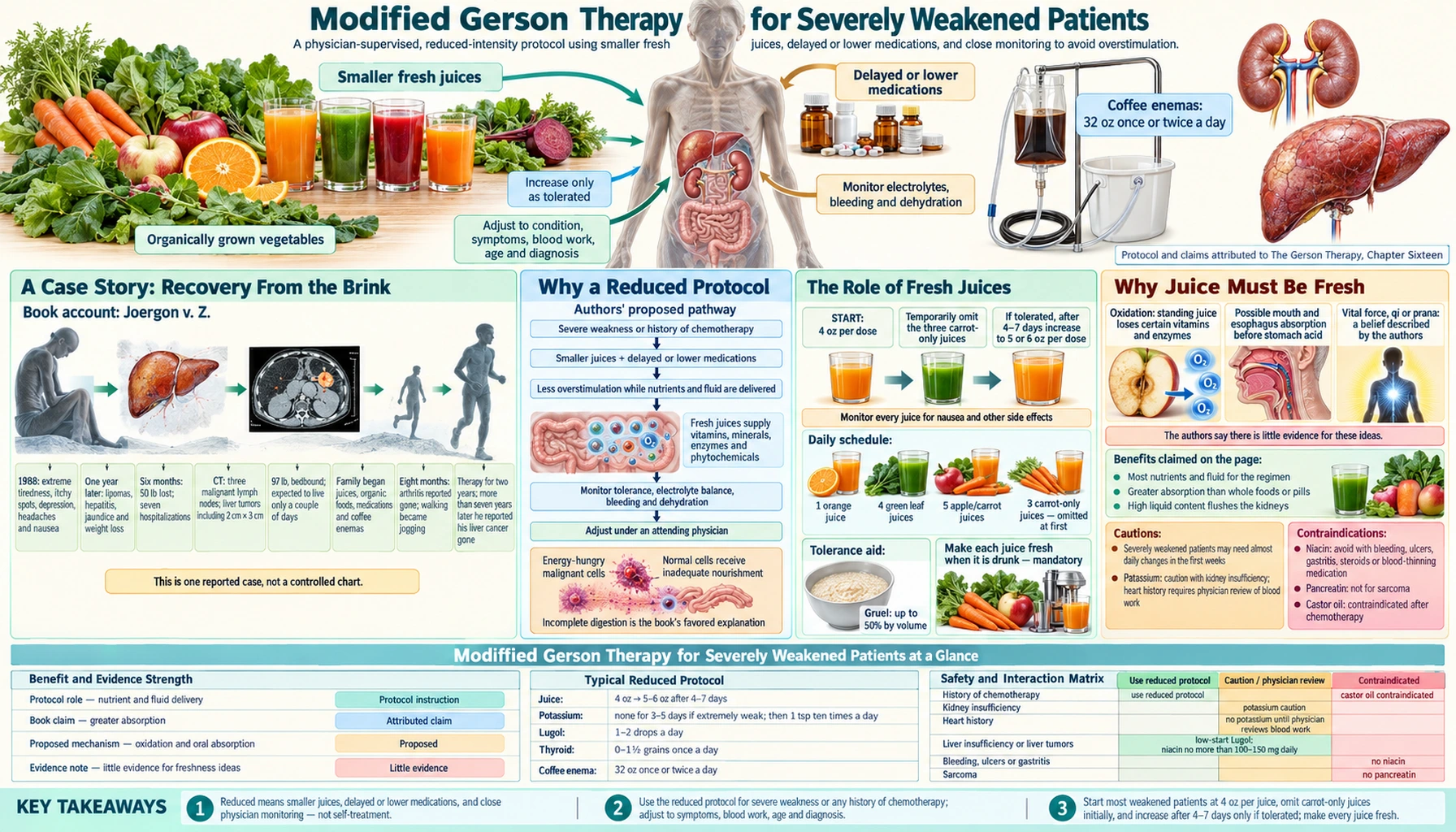
Chapter Sixteen of The Gerson Therapy sets out what Charlotte Gerson and Morton Walker call a “reduced” or modified Gerson protocol for the cancer patient who arrives in a severely weakened state — whether or not that patient has had chemotherapy first. The book describes Dr. Max Gerson’s approach for such patients as “ultraconservative”: smaller juices, delayed or lowered medications, and close watching by the attending physician.
The reasoning, as the book states it, is that the detoxification and salt/water management parts of the Gerson protocol are “extremely powerful,” and that a seriously impaired body “will not be able to mount an appropriate healing if the process is brought about too quickly or intensely.” This page walks through the chapter’s opening case story, its explanation of juices and of cancer-related weakness, each medication with its stated dose and contraindications, and the first-year follow-up plan.
Table of Contents
- 1. A Case Story: Recovery From the Brink
- 2. Why a Reduced Protocol
- 3. The Role of Fresh Juices
- 4. Why Juice Must Be Fresh
- 5. The Juice Schedule for Weakened Patients
- 6. Cachexia: Why Weakness Happens
- 7. Potassium, Lugol and Thyroid
- 8. Niacin, Enzymes, Liver and CoQ10
- 9. Laetrile, Castor Oil and Coffee Enemas
- 10. First-Year Follow-Up
- Key Research Papers
- Connections
- Featured Videos
1. A Case Story: Recovery From the Brink

The chapter opens with the story of Joergon v. Z., a physician from the Netherlands who later worked as a naturopathic physician and university professor in Montreal. In 1988 he noticed prolonged, extreme tiredness, followed by itchy spots over his body, depression, severe headaches and nausea. Chronic constipation followed — at times he did not move his bowels for five days — along with long-standing osteoarthritis pain in both knees.
A year later fatty lumps (lipomas) appeared under his skin; biopsies showed no malignancy. Blood tests then suggested hepatitis, he became jaundiced, and serious weight loss began. Within six months he had lost 50 pounds and had been hospitalized seven times for vomiting, extreme weakness and swollen lymph nodes. A CT scan finally showed three lymph nodes positive for malignancy, and further testing found several small malignant tumors on the right lobe of his liver and a larger 2 cm by 3 cm tumor on the left lobe.
His feet swelled, his abdomen filled with fluid (ascites), his liver enlarged and food nauseated him. The book reports that his doctors judged chemotherapy unlikely to help at that stage, and that prednisone was ruled out because of a childhood bout of tuberculosis. When his weight fell to 97 pounds and he could no longer leave his bed, he and his doctors expected him to live only a couple of days. He asked to be taken home to the mountains outside Montreal.
There, his brother gave him a copy of Dr. Max Gerson’s book. With family, friends and neighbors helping, he began the program: fresh organic vegetable and fruit juices, organically grown vegetables, the prescribed medications, and coffee enemas. The book notes that he “went overboard” with the enemas, taking one every hour — “perhaps eight to ten more per day than he should have taken.” He reported seeing large numbers of parasites in his stools.
According to the book, he then gained weight steadily, his weakness lifted and his energy returned. After eight months the arthritis in his knees had disappeared and he moved from walking mountain paths to jogging them. He stayed on the therapy for two years. More than seven years later, he told the authors: “My liver cancer is gone. … Thanks to God and Dr. Max Gerson I’ve become a healthy person once again.” He still eats only organic vegetables and fruits, with no animal protein and no grains, drinks fresh juices, and takes coffee enemas, “sometimes regularly but mostly irregularly.”
2. Why a Reduced Protocol
The book describes a weakened physical condition at the start of Gerson treatment as “a perilous position to be in,” with risks tied directly to the loss of strength. Its key rules for this group are:
- All patients with a history of chemotherapy (“chemical pretreatment”) should receive the reduced protocol.
- Patients in a weakened physical condition should also receive the less intense protocol, whether or not they have had chemotherapy.
- No overstimulation of body systems is allowed — healing pushed too fast or too hard cannot be sustained by a seriously impaired patient.
- The attending physician should take extra care to monitor regularly for electrolyte imbalance, bleeding, dehydration and other cancer-related complications.
- The plan is adjusted to the patient’s overall condition, symptoms, blood work, age, diagnosis and other factors.
The book stresses that these are guidelines for supervised care, and it gives self-treatment precautions throughout. It notes that this reduced program modifies the standard therapy (described in its Chapter 14) and differs somewhat from the modified plan for chemotherapy-pretreated patients in Chapter 15.
3. The Role of Fresh Juices
The authors call juice drinking “a critical aspect of the regimen.” In their account, the juices supply most of the vitamins, minerals, enzymes, phytochemicals and other nutrients needed for healing, as well as enough fluid. Fresh-squeezed, organically grown vegetable and fruit juices are said to allow greater absorption of nutrients than the whole foods or pills.
The book explains that people with degenerative disease almost always have trouble digesting and absorbing food — from toxicity, a poorly working digestive system, low stomach acid or other causes — and that this is also why many struggle to absorb vitamin and mineral pills. Dr. Gerson’s goal with weakened, often terminal, patients was to increase nutrient absorption, and the book reports that his clinical experimentation showed fresh juice from organically grown raw foods to be the easiest and most effective way to deliver high-quality nutrition, with the best clinical results.
The book adds that Gerson staff have looked at adding other juices and ways to ease the burden of the therapy, but have not found any way to reduce, substitute or eliminate the recommended juices, and that making each juice fresh at the time it is drunk is “mandatory.” The juices also flush the kidneys through their high liquid content.
4. Why Juice Must Be Fresh
The chapter answers common patient questions. Over Dr. Gerson’s thirty years of clinical practice (1928 to 1958), the quantity, volume and type of juices he prescribed changed considerably. The book says many patients have used the single table of juices and medications in his book A Cancer Therapy: Results of Fifty Cases as their road map. Experienced Gerson physicians may change a patient’s “juice prescription” in response to blood tests or healing reactions, and severely weakened patients often need changes to medications and juices almost daily in the first weeks.
The authors openly say that Gerson advisers do not fully understand why fresh juice heals better than juice that has stood for hours. They offer several possibilities:
- Oxidation — juice left standing loses certain vitamins and enzymes to oxygen.
- Absorption in the mouth — some enzymes in fresh juice may be absorbed through the lining of the mouth and esophagus before reaching stomach acid. The book points to the observation that patients fed through a nasogastric or stomach tube do not respond favorably to the therapy.
- “Vital force” — some believe fresh juice carries a plant “vital force,” “qi” or “prana” that supports the patient’s own.
The book states that there is little evidence for these ideas but that no possibility is ruled out, and that, however it works, true physiological restoration comes from consistent intake of fresh juices — a process it says has been validated by long-term positive outcomes.
5. The Juice Schedule for Weakened Patients

For most weakened cancer patients, the book advises starting with 4 ounces per dose instead of the usual full glass, and temporarily leaving out the three carrot-only juices. The dose depends on the patient’s condition, tolerance and side effects.
If the smaller amount is tolerated, juices may be increased after four to seven days, typically from 4 ounces to 5 or 6 ounces per dose. Increases must be carefully monitored to make sure the patient keeps tolerating every juice without significant nausea or other side effects.
The daily schedule given in the chapter is:
- 1 orange juice
- 4 green leaf juices
- 5 apple/carrot juices
- 3 carrot juices alone (the ones temporarily left out at the start)
Gruel may be added to any juice — up to 50 percent by volume — to reduce nausea and improve tolerance.
6. Cachexia: Why Weakness Happens
The chapter describes cachexia — the general bodily decline with weakness, weight loss, lack of energy and early fatigue, to the point that combing hair, cooking or shopping become impossible. The book notes that the same calories that feed normal cells can be used by energy-hungry malignant cells, and that this weakness occurs whether or not chemotherapy, immunotherapy or radiation has been given.
It reviews three explanations:
- Hypermetabolism — the body burns its energy stores too quickly.
- Poor lean-tissue building — the chronically ill body cannot make lean mass normally, so any weight gained is mostly fat and water. The book notes that both of these first two theories have not held up under testing.
- Incomplete digestion — the explanation the book favors. The cancer patient’s digestive system cannot fully break down fats and animal proteins; the partly digested “intermediate” products fail to nourish normal cells but feed the tumor, so the patient loses weight while the tumor grows.
By contrast, the book states, Gerson foods are rich in nutrients and enzymes that even a damaged digestive system can handle, and the enzymes in fresh raw foods and juices help break down tumor tissue — which is why, it says, patients can maintain or gain weight while breaking down tumors.
7. Potassium, Lugol and Thyroid
Potassium compound solution
The suggested starting dose is 1 teaspoon ten times a day — about 500 mg (12.5 mEq) each of potassium acetate, gluconate and monophosphate, for a total of 1.5 grams or 37.5 mEq a day. In extremely weakened patients, the book says no potassium should be given for three to five days, or until the patient stabilizes. After five to seven days, the dose may cautiously rise to 2 teaspoons ten times a day, then 3 and 4 teaspoons, as tolerated and if no side effects appear.
Cautions given: patients with kidney insufficiency, gastritis, nausea, significant bone metastases or any bleeding problems should start at 1 teaspoon ten times a day and increase slowly. Anyone with a history of heart failure, heart attack or cardiac insufficiency should receive no potassium until a physician has reviewed their blood work.
Lugol (half-strength potassium iodide)
Weakened patients take one to two drops a day. With a history of iodine allergy, Lugol is not used at first but may be cautiously added after three to five days, one drop to start. Patients with liver insufficiency, tumors in the liver, hepatitis or cirrhosis start at one to two drops a day to avoid bleeding or a drop in platelets; the same low start applies to bone metastases (to avoid excess bone breakdown and pain) and to known heavy-metal toxicity.
Thyroid hormone
Dosed at zero to 1½ grains once a day, with cautions similar to Lugol. The book says to watch for signs of overactive thyroid — rapid heartbeat, anxiety, insomnia, tremors — and reduce the dose if they appear, while noting that a brief rapid heartbeat alone often signals a toxic or flare-up reaction. Patients with a history of heart problems start on the lowest possible dose.
8. Niacin, Enzymes, Liver and CoQ10
- Niacin (vitamin B3) — 50 mg three times a day. Patients with liver insufficiency, liver tumors, hepatitis or cirrhosis take no more than 100 to 150 mg daily. Those with a history of bleeding, ulcers or gastritis, or taking prednisone, other steroids or blood-thinning medication, should not take niacin.
- Pancreatin (pancreatic enzyme) — three 325 mg tablets four times a day; not for sarcoma patients.
- Crude liver extract with vitamin B12 — a daily intramuscular injection of 3 cc crude liver with 100 mcg B12. Apart from excess B12 and occasional allergic reactions, the book lists no known contraindication.
- Betaine hydrochloride with pepsin (stomach-acid digestive aid) — two capsules three times a day with meals. Not for patients with stomach ulcers, gastritis, severe nausea, intestinal bleeding or esophageal problems, or those taking blood-thinning medication.
- Coenzyme Q10 — 90 mg on the first day; if there is no rapid heartbeat or arrhythmia, 300 mg on day two and 600 mg from day three onward.
- Systemic digestive enzyme products — used mainly for severe, excessive gas; the book notes some reports that they may help reduce tumor masses.
- Brewer’s yeast — not recommended in most cases, because of a possible increased risk of yeast overgrowth (candidiasis) and frequent reports of severe bloating and gas.
9. Laetrile, Castor Oil and Coffee Enemas
Laetrile (amygdalin)
The book says laetrile is indicated for bone metastases and may help in lung cancers. Where available, it is used mainly to reduce pain, which takes ten days to two weeks of daily use for best results. The dose is 2 grams (5 cc) intravenously once a day, and a physician must decide whether it suits a given weakened patient.
Castor oil treatment
Castor oil is contraindicated for patients who have had chemotherapy. For very weakened patients who have not, it may be used after six to nine months on the therapy — but with great caution. The book calls castor oil a powerful detoxifier that can draw long-buried toxins out of the tissues and produce severe healing reactions.
Coffee enemas
Coffee enemas remain standard for weakened patients: a 32-ounce enema once or twice a day. For some, the strength is halved by mixing 16 ounces of chamomile tea with 16 ounces of coffee. The number may be increased gradually as needed, but the book warns against overstimulating the liver, which could cause severe toxic reactions as stored chemotherapy residues are eliminated. (Compare the case story, where hourly enemas were described as more than he should have taken.)
10. First-Year Follow-Up
The reduced protocol requires follow-up and medication changes through the first year. About one month after leaving the inpatient center — roughly six to nine weeks after starting therapy — thyroid, potassium and Lugol doses are adjusted:
- If the patient was on extremely reduced levels, these may be raised by 25 to 50 percent. Other supplements generally stay at their starting levels.
- If the patient was on normal Gerson levels (for example 40 teaspoons of potassium and eighteen drops of Lugol) and is progressing and gaining strength, these are lowered by about 50 percent.
- The adjusted levels are usually kept for nine to fourteen months, with further changes guided by blood work and other tests.
The book stresses that this differs significantly from Dr. Gerson’s original book: patients are now kept on higher doses of the three main medications for longer, because reducing them too fast “often” led to slower recovery or a return of disease. The chapter closes with the authors’ view that, for weakened patients with or without prior chemotherapy, following these instructions will bring health improvement and potential recovery, and that the weakened state can be overcome by accepting Dr. Gerson’s recommendations.
Key Research Papers
- Gerson C, Walker M. The Gerson Therapy. Chapter Sixteen, “Modified Therapy for Severely Weakened Cancer Patients.” primary source for this page.
- Gerson M. A Cancer Therapy: Results of Fifty Cases, 6th edition. Bonita, Calif., 1999, pp. 223–248. — cited by the chapter for the original juice and medication tables.
- Gerson M. The cure of advanced cancer by diet therapy: a summary of 30 years of clinical experimentation. Physiol Chem Phys. 1978;10(5):449–64. — PubMed PMID: 751079
- Gerson M. [Cancer a problem of metabolism]. Med Klin. 1954;49(26):1028–32. — PubMed PMID: 13202917
PubMed Topic Searches
Connections
Featured Videos