Psychological Approaches of the Gerson Therapy
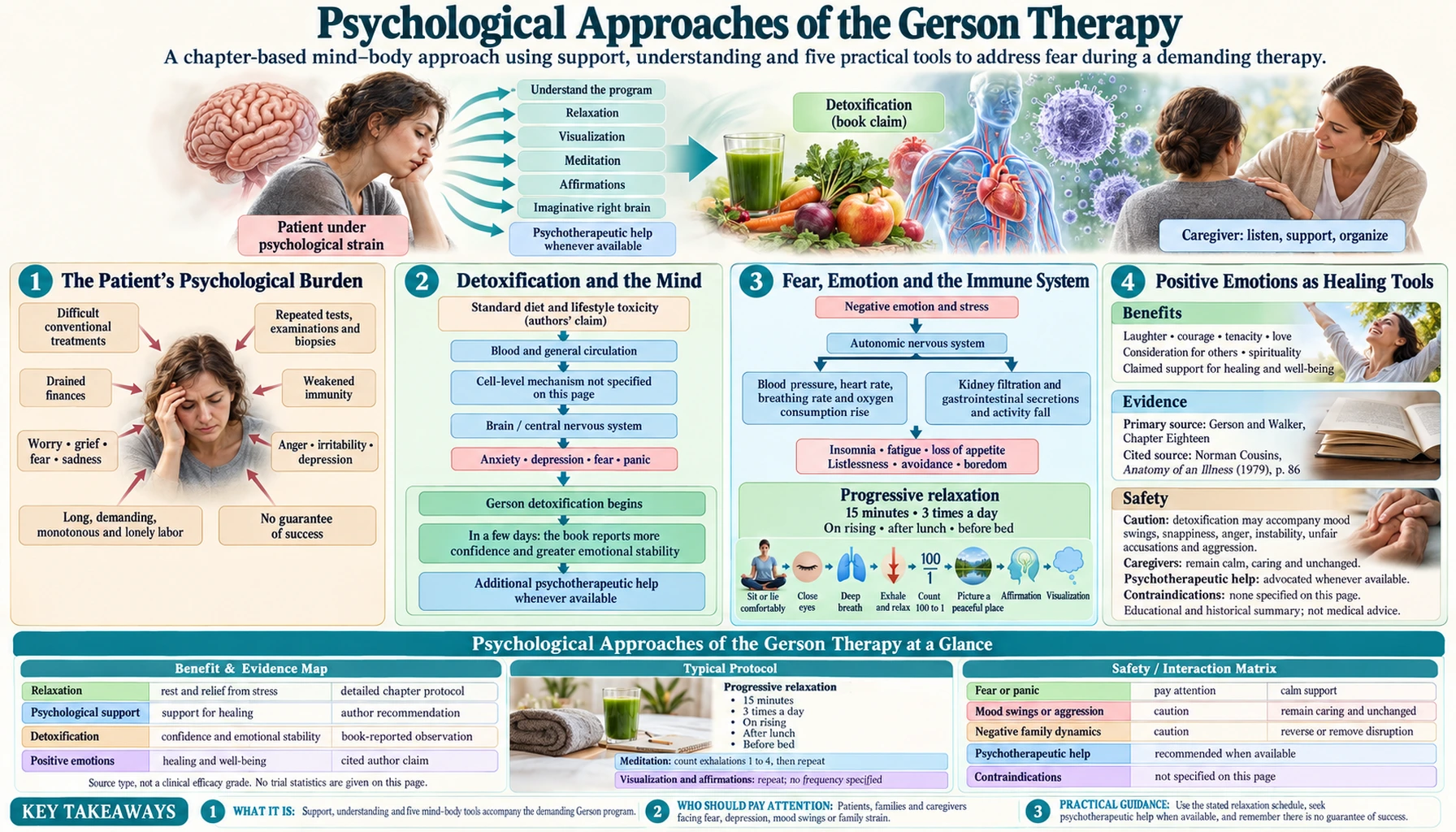
Chapter Eighteen of The Gerson Therapy turns from juices, diet and enemas to the patient’s mind. Charlotte Gerson and Morton Walker write that Gerson patients “bear an extra heavy psychological burden”: many arrive after difficult conventional treatments, with drained finances, weakened immunity and heavy demands already made on their emotions by repeated tests, examinations and biopsies. Many come depressed and gripped by worry, grief, fear, sadness, anger and irritability — and, the authors state, “even for these depressed, anxious, and generally unfortunate people, the Gerson Therapy offers healing and hope.”
The chapter sets out why the authors believe emotions matter to physical healing, what the detoxification itself does for mood, what a family caregiver is asked to do, and five practical tools — relaxation, visualization, meditation, affirmations and developing the “right brain” — drawn from a list of ten psychological considerations Gerson practitioners are taught to use. This page follows the book closely and in plain language.
Table of Contents
- The Patient’s Psychological Burden
- Detoxification and the Mind
- Fear, Emotion and the Immune System
- Positive Emotions as Healing Tools
- Understanding the Program Removes Fear
- The Caregiver’s Role
- Psychological Detoxification
- Ten Tools and Methods
- Relaxation Technique
- Creative Visualization
- Simple Meditation
- Affirmations
- The Imaginative Right Brain
- Key Research Papers
- Connections
- Featured Videos
1. The Patient’s Psychological Burden
The book describes the cancer patient as often “traumatized by a widespread belief that nothing much can be done to conquer cancer.” Patients and families may arrive at a Gerson facility already convinced, from what they have been told, that the disease is unbeatable in the end.
The authors note two kinds of arrivals. Patients who begin the Gerson procedures at an “earlier, less-damaged stage” often have fewer difficulties; the book states plainly that “receiving Gerson Therapy sooner rather than later is better for achieving healing and health maintenance.” Either way, both groups take on a treatment outside conventional medicine and face what the authors honestly call “a long, demanding, monotonous, and lonely labor, with strong hope and determination, but with no guarantee of success at the end.” Psychological factors, they write, do play a role in healing, and both the standard and the modified Gerson protocols provide procedural guidance.
2. Detoxification and the Mind
According to the book, patients with cancer and other chronic diseases “progress faster and more competently toward healing when they receive psychological support.” But the authors place the first psychological benefit in the therapy itself: its detoxification aspects “have excellent effects on the patient’s outlook.”
Their reasoning is that the toxicity of the standard American diet and lifestyle brings poisons into the blood and general circulation. These reach the brain and, the book says, tend to increase anxiety, depression, fear and panic. Once Gerson detoxification begins, the authors report that “in a few days the patients improve considerably, feel more confident, and exhibit greater emotional stability.” Even so, they remain “advocates of additional psychotherapeutic help whenever available.”
3. Fear, Emotion and the Immune System
The chapter quotes Dr. Gerson’s remark that more human beings die of panic than from cancer. The body, the authors write, is only one part of the illness; when sickness also produces fear, the combination causes a build-up of more toxins and a quicker physical decline.
Drawing on psychoneuroimmunology, the book states that “our every human thought and emotion equals a biochemical act,” and that the immune system is boosted by a hopeful, determined outlook and undermined by a despairing, helpless one. A cancer diagnosis itself is described as mental and emotional trauma, with reactions ranging from despair and panic to apathy or rage — emotions that, the authors say, hamper immunity. Because Gerson staff aim to rebuild the damaged immune system, “psychological factors must not be allowed to sabotage physical healing.”
What negative emotions do to the body
The book lists the effects of stress from negative emotions on the autonomic (involuntary) nervous system, both sympathetic and parasympathetic branches:
- Blood pressure, heart rate, breathing rate and oxygen consumption rise.
- Glucose is needlessly used up.
- Kidney filtration and gastrointestinal secretions and activity fall — affecting digestion and the release of body wastes and toxins.
- Insomnia, fatigue, loss of appetite, listlessness, avoidance and boredom appear in the patient.
Quoting Plato — “No attempt should be made to cure the body without [curing] the soul” — the authors conclude that body and mind “sicken together and must be healed together,” and that no program will work well “if something in the patient’s consciousness keeps saying no to life.” For patients or caregivers working at home without a Gerson hospital setting, their advice is to focus on handling negative emotions, which must be “reprogrammed and turned positive.”
4. Positive Emotions as Healing Tools
The book calls positive emotions “powerful weapons in the unwell individual’s war against disease.” It names laughter, courage, tenacity, love and consideration for others, and a connection to the patient’s own understanding of spirituality.
The authors draw on Norman Cousins, Ph.D., and his book Anatomy of an Illness, which described positive emotions as powerful mobilizers of the body’s natural healing resources. They quote Cousins’ conviction that “creativity, the will to live, hope, faith, and love had biochemical significance and contribute strongly to healing and to well-being. The positive emotions are life-giving experiences.”
5. Understanding the Program Removes Fear
The chapter quotes Marie Curie: “Nothing in life is to be feared; it is only to be understood. Now is the time to understand more, so that we may fear less.” The authors argue that understanding a disease and its cause is the first step in conquering it, and that grasping why the Gerson program works helps the patient believe in it.
A critically ill person may find it hard to study Dr. Gerson’s concepts, so the book assigns this to the family or caregiver. Still, the authors acknowledge that “words alone will not obliterate all of the fear” — a good result is what really counts, and early improvement does more than anything else to restore hope.
They describe how many newly arriving patients have lost the will to eat and drink. The program gives such patients simple foods and juices the body can easily digest; the book reports a restoration of blood flow, improvement in the nervous system and a general pick-up of body functions. The patient begins to eat, drink and sleep better, feels strengthened almost immediately, and — “probably for the first time since the patient heard his or her diagnosis” — sees the prospect of a future.
6. The Caregiver’s Role

The Gerson Therapy demands a drastic change of lifestyle, and the book is candid that daily life has ups and downs, with healing crises “occurring all too frequently.” The caregiver — a family member or friend — is asked to lighten that burden with steady support, empathy and well-focused counseling. The book lists these tasks:
- Creating a safe space through total listening and nonjudgmental attention.
- Building a healing partnership, turning the patient into an active ally who shares responsibility for the therapy.
- Dispelling the superstitious fear attached to cancer — helping reframe harmful ideas and identifying and eliminating self-defeating patterns.
- Exploring the patient’s beliefs and family dynamics; if those dynamics are negative or hostile to the therapy, trying to reverse them, moving the patient out of the disruptive environment, or removing the source of disruption.
- Dealing with resentment and unfinished business.
- Coping with the drastic mood swings and sometimes antisocial behavior that can accompany detoxification.
The practical workload
The book says a caregiver is “very necessary” to keep the patient from deciding the program is impossible to face at home alone. The caregiver’s work runs from shopping for food and arranging deliveries to cooking, checking on helpers, preparing and portioning juices, setting and keeping the daily routine, “washing up endlessly,” making the enema coffee, helping if an enema goes wrong, coping with healing reactions and flare-ups, relieving boredom, injecting enthusiasm — “and above all, causing sanity to prevail for both patient and caregiver.”
7. Psychological Detoxification
The caregiver is warned to expect emotional changes as the body is freed of stored poisons. The book quotes London journalist and psychotherapist Beata Bishop: “Physical detoxification inevitably brings about psychological detoxification, too. Toxins passing through the central nervous system evoke strange reactions and out-of-character behavior: violent mood swings, snappiness, anger, instability, unfair accusations, and aggression.”
She describes long-repressed drives and emotions, perhaps from childhood, coming to the surface — and her advice for helpers is the chapter’s key safety note for families: “It is part of the process. In whatever capacity we work with the patient, we remain calm, caring, unchanged, waiting for the inner upheaval to pass.”
8. Ten Tools and Methods
To offset the psychological toll of serious illness — cancer, heart disease, diabetes, arthritis, serious infections or other degenerative disease — the book says Gerson practitioners are taught to build these considerations into treatment:
- Employing relaxation techniques.
- Creating visualizations linked to self-healing.
- Engaging in simple meditations.
- Repeatedly using affirmations.
- Developing the imaginative power of the right brain — creative, artistic and idealistic.
- Reversing negative family dynamics.
- Emphasizing positive actions in all situations and relationships.
- Fully understanding the Gerson program, to build confidence and willingness for a demanding, rigid treatment that asks for much self-discipline.
- Removing internal physical pain relatively quickly with coffee enemas and other detoxification.
- Steadily showing symptomatic results the patient can see and feel.
The book then describes the first five in detail, as tools that give “a psychological uplift” to a person with cancer or another life-threatening disorder.
9. Relaxation Technique

The book recommends deep progressive relaxation for fifteen minutes, three times a day — on rising, after lunch and before bed — relaxing the head, then the neck, then the shoulders, and on down the whole body to the toes. It describes a method taught by Jose Silva:
- Sit comfortably in a chair or lie on the floor.
- Close the eyes and relax.
- Take a deep, lung-filling breath.
- While breathing out, relax the body even more.
- Count slowly backward from 100 to 1.
- Daydream about a peaceful place you know.
- Mentally say a strong affirmation, such as “I will always maintain a perfectly healthy body and mind.”
- Move into the well-practiced creative visualizations that give you the most comfort.
10. Creative Visualization
The chapter gives a basic creative-visualization procedure taught by Shakti Gawain:
- Use your own relaxation method (perhaps the one above).
- Imagine a healthy state of the body that you very much want.
- Imagine already having it — admire it, enjoy it, show it to loved ones and friends.
- Make positive statements (affirmations) about this healthy state.
- End with firm avowals that you will have this healthy state permanently.
Once relaxed and able to visualize easily, the book says to “start the healing process in earnest”: picture the tumor, imagine it stopping its growth, then see it getting smaller — a tiny bit more at each session. Patients are also encouraged to picture a very active immune system with its white blood cells (leukocytes), including lymphocytes, phagocytes and monocytes, however they personally imagine them.
11. Simple Meditation
The book defines meditation as a state in which awareness of the surroundings stops so the mind can focus on one thing, bringing rest and relief from stress. It takes patience: the mind wanders and attention must be brought back again and again. The authors compare the subject of meditation to a target that stray thoughts keep you from hitting.
Of the many methods available, the chapter describes a breath-counting technique from Zen training, as taught by psychotherapist Lawrence LeShan, Ph.D. The aim is to do one thing as fully as possible — counting exhalations. In LeShan’s words, “All your attention is gently and firmly and repeatedly brought to bear on this activity.”
The book’s practical version: count breaths up to four, then start again, filling the gap between exhalations with the word “and” — “one” — “and” — “two” — “and” — “three” — “and” — “four,” then repeat. The authors call this “a very fine technique for bringing you into a meditative state.”
12. Affirmations
Affirmations are described as strong, positive statements that something already is so. “Be assured,” the book says: “The body believes everything that it hears the mind say.” Unknowingly negative words, the authors write, attach a little of that negation to the body. Affirmations — said silently or aloud, written down, chanted or sung — replace “negative, stale, worn-out programming from the past” with constructive ideas, and the book calls their repeated use “vital for bringing about healing.”
Sample affirmations from the book
- Every day in every way I am getting better, better, and better.
- I am vibrantly healthy and radiantly beautiful!
- I am healthy and whole and complete in myself.
- I give thanks now for my life of perfect health and happiness.
- I am happy to be alive and well, anticipating what the future brings.
- I now recognize and accept the excellence of my healing path.
- I love and appreciate myself just as I am.
- I am conquering illness because the treatment is working.
How to use them
- Phrase them in the present tense, as if the goal already exists — “everything is created first in the mind before it becomes manifest in the physical.”
- State what you want, not what you don’t want; if something negative must be said, follow it at once with something positive.
- Keep them short, clear and strongly felt.
- Keep only those that fit you and feel right for your body and mind.
- Let each one produce a feeling of belief by suspending doubt.
- Use them repeatedly, alone or with creative visualization — the two go together very well.
13. The Imaginative Right Brain
The final tool is developing the imaginative power of the right side of the brain. The book explains lateralization — different mental abilities sited more on one side. It assigns reading, writing, arithmetic, spoken language, scientific skills, reasoning, linear and logical processing and right-hand control to the left hemisphere; and music awareness, spatial and artistic intelligence, holistic thinking, imagination, insight, intuition, three-dimensional and pattern perception and left-hand control to the right. The right brain, the authors add, also deals with relaxation, creativity, visualization, meditation and affirmations.
Because, in their view, “the right hemisphere provides more efficacy with the psychology of surviving cancer,” the authors “highly recommend that the person with a degenerative disease develop the imaginative power of the right side of the brain” using the methods described above.
Key Research Papers
- Gerson C, Walker M. “Psychological Approaches of the Gerson Therapy.” Chapter Eighteen in The Gerson Therapy: The Proven Nutritional Program for Cancer and Other Illnesses. — primary source for this page.
- Cousins N. Anatomy of an Illness. New York: W.W. Norton, 1979, p. 86. — cited in the chapter.
PubMed Topic Searches
- https://pubmed.ncbi.nlm.nih.gov/?term=psychoneuroimmunology+cancer
- https://pubmed.ncbi.nlm.nih.gov/?term=guided+imagery+cancer+patients
- https://pubmed.ncbi.nlm.nih.gov/?term=progressive+muscle+relaxation+cancer
- https://pubmed.ncbi.nlm.nih.gov/?term=meditation+cancer+immune+function
- https://pubmed.ncbi.nlm.nih.gov/?term=family+caregiver+cancer+support
Connections
Featured Videos