The Gerson Saltless Diet
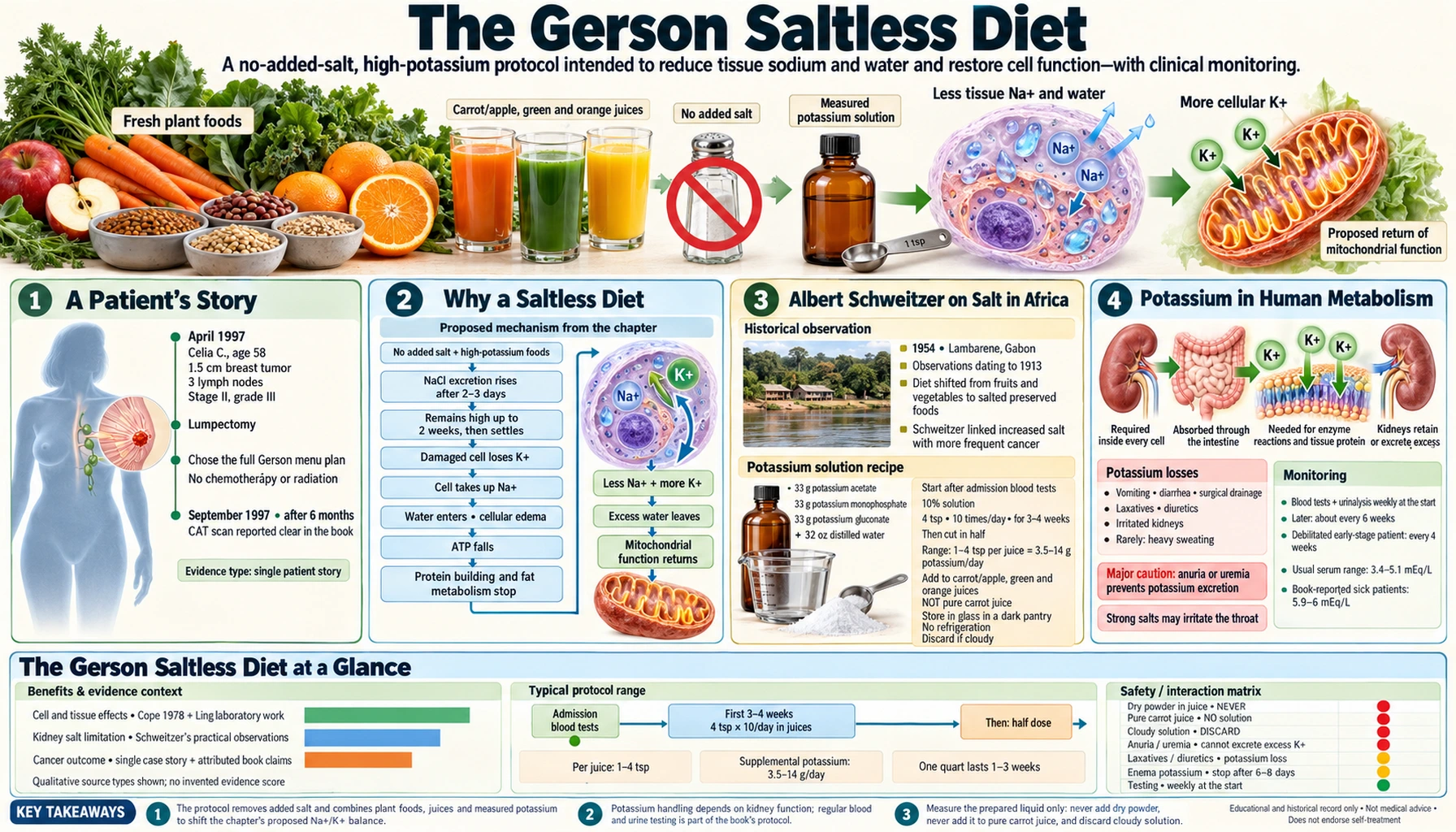
Removing salt from the diet is one of the foundations of the Gerson Therapy. In Chapter Ten of The Gerson Therapy, Charlotte Gerson and Morton Walker, D.P.M., explain why Dr. Max Gerson asked every patient to stop eating added salt, and why he paired that with large amounts of potassium from fresh foods, juices and a prepared potassium solution.
This page walks through the chapter in plain language: the case story that opens it, Dr. Gerson’s reasoning about sodium and potassium, Dr. Albert Schweitzer’s observations in Africa, the potassium doses and how the solution is made and stored, the monitoring the book calls for, and the “tissue damage syndrome” described by Freeman Cope, M.D.
Table of Contents
- A Patient’s Story
- Why a Saltless Diet
- Albert Schweitzer on Salt in Africa
- Potassium in Human Metabolism
- The Hyperkalemia Question
- Sodium-to-Potassium Ratios in Food
- Laboratory Monitoring
- Making and Using the Potassium Solution
- Potassium in the Enema Solution
- Tissue Damage Syndrome
- Key Research Papers
- Connections
- Featured Videos
1. A Patient’s Story
The chapter opens with Celia C., a fifty-eight-year-old professional puppeteer who arrived at a Gerson clinic in Sedona, Arizona (now closed) in April 1997 with breast cancer. Her records described an infiltrating ductal carcinoma of the right breast, 1.5 centimeters in diameter and involving three lymph nodes, classified as stage II, grade III and non-estrogen-receptive. A CAT scan also showed areas on her liver and lung that her doctors wanted to “watch.”
After a lumpectomy, she was offered six months of chemotherapy and seven weeks of radiation. Her breast surgeon, the book reports, did not recommend either. She chose the Gerson Therapy instead.
She was drawn to the saltless diet in particular: for years she had suspected that most people eat too much salt, and she often noticed swelling after salted foods. She began the full menu plan at once. She described the center as positive and encouraging, praised “the wonderful saltless food,” and reported that a CAT scan in September 1997, after six months on the therapy, came back clear, with her breast surgeon confirming she was free of cancer without chemotherapy or radiation.
2. Why a Saltless Diet
A central idea of Dr. Gerson’s, as the book presents it, is that raising a cancer patient’s potassium while restricting sodium works against tumor formation. He used a saltless diet to draw retained sodium, chloride and water out of the tissues, together with toxins, all over the body.
- Salt excretion rises. Dr. Gerson wrote that salt (NaCl) excretion increases in tuberculosis, cancer and other chronic diseases after two to three days on a saltless diet.
- It stays high, then settles. The higher excretion lasts up to two weeks, then drops to normal while the patient stays on the diet.
- Flare-ups can occur. Nausea, diarrhea and nervous disturbances sometimes appear. The Gerson Institute calls these “healing reactions,” attributed to greater bile secretion and stimulation of the visceral nervous system. After each flare-up, the book says, patients feel easier and improve physically and mentally.
The authors write that the saltless diet is not only for cancer. They state that it helps blood pressure and that each of the fifty-two disorders listed in the book — including arthritis, diabetes, multiple sclerosis, cardiovascular disease, autoimmune diseases and chronic fatigue syndrome — responds “exceedingly well” to avoiding salt. “Too much sodium consumption can be a killer!”
The chapter also quotes Freeman Cope, M.D., writing in 1978 in Physiological Chemistry and Physics: the high-potassium, low-sodium diet “has been observed experimentally to cure many cases of advanced cancer in man,” and laboratory work by Dr. Ling and associates suggested such environments “can partially return damaged cell proteins to their normal undamaged configuration.”
3. Albert Schweitzer on Salt in Africa
In 1954, Nobel laureate Dr. Albert Schweitzer wrote from his hospital at Lambarene, Gabon, that people living around the hospital had been changing their diet. Formerly, he wrote, they “lived almost exclusively on fruits and vegetables, bananas, cassava, ignam, taro, sweet potatoes and other fruits.” Now they were eating condensed milk, canned butter, salted meat-and-fish preserves and bread.
He linked the appearance of cancer, appendicitis and other degenerative diseases to this change. Based on his experience going back to 1913, he said cancer, if it occurred at all, had been very rare and had become more frequent since, and that it was “obvious to connect the fact of increase of cancer with the increased use of salt.”
He added that forty years of practical experience with salt limitation in kidney disease showed that radical salt restriction eased the burden on diseased kidneys, which then “recover in an amazingly short time” and eliminate more salt on a saltless diet than on a salt-rich one.
4. Potassium in Human Metabolism
If salt is removed, should something replace it? The book’s answer is potassium, sodium’s mineral antagonist. Potassium is needed by all plants and animals and is required inside every cell, which is why it is called the cell’s own mineral. It is found in all foods, especially fruits, vegetables and whole grains; animal foods contain it too, but the book says the plant form is easier to absorb.
Potassium is absorbed through the intestine and any excess leaves in the urine. The kidneys decide how much is kept or released. The book lists ways potassium is lost:
- kidneys irritated by chemicals, drugs or other problems
- vomiting, diarrhea and surgical drainage
- laxatives and diuretics
- rarely, heavy sweating from too much exercise or overheating
Dr. Gerson grouped potassium with phosphoric acids, carbohydrates and colloids as the “potassium group,” with sodium in its own “sodium group.” He taught that potassium ions are indispensable in certain enzyme reactions and play a role in building tissue protein, and that healthy muscle, brain and liver hold far more potassium than sodium.
5. The Hyperkalemia Question
The amounts are large. In a 1998 letter to Charlotte Gerson, Professor Jacob Shoham of Bar-Ilan University estimated about 20 grams of potassium in the supplemental solution during the first four weeks (halved afterward), about nine to ten grams in the juices and two to three grams in food — roughly thirty grams a day at first and twenty grams a day later. He raised the possibility of hyperkalemia (too much potassium).
The book responds that signs of hyperkalemia are not an effect of the supplementation as used. It reports that several patients, misreading a label, took about thirty-two times the recommended dose for up to three weeks without significant adverse effects, and states that normal kidneys easily excrete excess potassium.
Dr. Gerson himself wrote that “the content of potassium in the serum is, in many cases, misleading,” because it does not show how much potassium is actually in the tissues of essential organs. He listed seven situations in which he saw high blood potassium:
- loss of fluids — blood, and in most cases dehydration
- epilepsy, in most cases
- cancer patients, more often in the period before the terminal stage
- never in cancer patients during restoration time
- Addison’s disease
- anuria and uremia (the body unable to excrete excess potassium)
- acute and chronic asthma and other degenerative allergies
6. Sodium-to-Potassium Ratios in Food
The authors write that most of our sodium comes not from home cooking but from packaged foods and restaurant meals, and they call eating out an underlying source of illnesses such as high blood pressure, stroke and cancer.
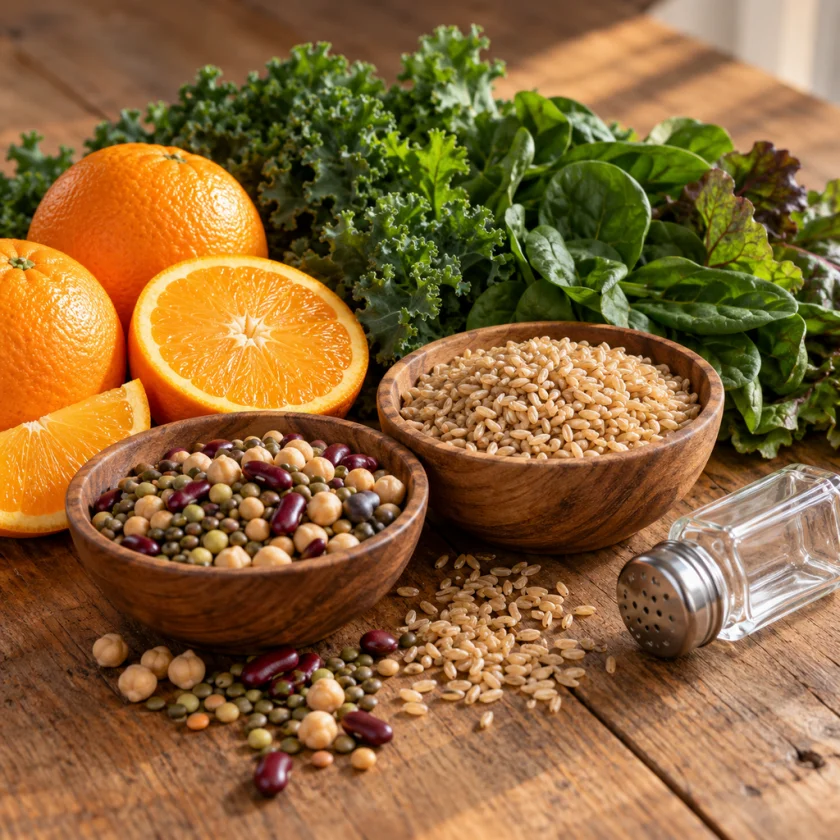
They quote a physician’s newsletter recommending vegetables, legumes, whole grains and fruit, which naturally carry a sodium-to-potassium ratio of at least 1:50:
- Oranges: about 1 part sodium to 260 parts potassium.
- Bananas: about 1:440 — but the book cautions they are high in sugars, especially for cancer patients, and should be eaten only in moderation.
7. Laboratory Monitoring
The book stresses that potassium therapy is done with testing:
- At Gerson hospitals, and under a Gerson-certified practitioner, blood tests and urinalyses are done once a week at the start.
- Later, tests are repeated about every six weeks depending on severity — or every four weeks for a debilitated patient in the early stages.
- Testing must accompany regular clinical examinations; serum potassium is one of the most important values.
The book reports that sick Gerson patients often show serum potassium between 5.9 and 6 mEq/L, against a usual normal range of 3.4 to 5.1 mEq/L, and that supplementation of up to 150 mEq a day continues even when serum levels are elevated. Dr. Gerson warned that “the restoration of the potassium content in the organs is a difficult and long-drawn-out process.”
8. Making and Using the Potassium Solution
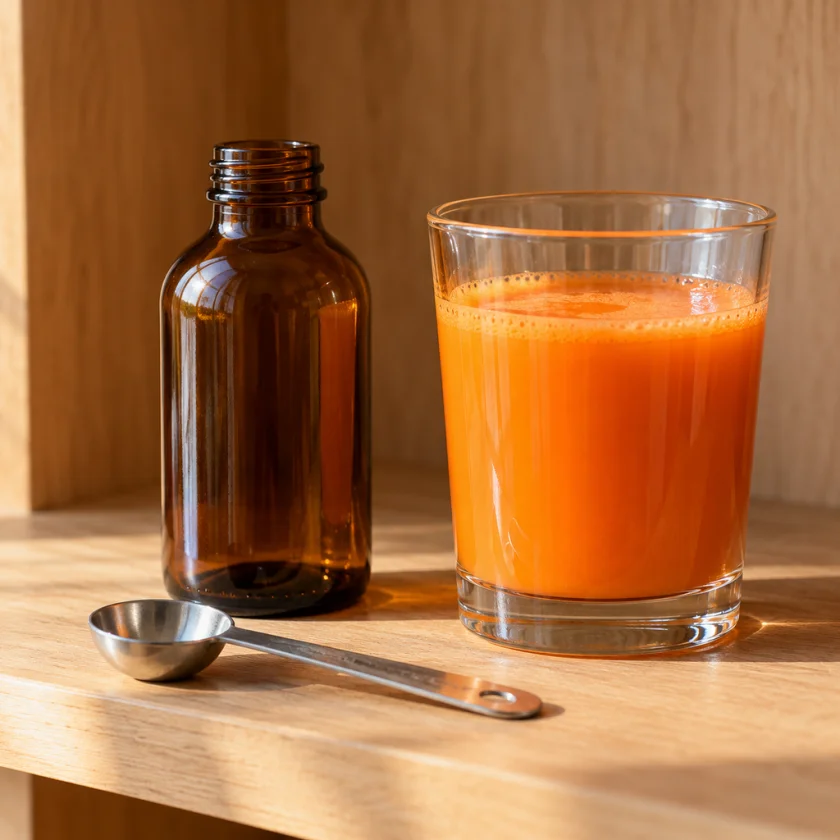
Recipe. The compound solution is made from 33 grams each of potassium acetate, potassium monophosphate and potassium gluconate, dissolved in 32 ounces of distilled water.
Dosing. At Gerson hospitals a 10 percent potassium solution is started right after admission blood tests, at 4 teaspoonfuls ten times a day added to the juices, usually for three to four weeks, then cut in half. Doses range from 1 to 4 teaspoonfuls per juice, representing 3.5 to 14 grams of potassium a day. It goes in equal amounts into the carrot/apple, green and orange juices — not into the pure carrot juices.
Safety notes from the book:
- Dissolve the powder in the 32 ounces of water first, then spoon the liquid into juices. Never spoon the powder itself into a juice — that gives far too large a dose.
- The strong salts may irritate the throat; oatmeal gruel is said to soothe it.
- Store in glass, not plastic or metal, in a dark pantry or an amber or brown bottle. No refrigeration needed.
- One quart lasts one to three weeks. Discard it and make fresh if it turns cloudy.
The authors call potassium a keystone of the therapy: with the diet and other medications, it is meant to raise cell potassium, reduce swelling between cells and restore normal cell function.
9. Potassium in the Enema Solution
The same solution may be added to enemas to relieve abdominal spasms from colon contractions, at 2 to 3 teaspoonfuls per enema. Less water may be needed when spasms are too strong to accept more fluid. The book cautions: stop adding potassium to the coffee enema after six to eight days, or it will irritate the colon.
10. Tissue Damage Syndrome
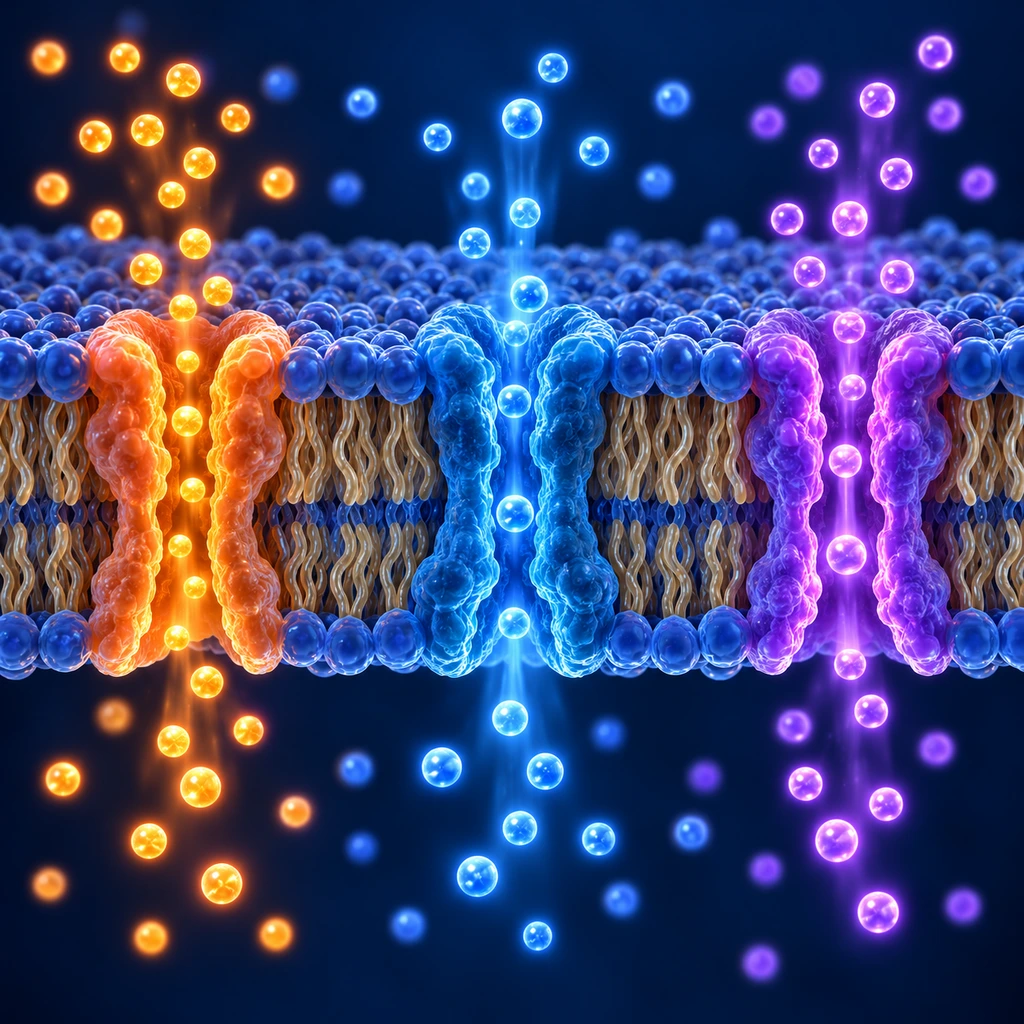
Freeman Cope, M.D., a physician and research physicist, described cells poisoned by carcinogens, allergens and other pollutants, or harmed by oxygen starvation or trauma, entering a repeating pattern he called tissue damage syndrome — a state in which cell proteins “lose their preference for association with K+ rather than Na+, and the water content of the cell increases.” Its three steps:
- The damaged cells lose potassium.
- The cells readily take up sodium.
- The cells swell with too much water (cellular edema).
A swollen cell, the book explains, cannot make enough ATP, the body’s energy currency, and protein building and fat metabolism stop. Without ATP the cell dies; enough dead cells and the tissue dies. On the Gerson Therapy, the damaged cell meets less sodium, binds potassium, loses its excess water and regains mitochondrial function.
The authors offer a picture: the cell is a nation and its mitochondria are its industrial cities. When the cell loses potassium, gains sodium and swells, it is as if every city’s sewers back up; the factories shut down and cannot make the energy needed to clear them.
Dr. Gerson was treating this condition from the 1920s, long before it was named, by removing sodium, feeding a high-potassium diet, adding potassium and clearing toxins from the bloodstream. The book concludes there is “no better means” of removing cellular edema from diseased tissue than the saltless, high-potassium Gerson diet.
Key Research Papers
- Gerson C, Walker M. The Gerson Therapy. Chapter Ten, “The Gerson Saltless Diet.” (Primary source for this page.)
- Gerson M. A Cancer Therapy: Results of Fifty Cases and The Cure of Advanced Cancer by Diet Therapy. 6th ed. Bonita, Calif: The Gerson Institute; 1999. (Book; cited in the chapter.)
- Cope FW. A medical application of the Ling association-induction hypothesis: the high potassium, low sodium diet of the Gerson cancer therapy. Physiol Chem Phys. 1978;10(5):465-8. — PubMed PMID: 751080
PubMed Topic Searches
Connections
Featured Videos