Gerson Therapy and Cancer: Rationale and Results
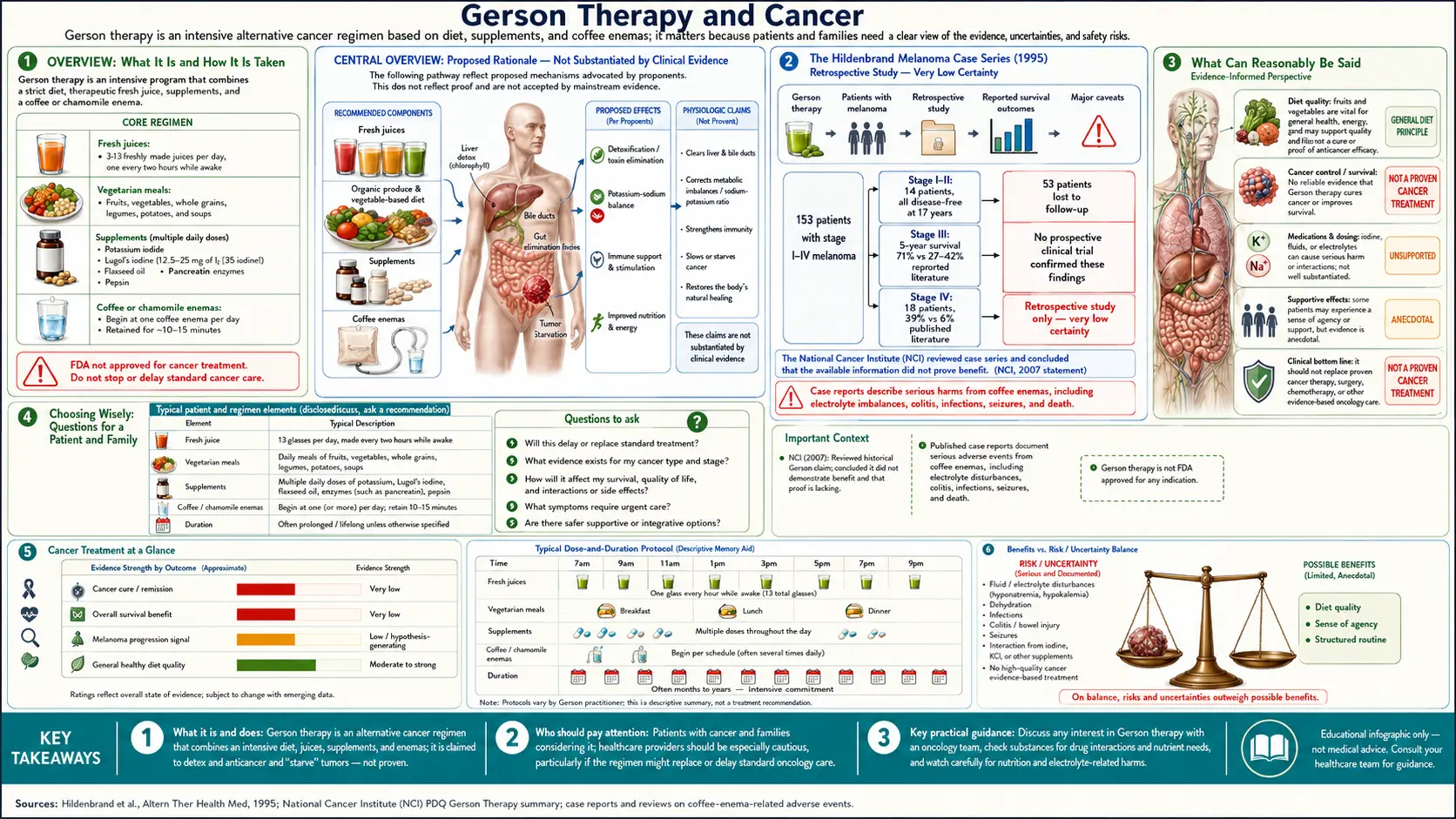
Table of Contents
- Overview
- Gerson’s Rationale: Cancer as a Metabolic Disease
- The Cancer Protocol as the Book Describes It
- The First Cancer Cases (1928 Onward)
- The 1946 Senate Hearing
- Gerson’s Fifty Cases (1958)
- The Hildenbrand Melanoma Review (1995)
- Case Histories Reported in the Book
- Response by Cancer Type
- Supervision, Contraindications and Healing Reactions
- Key Research Papers
- Connections
- Featured Videos
Overview
Cancer is the condition with which Dr. Max Gerson’s name is most closely linked. Gerson developed his dietary treatment first for his own migraines, then applied it to tuberculosis and a long list of chronic diseases, and treated his first cancer patient in 1928. Over the following three decades he came to regard cancer as the end stage of a body-wide metabolic breakdown — centred on the liver, on the loss of potassium from the cells and the intrusion of sodium, and on accumulated toxins — and built a treatment designed to reverse that breakdown rather than to attack the tumour directly.
This page sets out Gerson’s cancer approach, his rationale and the case results as The Gerson Therapy (Charlotte Gerson and Morton Walker, D.P.M.) states them: the 1946 Senate testimony, A Cancer Therapy: Results of Fifty Cases (1958), the 1995 Hildenbrand melanoma review, individual case histories, and the practical safety guidance the book gives for carrying out the therapy.
Gerson’s Rationale: Cancer as a Metabolic Disease
In his 1946 Senate testimony, Gerson said that “the liver is the center of the restoration process in those patients who improve strikingly. If the liver is too far destroyed, then the treatment cannot be effective.” He summarized the action of his diet in three components, quoted in the book:
- Elimination of toxins and the displaced sodium group. Removing toxins and returning the “extracellular” sodium (Na) group — which he connected with toxins, poisons, edema and destructive inflammation — from the tissues, tumours and organs where it does not belong.
- Restoring the potassium group. Bringing the lost intracellular potassium (K) group, together with vitamins, enzymes and ferments, back into the liver, muscles, heart, brain and kidney cortex; “on this basis, iodine, ineffective before, is made effective.”
- Restoring differentiation and oxidation. Using activated iodine to restore “differentiation, tonus, tension, oxidation” where tumours and metastases had grown with dedifferentiation and loss of resistance and healing power.
Gerson traced the root of the breakdown to the food supply. He told the Senate that “the fundamental damage starts with the use of artificial fertilizer for vegetables and fruits as well as for fodder,” and the book adds that commercially raised foods leave the body “deficient, weakened, toxic, and finally diseased.” The therapy therefore has two aims: to detoxify, and to “intensively flood the body with live, fresh, active nutrients.”
In 1978 physician Freeman Cope proposed a mechanism in Physiological Chemistry and Physics. The book quotes him: “The high potassium, low sodium diet of the Gerson Therapy has been observed experimentally to cure many cases of advanced cancer in man,” and studies from Gilbert Ling’s laboratory “indicate that high potassium, low sodium environments can partially return damaged cell proteins to their normal undamaged configuration.”
The Cancer Protocol as the Book Describes It
- Juices. Thirteen glasses a day of freshly pressed raw vegetable and fruit juice, given hourly and made from organically grown produce.
- Diet. An organically grown, salt-free, fat-free vegetarian diet, high in potassium.
- Coffee enemas. Gerson used them to help the liver open the bile ducts and release accumulated poisons. In terminally ill cancer patients he found toxicity so severe that he gave them as often as every four hours. The book reports that pain relief came quickly, so Gerson could stop prescribing painkillers almost at once.
- Supplements. Potassium compound solution, Lugol’s solution (half-strength), thyroid, niacin, digestive enzymes and crude liver/B12 injections, each at doses and with cautions the book lists.
- Duration. “In most patients, healing like this takes at least two years on the full Gerson therapeutic program.”
The book describes what Gerson expected once the body’s defences were restored: blood pressure usually came down in about five days, the immune system began to work again, and in some cases a healing fever developed. “Fever can help to destroy tumor tissue and should not be suppressed unless it goes way out of range (i.e., above 104.5°F).” With its defences restored, the book says, the body “is again capable of destroying tumor tissue, breaking it down and excreting it.”
The First Cancer Cases (1928 Onward)
Gerson told the Senate subcommittee: “The first cancer patient (bile ducts) was treated in 1928 with success. Seven favorable cases followed out of twelve and remain free of symptoms up to seven years.”
After he emigrated to New York in 1938, the book says, Gerson treated “hundreds of patients given up to die after receiving surgery and radiation (chemotherapy had not yet been invented).” It reports that the therapy “brought really sick people up to a 50 percent rate of recovery for even far advanced cancer cases,” and that once chemotherapy came into use, Gerson’s success rate in patients who had received it fell. He published early results in the 1940s, including his 1945 preliminary report on diet in malignant disease and his 1949 paper on a combined dietary regime in patients with malignant tumours.
The 1946 Senate Hearing
From July 1 to 3, 1946, a subcommittee of the Senate Committee on Foreign Relations of the 79th Congress heard testimony on Senate Bill 1875, the Pepper-Neely anticancer bill, which proposed $100 million for cancer research. The book reports that Senator Claude Pepper’s two investigators, a physician and an attorney, came back convinced that Gerson had a successful treatment for cancer, and that the subcommittee then invited him to present it.
Gerson brought five of his recovered cancer patients and the records of five more. The book reprints broadcaster Raymond Gram Swing’s ABC news report of July 3, 1946 on the testimony, and describes Gerson as the first physician to present recovered cancer patients before a United States Senate committee. According to the book, the bill was defeated by four votes; had it passed, it would have funded extensive research into the Gerson Therapy.
Gerson’s Fifty Cases (1958)
Gerson’s book A Cancer Therapy: Results of Fifty Cases, first published in 1958, presents fifty case histories. The Gerson Therapy calls it “the largest body of evidence offering proof of the Gerson Therapy’s value.” According to the book:
- Almost all of the patients had been biopsied by accredited medical institutions around the United States before starting the therapy.
- All but two of the fifty were in terminal condition.
- They survived a minimum of five years, and “at least a dozen people have remained alive for forty-five years” from the start of treatment.
The book also cites Dr. Harold Foster’s analysis of 200 recovered patients with “spontaneous” regressions. Foster found Gerson patients “heavily represented” among those who outlived their expected survival “by at least a factor of ten,” with recoveries from brain tumours, lymphosarcoma, basal cell carcinoma, kidney sarcoma, spreading melanoma, breast cancer, spinal cord tumour, metastasized testicular cancer and pituitary cancer. Gerson summarized thirty years of this clinical work in his paper “The cure of advanced cancer by diet therapy,” published in 1978, nineteen years after his death.
The Hildenbrand Melanoma Review (1995)
The book notes that malignant melanoma is the one cancer whose results have been analysed statistically in a peer-reviewed retrospective study. That study, “Five-Year Survival Rates of Melanoma Patients Treated by Diet Therapy after the Manner of Gerson: A Retrospective Review” by G. L. Hildenbrand, L. C. Hildenbrand, K. Bradford and S. W. Cavin, appeared in September 1995. It was carried out by members of the Gerson Institute and the Cancer Prevention and Control Program at the University of California, San Diego.
The review covered 153 adult melanoma patients treated between 1975 and July 1990, aged 25 to 72, almost all hospitalized at Gerson facilities in the Tijuana area (records came from four hospitals), and it included nonresponders. The patients received the lacto-vegetarian, low-sodium, low-fat, low-protein diet, hourly eight-ounce juices, thyroid, 2,600 to 3,200 calories a day, and coffee enemas as needed. The book reports these five-year survival figures, each set against a published reference group:
- Stages I and II: 100% of 14 Gerson patients, compared with 79% of 15,798 patients in a large published series.
- Stage IIIA: 82% of 17 Gerson patients, compared with 39% of 103 patients at a German specialist clinic.
- Stages IIIA and IIIB combined: 71% of 33 Gerson patients, compared with 41% of 134 patients at the same clinic.
- Stage IVA: 39% of 18 Gerson patients, compared with 6% of 194 patients in a cooperative oncology group’s series.
Overall, the book reports that 69% of the 153 Gerson patients lived beyond five years. Men and women survived at the same rates through stage IIIB, but women with stage IVA melanoma had a strong survival advantage over men. Survival was not assessed for stage IVB.
Case Histories Reported in the Book
- Stage IV melanoma, 1993. A 55-year-old California woman arrived at a Tijuana Gerson hospital with about twenty tumours, including masses in her lungs and liver, lesions on her spine, and a tumour on her nose. Her oncologists had given her less than six months. She spent three weeks at the hospital, then eighteen months on the therapy at home. The book reports that later scans showed most organ metastases gone, and that by June 1996 only two calcified lung nodules and one 1-millimetre liver calcification remained. After two years her Gerson physician pronounced her “almost completely clear of any cancer.”
- Osteogenic sarcoma at fifteen. The book tells of a woman alive and well more than forty-two years after she was diagnosed, at age fifteen, with metastatic osteogenic sarcoma and began the Gerson Therapy.
- Widely metastasized melanoma. An older woman who also had cataracts, osteoarthritis, obesity, high blood pressure and diabetes followed the therapy under her physician’s supervision. The book reports that “when the melanoma was gone, so were this patient’s other problems,” and that at 84 she was “working circles” around her family.
Response by Cancer Type
The book describes different cancers responding at different speeds. “The most aggressive kinds of malignancies — melanomas, ovarian cancers, small-cell lung cancers, aggressive lymphomas — retreat the most rapidly. One can almost watch them melt away.” Adenocarcinomas such as breast cancer, prostate cancer and bone metastases “disappear slowly but steadily.”
For pancreatic cancer, the book says the Gerson Institute has seen “a number of long-term, total recoveries,” but that poor responses are likely if chemotherapy was given first, because the organ “becomes just too damaged.” The book contrasts what it gives as an average chemotherapy remission rate of 12% in early- and intermediate-stage patients with a remission rate of up to 42% for Gerson Therapy in “largely terminal” cancer patients.
For cancers other than melanoma, the book says the Gerson Institute has many individual recovered cases, all with prior biopsies and long-term survival, but no exact figures, because patients tend to stop keeping in touch once they recover.
Supervision, Contraindications and Healing Reactions
The book describes the therapy as given under medical supervision — usually beginning at a Gerson hospital and continuing at home — and gives these cautions:
- Liver damage. Gerson said that if the liver “is too far destroyed,” the treatment cannot work.
- Prior chemotherapy. Lugol’s solution has contraindications in patients previously treated with chemotherapy. Patients with liver insufficiency or liver tumours start on one to two drops, and reduced doses are used with bone metastases.
- Potassium. Anyone with a history of cardiac insufficiency, heart attack or congestive heart failure should not receive potassium until a physician has reviewed their blood work. Patients with kidney problems, gastritis, nausea, significant bone metastases or bleeding problems start at a low dose.
- Thyroid. Watch for signs of hyperthyroidism (fast heart rate, anxiety, insomnia, tremor) and reduce the dose if they appear.
- Healing reactions (flare-ups). These can include nausea, diarrhoea, headaches, new pain or swelling, or loss of appetite. With diarrhoea, chamomile tea enemas replace some coffee enemas. If heavy bile flow causes vomiting, coffee enemas are stopped until it settles, and the patient takes peppermint tea, oatmeal gruel and chamomile enemas instead. The book reports that patients “feel easier and improve both physically and mentally” after each flare-up.
Key Research Papers
- Gerson M (1958). A Cancer Therapy: Results of Fifty Cases.
- Hildenbrand GL et al. (1995). Five-year survival in melanoma patients on Gerson diet therapy. Alternative Therapies in Health and Medicine. — PubMed PMID: 9359807
- Gerson M. The cure of advanced cancer by diet therapy: a summary of 30 years of clinical experimentation. Physiol Chem Phys. 1978;10(5):449-64. — PubMed PMID: 751079
- Cope FW. A medical application of the Ling association-induction hypothesis: the high potassium, low sodium diet of the Gerson cancer therapy. Physiol Chem Phys. 1978;10(5):465-8. — PubMed PMID: 751080
- Gerson M. Effects of a combined dietary regime on patients with malignant tumors. Exp Med Surg. 1949;7(4):299-317. — PubMed PMID: 15396126
- Gerson MB. Dietary considerations in malignant neoplastic diseases; a preliminary report. Rev Gastroenterol. 1945;12:419-24. — PubMed PMID: 21005988
- Gerson M. [No cancer in normal metabolism; results of special therapy]. Med Klin. 1954;49(5):175-9. — PubMed PMID: 13144228
- Gerson M. [Cancer a problem of metabolism]. Med Klin. 1954;49(26):1028-32. — PubMed PMID: 13202917
PubMed Topic Searches
- PubMed search: “Gerson therapy cancer”
- PubMed search: “Gerson M [Author]”
- PubMed search: “Gerson melanoma diet therapy”