Standard Gerson Therapy for Most Cancers
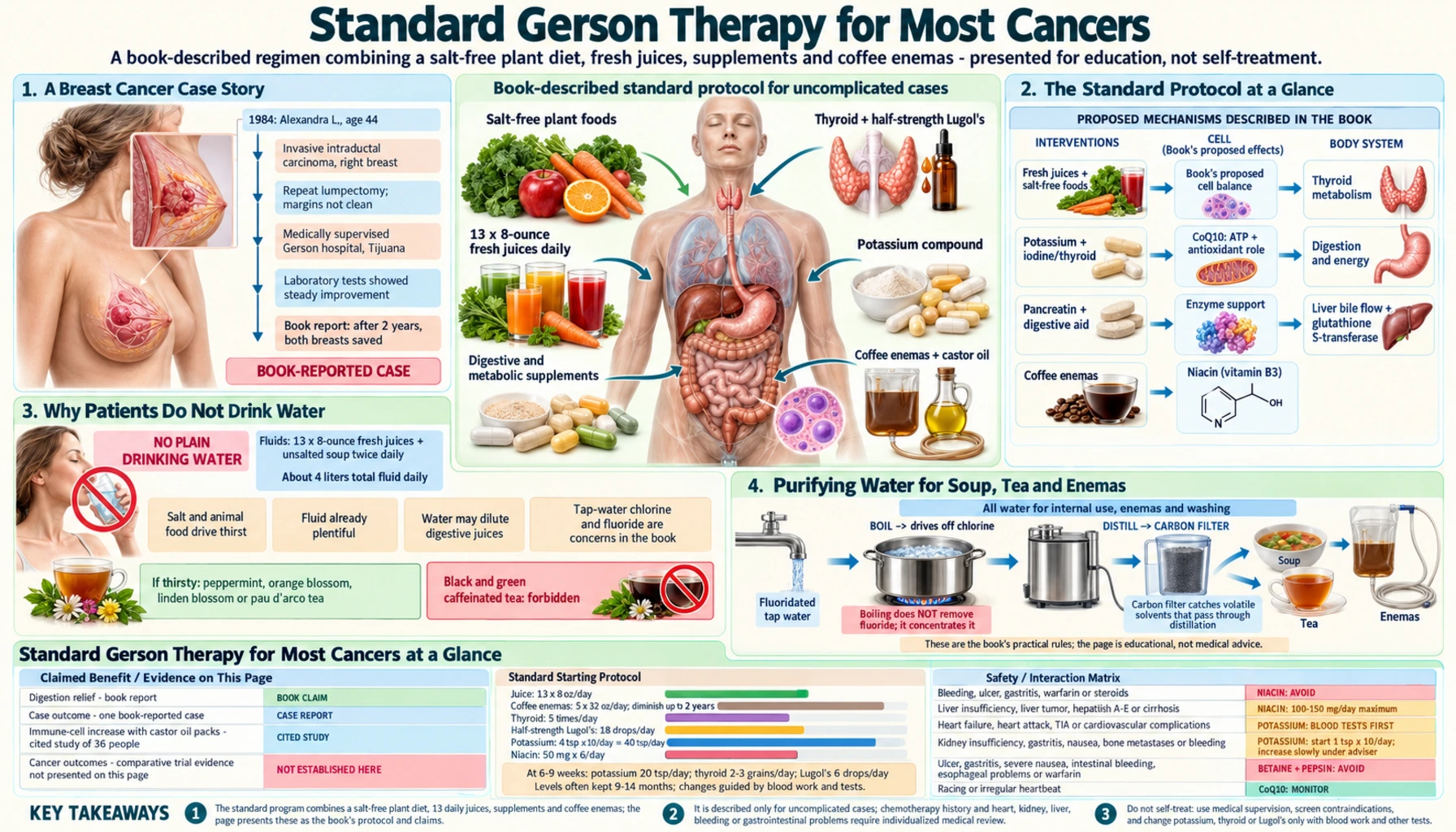
Chapter Fourteen of The Gerson Therapy is, in the authors’ own words, “the pivot for our entire book.” It sets out the standard Gerson protocol — the version followed by cancer and other degenerative-disease patients who are not coping with treatment complications such as prior chemotherapy. The chapter lists every medication and supplement in the program with its dose, explains why each one is used, and states who should not take it.
This page gathers those doses and rules in one place, exactly as the book gives them: no drinking water, thyroid and half-strength Lugol’s solution, the potassium compound, flaxseed oil, thirteen glasses of fresh juice, niacin, pancreatin, crude liver with vitamin B12, a betaine-hydrochloride-and-pepsin digestive aid, coenzyme Q10, laetrile, proteolytic enzymes, coffee enemas, castor oil, and the planned reduction of medications during the first year. For the broader cancer story, see the sibling page Gerson Cancer Treatment.
Table of Contents
- A Breast Cancer Case Story
- The Standard Protocol at a Glance
- Why Patients Do Not Drink Water
- Purifying Water for Soup, Tea and Enemas
- Thyroid Extract and Lugol’s Solution
- The Potassium Compound Solution
- Cold-Pressed Flaxseed Oil
- Niacin (Vitamin B3)
- Pancreatin and the Pre-Meal Digestive Aid
- Crude Liver and Vitamin B12 Injections
- Coenzyme Q10
- Laetrile and Proteolytic Enzymes
- Why Brewer’s Yeast Was Dropped
- Coffee Enemas and Castor Oil
- Changing Medications in the First Year
- Key Research Papers
- Connections
- Featured Videos
1. A Breast Cancer Case Story
The chapter opens with Alexandra L. of Sacramento, California. In 1984, aged forty-four and raising three teenagers, she was rediagnosed with invasive intraductal carcinoma of the right breast after an earlier lumpectomy. A repeat lumpectomy did not leave “clean” margins, and her surgeon proposed examining her lymph nodes and removing the breast. A consulting oncologist told her he did not expect her to live two years.
The book notes she was already carrying a heavy load: severe depression, chronic low blood sugar, constant headaches, floaters in her vision, many allergies, symptoms of yeast overgrowth, kidney stones, and great emotional stress after a divorce. Driving home, she noticed that some lawns were lush and green while others were brown, and reasoned that if the right food could revive grass, good nutrition might help her body too.
A health food store owner pointed her to Dr. Gerson’s book A Cancer Therapy: Results of Fifty Cases, calling the protocol “the hardest therapy to follow but the best.” Four days after phoning, she arrived at a medically supervised Gerson hospital in Tijuana, Mexico. Laboratory tests showed steady improvement, and she went home to continue the therapy herself. After two years, the book reports, she had saved both breasts and considered herself to have succeeded against breast cancer; some two years later she “felt at the peak of her abilities.”
2. The Standard Protocol at a Glance
The chapter lists the following elements and starting doses for the uncomplicated patient. It does not lay out an hour-by-hour timetable — the daily rhythm of juices and enemas is covered in the book’s chapters 12 and 13 (see Thirteen Glasses and Coffee Enema Protocol).
| Element | Standard dose as the book gives it |
|---|---|
| Drinking water | None — fluids come from juices, soup and herbal teas |
| Fresh juices | Thirteen 8-ounce glasses a day: apple/carrot, carrot alone, green leaf and/or orange |
| Thyroid extract | Taken five times per day |
| Lugol’s solution, half-strength | Eighteen drops per day |
| Potassium compound solution | 4 teaspoons, ten times per day (40 tsp/day) |
| Cold-pressed flaxseed oil | 1 tablespoon twice daily for four weeks, then 1 tablespoon a day |
| Niacin | 50 mg six times per day |
| Pancreatin (porcine) | Three 325-mg tablets four times per day |
| Crude liver + vitamin B12 | Daily intramuscular injection: 3 cc crude liver extract with 100 mcg B12 |
| Betaine hydrochloride + pepsin | Two capsules three times a day before meals |
| Coenzyme Q10 | 90 mg day one, 300 mg day two, 600 mg from day three (variable) |
| Laetrile (amygdalin) | Optional; especially for bone metastases — 500 mg oral three times a day, or IV |
| Proteolytic enzyme blends | For severe gas and tumor masses |
| Coffee enemas | Five 32-ounce enemas daily, slowly diminishing over up to two years |
| Castor oil | By mouth and by enema, every other day |
The authors stress that this standard program “is strictly for uncomplicated cancer or other degenerative disease patients.” Patients who have had chemotherapy follow a modified program, described in the book’s chapter 15. Each medication below also carries its own list of people who should not take it.
3. Why Patients Do Not Drink Water

The usual advice is about eight 8-ounce glasses of water a day. On the Gerson Therapy, the book says, the rules are different, for several reasons:
- Thirst comes from salt and animal food. A salty diet forces the body to drink to keep excess sodium in solution, and the end-products of digesting animal protein and fat also cause thirst. The authors note that people who eat only fruit rarely become thirsty, since fruit carries its own water.
- Fluid is already plentiful. Thirteen 8-ounce glasses (about 225 cc each) of fresh juice plus unsalted soup twice a day add up to about 4 liters of fluid daily, which the book calls “more than adequate.”
- Water dilutes digestive juices. Chronically ill patients are generally low in stomach acid, and Dr. Gerson observed that when his patients drank water their digestion suffered, with gas and discomfort.
- Tap water quality. The authors regard chlorinated and fluoridated tap water as harmful to the thyroid (see the next sections).
Patients who still want more to drink, or who wake thirsty at night, are given herbal teas — peppermint, orange blossom, linden blossom and/or pau d’arco (taheebo, lapacho) — kept in a thermos on the night table. Valerian tea can help with sleep, and peppermint tea is said to stimulate digestion and relieve gas. Black and green teas containing caffeine are treated as drugs and are forbidden.
4. Purifying Water for Soup, Tea and Enemas
If patients drink no water, why worry about its purity? The book gives four answers: water still goes into soup, tea and cooking; patients take three to five coffee enemas a day, and the colon is “a highly absorptive organ”; fluoride is a very small, active molecule that passes through the colon and even the skin; and so all water for internal use, enemas and washing must be free of chlorine, fluorine and other pollutants.
The authors view chlorine and fluorine as halogens that can displace iodine from the thyroid. Their practical rules:
- Chlorine can be driven off by boiling the water.
- Fluoride is not removed by boiling — because it is added as a salt, boiling concentrates it as water evaporates.
- Ordinary filters remove much but not all fluoride, and the book says even a small remainder cannot be tolerated by a seriously ill person. Fluoridated tap water should be distilled, with a carbon filter added to catch volatile solvents that pass through distillation.
On the worry that distilled water “leaches” minerals, the book replies that minerals in spring and bottled water are inorganic, poorly absorbed and often unbalanced, and that the body’s minerals should come from fresh fruit, salads and vegetable juices, which the Gerson diet supplies amply.
5. Thyroid Extract and Lugol’s Solution
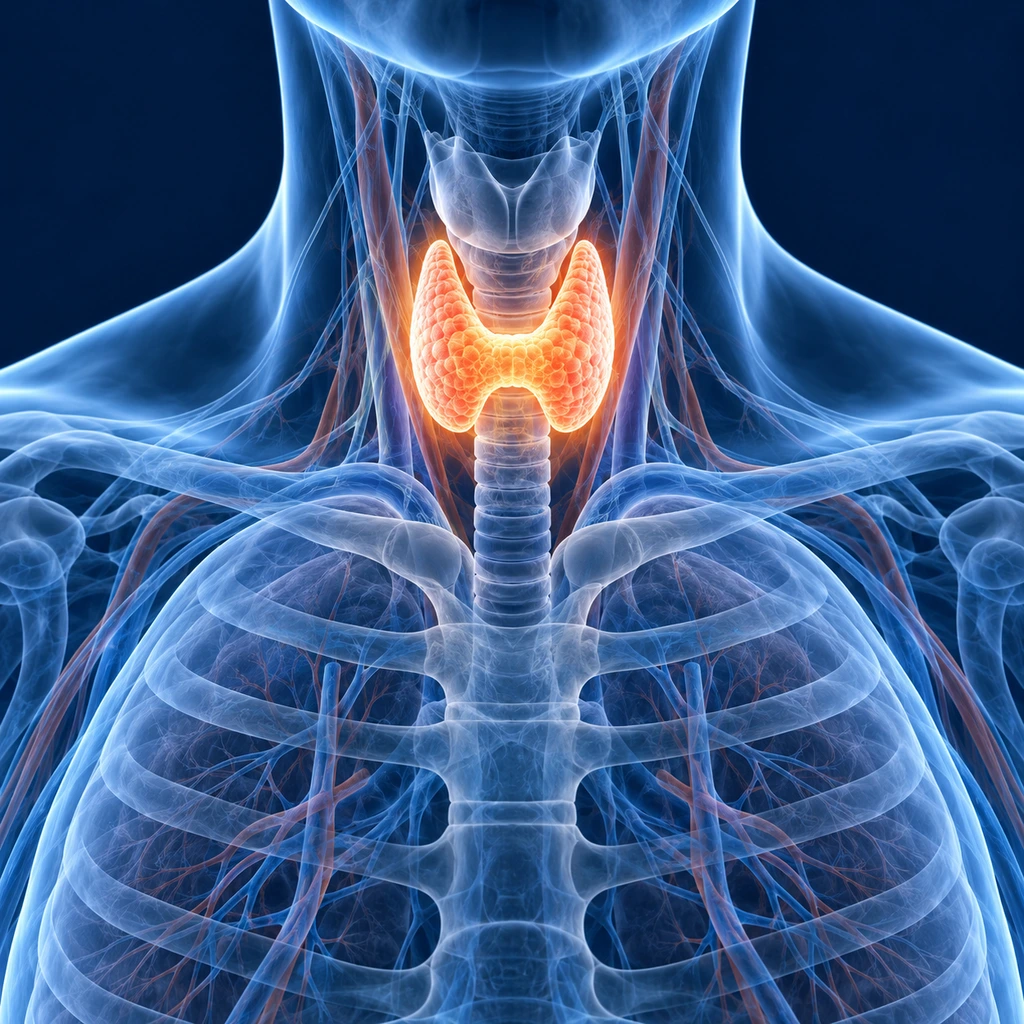
The book explains that the thyroid needs iodine to make thyroxine, the hormone that sets the metabolic rate — how fast food is burned — and that also governs body temperature and the ability to produce a fever to fight infection. When fluorine or chlorine displaces iodine from the gland, the authors say, three problems follow: the body cannot produce fever, allergies and infections arise, and food is not burned well, leading to low energy and fat storage.
They add that low thyroid function is linked to hardening of the arteries, citing endocrinologist Broda Barnes, M.D., who used thyroid extract in heart patients. They also note that the old U.S. “goiter belts,” where soil iodine was low, had higher cancer rates. These are the reasons given for thyroid extract five times per day.
Iodized salt solved goiter but, in Gerson’s view, created a new problem. Dr. Gerson held that all chronic disease begins with the loss of potassium from the cell and the invasion of sodium chloride; the book states that salt inhibits enzyme production in cells and promotes excessive cell division. Iodine therefore has to come from a salt-free source. Gerson used Lugol’s solution, half-strength — described as a 5 percent solution of potassium iodide, iodine and water — at eighteen drops per day, so that patients obtain iodine without sodium.
6. The Potassium Compound Solution
The standard dose is 4 teaspoons of the liquid potassium compound solution, ten times per day. The solution is made of potassium acetate, potassium gluconate and potassium monophosphate. The book’s summary list describes each 4-teaspoon dose as about 2 grams or 50 mEq of each salt; its detailed section states approximately 3½ grams or 50 mEq of each, for a total of 14 grams or 150 mEq per day. (Both figures are as printed in the chapter.)
Book’s cautions:
- Patients with any history of heart failure (cardiac insufficiency), heart attack, transient ischemic attack or other cardiovascular complications should not receive potassium until their blood tests have been analyzed.
- Patients with kidney insufficiency, gastritis, nausea, significant bone metastases or any bleeding problem start at just 1 teaspoon ten times a day, increased slowly under observation by the Gerson medical adviser.
7. Cold-Pressed Flaxseed Oil
For years Dr. Gerson allowed cancer patients no fat at all. The book tells how, with patients whose external (skin) cancers had healed, he cautiously added one oil or another and found that within a week or two the lesions reopened and tumors regrew — then disappeared again when the fat was removed. He tried polyunsaturated oils, olive oil and other monounsaturated oils, and nut and seed oils, and found none safe during healing; hence “No Fats, No Oils” in A Cancer Therapy. He found it took up to eighteen months before a little salt-free butter or oil could be given.
In 1958, the last year of his practice, Gerson came across the work of Johanna Budwig, Ph.D., who had found flaxseed (linseed) oil different from other fats. Gerson — whose father’s business had been pressing flaxseed — tried it and, the book reports, found it improved his results. The authors suggest the fatty acids help carry vitamin A (beta-carotene) in the blood to boost immune response and help dissolve arterial plaque.
Dose: from a letter Gerson wrote to Albert Schweitzer — 2 tablespoons a day for the first four weeks (1 at lunch, 1 at dinner), then 1 tablespoon a day. A few patients need adjustments based on serum electrolytes, HDL and LDL cholesterol and triglycerides.
Handling rules from the book:
- Buy oil from organically grown flaxseed, pressed cool, in light-proof bottles, kept refrigerated.
- Keeps about six months frozen and three months unopened in the refrigerator; once opened, use within three weeks.
- Never heat it, cook, bake or fry with it; do not add it to hot soup or a steaming baked potato — let food cool first.
- Do not eat the seeds, whole or crushed — take only the oil, “for it is a medication.”
8. Niacin (Vitamin B3)
The book calls niacin “an integral part of the Gerson Therapy protocol.” For cancer patients with little or no chemotherapy history and no ostomy or other surgery, the standard dose is 50 mg six times per day.
- Absolutely contraindicated in patients with a history of bleeding, ulcers or gastritis, and those taking prednisone, other steroids or the blood thinner warfarin.
- Patients with liver insufficiency, primary or metastatic tumors in the liver, any hepatitis (A through E) or cirrhosis may receive a maximum of 100–150 mg a day.
More detail is on the Niacin in the Gerson Therapy page.
9. Pancreatin and the Pre-Meal Digestive Aid
Pancreatin
The summary list gives three 325-mg porcine pancreatin tablets four times per day. Dr. Gerson wrote that he found pancreatin “in many cases a valuable help,” that a few patients cannot stand it, but that most have less gas, spasm and digestive trouble and regain weight and strength more easily. He used uncoated five-grain tablets after the detoxification period, “three or four tablets three times after meals, and later less.”
The chapter quotes other physicians who use pancreatic enzymes with meals to help digest protein, fat and carbohydrate, and between meals for a systemic effect — described as anti-inflammatory and as helping to dissolve the protective protein coating around cancer cells so the immune system can reach them.
Betaine hydrochloride with pepsin
Because chronically ill patients are low in stomach acid, patients without complications take two capsules of a betaine hydrochloride-and-pepsin combination three times a day before meals. The book says it should not be given to people with gastric ulcers, gastritis, severe nausea, intestinal bleeding or esophageal problems, or to those taking warfarin.
10. Crude Liver and Vitamin B12 Injections
The book states it is advantageous for degenerative-disease patients to receive a once-daily intramuscular injection of 100 mcg vitamin B12 (cyanocobalamin) with 3 cc of crude liver extract. Unless a patient has excessive blood levels of B12 or an allergic reaction to it, the authors say there is no known contraindication.
11. Coenzyme Q10
The chapter describes coenzyme Q10 as essential for producing energy (ATP) in oxygen-using cells and as part of the body’s antioxidant system; combined with vitamin E, selenium and beta-carotene, it is said to reduce free-radical damage in liver, kidney and heart tissue.
Dosing recommended by the Gerson Institute, per the book: 90 mg once on the first day. If there are no side effects — chiefly a racing or irregular heartbeat — the dose may go to 300 mg on the second day and 600 mg from the third day on.
12. Laetrile and Proteolytic Enzymes
Laetrile (amygdalin)
The book presents laetrile as useful for all primary cancers but specifically indicated for bone metastases. It quotes physicians who report that amygdalin improves the patient’s sense of well-being, relieves cancer pain and reduces the need for pain medication, and cites research reporting a 60 percent reduction in lung metastases and longer survival in breast and bone cancer. Pain relief is said to take at least ten days to two weeks of daily use.
Doses given: 9 grams per intravenous application (one physician’s preference), or for those not on IV laetrile, 500 mg of oral amygdalin three times a day, continued even after physical evidence of cancer has gone.
Proteolytic enzyme blends
The book describes imported German protein-digesting enzyme blends made from plant and animal sources, containing pancreatin, papain, bromelain, trypsin, chymotrypsin, lipase, amylase and rutin. They are indicated mainly for severe, excessive gas; some reports, the authors say, find them helpful in shrinking malignant masses. They are given as injections, tablets or suppositories.
13. Why Brewer’s Yeast Was Dropped
Dr. Gerson originally used brewer’s yeast, before he introduced liver juice and before yeast overgrowth (candidiasis) became common. Today, the book says, it is seldom recommended for cancer: there is a growing risk of candidiasis with severe bloating and gas, little clinical benefit has been seen, and negative responses have been noted in cancer patients, who the authors say have become more acidic and carry more candida than in Gerson’s day. The chapter’s summary calls it contraindicated for cancer patients.
14. Coffee Enemas and Castor Oil
Coffee enemas
The standard program calls for five 32-ounce coffee enemas a day, taken in slowly diminishing numbers for a variable period of up to two years. Organic caffeinated coffee is brewed, cooled to body temperature and given from an enema bag. The book explains that coffee contains choleretics that increase the flow of toxin-rich bile, calls the coffee enema “probably the only pharmaceutically effective choleretic” that can be used safely many times daily, and says it stimulates the liver’s glutathione S-transferase detoxifying enzymes. The authors add that this effect does not occur when coffee is drunk — “the only beneficial way to ingest coffee is through the rectum.” See Coffee Enemas.
Castor oil
Castor oil by mouth and by enema is routine, every other day in the standard program. Gerson recommended it during strong healing reactions — toxic diarrhea, vomiting of bile and similar — writing that “these strong reactions are actually indications of the beginning of improvement,” and that after one or two days patients feel greatly relieved, with better circulation, color and appetite. The book also reports that castor oil packs may reduce tumors and cysts, citing a study of thirty-six people in which pack users showed significant increases in lymphocytes and other immune cells. See Remission and Healing Reactions.
15. Changing Medications in the First Year
About one month after discharge from inpatient care — roughly six to nine weeks after starting therapy — three medications are reduced, while other supplements generally stay at their starting levels:
| Medication | Starting level | After reduction |
|---|---|---|
| Potassium compound | 40 tsp per day | 20 tsp per day |
| Thyroid | Five times per day | 2–3 grains per day |
| Lugol’s, half-strength | 18 drops per day | 6 drops per day |
These levels are often kept for nine to fourteen months, with further changes guided by blood work and other tests. The book notes this is a change from Gerson’s original book: patients today must stay on higher doses of the three main medications for longer, because when medications are cut too fast, “sick people often experience difficulties and a slowing of recovery or a recurrence of disease.”
Key Research Papers
- Gerson C, Walker M. The Gerson Therapy. Chapter Fourteen, “Standard Gerson Therapy for Most Cancers.” primary source for every dose and rule on this page.
- Gerson M. A Cancer Therapy: Results of Fifty Cases and The Cure of Advanced Cancer by Diet Therapy. 5th ed. Bonita, Calif.: The Gerson Institute; 1990. — cited in the chapter for pancreatin and the no-fat rule.
- Gerson M. The cure of advanced cancer by diet therapy: a summary of 30 years of clinical experimentation. Physiol Chem Phys. 1978;10(5):449–64. — PubMed PMID: 751079
PubMed Topic Searches
Connections
Featured Videos