Enders, Weller & Robbins: Growing Poliovirus, and the Vaccines That Followed
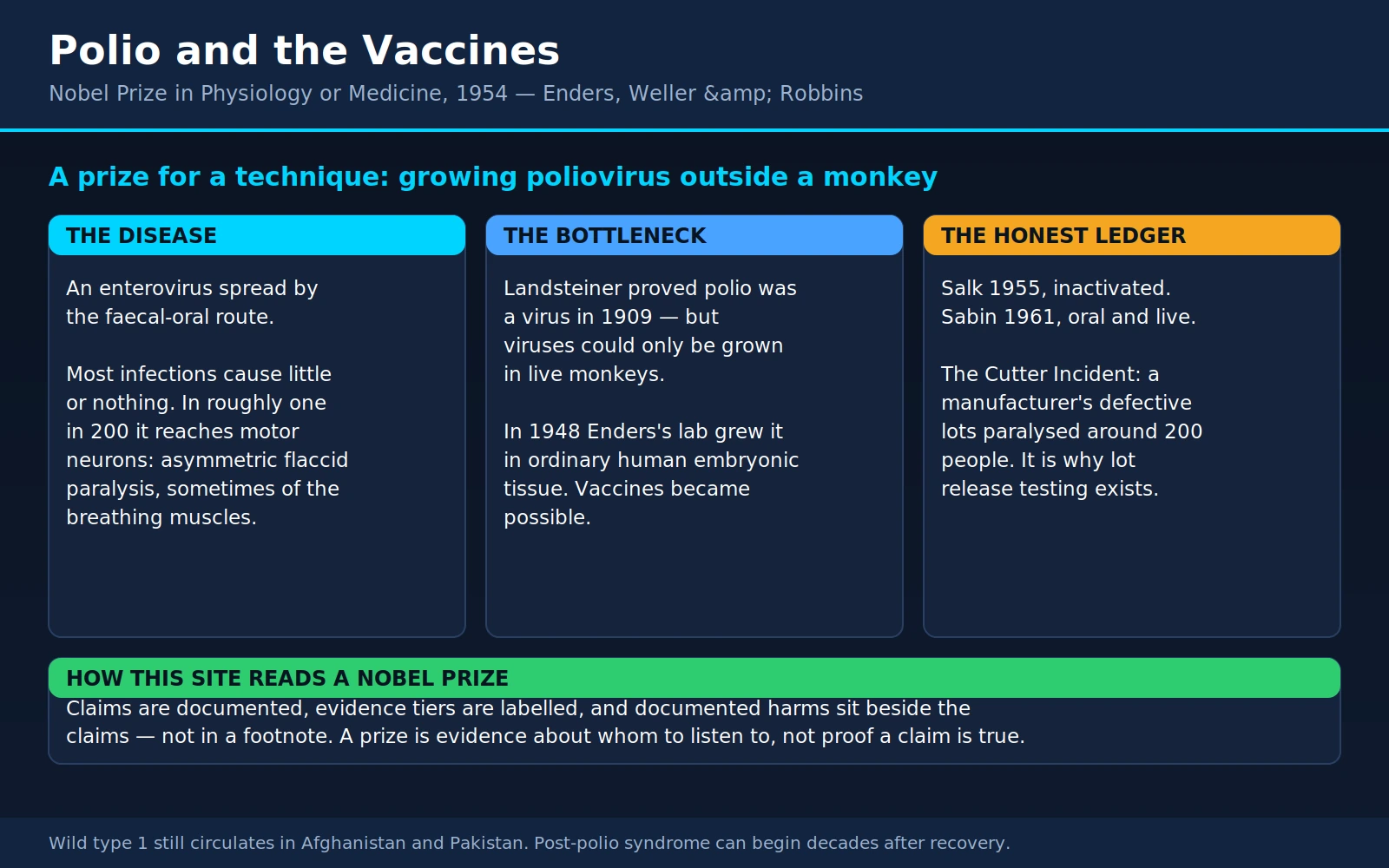
Table of Contents
- The Prize and the Three Men
- What Polio Did
- The Bottleneck: A Virus You Could Only Grow in a Monkey
- The Accident, 1948–1949
- Why the Technique Mattered More Than the Finding
- Salk, 1955 — and the Cutter Incident
- Sabin, 1961 — the Sugar Cube and Its Price
- Where Eradication Actually Stands
- Post-Polio Syndrome
- What This Means for You Today
- Iron Lungs and the Disability Legacy
- Where Mainstream Medicine Agrees / What Remains Hard
- Key Research Papers
- Connections
- Featured Videos
1. The Prize and the Three Men
In 1954 the Nobel Prize in Physiology or Medicine went to three men working in a converted laboratory at Children's Hospital in Boston: John Franklin Enders, Thomas Huckle Weller, and Frederick Chapman Robbins. The citation is worth quoting exactly, because it is unusual: the prize was awarded "for their discovery of the ability of poliomyelitis viruses to grow in cultures of various types of tissue."
Read that again. Not for a cure. Not for a vaccine. Not for identifying a disease or a gene or a hormone. The prize was given for a way of growing something in a dish. Nobel committees usually reward a finding — a molecule, a mechanism, a cause. Here they rewarded a technique, and they were entirely right to, because within six years of that dish the world had two polio vaccines, and within a decade it had vaccines for measles, mumps and rubella, a diagnostic virology industry, and the entire practice of growing human viruses outside a living animal. Almost everything that happened in virology for the next seventy years happened downstream of it. If you have ever had a viral culture, a vaccine, or a lab test that involved growing a virus, this is the technique that made it possible.
John Enders (1897–1985) came to science absurdly late, and by a route no career adviser would recommend. He was born in West Hartford, Connecticut, the son of a bank president, and had money behind him — a fact that mattered, because it let him take a very long time to decide what he was for. He went to Yale, left to serve as a flying instructor in the Naval Reserve Flying Corps during the First World War, came back and finished his degree, and then went into the real estate business. It bored him. He enrolled at Harvard as a graduate student in English literature, intending to become a teacher of Anglo-Saxon and Germanic philology.
What changed everything was a roommate. Hugh Ward, an Australian working in Hans Zinsser's bacteriology department at Harvard Medical School, brought Enders around to the lab and to Zinsser's dinner table. Zinsser — bacteriologist, typhus researcher, essayist, author of Rats, Lice and History — was exactly the sort of scientist who could make a literature student see that science was a humane subject. Enders switched fields and took his PhD in bacteriology and immunology in 1930, at the age of thirty-three. He never took a medical degree. He is now routinely called the father of modern vaccines.
In 1946 Enders left Zinsser's department to set up his own Research Division of Infectious Diseases at Children's Hospital in Boston. It was small on purpose. Enders disliked large groups, hated administrative meetings, wrote his own papers by hand, and worked at the bench himself well into his seventies. He had a reputation for two things: an almost obsessive insistence on controls, and a genuine indifference to credit.
Thomas Weller (1915–2008), the son of a University of Michigan pathologist, arrived at Harvard Medical School with a background in parasitology and a lifelong interest in the tropics. The Second World War sent him to the Antilles Medical Laboratory in Puerto Rico, where he ran bacteriology, virology and parasitology for the Army. He joined Enders in 1947. Weller was the technical craftsman of the group — the one whose tissue cultures actually stayed alive — and he would go on, largely on his own, to be the first person to grow varicella-zoster virus (chickenpox and shingles) in culture, to isolate and name cytomegalovirus, and to co-isolate rubella virus, the step that led to the rubella vaccine and the end of congenital rubella syndrome in much of the world.
Frederick Robbins (1916–2003) was born in Auburn, Alabama and raised in Columbia, Missouri, the son of a plant physiologist. He and Weller were classmates at Harvard Medical School and shared a room; they would share a Nobel Prize thirteen years after graduating. Robbins spent the war with the Army's 15th Medical General Laboratory in North Africa and Italy, running the virus and rickettsial disease section — infectious hepatitis, typhus, Q fever — and came back to Boston in 1948 on a National Research Council fellowship to work with Enders. He later became Dean of the medical school at Case Western Reserve and president of the Institute of Medicine.
One detail about the prize deserves recording, because it says something about Enders. It is widely recounted that the Nobel committee's original intention was to award the prize to Enders alone, as the senior figure, and that Enders replied that he would not accept it unless Weller and Robbins were named with him. Whether or not the story is exact in every particular, the underlying fact is not in dispute: the three papers that won the prize carry all three names, in rotating order, and Enders spent the rest of his life pointing at his younger colleagues. Robbins was 38 when he won the Nobel Prize; Weller was 39.
2. What Polio Did
Most people reading this have never seen a case of polio, and that is the whole point of the story — but it also means the disease has to be described before the achievement makes sense.
Poliomyelitis is caused by poliovirus, a small, tough, single-stranded RNA virus in the enterovirus family — a cousin of the coxsackieviruses and echoviruses that cause hand-foot-and-mouth disease and summer colds. There are three types, numbered 1, 2 and 3, and immunity to one does not protect against the others. The name is Greek and literal: polios (grey) + myelos (marrow) + -itis (inflammation) — inflammation of the grey matter of the spinal cord.
It spreads by the faecal-oral route: virus is shed in enormous quantity in stool for weeks, and reaches the next person through contaminated hands, water, food, or objects. Oral-to-oral spread through throat secretions happens too, particularly early in an infection and in places where sanitation is good. Someone can be shedding virus and infecting others for a week or more before anyone knows anything is wrong.
Once swallowed, the virus multiplies in the throat and in the lining of the gut and the lymphoid tissue around it. In the overwhelming majority of infections, that is where the story ends. Roughly three-quarters of infections cause no symptoms whatsoever. Another quarter cause a brief, unremarkable illness — fever, sore throat, headache, nausea, a few days of feeling rotten — that nobody would ever call polio; the textbooks call it abortive poliomyelitis. A smaller group, perhaps one to five percent, develop non-paralytic poliomyelitis: a viral meningitis with stiff neck, back pain and severe headache, frightening but recoverable.
And then there is the last fraction. In roughly one infection in two hundred — the figure is usually given as 0.1 to 0.5 percent, and it varies with virus type and the age of the patient — the virus crosses into the central nervous system and does something very specific. It infects and destroys the anterior horn cells: the large motor neurons in the front of the spinal cord whose long axons run out to the muscles. It can also take the motor nuclei of the brainstem.
Killing a motor neuron orphans every muscle fibre it commanded. The result is acute flaccid paralysis — limp, floppy weakness with absent reflexes — and it has a characteristic and cruel shape. It is asymmetric: one leg, not both; a shoulder but not the hand below it. It favours the legs over the arms, and proximal muscles over distal ones. Sensation is completely intact, which is one of the most distressing features for patients — a paralysed limb that can still feel pain and touch perfectly well. And the paralysis arrives fast, often over hours, typically after the fever has already begun to settle, so that a child who seemed to be getting better wakes up unable to stand.
The worst form is bulbar polio, which strikes the brainstem nuclei controlling swallowing, speech, and breathing. Roughly ten to fifteen percent of paralytic cases involved bulbar or bulbospinal disease. These patients cannot clear their own secretions, cannot swallow, and cannot move the diaphragm and intercostal muscles that pull air into the chest. Before mechanical ventilation, bulbar polio was very close to a death sentence; case fatality for paralytic polio overall ran around two to five percent in children and fifteen to thirty percent in adults, with bulbar cases far worse.
Those are the mechanics. The social reality was something else. From roughly 1900 to the mid-1950s, polio arrived every summer in the industrialised world like weather. Public swimming pools closed. Cinemas emptied. Summer camps were cancelled, playgrounds shut, children kept indoors through the hottest months of the year. Newspapers printed the daily case count the way they printed the weather. Quarantine placards went on front doors. Parents watched their children for a stiff neck the way earlier generations had watched for a rash. The 1952 epidemic in the United States — the worst on record there — produced roughly 57,000 reported cases, more than 21,000 of them paralytic, and over 3,000 deaths, in a single season. In 1916 New York City alone had recorded around 9,000 cases and more than 2,000 deaths, most of them children under five. (All of these figures are the historical reported counts and should be read as approximate; reporting was incomplete and definitions changed.)
The terror was rational and it was specific. Polio was not the biggest killer of children in that era — it was nowhere close. But it was arbitrary, invisible, summer-borne, and it took the healthy ones. It did not respect wealth, cleanliness, or good parenting. And it left its survivors visible: braces, crutches, wheelchairs, wards of iron lungs. A disease that kills quietly is forgotten; a disease that leaves a generation of children in leg braces is not.
The sanitation paradox — and why it is true
Here is the fact that most people find hardest to believe, and it needs stating plainly because it is genuinely counter-intuitive and it is genuinely correct: improved sanitation made polio epidemics worse.
In a society with contaminated water and no sewers, essentially every infant met poliovirus in the first months of life — while still carrying maternal antibodies transferred across the placenta and in breast milk. Infected under that antibody umbrella, the baby developed a mild or silent gut infection, cleared it, and emerged with lifelong immunity and, very often, no paralysis at all. Polio existed, but it existed as scattered infantile cases — which is why the nineteenth century called it infantile paralysis. It did not sweep through towns.
Clean water, sewers and household hygiene broke that pattern. Children now met poliovirus for the first time at four, or ten, or twenty — long after maternal antibody had faded, and at ages where the odds of paralysis are considerably higher. Whole cohorts grew up susceptible, and when the virus arrived it found thousands of non-immune hosts at once. That is an epidemic. The disease that became the emblem of mid-century public health was, in a real sense, a by-product of mid-century public health succeeding. The epidemiologist Neal Nathanson, who spent his career on this question, laid the argument out in detail in a 2010 review cited below.
This is not an argument against sanitation, which prevented cholera, typhoid and dysentery on a scale polio never approached. It is an argument for understanding that immunity to a common infection can be doing quiet work you only notice when it stops. And it is the reason polio could not be solved by cleanliness. It had to be solved by a vaccine — which meant it had to be solved by somebody who could grow the virus.
3. The Bottleneck: A Virus You Could Only Grow in a Monkey
By the late 1940s a great deal was known about polio and almost nothing could be done about it.
The foundational fact had been established forty years earlier by Karl Landsteiner — the same Vienna pathologist who discovered the ABO blood groups — working with Erwin Popper. In 1908 and 1909 they took spinal cord tissue from a nine-year-old boy who had died of polio, ground it up, passed it through a filter fine enough to hold back every known bacterium, and injected the filtrate into monkeys. The monkeys developed paralysis. Nothing that could be cultured on a bacteriological plate was present; something smaller than a bacterium and invisible to the microscopes of the day had transmitted the disease. Polio was caused by a filterable virus. Landsteiner's polio work is less famous than his blood groups but was, in its way, just as consequential — it defined what everyone afterwards was hunting for.
The trouble was that in 1909, and still in 1948, a virus was defined precisely by the thing that made it impossible to work with: it would only replicate inside a living cell. You cannot grow a virus on agar the way Robert Koch grew tuberculosis bacilli, or in broth the way anybody could grow E. coli. To make more poliovirus, you had to give it living nerve cells, and in practice that meant giving it a monkey.
Consider what that made every experiment cost. Want to know whether a patient's blood contains antibody to polio? Mix serum and virus, inject a monkey, wait, see if it is paralysed. Want to know how much virus is in a preparation? Serial dilutions, one monkey per dilution. Want to know whether there are two types of poliovirus or three? Cross-neutralisation in monkeys, for every strain against every serum. Want to test whether a candidate vaccine works? Monkeys again, and a lot of them.
Rhesus macaques were imported by the tens of thousands, largely from India, and the polio programme of that era consumed them at a rate that was expensive, ethically grim, logistically fragile, and above all slow. A single serotyping study could take years. And no vaccine of any kind could be manufactured at scale from ground-up monkey spinal cords — not for hundreds of millions of children, not at any price, and not with acceptable safety, since nervous tissue in an injected product carries its own serious hazards.
There was also a doctrine in the way, and it is the part of this story that most rewards attention. Everybody knew that poliovirus was strictly neurotropic — that it grew only in nerve cells. This was not folklore; it was a conclusion from good experiments. In 1936 Albert Sabin — who will reappear later in this page — and Peter Olitsky had succeeded in growing poliovirus in cultures of human embryonic brain tissue, and had tried and failed to grow it in cultures of non-nervous human tissue. Their result was correct as far as it went, and it was interpreted as a law of nature. Poliovirus lives in neurons; that is what poliovirus does.
The consequence was a dead end that looked like a fact. If poliovirus would only grow in nerve cells, then any cultured virus was contaminated with nerve tissue, and any vaccine made from it would risk causing allergic encephalomyelitis in the recipient. Growing the virus in bulk, safely, appeared to be impossible in principle rather than merely difficult in practice. That is the bottleneck the Boston laboratory walked into, largely by accident, in 1948.
4. The Accident, 1948–1949
Enders's laboratory was not working on polio. It is important to be clear about that, because the standard telling of this story turns it into a triumph of dogged focus, and it was almost the opposite.
The Boston group was working on mumps and, at that moment, on varicella — chickenpox. Weller was trying to grow varicella virus in cultures of human embryonic tissue. Enders had brought forward from his mumps work a deceptively simple culture method, a version of what was called a Maitland-type culture: small fragments of tissue suspended in a nutrient broth of ox serum ultrafiltrate and chick embryo extract, in a flask, kept alive for weeks with periodic changes of fluid. This was not the fussy, virtuosic tissue-culture technique of Alexis Carrel, which demanded rare skill; it was crude, robust, and reproducible by ordinary hands.
One further ingredient made it practical, and it belongs to two other men on this site. Cultures of animal tissue in nutrient broth are a paradise for bacteria, and before the 1940s a contaminated flask was simply lost — sometimes every flask, week after week. Enders's group added penicillin — Alexander Fleming's mould product, industrialised during the war — and streptomycin, isolated in Selman Waksman's laboratory in 1943. Between them the two antibiotics suppressed nearly everything bacterial that could ruin a culture while leaving the mammalian cells and the virus untouched. The tissue-culture revolution is usually told as a story about cells; it was equally a story about antibiotics making sterile technique achievable. Without Fleming and Waksman there is no Enders, Weller and Robbins.
In March 1948 Weller set up a batch of cultures of human embryonic tissue for the chickenpox work — and, as often happens, prepared more flasks than the experiment needed. There were four spare cultures. Enders remembered that the laboratory's deep freeze contained a vial of the Lansing strain of poliovirus, a type 2 strain that had been adapted to grow in mice. It was there almost incidentally.
Enders later described the decision with characteristic flatness. It occurred to him that since the material was at hand and the cultures would otherwise be discarded, they might as well inoculate them. There was no hypothesis being tested. The reigning doctrine said nothing would happen, and the experiment cost nothing, because the flasks were surplus.
The virus grew.
Not in nerve cells — the cultures were skin, muscle, connective tissue, intestine, human embryonic tissue with no neural component at all. The group confirmed it the hard way, by taking fluid from the flasks and injecting it into mice, which developed paralysis, and by carrying the virus through serial passages: fluid from flask one into fresh culture two, into three, into four, with the amount of virus rising at every step. That rules out the obvious objection — that they were merely detecting the virus they had put in. Something in those flasks was manufacturing new poliovirus.
The result appeared in Science on 28 January 1949 under the title "Cultivation of the Lansing Strain of Poliomyelitis Virus in Cultures of Various Human Embryonic Tissues." It runs to barely three pages. It is one of the most consequential short papers in the history of medicine.
Within months the group had extended it in every direction that mattered. Weller, Robbins and Enders showed that the virus grew in cultures of human foreskin — tissue that is about as far from a neuron as human tissue gets — and in a range of embryonic tissues, and, critically, that it was not only the mouse-adapted Lansing strain: fresh strains of all three poliovirus types, taken straight from patients, grew in the same system. They showed the virus could be grown in cultures of monkey kidney and monkey testis. They worked out that the cultures could be maintained for weeks and the virus harvested repeatedly.
And in 1950 Robbins, Enders and Weller published the finding that turned the technique from a curiosity into an instrument. Poliovirus growing in these cultures produced a visible cytopathic effect: the cells rounded up, shrivelled, granulated and died in a pattern you could see down an ordinary microscope. The dying culture also stopped acidifying its medium, so the phenol red indicator in the broth stayed red instead of turning yellow — meaning the result could be read as a colour change in a test tube, with no microscope at all.
That is the whole ballgame, and section 5 explains why.
How much of it was luck?
It is fair to ask, and the honest answer is: some, but much less than the word "accident" suggests. The luck was in the spare flasks and the vial in the freezer. Everything else was preparation. Enders's group had spent years developing a culture medium and a maintenance routine robust enough that tissue stayed alive for weeks. They had adopted antibiotics early and systematically. They had the controls in place to distinguish growth from carry-over. And when the result contradicted a well-established doctrine, they did not assume they had made a mistake — they tested it to destruction and published it.
Weller put the emphasis where it belongs in his Nobel lecture and in later accounts: the finding was unexpected, but the laboratory was built to notice unexpected things. Pasteur's line about chance favouring the prepared mind is quoted so often that it has gone soft, but this is precisely the case it was coined for.
5. Why the Technique Mattered More Than the Finding
The discovery that poliovirus grows in non-nervous tissue is a fact about poliovirus. The method for growing viruses in cultured human and animal cells, with antibiotics to keep them clean and cytopathic effect as a readout, is an instrument — and instruments compound. This is the section that explains the Nobel Prize.
Four things became possible more or less at once.
First: quantity. Virus could now be produced in litres rather than in monkeys. A vaccine requires industrial volumes of virus, produced reproducibly, batch after batch, to a specification. Tissue culture is what made vaccine manufacturing a thing that could exist. Salk's inactivated vaccine and Sabin's oral vaccine were both grown in cultured monkey kidney cells; neither could have been made any other way.
Second: purity — and therefore safety. Because the virus grew perfectly well in tissue containing no neurons, vaccine could be made without a trace of nervous tissue. This removed at a stroke the risk of post-vaccinal encephalomyelitis that had haunted earlier nerve-tissue-grown vaccines (the old Semple rabies vaccine being the notorious example). The doctrine of strict neurotropism had not merely been wrong; being wrong about it had been blocking the exit.
Third: measurement. This is the underrated one. Cytopathic effect gave virology a quantitative assay that ran in glassware. You could now titrate virus by dilution in tubes and read the endpoint by eye. You could measure a person's neutralising antibody by mixing their serum with virus and seeing whether the cells survived. Renato Dulbecco adapted the system in 1952 to count individual virus particles as plaques — discrete holes in a cell monolayer — giving virology the equivalent of the bacterial colony count.
Without a cheap, fast assay you cannot answer the questions a vaccine programme lives on. How many serotypes are there, and does the vaccine cover all of them? (Three, and it must.) Is this batch of virus fully inactivated? How much antibody did this child make? Is the attenuated strain still attenuated after passage? Every one of those is a tissue-culture question. The 1954 field trial of the Salk vaccine, with its hundreds of thousands of blood samples, is simply not conductible in a world where each antibody titre costs a monkey.
Fourth: everything else. Once you can grow one virus in cultured cells, you try the rest. The list of what came out of Enders's own laboratory in the following decade is close to absurd. Enders and Thomas Peebles isolated measles virus in 1954 from an eleven-year-old schoolboy named David Edmonston; the Edmonston strain, attenuated by Enders with Samuel Katz and others, is the ancestor of nearly every measles vaccine in use today. Enders declined to profit from it. Weller grew varicella-zoster, isolated and named cytomegalovirus, and co-isolated rubella — the last of which led directly to the rubella vaccine and to the near-disappearance of congenital rubella syndrome, a condition that had been blinding and deafening babies by the thousand.
Beyond Boston, the technique founded diagnostic virology as a clinical discipline, and it underlies the production of vaccines against measles, mumps, rubella, varicella, hepatitis A, rabies and influenza; the isolation and identification of most human viruses discovered after 1950; and the cell-culture infrastructure that modern virology, oncology and cell biology all still run on. The 1954 prize was awarded for a dish of tissue because the committee could see what a dish of tissue was going to do.
6. Salk, 1955 — and the Cutter Incident
Jonas Salk, at the University of Pittsburgh, had spent the early 1950s on a National Foundation for Infantile Paralysis project to determine how many types of poliovirus existed — the answer was three — and had come out of it convinced that a killed-virus vaccine could work. The idea was not new; the obstacle had been supply. Enders's method removed the obstacle. Salk grew all three poliovirus types in cultured monkey kidney cells, inactivated them with formaldehyde under conditions carefully worked out to destroy infectivity while leaving the viral proteins intact enough to provoke antibody, and injected the result.
He tested it on institutionalised children, on his own laboratory staff, on himself, and on his own three sons. The antibody responses were convincing. What followed was one of the largest medical experiments ever run.
The 1954 field trial was designed and evaluated by Thomas Francis Jr. of the University of Michigan — Salk's former mentor — who insisted, against considerable pressure, on a proper placebo-controlled design. Roughly 1.8 million children took part (the figure is usually given as about 1,800,000 and should be treated as approximate). Around 400,000 received vaccine, around 200,000 received a placebo injection in a double-blind arm, and roughly 1.2 million more served as observed controls. They were called the Polio Pioneers. Twenty thousand physicians and public health workers, forty thousand nurses, and something over 200,000 volunteers ran it.
On 12 April 1955 — the tenth anniversary of Franklin Roosevelt's death, chosen deliberately — Francis announced the results in a packed auditorium at Ann Arbor, broadcast live to cinemas and to the country. The vaccine was safe, effective, and potent. Against paralytic polio it ran roughly 60–70 percent effective for type 1 and above 90 percent for types 2 and 3.
The public reaction has no real modern parallel. Church bells were rung. Factory whistles were blown. Schools closed for the day. Salk became, overnight, one of the most famous men alive, and when Edward R. Murrow asked him who owned the patent, he gave the answer everybody still quotes: "Well, the people, I would say. There is no patent. Could you patent the sun?" Vaccine was licensed the same afternoon, after a review that took a couple of hours.
The Cutter Incident
Two weeks later, children who had received the vaccine started developing polio.
This page is going to tell that story in full, with real numbers, for a specific reason. A reader who first learns about the Cutter Incident from a source that is hostile to vaccination, having read a page like this one that never mentioned it, is entitled to conclude that they were managed rather than informed. So: here it is.
Cutter Laboratories of Berkeley, California was one of five manufacturers licensed to produce the Salk vaccine. Its inactivation process failed. Live, virulent poliovirus survived in some lots — the formaldehyde step had been performed in a way that allowed virus particles clumped in aggregates to escape inactivation, and the safety testing in use at the time was not sensitive enough to catch it. Roughly 120,000 children were injected with vaccine from the defective lots.
The epidemiological investigation was led by Neal Nathanson and Alexander Langmuir at the Communicable Disease Center, and their reports remain the authoritative account. The consequences, in approximate figures: about 40,000 children developed abortive polio — the fever-and-headache form; roughly 200 people were left with some degree of paralysis, of whom about 79 were vaccinated children and the remainder were family members and community contacts infected by them; and about 10 people died. Nathanson and Langmuir's tally attributed some 204 cases in total, with roughly three-quarters paralytic and eleven deaths. Every figure in this paragraph should be read as approximate, and different sources partition the vaccinee and contact cases slightly differently.
Two things need saying about it, both plainly.
It was a manufacturing failure, not a failure of the vaccine concept. The other four manufacturers' vaccine did not do this. The same vaccine, correctly inactivated, was at that moment preventing paralysis in hundreds of thousands of children and would go on to end epidemic polio in the industrialised world. What Cutter shipped was, in effect, an injection of live poliovirus — a completely different substance from what the licence described. The failure was in process control and in the inadequacy of the tests then used to release a lot.
And it is the reason the modern vaccine safety system exists. The Cutter Incident produced the machinery that governs biological manufacturing to this day. The federal Laboratory of Biologics Control was reorganised and expanded into the Division of Biologics Standards, which later moved to the FDA. Lot release testing — the rule that no batch of a vaccine reaches a child until samples of that specific batch have been independently tested and released by a regulator, not merely by the manufacturer — is a direct descendant of Cutter. So are the requirements for filtration to break up virus aggregates, for far larger safety-test sample sizes, and for the documented, inspected process validation that biologics manufacturing now runs on. The subsequent lawsuit, Gottsdanker v. Cutter Laboratories, also established that a manufacturer could be liable for a defective vaccine without proof of negligence — a legal shift whose long consequences included, eventually, the compensation systems that now sit alongside vaccine programmes in many countries.
Paul Offit's fiftieth-anniversary essay in the New England Journal of Medicine, cited below, is a short and unflinching read on all of this.
7. Sabin, 1961 — the Sugar Cube and Its Price
Albert Sabin, at the University of Cincinnati, had argued from the start that a killed vaccine was the wrong answer. His reasoning was biological. Polio is a gut infection; an injected killed vaccine produces circulating antibody that protects the individual's nervous system beautifully but does comparatively little to stop the virus setting up shop in the intestine. A live, weakened virus given by mouth would infect the gut the way the wild virus does, produce local secretory antibody in the intestinal lining, and thereby stop the recipient from carrying and spreading the virus at all.
Sabin took wild poliovirus strains and passaged them repeatedly through cultured monkey kidney cells — again, Enders's technique — selecting at each round for variants that had lost the ability to invade nerve tissue while retaining the ability to grow in the gut. The resulting attenuated strains for all three types became the oral poliovirus vaccine (OPV).
He could not get a large trial in the United States, where Salk's vaccine was already deployed. He got one in the Soviet Union instead, where his collaborator Mikhail Chumakov ran trials that eventually enrolled tens of millions of children — one of the genuine and under-remembered instances of Cold War scientific cooperation. OPV was licensed in the United States in 1961 (type 1 first, then types 2 and 3, with the trivalent formulation following in 1963), and it very rapidly displaced the injected vaccine almost everywhere.
Its advantages were enormous and they were mostly practical:
- No needle, no syringe, no trained injector. Two drops on the tongue or on a sugar cube. A volunteer can vaccinate hundreds of children an hour, in a village, in a market, at a border crossing.
- Cost. OPV costs a small fraction of an injected vaccine — on the order of cents per dose — which is the difference between a national programme being possible and being aspirational.
- Gut immunity. OPV interrupts transmission. IPV protects the person; OPV protects the person and quiets the epidemic around them.
- Secondary spread. Vaccinated children shed the attenuated virus, which spreads to unvaccinated contacts and immunises some of them incidentally — a free bonus in a crowded, under-vaccinated community.
The Salk–Sabin rivalry was long, personal, and public, and both men had a real case. Salk's vaccine cannot cause polio and does not require live virus in the field; Sabin's vaccine stops transmission and can be delivered at continental scale. In hindsight the sensible verdict is that the world needed both, used in the right order, and it took several decades and a great deal of argument to arrive at that conclusion. Global eradication would have been unimaginable without OPV; the endgame is being finished with IPV.
The honest cost
OPV contains live virus, and live virus evolves. Two consequences follow, and both are real.
Vaccine-associated paralytic poliomyelitis (VAPP). In a very small number of recipients or their close contacts, the attenuated vaccine virus reverts towards neurovirulence during replication in the gut and causes paralytic polio — clinically indistinguishable from the wild disease. The risk in the United States was estimated at roughly one case per 2.4 million doses distributed, concentrated heavily on the first dose (on the order of one per 750,000 first doses) and elevated in people with certain immune deficiencies. In practice that meant about eight to ten VAPP cases a year in the United States in the 1980s and 1990s. A 2014 review by Platt and colleagues put the global burden in the range of a few hundred VAPP cases per year worldwide during the OPV era. These are small numbers; they are not zero, and for the families concerned they were catastrophic.
Once wild polio had been eliminated from a country, VAPP became that country's only source of paralytic polio — which is an intolerable trade when there is no wild virus left to prevent. The United States moved to a sequential IPV-then-OPV schedule in 1997 and to an all-IPV schedule in 2000; most other high-income countries did the same. Alexander and colleagues documented the resulting disappearance of VAPP in the JAMA paper cited below. This is the single clearest example of a vaccine policy being changed because the risk-benefit arithmetic changed — the vaccine did not get worse; the disease got rarer.
Circulating vaccine-derived poliovirus (cVDPV). The second consequence is subtler and now the larger problem. Vaccine virus shed by a vaccinated child normally dies out. But in a population where too few children are immune, it can pass from person to person for months or years, accumulating mutations, and eventually recover both neurovirulence and transmissibility. At that point it is, for all practical purposes, a polio virus again, and it causes outbreaks of paralytic polio that look exactly like wild polio.
Type 2 has been the main offender. Wild poliovirus type 2 was declared eradicated in 2015, and in April–May 2016 the world executed "the switch": trivalent OPV was withdrawn globally and replaced with bivalent OPV containing only types 1 and 3, to stop seeding type 2 vaccine virus into the environment. The logic was sound, but it had a predictable and predicted downside — every child born after the switch grew up with no type 2 intestinal immunity, so the residual type 2 vaccine viruses already circulating found an expanding pool of susceptible hosts. cVDPV2 outbreaks grew rather than shrank.
The answer has been a genuinely impressive piece of engineering: novel oral polio vaccine type 2 (nOPV2), a type 2 strain re-engineered at the genetic level to stabilise the specific sites where the original Sabin strain reverts. Two candidates were tested in the trials reported by De Coster and colleagues in The Lancet in 2021; nOPV2 received WHO Emergency Use Listing in late 2020 and prequalification subsequently, and hundreds of millions of doses have since been used in outbreak response. It is markedly more genetically stable than Sabin type 2, though not absolutely so.
8. Where Eradication Actually Stands
The World Health Assembly resolved in 1988 to eradicate polio from the planet. At that time the disease was estimated to paralyse around 350,000 children a year across more than 125 countries. The Global Polio Eradication Initiative has since reduced wild poliovirus by more than 99.9 percent. It is one of the great public health achievements in history, and it is also more than two decades past its original target date.
All figures in this section are approximate, and case counts in particular are provisional and revised as laboratory confirmation catches up. For live numbers, the authoritative source is the Global Polio Eradication Initiative's own weekly reporting at polioeradication.org.
Wild poliovirus type 2 was certified eradicated in 2015; the last wild type 2 case was detected in India in 1999. Wild poliovirus type 3 was certified eradicated in 2019; its last case was in Nigeria in 2012. Two of the three wild polioviruses are gone from the world, permanently, and that is a fact worth sitting with.
Wild poliovirus type 1 has never been interrupted in two countries: Afghanistan and Pakistan. They share a single epidemiological block — families move constantly across the border — so the two programmes stand or fall together. Case counts there fluctuate sharply from year to year: the combined total was in the single digits in 2021, around 30 in 2022, around 12 in 2023, and then rose steeply to roughly 100 in 2024. That rise is the reason nobody in the field currently treats eradication as imminent. The obstacles are not scientific. They are insecurity and attacks on vaccination teams, population displacement, suspicion of the campaign (badly aggravated by the CIA's use of a fake hepatitis B vaccination drive in Abbottabad in 2011), fatigue after decades of repeated door-to-door campaigns, and chronically weak routine immunisation in the areas that need it most.
Wild type 1 also escapes occasionally. In 2021–22 a Pakistan-linked strain caused cases in Malawi and Mozambique — the first wild polio in Africa since the continent was certified free of indigenous wild poliovirus in 2020 — which is a reminder that "eliminated" is a statement about transmission, not about geography.
Detections in wealthy countries
Two 2022 events made polio news again in places that had forgotten it.
In London, enhanced environmental surveillance of sewage detected type 2 vaccine-derived poliovirus repeatedly between February and July 2022, with genetic evidence of sustained local transmission. No paralytic case occurred. The UK responded with a booster campaign for children aged 1 to 9 across London. Klapsa and colleagues published the surveillance data in The Lancet; it is a good illustration of a system working exactly as designed — the virus was found in the sewers, not in a hospital.
In New York, an unvaccinated young adult in Rockland County developed paralytic poliomyelitis in July 2022 from a type 2 vaccine-derived virus, genetically linked to the sequences found in London and in Israel. Wastewater sampling subsequently found poliovirus in several New York counties and in New York City. It was the first case of paralytic polio in the United States in nearly a decade. Link-Gelles and colleagues reported it in MMWR; the case occurred in a community with low vaccination coverage, and the patient had never been vaccinated.
The paradox that is not a paradox
In recent years, cases of paralytic polio caused by vaccine-derived virus have outnumbered cases caused by wild virus — often by a wide margin, with several hundred cVDPV cases reported globally in a typical recent year against a wild total in the tens. Stated bare, that sounds like an indictment of the vaccine. It is not, and the reason matters.
Consider what those two numbers actually measure. The wild total is small because vaccination worked — it fell from about 350,000 to about 100 a year. The vaccine-derived total is not small in comparison, but it is a few hundred cases, arising almost entirely in populations where vaccination coverage is too low, because cVDPV cannot establish itself in a well-immunised community. Vaccine virus needs susceptible people to pass through in order to revert; a population with good coverage stops it in the first host.
So the honest summary is: cVDPV is a disease of under-vaccination, not of vaccination. It appears where coverage has collapsed — conflict zones, displaced populations, areas where campaigns have been interrupted. Comparing 300 to 100 while ignoring that both used to be 350,000 is a ratio without a denominator. That said, the problem is genuinely real, it is genuinely caused by the oral vaccine, and it is genuinely why the endgame requires either nOPV or a full transition to injected vaccine — nobody in the field pretends otherwise.
Why polio is harder than smallpox
Smallpox was eradicated in 1980, and people reasonably ask why polio is taking so much longer. Three reasons:
- Smallpox was visible. Every infected person had a rash; you could find cases by looking. Polio hides — about 99.5 percent of infections cause no paralysis, so for every case you see, hundreds of silent infections are spreading. Surveillance therefore has to be indirect: investigating every child under 15 with acute flaccid paralysis from any cause, plus testing sewage.
- The vaccine itself can seed outbreaks. Smallpox vaccine had serious rare complications but the vaccinia virus did not revert into smallpox and circulate. OPV can.
- The last mile runs through the hardest places on earth. The remaining reservoirs are exactly the areas where health systems are weakest and vaccinators are least safe.
9. Post-Polio Syndrome
This section is here for a particular group of readers: people who had polio as children in the 1940s and 1950s, recovered, built ordinary lives, and are now — forty, fifty, sixty years later — getting weaker again. Many of them have been told it is simply ageing. Often it is not.
Post-polio syndrome (PPS) is new or worsening muscle weakness, abnormal muscle fatigue, and often pain, appearing in a polio survivor after a long period — typically fifteen to forty years — of stable neurological function. Estimates of how many survivors it affects vary widely with the definition used, from around 20 percent to 60 percent or more; a commonly cited working figure is that somewhere between a quarter and a half of paralytic polio survivors develop it. It is more likely in people whose original illness was severe.
What is actually happening
The mechanism is well understood in outline and it is a story about a repair that eventually wears out.
Acute polio killed a proportion of the motor neurons supplying a muscle. Every muscle fibre that lost its nerve became useless — but the surviving motor neurons responded by sprouting new axon branches and adopting the orphaned fibres. A motor neuron that had commanded, say, 200 muscle fibres might end up commanding 1,000. This is why recovery from polio was often so much better than the initial paralysis suggested: with enough sprouting, a muscle that lost most of its nerve supply can regain most of its strength. Survivors typically ended up with far fewer motor units than normal, each one enormously oversized.
Those giant motor units have been working at the edge of their capacity for decades — a neuron maintaining five times its design load, in a person who then went on to compensate for residual weakness by overusing the muscles that still worked. Over many years, the most distal sprouts begin to fail and are lost. Because each unit is so large, losing a single one costs a great deal of strength, so the decline can feel disproportionate to how gradual it is. Normal age-related motor neuron loss, arriving on top of an already depleted pool, compounds it.
There is no evidence of persistent poliovirus infection driving it, and PPS is not contagious, not a relapse, and not progressive in the way motor neurone disease is. Typical rates of strength loss are slow — on the order of one percent a year in affected muscles — and it does not shorten life expectancy. Lo and Robinson's two-part review in Muscle & Nerve, cited below, is the most useful clinical summary in the recent literature.
Diagnosis
PPS is a diagnosis of exclusion, which is not a formality. A polio survivor developing new weakness can equally have a compressive radiculopathy, cervical or lumbar spinal stenosis, a nerve entrapment from years of crutch use, hypothyroidism, sleep-disordered breathing, anaemia, depression, or a nutritional deficiency — all of which are treatable, and some of which are common in this group precisely because of decades of altered biomechanics. The working criteria require a documented history of paralytic polio, partial recovery, a stable interval of at least fifteen years, new persistent weakness or fatigue, and no other explanation.
One specific thing to insist on: many people with PPS have undiagnosed sleep-disordered breathing or nocturnal hypoventilation, particularly those whose original illness involved the respiratory or bulbar muscles or who have scoliosis. Morning headaches, unrefreshing sleep, and daytime fatigue in a polio survivor warrant a proper sleep and respiratory assessment. Non-invasive ventilation at night can transform daytime function, and it is frequently missed.
What helps
There is no drug that alters the course of PPS. What does help is management, and it is genuinely effective:
- Pacing and energy conservation. The single most consistent finding is that overuse makes PPS worse. The principle usually taught is to stop before fatigue, not at exhaustion; to break activity into shorter blocks with rest between; and to accept that a good day is not a licence to spend the week's energy in an afternoon. Many survivors were raised on the opposite doctrine — the mid-century rehabilitation culture was relentlessly "use it or lose it" — and unlearning that is often the hardest part.
- Non-fatiguing exercise, prescribed properly. This is not a recommendation to stop moving. Supervised, low-intensity, non-fatiguing exercise — short intervals, generous rest, avoiding the muscles most affected by polio, often in water — can maintain conditioning and cardiovascular health. What is contraindicated is a conventional progressive-resistance or endurance programme pushed to fatigue in polio-affected muscles. If a session leaves you weaker or aching for more than a day or two, it was too much.
- Bracing, orthotics and mobility aids. Modern lightweight carbon-fibre orthoses are a world away from the steel-and-leather braces of the 1950s, and a well-fitted brace reduces the energy cost of walking substantially. Using a scooter or wheelchair for distance is not surrender; it is energy banking, and it protects the muscles you want to keep.
- Weight management, because every extra kilogram is carried by a depleted motor pool.
- Treating the mechanical consequences — shoulder problems from decades of crutch and wheelchair use, spinal degeneration from asymmetric gait, falls prevention, and osteoporosis, which is common in paralysed limbs.
- Anaesthesia caution. Polio survivors are often more sensitive to sedatives, anaesthetics and neuromuscular blocking agents, and are at higher risk of post-operative respiratory difficulty. Tell every anaesthetist about the polio history, however long ago it was.
- Cold intolerance is common in affected limbs and is a real vasomotor consequence of the nerve damage, not imagination. Keeping the limb warm helps function measurably.
What does not have good evidence
Several drugs have been trialled for PPS fatigue and weakness and have not delivered. Pyridostigmine failed in randomised trials. Amantadine did not improve fatigue. Modafinil did not outperform placebo. Prednisone showed no lasting benefit. Intravenous immunoglobulin has been studied more than the others and shows, at best, small and inconsistent effects on pain and some strength measures in some trials, with no established durable benefit — it is not standard care. There is no supplement, no antiviral, and no stem cell treatment with credible evidence in post-polio syndrome, and the condition's slow, fluctuating course makes it an easy target for anecdotal claims. Be careful with anything sold specifically for it.
10. What This Means for You Today
The childhood schedule, in plain terms
Nearly every wealthy country now uses the inactivated (injected) vaccine, IPV — Salk's vaccine, in a modernised and considerably more potent form. It cannot cause polio, because there is no live virus in it.
In the United States the schedule is four doses: at 2 months, 4 months, 6–18 months, and 4–6 years. In the United Kingdom polio vaccine is given inside the combined "6-in-1" injection at 8, 12 and 16 weeks, with boosters in the pre-school 4-in-1 at around three years four months and in the teenage 3-in-1 at fourteen. Other countries vary in detail; the principle is a primary course in infancy plus at least one booster.
After a complete course, IPV is at least 99 percent effective at preventing paralytic polio, and the protection is generally considered lifelong. It is one of the most reliably protective vaccines in the schedule.
Adults and travel
Most adults who completed a childhood course need nothing further. Two situations change that:
- Travel to a country with circulating poliovirus (wild or vaccine-derived). Adults who had the childhood series should have one lifetime IPV booster before travelling; adults who were never vaccinated or whose history is unknown should have a primary course. Check current country lists before travelling — they change.
- Long stays in, or departure from, an infected country. Under the International Health Regulations, some countries require documented polio vaccination within the previous twelve months for travellers leaving after a stay of four weeks or more, recorded on an international certificate. This catches people out.
- Laboratory workers handling poliovirus and health workers with possible exposure to polio patients should be up to date regardless of travel.
Why countries with no polio keep vaccinating
This is a fair question and it has a concrete answer. Poliovirus is not gone from the world. It is still transmitting in Afghanistan and Pakistan, vaccine-derived strains are circulating in dozens of countries, and an aeroplane crosses the distance in hours. A population with no polio and no vaccination is not safe; it is a fully susceptible population with a lit fuse somewhere else. The 2022 New York case and the London sewage detections happened in two of the wealthiest cities on earth, in communities where coverage had drifted down.
Vaccination has to continue everywhere until the virus is certified gone everywhere — and for some years after that, because the transition has to be managed carefully. This is precisely how smallpox vaccination ended: not when the last country was clear, but when the world was.
If you are hesitant about this one
This site's practice is to document what is claimed, label the evidence tier, and put the documented harms beside the documented benefits — not to lecture. So here is the polio vaccine, laid out the same way.
What it prevents. Paralytic poliomyelitis: permanent, asymmetric, irreversible flaccid paralysis, most often of a leg, sometimes of the breathing muscles. There is no treatment. There has never been a treatment. Once anterior horn cells are dead, nothing brings them back — the entire history of polio care is supportive: ventilators, braces, surgery, rehabilitation. Roughly one in two hundred infections does this. In an unvaccinated population, essentially everyone is eventually infected.
What the injected vaccine (IPV) risks. It contains no live virus and cannot cause polio — not rarely, not theoretically. The reported adverse effects are soreness and redness at the injection site, and rarely a low-grade fever. Serious allergic reaction is possible, as with any injected product, at the order of one per million doses; IPV contains trace neomycin, streptomycin and polymyxin B, which matters if you have a documented anaphylactic allergy to one of those. That is the complete list of established risks. It is one of the least eventful vaccines in the schedule.
What the oral vaccine (OPV) risks. Roughly one case of vaccine-associated paralytic polio per 2.4 million doses distributed, concentrated on the first dose, and higher in people with certain inherited immune deficiencies. Plus the community-level risk of vaccine-derived strains emerging where coverage is poor. These are real, they are quantified above, and they are exactly why high-income countries stopped using OPV in the late 1990s. If you live in the United States, the United Kingdom, Canada, Australia or the European Union, your child is not being offered OPV; this risk is not on your table.
The arithmetic. Against a disease that paralyses roughly one in two hundred of the people it infects and has no cure, IPV offers greater than 99 percent protection with a side-effect profile of a sore arm. There are vaccines where the risk-benefit conversation is genuinely nuanced and depends on your age, your health and your exposure. This is not one of them.
One more thing, said without any edge: the strongest reason to vaccinate against polio is not the individual arithmetic at all. It is that we are perhaps a few hundred cases away from removing a human disease from the universe permanently, for every child who will ever be born. That opportunity has arisen exactly once before, with smallpox. Coverage is the only thing standing between here and there.
11. Iron Lungs and the Disability Legacy
The iron lung was invented at Harvard by Philip Drinker and Louis Agassiz Shaw and first used in 1928 at Children's Hospital in Boston — the same institution where, twenty years later, Enders's group would grow the virus. It is a negative-pressure ventilator: the patient lies inside a sealed steel cylinder with only the head outside, and a bellows cycles the pressure inside the tank. When the pressure drops, the chest expands and air is pulled in through the mouth and nose; when it rises, the chest is squeezed and air goes out. It breathes for you from the outside. John Emerson's cheaper 1931 redesign put the machine within reach of ordinary hospitals.
The photographs of iron lung wards — rows of steel tanks with children's faces at the end of each, nurses moving between them, mirrors angled above each head so the occupant could see the room — are the defining image of the disease, and they are worth looking at properly. Most patients in them were there for days or weeks while the paralysis of the respiratory muscles improved. Some were there for the rest of their lives. A small number of people were still using iron lungs into the 2010s and 2020s, having lived in and around them for over sixty years, mostly because negative-pressure ventilation suited them better than the alternatives and the machines were the ones they knew.
Polio also gave the world intensive care medicine, in a specific and identifiable moment. During the catastrophic 1952 Copenhagen epidemic, the city's few iron lungs were overwhelmed and bulbar patients were dying at a rate above 80 percent. The anaesthetist Bjørn Ibsen argued that they were dying of carbon dioxide retention, and that the answer was positive-pressure ventilation through a tracheostomy — pushing air in rather than sucking the chest out. There were no machines to do it, so it was done by hand: medical and dental students, working in relays around the clock, squeezing rubber bags for weeks on end. Mortality fell dramatically. Out of that improvisation came the mechanical positive-pressure ventilator, the dedicated intensive care unit, and the specialty of intensive care medicine. Everyone who has ever been on a ventilator owes something to the students of Copenhagen.
The survivors who changed the law
Polio left hundreds of thousands of survivors in the industrialised world — a large, articulate, well-organised cohort of people with mobility impairments who had been children together in the same hospitals and rehabilitation centres, and who had been raised to expect to participate. That cohort went on to build the independent living and disability rights movements, and the story deserves telling as more than a footnote.
Ed Roberts contracted polio at fourteen and was left quadriplegic, using a wheelchair by day and an iron lung at night. When he applied to the University of California, Berkeley in 1962, the state rehabilitation agency initially deemed him too disabled to be employable, and the university had nowhere for him to live — so he lived in the campus hospital, and other severely disabled students followed him there. They called themselves the Rolling Quads. What began as a demand for accessible housing became the Physically Disabled Students' Program and then, in 1972, the Center for Independent Living in Berkeley — the first of its kind and the template for hundreds worldwide. Its founding premise was that disabled people should direct their own services and their own lives, rather than being managed. Roberts later ran the same state agency that had once written him off.
Judy Heumann had polio at eighteen months and used a wheelchair from childhood. She was excluded from school in Brooklyn as a "fire hazard." When New York refused her a teaching licence in 1970 on the grounds that she could not walk, she sued, and won. In 1977 she helped lead the occupation of the federal building in San Francisco — 26 days, the longest sit-in of a federal building in American history — to force the signing of the regulations implementing Section 504 of the Rehabilitation Act, the first American law prohibiting discrimination against disabled people. She spent the following decades on the architecture of the Americans with Disabilities Act and on international disability rights.
The curb cut you rolled a suitcase over this week, the ramp beside the steps, the accessible toilet, the lift with braille buttons, the legal right of a disabled child to attend an ordinary school: a large share of that came from people who caught a virus in the 1940s and 1950s and refused the life that was planned for them. Polio survivors also include Wilma Rudolph, who wore a leg brace until she was twelve and won three Olympic sprint golds in 1960; and Itzhak Perlman, Arthur C. Clarke, Joni Mitchell, Neil Young, Francis Ford Coppola, Mia Farrow and Alan Alda, among many others.
It is a strange kind of legacy: a disease that made the built world more usable for everyone, because of who it happened to and what they did next. It should not have taken that. But it is a reason to talk about polio survivors as agents rather than as a cautionary illustration, and this page would be worse if it did not say so.
12. Where Mainstream Medicine Agrees / What Remains Hard
Settled, and not seriously disputed
- Poliovirus causes poliomyelitis, and it is spread person to person mainly by the faecal-oral route. Established since Landsteiner and Popper in 1908–09 and confirmed a thousand ways since.
- Enders, Weller and Robbins's tissue-culture method is the foundation of modern virology and of vaccine manufacturing. Neither polio vaccine, nor the measles, mumps, rubella or varicella vaccines, could have been made without it.
- Both polio vaccines work. IPV prevents paralysis in more than 99 percent of fully vaccinated people; OPV does the same and additionally interrupts transmission.
- Wild poliovirus types 2 and 3 are eradicated. Certified 2015 and 2019 respectively.
- Vaccine-associated paralytic polio and circulating vaccine-derived poliovirus are real phenomena of the live oral vaccine, quantified above, and are the reason for the switch to IPV in countries that have eliminated wild polio.
- The Cutter Incident happened, and it was a manufacturing failure. It is taught in regulatory and public health courses as the origin of modern lot release testing.
- Post-polio syndrome is a genuine clinical entity with a plausible and well-supported mechanism in the degeneration of oversized reinnervated motor units.
Genuinely unresolved or difficult
- Whether eradication is achievable at all. Serious people disagree. The optimistic case is that only two countries remain and the tools now include nOPV2. The pessimistic case is that the target has been missed repeatedly since 2000, that cVDPV has proved harder to contain than modelled, and that the last reservoirs are in places where the constraint is security and trust rather than immunology. There is a live policy argument about whether the world should continue pressing for eradication or shift to indefinite high-coverage control.
- How to end OPV use safely. Stopping OPV removes the source of vaccine-derived virus, but IPV alone gives weaker intestinal immunity, so an all-IPV world may not stop transmission if the virus is reintroduced. The intended sequence — interrupt wild transmission, withdraw OPV, hold the line with IPV — has a genuinely hard middle section, as the 2016 type 2 switch demonstrated.
- Chronic excretors. A small number of people with particular B-cell immune deficiencies shed vaccine-derived poliovirus for years or decades. They are almost impossible to find systematically, they are a permanent reintroduction risk, and there is no reliable way to clear the infection. Antiviral compounds for this purpose remain experimental.
- How common post-polio syndrome really is, and how to predict who will get it. Prevalence estimates span a threefold range because case definitions differ, and there is no biomarker.
- Whether anything slows PPS. No drug has succeeded. The evidence base for exercise prescription in PPS is thin, mostly small trials, and clinicians are working from principle as much as from data.
- How much of the mid-century epidemic pattern the sanitation hypothesis explains. The broad account is well supported; the quantitative details — how much of the shift was hygiene, how much was changing virus circulation, how much was better ascertainment — are still argued over.
13. Key Research Papers
- Enders JF, Weller TH, Robbins FC. Cultivation of the Lansing strain of poliomyelitis virus in cultures of various human embryonic tissues. Science 1949;109(2822):85-7 — the Nobel paper.
- Weller TH, Robbins FC, Enders JF. Cultivation of poliomyelitis virus in cultures of human foreskin and embryonic tissues. Proc Soc Exp Biol Med 1949;72(1):153-5
- Robbins FC, Enders JF, Weller TH. Cytopathogenic effect of poliomyelitis viruses in vitro on human embryonic tissues. Proc Soc Exp Biol Med 1950;75(2):370-4 — the readout that made assays possible.
- Enders JF, Peebles TC. Propagation in tissue cultures of cytopathogenic agents from patients with measles. Proc Soc Exp Biol Med 1954;86(2):277-86 — the isolation behind the measles vaccine.
- Francis T Jr. Evaluation of the 1954 poliomyelitis vaccine field trial: further studies of results determining the effectiveness of poliomyelitis vaccine (Salk) in preventing paralytic poliomyelitis. J Am Med Assoc 1955;158(14):1266-70
- Nathanson N, Langmuir AD. The Cutter incident. Poliomyelitis following formaldehyde-inactivated poliovirus vaccination in the United States during the spring of 1955. II. Relationship of poliomyelitis to Cutter vaccine. Am J Hyg 1963;78:29-60
- Offit PA. The Cutter incident, 50 years later. N Engl J Med 2005;352(14):1411-2
- Sabin AB. Oral poliovirus vaccine: history of its development and use and current challenge to eliminate poliomyelitis from the world. J Infect Dis 1985;151(3):420-36
- Platt LR, Estívariz CF, Sutter RW. Vaccine-associated paralytic poliomyelitis: a review of the epidemiology and estimation of the global burden. J Infect Dis 2014;210 Suppl 1:S380-9
- Alexander LN, Seward JF, Santibanez TA, et al. Vaccine policy changes and epidemiology of poliomyelitis in the United States. JAMA 2004;292(14):1696-701 — the OPV-to-IPV transition and the end of VAPP.
- Nathanson N, Kew OM. From emergence to eradication: the epidemiology of poliomyelitis deconstructed. Am J Epidemiol 2010;172(11):1213-29 — including the sanitation paradox.
- Bandyopadhyay AS, Garon J, Seib K, Orenstein WA. Polio vaccination: past, present and future. Future Microbiol 2015;10(5):791-808
- De Coster I, Leroux-Roels I, Bandyopadhyay AS, et al. Safety and immunogenicity of two novel type 2 oral poliovirus vaccine candidates compared with a monovalent type 2 oral poliovirus vaccine in healthy adults: two clinical trials. Lancet 2021;397(10268):39-50 — nOPV2.
- Link-Gelles R, Lutterloh E, Schnabel Ruppert P, et al. Public health response to a case of paralytic poliomyelitis in an unvaccinated person and detection of poliovirus in wastewater — New York, June–August 2022. MMWR Morb Mortal Wkly Rep 2022;71(33):1065-8
- Klapsa D, Wilton T, Zealand A, et al. Sustained detection of type 2 poliovirus in London sewage between February and July, 2022, by enhanced environmental surveillance. Lancet 2022;400(10362):1531-8
- Lo JK, Robinson LR. Postpolio syndrome and the late effects of poliomyelitis. Part 1: pathogenesis, biomechanical considerations, diagnosis, and investigations. Muscle Nerve 2018;58(6):751-9
- Lo JK, Robinson LR. Post-polio syndrome and the late effects of poliomyelitis. Part 2: treatment, management, and prognosis. Muscle Nerve 2018;58(6):760-9
- Hardy CM, Rathee M, Chaudhury S, et al. Progress toward poliomyelitis eradication — Afghanistan, January 2023–September 2024. MMWR Morb Mortal Wkly Rep 2024;73(49):1129-34
- Mbaeyi C, Ul Haq A, Safdar RM, et al. Progress toward poliomyelitis eradication — Pakistan, January 2023–June 2024. MMWR Morb Mortal Wkly Rep 2024;73(36):788-92
Official reference sources: the Nobel Prize in Physiology or Medicine 1954, and the Global Polio Eradication Initiative for current case counts and country status.
Live PubMed Searches
- Poliovirus tissue culture (Enders)
- Inactivated polio vaccine efficacy
- Vaccine-derived poliovirus
- Post-polio syndrome management
- Polio eradication status
Connections
- All Notable Doctors
- Nobel Prize in Physiology or Medicine — the full roll of laureates, including the 1954 award for tissue culture
- Karl Landsteiner — proved in 1908–09 that polio was caused by a filterable virus, the fact this whole story starts from
- Alexander Fleming — penicillin, without which contamination-free tissue culture was not practical
- Selman Waksman — streptomycin, the second antibiotic that kept the culture flasks clean
- Emil von Behring — serum therapy and the first Nobel Prize in Medicine; the beginning of the vaccine lineage
- Baruch Blumberg — hepatitis B virus and the first vaccine against a human cancer
- Harald zur Hausen — HPV and cervical cancer; another virus-to-vaccine story
- Robert Koch — the culture methods for bacteria that viruses stubbornly refused to follow
- Infectious Disease — the site's index of infections, transmission and prevention
- Neurology — all neurological conditions covered on this site
- Guillain-Barré Syndrome — the other great cause of acute flaccid paralysis, and the main differential when polio is suspected
- Spinal Muscular Atrophy — a genetic disease of the same anterior horn cells polio destroys
- Peripheral Neuropathy — nerve damage with weakness and sensory loss, a common alternative explanation in ageing polio survivors
- Chronic Fatigue Syndrome — pacing and energy management, the same principles that help post-polio fatigue