Bryan Ardis — Benefits Deep Dive
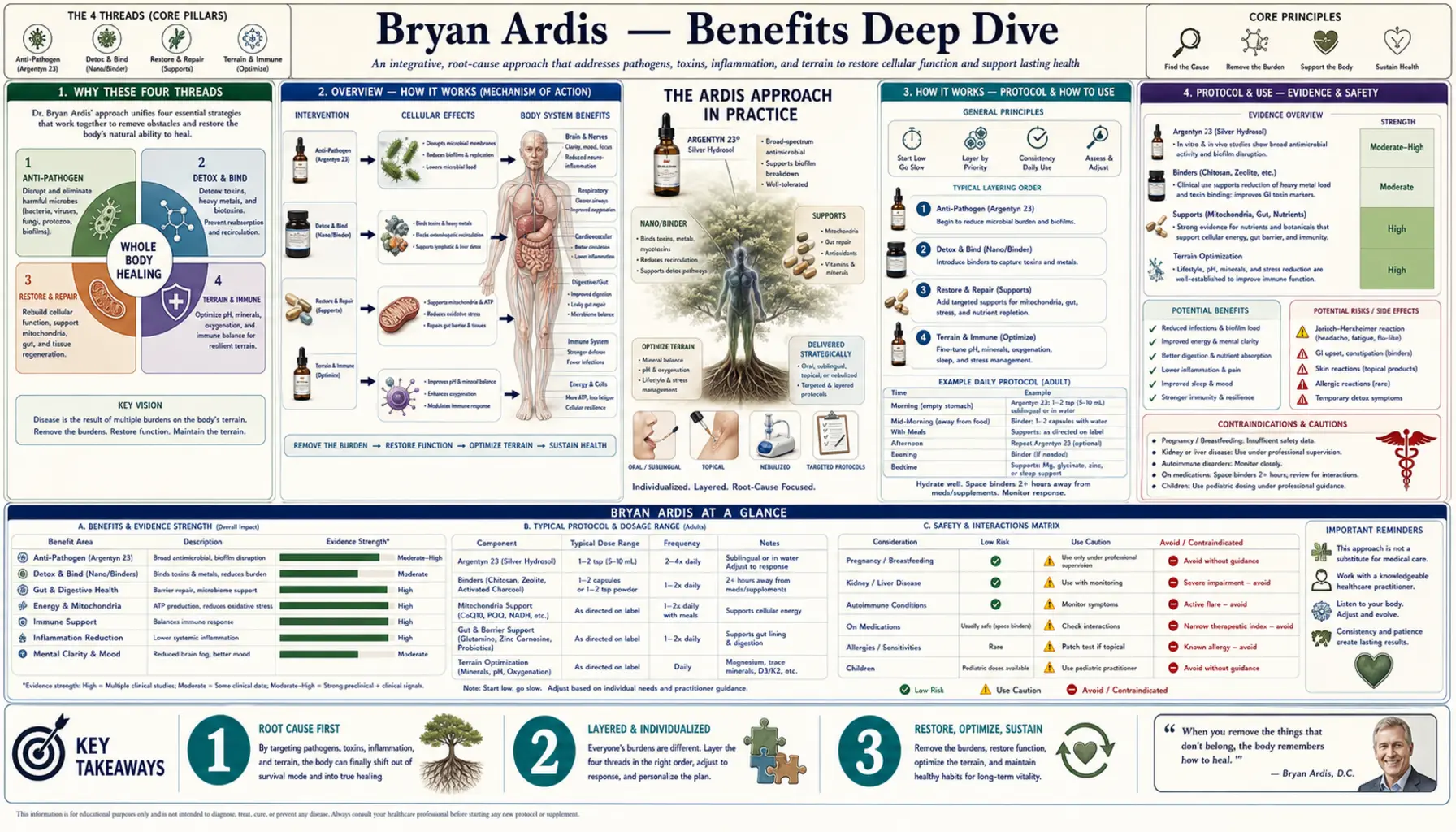
Dr. Bryan Ardis’s public research divides into four threads. The receptor-pharmacology layer (nicotinic acetylcholine receptors, the cholinergic anti-inflammatory pathway, the three-finger-toxin literature) draws on published neuroscience — Kevin Tracey’s inflammatory-reflex work in Nature, decades of elapid-toxin pharmacology, and the α-bungarotoxin and α-cobratoxin literature. The protocol layer (transdermal nicotine, pine-needle tea, NAC, dandelion root, methylene blue) is the practical side of the work, drawing on traditional use, off-label practice, and preclinical or in-vitro data. His structural-biology proposal is that the SARS-CoV-2 spike is in effect a synthetic venom peptide; its most publicised extension is his claim that this venom analog was delivered in part through municipal water. The fourth thread is his documentary case against remdesivir and the early ventilator protocol. Each card below opens an existing article on this site that maps one thread, so the reader can form an independent judgment rather than being told what to conclude.
Deep-Dive Articles
Snake Venom Hypothesis
Dr. Ardis’s structural-biology framing: three-finger toxins (3FTx) from elapid venom share a conserved disulfide-stabilised fold and target nicotinic acetylcholine receptors with nanomolar affinity, and in his telling the SARS-CoV-2 spike is in effect a synthetic venom peptide. The page sets out the four claims in his argument — structural homology, functional convergence, engineered origin, and water-supply delivery — and covers α-bungarotoxin, α-cobratoxin, and the Changeux 2020 nicotinic-hypothesis paper in Comptes Rendus Biologies.
Read the deep dive →Nicotine Patch Protocol
The practical layer of Dr. Ardis’s nicotine thread: why patches rather than gum or pouches, the 7 / 14 / 21 mg dose ladder, the half-patch start, application window and site rotation, typical course length, and the taper schedule. Also the parts that matter more than the dosing — absolute and relative contraindications, drug interactions, side effects, sourcing, monitoring, the serious danger to children and pets, and the absolute distinction between transdermal nicotine and combustion tobacco. The receptor rationale behind it lives on the nAChR page.
Read the deep dive →The Detox Stack: Pine Needle, NAC & Dandelion Root
Dr. Ardis’s layered “spike-clearance” stack, agent by agent: NAC and the glutathione foundation, high-dose vitamin C, dandelion root, pine-needle tea and shikimic acid (with the species-identification warnings and the pregnancy contraindication that matter more than the dose), nattokinase and serrapeptase for the microclot hypothesis, methylene blue, melatonin, zinc and quercetin, and how to sequence a stack instead of taking everything at once. There is no suramin page on this site; the section below sets out what suramin is and what pine needles contain.
Read the deep dive →Moving Beyond the COVID-19 Lies — The Book
Dr. Ardis’s 2024 book Moving Beyond the COVID-19 Lies: Restoring Health & Hope for Humanity: its own description of what it covers, and the page on this site that sets out each topic. The underlying protocol argument is documented on Hospital Protocols and Remdesivir.
Read the deep dive →Table of Contents
- Deep-Dive Articles
- Why These Four Threads
- Suramin and Pine Needles
- Dr. Ardis’s Own Work
- Research: Spike, 3FTx & the α7 Receptor
- Research: Nicotine & the Cholinergic Anti-Inflammatory Pathway
- Research: The Detox Stack
- Research: The Hospital-Protocol Evidence Base
- Research: Cross-Cutting — Origin, Endothelium & Open Questions
- External Authoritative Resources
- Connections
- Featured Videos
Why These Four Threads
Of the dozens of topics Dr. Ardis has discussed on his podcast and in interviews, these four were selected for this hub because they recur most often in his public work, and each one can be read on its own, separate from any other claim in his body of work.
- The snake-venom thread. Three-finger-toxin and nAChR pharmacology has a fifty-year literature covering the disulfide-stabilised fold, the receptor pharmacology, and the venom-evolution narrative, and the human proteome contains its own three-finger-fold proteins (Lynx1, SLURP-1). What Dr. Ardis adds to that field is his claim that the SARS-CoV-2 spike is a deliberately engineered venom analog, delivered in part through municipal water.
- The nicotine thread. Nicotine is an α7-nAChR ligand: the receptor exists, the cholinergic anti-inflammatory pathway is well described, and nicotine occupies the site. Alongside the receptor pharmacology, the thread draws on the observational smoking-prevalence signal, which has been analysed and re-analysed. Nicotine is also addictive, raises heart rate and blood pressure, and is acutely dangerous to children and pets.
- The detox stack. Dr. Ardis presents it as a layered “spike-clearance” stack. Most of it is food-grade — NAC, vitamin C, zinc, quercetin, melatonin, dandelion, pine-needle tea. The safety case rests on long traditional use rather than on trials, and the specific hazards that do exist are botanical rather than pharmacological — misidentifying a yew for a pine, or drinking pine-needle tea in pregnancy.
- The hospital-protocol case. Every load-bearing figure in it comes from a medical journal: the failed remdesivir arm of the PALM Ebola trial in the New England Journal of Medicine, the ACTT-1 mortality readout whose confidence interval crossed unity, the WHO Solidarity trial finding no mortality benefit, and the 88% ventilated-patient mortality in the Northwell New York series in JAMA. Dr. Ardis’s interpretation is that the payment architecture explains the protocol.
Suramin and Pine Needles
An earlier draft of this hub advertised a page on “suramin and pine-needle tea.” That page was never written. This section sets out what each of the two substances is.
- Suramin is a wholly synthetic molecule. It is a symmetrical polysulfonated naphthylurea, first prepared in 1916, with no natural source.
- Pine needles contain shikimic acid. Shikimic acid is a small cyclohexene carboxylic acid. Its industrial claim to fame is as the starting material for the chemical synthesis of oseltamivir — a multi-step synthesis performed in a factory. Drinking pine-needle tea delivers shikimic acid and assorted phenolics.
- Suramin is not an oral drug. It carries six sulfonate groups, is highly charged, and is given by slow intravenous injection. Its recognised uses are parasitic: early-stage African trypanosomiasis and onchocerciasis. Its toxicity profile includes nephrotoxicity, peripheral neuropathy and adrenal insufficiency. It is not a supplement and is not self-administrable.
- Suramin has its own research literature — as a broad purinergic (P2X/P2Y) receptor antagonist, which is the basis of the antipurinergic-therapy work in autism reviewed by Naviaux (cited below).
Pine-needle tea is covered on the Detox & Recovery page, and pine as a botanical is covered on Pine Needle Oil.
Dr. Ardis’s Own Work
Dr. Bryan Ardis’s nicotine protocol and the reasoning behind it, in his own words — his show, the interviews in which he lays it out, and his book.
- The Dr. Ardis Show — official site
- The Dr. Ardis Show, 28 August 2023 — “Venom Industrial Complex: Weaponizing Venoms” — the 7 mg, six-day nicotine instruction and the long-hauler symptom list.
- The Dr. Ardis Show podcast archive, April 2024 — his nicotine presentation “The Other ‘N’ Word.”
- Myers Detox Podcast #607 — “Nicotine Can Reverse Brain Fog, Inflammation, Dementia, and Chronic Illness” with Dr. Bryan Ardis — full transcript.
- Cosmic Reality Podcast, May 2024 — Dr. Ardis on nicotine and snake venom
- Bryan Ardis, Moving Beyond the COVID-19 Lies: Restoring Health & Hope for Humanity (Harvest Creek Publishing, 2024; ISBN 978-1-961641-22-8) — library record.
- His nicotine protocols, documented by a reader site — the prevention, long-hauler and vaccine-injury instructions from his “How to Use Nicotine” handout.
On this site: Nicotine Patch Protocol · The Leitzke cases · Cobra venom and nicotine · Pyrazines · Nightshade nicotine and Parkinson’s
Research Papers: Spike, Three-Finger Toxins & the α7 Receptor
These are the primary papers behind the receptor-homology argument: structural-biology and in-silico docking studies proposing an interaction, plus one cell-level follow-up.
- Changeux JP, Amoura Z, Rey FA, Miyara M. A nicotinic hypothesis for Covid-19 with preventive and therapeutic implications. C R Biol. 2020;343(1):33-39. — doi:10.5802/crbiol.8 · PubMed PMID: 32720486
- Lagoumintzis G, Chasapis CT, Alexandris N, et al. Nicotinic cholinergic system and COVID-19: in silico identification of interactions between α7 nicotinic acetylcholine receptor and the cryptic epitopes of SARS-CoV and SARS-CoV-2 spike glycoproteins. Food Chem Toxicol. 2021;149:112009. — doi:10.1016/j.fct.2021.112009 · PubMed PMID: 33503469
- Oliveira ASF, Ibarra AA, Bermudez I, et al. A potential interaction between the SARS-CoV-2 spike protein and nicotinic acetylcholine receptors. Biophys J. 2021;120(6):983-993. — doi:10.1016/j.bpj.2021.01.037 · PubMed PMID: 33609494
- Tanmay S, Labrou D, Farsalinos K, Poulas K. Is SARS-CoV-2 spike glycoprotein impairing macrophage function via α7-nicotinic acetylcholine receptors? Food Chem Toxicol. 2021;152:112184. — doi:10.1016/j.fct.2021.112184 · PubMed PMID: 33838172
- Alexandris N, Lagoumintzis G, Chasapis CT, et al. Nicotinic cholinergic system and COVID-19: in silico evaluation of nicotinic acetylcholine receptor agonists as potential therapeutic interventions. Toxicol Rep. 2021;8:73-83. — doi:10.1016/j.toxrep.2020.12.013 · PubMed PMID: 33425684
For the underlying toxin literature, which is far too large to list, search it directly:
Research Papers: Nicotine & the Cholinergic Anti-Inflammatory Pathway
These are the mechanism papers and the clinical papers behind the nicotine thread.
- Tracey KJ. The inflammatory reflex. Nature. 2002;420(6917):853-859. — the foundational description of vagal cholinergic control of inflammation. — doi:10.1038/nature01321 · PubMed PMID: 12490958
- Barrantes FJ. Structure and function meet at the nicotinic acetylcholine receptor-lipid interface. Pharmacol Res. 2023;190:106729. — doi:10.1016/j.phrs.2023.106729 · PubMed PMID: 36931540
- Farsalinos K, Bagos PG, Giannouchos T, et al. Smoking prevalence among hospitalized COVID-19 patients and its association with disease severity and mortality: an expanded re-analysis of a recent publication. Harm Reduct J. 2021;18(1):9. — a re-analysis, not a trial; the authors themselves treat the finding as hypothesis-generating. — doi:10.1186/s12954-020-00437-5 · PubMed PMID: 33453726
- Leitzke M. Is the post-COVID-19 syndrome a severe impairment of acetylcholine-orchestrated neuromodulation that responds to nicotine administration? Bioelectron Med. 2023;9(1):2. — a hypothesis paper with case observations, not controlled evidence. — doi:10.1186/s42234-023-00104-7 · PubMed PMID: 36650574
Research Papers: The Detox Stack
Of the papers below, two are analytical-chemistry papers establishing that conifer needles contain shikimic acid; one is a cell-free binding assay; one is a proteomics study of microclots.
- Bai J, Wu Y, Liu X, et al. Antibacterial activity of shikimic acid from pine needles of Cedrus deodara against Staphylococcus aureus through damage to cell membrane. Int J Mol Sci. 2015;16(11):27145-27155. — doi:10.3390/ijms161126015 · PubMed PMID: 26580596
- Chen F, Hou K, Li S, et al. Extraction and chromatographic determination of shikimic acid in Chinese conifer needles with 1-benzyl-3-methylimidazolium bromide ionic liquid aqueous solutions. J Anal Methods Chem. 2014;2014:256473. — doi:10.1155/2014/256473 · PubMed PMID: 24782942
- Tran HTT, Gigl M, Le NPK, et al. In vitro effect of Taraxacum officinale leaf aqueous extract on the interaction between ACE2 cell surface receptor and SARS-CoV-2 spike protein D614 and four mutants. Pharmaceuticals (Basel). 2021;14(10):1055. — the dandelion paper. It is an in-vitro binding study; no patient was treated. — doi:10.3390/ph14101055 · PubMed PMID: 34681279
- Kruger A, Vlok M, Turner S, et al. Proteomics of fibrin amyloid microclots in long COVID/post-acute sequelae of COVID-19 (PASC) shows many entrapped pro-inflammatory molecules that may also contribute to a failed fibrinolytic system. Cardiovasc Diabetol. 2022;21(1):190. — doi:10.1186/s12933-022-01623-4 · PubMed PMID: 36131342
- Naviaux RK. Antipurinergic therapy for autism — an in-depth review. Mitochondrion. 2018;43:1-15. — the real suramin research literature, included so readers can see what it actually says. — doi:10.1016/j.mito.2017.12.007 · PubMed PMID: 29253638
Research Papers: The Hospital-Protocol Evidence Base
These are the trials and the case series behind the figures in Dr. Ardis’s hospital-protocol case.
- Mulangu S, Dodd LE, Davey RT Jr, et al. A randomized, controlled trial of Ebola virus disease therapeutics. N Engl J Med. 2019;381(24):2293-2303. — the PALM trial, in which the remdesivir arm performed worst. — doi:10.1056/NEJMoa1910993 · PubMed PMID: 31774950
- Beigel JH, Tomashek KM, Dodd LE, et al. Remdesivir for the treatment of Covid-19 — final report. N Engl J Med. 2020;383(19):1813-1826. — ACTT-1: faster recovery, mortality difference not statistically significant. — doi:10.1056/NEJMoa2007764 · PubMed PMID: 32445440
- WHO Solidarity Trial Consortium. Remdesivir and three other drugs for hospitalised patients with COVID-19: final results of the WHO Solidarity randomised trial and updated meta-analyses. Lancet. 2022;399(10339):1941-1953. — doi:10.1016/S0140-6736(22)00519-0 · PubMed PMID: 35512728
- Richardson S, Hirsch JS, Narasimhan M, et al. Presenting characteristics, comorbidities, and outcomes among 5700 patients hospitalized with COVID-19 in the New York City area. JAMA. 2020;323(20):2052-2059. — the Northwell series behind the widely quoted ventilated-patient mortality figure. — doi:10.1001/jama.2020.6775 · PubMed PMID: 32320003
Research Papers: Cross-Cutting — Origin, Endothelium & Open Questions
Two papers sit across all four threads: the phylogenetic paper on the origin of SARS-CoV-2, and the autopsy study behind the vascular reading of COVID pathology that the receptor argument draws on.
- Andersen KG, Rambaut A, Lipkin WI, Holmes EC, Garry RF. The proximal origin of SARS-CoV-2. Nat Med. 2020;26(4):450-452. — the phylogenetic argument against deliberate construction. Its own conclusions have since been debated at length, and readers should follow that debate rather than treat the paper as final. — doi:10.1038/s41591-020-0820-9 · PubMed PMID: 32284615
- Ackermann M, Verleden SE, Kuehnel M, et al. Pulmonary vascular endothelialitis, thrombosis, and angiogenesis in Covid-19. N Engl J Med. 2020;383(2):120-128. — autopsy evidence that severe COVID is substantially a vascular and endothelial disease. — doi:10.1056/NEJMoa2015432 · PubMed PMID: 32437596
- PubMed: SARS-CoV-2 origins — the continuing literature
- PubMed: Long COVID, endothelial dysfunction and microclots
- PubMed: Anything indexed under Bryan Ardis — run it yourself and see what comes back.
External Authoritative Resources
- PubMed (NLM) — the primary index. Every citation on this page carries its PMID so it can be checked in one click.
- ClinicalTrials.gov — where to check whether a proposed therapy has been trialled, and what its registered endpoints were before the results came in.
- WHO therapeutics guidance for COVID-19 — the living guideline that carries the recommendation on remdesivir use.
- WHO fact sheet: human African trypanosomiasis — the clinical setting in which suramin is used.
- LiverTox (NIDDK/NLM) — NIH reference on drug and supplement hepatotoxicity, useful before adding anything to a stack.
- NIH Office of Dietary Supplements — fact sheets on the vitamin and mineral components of the detox stack.
- Poison Help (HRSA) — 1-800-222-1222. Relevant because nicotine patches and concentrated nicotine are a genuine paediatric and veterinary poisoning hazard.
Connections
- All Remedies
- Dr. Bryan Ardis: The Nicotine Hypothesis, COVID-19 Lies & the Snake-Venom Theory — the parent hub this Benefits section expands on.
- The Synthetic-Venom-Peptide Hypothesis — the three-finger-toxin thread in full, with the mainstream rebuttals.
- Nicotinic Acetylcholine Receptors (nAChRs) — the established receptor pharmacology the nicotine thread rests on.
- Nicotine Patch Protocol — dosing, sourcing, tapering, and contraindications for the transdermal protocol.
- The Nicotine Hypothesis — nicotine decoupled from combustion, and what the observational data can and cannot show.
- Detox & Recovery — the spike-clearance stack agent by agent, including pine-needle tea and shikimic acid.
- Hospital Protocols and Remdesivir — the trial record, the AKI signal, and the ventilator-mortality data.
- Moving Beyond the COVID-19 Lies — Dr. Ardis’s 2024 book, in his words, and where each of its topics is set out on this site.
- Vaccine-Injury Recovery — the post-vaccination symptom protocol and what supports it.
- Tobacco, Indigenous Medicine & Therapeutic Nicotine — the 60-year history behind the nicotine thread.
- Bryan Ardis: History and Origins — how a chiropractor came to be at the centre of this argument.
- Pine Needle Oil — what pine actually contains, and what it does not.