— March 24, 2026
· FDA Reopens DSHEA Innovation Door


Table of Contents
- FDA to Reopen the DSHEA "Innovation Door" — Public Meeting March 27
- Harvard Cohort Study, Up to 43 Years: Caffeinated Coffee Linked to 18% Lower Dementia Risk
- Use of Complementary Health Approaches Nearly Doubles in Two Decades
- Herbal Supplement Market Estimates for 2026
- Melatonin for Children: Scientists Raise Red Flags as Use Skyrockets
- FDA Considers Easing the Repeated Supplement Disclaimer Rule
- Key Research Papers
- Connections
- Featured Videos
FDA to Reopen the DSHEA "Innovation Door" — Public Meeting March 27
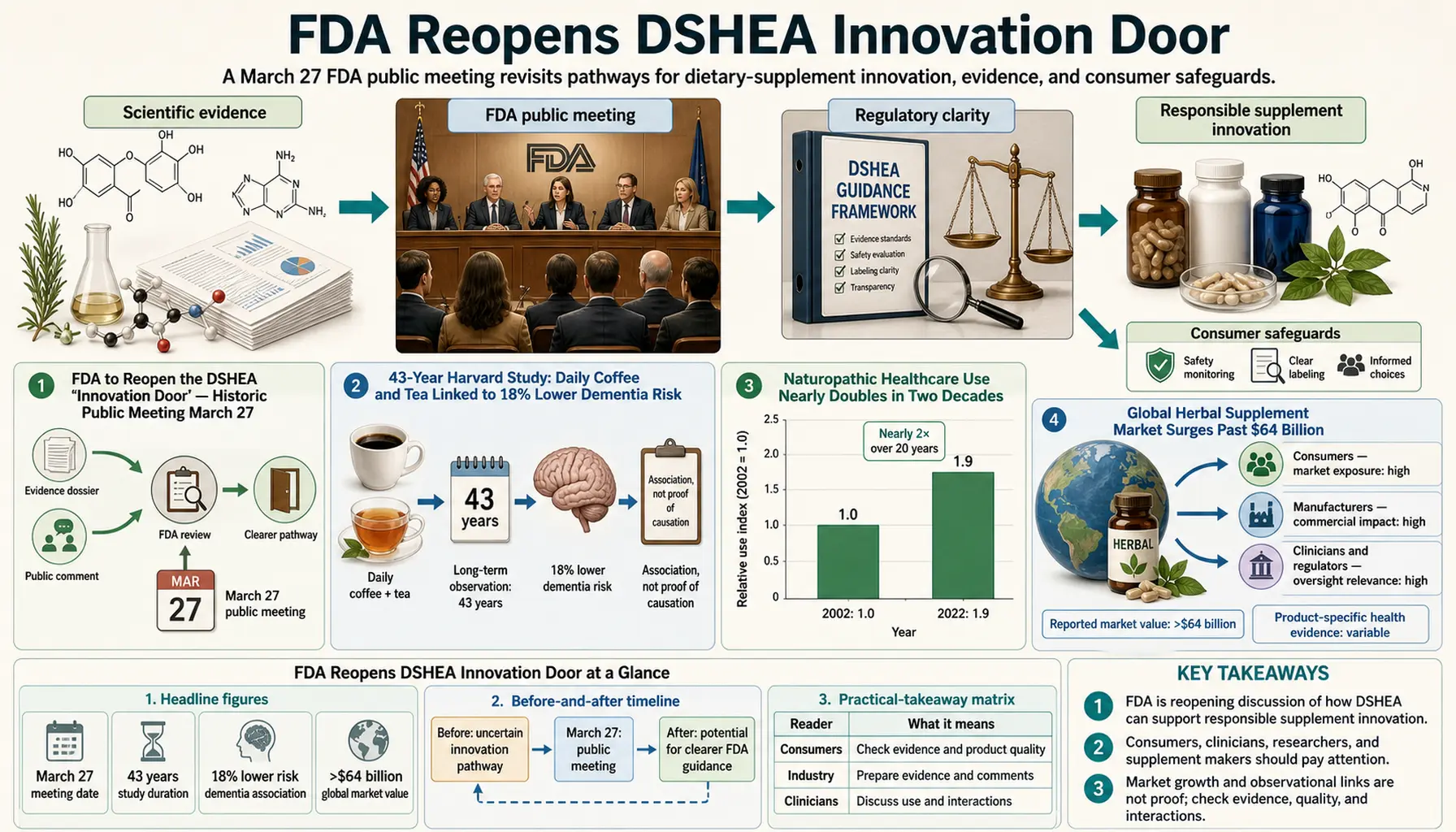
The U.S. Food and Drug Administration has announced a public meeting for March 27, 2026, titled "Exploring the Scope of Dietary Supplement Ingredients." The FDA's Human Foods Program announced it in a constituent update on 3 March 2026. Supplement trade press has framed the year in large terms, one headline asking whether 2026 could be the biggest year for dietary supplements since the introduction of Good Manufacturing Practices (GMPs).
The meeting will revisit the foundational definitions established by the Dietary Supplement Health and Education Act (DSHEA) of 1994 — the law that wrote the list of dietary ingredients into the Federal Food, Drug, and Cosmetic Act (section 201(ff)(1)). Specifically, the FDA will examine the meaning of the phrase "dietary substance for use by man to supplement the diet by increasing the total dietary intake" (section 201(ff)(1)(E)) and how far it reaches.
What's on the Agenda
The FDA's meeting page lists three topics:
- The scope of "dietary substance" — including whether the phrase can cover substances that have never been part of the human diet
- New methods for producing existing dietary ingredients — the FDA names precision fermentation, cell culture technology and recombinant production; the agency's memo to the docket also names synthesis
- Specific ingredient types — proteins, enzymes and microbials (such as probiotics), which the meeting page notes are not specifically listed in section 201(ff)(1); the FDA's memo to the docket adds peptides to its question on how such ingredients are identified
The meeting will be held from 9:00 a.m. to 3:00 p.m. ET at the FDA's Human Foods Program location in College Park, MD (Wiley Auditorium, 5001 Campus Drive), with virtual attendance available. Written comments are accepted through April 27, 2026 on docket FDA-2026-N-2047. The meeting was announced on the FDA's own web pages; no Federal Register notice for it was found.
The Positions Being Put Forward
Supplement-industry groups have argued that the FDA's current reading of "dietary substance" (a substance commonly used as human food or drink) is too narrow for ingredients such as certain peptides, probiotic strains isolated from the human gut, and ingredients made by newer production methods. Consumer-advocacy groups have argued that a broader reading could let substances with little safety study into a market the FDA already struggles to oversee.
A public meeting is a listening step: by itself it changes no rule and clears or bars no ingredient. What the agency said at the meeting, the four questions it put in the docket and the range of views presented are reported on the FDA public meeting on what counts as a dietary ingredient page.
Sources: FDA — Public Meeting: Exploring the Scope of Dietary Supplement Ingredients | NutraIngredients — Is FDA Opening the Long-Shut DSHEA Innovation Door? | NutraIngredients — Could 2026 Be the Biggest Year for Dietary Supplements?
Harvard Cohort Study, Up to 43 Years: Caffeinated Coffee Linked to 18% Lower Dementia Risk
A prospective cohort study in JAMA (issue dated 17 March 2026) reports that higher intake of caffeinated coffee and of tea was associated with lower dementia risk and modestly better cognitive function. The investigators were from Mass General Brigham, the Harvard T.H. Chan School of Public Health and the Broad Institute of MIT and Harvard; follow-up lasted up to 43 years (median 36.8 years).
Key Findings
The study followed 131,821 participants from the Nurses' Health Study (women) and the Health Professionals Follow-up Study (men), among whom there were 11,033 cases of dementia. The paper reports:
- Caffeinated coffee: pooled across both cohorts, people in the highest quarter of caffeinated coffee intake had an 18% lower risk of dementia than those in the lowest quarter (hazard ratio 0.82; 141 vs 330 cases per 100,000 person-years)
- Tea: higher tea intake showed similar associations with the cognitive outcomes; the abstract gives no separate percentage for tea
- Dose-response: the associations were nonlinear, and the most pronounced differences were seen at about 2–3 cups of caffeinated coffee or 1–2 cups of tea per day
- Decaffeinated coffee: not associated with lower dementia risk or better cognitive performance; as reported by the Harvard Gazette, the researchers said this suggests caffeine may be the active factor, though further research is needed to establish the factors and mechanisms responsible
What the Study Can and Cannot Show
Caffeine blocks adenosine receptors, and effects on neuroinflammation and on amyloid-beta (a hallmark of Alzheimer's disease) have been proposed as ways caffeine could act on the brain; this study did not test any mechanism. In the women's cohort, the difference in global cognition score did not reach statistical significance (P = .06), while the difference on a telephone cognitive test did.
The study is observational: it shows an association between intake and dementia risk, not that coffee or tea causes the lower risk.
Sources: JAMA — Coffee and Tea Intake, Dementia Risk, and Cognitive Function | Harvard Gazette — Drinking 2-3 Cups of Coffee a Day Tied to Lower Dementia Risk | ScienceDaily — Your Daily Coffee May Be Protecting Your Brain, 43-Year Study Finds
Use of Complementary Health Approaches Nearly Doubles in Two Decades
According to data from the National Health Interview Survey (NHIS), the percentage of U.S. adults using at least one complementary health approach rose from 19.2% in 2002 to 36.7% in 2022, in an analysis led by NIH researchers and published in JAMA in 2024. News coverage put the number of people at about 122 million in 2022.
The umbrella of complementary and alternative medicine (CAM) includes yoga, meditation, massage therapy, chiropractic care, acupuncture, naturopathy, herbal medicine, and guided imagery. Naturopathy is one of these approaches; growth figures for naturopathy alone that circulate in coverage could not be traced to the primary analysis and are not given here.
Explanations Offered for the Rise
The survey measured use, not motives. Explanations put forward in coverage of the trend and by practitioners include:
- Views of conventional care — the cost of care, concern about drug side effects, and short appointment times
- Pain management — the NIH analysis looked separately at use of complementary approaches for pain management, an area where people look for options beyond opioids and NSAIDs. Related: Stress Management
- Mental health — practitioners describe interest in non-drug approaches to anxiety and depression (see natural anxiety relief)
- Fertility — practitioners describe interest in acupuncture and naturopathic support for reproductive health
Licensing of naturopathic doctors is decided state by state; in states that license them, their scope of practice can include primary care. A survey figure on public support for insurance coverage of alternative medicine and a count of licensing states that circulated in coverage could not be traced to a primary source and are not given here.
Sources: Central Maine — More Americans Are Turning to Naturopathic Healthcare | NIH — Significant Rise in Use of Complementary Health Approaches | AANP — The Data Speaks: Naturopathic Doctors Are Thriving Professionally
Herbal Supplement Market Estimates for 2026
Market estimates vary by source. A supplement contract manufacturer's market overview, citing aggregated industry analysis, projects the global herbal supplements market to exceed $64 billion by 2026, with a compound annual growth rate (CAGR) of over 11%. A market-research report puts the global adaptogens market at $12.72 billion in 2026 and projects $21.92 billion by 2034, a CAGR of 7.04% from 2025 to 2034. These are commercial projections, not measured sales.
Factors Cited in Industry Coverage
- Adaptogens and nootropics — Herbs such as ashwagandha, rhodiola rosea, lion's mane mushroom and bacopa monnieri are described as sold for stress, cognition and mood
- Extraction and delivery technology — bioavailability is named as a trend: liposomal delivery, standardized extracts, and proprietary branded extracts of herbs such as ashwagandha and bacopa; trial results for one extract do not necessarily transfer to another
- Pharma-herbal partnerships — industry coverage describes partnerships between pharmaceutical companies and herbal supplement firms as a distribution channel
- E-commerce — industry coverage describes online, subscription and direct-to-consumer sales as growing faster than store retail
- Clinical trials — a 2024 meta-analysis of nine randomized controlled trials (558 participants) found that ashwagandha's formulations lowered perceived-stress scores, anxiety scores and serum cortisol compared with placebo; four of the trials reported mild to moderate adverse events, and the authors noted that long-term safety data are lacking
Trends Named for 2026
One industry analyst's list of 2026 supplement trends names bioavailability advances, creatine, natural colors, longevity supplements, mushrooms (particularly lion's mane), peptides, probiotics (often discussed in connection with the gut-brain axis) and products combining brain performance with energy, and mentions shilajit among Indian ingredients now widely known. Other ingredients that drew attention in consumer coverage include magnesium glycinate, berberine, sea moss, and medicinal mushrooms such as reishi, chaga and turkey tail; search-growth percentages circulated for these could not be traced to a primary source and are not given here.
Sources: Herbal Supplements Market — Why the Market is Booming in 2026 | Precedence Research — Adaptogens Market Size to Surpass $21.92 Billion by 2034 | SupplySide — Industry Vet Identifies Top Supplement Trends for 2026
Melatonin for Children: Scientists Raise Red Flags as Use Skyrockets
A systematic review of melatonin in young children, published in JAMA Network Open in January 2026 by researchers at the University of Kansas Medical Center, included 19 articles (12 observational studies, 6 trials and 1 protocol). The trials, with 167 young children with neurologic conditions such as autism spectrum disorder, provided evidence of improved sleep onset with few adverse events. Efficacy data were not available for children with typical development, and data on long-term outcomes were absent. The authors rated the methodological quality of the included studies as poor for 3, fair for 9 and good for 6, and found a global rise in prescriptions, extended use and overdoses.
The Scale of the Problem
The review describes melatonin as the leading cause of unsupervised medication exposure and overdose in emergency departments for young children (aged 0–6 years). A CDC analysis estimated about 11,000 emergency department visits for unsupervised melatonin ingestion by children aged 5 and under in 2019–2022, 7.1% of all such visits for unsupervised medication exposures in that age group; gummies were the most commonly documented dosage form (47.3%), and where the container was documented, about three quarters of children got the melatonin from a bottle. Annual pediatric melatonin ingestions reported to U.S. poison centers rose 530% from 2012 to 2021.
Product Quality Concerns
Laboratory testing has found wide variability in melatonin content in over-the-counter products. A 2017 Canadian analysis of 31 supplements found melatonin content ranging from −83% to +478% of the labeled amount; more than 71% of products were not within 10% of the label claim, and eight contained serotonin.
Unresolved Long-Term Questions
Scientists emphasize that long-term safety data are particularly lacking, with unresolved questions about melatonin's potential effects on:
- Puberty onset and timing — Melatonin plays a role in reproductive hormone regulation, and chronic supplementation during development could theoretically alter pubertal timing
- Immune function — Melatonin is an immune modulator, and the consequences of long-term supplementation on developing immune systems are unknown
- Metabolic development — Emerging research links melatonin to insulin sensitivity and glucose metabolism
- Neurological development — As a neurohormone, chronic exogenous melatonin could affect brain development in ways not yet studied
Experts quoted in coverage of the research state that behavioral sleep interventions (consistent routines, reduced screen exposure, age-appropriate expectations) are the first-line treatment for childhood insomnia, and that when melatonin is considered, the guidance they describe is the lowest effective dose, for the shortest possible time, under medical supervision.
Sources: JAMA Network Open — Melatonin Use in Young Children: A Systematic Review | ScienceDaily — Millions of Kids Take Melatonin but Doctors Are Raising Red Flags | EurekAlert — Why Experts Urge Caution on Melatonin Use in Children
FDA Considers Easing the Repeated Supplement Disclaimer Rule
In a letter to industry, FDA Deputy Commissioner for Human Foods Kyle Diamantas said the agency is considering revising the regulation that requires the disclaimer "This statement has not been evaluated by the Food and Drug Administration. This product is not intended to diagnose, treat, cure, or prevent any disease" to appear on each panel of a dietary supplement label that carries a claim. Under the change being considered, the disclaimer would appear once on the label. Trade press reports that the FDA will exercise enforcement discretion on repeated placement in the meantime, while products must still carry the statement and link it to each claim. No proposed rule had been published in the Federal Register as of this article.
The letter states that revising the regulation "would reduce label clutter and unnecessary costs." Coverage also reports that the current rule has rarely been enforced and that the FDA has set no timeline for formal rulemaking.
The Debate
Critics, including a Harvard Medical School physician who researches supplement safety, have said that fewer disclaimers could weaken consumers' understanding of the products they buy and make the statement easier to overlook, and that the change does not address deeper issues such as inconsistent product quality.
Separately, the Dietary Supplement Regulatory Uniformity Act, introduced on 4 February 2026 by Representative Nick Langworthy (R-N.Y.), would establish federal primacy over dietary supplement regulation, preventing states from setting conflicting requirements while letting a state petition the FDA when it has evidence-based health concerns. Four supplement and consumer-health trade associations endorsed the bill. "If a product is safe under federal law, it shouldn't be treated as dangerous in New York and lawful just across the border," Langworthy said.
Sources: Pharmacy Times — FDA May Relax Dietary Supplement Warning Label Rules | Nutraceutical Business Review — FDA Signals Possible Easing of Disclaimer Requirements | Nutritional Outlook — New Legislation Aims to Reaffirm FDA Authority Over Supplements
Key Research Papers
Primary papers behind the stories, in story order. Each was checked against its PubMed record before it was written down. The FDA meeting and disclaimer stories rest on agency and trade-press documents linked under those stories.
- Zhang Y, Liu Y, Li Y, Li Y, Gu X, Kang JH, et al. (2026). Coffee and Tea Intake, Dementia Risk, and Cognitive Function. JAMA 335(11):961-974. — PubMed PMID: 41661604
- Nahin RL, Rhee A, Stussman B (2024). Use of Complementary Health Approaches Overall and for Pain Management by US Adults. JAMA 331(7):613-615. — PubMed PMID: 38270938
- Arumugam V, Vijayakumar V, Balakrishnan A, B Bhandari R, Boopalan D, Ponnurangam R, et al. (2024). Effects of Ashwagandha (Withania Somnifera) on stress and anxiety: A systematic review and meta-analysis. Explore (NY) 20(6):103062. — PubMed PMID: 39348746
- Kracht CL, Bolamperti G, Breeden R, Crocker M, Christifano DN, Gibler RC, et al. (2026). Melatonin Use in Young Children: A Systematic Review. JAMA Network Open 9(1):e2551958. — PubMed PMID: 41481289
- Freeman DI, Lind JN, Weidle NJ, Geller AI, Stone ND, Lovegrove MC (2024). Notes from the Field: Emergency Department Visits for Unsupervised Pediatric Melatonin Ingestion — United States, 2019-2022. MMWR Morbidity and Mortality Weekly Report 73(9):215-217. — PubMed PMID: 38451863
- Lelak K, Vohra V, Neuman MI, Toce MS, Sethuraman U (2022). Pediatric Melatonin Ingestions — United States, 2012-2021. MMWR Morbidity and Mortality Weekly Report 71(22):725-729. — PubMed PMID: 35653284
- Erland LA, Saxena PK (2017). Melatonin Natural Health Products and Supplements: Presence of Serotonin and Significant Variability of Melatonin Content. Journal of Clinical Sleep Medicine 13(2):275-281. — PubMed PMID: 27855744
PubMed Topic Searches
- Clinical trials on dietary supplement regulation — PubMed search
- Clinical trials on coffee and dementia risk — PubMed search
- Clinical trials on tea and cognitive decline — PubMed search
- Clinical trials on naturopathic medicine outcomes — PubMed search
- Clinical trials on melatonin safety in children — PubMed search
- Clinical trials on herbal supplements — PubMed search
Connections
Explore our in-depth articles on the supplements, herbs, and health topics mentioned in today's news:
Trending Herbs & Adaptogens
- Ashwagandha — Adaptogen studied for stress, cortisol, and anxiety
- Rhodiola Rosea — "Golden root," studied for mental performance and fatigue
- Bacopa Monnieri — The Ayurvedic nootropic for memory and cognition
- Chamomile — The ancient calming herb for sleep and digestion
- Lavender — Clinically studied for anxiety, sleep, and pain
- Passionflower — GABA-modulating herb for anxiety and insomnia
- Valerian — Traditional sleep and relaxation support
- Kava — The Pacific Islands' sacred relaxation root
- Lemon Balm — Paracelsus' "elixir of life" for calm and cognition
- Elderberry — Immune support and antiviral properties
- He Shou Wu — The legendary longevity herb of Chinese medicine
- Echinacea — Immune system stimulation and cold prevention
- Turmeric — Curcumin-containing spice studied for inflammation
- St. John's Wort — Herb studied in mild depression
- Milk Thistle — Liver protection and detoxification support
- Ginkgo Biloba — Cognitive function and circulation
- Herbs
- Coffee
- Dementia
- Supplements
Trending Superfoods & Mushrooms
- Lion's Mane Mushroom — Studied for effects on nerve growth factor
- Reishi Mushroom — The "mushroom of immortality" for immune modulation
- Chaga Mushroom — Birch-growing medicinal mushroom
- Turkey Tail Mushroom — Source of the polysaccharides PSK and PSP, studied in cancer care
- Sea Moss — Red seaweed sold as a mineral source
- Collagen — Foundational protein for skin, joints, and gut healing
- Probiotics — Gut microbiome support and immune health
- Spirulina — Blue-green algae superfood
Trending Minerals & Supplements
- Magnesium Glycinate — A magnesium form discussed for sleep and anxiety
- Magnesium — The essential mineral and how much people get
- Shilajit — The Himalayan mineral resin
- Inositol — Studied for PCOS, anxiety, and hormonal balance
Trending Remedies & Protocols
- Berberine — Plant alkaloid studied for blood sugar and metabolic health
- NAD+ and NMN — Cellular energy and the science of aging
- The Gut-Brain Axis — How your microbiome shapes your mind
- Natural Anxiety Relief — Evidence-based approaches to anxiety management
- Longevity Protocols — Evidence-based strategies for healthy aging
- Sleep Hygiene — Natural strategies for better sleep
- Stress Management — Holistic approaches to stress reduction
- Immune Boosting — Natural strategies to strengthen immunity
- Gut Healing — Restoring digestive health naturally
Featured Videos