Collagen
Table of Contents
- What Is Collagen
- Types of Collagen
- Collagen and Ageing: What Studies Measured
- Skin: What the Trials Report
- Joints and Cartilage: What the Trials Report
- The Gut: What Has Been Studied
- Bone Mineral Density: The König 2018 Trial
- Nails and Hair: What Has Been Studied
- Blood Vessels: An Uncontrolled Study
- Muscle: The Zdzieblik 2015 Trial
- Collagen in Foods
- Collagen Peptides vs Gelatin vs Undenatured Collagen
- Vitamin C and Collagen Synthesis
- Doses Used in the Trials
- Safety Findings and Allergy Research
- Key Research Papers
- Connections
- Featured Videos
What Is Collagen
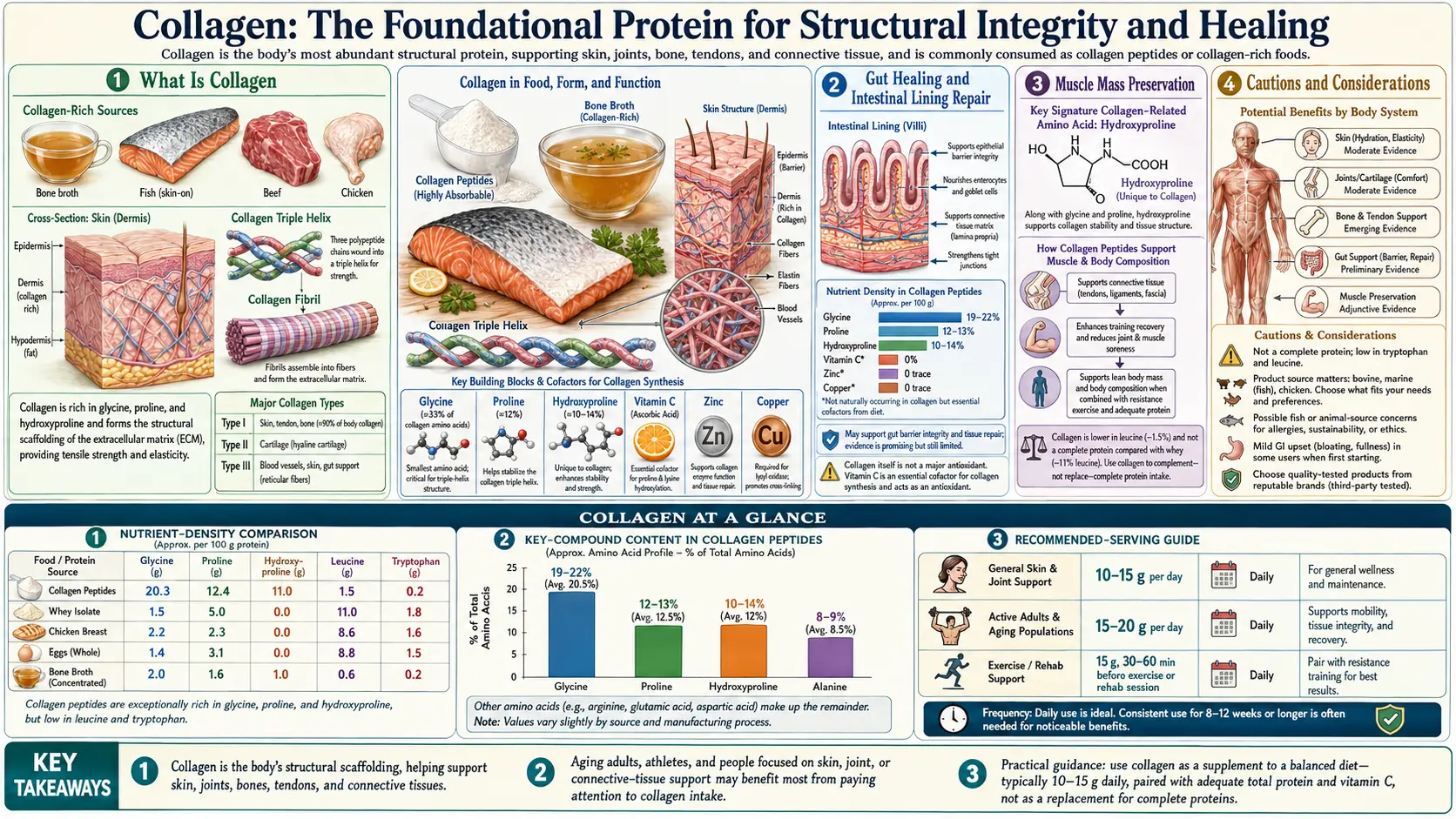
Collagen is the most abundant protein in animals. In humans it makes up about one-third of total protein and three-quarters of the dry weight of skin, and it is the most prevalent component of the extracellular matrix, the material that surrounds and supports cells (Shoulders 2009). Collagens contribute to the mechanical properties, organization and shape of tissues, and they also interact with cells through several families of receptors, regulating how cells multiply, move and specialize (Ricard-Blum 2011).
A collagen molecule is built from three chains coiled around one another into a right-handed triple helix. The tight packing of the three chains requires every third amino acid to be glycine, giving a repeating Xaa-Yaa-Gly sequence that occurs in all types of collagen. Proline in the Yaa position is converted to hydroxyproline by the enzyme prolyl 4-hydroxylase after the chain is made (Shoulders 2009).
Vitamin C (ascorbate) is required for this hydroxylation of proline in procollagen, the precursor molecule; hydroxyproline stabilizes the triple helix, and ascorbate stimulates the secretion of procollagen from the cell (Peterkofsky 1991). Once collagen fibrils have assembled, lysine side chains in the fibrils' end regions are cross-linked with the help of the enzyme lysyl oxidase, which gives mature fibrils their strength and stability (Shoulders 2009). Lysyl oxidase is a copper-containing enzyme, and dietary copper directly influences its functional activity (Rucker 1998).
Types of Collagen
Twenty-eight types of collagen, made from at least 46 distinct chains, have been identified in vertebrates (Shoulders 2009). Each contains at least one triple-helical domain, collagens are deposited in the extracellular matrix, and some have a restricted tissue distribution and specific functions (Ricard-Blum 2011). The types most often discussed in supplement research are these:
- Type I collagen forms the prototypical collagen fibril, whose structure has been described in detail (Shoulders 2009). Skin makes both type I and type III collagen (both were measured in Knuutinen 2002), and type I collagen is the main content of gelatin and is also found in fish meat and skin (Sakaguchi 2000).
- Type II collagen is the main collagen of joint cartilage. Collagen makes up about 60% of the dry weight of articular cartilage, and type II collagen is 90–95% of that collagen, forming fibrils intertwined with proteoglycan aggregates; types I, IV, V, VI, IX and XI are present in minor amounts (Sophia Fox 2009).
- Type III collagen is made in skin alongside type I (Knuutinen 2002).
- Collagens in muscle: collagen accounts for 1–10% of the dry weight of skeletal muscle, and types I, III, IV, V, VI, XI, XII, XIV, XV and XVIII are expressed during muscle development (Gillies 2011).
Collagen and Ageing: What Studies Measured
In a study that measured forearm skin in a large number of healthy people, skin collagen decreased with age and was lower in women than in men at all ages; dermal thickness tracked skin collagen (Shuster 1975).
Studies have also measured outside influences on skin collagen:
- Ultraviolet light. In human skin, ultraviolet-B exposure induced matrix-degrading metalloproteinases (MMPs) within hours, at doses well below those that redden the skin. The authors proposed that these enzymes degrade skin collagen and elastin and that, repeated over a lifetime, the imperfectly repaired damage leads to premature skin ageing (Fisher 1996).
- Smoking. In a comparison of 47 current smokers with 51 people who had never smoked, the synthesis rates of type I and type III collagen in skin were 18% and 22% lower in the smokers, and levels of the collagen-degrading enzyme MMP-8 were 100% higher (Knuutinen 2002).
- Vitamin C deficiency. Lack of vitamin C impairs collagen formation and causes scurvy, described in the vitamin C section below (Peterkofsky 1991; Hirschmann 1999).
Skin: What the Trials Report
Collagen accounts for about three-quarters of the dry weight of skin (Shoulders 2009). Two placebo-controlled trials from one research group in 2014 tested collagen peptides taken by mouth for 8 weeks:
- Proksch 2014 (elasticity). 69 women aged 35–55 took 2.5 g or 5 g of collagen hydrolysate or placebo once a day. Skin elasticity improved significantly in both collagen groups compared with placebo. Skin moisture and water loss showed a positive trend only in a subgroup analysis that did not reach statistical significance. No side effects were noted.
- Proksch 2014 (wrinkles). 114 women aged 45–65 took 2.5 g of collagen peptides or placebo once a day. Eye-wrinkle volume fell by 20% compared with placebo after 8 weeks (p < 0.05). In a biopsy subgroup, procollagen type I was 65% and elastin 18% higher than with placebo; a 6% rise in fibrillin was not statistically significant.
Reviews of the skin trials reach different conclusions. A 2021 meta-analysis of 19 randomized, double-blind trials (1,125 participants aged 20–70, 95% women) reported favorable results for hydration, elasticity and wrinkles compared with placebo (de Miranda 2021). A 2025 meta-analysis of 23 trials (1,474 participants) also found an overall improvement, but the studies not funded by pharmaceutical companies showed no effect on hydration, elasticity or wrinkles, and the high-quality studies showed no significant effect in any category; the authors concluded that there is currently no clinical evidence to support the use of collagen supplements to prevent or treat skin ageing (Myung 2025). A 2026 narrative review described the evidence as limited by short study durations, heterogeneous designs, multi-ingredient products and industry funding (Biełach-Bazyluk 2026).
On how collagen might reach the skin: after healthy volunteers ingested 9.4–23 g of gelatin hydrolysates, peptide forms of hydroxyproline rose in their blood, peaking after 1–2 hours; the main peptide was prolyl-hydroxyproline (Pro-Hyp) (Iwai 2005). In the laboratory, Pro-Hyp increased the migration and growth of fibroblasts from mouse skin (Shigemura 2009). That is a cell finding; it has not been shown that the same happens in human skin after a supplement.
Joints and Cartilage: What the Trials Report
Articular cartilage provides a smooth, lubricated surface for joint movement. It has no blood vessels, lymphatics or nerves, and it has a limited capacity for intrinsic healing and repair (Sophia Fox 2009).
Two quite different kinds of collagen product have been tested for joints: hydrolyzed collagen (collagen peptides), given in grams, and undenatured type II collagen from chicken sternum cartilage, given in milligrams (Lugo 2016).
Hydrolyzed collagen.
- Clark 2008: 147 athletes with activity-related joint pain and no joint disease took 10 g of collagen hydrolysate or placebo daily for 24 weeks. Data from 97 of the 147 could be statistically evaluated; in them, six pain measures improved significantly more than with placebo, and the differences were larger in the 63 with knee pain. The authors noted the study's size and limitations and wrote that future studies are needed.
- Benito-Ruiz 2009: in a randomized, double-blind, controlled multicentre trial, 250 people with knee osteoarthritis were given 10 g of collagen hydrolysate daily for 6 months; the authors reported a significant improvement in knee joint comfort on visual analogue pain scales and the WOMAC pain subscale.
- McAlindon 2011: in a 30-person pilot trial in mild knee osteoarthritis, an MRI measure of cartilage (dGEMRIC) rose in two of six cartilage regions with collagen hydrolysate and fell with placebo at 24 weeks; there were no significant differences in the other regions or in the clinical outcomes, that is, no difference in symptoms.
- A 2000 review described a multicentre placebo-controlled trial in the United States, the United Kingdom and Germany that found no statistically significant difference in pain for the study group as a whole, with an advantage over placebo at the German sites and among people with more severe symptoms (Moskowitz 2000).
- In mice, radiolabelled gelatin hydrolysate given by stomach tube was absorbed and accumulated in cartilage, where radioactivity was more than twice as high as after labelled proline (Oesser 1999). That is an animal finding.
Undenatured type II collagen.
- Lugo 2016: 191 people with knee osteoarthritis took 40 mg of undenatured type II collagen, glucosamine hydrochloride 1,500 mg plus chondroitin sulfate 1,200 mg, or placebo daily for 180 days. In the primary analysis at day 180, total WOMAC score fell significantly more with undenatured collagen than with placebo (p = 0.002) and than with glucosamine plus chondroitin (p = 0.04). In the paper's repeated-measures and area-under-the-curve analyses, the difference from placebo remained significant (p = 0.0097 and p = 0.0098) but the difference from glucosamine plus chondroitin did not (p = 0.25 and p = 0.26). Safety outcomes did not differ among the groups. The trial was sponsored by the ingredient's supplier; two of the three authors were its employees and the third provided consulting services to it.
- Crowley 2009: 52 people with knee osteoarthritis took 40 mg of undenatured type II collagen or glucosamine plus chondroitin daily for 90 days, with no placebo group. WOMAC scores fell by 33% against 14%, pain scores by 40% against 15.4%, and the Lequesne functional index by 20% against 6%. The paper states that the research was supported by the ingredient supplier's research center.
The proposed mechanism for undenatured type II collagen is oral tolerance: an antigen eaten in small amounts dampening a later immune response to it. The evidence for that mechanism comes from animals. In mice, soluble type II collagen given by stomach tube before immunization suppressed collagen-induced arthritis, while denatured type II collagen had no observable effect (Nagler-Anderson 1986). It has not been shown in people; the Lugo 2016 authors wrote that additional studies to elucidate the mechanism are warranted.
A 2024 meta-analysis of 35 randomized trials (3,165 people) of collagen products in osteoarthritis reported small-to-moderate effects on pain (standardized mean difference −0.35, moderate certainty) and on function (−0.31, high certainty), with no increase in withdrawals or adverse events compared with control (Liang 2024).
The Gut: What Has Been Studied
Collagen is often described as supporting the intestinal lining, but the human evidence identified for this page is limited to one uncontrolled study. In that open-label, single-arm digital study, healthy women with a body-mass index above 25 were asked to take 20 g of collagen peptides a day for 8 weeks; 14 of the 40 recruited completed it, and 13 of those 14 reported a reduction in digestive symptoms, including bloating. There was no placebo group. One author was an employee of a company and another received consulting fees from it (Abrahams 2022).
Animal studies have tested collagen peptides in experimental colitis. In mice with chemically induced (dextran sulfate sodium) colitis, a fish collagen peptide reduced colon shortening and tissue damage and changed markers of inflammation, the intestinal barrier and the gut microbiota (Yang 2024). These are animal results, not human ones.
Bone Mineral Density: The König 2018 Trial
In a randomized, placebo-controlled, double-blind trial, 131 postmenopausal women with an age-related reduction in bone mineral density took 5 g of collagen peptides or placebo daily for 12 months; 102 completed the study and all were included in the analysis. Bone mineral density of the spine and of the femoral neck rose compared with placebo (spine T-score +0.10 vs −0.03, p = 0.030; femoral neck +0.09 vs −0.01, p = 0.003). A marker of bone formation (P1NP, a fragment of type I collagen) rose in the collagen group, while a marker of bone breakdown (CTX 1) rose in the placebo group. The authors declared no conflict of interest; one of the five listed a collagen research institute (König 2018).
An earlier review described studies in which calcitonin, an osteoporosis drug, combined with a collagen hydrolysate-rich diet lowered a urinary marker of bone collagen breakdown more than calcitonin alone (Moskowitz 2000).
Nails and Hair: What Has Been Studied
Hexsel 2017: in an open-label, single-centre trial with no placebo group, 25 people with brittle nails took 2.5 g of collagen peptides once a day for 24 weeks, followed by 4 weeks without them. The authors reported a 12% increase in nail growth rate and a 42% fall in the frequency of broken nails, and 64% of participants had a global clinical improvement. Two of the six authors listed a collagen research institute (Hexsel 2017).
A 2026 narrative review reported that collagen peptide supplementation has been associated with supporting hair thickness and strength and modestly enhancing nail growth, and described the evidence as limited by short study durations, heterogeneous designs, multi-ingredient products and industry funding (Biełach-Bazyluk 2026).
Blood Vessels: An Uncontrolled Study
The evidence on collagen and the arteries identified for this page is one open-label study with no control group. Healthy volunteers took 16 g a day of collagen tripeptide (a collagen product rich in Gly-X-Y tripeptides) for 6 months. The ratio of LDL to HDL cholesterol fell in those whose starting ratio was 2.5 or higher, a measure of toxic advanced glycation end-products fell, and the cardio-ankle vascular index, a measure of arterial stiffness, fell significantly; no adverse events were observed. The changes in arterial stiffness were not related to the changes in the other measures. Two authors were employees of a company and a third had been a board member of it, and the first author was a board member and shareholder of another company (Tomosugi 2017).
Muscle: The Zdzieblik 2015 Trial
Collagen is the major structural protein of the extracellular matrix of skeletal muscle and accounts for 1–10% of muscle dry weight (Gillies 2011).
In a randomized, double-blind, placebo-controlled trial, 53 men (average age 72) with sarcopenia completed a 12-week resistance-training programme of three sessions a week and took either 15 g a day of collagen peptides after exercise or a silica placebo. All participants gained fat-free mass and strength and lost fat mass, and the changes were significantly larger with collagen peptides: fat-free mass +4.2 kg vs +2.9 kg, quadriceps strength +16.5 vs +7.3 Nm, and fat mass −5.4 kg vs −3.5 kg (Zdzieblik 2015). A 2025 correction to the paper added that a company provided the study samples and paid for participant compensation and sample analysis; one of the five authors listed a collagen research institute.
Collagen in Foods
Collagen is an animal protein (Shoulders 2009), and the collagen products used in research come from animal tissues:
- Pork skin, chicken feet and cartilage were the sources of the gelatin hydrolysates in the study that identified collagen peptides in human blood (Iwai 2005).
- Chicken sternum cartilage is the source of the undenatured type II collagen tested in the knee osteoarthritis trials (Lugo 2016).
- Fish skin contains type I collagen and is used to make fish gelatin (Sakaguchi 2000); fish collagen and gelatin are of renewed interest because of safety and religious concerns about mammalian sources (Liu 2015).
- Eggshell membrane is described in its trial report as containing glycosaminoglycans and proteins; in a placebo-controlled trial of 67 people with knee osteoarthritis, 500 mg a day for 8 weeks improved pain and stiffness response rates but not function or overall WOMAC scores (Ruff 2009). The first author listed a company affiliation.
- Bone broth. An analysis of commercial and laboratory-prepared bone broths found that broth made to a standardized recipe contained significantly lower amounts of hydroxyproline, glycine, proline, hydroxylysine, leucine and lysine than a 20 g dose of the collagen supplements used in research, and that broths made to non-standardized recipes varied widely. The authors concluded that bone broth is unlikely to be a consistently reliable source of these amino acids (Alcock 2019).
The body's own collagen synthesis also depends on vitamin C, which occurs mainly in fruits and vegetables (Hirschmann 1999), and on copper for lysyl oxidase (Rucker 1998).
Collagen Peptides vs Gelatin vs Undenatured Collagen
Collagen hydrolysate (collagen peptides): pharmaceutical-grade collagen hydrolysate is obtained by hydrolysis of gelatin. Hydrolyzed gelatin products have long been used in foods and medicines and are generally recognized as safe food products by regulatory agencies (Moskowitz 2000). In mice, 95% of a radiolabelled gelatin hydrolysate given by stomach tube was absorbed within 12 hours, partly as peptides of 2.5–15 kD (Oesser 1999); in people, collagen-derived peptides, mainly Pro-Hyp, appeared in the blood within 1–2 hours of eating gelatin hydrolysates (Iwai 2005).
Gelatin is the starting material for collagen hydrolysate (Moskowitz 2000), and type I collagen is its main content (Sakaguchi 2000). One small crossover study gave 5 g or 15 g of vitamin C-enriched gelatin before exercise and is described in the vitamin C section below (Shaw 2017).
Undenatured type II collagen comes from chicken sternum cartilage and was tested in the knee trials at 40 mg a day (Lugo 2016; Crowley 2009). The proposed oral-tolerance mechanism rests on animal studies (Nagler-Anderson 1986), as the joint section above describes. None of the trials described on this page tested hydrolyzed collagen and undenatured type II collagen together.
Vitamin C and Collagen Synthesis
Ascorbate is required for the hydroxylation of proline residues in procollagen, and the resulting hydroxyproline stabilizes the collagen triple helix; ascorbate therefore stimulates procollagen secretion. In vitamin C-deficient guinea pigs, collagen synthesis fell with only moderate effects on proline hydroxylation, and the fall tracked weight loss during scurvy (Peterkofsky 1991).
Humans, unlike most animals, cannot make vitamin C and need it from the diet. In adult scurvy, the earliest symptom is fatigue, after many weeks of deficient intake; common skin findings include perifollicular hemorrhages, bruising, leg swelling, poor wound healing and coiled body hairs; people with teeth develop swollen, bleeding gums; pain in the back and joints is common; and fainting and sudden death may occur. Treatment with vitamin C brings rapid, often dramatic, improvement (Hirschmann 1999).
Shaw 2017: in a randomized, double-blind crossover study of eight healthy men, drinks of 5 g or 15 g of vitamin C-enriched gelatin, or a placebo, were taken one hour before 6 minutes of rope-skipping, three times a day for 3 days. In the men who took 15 g of gelatin one hour before exercise, a blood marker of collagen synthesis (amino-terminal propeptide of collagen I) doubled. The study did not test gelatin without vitamin C (Shaw 2017).
Doses Used in the Trials
The trials described on this page used these products, amounts and durations:
- Skin: 2.5 g or 5 g of collagen peptides daily for 8 weeks (Proksch 2014, both trials)
- Joints, hydrolyzed collagen: 10 g daily for 24 weeks in athletes (Clark 2008); 10 g daily for 6 months in knee osteoarthritis (Benito-Ruiz 2009)
- Joints, undenatured type II collagen: 40 mg daily for 90 days (Crowley 2009) or 180 days (Lugo 2016)
- Bone: 5 g of collagen peptides daily for 12 months (König 2018)
- Muscle: 15 g of collagen peptides daily after exercise, with 12 weeks of resistance training (Zdzieblik 2015)
- Nails: 2.5 g of collagen peptides daily for 24 weeks, open-label (Hexsel 2017)
- Digestion: 20 g of collagen peptides daily for 8 weeks, open-label and uncontrolled (Abrahams 2022)
- Arteries: 16 g of collagen tripeptide daily for 6 months, open-label and uncontrolled (Tomosugi 2017)
These amounts describe the research, not a regimen. Decisions about supplements belong with a clinician.
Safety Findings and Allergy Research
- Side effects in trials. No side effects were noted in the Proksch 2014 elasticity trial; safety outcomes did not differ among groups in Lugo 2016; and a 2024 meta-analysis found no increase in withdrawals or adverse events with collagen products compared with control (Liang 2024). A 2000 review described minimal adverse effects, mainly gastrointestinal, such as fullness or an unpleasant taste (Moskowitz 2000).
- Allergy. Bovine type I collagen is a major allergen in bovine gelatin allergy. In a study of children with fish allergy, 3 of 10 had IgE antibodies to fish gelatin, and there was little cross-reactivity between fish and bovine gelatins (Sakaguchi 2000). In a study of 100 people with fish allergy or sensitization, 3 reacted to gelatin from tuna skin, and no cross-reactivity between bovine or porcine and fish gelatin was seen (André 2003).
- Funding. Industry funding is common in this research (Biełach-Bazyluk 2026). In the 2025 skin meta-analysis, the effects were seen in studies funded by pharmaceutical companies and not in those without such funding (Myung 2025). The funding of each trial described above is stated where the paper reports it.
- Animal origin. Collagen is an animal protein (Shoulders 2009); the products in the trials on this page came from animal sources such as pork skin, chicken feet and cartilage, chicken sternum cartilage and fish.
Questions about any supplement are for a clinician.
Key Research Papers
Selected peer-reviewed literature. Links resolve to PubMed or DOI.
- Proksch E, Segger D, Degwert J, et al. Oral supplementation of specific collagen peptides has beneficial effects on human skin physiology: a double-blind, placebo-controlled study. Skin Pharmacol Physiol. 2014;27(1):47-55. (Editorial note: this entry previously linked PMID 25884286, a 2015 review of collagen and gelatin, now listed separately below.) — PubMed PMID: 23949208
- Proksch E, Schunck M, Zague V, et al. Oral intake of specific bioactive collagen peptides reduces skin wrinkles and increases dermal matrix synthesis. Skin Pharmacol Physiol. 2014;27(3):113-9. — PubMed PMID: 24401291
- Clark KL, Sebastianelli W, Flechsenhar KR, et al. 24-Week study on the use of collagen hydrolysate as a dietary supplement in athletes with activity-related joint pain. Curr Med Res Opin. 2008;24(5):1485-96. (Editorial note: this entry previously linked PMID 19212858, a different collagen hydrolysate trial, now listed separately below.) — PubMed PMID: 18416885
- Zdzieblik D, Oesser S, Baumstark MW, et al. Collagen peptide supplementation in combination with resistance training improves body composition and increases muscle strength in elderly sarcopenic men: a randomised controlled trial. Br J Nutr. 2015;114(8):1237-45. (A correction adding funding information was published in 2025, PMID 40859798.) — PubMed PMID: 26353786
- König D, Oesser S, Scharla S, et al. Specific Collagen Peptides Improve Bone Mineral Density and Bone Markers in Postmenopausal Women-A Randomized Controlled Study. Nutrients. 2018;10(1). — PubMed PMID: 29337906
- Hexsel D, Zague V, Schunck M, et al. Oral supplementation with specific bioactive collagen peptides improves nail growth and reduces symptoms of brittle nails. J Cosmet Dermatol. 2017;16(4):520-526. — PubMed PMID: 28786550
- Moskowitz RW. Role of collagen hydrolysate in bone and joint disease. Semin Arthritis Rheum. 2000;30(2):87-99. (Review.) — PubMed PMID: 11071580
- Shaw G, Lee-Barthel A, Ross ML, et al. Vitamin C-enriched gelatin supplementation before intermittent activity augments collagen synthesis. Am J Clin Nutr. 2017;105(1):136-143. — PubMed PMID: 27852613
- Tomosugi N, Yamamoto S, Takeuchi M, et al. Effect of Collagen Tripeptide on Atherosclerosis in Healthy Humans. J Atheroscler Thromb. 2017;24(5):530-538. (Open-label, no control group.) — PubMed PMID: 27725401
- Biełach-Bazyluk A, Jurga M, Flisiak I, et al. Dietary Collagen Supplementation as a Strategy for Skin Health: A Narrative Review of Clinical Effects on Skin, Hair, Nails, and Wound Healing. Nutrients. 2026;18(13). (Narrative review. Editorial note: this entry was previously labelled as a search.) — PubMed PMID: 42451143
- Benito-Ruiz P, Camacho-Zambrano MM, Carrillo-Arcentales JN, et al. A randomized controlled trial on the efficacy and safety of a food ingredient, collagen hydrolysate, for improving joint comfort. Int J Food Sci Nutr. 2009;60 Suppl 2:99-113. — PubMed PMID: 19212858
- Liu D, Nikoo M, Boran G, et al. Collagen and gelatin. Annu Rev Food Sci Technol. 2015;6:527-57. (Review.) — PubMed PMID: 25884286
- Lugo JP, Saiyed ZM, Lane NE. Efficacy and tolerability of an undenatured type II collagen supplement in modulating knee osteoarthritis symptoms: a multicenter randomized, double-blind, placebo-controlled study. Nutr J. 2016;15:14. — PubMed PMID: 26822714
- Crowley DC, Lau FC, Sharma P, et al. Safety and efficacy of undenatured type II collagen in the treatment of osteoarthritis of the knee: a clinical trial. Int J Med Sci. 2009;6(6):312-21. — PubMed PMID: 19847319
- McAlindon TE, Nuite M, Krishnan N, et al. Change in knee osteoarthritis cartilage detected by delayed gadolinium enhanced magnetic resonance imaging following treatment with collagen hydrolysate: a pilot randomized controlled trial. Osteoarthritis Cartilage. 2011;19(4):399-405. — PubMed PMID: 21251991
- Myung SK, Park Y. Effects of Collagen Supplements on Skin Aging: A Systematic Review and Meta-Analysis of Randomized Controlled Trials. Am J Med. 2025;138(9):1264-1277. — PubMed PMID: 40324552
- de Miranda RB, Weimer P, Rossi RC. Effects of hydrolyzed collagen supplementation on skin aging: a systematic review and meta-analysis. Int J Dermatol. 2021;60(12):1449-1461. — PubMed PMID: 33742704
- Iwai K, Hasegawa T, Taguchi Y, et al. Identification of food-derived collagen peptides in human blood after oral ingestion of gelatin hydrolysates. J Agric Food Chem. 2005;53(16):6531-6. — PubMed PMID: 16076145
- Shigemura Y, Iwai K, Morimatsu F, et al. Effect of Prolyl-hydroxyproline (Pro-Hyp), a food-derived collagen peptide in human blood, on growth of fibroblasts from mouse skin. J Agric Food Chem. 2009;57(2):444-9. (Mouse cell study.) — PubMed PMID: 19128041
- Oesser S, Adam M, Babel W, et al. Oral administration of (14)C labeled gelatin hydrolysate leads to an accumulation of radioactivity in cartilage of mice (C57/BL). J Nutr. 1999;129(10):1891-5. (Animal study.) — PubMed PMID: 10498764
- Nagler-Anderson C, Bober LA, Robinson ME, et al. Suppression of type II collagen-induced arthritis by intragastric administration of soluble type II collagen. Proc Natl Acad Sci U S A. 1986;83(19):7443-6. (Animal study.) — PubMed PMID: 3463976
- Liang CW, Cheng HY, Lee YH, et al. Efficacy and safety of collagen derivatives for osteoarthritis: A trial sequential meta-analysis. Osteoarthritis Cartilage. 2024;32(5):574-584. — PubMed PMID: 38218227
- Shoulders MD, Raines RT. Collagen structure and stability. Annu Rev Biochem. 2009;78:929-58. (Review.) — PubMed PMID: 19344236
- Ricard-Blum S. The collagen family. Cold Spring Harb Perspect Biol. 2011;3(1):a004978. (Review.) — PubMed PMID: 21421911
- Sophia Fox AJ, Bedi A, Rodeo SA. The basic science of articular cartilage: structure, composition, and function. Sports Health. 2009;1(6):461-8. (Review.) — PubMed PMID: 23015907
- Gillies AR, Lieber RL. Structure and function of the skeletal muscle extracellular matrix. Muscle Nerve. 2011;44(3):318-31. (Review.) — PubMed PMID: 21949456
- Shuster S, Black MM, McVitie E. The influence of age and sex on skin thickness, skin collagen and density. Br J Dermatol. 1975;93(6):639-43. — PubMed PMID: 1220811
- Fisher GJ, Datta SC, Talwar HS, et al. Molecular basis of sun-induced premature skin ageing and retinoid antagonism. Nature. 1996;379(6563):335-9. — PubMed PMID: 8552187
- Knuutinen A, Kokkonen N, Risteli J, et al. Smoking affects collagen synthesis and extracellular matrix turnover in human skin. Br J Dermatol. 2002;146(4):588-94. — PubMed PMID: 11966688
- Peterkofsky B. Ascorbate requirement for hydroxylation and secretion of procollagen: relationship to inhibition of collagen synthesis in scurvy. Am J Clin Nutr. 1991;54(6 Suppl):1135S-1140S. — PubMed PMID: 1720597
- Rucker RB, Kosonen T, Clegg MS, et al. Copper, lysyl oxidase, and extracellular matrix protein cross-linking. Am J Clin Nutr. 1998;67(5 Suppl):996S-1002S. — PubMed PMID: 9587142
- Hirschmann JV, Raugi GJ. Adult scurvy. J Am Acad Dermatol. 1999;41(6):895-906. (Review.) — PubMed PMID: 10570371
- Alcock RD, Shaw GC, Burke LM. Bone Broth Unlikely to Provide Reliable Concentrations of Collagen Precursors Compared With Supplemental Sources of Collagen Used in Collagen Research. Int J Sport Nutr Exerc Metab. 2019;29(3):265-272. — PubMed PMID: 29893587
- Abrahams M, O'Grady R, Prawitt J. Effect of a Daily Collagen Peptide Supplement on Digestive Symptoms in Healthy Women: 2-Phase Mixed Methods Study. JMIR Form Res. 2022;6(5):e36339. (Open-label, single-arm.) — PubMed PMID: 35639457
- Yang L, Wang Y, Li X, et al. The Hydrophobic Amino Acid-Rich Fish Collagen Peptide Ameliorates Dextran Sulfate Sodium-Induced Ulcerative Colitis in Mice via Repairing the Intestinal Barrier, Regulating Intestinal Flora and AA Metabolism. J Agric Food Chem. 2024;72(46):25690-25703. (Animal study.) — PubMed PMID: 39514440
- Sakaguchi M, Toda M, Ebihara T, et al. IgE antibody to fish gelatin (type I collagen) in patients with fish allergy. J Allergy Clin Immunol. 2000;106(3):579-84. — PubMed PMID: 10984381
- André F, Cavagna S, André C. Gelatin prepared from tuna skin: a risk factor for fish allergy or sensitization?. Int Arch Allergy Immunol. 2003;130(1):17-24. — PubMed PMID: 12576731
- Ruff KJ, Winkler A, Jackson RW, et al. Eggshell membrane in the treatment of pain and stiffness from osteoarthritis of the knee: a randomized, multicenter, double-blind, placebo-controlled clinical study. Clin Rheumatol. 2009;28(8):907-14. — PubMed PMID: 19340512
PubMed Topic Searches
Connections
- All Amino Acids
- Vitamin C, Collagen & Why Sailors Fell Apart — interactive animation
- Collagen Benefits Deep Dive
- Proline
- Bone Broth
- Vitamin C
- Glycine
- Calcium
- Gut Healing
- Organ Meats
- Osteoporosis
- Lysine
- Arthritis
- Zinc
- Copper
- Magnesium
- Turmeric
- Probiotics
- Methionine
- Creatine
- Phosphorus
- Conditions on this site that reference this page: Bursitis · Herniated Disc · Rotator Cuff Injury · Scoliosis · Spinal Stenosis · Tendinitis · Cross-Reactive Medications in Alpha-Gal Syndrome · Ehlers-Danlos Syndrome
- Hyaluronic Acid — the water-holding molecule that sits beside collagen in skin and joints
Featured Videos