Maitake Mushroom for Cholesterol and Blood Pressure
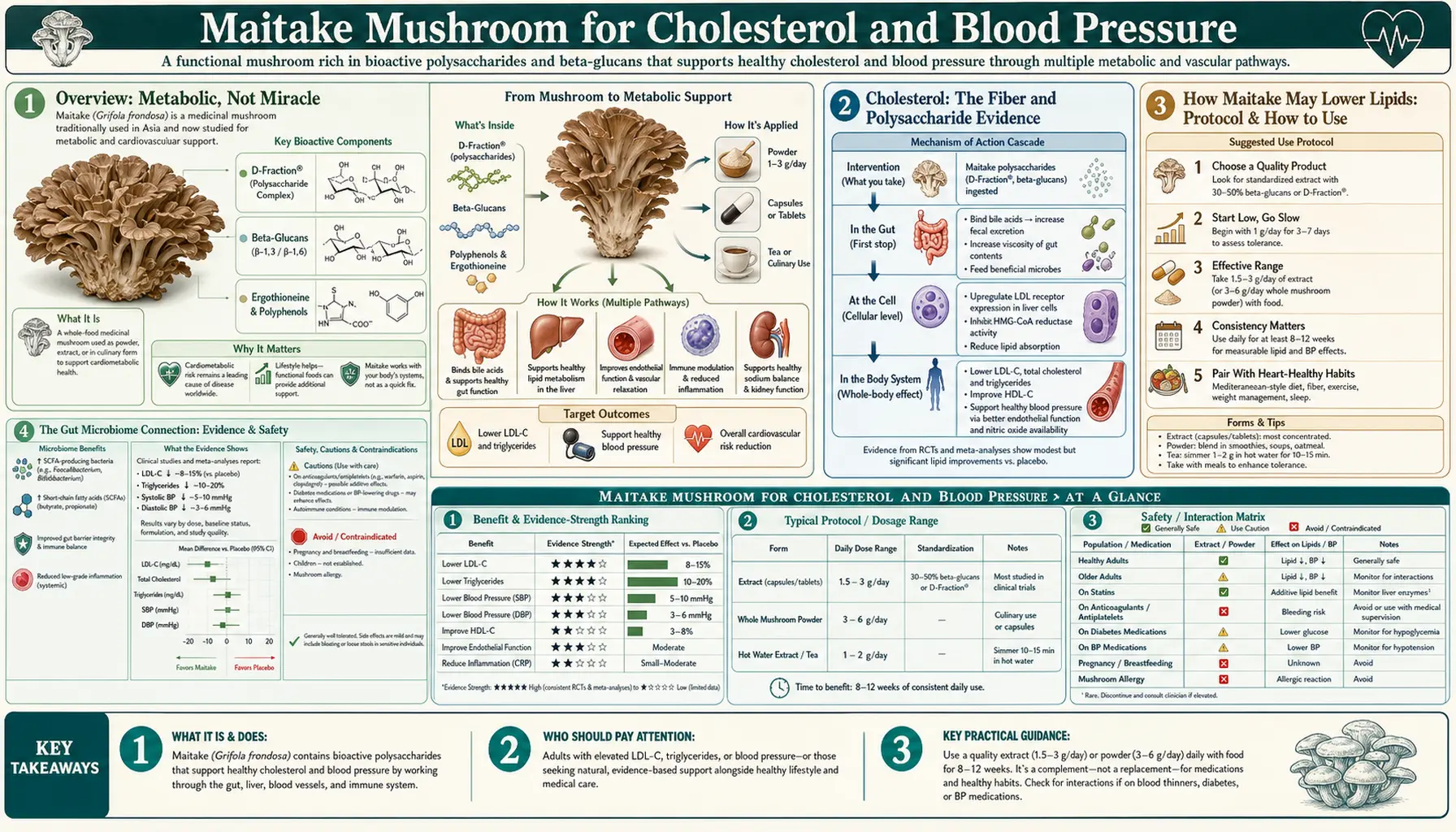
Maitake's cardiovascular research runs along two lines: lowering blood lipids (cholesterol and triglycerides) and lowering blood pressure. Both are biologically plausible — maitake is rich in the same viscous soluble fiber and bioactive polysaccharides that give oats and other mushrooms modest lipid-lowering effects, and it shifts the gut microbiome in favorable ways. As with maitake's other benefits, the evidence is strongest in animals (especially spontaneously hypertensive and high-fat-fed rats) and thin in humans. This page separates the reasonably supported mechanisms from the claims that outrun the data, and puts maitake in its proper place: a healthy high-fiber food that fits a heart-friendly diet, not a substitute for statins or blood-pressure medication.
Table of Contents
- Overview: Metabolic, Not Miracle
- Cholesterol: The Fiber and Polysaccharide Evidence
- How Maitake May Lower Lipids
- The Gut Microbiome Connection
- Fatty Liver (NAFLD) and Lipid Metabolism
- Blood Pressure: The Animal Evidence
- A Maitake Peptide and Endothelial Function
- Where the Human Evidence Stands
- Practical Use and Monitoring
- Cautions and Interactions
- Key Research Papers
- External Resources
- Connections
- Featured Videos
Overview: Metabolic, Not Miracle
It helps to set expectations before reviewing the studies. High-fiber foods, as a category, produce modest reductions in LDL cholesterol — the oat beta-glucan health claim, for instance, rests on a few percentage points of LDL lowering at meaningful daily fiber intakes. Maitake belongs to this general category. Any realistic cholesterol or blood-pressure benefit from maitake is therefore likely to be modest and diet-dependent, not dramatic, and it stacks with rather than replaces the proven interventions (diet pattern, weight, exercise, and, when indicated, medication).
The animal literature sometimes shows larger effects, but animals are often fed maitake at high proportions of the diet under controlled conditions that do not mirror human eating. The gap between an impressive rat result and a modest, uncertain human effect is a recurring theme here and worth keeping in mind throughout.
Cholesterol: The Fiber and Polysaccharide Evidence
The clearest cholesterol study is an early one by Fukushima and colleagues, who compared the cholesterol-lowering effects of dietary fiber from maitake, shiitake, and enokitake mushrooms in rats and found the maitake fiber lowered plasma cholesterol. Kabir and colleagues, in a much-cited 1987 study, fed maitake and shiitake to spontaneously hypertensive rats and reported reductions in both blood pressure and plasma lipids. Sato and colleagues examined dietary maitake in cholesterol-fed mice and found changes in plasma cholesterol accompanied by shifts in hepatic (liver) gene expression governing cholesterol handling.
More recent work uses purified polysaccharide extracts. Wu and colleagues reported that maitake polysaccharides reduced oxidative stress and hypercholesterolaemia in hamsters on a high-fat, high-cholesterol diet. Several groups (Li, Pan, and others) have shown maitake polysaccharides or extracts improving lipid profiles in high-fat-diet rats. The consistency across models is a genuine positive signal — but note that every one of these is an animal study, and the responsible molecule (soluble fiber vs. specific polysaccharide) and the magnitude vary.
How Maitake May Lower Lipids
Several complementary mechanisms are proposed, mirroring how other soluble fibers act:
- Bile-acid binding. Viscous fiber binds bile acids in the gut and carries them out in stool. The liver then pulls cholesterol from the blood to make replacement bile acids, lowering circulating LDL. This is the classic soluble-fiber mechanism.
- Reduced cholesterol absorption. The gel formed by soluble polysaccharides physically impedes the absorption of dietary cholesterol and fat.
- Hepatic gene regulation. Sato and colleagues' finding of altered liver gene expression suggests maitake may also influence the enzymes and receptors (such as those governing cholesterol synthesis and LDL clearance) inside the liver, not only absorption in the gut.
- Short-chain fatty acids. Fermentation of maitake fiber by gut bacteria yields short-chain fatty acids such as propionate, which can modestly suppress hepatic cholesterol synthesis.
These mechanisms are well established for soluble fiber in general and plausibly apply to maitake. What is not established is how much LDL lowering a realistic human maitake intake would actually deliver.
The Gut Microbiome Connection
A prominent recent theme ties maitake's lipid effects to the gut microbiome. Ding and colleagues investigated the mechanisms behind maitake's hypolipidaemic (lipid-lowering) effects in rat liver, and Li and colleagues and Pan and colleagues reported that maitake polysaccharides or ethanol extracts improved lipid metabolism while shifting gut-bacterial composition in high-fat-fed rats — typically increasing beneficial short-chain-fatty-acid producers and reducing markers of dysbiosis.
This prebiotic mechanism is appealing because it connects maitake's indigestible fiber directly to metabolic outcomes without requiring absorption. It also links the cholesterol story to the blood-sugar story (see the Blood Sugar & Insulin Sensitivity page), since the same microbiome shifts influence glucose handling. As always, the causal chain is best supported in rodents; human microbiome-mediated lipid effects of maitake are not proven.
Fatty Liver (NAFLD) and Lipid Metabolism
Because the liver is central to both cholesterol handling and fat storage, several studies examine maitake in non-alcoholic fatty liver disease (NAFLD) models. Li and colleagues reported that a maitake heteropolysaccharide had positive effects on NAFLD and regulated the gut microbiota in a diet-induced model. These findings fit the broader picture of maitake improving diet-induced metabolic dysfunction in animals.
NAFLD is tightly interwoven with insulin resistance, obesity, and dyslipidemia, so an agent that improves the whole cluster in animals is mechanistically coherent. But NAFLD management in humans rests on weight loss and metabolic control; maitake is, at most, an unproven dietary adjunct in that context, and this page makes no claim that it treats fatty liver in people.
Blood Pressure: The Animal Evidence
The blood-pressure research centers on the spontaneously hypertensive rat (SHR), a standard genetic model of high blood pressure. Kabir and colleagues' 1987 study found that feeding maitake (and shiitake) lowered blood pressure in SHRs. Preuss and colleagues later reported that maitake mushroom extracts ameliorated progressive hypertension and other chronic metabolic perturbations in aging female rats — tying the blood-pressure effect to maitake's broader influence on the metabolic syndrome cluster (glucose, lipids, and pressure together).
The proposed mechanisms include improved insulin sensitivity (insulin resistance drives hypertension), effects on vascular tone, and possibly modulation of the renin-angiotensin system. The picture is plausible and internally consistent across studies. It is, however, an animal picture. There is no established human antihypertensive effect of maitake, and blood-pressure control in people should never be entrusted to a supplement.
A Maitake Peptide and Endothelial Function
Newer chemistry has looked beyond polysaccharides to peptides. Cai and colleagues (2025) identified a maitake-derived hexapeptide (designated APPLRP) that reduced blood pressure and improved exosome-mediated vascular endothelial inflammation in spontaneously hypertensive rats. Bioactive peptides that inhibit angiotensin-converting enzyme (ACE) or protect the endothelium are a recognized route to blood-pressure lowering (the same target as ACE-inhibitor drugs), so isolating such a peptide from maitake is a scientifically interesting development.
This is early-stage discovery science: a single isolated peptide, tested in a rat model. It does not mean eating maitake delivers a blood-pressure drug. It is included here because it illustrates that maitake's cardiovascular research is active and expanding into new mechanisms — while still being far from clinical use.
Where the Human Evidence Stands
Bluntly: there is little. The cholesterol and blood-pressure literature for maitake is dominated by rodent studies. There is no large, well-controlled human trial demonstrating that maitake meaningfully lowers LDL cholesterol or blood pressure in people, and this page does not imply one exists. The most that can be honestly said for humans is that maitake is a high-fiber, low-calorie food consistent with the dietary patterns known to support cardiovascular health, and that its concentrated extracts are an unproven adjunct at present.
That is not a dismissal — the animal signal is real and worth testing — but it is a clear statement of the evidence ceiling, so no reader mistakes maitake for a validated cardiovascular therapy.
Practical Use and Monitoring
- Food first. Cooked maitake is a sensible part of a heart-friendly, high-fiber, plant-forward diet. As food, it is low-risk and reasonable.
- Extracts are adjuncts, not treatments. If you use a maitake extract for cardiovascular support, treat it as unproven and additive to — never a replacement for — proven measures.
- Keep taking prescribed medication. Do not reduce or stop a statin or antihypertensive to try maitake. Track your own lipid panel and blood-pressure readings so any change is measured, not assumed. See Lipid Panel.
- Set realistic expectations. Even in the best case, a fiber-type effect is modest and works alongside overall diet quality, weight, and activity.
Cautions and Interactions
- Additive blood-pressure lowering. If maitake does lower blood pressure and is combined with antihypertensive drugs, the effect could stack — monitor for dizziness or low readings.
- Blood sugar. Maitake also lowers glucose; relevant if you take diabetes medication (see the Blood Sugar page).
- Anticoagulants and surgery. Theoretical effects on bleeding warrant caution with blood thinners and around surgery; disclose maitake use to your surgeon.
- GI tolerance. High-fiber extracts can cause bloating or loose stools; introduce gradually.
- Pregnancy and breastfeeding. Culinary amounts are food; concentrated extracts are inadequately studied and best avoided.
- Not a cardiovascular treatment. Maitake does not replace proven management of high cholesterol or hypertension.
Key Research Papers
- Kabir Y et al. (1987). Effect of shiitake (Lentinus edodes) and maitake (Grifola frondosa) mushrooms on blood pressure and plasma lipids of spontaneously hypertensive rats. Journal of Nutritional Science and Vitaminology (Tokyo), 33(5):341–346. — PubMed 3443885
- Fukushima M et al. (2001). Cholesterol-lowering effects of maitake (Grifola frondosa) fiber, shiitake fiber, and enokitake fiber in rats. Experimental Biology and Medicine (Maywood), 226(8):758–765. — PubMed 11520942
- Preuss HG et al. (2010). Maitake mushroom extracts ameliorate progressive hypertension and other chronic metabolic perturbations in aging female rats. International Journal of Medical Sciences, 7(4):169–180. — PubMed 20567593
- Sato M et al. (2013). Effect of dietary maitake (Grifola frondosa) mushrooms on plasma cholesterol and hepatic gene expression in cholesterol-fed mice. Journal of Oleo Science, 62(12):1049–1058. — PubMed 24292357
- Ding Y et al. (2016). The mechanisms underlying the hypolipidaemic effects of Grifola frondosa in the liver of rats. Frontiers in Microbiology, 7:1186. — PubMed 27536279
- Li L et al. (2019). Grifola frondosa polysaccharides ameliorate lipid metabolic disorders and gut microbiota dysbiosis in high-fat-diet-fed rats. Food & Function, 10(5):2560–2572. — PubMed 30994668
- Pan YY et al. (2018). Effect of Grifola frondosa 95% ethanol extract on lipid metabolism and gut microbiota composition in high-fat-diet-fed rats. Food & Function, 9(12):6268–6278. — PubMed 30403219
- Wu WT et al. (2022). Polysaccharides of Grifola frondosa ameliorate oxidative stress and hypercholesterolaemia in hamsters fed a high-fat, high-cholesterol diet. Journal of Pharmacy and Pharmacology, 74(9):1296–1306. — PubMed 35567773
- Li X et al. (2019). The positive effects of Grifola frondosa heteropolysaccharide on NAFLD and regulation of the gut microbiota. International Journal of Molecular Sciences, 20(21). — PubMed 31653116
- Cai Q et al. (2025). Antihypertension and improvement effects of the hexapeptide APPLRP on exosome-mediated vascular endothelial inflammation in spontaneously hypertensive rats. Journal of Agricultural and Food Chemistry, 73(47):30458–30472. — PubMed 41229141
PubMed Topic Searches
- PubMed: Maitake and cholesterol
- PubMed: Maitake and blood pressure
- PubMed: Maitake, lipids, and gut microbiota
- PubMed: Mushroom beta-glucan and cholesterol
- PubMed: Maitake and fatty liver (NAFLD)
External Resources
- Memorial Sloan Kettering — About Herbs: Maitake (evidence-graded)
- PubMed — Maitake cardiovascular research
- PubMed — all Grifola frondosa research
Connections
- Maitake Mushroom (Main Page)
- Maitake Benefits Hub
- Maitake for Immune Support
- Maitake for Blood Sugar
- Maitake and Cancer Research
- Hypertension
- Atherosclerosis
- Cardiovascular Disease
- Lipid Panel
- Oat Beta-Glucan and Cholesterol
- Niacin and Cholesterol
- Metabolic Syndrome
- Reishi Mushroom
- Cardiology (Diseases)
- All Mushrooms