Maitake Mushroom and Cancer Research
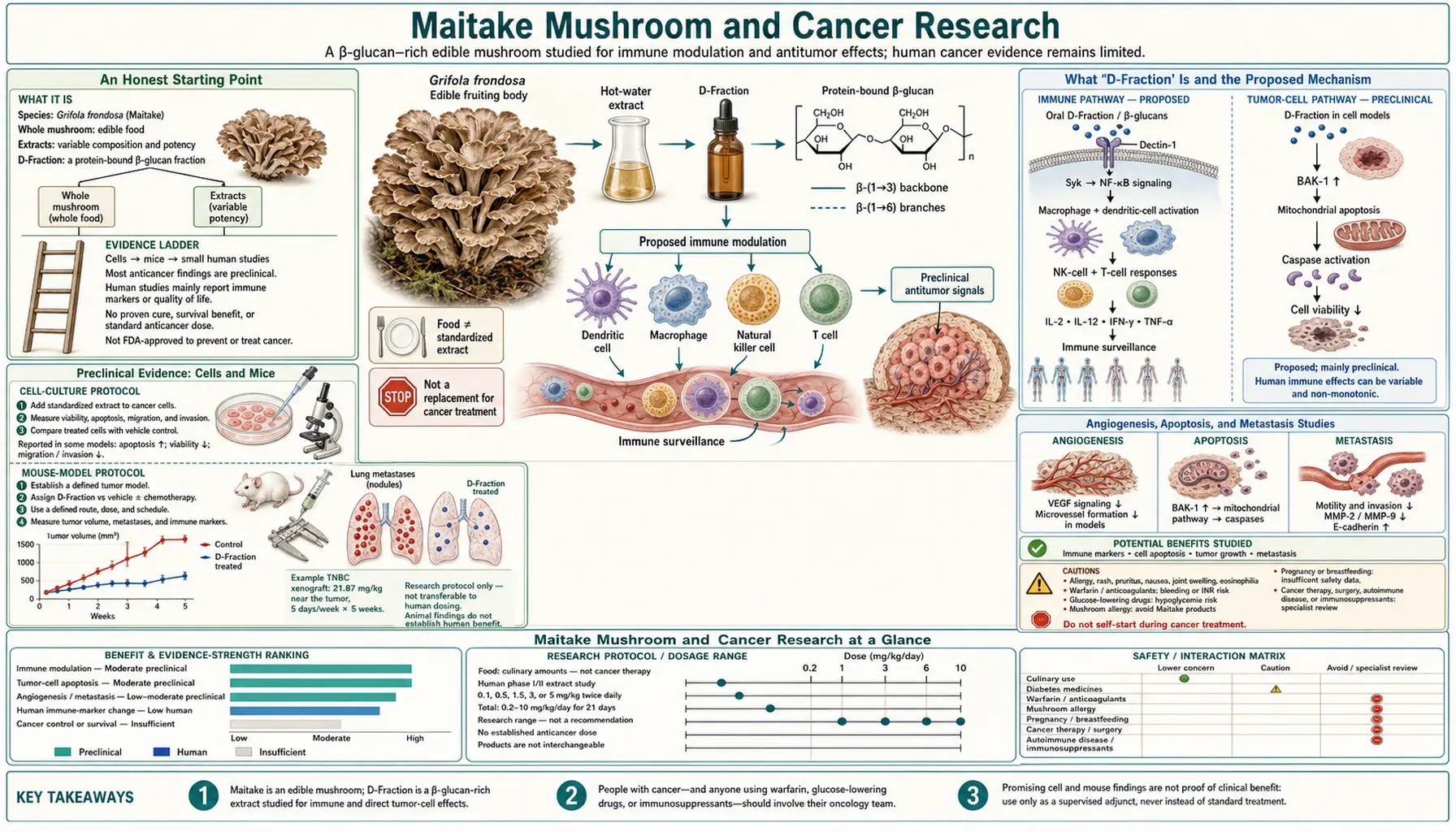
Read this first. Maitake does not cure, treat, or prevent cancer, and nothing on this page should be taken as a reason to delay or replace conventional cancer care. What maitake's beta-glucan "D-fraction" actually is, is a research subject — studied as a possible complementary agent that might support the immune system alongside standard treatment. The great majority of that research is preclinical (cancer cells in a dish and tumors in mice), and the human research consists of a handful of small, early-phase studies that mostly measured immune markers, not survival or cure. This page lays out honestly what the studies show, what they do not show, and why the gap between the two is large.
Table of Contents
- An Honest Starting Point
- What "D-Fraction" Is and the Proposed Mechanism
- Preclinical Evidence: Cells and Mice
- Angiogenesis, Apoptosis, and Metastasis Studies
- The Human Evidence: Small and Early
- Reducing Chemotherapy Toxicity (Preclinical)
- What Systematic Reviews Conclude
- Important Limitations
- Talking With Your Oncology Team
- Key Research Papers
- External Resources
- Connections
- Featured Videos
An Honest Starting Point
Medicinal mushrooms occupy a genuinely gray zone in oncology. On one hand, a related mushroom product — PSK (krestin), from Trametes versicolor/turkey tail — has decades of use in Japan as an approved adjuvant alongside chemotherapy, and beta-glucans as a class have real, measurable effects on immune cells. On the other hand, this legitimate biology is routinely exaggerated in marketing into claims that mushrooms "fight" or "beat" cancer, which the evidence does not support.
Maitake sits firmly on the research side of that line. It has interesting immunology and a large preclinical literature, but the clinical evidence needed to call it a cancer treatment does not exist. The useful, honest framing is: maitake beta-glucan is being investigated as a possible immunologic adjunct — something that might help the immune system while proven treatments do the actual work — and that investigation is still early.
What "D-Fraction" Is and the Proposed Mechanism
The maitake "D-fraction" is a protein-bound beta-glucan extract; its more purified form is the "MD-fraction." As described on the Immune Support page, these beta-glucans are recognized by immune receptors such as Dectin-1 on macrophages and dendritic cells, and they can raise natural-killer-cell activity.
The proposed anticancer rationale is entirely immune-mediated: the beta-glucan does not attack tumor cells directly the way chemotherapy does. Instead, the hypothesis is that it primes innate immune cells (NK cells, macrophages, dendritic cells) so they recognize and attack tumor cells more effectively, and that it may counteract the immune suppression that tumors create around themselves. This is a plausible mechanism, and it is the mechanism actually observed in the animal studies. It is also why any real-world role would be as an add-on to, never a replacement for, treatments that reduce tumor burden directly.
Preclinical Evidence: Cells and Mice
The largest body of maitake cancer research is preclinical. In tumor-bearing mice, Kodama and colleagues repeatedly showed that D-fraction slowed tumor growth in an NK-cell-dependent manner. Masuda and colleagues found that orally administered soluble maitake beta-glucan produced a systemic antitumor immune response and reduced tumor-associated immunosuppression in mice. In breast-cancer cell lines, Alonso and colleagues reported that maitake D-fraction altered gene-expression programs associated with a less malignant phenotype and showed antitumoral and antimetastatic activity in triple-negative breast cancer cells.
These are real, peer-reviewed findings and they are internally consistent. But two cautions are essential. First, mouse tumor models and cell lines are notoriously poor predictors of human outcomes; a large fraction of agents that shrink tumors in mice fail in people. Second, much of the maitake antitumor animal work comes from a small number of research groups, and independent large-scale replication is limited. Preclinical promise is a reason to run human trials — it is not evidence that the agent works in humans.
Angiogenesis, Apoptosis, and Metastasis Studies
Mechanistic studies have looked at specific cancer processes. Matsui and colleagues reported that maitake D-fraction affected carcinoma angiogenesis (the tumor's recruitment of new blood vessels) in an experimental model. Zhang and colleagues reported that maitake polysaccharides induced breast-cancer-cell apoptosis (programmed cell death) through a mitochondrial pathway in cell culture. Alonso and colleagues' metastasis work in triple-negative breast cancer cells pointed to reduced migratory/invasive behavior.
Findings like "induces apoptosis in a cancer cell line" are frequently over-quoted in supplement marketing, so it is worth stating plainly what they mean: an isolated cancer cell in a dish died when exposed to a concentration of extract, often high, under artificial conditions. This is standard early screening biology. It does not demonstrate that eating maitake or taking a maitake capsule delivers a relevant concentration to a tumor in a living person, nor that it produces any clinical benefit. These studies generate hypotheses; they do not establish efficacy.
The Human Evidence: Small and Early
The single most rigorous human study is the phase I/II trial by Deng and colleagues at Memorial Sloan Kettering, which administered a maitake polysaccharide extract to postmenopausal breast-cancer patients. It is crucial to understand what this trial was and was not. It was a dose-finding immunology trial: its purpose was to find a tolerable dose and measure the extract's effect on immune-cell function — not to measure whether patients' cancer improved. Its finding was that maitake produced dose-dependent immunologic changes that were both stimulatory and, at some doses, inhibitory — a nuanced result, not a clean "maitake boosts anti-cancer immunity" headline.
Beyond that trial, the human record is a handful of small case reports and observational descriptions, such as Kodama and colleagues' reports on whether MD-fraction might aid cancer patients. There is no completed large randomized controlled trial showing that maitake improves survival, recurrence, tumor response, or quality of life in any cancer. Any claim otherwise misrepresents the evidence. The honest summary of human data: maitake beta-glucan is tolerable and measurably engages the immune system in cancer patients, and whether that helps them clinically is unknown.
Reducing Chemotherapy Toxicity (Preclinical)
A separate research thread asks whether maitake beta-glucan could reduce the harms of chemotherapy while preserving its benefit. In mice, Masuda and colleagues reported that maitake beta-glucan reduced the bone-marrow suppression and kidney toxicity of cisplatin without blunting its antitumor effect, and related work found reduced doxorubicin toxicity in bone-marrow cell cultures. A 2024 study reported that maitake beta-glucan enhanced the tumor-cell-killing (antibody-dependent cytotoxicity) of the targeted antibody drug trastuzumab in laboratory models.
If confirmed in humans, effects like these — protecting blood counts, protecting the kidney, or amplifying a targeted drug — would be clinically valuable. But they are animal and laboratory findings. They are also the reason maitake must never be added silently during cancer treatment: an agent that changes how chemotherapy or a targeted drug behaves could in principle help or interfere, and only the treating oncologist can weigh that.
What Systematic Reviews Conclude
Independent reviews are the appropriate place to look for a balanced verdict. A 2023 systematic review of medicinal-mushroom supplements in cancer by Narayanan and colleagues examined the clinical-trial evidence across mushroom products and concluded, consistent with earlier appraisals, that while some mushroom preparations show immunomodulatory signals and reasonable safety, the clinical evidence for improving cancer outcomes is limited, heterogeneous, and generally of low quality — with the strongest data belonging to turkey-tail-derived PSK/PSP rather than maitake. Broader reviews of medicinal mushrooms in oncology reach similar conclusions: promising biology, insufficient high-quality human evidence, and a clear need for larger trials.
The takeaway from the review literature is not "mushrooms don't do anything" — it is that the honest current status is unproven for cancer outcomes, with maitake specifically less clinically studied than some of its relatives.
Important Limitations
- Preclinical ≠ proven. Most maitake cancer data are from cells and mice, which frequently do not translate to humans.
- No outcome trials. There is no large randomized trial showing maitake improves survival, recurrence, or tumor response in any cancer.
- Product variability. Beta-glucan content and extract type differ hugely between products and between studies, so a supplement may not match any studied material.
- Publication and group bias. A large share of positive maitake antitumor work comes from a few groups; independent replication is limited.
- Immunomodulation cuts both ways. The best human trial found dose-dependent effects that were not uniformly beneficial — more is not automatically better, and interactions with immunotherapy are not understood.
Talking With Your Oncology Team
If you are living with cancer and interested in maitake, the single most important step is to tell your oncology team before taking anything. Reasons this matters concretely:
- Interaction risk. Beta-glucans modulate the immune system; their interaction with modern immunotherapies (checkpoint inhibitors) and with chemotherapy is not well characterized.
- Timing around treatment. Some centers ask patients to pause supplements around infusions or surgery.
- Bleeding and blood sugar. Maitake may affect blood glucose and, theoretically, bleeding — relevant around procedures.
- Never a substitute. Maitake is not a treatment. Declining or delaying proven therapy in favor of a mushroom supplement is associated with worse survival across cancer types.
A reasonable, honest position is that culinary maitake is a healthy food, and that concentrated extracts are an experimental adjunct at best, to be used — if at all — only with the knowledge and agreement of the treating oncologist.
Key Research Papers
- Deng G et al. (2009). A phase I/II trial of a polysaccharide extract from Grifola frondosa (Maitake mushroom) in breast cancer patients: immunological effects. Journal of Cancer Research and Clinical Oncology, 135(9):1215–1221. — PubMed 19253021
- Narayanan S et al. (2023). Medicinal Mushroom Supplements in Cancer: A Systematic Review of Clinical Studies. Current Oncology Reports, 25(6):569–587. — PubMed 36995535
- Kodama N et al. (2002). Can maitake MD-fraction aid cancer patients? Alternative Medicine Review, 7(3):236–239. — PubMed 12126464
- Kodama N et al. (2002). Effects of D-Fraction, a polysaccharide from Grifola frondosa, on tumor growth involve activation of NK cells. Biological & Pharmaceutical Bulletin, 25(12):1647–1650. — PubMed 12499658
- Matsui K et al. (2001). Effects of maitake (Grifola frondosa) D-Fraction on carcinoma angiogenesis. Cancer Letters, 172(2):193–198. — PubMed 11566496
- Kodama N et al. (2005). Maitake D-Fraction enhances antitumor effects and reduces immunosuppression by mitomycin-C in tumor-bearing mice. Nutrition, 21(5):624–629. — PubMed 15850970
- Masuda Y et al. (2009). Maitake beta-glucan enhances therapeutic effect and reduces myelosuppression and nephrotoxicity of cisplatin in mice. International Immunopharmacology, 9(5):620–626. — PubMed 19249389
- Alonso EN et al. (2013). Genes related to suppression of malignant phenotype induced by Maitake D-Fraction in breast cancer cells. Journal of Medicinal Food, 16(7):602–617. — PubMed 23875900
- Alonso EN et al. (2017). Antitumoral effects of D-Fraction from Grifola frondosa (Maitake) mushroom in breast cancer. Nutrition and Cancer, 69(1):29–43. — PubMed 27892708
- Alonso EN et al. (2018). Antitumoral and antimetastatic activity of Maitake D-Fraction in triple-negative breast cancer cells. Oncotarget, 9(34):23396–23412. — PubMed 29805742
- Zhang Y et al. (2017). Grifola frondosa polysaccharides induce breast cancer cell apoptosis via the mitochondrial-dependent apoptotic pathway. International Journal of Molecular Medicine, 40(4):1089–1095. — PubMed 28765878
- Masuda Y et al. (2024). Maitake beta-glucan enhances the therapeutic effect of trastuzumab via antibody-dependent and complement-dependent cytotoxicity. Biological & Pharmaceutical Bulletin, 47(4):840–847. — PubMed 38616114
- Sevindik M et al. (2025). The role of medicinal mushrooms in cancer treatment: bioactive compounds and therapeutic potential (review). International Journal of Medicinal Mushrooms, 27(12):1–24. — PubMed 41135064
PubMed Topic Searches
- PubMed: Maitake D-fraction and tumors
- PubMed: Maitake and breast cancer
- PubMed: Medicinal mushrooms in cancer, clinical trials
- PubMed: Beta-glucan as chemotherapy adjunct
- PubMed: Maitake, angiogenesis, and metastasis
External Resources
- Memorial Sloan Kettering — About Herbs: Maitake (clinician-reviewed, purported-uses vs. evidence)
- National Cancer Institute — Complementary and Alternative Medicine
- PubMed — Maitake cancer research
Connections
- Maitake Mushroom (Main Page)
- Maitake Benefits Hub
- Maitake for Immune Support
- Maitake for Blood Sugar
- Maitake for Cholesterol & BP
- Turkey Tail (PSK/PSP)
- Reishi Mushroom
- Agaricus Blazei
- Oncology (Diseases)
- Breast Cancer
- Prostate Cancer
- Colorectal Cancer
- Immunology (Diseases)
- Immune Boosting
- All Mushrooms