Maitake Mushroom for Blood Sugar and Insulin Sensitivity
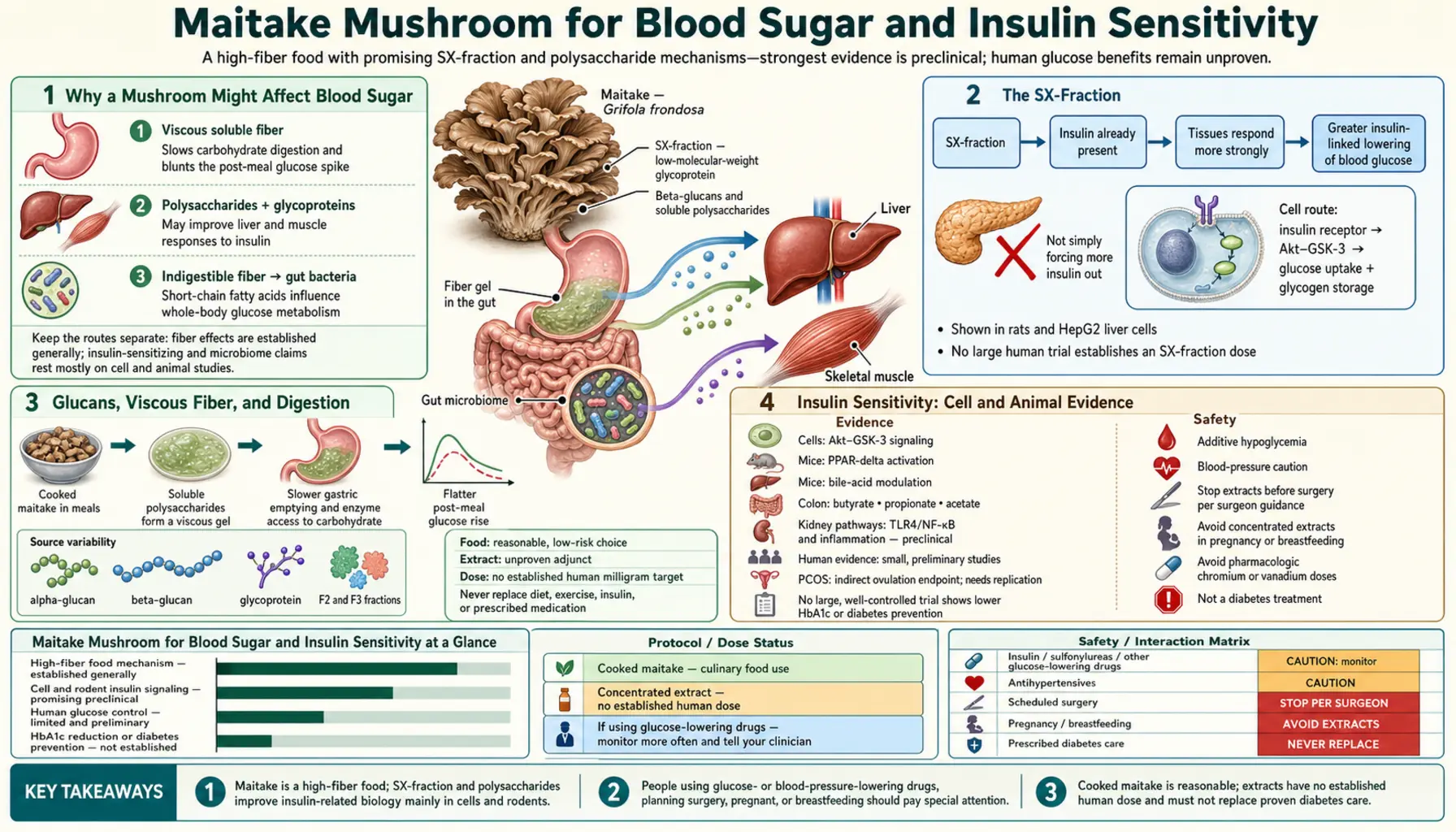
Alongside its immune beta-glucans, maitake (Grifola frondosa) contains a separate, lower-molecular-weight glycoprotein — the "SX-fraction" — that has been studied specifically for effects on blood glucose and insulin sensitivity. In diabetic and insulin-resistant animal models, maitake extracts consistently lower blood sugar, improve glucose tolerance, and appear to make tissues respond better to insulin, working through the liver, skeletal muscle, and the gut microbiome. The honest headline, though, is that this evidence is overwhelmingly preclinical: strong and reproducible in rodents and cell cultures, but supported by only small, preliminary human studies. This page explains the mechanisms, walks through the animal and human data, and is explicit about where the science stops.
Table of Contents
- Why a Mushroom Might Affect Blood Sugar
- The SX-Fraction
- Glucans, Viscous Fiber, and Digestion
- Insulin Sensitivity: Cell and Animal Evidence
- PPAR Signaling and the Liver
- The Gut Microbiome Route
- The Human Evidence (Including PCOS)
- Diabetic Kidney Protection (Preclinical)
- What This Means in Practice
- Cautions and Interactions
- Key Research Papers
- External Resources
- Connections
- Featured Videos
Why a Mushroom Might Affect Blood Sugar
There are three biologically distinct ways an edible mushroom could influence blood glucose, and maitake plausibly uses all three. First, as a food it is high in viscous soluble fiber, which slows carbohydrate digestion and blunts the post-meal glucose spike — a purely physical effect shared by many high-fiber foods. Second, its polysaccharides and glycoproteins appear to act as signaling molecules that improve how the liver and muscle respond to insulin. Third, its indigestible fiber feeds gut bacteria that produce short-chain fatty acids, which in turn influence whole-body glucose metabolism.
Distinguishing these matters, because the first (fiber slowing digestion) is well established for high-fiber foods generally and is not unique or dramatic, while the second and third (true insulin-sensitizing signaling) are the interesting claims that rest mostly on animal and cell studies. Keeping them separate prevents overstating what a maitake supplement is likely to do.
The SX-Fraction
The maitake fraction most associated with metabolic effects is the SX-fraction, a low-molecular-weight glycoprotein distinct from the immune-active D/MD beta-glucans. It was characterized largely by Harry Preuss and colleagues, who reported that rats consuming this specific glycoprotein showed enhanced insulin-linked lowering of blood glucose — in other words, a given amount of insulin dropped glucose more when the animals were on the SX-fraction, which is the signature of improved insulin sensitivity rather than simply forcing more insulin out.
This is an important conceptual point. Some blood-sugar supplements work by squeezing more insulin from the pancreas (which does not fix, and can worsen, insulin resistance). The SX-fraction research instead points toward the tissues becoming more responsive to the insulin already present — the more desirable direction, and the same direction that exercise and metformin work. That said, the SX-fraction data are again animal and mechanistic; there is no large human trial establishing an SX-fraction dose for people with diabetes.
Glucans, Viscous Fiber, and Digestion
Maitake's beta-glucans and other soluble polysaccharides are viscous fibers. In the gut they form a gel that slows gastric emptying and the movement of digestive enzymes to carbohydrate, flattening the rise in blood glucose after a meal. This is the same mechanism by which oat beta-glucan modestly lowers post-meal glucose and cholesterol — see our related Oat Beta-Glucan and Cholesterol page.
Several maitake animal studies report improved oral glucose tolerance. Horio and colleagues found maitake improved glucose tolerance in experimental diabetic rats. Hong and colleagues isolated an alpha-glucan (not the beta-glucan, notably) from the fruiting body that reduced blood glucose in genetically diabetic KK-Ay mice. Different maitake polysaccharide fractions (labeled F2 and F3 by Xiao and colleagues) improved insulin resistance in diabetic rats. The recurring theme is that maitake carbohydrates, delivered orally, lower glucose in diabetic rodents — but the responsible molecule differs between studies (alpha-glucan, beta-glucan, glycoprotein), which reflects how heterogeneous "maitake extract" really is.
Insulin Sensitivity: Cell and Animal Evidence
Beyond slowing digestion, several studies probe whether maitake genuinely improves insulin signaling inside cells. Ma and colleagues reported that a maitake polysaccharide relieved insulin resistance in HepG2 liver cells by acting on the Akt–GSK-3 pathway — a core insulin-signaling cascade that controls glucose uptake and glycogen storage. Ding and colleagues (2025) characterized a maitake polysaccharide structurally and showed it improved insulin resistance in high-fat-diet-fed mice. Zhang and colleagues (2025) reported that maitake polysaccharide F2 improved disordered glucose and lipid metabolism in prediabetic mice, partly by modulating bile acids.
Taken together, the mechanistic studies build a coherent case that maitake components can act on established insulin-signaling nodes (Akt/GSK-3, and receptor pathways) rather than merely blunting absorption. This is genuinely promising biology. It is also, at present, biology demonstrated in cultured cells and rodents. The leap from "improves the Akt-GSK-3 pathway in HepG2 cells" to "improves a person's HbA1c" has not been made in adequately powered human trials.
PPAR Signaling and the Liver
One especially interesting mechanistic finding involves the peroxisome proliferator-activated receptors (PPARs) — nuclear receptors that regulate how the body burns and stores fat and how sensitive tissues are to insulin. The diabetes drug class of thiazolidinediones works through PPAR-gamma. Aoki and colleagues reported that a maitake extract activated PPAR-delta and improved glucose intolerance in high-fat-diet-induced obese mice.
PPAR-delta activation in muscle and liver promotes fatty-acid oxidation and can improve insulin sensitivity, so this offers a plausible molecular explanation that links maitake's glucose and lipid effects (the lipid side is covered on the Cholesterol & Blood Pressure page). It is worth noting this is a receptor-activation finding in mice, and PPAR pharmacology in humans is complex and has produced both successful drugs and abandoned ones. It is a mechanism to watch, not a proven human effect.
The Gut Microbiome Route
A growing set of studies attributes part of maitake's metabolic benefit to the gut microbiome. Because beta-glucans and other maitake polysaccharides reach the colon undigested, they act as prebiotics: gut bacteria ferment them into short-chain fatty acids (butyrate, propionate, acetate) that improve gut-barrier integrity, reduce low-grade inflammation, and signal to the liver and pancreas in ways that improve glucose handling.
Guo and colleagues found a maitake polysaccharide-chromium complex improved both glucose and lipid measures in diabetic mice, and multiple groups have tied maitake polysaccharides to favorable shifts in gut-bacterial composition alongside their metabolic effects. This microbiome mechanism is attractive because it does not require the polysaccharide to be absorbed — it works from the gut. But it is also inferred largely from mouse microbiome sequencing plus metabolic readouts; causation in humans is not established.
The Human Evidence (Including PCOS)
Human data on maitake and glucose are limited and preliminary. The most cited human study is not about diabetes at all but polycystic ovary syndrome (PCOS), a condition driven substantially by insulin resistance. Chen and colleagues reported that a maitake extract (SX-fraction) induced ovulation in women with PCOS, both alone and in combination with the standard fertility drug clomiphene after clomiphene had failed. Because PCOS ovulation is tightly linked to insulin sensitivity, this is often cited as indirect human evidence for a metabolic effect — but it was a small study, focused on an ovulation endpoint rather than glucose control, and needs replication.
There are older small reports of maitake lowering fasting or post-meal glucose in people, but there is no large, well-controlled randomized trial demonstrating that maitake meaningfully lowers HbA1c or prevents diabetes in humans. The responsible position: the human evidence is a small set of encouraging but preliminary studies, not a basis for using maitake in place of proven diabetes care.
Diabetic Kidney Protection (Preclinical)
Several recent studies extend maitake's metabolic research to diabetic complications, particularly the kidney. Jiang and colleagues reported that maitake polysaccharides had hypoglycemic and kidney-protective effects in early diabetic nephropathy in rodents, and a follow-up implicated suppression of the TLR4/NF-κB inflammatory pathway. Zou and colleagues linked a maitake polysaccharide to reduced inflammation via macrophage polarization in type-2-diabetic rats.
These are mechanistically rich animal studies suggesting maitake's effects might extend beyond glucose numbers to the inflammatory processes that damage organs in diabetes. As with everything on this page, they are preclinical. They justify further research; they do not justify using maitake to treat or prevent diabetic kidney disease, which requires proven medical management.
What This Means in Practice
- As a food, maitake is a sound choice for anyone managing blood sugar: high in fiber, low in available carbohydrate, and filling. Including cooked maitake in meals is reasonable and low-risk.
- As a supplement, treat blood-sugar claims cautiously. The strongest evidence is preclinical. If you try a maitake extract for metabolic support, treat it as an unproven adjunct, not a replacement for diet, exercise, or prescribed medication.
- Monitor if you are already treated. If you take insulin, sulfonylureas, or other glucose-lowering drugs, maitake's own glucose-lowering effect could stack additively — check your glucose more often when starting and tell your clinician.
- No established human dose. Study doses vary by fraction and are mostly animal-derived, so there is no evidence-based milligram target for people.
Cautions and Interactions
- Additive hypoglycemia. The main practical risk. Combined with diabetes medication, maitake may lower blood sugar more than expected; watch for symptoms and monitor.
- Blood pressure. Maitake also lowers blood pressure in animals; caution if on antihypertensives.
- Surgery. Because of possible effects on blood sugar (and theoretical effects on bleeding), discontinue extract use before scheduled surgery per your surgeon's guidance.
- Pregnancy and breastfeeding. Culinary amounts are food; concentrated extracts are not well studied and are best avoided.
- Chromium/vanadium-enriched products. Some experimental maitake preparations are enriched with trace metals; these are research materials, and excess vanadium or chromium can be harmful. Ordinary supplements should not contain pharmacologic metal doses.
- Not a diabetes treatment. Maitake is not a substitute for insulin or oral hypoglycemics. Never stop prescribed diabetes medication to use it.
Key Research Papers
- Preuss HG et al. (2007). Enhanced insulin-hypoglycemic activity in rats consuming a specific glycoprotein extracted from maitake mushroom. Molecular and Cellular Biochemistry, 306(1–2):105–113. — PubMed 17671829
- Horio H et al. (2001). Maitake (Grifola frondosa) improve glucose tolerance of experimental diabetic rats. Journal of Nutritional Science and Vitaminology (Tokyo), 47(1):57–63. — PubMed 11349892
- Hong L et al. (2007). Anti-diabetic effect of an alpha-glucan from fruit body of maitake (Grifola frondosa) on KK-Ay mice. Journal of Pharmacy and Pharmacology, 59(4):575–582. — PubMed 17430642
- Ma X et al. (2014). A polysaccharide from Grifola frondosa relieves insulin resistance of HepG2 cells by the Akt–GSK-3 pathway. Glycoconjugate Journal, 31(5):355–363. — PubMed 24908430
- Xiao C et al. (2015). Hypoglycemic effects of Grifola frondosa (Maitake) polysaccharides F2 and F3 through improvement of insulin resistance in diabetic rats. Food & Function, 6(11):3567–3575. — PubMed 26311233
- Aoki H et al. (2018). Grifola frondosa (Maitake) extract activates PPARδ and improves glucose intolerance in high-fat diet-induced obese mice. Bioscience, Biotechnology, and Biochemistry, 82(9):1550–1559. — PubMed 29873587
- Ding YY et al. (2025). Structure characterization of a Grifola frondosa polysaccharide and its effect on insulin resistance in HFD-fed mice. npj Science of Food, 9(1):3. — PubMed 39774946
- Zhang R et al. (2025). Grifola frondosa polysaccharide F2 ameliorates disordered glucose and lipid metabolism in prediabetic mice by modulating bile acids. Foods, 14(6). — PubMed 40232013
- Chen JT et al. (2010). Maitake mushroom (Grifola frondosa) extract induces ovulation in patients with polycystic ovary syndrome. Journal of Alternative and Complementary Medicine, 16(12):1295–1299. — PubMed 21034160
- Jiang T et al. (2020). Hypoglycemic and renal protective effects of Grifola frondosa polysaccharides in early diabetic nephropathy. Journal of Food Biochemistry, 44(12):e13515. — PubMed 33043487
- Jiang T et al. (2022). Grifola frondosa polysaccharide ameliorates early diabetic nephropathy by suppressing the TLR4/NF-κB pathway. Applied Biochemistry and Biotechnology, 194(9):4093–4104. — PubMed 35616773
- Guo WL et al. (2019). A novel Grifola frondosa polysaccharide-chromium(III) complex and its hypoglycemic and hypolipidemic activities in diabetic mice. International Journal of Biological Macromolecules, 131:81–88. — PubMed 30851330
PubMed Topic Searches
- PubMed: Maitake, glucose, and diabetes
- PubMed: Maitake SX-fraction and insulin
- PubMed: Maitake and insulin resistance
- PubMed: Maitake polysaccharide and gut microbiota
- PubMed: Maitake and PCOS
External Resources
- Memorial Sloan Kettering — About Herbs: Maitake (evidence-graded)
- PubMed — Maitake hypoglycemic research
- PubMed — all Grifola frondosa research
Connections
- Maitake Mushroom (Main Page)
- Maitake Benefits Hub
- Maitake for Immune Support
- Maitake for Cholesterol & BP
- Maitake and Cancer Research
- Type 2 Diabetes
- Insulin Resistance
- Metabolic Syndrome
- Chromium
- Magnesium
- Oat Beta-Glucan
- Berberine
- Reishi Mushroom
- Endocrinology (Diseases)
- All Mushrooms