Shilajit: History and Traditional Use
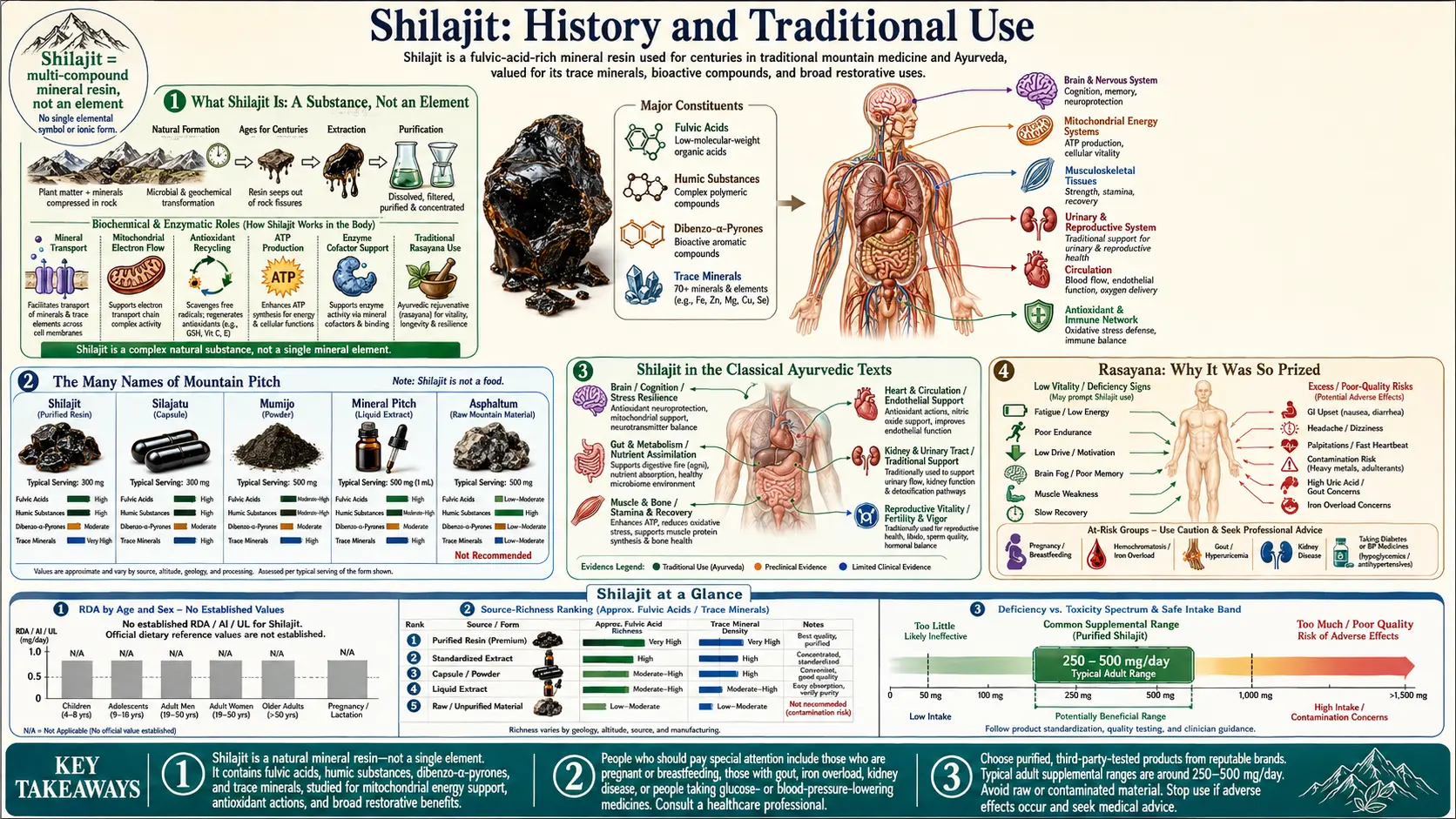
Shilajit has no inventor and no date of discovery, because it was never invented or discovered in the way a chemical element is. It is a dark, tar-like substance that seeps from cracks in high mountain rock, and people across the Himalaya and Central Asia have gathered and used it for a very long time — long before anyone could say what it was made of. This article traces what the historical record actually supports: where the substance comes from and what it was thought to be, what its many names mean (including a genuine disagreement over the meaning of the word "shilajit" itself), its place in the classical Ayurvedic texts, the famous legend of how it was first noticed, its parallel life as mumijo in the mountains of Russia and Central Asia and its appearance in the medical writings of the Islamic Golden Age, and finally the moment in the twentieth century when chemists began to identify the molecules behind it. Where the record is firm we say so; where a claim is tradition, legend, or still argued over, we name it as such.
Table of Contents
- What Shilajit Is: A Substance, Not an Element
- The Many Names of Mountain Pitch
- Shilajit in the Classical Ayurvedic Texts
- Rasayana: Why It Was So Prized
- The Legend of the White Monkeys
- Mumijo: Central Asia, Persia, and the Islamic Physicians
- Shodhana: Traditional Purification and Use
- From Mountain Resin to Laboratory
- Research Papers and References
- Connections
- Featured Videos
What Shilajit Is: A Substance, Not an Element
It is worth being clear at the outset about what kind of thing shilajit is, because it changes the whole shape of its history. Most of the entries in a minerals collection are chemical elements — iron, zinc, selenium, magnesium — and each has a tidy discovery story: a chemist who first isolated it, a year, sometimes a prize. Shilajit is not like that. It is not an element and not a single compound. It is a naturally occurring exudate: a dark, sticky, asphalt-like material that oozes out of fissures in rock at high altitude, mainly across the Himalaya and the mountain ranges of Central Asia, and hardens in the sun. Chemically it is a complex, variable mixture of humic substances (above all fulvic acid), mineral salts, and the residues of plant and microbial matter that built up in the rock over a very long time.
Because it is a found substance rather than an isolated element, shilajit has no single human discoverer and no datable moment of discovery. Like a mineral spring or a salt deposit, it was simply encountered — noticed seeping from the rocks by people living in the high country — and then used, named, and written about by many cultures over a great span of time. The honest history of shilajit is therefore a history of traditional use: who used it, what they believed it did, what they called it, and how, much later, science began to take it apart. Anyone who offers a precise "date shilajit was discovered" or names a single discoverer is supplying a tidiness the record does not contain.
This page treats the classical texts (the Charaka Samhita and Sushruta Samhita) and the medieval Islamic medical writings as historical primary sources — evidence of how the substance was used and understood in the past — not as modern clinical sources. The science of what shilajit actually contains and does is covered on the main Shilajit page and in the Benefits articles.
The Many Names of Mountain Pitch
The English word most people use, shilajit, comes from Sanskrit, and its meaning is the subject of a real and rarely-acknowledged disagreement. The two parts are shila, "rock" or "stone," and a second element that classical dictionaries read in two different ways. One reading treats the word as shilajatu, from shila + jatu, where jatu means "lac, gum, or resin" — giving the plain, descriptive sense of a resin or exudate of rock. The other reading treats it as shilajit, from shila + jit, where jit means "what conquers or overpowers," giving the sense "rock-overpowering." The standard Sanskrit lexicons (Monier-Williams and the Cologne digital dictionaries) record both forms and, in either case, identify the substance itself with bitumen — a rock-exudation that, in the dictionaries' words, "is supposed to ooze from the stones of mountains in the hot weather." Both readings are old and both are defensible: one names the thing for what it physically is (a rock-exudate), the other for what it was believed to do (overpower or conquer).
From the second, "conqueror" reading flow the well-known poetic epithets — "conqueror of mountains" and "destroyer of weakness." These are best understood as traditional and interpretive renderings that capture the substance's reputation as a strengthening tonic, rather than as the literal dictionary translation of the word; this page presents them that way. In classical pharmacology shilajit is also identified by the botanical-style name Asphaltum punjabianum, reflecting its asphalt-like nature.
Beyond Sanskrit, the substance gathered names everywhere it was used — itself a kind of evidence of how widely it travelled. In Urdu it is salajeet; in Bengali, silajatu. Across Russia, Siberia, and Central Asia the closely related (often treated as the same) material is known as mumijo, also written mumiyo, mumie, or moomiyo. In Mongolian and Tibetan tradition it is brag-shun (also baragshun), commonly translated as the "oil" or "juice" of the mountain, and in some sources the "blood of the mountain." Arabic sources refer to it under names such as araq al-jibal, "sweat of the mountains." The recurring image across all these languages is the same: a dark substance that the rock itself seems to weep.
Shilajit in the Classical Ayurvedic Texts
Shilajit's richest and most continuous documented tradition belongs to Ayurveda, the classical medical system of the Indian subcontinent, where it is named and described in the foundational compendia — the Charaka Samhita and the Sushruta Samhita. These texts took shape and were edited over a long stretch of antiquity, and modern scholars generally date the surviving forms of the Charaka Samhita to around the early centuries of the Common Era, with the Sushruta Samhita compiled somewhat later, though both clearly draw on older material. This is why writers describe shilajit's recorded use variously as "more than two thousand" or "more than three thousand" years old: the figure depends entirely on how one dates the texts and the traditions behind them. Rather than fix a precise number, it is safer to say that shilajit's documented medical use is genuinely ancient, reaching back at least two millennia.
In these texts shilajit is placed among the rasayana substances — the rejuvenating tonics (the subject of the next section) — and is praised in striking terms. A famous passage attributed to the Charaka tradition holds that there is scarcely a curable disease that shilajit cannot help to treat when it is properly purified and given at the right time, in the right combination, with a suitable vehicle. Such statements are classical claims of esteem, showing how highly the substance was regarded; they are not modern medical findings, and a traditional indication is not evidence of effectiveness. The Sushruta Samhita records more specific uses, including the management of madhumeha — a classical category of "sweet/honey urine" conditions that later writers have associated with what we now call diabetes — with purified shilajit given alongside herbal decoctions.
What the Ayurvedic record reliably tells us is not that any particular cure was proven, but that shilajit was, for a very long time, one of the central restorative substances of an entire medical culture — reached for when a person was weak, depleted, aged, or unwell, and treated as something close to a panacea.
Rasayana: Why It Was So Prized
To understand shilajit's standing in its home tradition, it helps to understand the idea of rasayana. Rasayana is one of the classical branches of Ayurveda and refers to a class of remedies and practices aimed at rejuvenation: promoting strength, vitality, resistance to illness, mental clarity, and long, healthy life. A rasayana was not thought of as a drug for a single disease so much as a restorative meant to nourish the whole body and help it recover and preserve its vigour. Shilajit is repeatedly named among the most valued substances in this category — and unusually, it is a mineral rasayana in a tradition where most rasayanas are herbs.
Within this framework shilajit was particularly associated with energy, stamina, and the reproductive and urinary systems, and was classed in places as a medhya (intellect-supporting) substance as well. This is the conceptual root of the modern label most people now attach to it: adaptogen, a twentieth-century term for substances thought to help the body cope with stress. The two ideas are not identical — "adaptogen" is a modern framework, not a classical Ayurvedic one — but it is easy to see why shilajit became one of the substances the adaptogen concept was applied to, since a tradition had already spent centuries describing it as the thing you take to rebuild a tired, depleted body.
The honest takeaway is that the rasayana framework explains why shilajit was so prized: it sat in the most elite tier of restorative substances. But that was a particular cultural model of health, not a measured pharmacological one. The work of testing those inherited claims against controlled evidence is recent, and is the subject of the final section.
The Legend of the White Monkeys
No history of shilajit is complete without its origin legend, which is told and retold across the Himalayan regions. In the most common version, villagers in the high mountains of India and Nepal noticed troops of large pale or white monkeys that climbed to the upper crags in the warm months and ate a dark substance seeping from the rocks. The monkeys, the story goes, were remarkably strong, agile, and long-lived, and the people reasoned that the substance they were eating must be the source of that vigour. They tried it themselves, felt the better for it, and so the medicinal use of shilajit was born.
This account should be enjoyed for what it is: a traditional origin legend, not a documented historical event. It is genuinely old and widely repeated, and it captures something real — that shilajit is a substance literally observed seeping from high rock in summer, which is exactly when collectors gather it. But the tale of the monkeys is folklore that explains an origin after the fact, in the way many cultures explain how a valued food or medicine first came to be used. It tells us how the tradition remembers its beginnings, which is itself worth knowing, while telling us nothing verifiable about who first picked up a lump of mountain pitch, or when.
Mumijo: Central Asia, Persia, and the Islamic Physicians
Shilajit's story is not confined to India. The same kind of mountain exudate has its own long tradition far to the north and west, where it is known as mumijo (mumiyo, mumie, moomiyo). It has been collected and used for centuries in the Altai, the Caucasus, the Pamir and other ranges across Russia, Siberia, Kazakhstan, Mongolia, and the wider region — valued there, much as in India, as a healing and strengthening agent and as a remedy for fractures and for the strains of life at high altitude. Because the substances are so similar, modern reviews of shilajit routinely treat mumijo as the same material under another name, while noting that composition varies from place to place.
The material also appears in the written medicine of the Islamic Golden Age. The great eleventh-century physician Ibn Sina (Avicenna), in his Canon of Medicine, describes mumiyo and its uses, and the polymath Al-Biruni, a contemporary, discusses it in his work on minerals. These references are well attested in the history-of-medicine literature and show that the substance was known, named, and prescribed across the Persian and Arabic medical world a thousand years ago. A caution is in order, though: ancient and medieval names for mineral pitches were used loosely, and the word "mumiyo" could cover more than one tar-like material (the name is connected to the same root as "mummy," from the bituminous substances used in embalming). So while it is well founded to say that the Islamic physicians wrote about a shilajit-like mountain exudate under the name mumiyo, one should not assume every historical mention refers to exactly the Himalayan product sold today.
The picture that emerges is of a single broad tradition with two great centres — the Ayurvedic world to the south and the Central Asian and Persian world to the north — both prizing a dark mountain resin, under different names, for strikingly similar reasons.
Shodhana: Traditional Purification and Use
One feature of shilajit's traditional history matters as much for safety as for history: it was never meant to be used raw. Classical Ayurvedic practice insists that the crude material be put through shodhana — a purification process — before use. In the traditional method the raw exudate is dissolved in water or in herbal decoctions, filtered to remove sand, rock, and other debris, and then gently concentrated by controlled heating until a cleaned, semi-solid material remains. This was understood within the tradition as removing impurities and making the substance fit and safe to take.
That instinct turns out to be well placed. Because shilajit forms in and seeps from rock, raw material can carry mineral and heavy-metal contaminants, and the traditional purification step is the historical ancestor of the heavy-metal testing and standardisation that quality producers use today. It is one of the clearer cases where a piece of old practice and modern safety thinking point the same way — a theme discussed further on the main Shilajit page.
Once purified, shilajit was typically taken in small amounts dissolved in a warm carrier — classically warm milk, or water, often with honey or ghee — and frequently combined with other herbs chosen, in the language of the tradition, as an anupana (vehicle) to direct its effect. As with other rasayana substances meant to be taken over weeks or months, the emphasis was on steady, modest, repeated use rather than a single large dose. These are descriptions of traditional practice, recorded here as history; they are not dosing instructions, and the standardised resins and extracts sold today are quite different products from a pinch of purified pitch stirred into warm milk.
From Mountain Resin to Laboratory
For almost all of its history, shilajit was used long before anyone could say what was in it. That began to change in the twentieth century. In the former Soviet Union, where mumijo had a strong folk reputation, researchers carried out some of the earliest modern investigations of the substance, and from the later twentieth century onward scientists in India and elsewhere set about analysing shilajit chemically. This work gradually revealed that the active material is dominated by humic substances — above all fulvic acid, which makes up a large share of the purified organic matter — together with a family of small molecules called dibenzo-alpha-pyrones, plus a broad spread of minerals in ionic form.
It is important to frame this correctly. No single scientist "discovered" shilajit, and there is no neat isolation milestone of the kind that defines an element's history. What modern chemistry did was different: it identified the components responsible for the substance's activity — giving a centuries-old folk material a molecular description for the first time. Reviews such as the one by Eugene Wilson and colleagues in the Journal of Ethnopharmacology (2011), and Sidney Stohs's assessment of safety and efficacy in Phytotherapy Research (2014), pulled this scattered chemistry and the surviving traditional knowledge together into modern summaries.
From there, research turned to testing the inherited claims — clustering, tellingly, around exactly the areas the old traditions emphasised: energy and fatigue, physical performance, male reproductive vitality, and, more recently, the possibility that fulvic acid might interfere with the protein tangles involved in Alzheimer's disease. That modern evidence, with its mechanisms, dosing, and important cautions — including the real concern about heavy-metal contamination in poorly sourced products — is the subject of the main Shilajit page and the Benefits articles. This history is concerned only with how the substance came to be used in the first place.
Two honest cautions close any history like this. First, a long tradition of use is a reason to investigate a substance, not proof that it works — tradition raises the questions; research tests the answers. Second, the traditional insistence on purification was not superstition: because shilajit comes out of rock, sourcing and testing genuinely matter, and anyone considering it — especially during pregnancy, with iron-overload conditions, or alongside other medication — should talk with a clinician. The thread from a lump of purified mountain pitch in warm milk to a tested, standardised resin is unbroken; following it carefully, and honestly, is the point of knowing the history at all.
Research Papers and References
The list below gathers peer-reviewed reviews of shilajit that document its history, ethnobotany, and chemistry, together with curated PubMed topic-search links. Historical primary sources — the Charaka Samhita and Sushruta Samhita, and the medieval writings of Ibn Sina (Avicenna) and Al-Biruni — are named in the article as historical sources rather than as modern citations, and the meanings of the Sanskrit terms are taken from standard Sanskrit dictionaries (Monier-Williams and Wiktionary). Author names, titles, and journals are given as plain text; only the stable DOI, PMID, or archive link is hyperlinked, and each opens in a new tab.
- Wilson E, Rajamanickam GV, Dubey GP, Klose P, Musial F, Saha FJ, Rampp T, Michalsen A, Dobos GJ. Review on shilajit used in traditional Indian medicine. Journal of Ethnopharmacology. 2011;136(1):1-9. — Search PubMed
- Agarwal SP, Khanna R, Karmarkar R, Anwer MK, Khar RK. Shilajit: a review. Phytotherapy Research. 2007;21(5):401-405. — doi:10.1002/ptr.2100
- Carrasco-Gallardo C, Guzmán L, Maccioni RB. Shilajit: a natural phytocomplex with potential procognitive activity. International Journal of Alzheimer's Disease. 2012;2012:674142. — doi:10.1155/2012/674142
- Stohs SJ. Safety and efficacy of shilajit (mumie, moomiyo). Phytotherapy Research. 2014;28(4):475-479. — doi:10.1002/ptr.5018
- Shilajit (mumijo) — history and traditional use PubMed: shilajit and mumijo traditional use
- Shilajit ethnopharmacology and fulvic acid chemistry PubMed: shilajit ethnopharmacology and composition
External Authoritative Resources
- NCCIH — Herbs and Supplements at a Glance
- Wisdomlib — Sanskrit definitions of shilajit / shilajatu
- PubMed — All research on shilajit