Phosphorus: Food Sources & Daily Intake
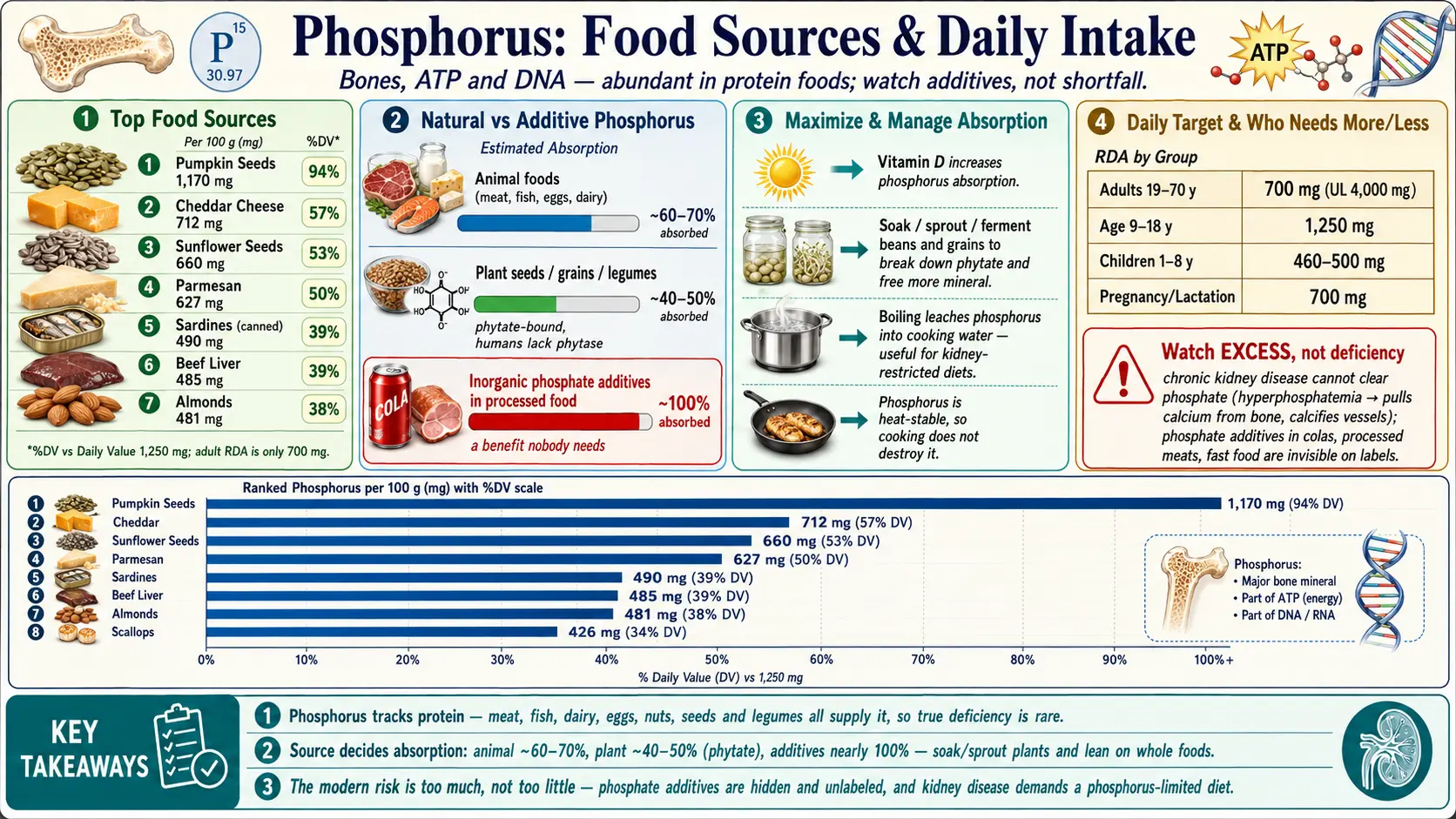
Phosphorus is the body’s second most abundant mineral after calcium, and the two work as a pair: about 85% of your phosphorus sits in bones and teeth as calcium-phosphate crystal, giving the skeleton its hardness. The rest is busy everywhere else — it forms the high-energy bonds of ATP that power every cell, builds the backbone of DNA and RNA, makes up cell-membrane phospholipids, and buffers blood pH. Because it is built into all protein-rich tissue, phosphorus is plentiful in food: dairy, fish, meat, poultry, eggs, nuts, seeds and legumes are all strong natural sources, and a normal mixed diet easily meets the requirement.
| Phosphorus: Food Sources & Daily Intake | ||||||
|---|---|---|---|---|---|---|
| Rank | Food (serving) | Per 100 g | %DV / 100g | Glucose | Fructose | Notes |
| 1 | Pumpkin Seeds 1 oz / 28 g | 1,170 mg | 🟢 94% | 0.1 | 0.1 | Among the richest plant sources, though some is phytate-bound. |
| 2 | Cheddar Cheese 1 oz / 28 g | 712 mg | 🟢 57% | — | — | |
| 3 | Sunflower Seeds 1 oz / 28 g | 660 mg | 🟢 53% | — | — | |
| 4 | Parmesan Cheese 1 oz / 28 g | 627 mg | 🟢 50% | 0 | 0 | Hard, aged cheeses are among the densest whole-food sources. |
| 5 | Sardines (Canned) 1 can / 92 g | 490 mg | 🟡 39% | 0 | 0 | The soft, edible bones add both phosphorus and calcium. |
| 6 | Beef Liver 3 oz / 85 g | 485 mg | 🟡 39% | 0 | 0 | An exceptional whole-food source, like most organ meats. |
| 7 | Almonds 1 oz / 28 g | 481 mg | 🟡 38% | 0.2 | 0.1 | |
| 8 | Scallops 3 oz / 85 g | 426 mg | 🟡 34% | 0 | 0 | |
| 9 | Salmon ½ fillet / 154 g | 371 mg | 🟡 30% | — | — | |
| 10 | Milk (Whole) 1 cup / 244 g | 354 mg | 🟡 28% | 0 | 0 | |
| 11 | Beef Organ Meats 3 oz / 85 g | 304 mg | 🟡 24% | 0 | 0 | Nutrient-dense organ meat. |
| 12 | Pork Organ Meats 3 oz / 85 g | 240 mg | 🟡 19% | — | — | Nutrient-dense organ meat. |
| 13 | Chicken Organ Meats 3 oz / 85 g | 235 mg | 🟡 19% | — | — | Nutrient-dense organ meat (giblets). |
| 14 | Turkey 3 oz / 85 g | 230 mg | 🟡 18% | 0 | 0 | |
| 15 | Beef Meat 3 oz / 85 g | 224 mg | 🟡 18% | 0 | 0 | |
| 16 | Pork 3 oz / 85 g | 223 mg | 🟡 18% | 0 | 0 | |
| 17 | Brown Rice 1 cup / 195 g | 103 mg | ⚪ 8% | 0 | 0 | Common staple. |
Table of Contents
- How to Read These Tables
- Recommended Intakes & Upper Limits
- Bioavailability & Absorption
- Cooking & Storage
- Vegetarian & Vegan Sources
- Who Needs to Pay Attention
- Data Sources & References
- Connections
- Featured Videos
How to Read These Tables
- Abundant in protein foods. Phosphorus tracks protein closely — if a food is high in protein (meat, fish, dairy, eggs, beans, nuts), it is almost always high in phosphorus. This is why outright deficiency is rare in people who eat enough food.
- %DV vs RDA. The %DV column compares a serving against the FDA Daily Value of 1,250 mg — a high reference set decades ago. Your actual physiological target (the RDA) is only 700 mg for adults, so most servings will look modest against the DV yet still cover a real day’s need quickly.
- Watch the upper limit, not just the floor. For most minerals the concern is getting enough; with phosphorus the more common modern issue is getting too much from phosphate additives in processed food. The second table lists the Tolerable Upper Intake Level (UL) for each life stage.
Recommended Intakes & Upper Limits
Your personal target depends on age, sex and pregnancy. The Daily Value used for the %DV column above is a single label figure; the table below is the age-specific guidance.
| Life stage | RDA / AI (mg/day) | Upper limit (mg/day) |
|---|---|---|
| Infants 0–6 mo | 100* (AI) | Not set |
| Infants 7–12 mo | 275* (AI) | Not set |
| Children 1–3 y | 460 | 3,000 |
| Children 4–8 y | 500 | 3,000 |
| Children 9–13 y | 1,250 | 4,000 |
| Adolescents 14–18 y | 1,250 | 4,000 |
| Adults 19–70 y | 700 | 4,000 |
| Adults 71+ y | 700 | 3,000 |
| Pregnancy | 700 (1,250 if ≤18 y) | 3,500 |
| Lactation | 700 (1,250 if ≤18 y) | 4,000 |
Bioavailability & Absorption
How much phosphorus you actually absorb depends heavily on its source. Phosphorus from animal foods (meat, fish, eggs, dairy) is well absorbed — roughly 60–70%. Phosphorus in plant seeds, grains, nuts and legumes is largely stored as phytate (phytic acid), and humans lack the enzyme phytase to break it down, so only about 40–50% is available. The most absorbable form of all is the inorganic phosphate added to processed foods, which is nearly 100% absorbed — a benefit nobody needs and a real concern for anyone who must limit phosphorus. Vitamin D increases phosphorus absorption, which is one reason the two are discussed together.
Cooking & Storage
Phosphorus is a chemically stable mineral — it is not destroyed by heat, light or air the way fragile vitamins are, so ordinary cooking does not lower the phosphorus content of a food. Some can leach into cooking water when foods are boiled, which is one of the few practical levers people on a phosphorus-restricted diet use (boiling and discarding the water modestly reduces the amount in vegetables and meats). For everyone else, soaking and cooking beans, lentils and grains is helpful in the opposite direction: it begins to break down phytate and makes the plant phosphorus a little more available.
Vegetarian & Vegan Sources
Plant-based eaters have plenty of phosphorus sources — legumes, nuts, seeds and whole grains are all rich, and dairy and eggs add more for vegetarians. The catch is absorption: much of the phosphorus in plant seeds is locked in phytate and only partly available, so the figure on a label overstates what you take up. In practice this is rarely a problem because the requirement is easy to reach, and soaking, sprouting, fermenting and cooking these foods releases more of the mineral. Anyone eating a varied plant diet with adequate protein meets the need comfortably.
Who Needs to Pay Attention
Dietary deficiency is rare in healthy people because phosphorus is so widespread; true depletion is seen mainly with severe malnutrition, chronic heavy alcohol use, refeeding syndrome, or certain medications and absorption disorders, and causes weakness, bone pain and appetite loss. For most readers the more relevant issue is excess. Phosphate additives — used in colas, processed meats, fast food, baked goods and many packaged products — are nearly fully absorbed and are a large, often invisible source that does not appear on nutrition labels. The group that must pay the closest attention is people with chronic kidney disease: failing kidneys cannot clear phosphorus, so it builds up in the blood (hyperphosphatemia), pulling calcium from bone and calcifying blood vessels. Kidney patients are routinely advised to limit phosphorus, favor whole foods over additive-laden processed ones, and work with a renal dietitian. Anyone with kidney disease should treat the UL as a ceiling and seek individual guidance.
Data Sources & References
- NIH Office of Dietary Supplements — Phosphorus Fact Sheet (RDA, AI, UL)
- Linus Pauling Institute — Phosphorus Micronutrient Information Center
- PubMed — dietary phosphorus bioavailability, phosphate additives and absorption
- PubMed — phosphorus, hyperphosphatemia and chronic kidney disease
Connections
- All Minerals
- Phosphorus (Main Page)
- Phosphorus Benefits
- Phosphorus History
- Calcium (the Ca:P balance)
- Magnesium
- Vitamin D3 (drives absorption)
- Sardines