Phosphorus: History and Discovery
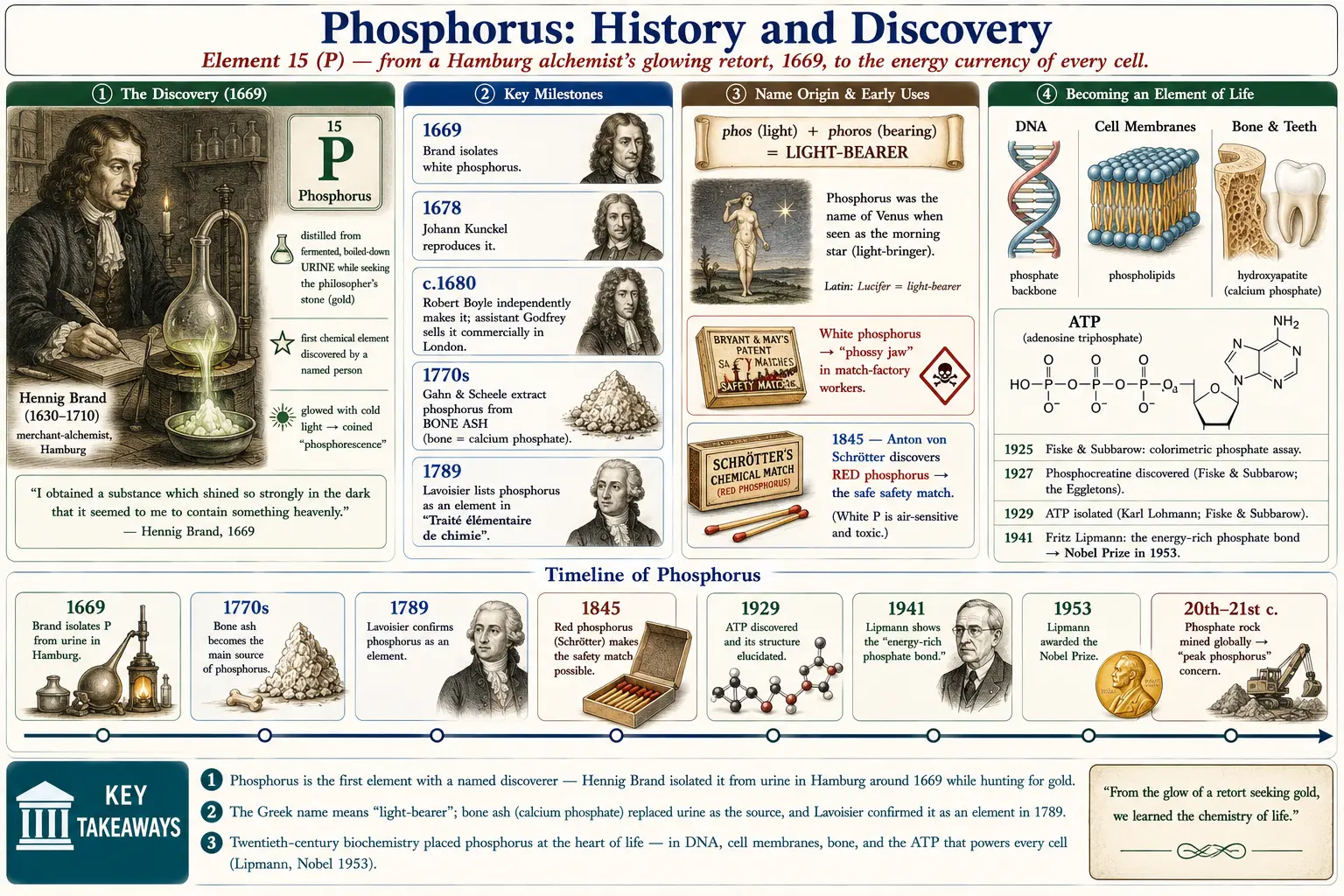
Phosphorus has one of the strangest origin stories in all of chemistry: it was the first chemical element to be discovered by a known, named person — and it was found by an alchemist boiling down human urine in the hope of making gold. Around 1669, in Hamburg, the merchant and amateur alchemist Hennig Brand distilled a white, waxy substance that glowed in the dark, and named it after the Greek for "light-bearer." This article traces what the historical record actually supports: how Brand stumbled onto the element and tried to keep it secret, the tangled dispute over who deserves the credit, how phosphorus came to be recognised as a true element by Lavoisier, the discovery that our own bones are built from calcium phosphate, and — centuries later — the slow unravelling of phosphorus's role at the very centre of life, in DNA, in bone, and in the ATP that powers every cell. Where the record is firm we say so; where a claim is disputed or uncertain, we name it as such.
Table of Contents
- Hennig Brand and the Glowing Cold Fire (1669)
- What "Phosphorus" Means
- A Tangled Priority Dispute: Krafft, Kunckel, and Boyle
- Becoming an Element: Lavoisier and the New Chemistry
- Phosphorus in Bone: Gahn, Scheele, and Calcium Phosphate
- Matches and Allotropes: Red Phosphorus (1845)
- Discovering the Element of Life: DNA, Bone, and Cells
- The Energy Currency: Phosphocreatine and ATP
- From Bone Ash to a Finite Resource
- Research Papers and References
- Connections
- Featured Videos
Hennig Brand and the Glowing Cold Fire (1669)
The discovery of phosphorus is usually credited to Hennig Brand, a merchant and amateur alchemist who worked in Hamburg, Germany. His exact dates are uncertain — he was born around 1630 and died somewhere between about 1692 and about 1710 — and the sources describe him as a former junior army officer who turned to alchemy in search of the philosopher's stone, the legendary substance believed to turn base metals into gold. Like many alchemists of his day, Brand believed that the secret of gold-making might be hidden in the human body, and he settled on an unlikely raw material: urine, which he collected and processed in very large quantities.
The procedure that produced phosphorus, reconstructed from the historical accounts, was crude but consequential. Brand let the urine stand and ferment, boiled it down to a thick black sludge, and then heated that residue strongly in a retort. Around 1669, instead of gold, the red-hot vessel suddenly filled with luminous fumes, and a white, waxy material dripped out that glowed with a pale-green light in the dark and could burst into flame in air. He had isolated elemental phosphorus — though, of course, no one at the time had the modern concept of a chemical element to describe what he had done. This is the basis for the often-repeated and well-supported claim that Brand was the first named person in recorded history to discover a chemical element: earlier elements such as gold, copper, sulfur, and iron had been known since antiquity, with no individual discoverer attached.
It is worth being plain about what is firm and what is folklore here. That Brand isolated phosphorus from urine around 1669 in Hamburg is well documented. The vivid figures sometimes quoted — that he hoarded enormous volumes of urine, or processed well over a thousand gallons — are part of the traditional retelling and vary from source to source, so this page treats the broad story as reliable while not insisting on any single dramatic number.
What "Phosphorus" Means
The name phosphorus comes from Greek and means roughly "light-bearer" or "light-bringer" (from phos, "light," and phoros, "bearing"). It was an apt choice: the freshly made substance glowed steadily in the dark, a cold, eerie luminescence quite unlike a flame. That same Greek word had long been used as a name for the planet Venus when it appears as the "morning star," so the term carried an old association with light in the sky before it was ever attached to the element.
This is also the origin of a word we still use today. The phenomenon of glowing without noticeable heat — the very property that astonished Brand and his contemporaries — is now called phosphorescence. There is a small irony worth noting: the characteristic glow of white phosphorus in air is actually caused by slow oxidation (a faint, ongoing chemical burning), which in strict modern terms is chemiluminescence rather than true phosphorescence. The element gave its name to the phenomenon before the chemistry behind either was understood.
A Tangled Priority Dispute: Krafft, Kunckel, and Boyle
Brand, following the secretive habits of alchemists, did not publish his method, and he hoped to profit from it. This secrecy is the root of a genuine priority dispute that has clouded the credit for phosphorus ever since. According to the standard accounts, Brand eventually sold his recipe to Johann Daniel Krafft, who then travelled around Europe demonstrating the glowing marvel to natural philosophers and nobility, helping to spread word of it widely.
Two other names recur in the story. Johann Kunckel (c. 1630–1703), a German chemist and apothecary, learned that phosphorus could be made and succeeded in producing it himself — commonly dated to 1678 — and he is sometimes said to have later claimed the discovery for his own. Independently, the celebrated English natural philosopher Robert Boyle managed to make phosphorus around 1680, apparently after learning from Krafft's demonstrations that the source was something belonging to the human body, and he worked out a practical method. Because Brand had never published, several of these figures — Kunckel, Krafft, and Boyle — were at various times popularly thought of as the discoverer.
The careful conclusion is that the first isolation is attributed to Hennig Brand around 1669, while Kunckel and Boyle are best described as independent rediscoverers a decade or so later, not as the original discoverers. Boyle's contribution was nonetheless important: his work was eventually published, and his laboratory assistant, the German-born chemist Ambrose Godfrey (Hanckwitz), went on to manufacture phosphorus commercially in London, making it more widely available to chemists and apothecaries. Secrecy cost Brand much of his fame; openness is part of why Boyle's name stayed attached to the element.
Becoming an Element: Lavoisier and the New Chemistry
For more than a century after Brand, phosphorus was a known and traded substance, but the very idea of a chemical "element" in the modern sense did not yet exist. That changed in the late eighteenth century with the French chemist Antoine-Laurent Lavoisier. Lavoisier studied combustion carefully and showed that when substances such as phosphorus and sulfur are burned, they gain weight by combining with a component of the air (oxygen) — evidence that helped him overturn the old phlogiston theory and build a new, quantitative chemistry.
In his landmark textbook Traité élémentaire de chimie ("Elements of Chemistry"), published in Paris in 1789, Lavoisier included a famous "Table of Simple Substances" — the first modern list of the then-known chemical elements. Phosphorus appears on that list, alongside oxygen, hydrogen, nitrogen, sulfur, and the common metals. With this, phosphorus made the conceptual leap from an alchemical curiosity to a recognised chemical element, defined as a simple substance that could not be broken down further. The glowing material Brand had pulled from urine now had a settled place in the new science of chemistry.
Phosphorus in Bone: Gahn, Scheele, and Calcium Phosphate
One of the most important early findings about phosphorus — and the one most relevant to human health — was the discovery that it is a major building block of our own skeleton. In the 1770s, the Swedish chemists Johan Gottlieb Gahn (1745–1818) and Carl Wilhelm Scheele (1742–1786) showed that bone is rich in calcium phosphate. Gahn is credited with demonstrating the presence of phosphate in bones around 1769, a finding published by Scheele in 1771. They further showed that elemental phosphorus could be extracted from bone ash — the white, mineral residue left after bone is burned.
This had two large consequences. Scientifically, it revealed that phosphorus is not some exotic laboratory product but a fundamental constituent of living bodies, locked into the hard mineral of bone as calcium phosphate. Practically, it transformed how phosphorus was made: bone ash replaced urine as the raw material, and remained the principal industrial source of phosphorus for roughly the next seventy years, until phosphate rock (mineral deposits of calcium phosphate) eventually took over. The thread connecting an alchemist's urine, a burned bone, and the mineral that stiffens your skeleton is, in this sense, one continuous chemical story — the same calcium phosphate throughout.
Matches and Allotropes: Red Phosphorus (1845)
The phosphorus Brand discovered is the form now called white phosphorus — waxy, glowing, dangerously flammable, and quite toxic. In the nineteenth century it became the active ingredient in the first "strike-anywhere" matches, a hugely popular product with a grim human cost: the white phosphorus used in match factories caused a disfiguring and often fatal bone disease, "phossy jaw" (phosphorus necrosis of the jaw), among workers exposed to its fumes.
A turning point came in the mid-1840s. The Austrian chemist Anton von Schrötter (1802–1875) found that heating white phosphorus in the absence of air converted it into a very different, far less hazardous form — red phosphorus — which is much more stable and does not spontaneously catch fire or glow in the same way. This discovery is generally dated to 1845 (with his formal account appearing in the following years). Red phosphorus made possible the modern safety match, in which the phosphorus is on the striking surface of the box rather than in the match head. Red phosphorus is one of several allotropes — different structural forms of the same element — and its discovery is a clear, datable scientific milestone in the element's story, achieved by a named chemist.
Discovering the Element of Life: DNA, Bone, and Cells
Knowing that phosphorus exists in bone is one thing; understanding why life cannot do without it is another, and that understanding came together gradually across the nineteenth and twentieth centuries. As biochemistry matured, phosphorus turned out to sit at the very heart of the cell. It forms the backbone of DNA and RNA: the sugar units of these molecules are strung together by phosphodiester linkages, so without phosphorus there is no genetic material at all. When the structure of DNA was described in the 1950s, that famous double helix was literally held together along its length by a chain of phosphate groups.
Phosphorus is also essential to the membranes that enclose every cell, in the form of phospholipids, and — as the Swedish chemists had shown long before — to the mineral of bone and teeth, hydroxyapatite, a form of calcium phosphate. The recognition that one element is simultaneously the scaffold of our genes, the skin of our cells, and the stiffening of our skeleton is part of why phosphorus is sometimes called an "element of life." The detailed biology — how phosphate is absorbed, regulated by the kidneys and hormones, and used throughout the body — is covered on the main Phosphorus page and in the Phosphorus Benefits articles; this history is concerned with how that role came to be understood.
The Energy Currency: Phosphocreatine and ATP
Perhaps the most far-reaching biological discovery about phosphorus is its central place in how cells handle energy. In the 1920s, researchers studying muscle began isolating energy-rich phosphorus compounds. Around 1927, two groups working on muscle — Cyrus Fiske and Yellapragada Subbarow at Harvard Medical School, and the husband-and-wife team Grace and Philip Eggleton in England — independently identified phosphocreatine (creatine phosphate), a phosphate-bearing molecule that muscle uses as a rapid energy reserve. (Fiske and Subbarow are also remembered for their widely used colorimetric method for measuring phosphate, published in 1925, which made such work possible.)
Two years later, in 1929, came the discovery of the molecule now famous as the cell's energy currency: adenosine triphosphate (ATP). It was isolated independently and almost simultaneously by the German biochemist Karl Lohmann and again by Fiske and Subbarow — the two camps effectively racing each other. The deeper meaning of these phosphate compounds was crystallised by the biochemist Fritz Lipmann, who in 1941 proposed the influential idea of the "energy-rich phosphate bond" and framed ATP as the universal carrier of usable energy between the reactions that release it and the reactions that need it. Lipmann shared the 1953 Nobel Prize in Physiology or Medicine (with Hans Krebs) "for his discovery of co-enzyme A and its importance for intermediary metabolism" — a body of work at the centre of which sits phosphorus. From the cold glow in Brand's retort to the chemistry that powers every heartbeat, the element had revealed itself as indispensable to life.
From Bone Ash to a Finite Resource
The modern history of phosphorus is, in large part, an agricultural one. Because phosphorus is essential to every living thing, it is essential to growing food: it is one of the three major nutrients (with nitrogen and potassium) in fertilizer, and there is no substitute for it in crop production. Once mineral deposits of phosphate rock were exploited on a large scale in the nineteenth and twentieth centuries, they replaced bone ash as the source of the element and became the foundation of the fertilizers that feed much of the world's population.
This dependence has given the old "light-bearer" a new and serious significance. Phosphate rock is a finite, non-renewable resource concentrated in a relatively small number of countries, and concern about long-term supply — sometimes discussed under the heading of "peak phosphorus" — has made the careful use and recycling of phosphorus an active area of research and policy. There is a certain symmetry to it: the element first pulled from human urine in a search for gold is now recovered, among other ways, from wastewater and food systems in an effort to keep it in circulation. Phosphorus's history runs without a break from a Hamburg alchemist's furnace in 1669 to the food on the modern table and the question of how to sustain it.
Research Papers and References
The list below gathers historical and biochemical sources on the discovery of phosphorus and the understanding of its role in the body, together with curated PubMed topic-search links. Author names, titles, and journals are given as plain text; only the stable DOI, PMID, PMCID, or archive link is hyperlinked, and each opens in a new tab. Primary historical sources (Lavoisier's Traité élémentaire de chimie, and the eighteenth-century work of Gahn and Scheele) are named in the article as historical sources rather than as modern citations.
- Dorozhkin SV. Calcium orthophosphates and human beings: a historical perspective from the 1770s until 1940. Biomatter. 2012;2(2):53-70. — PMID: 23507803
- Simoni RD, Hill RL, Vaughan M. The determination of phosphorus and the discovery of phosphocreatine and ATP: the work of Fiske and SubbaRow (JBC Classics). Journal of Biological Chemistry. 2002;277(32):e1-e2. — doi:10.1016/S0021-9258(20)70222-X
- Fiske CH, Subbarow Y. The colorimetric determination of phosphorus. Journal of Biological Chemistry. 1925;66(2):375-400. — doi:10.1016/S0021-9258(18)84756-1
- Kalckar HM. 50 years of biological research — from oxidative phosphorylation to energy requiring transport regulation. Annual Review of Biochemistry. 1991;60:1-38. — doi:10.1146/annurev.bi.60.070191.000245
- The Nobel Prize in Physiology or Medicine 1953 (Hans Krebs; Fritz Lipmann). NobelPrize.org. — NobelPrize.org — 1953 Physiology or Medicine
- Phosphorus — Health Professional Fact Sheet. Office of Dietary Supplements, National Institutes of Health. — NIH ODS — Phosphorus
- Discovery and early history of phosphorus — PubMed: phosphorus discovery and history
- History of ATP and phosphocreatine in muscle energetics — PubMed: history of ATP and phosphocreatine
External Authoritative Resources
- NIH Office of Dietary Supplements — Phosphorus
- Royal Society of Chemistry — Phosphorus (element information and history)
- NobelPrize.org — 1953 Prize (Krebs and Lipmann)