Iron: Food Sources & Daily Intake
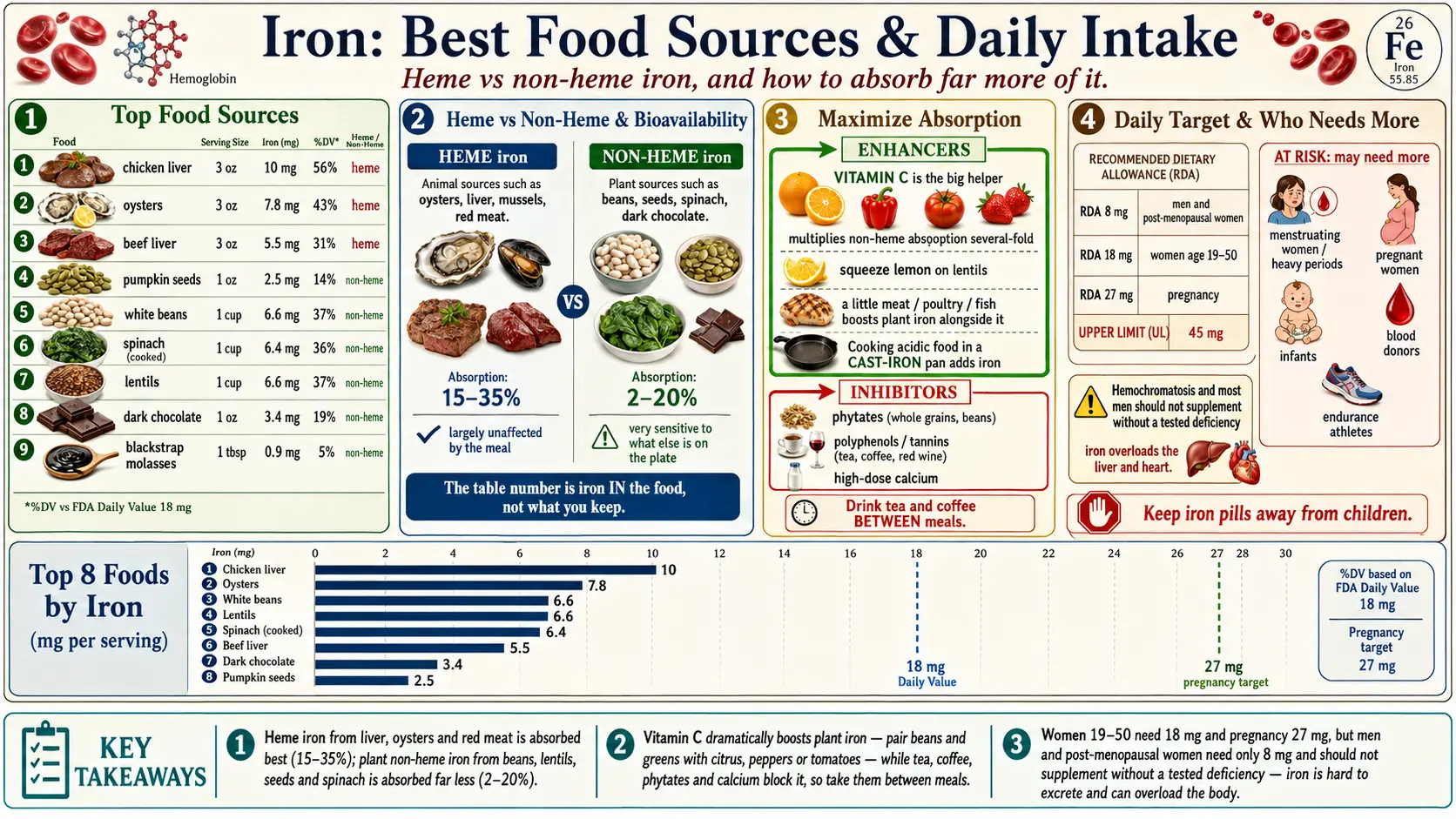
Iron is the mineral at the centre of your red blood cells: it forms the core of hemoglobin, the molecule that carries oxygen from your lungs to every tissue. Too little leaves you tired, pale and short of breath. Iron comes in two very different dietary forms — heme iron from meat, poultry and seafood, which the body absorbs easily, and non-heme iron from plants, beans, seeds and eggs, which is absorbed far less efficiently but can be helped along by the right food pairings.
| Iron: Food Sources & Daily Intake | ||||||
|---|---|---|---|---|---|---|
| Rank | Food (serving) | Per 100 g | %DV / 100g | Glucose | Fructose | Notes |
| 1 | Sesame Seeds 1 tbsp / 9 g | 15 mg | 🟢 81% | — | — | |
| 2 | Cocoa Powder 1 tbsp / 5 g | 14 mg | 🟢 77% | — | — | Very concentrated non-heme iron by weight. |
| 3 | Dark Chocolate 1 oz / 28 g | 12 mg | 🟢 66% | 0 | 0 | Non-heme iron; choose higher-cocoa bars for more iron and less sugar. |
| 4 | Chicken Liver 3 oz / 85 g | 12 mg | 🟢 64% | 0 | 0 | Heme iron, plus folate and B12. |
| 5 | Oysters 3 oz / 85 g | 9.2 mg | 🟢 51% | 0 | 0 | Heme iron — one of the best-absorbed sources, and rich in zinc and B12 too. |
| 6 | Sun-Dried Tomatoes ½ cup / 27 g | 9.1 mg | 🟢 50% | — | — | Non-heme iron, and the natural vitamin C helps absorption. |
| 7 | Pumpkin Seeds 1 oz / 28 g | 8.8 mg | 🟡 49% | 0.1 | 0.1 | One of the richest plant (non-heme) iron sources. |
| 8 | Chicken Organ Meats 3 oz / 85 g | 6.8 mg | 🟡 38% | — | — | Nutrient-dense organ meat (giblets). |
| 9 | Mussels 3 oz / 85 g | 6.7 mg | 🟡 37% | — | — | Heme iron, well absorbed. |
| 10 | Beef Liver 3 oz / 85 g | 6.5 mg | 🟡 36% | 0 | 0 | Heme iron plus very high vitamin A and B12 — nutrient-dense but eat in moderation. |
| 11 | Beef Organ Meats 3 oz / 85 g | 5.8 mg | 🟡 32% | 0 | 0 | Nutrient-dense organ meat. |
| 12 | Pork Organ Meats 3 oz / 85 g | 5.3 mg | 🟡 29% | — | — | Nutrient-dense organ meat. |
| 13 | Blackstrap Molasses 1 tbsp / 20 g | 4.7 mg | 🟡 26% | 11.9 | 12.8 | A concentrated non-heme iron source by the spoonful. |
| 14 | White Beans 1 cup / 179 g | 3.7 mg | 🟡 21% | — | — | Among the highest-iron legumes. |
| 15 | Spinach 1 cup / 180 g | 3.6 mg | 🟡 20% | — | — | Non-heme iron; cooked spinach delivers far more per portion than raw. |
| 16 | Lentils 1 cup / 198 g | 3.3 mg | 🟡 18% | — | — | Reliable non-heme iron; pair with a vitamin-C food to boost absorption. |
| 17 | Brown Rice 1 cup / 195 g | 0.6 mg | ⚪ 3% | 0 | 0 | Common staple. |
Table of Contents
- How to Read These Tables
- Recommended Intakes & Upper Limits
- Bioavailability & Absorption
- Cooking & Storage
- Vegetarian & Vegan Sources
- Who Needs to Pay Attention
- Data Sources & References
- Connections
- Featured Videos
How to Read These Tables
- Heme vs non-heme iron. The single most important thing about iron. Heme iron (animal foods — oysters, liver, red meat) is absorbed at roughly 15–35%. Non-heme iron (plants — beans, seeds, spinach, dark chocolate) is absorbed at only about 2–20% and is far more sensitive to what else is on the plate. The number on the table is the iron in the food, not the amount you keep.
- %DV vs your real target. The %DV column compares a serving against the FDA Daily Value of 18 mg used on labels. Your personal target (the RDA) varies a lot: just 8 mg for men and post-menopausal women, but 18 mg for women 19–50 and 27 mg in pregnancy — see the second table.
- Per 100 g vs per serving. Per-100 g lets you compare foods fairly; the serving size shown beside each food is what you actually eat. Some foods (cocoa powder, molasses) look huge per 100 g but contribute modestly in a real spoonful, while a cup of beans or cooked spinach adds up nicely.
Recommended Intakes & Upper Limits
Your personal target depends on age, sex and pregnancy. The Daily Value used for the %DV column above is a single label figure; the table below is the age-specific guidance.
| Life stage | RDA / AI (mg/day) | Upper limit (mg/day) |
|---|---|---|
| Infants 0–6 mo | 0.27* (AI) | Not established |
| Infants 7–12 mo | 11 | 40 |
| Children 1–3 y | 7 | 40 |
| Children 4–8 y | 10 | 40 |
| Children 9–13 y | 8 | 40 |
| Males 14–18 y | 11 | 45 |
| Males 19+ y | 8 | 45 |
| Females 14–18 y | 15 | 45 |
| Females 19–50 y | 18 | 45 |
| Females 51+ y | 8 | 45 |
| Pregnancy | 27 | 45 |
| Lactation | 9–10 | 45 |
Bioavailability & Absorption
How much iron you actually absorb depends heavily on its form and on the rest of the meal. Heme iron from meat and seafood is absorbed well (roughly 15–35%) and is largely unaffected by other foods. Non-heme iron from plants is absorbed far less efficiently and is strongly influenced by meal companions. Vitamin C is the big helper: eating a vitamin-C food in the same meal (citrus, peppers, tomatoes, strawberries) can multiply non-heme absorption several-fold, so a squeeze of lemon on lentils or peppers in a bean chili is genuinely worth doing. A little meat, poultry or fish in the same meal also boosts the non-heme iron from any plant foods alongside it. Working the other way, phytates in whole grains, beans and seeds, polyphenols and tannins in tea, coffee and red wine, and high doses of calcium all reduce iron absorption — so it helps to drink tea or coffee between meals rather than with them.
Cooking & Storage
Iron stands up to heat far better than the fragile vitamins, so ordinary cooking does not destroy it. A few practical points still help: soaking, sprouting and fermenting beans, grains and seeds breaks down some of the phytates that block absorption, which is one reason sourdough, sprouted lentils and properly soaked beans treat your iron stores more kindly. Cooking acidic foods (like a tomato sauce) in a cast-iron pan measurably raises the iron content of the dish. And because cooked spinach packs down, a cooked portion delivers far more iron than the same volume of raw leaves.
Vegetarian & Vegan Sources
Plant-based eaters can absolutely meet their iron needs, but it takes a little planning because plant iron is the harder-to-absorb non-heme form. The backbone is legumes (lentils, chickpeas, white and kidney beans), seeds (pumpkin, sesame), dark leafy greens and dark chocolate. The key habit is to pair iron-rich plants with a vitamin-C food in the same meal — beans with peppers and tomato, lentils with a squeeze of lemon, oatmeal with strawberries — which can dramatically raise how much you absorb. It also helps to keep tea and coffee to between meals. Because absorption is lower, some guidelines suggest vegetarians aim higher than the standard RDA. Anyone who is plant-based, menstruating and feeling persistently tired should get their iron status checked.
Who Needs to Pay Attention
Iron deficiency is the most common nutritional deficiency in the world, and the groups most at risk are menstruating women (especially with heavy periods), pregnant women (whose needs jump to 27 mg/day), infants and young children, frequent blood donors, endurance athletes, and people with gut conditions that impair absorption. Deficiency progresses from low stores to full iron-deficiency anemia — fatigue, pallor, breathlessness, cold hands, brittle nails, and sometimes odd cravings for ice or starch. The opposite caution matters too: iron is one of the few minerals the body cannot easily get rid of, so it is possible to overload. People with hereditary hemochromatosis (an inherited condition causing excess iron absorption), and men and post-menopausal women generally, should not take iron supplements unless a blood test shows a real deficiency — excess iron accumulates in the liver, heart and pancreas and causes damage over time. Iron supplements are also a leading cause of accidental poisoning in young children, so keep them well out of reach.
Data Sources & References
- NIH Office of Dietary Supplements — Iron Fact Sheet (DV, RDA, UL)
- Linus Pauling Institute — Iron Micronutrient Information Center
- PubMed — heme vs non-heme iron absorption and bioavailability
- PubMed — vitamin C enhancement of non-heme iron absorption
Connections
- All Minerals
- Iron (Main Page)
- Iron Benefits
- Iron History
- Vitamin C (boosts non-heme iron)
- Copper (needed to use iron)
- Zinc
- Lentils
- Spinach